Gravel soil vineyards: what the science actually says
TL;DR
- Gravel soils drain fast, warm early in spring, and push vine roots deep toward subsoil moisture.
- That controlled water stress concentrates sugars and phenolics.
- Médoc's gravel ridges prove the idea at scale.
- But gravel pays off only when matched to the right variety, rootstock, and irrigation plan.
- Bad matches give you chronically stressed, low-yield blocks that cost more than they return.
What makes gravel soil different from other vineyard soils?
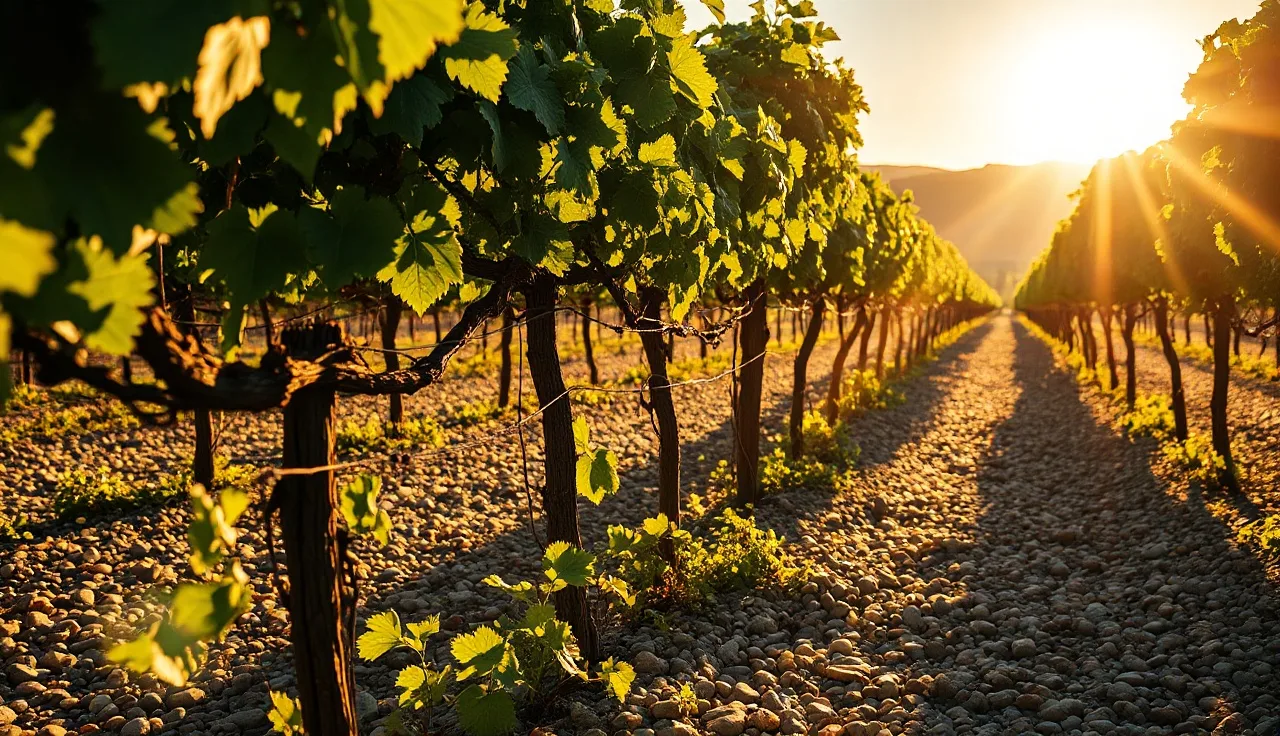
Gravel soil in viticulture means any soil where coarse fragments larger than 2 mm make up a real share of the profile, often 30 to 70 percent by volume in the top meter. Those fragments might be rounded river pebbles, angular decomposed granite, quartzite cobbles, or an alluvial jumble. The mineral type matters less than the physical result: gravel drains fast, holds little plant-available water, and warms earlier in spring than clay or silt loam.
The USDA Natural Resources Conservation Service defines gravel as coarse fragments between 2 mm and 76 mm across. Above 76 mm, they're cobbles. Plenty of blocks growers call "gravelly" are really a mix of gravel, cobbles, and a finer sandy matrix, and that matrix decides how much water the soil can store between rains or irrigations [1].
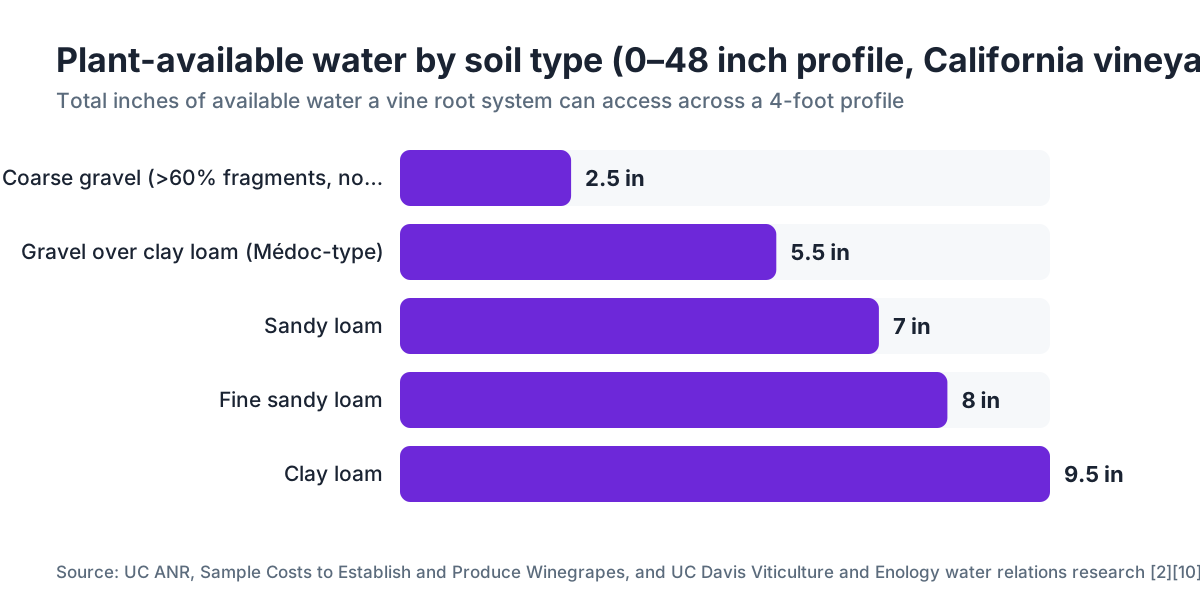
Here's a number growers skip past. A profile that's 60 percent gravel by volume may store only 0.5 to 0.8 inches of plant-available water per foot of depth. A fine sandy loam stores 1.5 to 2.0 inches per foot. Over a 4-foot rooting zone, that's roughly 2 to 3 inches of total available water against 6 to 8 inches. In a dry summer, that gap is the difference between moderate stress and severe stress inside two weeks of the last rain or irrigation.
Low water-holding capacity buys you one clear thing: lower disease pressure. Gravel surfaces dry fast after rain, which cuts humidity at the cluster zone and slows Botrytis and downy mildew. That's a real operating advantage, not a wine-marketing line.
Why do gravel soils produce concentrated, complex wines?
The short answer is controlled water deficit. A vine under mild to moderate water stress slows shoot growth before it slows fruit development. The canopy stops expanding, carbohydrate production stays high, and the berry piles on sugar, anthocyanins, and tannin faster relative to its water content. You get smaller berries with a higher skin-to-juice ratio, which in red varieties means deeper color and grippier tannin [2].
UC Davis viticulture research shows that regulated deficit irrigation, which mimics what gravel imposes naturally, improves wine quality in Cabernet Sauvignon and Syrah when the stress runs from fruit set to veraison and stays above roughly -1.2 MPa stem water potential [2]. Push below that and you risk permanent stomatal damage and premature shrivel, which reads as harsh and raisined, not concentrated.
Gravel also warms fast in spring. Stone conducts heat well, so the top of the profile heats early. That earlier warmth wakes roots sooner, breaks dormancy a few days ahead, and can add a week or more to the effective season in marginal climates. In Bordeaux's Médoc, where Cabernet Sauvignon needs every degree-day, that early heat is part of why the grands crus estates sit on the best-drained gravel ridges the French call "croupes." Médoc gravel, mostly Günzian and Mindel glaciofluvial deposits, runs 5 to 8 meters deep on the best ridges, giving roots almost unlimited vertical drainage and moisture access [3].
The heat-sink effect softens nighttime temperatures at the cluster zone during ripening, slowing the loss of aroma compounds that boil off above 30°C. It's one reason Grenache on the warm "galets roulés" of Châteauneuf-du-Pape ripens to full fruit without going flat.
What are the main challenges of farming a gravel soil vineyard?
Irrigation is the hardest part. Gravel drains so fast that short, frequent sets beat long, infrequent ones. Run drip at 0.5 gallons per emitter per hour on a soil that's 65 percent gravel and you'd better know your wetting front, because water moves laterally faster in a gravel-sand mix than in loam. A soil probe or tensiometer at 12 and 24 inches tells you more than any generic schedule ever will.
Nutrient retention is next. Cation exchange capacity in gravelly soils runs low, often under 10 meq/100g, so potassium, calcium, and magnesium leach fast after heavy rain or over-irrigation. Magnesium deficiency shows up as interveinal chlorosis in gravel blocks, especially on sandy-gravel matrix soils above pH 7.5 where magnesium uptake competes with high calcium. Foliar magnesium sulfate mid-season is a decent stopgap. The real fix is annual soil testing and correcting before you plant [4].
Erosion is a genuine problem on slopes. Coarse gravel gives almost no cohesion once the fine matrix washes out in a hard rain. Cover crops and permanent sod between rows slow runoff and protect the fine fraction that carries what little water and nutrition the soil has. WSU Extension recommends interrow cover cropping in droughty soils to build organic matter and slow water movement [5].
Establishment costs run high. Drilling or ripping a gravel profile eats more equipment hours per acre than loam. If it's river cobble over hardpan, you may need a ripper or subsoiler pass before you can auger. Budget an extra $500 to $1,500 per acre for site prep in dense gravel over what a standard loam planting would cost.
Small operations juggling all of this need one searchable place for soil moisture readings, fertigation events, and interrow decisions. VitiScribe is built for exactly that field-to-compliance trail, so nothing slips between your soil probe log and your spray records.
Which grape varieties perform best in gravel soils?
Cabernet Sauvignon is the textbook answer, and three centuries of Bordeaux back it up. It roots deep, tolerates moderate drought, and responds to water stress by building phenolics instead of shutting down. It also ripens late, which fits the long season that deep gravel ridges buy by pushing bud break early.
Syrah does well on warm gravel. Its tight clusters lean toward Botrytis, but gravel's fast surface drying after rain offsets some of that. In the Rhône and around Paso Robles (see paso-robles-wineries), Syrah on decomposed granite and gravel loam gives the concentrated, peppery, dark-fruited style the grape is known for.
Grenache loves gravel in hot climates because its deep roots reach subsoil moisture that buffers surface drought. The galets roulés of Châteauneuf-du-Pape, river-rolled stones sometimes 30 cm across, soak up daytime heat and give it back at night, letting Grenache hit full phenolic ripeness before sugar outruns acid.
Some varieties fight gravel. Pinot Noir on very low water-holding sites is the usual casualty. It wants steady, moderate moisture through berry development. Severe stress gives you uneven ripening and tight, rot-prone clusters. Plant Pinot on marginal gravel and you'll need irrigation infrastructure plus the discipline to run it tight. Riesling can also stumble in deep, free-draining gravel in warm climates, jumping from green to overripe fast when the vine can't touch any cool subsoil moisture.
Rootstock changes the math a lot. 110R and 1103P, both drought-tolerant and often recommended for low water-holding soils, root deeper and moderate stress. 101-14 Mgt, planted all over California, is much less drought tolerant and can suffer in coarse gravel during dry years. Cornell Cooperative Extension's rootstock guidance stresses matching rootstock vigor and drought tolerance to both soil water capacity and target scion vigor [6].
How does the Médoc's gravel soil work, and what can other regions copy?
The Médoc is the most studied gravel-viticulture site on earth. Its gravel is Quaternary glaciofluvial sediment, mostly quartzite and flint pebbles eroded off the Massif Central and dropped by ancient Garonne terraces. The top sites sit on raised gravel ridges (croupes) that can be 5 to 8 meters of gravel over clay subsoil. The clay is the whole trick: it holds a moisture reservoir the roots reach in dry summers, without any topsoil water-holding that would coax roots to stay shallow [3].
The lesson for everyone else is blunt. "Gravel" without a moisture-retentive subsoil is harder farming than the Médoc model. Gravel over gravel over gravel, no clay or silt layer at depth, means the vine has no drought reserve to draw on without irrigation. The Médoc's gravel-over-clay is really a two-layer profile: free drainage in the top meter to fight waterlogging and disease, plus a moisture bank down deep for summer.
California has close cousins. Alexander Valley benchland gravel over clay loam, Dry Creek Valley alluvial fans, and parts of the Stag's Leap District in Napa all show gravel-over-clay or gravel-over-loam layering that behaves the same way. The vineyard management style in these spots often leans on dry-farming feasibility, and it's the subsoil reserve that makes that possible.
What you can steal from the Médoc: plant the elevated, well-drained ridges first. Skip low-lying gravel that pools cold air and stays wetter. Use Cabernet-family varieties on deep-rooting, drought-tolerant rootstocks. Accept lower yields. Médoc grands crus often make 30 to 45 hL/ha, well under California's irrigated 50 to 80 hL/ha in warm appellations, and they trade that volume for concentration. That's a business call as much as an agronomic one.
How do you irrigate a gravel soil vineyard without over- or under-watering?
Irrigate on vine water status, not the calendar. On gravel, a calendar schedule almost always lands on over-watering (shallow roots, runaway vigor) or under-watering (the soil drains faster than you guessed). There's no third outcome worth planning for.
Stem water potential from a pressure chamber is the most reliable vine water status reading you can get. UC Davis research recommends holding stem water potential between -0.8 and -1.2 MPa during the deficit window, from post fruit-set to veraison, for premium red production [2]. Below -1.4 MPa you're in severe stress that can wreck berry development. Take the reading mid-day on leaves bagged in plastic with a foil cover for at least 90 minutes so they equilibrate.
Soil moisture probes or tensiometers at two depths, 12 and 24 inches, help you calibrate run times. In 60 percent gravel, readings drop and recharge much faster than in loam. A reading of -30 kPa at 12 inches in gravel can mean a drier vine than the same number in loam, because total available water started lower.
Drip design has to match the gravel's wetting pattern. In coarse sandy-gravel the wetting front is narrow and deep. You may need two emitters per vine, or a higher-flow emitter, to wet enough root zone. Short cycles of 30 to 60 minutes run two or three times per event beat one long soak, which mostly drains past the roots before the vine can drink it.
The EPA Worker Protection Standard kicks in whenever a pesticide or fertigation event happens with workers nearby. Log every irrigation and fertigation time, especially when you inject nutrients or pH adjusters through the drip line, because those events can collide with re-entry intervals [7].
What soil amendments actually help in gravel vineyard blocks?
Compost is the most reliably useful amendment in low-CEC gravel. Work 2 to 4 tons of finished compost per acre to 18 inches pre-plant and you raise organic matter, nudge up water-holding capacity, and add slow-release nitrogen and micronutrients. Don't expect a water-holding miracle from one pass. Organic matter breaks down quickly in coarse soils, so the benefit is strongest in years one through three [4].
Gypsum (calcium sulfate) earns its keep on gravel with sodium buildup, mostly in arid regions where irrigation water hauls a salt load. Gypsum knocks sodium off exchange sites and improves structure without raising pH. Typical rates run 500 to 1,000 lbs per acre worked into the top 6 inches before planting.
Lime is usually unnecessary. Many gravel sites sit at pH 5.5 to 7.0 depending on parent rock. Gravel off limestone parent can run pH 7.5 to 8.2, which ties up phosphorus and iron. There, acidifying fertilizers (ammonium sulfate over calcium nitrate) and foliar iron beat trying to drop soil pH across a whole block.
Biochar keeps coming up as a water-retention fix for sandy and gravelly soils. A 2019 review in the journal Agronomy found biochar improved plant-available water capacity by 3 to 15 percent in coarse-textured soils, with effects lasting multiple seasons [8]. Vineyard rates run 1 to 5 tons per acre. The honest caveat: biochar quality swings wildly with feedstock and production temperature, and the effect sizes in existing studies cover a broad band. It won't rescue a severely water-limited site, but it's a fair tool in a low-CEC block if you can buy certified biochar at a sane price.
Skip the high-nitrogen fertilizer during spring growth. Nitrogen spikes fast in warm gravel, and if that lands on rapid shoot growth you get too much vigor, a dense canopy, and every disease and ripening headache that follows. Split the nitrogen budget and dribble it in after fruit set instead of one big pre-bloom shot.
How do gravel soils affect disease pressure and spray programs?
Good news first: gravel sites usually carry lower Botrytis and downy mildew pressure than heavier soils in the same climate. Gravel drains surface water fast, which cuts the soil-splash that flings Botrytis spores onto the lower canopy, and the open, porous surface dries quickly after rain. Over-irrigate, though, or plant a tight-clustered variety on a warm gravel site, and Botrytis inside the cluster gets as bad as anywhere.
Powdery mildew doesn't care about your drainage. Its pressure tracks temperature, humidity, and vine phenology, not soil. Hot gravel surfaces can raise canopy temperature a touch, which may slow mildew above 95°F since sporulation drops off past that point [12], but that's not a plan you'd build a program on.
The EPA Worker Protection Standard requires every pesticide application in agriculture, vineyards included, to be documented with application date, pesticide name, EPA registration number, rate, and treated area [7]. Gravel sites often run higher airspeed and faster evaporation near the surface, which changes drift and deposition. Spraying contact fungicides by ground rig, watch boom height and nozzle choice. Fine droplets drift more in the open air common over warm gravel.
The re-entry interval after sulfur, still the backbone of most organic and conventional powdery mildew programs, is 24 hours under the Worker Protection Standard [7]. In the heat that warm gravel sites throw off, elemental sulfur can burn foliage if applied within 48 hours of temperatures above 90°F [12]. That's a timing constraint gravel imposes more often than cooler, heavier-soil sites.
For a clean record of applications, re-entry intervals, and any restricted-entry exceptions, a digital spray log kills the transcription errors that turn into compliance exposure. VitiScribe's spray record module is built around WPS and California DPR requirements, so your records read the way an inspector wants from day one.
What does a soil test for a gravel vineyard block need to include?
Standard soil test panels shortchange gravel blocks because they're built for soils with meaningful CEC. For gravel, ask for: pH, organic matter percent, CEC, base saturation (calcium, magnesium, potassium, sodium percentages), available phosphorus by Olsen or Mehlich-3, boron, zinc, and iron. Add particle size distribution, which gives you the actual gravel/sand/silt/clay split and lets you estimate water-holding capacity [4].
Depth matters. On a layered gravel site, pull separate samples at 0 to 12 inches, 12 to 24 inches, and 24 to 36 inches. The subsoil is where roots spend summer, and potassium stratification down deep is a common problem a surface-only sample never catches.
Timing counts too. Take pre-plant samples in fall before any amendment goes down. In an established block, sample after harvest and before post-harvest fertilization. That captures the end-of-season status and gives you the winter to adjust before spring growth.
UC Davis and the University of California Division of Agriculture and Natural Resources publish soil test interpretation guidelines for California wine grapes that account for the coarse-textured soils common on the Central Coast and in the Sierra Foothills [4]. Cornell Cooperative Extension does the same for New York, where gravel and shale-derived soils blanket the Finger Lakes hillsides [6].
Use a certified agricultural lab that tests for tree fruits and vines, not a general garden lab. Labs tuned for high-organic vegetable systems report sufficiency ranges too high for grapevines, which do fine at relatively low nutrient levels next to annual crops.
Is gravel soil good for every wine region, or only warm climates?
Gravel performs most reliably in warm to moderate climates where water, not heat, is the limit on quality. There, its drainage and water-stress traits push ripeness and concentration in ways a winemaker can actually use.
In cool, wet climates, gravel can work against you unless the site also has good aspect and air drainage. Waterlogging is rare on gravel, a plus, but low water-holding capacity stops mattering where rain is adequate or heavy all season. What counts more in cool country is warming the soil fast to advance bud break and grab degree-days, and gravel does help with that.
The Finger Lakes in New York make an interesting case. Some of the best Riesling blocks sit on shale-derived gravelly loam on steep slopes above the lakes. That gravel-loam mix holds enough water for Riesling while draining well enough to dodge root rot in wet springs. Cornell's extension research on Finger Lakes soils shows vine performance tracks slope aspect and drainage class more than soil texture alone [6].
Oregon's Willamette Valley holds pockets of volcanic basalt-derived and marine sediment-derived soils, with the Chehalem Mountains AVA and parts of the Dundee Hills carrying real gravel content. In Oregon's cooler climate, gravel's warming effect suits Pinot Noir better than it does in California, where Pinot on coarse gravel risks over-stress in drought years.
The honest verdict: gravel is a tool that shines in the right context. It's not better than volcanic clay, limestone, or schist. The world's great vineyard soils are diverse because different varieties and climates want different physical properties. Gravel just crowds the short list of famous fine-wine regions partly because those places had centuries of selection pressure, growers farming what worked and walking away from what didn't.
How do you manage cover crops and erosion in a gravel vineyard?
Gravel under the vine row gives almost no erosion protection once the fine matrix washes out. The coarse fraction stays put, but the silt and clay that hold nutrients and feed soil microbes can move fast on any slope above 3 percent in a hard rain. Lose that fraction and you've permanently lowered what the site can grow.
Permanent sod between rows is the strongest erosion tool on sloped gravel. A mix of low-growing fescue or native grasses that shrug off dry summers works well. The roots bind the surface, slow runoff, and leave organic matter behind as they turn over. WSU Extension's cover crop guidance for dryland and droughty sites recommends drought-tolerant species like sheep fescue (Festuca ovina) or hard fescue that won't fight the vines hard for water [5].
Under-vine work in gravel needs care. Mechanical cultivation between vines works, but metal on cobble wears equipment faster. Plenty of gravel operators use a thick layer of the native gravel itself as under-vine mulch, which suppresses weeds and holds a little surface moisture. That's standard in Médoc gravel management, where the natural stone layer stays put rather than getting disturbed.
On steep blocks, cross-slope cover cropping or grass strips on every other row slow water downhill while leaving tractor access. The tradeoff is slightly more vine water competition in the grassed rows, but the erosion protection pays for it on grades above 8 to 10 percent.
Annual cover crop records, alongside your chemical inputs and irrigation logs, feed both PCA reporting and any sustainable certification audit. Keep all of it in one searchable system and you save real hours when the auditor shows up.
What do gravel vineyard sites actually cost, and is the investment worth it?
Land in established appellations with proven gravel terroir carries a stiff premium. Napa Valley vineyard land averaged $200,000 to $450,000 per planted acre in recent years, with top Stag's Leap District and Oakville gravel benchland at the high end [9]. Sonoma Coast and Alexander Valley planted land runs $50,000 to $150,000 per acre depending on sub-appellation and water rights. None of these numbers hold still, and the market has bounced around since 2020.
Development on unplanted gravel adds $25,000 to $50,000 per acre for clearing, ripping, infrastructure (irrigation, trellis), and vines plus planting. Gravel sites tack on another $1,000 to $3,000 per acre for extra prep, as noted earlier.
The return hinges on fruit price. Sell Cabernet Sauvignon from a recognized gravel appellation at $3,000 to $5,000 per ton and average 3 to 4 tons per acre (realistic in a well-farmed premium gravel block) and gross revenue lands at $9,000 to $20,000 per acre before farming costs. Farming premium California appellations runs $5,000 to $12,000 per acre per year depending on labor, inputs, and irrigation. The math can work. The margins stay thin without an owned-brand premium or a long-term contract price.
For a small owner weighing a gravel block against a heavier-soil block, the honest answer: gravel costs more to establish, demands more irrigation attention, and yields less. The quality payoff is real, but only if the fruit goes into a wine that can charge for it. Sell into a bulk market at $300 to $600 per ton and the gravel premium vanishes straight into your cost base.
| Site type | Est. planting cost/acre | Typical yield (tons/acre) | Water use (ac-in/yr, CA) |
|---|---|---|---|
| Coarse gravel, no clay subsoil | $30,000-$50,000 | 2-4 | 18-28 |
| Gravel over clay loam | $27,000-$45,000 | 3-5 | 14-22 |
| Sandy loam | $22,000-$38,000 | 4-7 | 16-24 |
| Clay loam | $20,000-$35,000 | 5-9 | 12-18 |
Estimates compiled from UC ANR and USDA Farm Service Agency enterprise budgets [10][11].
Frequently asked questions
Does gravel soil really improve wine quality, or is that marketing?
The science backs a real but conditional effect. Gravel-induced water stress, held moderate at no worse than -1.2 MPa stem water potential, consistently raises anthocyanins and phenolics in red varieties in peer-reviewed trials. The Médoc's centuries of top output from gravel ridges is real evidence too. The catch: severe stress on gravel makes harsh, unbalanced wine, not great wine. Management is everything.
What rootstocks work best in gravel vineyard soils?
110R and 1103 Paulsen top the list for deep, dry gravel. Both root deeply, handle water deficit well, and support moderate to high vigor in low-water-holding soil. 101-14 Mgt, common in California, is far more water-sensitive and struggles in coarse gravel during drought years. Match rootstock to both the soil's water-holding capacity and your target scion vigor. Cornell and UC Davis extension both publish rootstock-by-soil-type guides.
How do I tell if my vineyard soil is too gravelly for dry farming?
Measure total plant-available water in the profile. If your 0 to 48-inch profile holds under 4 inches of available water (common above 65 percent gravel with no clay subsoil), dry farming most varieties without irrigation in climates under 20 inches of annual rainfall is high risk. A soil texture analysis and water-holding estimate from a certified lab costs $50 to $150 and hands you the number instead of a guess.
Can I grow Pinot Noir in gravel soil?
Yes, but it's harder than Cabernet or Syrah. Pinot Noir wants steady, moderate soil moisture through berry development. In coarse gravel with no clay subsoil you need drip, a drought-tolerant rootstock, and pressure-chamber monitoring to keep vines above -1.2 MPa during that window. Gravel-over-loam or gravel-over-clay profiles suit Pinot better than pure coarse gravel. Oregon's Chehalem Mountains is a reasonable template.
How often should I run soil tests in a gravel vineyard block?
Annually for the first three years after planting, then every two years once the block is established and nutrient status is stable. Because gravel has low CEC and leaches readily, season-to-season swings can be big. Take subsoil samples at 12 to 24 inches on top of surface samples, since that's where roots live in summer. UC ANR and Cornell extension both provide vine-specific interpretation ranges.
What cover crops are best for a gravel vineyard?
Drought-tolerant, low-growing species work best between rows. Sheep fescue, hard fescue, or native bunch grasses compete less for water than annual clovers or cereal rye in dry summers. If water competition worries you in a dry year, mow early or use a desiccant in May to stop the cover crop before it pulls hard on summer moisture. Under-vine, native gravel mulch or mechanical cultivation cuts weed competition without leaning on chemicals.
What is the gravel soil depth at Château Latour and other Médoc first growths?
Gravel at the major Médoc first growths (Latour, Lafite, Margaux, Mouton) runs 3 to 8 meters on the best-drained ridge parcels, then grades into clay-rich subsoil. That clay is the moisture reservoir Cabernet Sauvignon roots tap through dry Bordeaux summers. Without it, drainage would be too extreme for dry farming. INRAE and published Médoc terroir studies document this stratigraphy.
How does gravel soil affect frost risk in the vineyard?
Gravel stores daytime heat and lets it go slowly at night, which can cut frost risk by 1 to 2°F at the cluster zone versus bare or cover-cropped soil on the same night. The effect is strongest with large, dark cobbles in direct sun. But gravel sites often sit on elevated ridges with good cold-air drainage, and that's the bigger factor. The stone heat-sink is real but secondary to site selection and cold-air drainage.
Do I need a different spray program for a gravel vineyard than for a loam vineyard?
Fungicide timing and intervals still run on disease models and weather, not soil type. The differences are operational: faster surface drying on gravel shortens the re-wetted-surface window for contact fungicides, and heat above 90°F over gravel raises sulfur phytotoxicity risk. Powdery mildew programs don't change materially. Botrytis programs may be lighter if your canopy management is solid and gravel drainage keeps surface humidity low.
How do I find out if my gravel vineyard soil has a hardpan or restrictive layer?
Dig a soil pit 4 to 5 feet deep in a representative spot and look for compaction layers, clay accumulation horizons (argillic), or cemented gravel (duripan or fragipan). A soil probe or penetrometer flags resistance before you dig. Your local NRCS office or a university extension soil specialist can help read what you find. Catching a restrictive layer before planting saves expensive remediation later.
What are the EPA Worker Protection Standard requirements for gravel vineyard pesticide applications?
The EPA WPS requires operators to post application information at a central location, train all agricultural workers on pesticide safety, keep decontamination supplies near treated areas, and honor label re-entry intervals. Each application record must list the pesticide name, EPA registration number, rate, date, time, and field treated. Violations can draw fines up to $19,605 per violation under current EPA civil penalty figures.
Is it possible to over-irrigate a gravel vineyard block?
Yes, and it's common when growers apply loam-calibrated volumes to gravel. Over-irrigation leaches nutrients, keeps roots shallow (they stay near the surface water and never go deep), drives excess vigor, and builds the dense canopy that ironically raises disease risk. On gravel the goal is to irrigate less than you would in loam, let stem water potential guide timing, and accept that some stress is working for you.
Which California wine regions have significant gravel vineyard soils?
Alexander Valley benchland, the Stag's Leap District in Napa, parts of Dry Creek Valley, and much of the Paso Robles Estrella District carry real alluvial gravel. The Sierra Foothills AVA (Amador and El Dorado counties) has decomposed granite and rocky loam that drains and holds water much like gravel. Many smaller Sonoma and Mendocino benchland sites sit on gravel-over-clay profiles that closely match the Médoc model.
Sources
- UC Davis Viticulture and Enology, water relations and wine quality research: UC Davis research recommends maintaining stem water potential between -0.8 and -1.2 MPa during regulated deficit irrigation for premium red wine grape production
- INRAE (French National Research Institute for Agriculture, Food and Environment), Médoc terroir and soil geology studies: Médoc gravel deposits are Quaternary glaciofluvial sediments reaching 5 to 8 meters depth on best-drained ridges (croupes), overlying clay subsoil moisture reserves
- UC Agriculture and Natural Resources (UC ANR), soil management guidance for California vineyards: Cation exchange capacity in gravelly soils is often under 10 meq/100g; compost application of 2 to 4 tons per acre pre-plant improves CEC and water retention in coarse-textured vineyard soils
- WSU Extension, cover crop guidance for vineyards in droughty soils: WSU Extension recommends drought-tolerant cover crop species like sheep fescue for interrow ground cover in droughty and coarse-textured vineyard soils to build organic matter and control erosion
- Cornell Cooperative Extension, rootstock and soil management for New York vineyards: Cornell extension identifies 110R and 1103P as appropriate rootstocks for low water-holding soils; vine performance on Finger Lakes hillside sites correlates strongly with slope aspect and drainage class
- EPA, Agricultural Worker Protection Standard (40 CFR Part 170): EPA WPS requires pesticide application records including name, EPA registration number, rate, date, time, and treated area; sulfur re-entry interval is 24 hours; civil penalties up to $19,605 per violation
- Agronomy (MDPI), review of biochar effects on soil hydrological properties (2019): A 2019 review found biochar incorporation improved plant-available water capacity by 3 to 15 percent in coarse-textured soils with effects persisting over multiple seasons
- USDA National Agricultural Statistics Service, California land and vineyard values: Napa Valley planted vineyard land averaged $200,000 to $450,000 per acre in recent years, with top gravel benchland sites at the high end of the range
- UC ANR, Sample Costs to Establish and Produce Winegrapes, North Coast Region: UC ANR enterprise budget data underpins estimated vineyard establishment costs by soil type and annual water use ranges for California wine grape production
- USDA Farm Service Agency, vineyard establishment cost benchmarks: USDA FSA benchmarks used to estimate comparative vineyard development costs by soil and site type
- UC ANR, Integrated Pest Management Guidelines for Grapes: Elemental sulfur can cause phytotoxicity if applied within 48 hours of temperatures above 90°F; powdery mildew sporulation slows above 95°F
Last updated 2026-07-09