Gravelly soil vs. loam in vineyards: what actually matters for vine performance
TL;DR
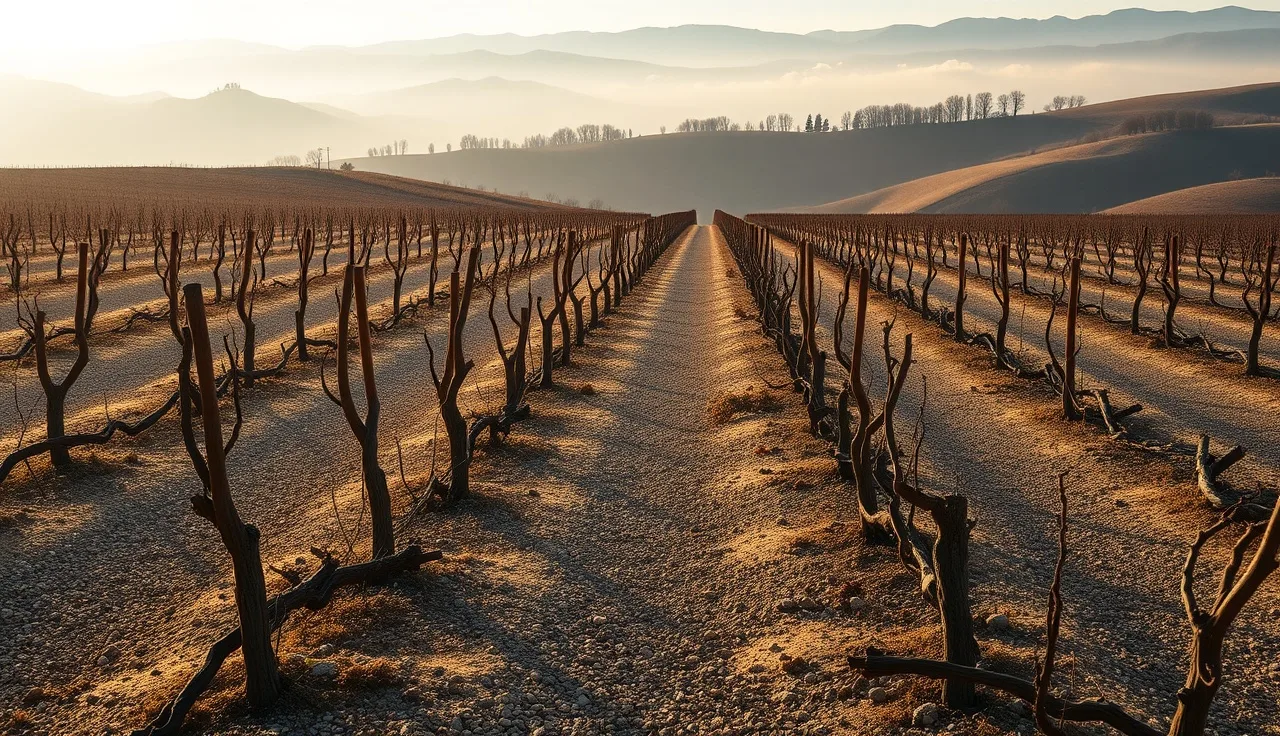
- Gravelly vineyard soils drain fast, hold little water, and warm early in spring, so vines run a moderate stress that shrinks berries and concentrates flavor.
- Loam holds more water and nutrients and pushes higher yields.
- The strongest sites usually stack both: a gravelly surface over clay or loam subsoil.
- Italy and California show the pattern over and over.
What makes a soil 'gravelly' and how is it different from loam?
Gravel is any rock fragment between 2 mm and 75 mm across. A soil counts as gravelly once those fragments make up roughly 15 percent or more by volume, enough to change how air, water, and roots move through the profile [1]. The mineral chemistry of the gravel matters less than most wine writers claim. Granite gravel, limestone gravel, and river cobble all behave about the same hydrologically.
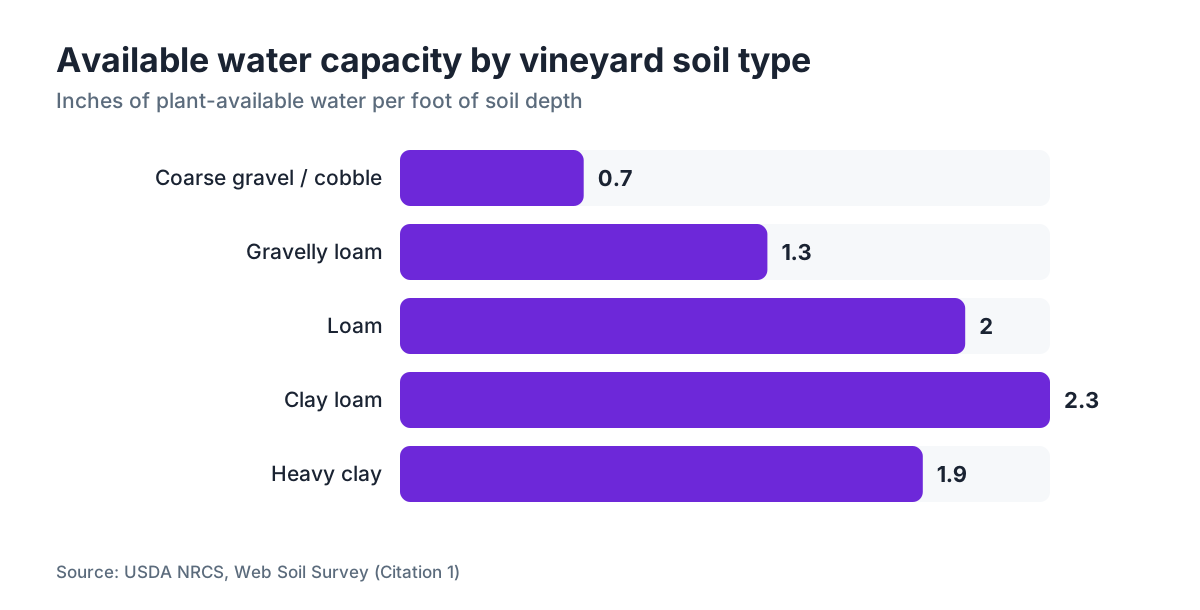
Loam is a texture class, not a rock type. USDA defines loam as roughly 25 to 50 percent sand, 25 to 50 percent silt, and 7 to 27 percent clay by weight [1]. That mix holds around 1.5 to 2.5 inches of available water per foot of soil depth. Coarse sandy soils hold 0.4 to 0.9 inches per foot. The gap is large, and it drives most of the vine behavior growers argue about.
The two categories overlap. Gravelly loam is a loam-textured fine earth fraction with a lot of coarse fragments mixed in. That blend runs through the vineyard regions people respect most: the Medoc, Chateauneuf-du-Pape, the Paso Robles benchlands, and wide stretches of Tuscany all sit on some version of gravelly loam, or gravelly loam over clay.
Why growers reach for some gravel is simple. Coarse fragments cut the volume of fine earth that can hold water, so vines feel moderate stress through summer even without irrigation. Kept in check, that stress limits berry size and pushes up sugars and phenolics.
How does gravelly soil affect vine water stress and root development?
Vines in gravelly soil root deep. When the surface dries fast, roots chase moisture down, sometimes 6 to 10 feet in a well-drained profile [2]. That depth buffers the vine through short dry spells, because the subsoil, especially a clay-rich layer, holds a reserve the surface gravel never could.
WSU Extension notes that vine roots in well-drained coarse soils cluster in the top 3 feet under irrigation, but under dryland or limited water a real share of root mass sits below 5 feet [2]. That architecture decides how you irrigate and what deficit thresholds you set.
Moderate water deficit, a midday stem water potential around -10 to -14 bars near veraison, ties to smaller berries and higher skin-to-pulp ratios in UC Davis research [3]. Gravelly soils nudge vines into that range on their own, no fancy scheduling required. The danger is overshooting past -16 bars into severe stress, which shuts down photosynthesis and can damage vines in hot climates.
Heat is the second lever. Gravel soaks up sun during the day and gives it back at night, raising effective growing degree days in the root zone. UC Davis work on soil heat flux in California vineyards found dark cobble and gravel surfaces can run 5 to 15 degrees Fahrenheit hotter than nearby fine-textured soil on the same warm afternoon [3].
What soil texture and drainage numbers actually matter for planting decisions?
| Soil type | Available water (in/ft) | Typical vine vigor | Drainage class | Common regional example |
|---|---|---|---|---|
| Coarse gravel/cobble | 0.4 to 0.9 | Low | Excessive | Chateauneuf-du-Pape galets |
| Gravelly loam | 1.0 to 1.6 | Low-medium | Well-drained | Medoc, Paso Robles bench |
| Loam | 1.5 to 2.5 | Medium | Moderately well | Willamette Valley floor |
| Clay loam | 1.8 to 2.8 | Medium-high | Somewhat poor | Napa Valley floor |
| Heavy clay | 1.5 to 2.2 | Variable | Poor | Some Pomerol, Priorat |
Those values come from USDA NRCS soil survey data and are approximate. Real numbers shift with organic matter, compaction, and stoniness [1].
For a planting call, the single most useful test is a percolation test. Dig a hole 18 inches deep, fill it with water twice (the first fill saturates the walls), then time the second drain. Faster than 2 inches per hour means excessive drainage. Slower than 0.5 inches per hour means poor drainage that may need tile or mounding [4].
Then dig a soil pit to at least 4 feet, ideally 6, to see what roots will actually hit. Gravel over a clay hardpan is a different animal than gravelly loam all the way down. That clay layer can be a gift (it holds a water reserve) or a headache (it perches a water table in wet winters). Knowing which one you've got before planting saves you from ripping out vines in year eight.
Why do Italian vineyards with gravelly loam and clay soil produce the way they do?
Italy's best-studied gravelly-loam-over-clay sites sit in Tuscany and Piedmont. Brunello di Montalcino grows mostly on galestro, a friable schist-like stone that breaks into angular chips, mixed with alberese, a hard clay-limestone. The result drains fast up top but holds clay in the lower horizons, so roots reach stored summer water [5].
Barolo's Serralunga d'Alba subzone sits on compact Helvetian-age Lequio clay, while La Morra runs richer, sandier Tortonian soils. Serralunga growers report lower yields, harder tannins, and longer aging than La Morra. That split tracks soil texture and water availability, not any mystical terroir magic.
In Bolgheri and the Maremma, where Sassicaia made gravel famous, the soils are gravelly alluvial fans off the Apennines, sitting over clay subsoils. The clay matters. It keeps nutrients from leaching away in the wet Tuscan winter and stores moisture for August, when the heat peaks.
One pattern keeps showing up across these benchmark sites: a coarse surface that drains and warms fast, a finer subsoil that holds water and nutrients. Neither layer does the job alone.
How do you manage fertility and pH in gravelly loam vineyard soils?
Gravelly soils tend to run low on organic matter, because coarse fragments dilute the fine earth and good drainage speeds oxidation of what's there. Low organic matter means low cation exchange capacity, which means potassium, magnesium, and calcium leach out easily [4].
So watch petiole nitrogen around bloom harder in gravel than in loam. Nitrogen deficiency is common in the first few years after planting, more so if a cover crop is competing for it. UC Davis extension puts adequate petiole nitrate-nitrogen at bloom above 350 ppm for low-vigor soils, though the target moves with variety and rootstock [3].
Potassium earns attention too. Petiole potassium below 1.2 percent at bloom shows up often in gravelly, low-clay soils, because there's less clay surface to hold K against leaching. Fix it with small, split applications of potassium sulfate instead of one big annual dump.
pH in gravelly limestone soils often lands between 7.5 and 8.2, which can trigger iron and zinc deficiency in sensitive rootstocks. Web Soil Survey gives you a pH range for the mapped series before you pull a single sample, worth a look as a first pass [1].
Many growers in gravelly loam blocks run permanent sod in alternate rows to hold soil and build organic matter slowly, while keeping the under-vine strip clean or mulched. The mulch insulates the soil and softens the temperature swing that bare gravel makes worse.
What rootstocks perform best in gravelly, well-drained vineyard soils?
Rootstock choice in gravel comes down to three things: drought tolerance, vigor control, and lime tolerance if the gravel is calcareous.
110R (Richter 110) is the usual pick for dry, gravelly, rocky sites, because it roots deep and rides out drought. UC Davis rootstock trial data shows 110R holding vine water status better than 3309C or 101-14 Mgt under deficit irrigation [3]. The catch is that 110R is moderate to high vigor, so in a fertile gravelly loam you can end up with more canopy than you wanted.
1103P (Paulsen 1103) matches 110R on drought and gets used more in Mediterranean climates with calcareous soils. It's the dominant rootstock across much of southern Italy and Spain, and for good reason.
When you want low vigor, 3309C is common in Oregon and New York on loam and gravelly loam. Cornell Cooperative Extension rootstock guidance for cool climates lists 3309C as well-suited to moist, moderately drained soils but flags that it can struggle in gravelly, fast-draining profiles during drought years [6].
140Ru handles extreme drought and high lime about as well as any commercial rootstock going, which is why it turns up in the harshest Sardinian and Sicilian sites.
Phylloxera resistance is non-negotiable in most U.S. regions. In areas where phylloxera isn't established, a few growers still run own-rooted vines in very coarse sandy-gravel soils, because the physical environment slows the insect's movement. That's a calculated bet, not a general recommendation.
How does gravelly loam soil affect spray and pesticide record-keeping in vineyards?
Soil texture shapes pesticide behavior more than most growers think about at spray time. In gravelly, low-organic-matter soil, less pesticide binds to soil particles, so mobile water-soluble materials like some systemic fungicides can leach toward groundwater faster than they would in loam or clay [7].
EPA's pesticide fate and groundwater review flags soils with low organic matter, high coarse-fragment content, and high permeability as higher-risk for groundwater contamination from mobile pesticides [7]. If you sit in a groundwater protection area on gravelly soil, read the label groundwater advisories before you spray materials with a high Groundwater Ubiquity Score.
The EPA Worker Protection Standard (40 CFR Part 170) requires spray records no matter your soil, and restricted-entry intervals come off the pesticide label, not the dirt [8]. If gravelly, low-organic soil pushes you toward higher rates because residual activity fades fast, the record-keeping obligation follows the rate on the label, not what you figure the soil can absorb.
Records organized by block, rootstock, and soil zone make an audit go fast. Gravelly blocks often need different fungicide timing than loam blocks because canopy density differs, and those programs have to be tracked apart. VitiScribe's spray record module handles block-by-block program differences, so your gravel and loam blocks stay on separate schedules without you tracking it all by hand.
In California, the county agricultural commissioner requires spray records kept for two years under California Food and Agricultural Code Section 12981 [9]. Most states run something similar. Check your own state ag department.
How do you read a USDA Web Soil Survey report for your vineyard blocks?
Web Soil Survey at websoilsurvey.sc.egov.usda.gov gives you mapped soil series, texture, drainage class, available water capacity, pH, and more for any U.S. location [1]. It's free, and you can learn it in about 20 minutes.
The area-of-interest tool lets you draw your vineyard boundary. The system hands back a soil map with the percentage of each mapped unit and tables of agronomic properties. The 'available water capacity' column is the one that tells you how much moisture a given depth of soil holds between field capacity and wilting point.
Here's the limit. Soil survey maps were never built for vineyard-scale precision. One block can span two or three map units, and any single unit hides real variability inside it. Use WSS as a starting point, not a finish line. Ground-truthing with soil pits or an electrical conductivity survey (EM38 or Veris) is the next step for blocks where you're spending money on irrigation infrastructure or rootstock selection.
Conductivity surveys work well in vineyards with patchy gravel, because coarse fragments pull apparent EC readings down. A low-EC zone on an EM38 map almost always maps to coarser, gravel-rich soil. The correlation holds well enough that UC Davis and several California consultants use it as a texture proxy instead of pulling dozens of samples [3].
How do Paso Robles and other California gravelly loam regions compare to Italy?
The Paso Robles benchlands west of Highway 101 sit on Kimball gravelly loam and similar series built from alluvial fans off the Santa Lucia Range [10]. Those soils drain well, run low in organic matter, and lean alkaline. That profile lines up with Bolgheri's alluvial fan soils in Tuscany more closely than most wine writing admits.
Both sites share the shape: gravelly loam surface, clay-enriched subsoil (an argillic horizon in the Kimball series, similar in Bolgheri), and a Mediterranean climate with dry summers. Both make wines with the concentration you get from moderate water stress. Both demand attention to potassium and nitrogen, because coarse soils don't buffer nutrients.
The real difference is temperature and swing. Paso Robles benchlands routinely see 50-degree Fahrenheit gaps between day high and night low, wider than coastal Tuscany. That swing holds acid in grapes ripened under real heat, which is a big reason Paso Rhone varieties perform the way they do despite hot summers.
For smaller wineries weighing a California site, Paso Robles wineries and the gravelly benchland AVAs show what gravelly loam can do in a warm climate. The mountain winery case adds another variable: elevation brings its own cooling, and gravelly soils on slopes drain even faster than on flat ground.
South Coast California, including the Temecula Valley, runs a different profile with more decomposed granite and loamy sand. South Coast winery operators work faster-draining soils with even less water-holding capacity than gravelly loam, which pulls irrigation management in a different direction.
What are the irrigation design implications of gravelly vs. loam vineyard soils?
Gravelly soils and loam soils want different emitter placement, run times, and deficit thresholds. Get it wrong and you don't just waste water. You push vines into the wrong vigor and ripeness path for what you're after.
In gravel, water moves mostly straight down by gravity with little sideways spread. One drip emitter at 1 gallon per hour may wet only a 10 to 14-inch column in very coarse gravel, versus 24 to 36 inches in loam [4]. So single-emitter drip can leave half the root zone dry if roots spread across a 3-foot strip. Two emitters per vine, or a lower-flow emitter with a longer run, fixes the distribution.
Scheduling in gravel works better on high-frequency, short runs than the long, infrequent soaks people use on loam. Storage is low and infiltration is fast, so small frequent events keep the root zone in range without the wet-dry whiplash of weekly irrigation.
Pressure-compensating emitters matter more on gravelly slopes, because head-pressure changes that loam's capillary movement would smooth out have no cushion in coarse soil. Skip PC emitters and your upslope vines drink more than your downslope vines.
For deficit targets in gravelly loam, UC Davis Cooperative Extension guidance for warm-climate Cabernet Sauvignon is to hold stem water potential between -8 and -14 bars through veraison, then allow moderate stress toward -16 bars in final ripening [3]. In gravel without a deep clay reserve, -16 bars can arrive faster than you expect during a heat event, so a weekly pressure-chamber reading earns its time.
How should you document soil variability for compliance and long-term records?
Regulations don't require soil documentation, but lenders, buyers, and GAP/SQF auditors ask for it more and more. More useful day to day: your spray records and irrigation logs hold up better when you can show that different blocks got different treatments because they have documented soil differences.
The minimum worth keeping is three things. A WSS soil map printed and marked with your block boundaries. At least one soil pit log per major soil type (texture, structure, color by horizon, gravel presence, depth to any restrictive layer). And petiole test results logged by block over the years.
Done an EM38 survey? Keep the raw data file and the interpolated map. Those earn their keep when you're explaining to an auditor or buyer why block A got more irrigation events than block B.
Block-level field notes are where VitiScribe pays off most for operations juggling several soil types. When your gravelly loam blocks ripen 5 to 7 days ahead of your loam floor blocks, that gap shows up in the harvest-date logs year after year, and it tells you how to schedule later without leaning on anyone's memory.
For California operations, the Central Coast Vineyard Team's sustainable winegrowing self-assessment includes soil health scoring that asks about texture, organic matter management, and erosion risk [9]. Documenting your gravelly block management answers several of those items outright.
Water board reporting in some California regions now asks about leaching potential for certain pesticide classes, which ties straight back to soil texture. A record of your soil types by block is the fastest way to answer those questions.
What cover crops work in gravelly vineyard rows without competing too hard with vines?
Competition is the whole game. In a gravelly, low-water-holding soil, a hungry cover crop in the vine row can pull enough moisture to stress vines harder than you meant, especially in a low-rainfall winter.
The standard move in dry gravel blocks is to keep the under-vine strip tilled or mulched and run a moderate-density cover crop in the mid-row. Mow or roll that mid-row cover before it sets seed if you're using annuals.
For species, UC Cooperative Extension points to low-water-use annual grasses like blando brome or annual fescue for California gravelly soils where competition risk is high [3]. In the Pacific Northwest, WSU Extension suggests cereal rye or oat rolled at boot stage for gravelly benchland sites that need erosion control but limited competition [2].
Permanent perennial grass in the mid-row is fine in wetter years and in soils with a clay subsoil that keeps a reserve below the cover crop's roots. In dryland gravel with no clay subsoil, permanent sod can push vine stress into the severe range by midsummer in a dry year.
A practical compromise that works at several Oregon and Washington benchland vineyards: permanent perennial grass in alternate mid-rows, bare or lightly mulched in the rest. You manage traffic, erosion, and competition at once without committing to full-row sod everywhere.
Frequently asked questions
Is gravelly loam the best soil type for wine grapes?
There's no single best soil, but gravelly loam keeps turning up in high-quality regions because it drains well, holds vine vigor down through moderate water stress, and warms fast in spring. The winning setup is usually a gravelly surface over a clay or loam subsoil that stores water deeper. Very coarse gravel with no fine-earth reserve can push vines into severe stress in hot climates.
How deep should I dig a soil pit before planting a vineyard?
At least 4 feet, ideally 6. Vine roots reach 5 to 8 feet in well-drained gravelly profiles. You need to know whether a clay pan, caliche layer, or hardpan will stop roots before they reach subsoil moisture. A 2-foot pit tells you almost nothing about the zone roots will spend most of their life in.
Do Italian Barolo and Brunello vineyards have gravelly or clay soils?
Both, in different proportions by subzone. Barolo's Serralunga d'Alba sits on compact Lequio clay, while La Morra runs sandier, more fertile Tortonian soils. Brunello di Montalcino combines galestro, a friable stony schist, with alberese clay-limestone. The stony surface fraction drains quickly while the clay fractions hold water and nutrients in the subsoil.
How do I know if my vineyard soil has enough drainage for wine grapes?
A percolation test gives the fastest answer. Dig an 18-inch hole, fill it with water twice, then time how fast the second fill drains. Rates between 0.5 and 2 inches per hour are generally good for wine grapes. Slower than 0.5 inches per hour and you may need tile drainage or raised berms. USDA NRCS Web Soil Survey also lists drainage class for mapped soil series.
What rootstock should I use in gravelly, dry vineyard soil?
110R and 1103P are the most widely recommended for gravelly, drought-prone soils. Both root deeply and hold vine water status better than shallow-rooting options like 3309C or 101-14 Mgt under deficit. In calcareous (high-pH) gravel, 1103P and 140Ru handle lime better. UC Davis rootstock trial data backs these choices in warm, dry California sites.
Can I use USDA Web Soil Survey data to plan my vineyard irrigation?
As a starting point, yes. WSS gives available water capacity by soil series, which helps estimate how much water a given soil depth holds. But survey maps aren't precise enough to design irrigation at the block level. Ground-truth with soil pits and, if the budget allows, an EM38 conductivity survey to map texture variability within blocks before you size emitters and run times.
How does gravel content affect pesticide leaching risk in vineyards?
More gravel means less organic matter and less clay surface, which lowers pesticide adsorption. Mobile, water-soluble pesticides leach more easily through gravelly profiles. EPA's pesticide fate and groundwater review flags low-organic, high-permeability soils as elevated-risk for groundwater contamination. Check the label groundwater advisory and the product's Groundwater Ubiquity Score before applying mobile materials in gravelly blocks near water sources.
What spray record-keeping is required in California vineyards?
California Food and Agricultural Code Section 12981 requires pesticide application records kept for two years and submitted to the county agricultural commissioner within a set window after application (typically monthly for restricted-use pesticides). Records must include the product name, EPA registration number, rate, date, target pest, block or field ID, and acreage treated. Block-level soil documentation isn't legally required but supports defensible records.
How does gravelly soil affect cover crop management in vineyards?
In gravelly, low-water-holding soils, a vigorous cover crop in the vine row can cause more water stress than you intended. Standard practice keeps the under-vine strip clean or mulched and uses a moderate-density annual grass in the mid-row, mowed before seed set. Low-water-use species like blando brome or annual fescue (per UC Cooperative Extension) beat aggressive legumes or perennial grasses in dry, coarse-soil blocks.
How often should I take petiole tissue samples in gravelly loam vineyard blocks?
At minimum, once at full bloom and once at veraison. Gravelly loam soils with low organic matter run prone to nitrogen and potassium deficiency, because coarse fragments dilute the fine earth and leaching is fast. UC Davis puts petiole nitrate-nitrogen above 350 ppm at bloom as a sufficiency threshold for low-vigor soils. If you spot leaf color changes or sluggish shoot growth, sample earlier.
What's the difference between gravelly loam and sandy loam for vine root development?
Both drain well, but coarse gravel fragments take up soil volume without adding much water storage or nutrition, while sand is fine earth that does add (modestly) to both. Sandy loam keeps roots spread more evenly through the profile. Gravelly loam tends to drive roots deeper to find moisture and nutrients below the surface layer. Very gravelly profiles also give young roots more physical resistance than sandy loam does.
Does organic matter content matter more in gravelly vineyard soils than in loam?
Yes. In loam, clay minerals carry real cation exchange capacity even at low organic matter. In gravelly soils with little clay, organic matter becomes the main source of CEC and nutrient holding. Losing organic matter in a gravelly block hits fertility and water retention harder than the same loss in loam. Cover crops, compost, and less tillage all help hold the organic fraction coarse soils can't afford to lose.
Are there UC Davis or Cornell resources specifically on vineyard soil management?
UC Davis Cooperative Extension publishes the Viticulture Series on irrigation, nutrition, and rootstocks through the UC ANR catalog. Cornell Cooperative Extension's viticulture program publishes rootstock and soil management guides for cool-climate northeastern soils. WSU Extension covers Pacific Northwest benchland and gravelly alluvial sites at wine.wsu.edu. All three are free and kept current by working researchers.
How does diurnal temperature variation interact with gravelly soils at ripening?
Gravel radiates absorbed daytime heat into the canopy at night, which can cut the overnight cooling that preserves acidity. This matters in warm climates like Paso Robles, where diurnal swings are already big. The practical effect depends on row orientation and canopy density. Sites with large swings and gravelly soils can ripen berries with both high sugar and retained acid, because cool nights offset the daytime heat stored in the gravel.
Sources
- USDA NRCS, Web Soil Survey: Soil textural class definitions, available water capacity ranges by texture, and drainage class classifications for vineyard planning
- WSU Extension, Viticulture Publications: Vine root depth and distribution in coarse-textured and irrigated vs. dryland vineyard soils in the Pacific Northwest
- UC Davis Cooperative Extension, Viticulture Series (UC ANR): Midday stem water potential thresholds for deficit irrigation, petiole sufficiency levels, soil EC surveys as texture proxies, and rootstock trial data for California vineyards
- Consorzio del Vino Brunello di Montalcino: Galestro and alberese soil descriptions in Brunello di Montalcino production zone
- Cornell Cooperative Extension, Grapes (Cornell CALS): Rootstock recommendations for cool-climate northeastern soils including 3309C suitability and limitations in fast-draining profiles
- U.S. EPA, Pesticides: Leaching potential index and groundwater risk factors associated with low-organic-matter, high-coarse-fragment, high-permeability soils
- U.S. EPA, Agricultural Worker Protection Standard 40 CFR Part 170: Federal spray record-keeping requirements, restricted-entry intervals, and label compliance under the EPA Worker Protection Standard
- California Department of Pesticide Regulation, California Food and Agricultural Code Section 12981: California two-year pesticide record retention requirement and county agricultural commissioner reporting obligations
- USDA NRCS, Official Soil Series Descriptions: Kimball gravelly loam soil series description, drainage class, and argillic horizon characteristics relevant to Paso Robles benchland vineyards
Last updated 2026-07-09