Stormwater runoff prevention documentation for small vineyards
TL;DR
- Most small vineyards need some stormwater documentation even when they're exempt from a formal NPDES permit.
- At minimum, keep a site map, an erosion control log, and chemical application records within 100 feet of any waterway.
- Clean Water Act penalties reach $25,937 per day per violation.
- Here's what to document, how to organize it, and what actually gets checked.
Do small vineyards actually need stormwater permits?
Maybe. And the threshold is lower than most growers think.
Under the Clean Water Act's National Pollutant Discharge Elimination System (NPDES), agricultural stormwater discharges get a general exemption from permit requirements as long as the runoff comes from normal farming operations and isn't from a point source [1]. That sounds like a wide door. The exemption has real edges, though. If your vineyard has a constructed drainage channel that discharges into a navigable waterway, that channel can count as a point source, and the exemption disappears.
Size matters, but not the way growers expect. Acreage alone doesn't trigger permitting. What triggers it is whether you run a concentrated animal feeding operation (CAFO), disturb soil above a grading threshold during replanting, or produce a discharge that the regional EPA or a state agency has specifically regulated. California, Oregon, Washington, New York, and Michigan all run state-level programs that go past the federal floor [2].
In California, vineyards discharging to impaired water bodies or sitting in certain coastal zones often fall under the State Water Board's Irrigated Lands Regulatory Program (ILRP) [3]. Enrollment there requires documentation even for operations under 5 acres if they're in a regulated watershed.
Call your state's Regional Water Quality Control Board before you assume you're exempt. The phone call is free. The fine for guessing wrong starts high: up to $25,937 per day per violation under 33 U.S.C. § 1319, adjusted annually for inflation [1].
What stormwater records do vineyard managers have to keep?
Even exempt operations need records. This is where small operations get tripped up. They think "no permit, no records." Regulators see it differently. To claim the exemption, you need a paper trail showing the exemption actually applies to you.
Here's the core document set any vineyard should keep, permit or no permit:
| Document | What it proves | Retention period |
|---|---|---|
| Site map with drainage features | Where water goes when it rains | Keep current; 5-yr archive |
| Erosion and sediment control log | BMP installation and maintenance dates | 3 years minimum |
| Spray application records near water | No restricted pesticides entered waterways | 2 years (federal WPS); state may require more |
| Cover crop planting/termination log | Ground cover during high-rain windows | 3 years |
| Visual monitoring log | Field observations during and after storms | Varies by permit; 3 years typical |
| Rainfall and irrigation records | Correlates runoff events to precipitation | 3 years |
| Any complaints or notices received | Shows timely response | Permanent |
Enrolled in a general permit (NPDES or a state equivalent)? Then you'll also need a Stormwater Pollution Prevention Plan (SWPPP) [4]. That's a formal written document, not a folder of field notes. It names responsible staff, describes your BMPs (best management practices), includes a site map, and gets updated whenever something material changes at the site.
For California vineyards under the ILRP, the Tier classification (1, 2, or 3) dictates how much documentation you submit to the board versus keep on file. Tier 1 is lowest risk. Tier 3 requires third-party certification [3].
What goes in a vineyard stormwater pollution prevention plan (SWPPP)?
A SWPPP isn't a form you fill out. It's a site-specific document you write and then keep updating. Think of it as your stormwater management manual, the one an inspector asks for first.
WSU Extension's guidance for agricultural operations lists the core components: a property description and map, a list of potential pollutant sources (pesticides, fertilizers, sediment, fuel storage), your planned and installed BMPs, a schedule for inspecting and maintaining them, and a corrective action procedure for when something fails [5]. That last piece is where most growers stop short. Regulators want more than "we installed silt fencing." They want "we check it after every storm over 0.5 inches and repair it within 72 hours."
Your site map needs to show:
- Property boundaries and lot lines
- All drainage features (swales, berms, perimeter ditches, tile drains)
- Waterways, ponds, or wetlands within 300 feet
- Pesticide mixing and loading areas
- Fuel and chemical storage locations
- Cover crop and bare soil areas by block
The map doesn't have to be a CAD drawing. A clear aerial photo with hand-drawn annotations works in most jurisdictions. What it can't be is vague.
Update your SWPPP whenever you replant a block, install or remove irrigation, change your spray program significantly, add a new chemical storage area, or receive a notice of violation. Don't wait for the annual review. Do it within 30 days of the change and note the revision date on the document.
Which best management practices actually reduce vineyard runoff, and how do you document them?
Regulators want proof you picked the right BMPs for your site and that you're maintaining them. The documentation isn't only for compliance. It's evidence the BMPs are doing what they're supposed to do.
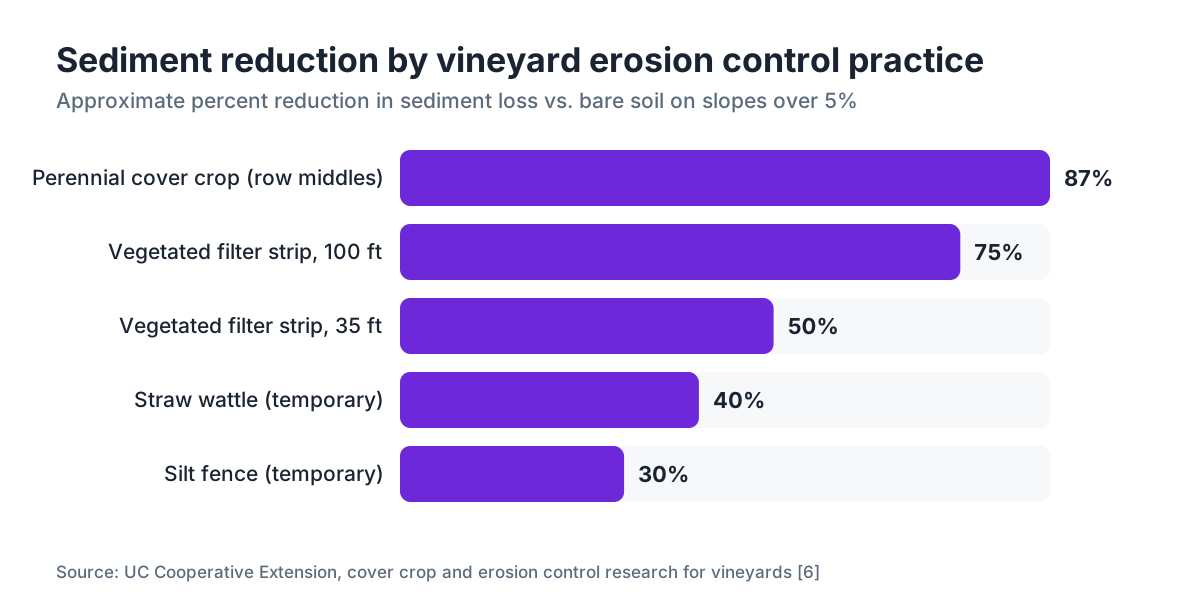
The practices with the strongest evidence base for vineyards, per UC Cooperative Extension research, are these.
Cover crops in the vine row middles. Perennial grasses and clovers can reduce sediment loss by 80 to 95 percent compared to bare soil on slopes over 5 percent [6]. Document the species planted, the planting date, germination notes, and your mowing or tillage schedule. A timestamped photo log earns its keep here, both for your own review and for showing an inspector that ground cover was established before the wet season.
Vegetated filter strips along waterways. A 35-foot vegetated buffer cuts sediment delivery to streams by roughly 50 percent on typical vineyard slopes. A 100-foot buffer gets you to 70 to 80 percent [6]. Document the buffer width on your site map, note what's planted, and record any maintenance (mowing, replanting bare spots).
Silt fencing and straw wattles. Useful during construction and replanting. Document installation date, material type, linear feet installed, and inspection and repair dates. You'll toss the fencing after construction. Keep the records.
Terrace and berm maintenance. If you've got contour berms or terraces, document the as-built grade and cross-section, and record any regrading after erosion events.
For spray applications near water, your pesticide records already double as stormwater documentation, as long as you note the distance to the nearest waterway and the application conditions (wind speed, soil saturation). This is one place spray record software like VitiScribe earns its keep, because the application log already captures the fields regulators care about.
One cheap habit pays off out of proportion: photograph erosion-prone areas at the start of each wet season and after major storms, and keep the photos in a dated file [7]. Nobody else is going to do that for you. Five minutes has kept growers out of enforcement actions they couldn't have fought otherwise.
How close can you apply pesticides to waterways, and what does that have to do with stormwater compliance?
Pesticide law and stormwater law overlap more than most growers realize.
The EPA's Worker Protection Standard doesn't set waterway buffers directly, but pesticide labels do, and the label is the law under FIFRA (7 U.S.C. § 136 et seq.) [8]. Many fungicides and herbicides common in vineyards carry label language that bars application within 25, 50, or even 300 feet of surface water. Copper-based fungicides, a vineyard staple, carry aquatic toxicity concerns and face restrictions in California's Central Coast and North Coast regions under the ILRP that go beyond the federal label.
Here's where the two worlds meet. If an inspector finds elevated copper or diuron in a waterway next to your property and you can't produce application records showing distance from water, rate, and conditions, you're in a bad spot. Your stormwater documentation is the evidence that your pesticide management couldn't have caused the problem, or that you caught it and corrected it.
The habit that matters: for every application within 200 feet of any waterway, record the distance to water, wind direction and speed, whether soils were saturated, and whether runoff occurred within 48 hours. It takes 90 seconds to add to an application log. Its legal value is out of all proportion to that.
EPA reissued its NPDES Pesticide General Permit, which governs discharges from pesticide applications to navigable waters, in 2022 [9].
What triggers a stormwater inspection on a vineyard?
Most inspections aren't random. They come from complaints.
A neighbor sees muddy water leaving your property during a storm. A downstream landowner reports a fish kill. Someone files a complaint with the regional water board. Those are the realistic triggers for small vineyard inspections, not a regulator cruising the county roads looking for trouble.
The other common trigger is a discharge you self-report. If your permit requires you to monitor and report exceedances, failing to report is usually a separate violation stacked on top of the discharge itself. So the self-reporting habit, uncomfortable as it is, actually protects you.
What inspectors want on arrival: your SWPPP (or documentation showing you're exempt), your visual monitoring log, evidence your BMPs are installed and maintained (they'll walk the site), and your most recent application records. They'll check whether bare soil sits exposed on slopes before rain season, whether drainage ditches are vegetated or armored, and whether any obvious discharge path leads toward water.
The worst thing you can do is produce no records. The second worst is produce records that contradict what they can see. If your log says you checked the silt fence last week and it's been failed and half-buried for months, that's an aggravating factor in any enforcement action.
How should you organize your stormwater records so you can find them during an inspection?
Paper binders still work. Plenty of growers keep the stormwater file in a 3-ring binder divided by year, with tabs for SWPPP, site maps, BMP logs, spray records, visual monitoring logs, agency correspondence, and any notices or complaints.
The alternative is digital. Tools like VitiScribe keep application records, field observations, and compliance documents in one place. That matters when an inspector shows up at 8 a.m. on a Tuesday and asks for two years of spray logs. Pulling that in two minutes looks a lot different than digging through a filing cabinet for 45.
Whatever system you use, a few habits carry most of the weight.
Date-stamp everything. "April" is not a date. April 14, 2025, is.
Keep original records. Don't edit or white-out. If you made a recording error, draw a single line through it, write the correction, initial it, and date it. That's the standard for regulatory records in most jurisdictions.
Store a backup off-site. A fire or flood that destroys your records doesn't destroy your compliance obligations. A cloud backup or a copy at your accountant's office is reasonable.
Train the person who covers when you're out. If you're the only one who knows where the stormwater file lives, that's a liability. The irrigation manager or assistant vineyard manager should know the filing system too.
What are the penalties for poor stormwater documentation at a vineyard?
Read this part carefully, because the numbers are real and enforcement has picked up in agricultural areas, California and Oregon especially, over the last decade.
Under the federal Clean Water Act, civil penalties for NPDES violations run up to $25,937 per day per violation [1]. The EPA adjusts these figures every year for inflation under the Federal Civil Penalties Inflation Adjustment Act. Criminal violations for knowing discharge can reach $50,000 per day and carry prison time.
California's State Water Resources Control Board can impose administrative civil liability up to $10,000 per day for minor violations, and $10,000 per day plus $10 per gallon discharged for serious ones [3]. The ILRP has fined vineyard operations in the $25,000 to $200,000 range for documented sediment discharge events in sensitive watersheds.
The documentation angle is the whole point. If you have records showing your BMPs were installed, inspected, and maintained, you're in a far stronger position to argue a discharge was unforeseeable and that you moved fast to correct it. Regulators and courts treat documented good-faith effort very differently from no effort. In several ILRP cases, growers with thorough documentation got compliance orders and no fine, while growers with no documentation in the same watershed took maximum administrative penalties.
Insurance won't save you here. Standard farm policies typically exclude pollution liability, and stormwater discharge usually counts as pollution. A few specialty agricultural pollution policies exist (ask your farm insurance broker), but they come with their own documentation requirements.
Are there state-specific stormwater rules for vineyards in California, Oregon, and Washington?
Yes, and they diverge meaningfully from the federal baseline.
California. The Irrigated Lands Regulatory Program (ILRP) is the main framework for vineyard stormwater compliance. The State Water Resources Control Board runs it through nine Regional Boards, assigning vineyards to Tiers 1, 2, or 3 based on proximity to impaired water bodies, discharge history, and operation complexity [3]. Tier 1 operations self-certify under a general permit and keep records on-site. Tier 3 operations need a third-party-certified Farm Water Quality Management Plan. California also has a Construction General Permit that kicks in when you disturb more than 1 acre during establishment or replanting.
Oregon. The Oregon Department of Environmental Quality administers the Agricultural Water Quality Management Act through a network of Area Management Plans [10]. Vineyards in regulated areas (most of the Willamette Valley qualifies) must run practices consistent with the local Area Plan, which usually includes bank stabilization, filter strips, and cover crop requirements. Documentation requirements are less prescriptive than California's ILRP, but the federal penalty exposure is identical.
Washington. WSU Extension has produced some of the best practical guidance on agricultural stormwater BMPs in the country [5]. Washington's Department of Ecology administers a general permit for agricultural stormwater that exempts most small vineyards from formal permit coverage but does not exempt them from liability if a discharge causes a water quality violation. Wineries (as opposed to vineyards) processing more than 1 million gallons a year may need a separate industrial stormwater permit.
New York. Cornell's guidance focuses on erosion control for the Finger Lakes and Hudson Valley [7]. The state's CAFO and small farm stormwater rules mostly exempt vineyards, but operations near regulated waterbodies under the Soil and Water Conservation District programs may carry additional obligations.
Check with your state's agricultural water quality program directly. Rules change, thresholds get updated, and extension publications sometimes lag enforcement reality by a year or two.
How often should you update and review your stormwater documentation?
At minimum, once a year before the wet season. In practice, you'll touch the documentation more often than that.
A sensible review calendar looks like this.
September or October, pre-season. Walk the site with your SWPPP in hand. Confirm every BMP is installed, working, and correctly described in your plan. Update the site map if anything changed. Review the season's application records and check that distances to waterways are documented for every spray near water.
After every significant storm (generally over 0.5 inches in 24 hours). Do a visual inspection and log it. Look at your drainage channels, silt fencing, and vegetated buffer strips. Note what you see, what worked, and what needs repair. Date and sign the entry.
Within 30 days of any significant site change. Update the SWPPP. New block, new drain, new chemical storage, changed cover crop strategy. This is the most commonly skipped step.
Annually. Review the whole package. Do this year's records match what the plan says you'll be doing? Are your BMP inspection dates consistent with your stated inspection frequency? File any reports your regional agency requires.
UC Davis has published guidance on sustainable winegrowing and seasonal vineyard operations that pairs well with a stormwater review calendar, since many of the same site walks that inform canopy management also catch early erosion problems [11].
What's the fastest way to get your stormwater documentation in order if you're starting from scratch?
Don't try to do it all at once. That's how growers end up with a half-finished SWPPP nobody looks at again.
Start with a site map. You can do it in an afternoon with a printed aerial image from Google Earth and a Sharpie. Mark every drainage feature, every waterway within 300 feet, your spray mixing area, and your chemical storage. This one document is the foundation of everything else.
Next, open a log. A spreadsheet is fine. Date, location, observation, action taken. Start filling it in now. A log that starts today and covers the next three months beats a retroactive log nobody will believe.
Pull your pesticide application records. If you've been keeping spray records (required under FIFRA [8] and most state pesticide laws), you already hold the core of your chemical-near-water documentation. Check that you recorded distance to waterways for applications in sensitive areas. If you didn't, add a note in a separate column with what you remember and flag it as reconstructed.
Contact your Regional Water Board or state equivalent. Tell them you're a small vineyard trying to understand your obligations. Most have agricultural liaison staff who'll tell you plainly whether you need to enroll in a permit program. The call also creates a record of good-faith inquiry, which matters if a dispute ever comes up.
Budget one to two days to get a basic system in place. After that, maintaining it takes maybe 30 minutes a week during the growing season and two to three hours a year for the formal review. The investment is modest. The exposure for skipping it is not.
Frequently asked questions
Does a vineyard under 5 acres need a stormwater permit?
Usually not a formal NPDES permit, but size alone doesn't decide your obligations. If your property sits in a regulated watershed, near an impaired waterway, or has a constructed discharge point, you may need to enroll in a state program regardless of acreage. California's ILRP applies to vineyards of any size that discharge to regulated water bodies. Check with your Regional Water Quality Control Board.
What is a SWPPP and does my vineyard need one?
A Stormwater Pollution Prevention Plan (SWPPP) is a written, site-specific document that describes your drainage features, potential pollution sources, and the BMPs you use to prevent discharges. Vineyards with a formal NPDES permit or enrolled in a state general permit almost always need one. Even without a permit, a SWPPP-style document is your best defense if a discharge complaint triggers an inspection.
How long do I have to keep stormwater records?
The standard retention period under most NPDES permits is three years from the date of the record, but several state programs require five. Pesticide application records carry separate rules: two years under the federal Worker Protection Standard, though California and Washington require three. Keep complaints and agency correspondence permanently. When in doubt, keep records longer.
Can sediment from a vineyard really cause a Clean Water Act violation?
Yes. Sediment is a regulated pollutant under the Clean Water Act when it degrades water quality or is discharged from a point source. Turbid runoff from a bare-soil replanting block that reaches a stream has triggered NPDES enforcement against vineyards in California and Oregon. The agricultural stormwater exemption does not protect you if a constructed drainage channel is involved.
Do cover crops count as a BMP for stormwater compliance purposes?
Yes, and they're one of the most effective ones available. UC Cooperative Extension research shows perennial cover crops in vine row middles can reduce sediment loss by 80 to 95 percent compared to bare soil on slopes over 5 percent. To get credit in a compliance context, document species, planting date, establishment percentage, and your management schedule including mowing and any herbicide or tillage use.
What's the difference between an NPDES permit and California's ILRP?
NPDES is the federal permit program under the Clean Water Act, administered by the EPA or delegated to states. California's ILRP is a state program run by the State Water Resources Control Board specifically for irrigated agricultural lands including vineyards. The ILRP functions as a waiver of NPDES requirements for enrolled California farms, but it carries its own Tier-based documentation and reporting requirements that are in some ways more demanding than a basic federal permit.
What visual monitoring records do I actually need to keep after storms?
You need a dated log entry for each storm inspection, typically triggered by rainfall over 0.5 inches in 24 hours or a threshold defined in your permit. Record the date, rainfall amount, inspector name, observations at each BMP location (silt fences, filter strips, drainage outlets), any erosion or discharge observed, and corrective actions taken with a completion date. A timestamped photo is a strong supplement but doesn't replace the written log.
Do I need to document my pesticide buffer zones for stormwater purposes?
Yes, and it's underappreciated. For every application within 200 feet of a waterway, your record should include the distance from the application area to the nearest surface water, wind direction and speed at time of application, soil saturation status, and any observed runoff in the 48 hours after. That record does double duty: it satisfies pesticide recordkeeping rules and demonstrates your discharge prevention practices to water quality regulators.
What happens if I get a stormwater inspection notice with no records prepared?
Producing no records is the worst outcome in an inspection. Regulators read it as evidence that no BMPs were implemented, not that you did the work informally. If you get an inspection notice, contact your county farm bureau or an agricultural attorney right away. You can sometimes document current conditions before the inspection date, but never backdate or falsify records, which turns a civil matter into a criminal one.
Is there a free template for a vineyard SWPPP?
WSU Extension and UC Cooperative Extension both offer free agricultural stormwater planning templates and BMP guides online. California's State Water Resources Control Board has template documents for the ILRP. These are starting points; your SWPPP has to reflect your actual site, so some customization is always required. Your local Resource Conservation District often provides free or low-cost technical assistance for small farms.
Do winery operations at the same site create separate stormwater obligations from vineyard operations?
Sometimes yes. Wineries generating wastewater from crush and fermentation may fall under industrial stormwater permit requirements separate from agricultural stormwater rules. In Washington, wineries over 1 million gallons annual production typically need an industrial general permit. Process water cannot be discharged to storm drains without treatment. Your stormwater documentation should note whether winery operations occur on the same parcel and whether their drainage is separate.
How do I document erosion control during vineyard replanting?
Replanting is your highest-risk period for sediment discharge. Document the pre-disturbance condition with photos, note the acreage disturbed and the dates, record every erosion control installed (silt fence, straw wattles, hydroseed, temporary cover), and keep a log of inspections during the disturbed-soil period. If you disturb more than 1 acre in California, you likely need to enroll in the Construction General Permit separately from your agricultural stormwater coverage.
Can my RCD help with stormwater documentation?
Yes, and it's one of the most underused resources available to small vineyards. Resource Conservation Districts in most states offer free or heavily subsidized technical assistance for farm water quality planning, including help writing a SWPPP, choosing appropriate BMPs, and understanding state permit requirements. Some RCDs also administer USDA EQIP cost-share funding for erosion control infrastructure like vegetated buffers and grade stabilization structures.
What federal law sets the penalties for stormwater violations?
The Clean Water Act (33 U.S.C. § 1251 et seq.) sets the framework, with penalty provisions under 33 U.S.C. § 1319. Civil penalties for NPDES violations run up to $25,937 per day per violation, a figure the EPA adjusts annually for inflation. Knowing (criminal) discharge can reach $50,000 per day and carry imprisonment. State programs add their own penalty schedules on top of the federal exposure.
Sources
- U.S. EPA, National Pollutant Discharge Elimination System (NPDES) (Clean Water Act, 33 U.S.C. § 1251 et seq.): Agricultural stormwater exemption scope and civil penalties up to $25,937 per day per violation under 33 U.S.C. § 1319
- U.S. EPA, NPDES State Program Information: States including California, Oregon, and Washington administer their own NPDES-equivalent programs that go beyond the federal baseline
- California State Water Resources Control Board, Irrigated Lands Regulatory Program: California's ILRP assigns vineyards to Tier 1, 2, or 3; Tier 3 requires third-party certified Farm Water Quality Management Plans; administrative civil liability runs up to $10,000 per day
- U.S. EPA, National Pollutant Discharge Elimination System (SWPPP requirements under the Construction and Multi-Sector General Permits): SWPPP requirements include site maps, pollutant source identification, BMP descriptions, inspection schedules, and corrective action procedures
- Washington State University Extension: WSU Extension guidance lists SWPPP components including property description, potential pollutant sources, BMP lists, maintenance schedules, and corrective action procedures
- University of California Agriculture and Natural Resources (UC Cooperative Extension), cover crop and erosion control research for vineyards: Perennial cover crops reduce sediment loss by 80-95% on slopes over 5%; vegetated filter strips 35 feet wide reduce sediment delivery by roughly 50%, and 100-foot strips by 70-80%
- Cornell University, College of Agriculture and Life Sciences (Cornell AgriTech, viticulture and enology): Cornell recommends photographing erosion-prone areas at the start of each wet season and after major storms and filing dated photo records
- U.S. EPA, Summary of the Federal Insecticide, Fungicide, and Rodenticide Act (FIFRA): Pesticide labels are legally enforceable under FIFRA (7 U.S.C. § 136 et seq.), including waterway buffer restrictions printed on the label
- U.S. EPA, National Pollutant Discharge Elimination System (Pesticide General Permit, reissued 2022): EPA's NPDES Pesticide General Permit governing discharges from pesticide applications to navigable waters was reissued in 2022
- Oregon Department of Environmental Quality, Water Quality program: Oregon DEQ administers the Agricultural Water Quality Management Act through local Area Management Plans; Willamette Valley vineyards are typically in regulated areas
- University of California, Davis, Department of Viticulture and Enology: UC Davis guidance on seasonal vineyard operations supports integrating stormwater site walks with routine canopy management and vineyard monitoring activities
- U.S. EPA, Agricultural Worker Protection Standard (40 CFR Part 170): Federal WPS requires pesticide application records to be retained for at least two years; state programs may require longer retention
Last updated 2026-07-11