Grégoire Ecoprotect vineyard sprayer: full operator guide

TL;DR
- The Grégoire Ecoprotect is an air-assisted vineyard sprayer that uses directed air-jets and closed-transfer chemical loading to cut spray drift and reduce operator exposure.
- It targets 50-75% drift reduction versus conventional airblast, helps with EPA Worker Protection Standard compliance, and fits both VSP and high-wire systems.
- New units run roughly $80,000 to $150,000 depending on tank size and electronics.
What is the Grégoire Ecoprotect and how does it work?
The Grégoire Ecoprotect is a tractor-mounted, air-assisted vineyard sprayer built by Grégoire, the French manufacturer best known for grape harvesting machines. It uses a directed air-jet system instead of a traditional axial fan. A conventional airblast throws a big outward column of air. The Ecoprotect does the opposite. It sends individual air streams aimed at each vine row from multiple nozzle heads mounted on adjustable booms.
The practical result: air energy lands where the canopy is, not in the sky between rows. The machine reads the vine row and puts spray there. Grégoire calls this the "Ecoprotect" concept, meaning it protects the crop while protecting the operator, bystanders, and the surrounding land through lower drift and closed-loop chemical transfer.
On the chemical side, the feature that matters most is the induction bowl, or closed-transfer system, for loading concentrate. The operator never tips a pesticide jug over an open tank. Concentrate goes into a sealed induction port, and rinsate from the empty container cycles back into the main tank. This targets the single highest-exposure moment in any spray operation: the mix-and-load step, where skin and inhalation exposure peak.
The sprayer runs off a standard PTO-driven hydraulic pump. Tank sizes in the Ecoprotect line run from roughly 400 liters to 1,600 liters, and you can order it as a trailed unit or as a self-propelled attachment on compatible Grégoire carrier platforms. The boom folds for road transport and adjusts to row widths from about 1.8 meters to 3.5 meters.
How much drift reduction does the Grégoire Ecoprotect actually achieve?
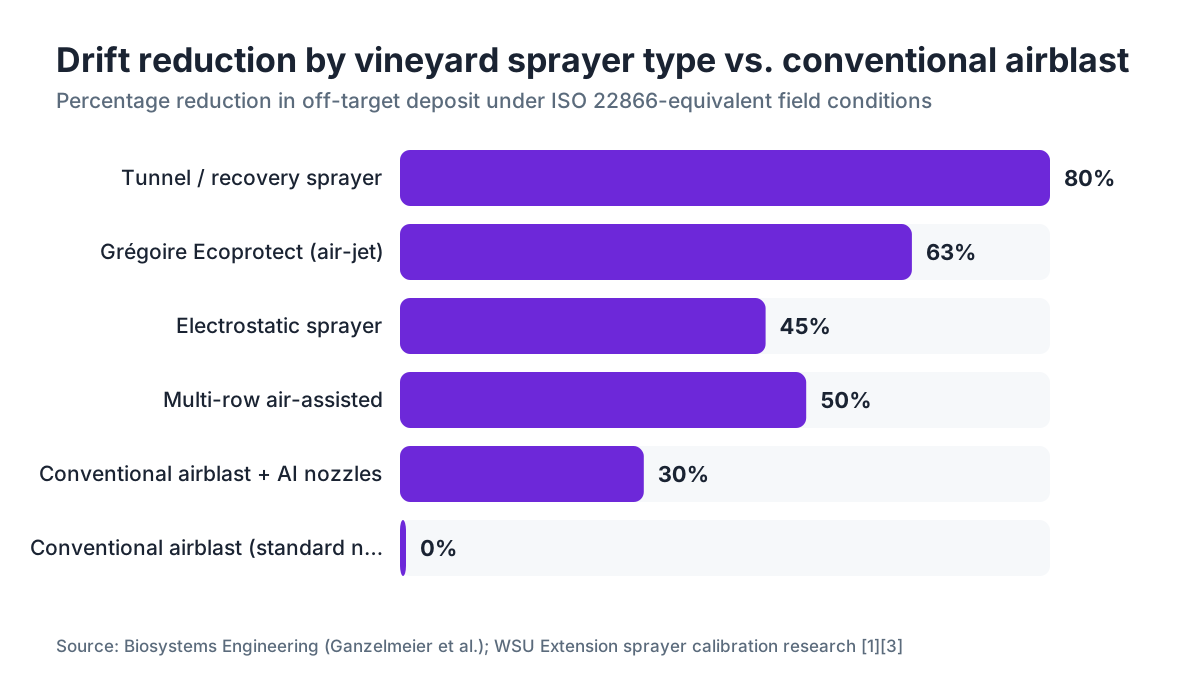
Air-jet sprayers like the Ecoprotect have shown drift reductions of 50 to 90% versus conventional airblast in European field trials, but only when operated correctly at low wind speeds. That's the number everyone wants, and the honest answer is that it swings hard with conditions. Peer-reviewed work backs the range. Marketing figures usually sit at the top of it.
A 2006 study in Biosystems Engineering by Ganzelmeier and colleagues measured off-target deposits from a range of European sprayer types. Tunnel and air-jet designs consistently produced lower ground deposits and airborne drift fractions than open-fan airblast machines. [1] Reduction fell apart at wind above 4 m/s (about 9 mph). Above that, even reduced-drift sprayers struggled to stay within acceptable bounds.
The ISO 22866 standard governs how sprayer drift is measured in Europe, and Grégoire's Ecoprotect documentation references it. ISO 22866 requires measurements at multiple downwind distances and specifies a standardized wind speed corridor. The numbers you see in a brochure almost always come from ISO 22866 tests run under favorable conditions. Treat them as best-case.
In California, the Department of Pesticide Regulation's drift management guidelines recommend stopping applications when wind exceeds 10 mph, whatever sprayer you run. [2] The Ecoprotect buys you more buffer. It does not exempt you from the threshold.
WSU Extension has run comparative work on air-assisted sprayers in Washington wine country. Its finding is blunt: nozzle selection and matching air volume to canopy density drive real-world drift more than the brand on the tank. [3] The Ecoprotect's adjustable boom and multi-point air delivery help. You still have to dial in nozzle size and travel speed for your own canopy.
What does a Grégoire Ecoprotect cost, and is it worth it for a small vineyard?
New units in North America run roughly $80,000 to $150,000, depending on tank size, boom configuration, GPS prescription-rate electronics, and whether you buy the sprayer alone or on a Grégoire carrier. Dealer quotes in California and the Pacific Northwest have landed in that range through 2024 and 2025, though the euro-to-dollar rate moves the number since the machines are built in France. [4]
For comparison, a good conventional airblast sprayer from an established brand like Rears or Proptec runs $15,000 to $40,000. So the Ecoprotect costs three to four times more at entry. That gap is real, and it stings if you farm under 50 acres.
Here's where the math starts to move. California's tighter drift rules, harder buffer-zone enforcement near homes, and the labor cost of WPS-compliant PPE and decontamination facilities all pile up. Farm near a school, a subdivision, or in a county with an aggressive ag commissioner, and a documented drift-reduction machine gives you agronomic and legal cover at once. That has dollar value, even if it never fits cleanly on a spreadsheet.
Over 100 acres, the labor argument gets stronger. The closed-transfer loading cuts the time and PPE burden of mix-and-load. If your state requires a licensed applicator for mixing, taking friction out of that step pays back in real hours.
Under 30 acres, my honest read is that you're better off with a quality conventional sprayer, good nozzles, and strict drift protocols than stretching the budget for an Ecoprotect. The machine's advantages are real, not magic. Good technique on a cheaper machine beats sloppy technique on an expensive one, every season.
How does the Ecoprotect handle EPA Worker Protection Standard compliance?
The EPA's Agricultural Worker Protection Standard (WPS), codified at 40 CFR Part 170 and last revised in 2015, sets pesticide safety rules on farms: restricted-entry intervals, decontamination supplies, and application exclusion zones. [5] The Ecoprotect's closed-transfer loading goes straight at one of the standard's most painful requirements, keeping handlers away from concentrate during mixing and loading.
Under WPS, anyone who mixes, loads, or applies pesticides is a "handler" and needs specific PPE, training, and access to eyewash and decontamination supplies. The closed-transfer induction system means the operator touches concentrate far less than with an open-tank rig. That doesn't waive the PPE (you still need gloves, eye protection, and whatever the label demands), but it drops the odds of an actual exposure event, and exposure events are what drive incidents and inspections.
The machine also supports GPS-linked spray records. Some versions log flow and application rate straight to a field computer, and that data exports to formats most state reporting systems can read. California, for one, requires pesticide use reports (PURs) within a set deadline of application, with accurate records of rate, timing, and location. [6]
If you want spray records, application logs, and WPS training documents in one place, tools like VitiScribe are built for that workflow, tying sprayer data to the compliance paperwork.
Cornell's pesticide education program publishes WPS compliance checklists that cover equipment inspection, handler training, and application exclusion zones. [7] Walk through one every year, whatever sprayer sits in your barn.
What canopy types and trellis systems work best with the Ecoprotect?
The Ecoprotect fits vertical shoot positioning (VSP) systems well, and VSP is the dominant trellis style across most North American wine regions. The directed booms set to match canopy height, delivering air and spray into the fruiting zone without blasting above and below the wire. [4]
High-wire cordon systems, common in some Zinfandel and Primitivo blocks, work too, but they want different boom settings and sometimes different nozzles. The machine handles them fine. It just eats more setup time when you're jumping between block types on the same day.
Where it struggles: old-vine, head-trained blocks with irregular canopy shapes. The boom geometry assumes some regularity in vine architecture. Head-trained Grenache or Mourvèdre on uneven ground, where every vine is shaped a little differently, may not get uniform coverage from a directed system. Conventional airblast sometimes wins there, because its big diffuse air volume finds its way into ragged canopies that a directed system skips.
Row width matters. The machine is built for typical European and Californian spacings around 2.0 to 3.0 meters. Very narrow rows under 1.5 m, common on tight Oregon Pinot Noir hillside plantings, can be a problem. Very wide rows over 3.5 m on trellised table grape systems may need boom extension kits.
Mixed block types? Have a serious talk with your Grégoire dealer before you buy. Ask about your canopy heights, your row spacings, and how your vines actually grow at bloom and veraison, more than mid-season. Canopy density at each growth stage decides how much air you need to push.
How does the Ecoprotect compare to other low-drift vineyard sprayers?
The low-drift sprayer market has several serious players, and no single machine wins every category. The table below lays out the main approaches with honest notes on where each one earns its price.
| Sprayer Type | Drift Reduction vs. Airblast | Typical Price Range (USD) | Best Canopy Fit | Closed-Transfer Chemical Loading |
|---|---|---|---|---|
| Grégoire Ecoprotect (air-jet) | 50-75% (ISO 22866 conditions) | $80,000-$150,000 | VSP, high-wire cordon | Yes |
| Conventional airblast (Rears, TeeJet nozzle upgrade) | 20-40% with drift-reduction nozzles | $15,000-$40,000 | Most systems | No |
| Tunnel/recovery sprayer (Caffini, Lipco) | 70-90% | $60,000-$120,000 | VSP, low-mid canopy | Sometimes |
| Electrostatic sprayer (Electrodyne, OcuSpray) | 30-60% (highly variable) | $10,000-$50,000 | Low, open canopy | No |
| Multi-row air-assisted (Durand-Wayland) | 40-60% | $25,000-$70,000 | VSP, table grapes | Sometimes |
Tunnel and recovery sprayers beat the Ecoprotect on pure drift reduction because they wrap the vine and recapture overspray. The tradeoff is speed. Tunnels crawl, and they're impractical on steep or rocky ground. They're the right call for flat, high-value VSP blocks where drift onto a neighbor's property is the whole concern.
For a Grégoire vineyard sprayer comparison, the nearest competitors are the Berthoud Seguip or the Tecnoma air-jet designs, which work on the same principles at similar price points. None of them carry a clear agronomic edge over the others in peer-reviewed North American work. Machine fit to your canopy and operator discipline decide the outcome, not the badge.
UC Davis Cooperative Extension publishes comparative sprayer guides for wine grapes with field data on coverage uniformity and drift across machine types. [8] That's the most reliable primary source for California conditions.
What are the nozzle and calibration settings for the Ecoprotect?
Calibrating the Ecoprotect starts with matching air volume to canopy density, not with hitting a volume-per-acre target first. Grégoire's operator manual lays out the protocol, and it flips the habit most growers learned on airblast, where you set the blower speed and then adjusted nozzle size to hit gallons per acre.
On the Ecoprotect the sequence runs: assess canopy density (measured as Leaf Wall Area, or LWA), set air volume to match the LWA, then pick nozzle size and travel speed to deliver your target volume per acre inside that air flow. WSU Extension's sprayer calibration resources, which are excellent and free, use an LWA-based approach that maps cleanly onto this machine. [3]
Nozzle choice matters a lot here. The machine ships with flat-fan nozzles but takes air-induction (AI) or twin-flat-fan nozzles that cut fine droplet production further. AI nozzles make larger droplets with internal air bubbles, which trims the drift-prone fine fraction. The catch: AI nozzles work poorly at low pressure. They need at least 30 psi to operate right.
For fungicide work in dense canopies (think Chardonnay at veraison), smaller droplets with better penetration often beat larger drift-reduction droplets on coverage inside the canopy. That's a real agronomic tension, not a marketing dodge. Nobody has a clean answer. The closest data comes from Cornell's sprayer research, which found that cutting travel speed often made up for going to a larger nozzle on coverage uniformity. [7]
Calibrate at the start of every season and after any real equipment change. A calibration record with date, nozzle type, pressure, travel speed, and volume per acre is exactly the documentation that satisfies both state pesticide use reports and a WPS inspection.
What do you need to know about maintenance and parts availability?
The Ecoprotect shares a lot of components with other Grégoire sprayer platforms, which helps parts availability a little. The hydraulic pump, PTO shaft, and standard plumbing fittings come from common European ag suppliers and aren't proprietary.
The hard-to-source parts in North America: boom articulation sensors, the nozzle head assemblies specific to the Ecoprotect, and the electronics in GPS rate-controller units. Grégoire distributes through a North American dealer network, but it's thinner than a John Deere or AGCO network. If your nearest dealer is 300 miles away, a hydraulic fitting that fails during peak fungicide timing turns into a real problem fast.
The smart move, which most seasoned operators already make, is to keep a season's worth of wear items on the shelf: nozzle tips (extras in every type you run), nozzle gaskets, diaphragm check valves, and a spare pressure gauge. Your dealer should hand you a recommended spare parts list for your model at purchase. If they don't, ask for one.
Winter service should cover nozzle tip inspection (TeeJet publishes flow-rate wear tables; a tip flowing more than 10% over rated output should be replaced), boom pivot lubrication, induction bowl seal replacement, and a full hydraulic pressure check. [9] Where hard frost hits, a complete water purge and antifreeze flush of the pump and plumbing is non-negotiable.
Operator training earns its cost. Grégoire runs training through dealers, and some regions have CDFA or cooperative extension spray equipment clinics covering calibration and maintenance. An untrained operator on a $120,000 sprayer gets worse results and more breakdowns than a trained one on a $30,000 machine. That's not an exaggeration.
How do spray records for the Ecoprotect satisfy state reporting requirements?
Every pesticide application in commercial agriculture needs documentation. The specifics vary by state, but the core data is the same everywhere: product name and EPA registration number, rate applied, total volume, target pest, application date and time, field location, applicator name and license number, and equipment used. [6]
The Ecoprotect's electronic rate controller, on units that have it, logs volume flow in real time and exports it by USB or a connected display. The snag is that raw sprayer data doesn't turn itself into a state-compliant pesticide use report. Someone still maps the machine output to the required fields on the form.
California growers submit PURs to the county agricultural commissioner within set deadlines of application for agricultural products, with tighter handling for restricted-use materials. [6] Washington requires annual pesticide use reporting under different thresholds. Oregon has its own rules.
This is where a purpose-built field operations tool earns a look. VitiScribe takes spray log inputs, including equipment type, and outputs records formatted for state PUR requirements. Worth the free trial if you're running spray records in spreadsheets or a paper logbook, because the time cost of building those reports by hand from raw sprayer data stacks up fast across a 100-plus application season.
Keep spray records at least 2 years under federal WPS requirements. [5] Many state programs want 3 years, and California growers commonly keep them indefinitely for liability reasons. Back up electronic records in at least two places.
What are the real-world limitations operators report with the Ecoprotect?
The Ecoprotect has genuine strengths. It also has friction points that show up after a few seasons, and knowing them before you sign matters more than any brochure figure.
Setup time between block types is longer than on a conventional airblast. Switching boom height, spread angle, and air volume from low-cordon Pinot Noir to high-wire Cabernet Sauvignon takes 15 to 30 minutes if you do it right. During a wet disease window on a tight schedule, that lost time is real.
Second, the closed-transfer induction system, safer as it is for operators, can clog or leak if you neglect it. The induction bowl seals need regular inspection. A failed seal during loading can actually concentrate exposure instead of preventing it. Operators report the system works well when new and degrades faster than expected in heavy-use seasons.
Third, the machine's precision setup rewards flat ground with consistent row spacing. Vineyards on slopes over 15 to 20% grade with variable spacing are tougher. On hillside blocks you may still need conventional airblast, or a knapsack for spot treatments, as a supplement.
Fourth, the electronics on GPS-equipped units lean on dealer support for firmware updates and troubleshooting. A mechanical part you can fix in the field. An electronic rate controller failure may mean shipping a component back or waiting on a technician.
None of these are dealbreakers on a well-run operation. They're the things you want to plan around, not discover at 6 a.m. during a botrytis alert.
Where can vineyard managers find training and calibration resources for the Ecoprotect?
Start with the Grégoire dealer network in North America. Dealers are supposed to provide operator training at delivery, and most will come back for a calibration session during your first season. Don't skip the second visit. First-season calibration problems are common, and most get fixed fast with dealer input.
For independent, manufacturer-neutral training, three university extension programs stand out.
UC Davis Cooperative Extension runs sprayer calibration workshops and publishes guides specific to California wine grapes, including air-assisted and low-drift technology. Its pest management guidelines give application technology recommendations by crop and pest. [8]
Cornell Cooperative Extension runs the Pesticide Management Education Program, with online and in-person training on sprayer calibration, WPS compliance, and pesticide recordkeeping. The material leans toward eastern US conditions, but the calibration method works anywhere. [7]
WSU Extension has some of the best free sprayer calibration content in the country, including its wine grape sprayer calibration publication and online tools that turn field measurements into application rates. [3] Run an air-assisted machine in Washington, Idaho, or Oregon, and WSU is your best free reference.
The National Pesticide Information Center (NPIC), run by Oregon State University with EPA cooperation, is a solid resource for product-specific questions and label interpretation. [10]
For drift specifically, EPA's stewardship guidance covers drift reduction technologies and references the same ISO 22866 framework Grégoire cites in its Ecoprotect documentation. [11]
Frequently asked questions
What tank sizes does the Grégoire Ecoprotect come in?
The Ecoprotect line offers tanks from roughly 400 to 1,600 liters, depending on the model and whether it's trailed or carrier-mounted. Most North American wine grape operations pick 600 to 1,000 liter configurations, which balance refill frequency against tractor weight on hillside blocks. Confirm the exact options with your regional Grégoire dealer, since available configurations vary by market.
Does the Grégoire Ecoprotect require a special tractor to operate?
No. The trailed versions need a standard agricultural tractor with a rear PTO (540 or 1000 RPM depending on model), a hydraulic remote outlet for boom control, and enough drawbar capacity for the loaded tank weight. A mid-size vineyard tractor in the 60 to 90 HP range works for the smaller tanks. Larger 1,200 to 1,600 liter units may want 80 to 120 HP. Check the operator manual for your model.
How does the Ecoprotect's closed-transfer system reduce WPS violations?
The closed-transfer induction port moves concentrate from container to tank through a sealed connection instead of an open pour. That removes one of the highest-exposure moments in handler operations. Under EPA's Worker Protection Standard (40 CFR Part 170), handlers still wear label-required PPE during loading, but a working closed-transfer system cuts the splash and vapor exposure events that lead to WPS violations and injury reports.
Can the Grégoire Ecoprotect apply both fungicides and insecticides effectively?
Yes. The machine isn't product-specific. It sprays any formulation compatible with its pump and nozzles, including emulsifiable concentrates, wettable powders, and suspension concentrates. The calibration point is that different target pests want different droplet sizes and coverage densities. Fungicides against botrytis in dense canopies often need finer coverage than contact insecticides. Adjust nozzle selection and travel speed when you switch application objectives.
Is the Grégoire Ecoprotect approved for use under California's DPR drift regulations?
California DPR keeps no approved sprayer list, but its drift regulations under CCR Title 3, Section 6614 set application conditions (wind speed, temperature inversion, proximity to sensitive sites) that every sprayer must meet. The Ecoprotect's documented drift performance helps operators stay inside those conditions at wind speeds where a conventional airblast might exceed drift thresholds. Always follow the pesticide label, which legally governs application conditions.
How long does it take to calibrate the Grégoire Ecoprotect at the start of a season?
A thorough seasonal calibration covering nozzle flow checks, boom height, travel speed, and pressure system test takes 2 to 4 hours for an operator who knows the machine. A first-season calibration by someone new to it can eat a full day, especially working through LWA-based air volume settings for multiple block types. Having a Grégoire dealer or extension specialist present for the first calibration is time well spent.
What is Leaf Wall Area (LWA) and why does it matter for the Ecoprotect?
Leaf Wall Area measures the vertical canopy surface per unit of row length, usually in square meters per meter of row. You calculate it by multiplying canopy height by canopy width, then by two for both sides of the row. LWA drives the air volume setting for air-jet sprayers like the Ecoprotect, because denser canopies need more air to penetrate. WSU Extension's calibration resources include LWA worksheets and air volume tables.
How do I keep spray records for the Ecoprotect that satisfy state pesticide use reporting requirements?
Log at minimum: product name and EPA registration number, application rate and total volume, target pest, field location, application date and time, applicator license number, and equipment used. California requires pesticide use reports within set deadlines for agricultural products. The Ecoprotect's electronic rate controller, on GPS-equipped units, logs flow data that supplements manual records. Vineyard field operations software can format those records for state-specific reports.
Does the Grégoire Ecoprotect work on steep hillside vineyards?
It handles moderate slopes but suits vineyards over 15 to 20% grade less well, especially with irregular row spacing. On steep ground the directional boom can lose canopy alignment as the frame tilts, and a filled tank raises stability concerns. Many hillside operators run the Ecoprotect on their flatter parcels and use different equipment on steep blocks. Ask your dealer about slope specifications for the specific model.
What nozzle types are compatible with the Grégoire Ecoprotect?
The machine uses standard ISO nozzle fittings and ships with flat-fan nozzles. Air-induction (AI) nozzles, which cut fine droplet production and improve drift control, are compatible and widely used by drift-focused operators. Twin flat-fan nozzles work well for dense canopy coverage. TeeJet, Greenleaf, and Lechler are common aftermarket brands. Match nozzle size to your target application volume and travel speed with a standard nozzle flow rate chart.
How does the Ecoprotect compare to a tunnel sprayer for drift reduction?
Tunnel (recovery) sprayers usually hit higher drift reduction, 70 to 90% versus 50 to 75% for air-jet designs like the Ecoprotect, because they physically capture overspray. The Ecoprotect wins on speed and terrain flexibility: it moves faster, handles more row configurations, and works on moderate slopes where a tunnel is impractical. For flat, high-value VSP blocks near sensitive receptors, a tunnel may drift less. For mixed terrain, the Ecoprotect is more versatile.
What are the most common repair issues with the Grégoire Ecoprotect?
Operators most often report induction bowl seals (they degrade with heavy use and UV exposure), nozzle tip wear (normal, needs annual flow-rate checks), boom articulation sensor faults, and pressure regulator drift over time. Electronic rate controller failures on GPS units need dealer support and can carry longer parts lead times. Keeping a season's supply of nozzle tips, gaskets, and diaphragm check valves on-site prevents most spray-day stoppages.
Is there an organic-compatible version of the Grégoire Ecoprotect?
The sprayer is equipment, not a chemistry choice, so it applies OMRI-listed organic fungicides and insecticides with no machine modification. The closed-transfer induction system handles liquid concentrate organics like copper hydroxide suspensions and kaolin. For sulfur dust, which some organic vineyards still use, you need a duster, a different machine type. The Ecoprotect sprays liquid sulfur formulations fine. Clean the tank thoroughly between conventional and organic programs to avoid contamination.
Sources
- Biosystems Engineering, Ganzelmeier et al. (European sprayer drift study) via ScienceDirect: Air-jet and tunnel sprayers produced 50-90% lower drift deposits versus conventional airblast in European vineyard trials under ISO 22866 test conditions
- California Department of Pesticide Regulation, Pesticide Drift Enforcement Guidelines: California DPR drift management guidelines recommend stopping spray applications when winds exceed 10 mph
- Washington State University Extension, Sprayer Calibration for Wine Grapes: WSU Extension found that nozzle selection and air volume matching to canopy density matter more than machine brand in real-world drift outcomes; LWA-based calibration is recommended for air-assisted sprayers
- Grégoire, Ecoprotect Sprayer Product Documentation: Grégoire Ecoprotect tank sizes range from approximately 400 to 1,600 liters; new unit pricing in North America ranges from roughly $80,000 to $150,000 depending on configuration
- U.S. EPA, Agricultural Worker Protection Standard (40 CFR Part 170): EPA WPS (40 CFR Part 170, revised 2015) requires handler PPE during mixing and loading, decontamination supplies, and minimum 2-year record retention for pesticide applications
- California Department of Pesticide Regulation, Pesticide Use Reporting Program: California requires pesticide use reports (PURs) to be submitted to the county agricultural commissioner within set deadlines of application for agricultural pesticide products
- Cornell Cooperative Extension, Cornell Pesticide Management Education Program: Cornell's sprayer research found that reducing travel speed often compensated for larger nozzle size on coverage uniformity inside dense canopies; Cornell publishes WPS compliance checklists for growers
- UC Davis / UC Agriculture and Natural Resources, Grape Pest Management Guidelines and Sprayer Technology Resources: UC Cooperative Extension publishes comparative sprayer guides for California wine grapes including field trial data on coverage uniformity and drift from multiple machine types
- TeeJet Technologies, Nozzle Wear and Flow Rate Specifications: TeeJet publishes flow-rate wear tables; nozzles flowing more than 10% over rated output should be replaced to maintain application accuracy
- National Pesticide Information Center (NPIC), Oregon State University and U.S. EPA: NPIC, operated by Oregon State University with EPA cooperation, provides pesticide label interpretation and product-specific application guidance
- U.S. EPA, Reducing Pesticide Drift: EPA references ISO 22866 as the standard framework for evaluating drift reduction technology performance
Last updated 2026-07-09