Growing grapes in Texas: a practical guide for serious growers
TL;DR
- Texas has more than 400 bonded wineries and ranks fifth in U.S.
- wine production.
- Growing grapes here is possible but hard.
- Pierce's disease, alkaline soils, and triple-digit summers are your biggest obstacles.
- Spanish and Mediterranean varieties beat the Bordeaux classics every time.
- Site selection and rootstock choice matter more in Texas than almost anywhere else in the country.
Why is Texas grape growing so different from other regions?
Texas is not one climate. It's a continent squeezed into one state. A grower in the Texas Hill Country deals with limestone-heavy alkaline soils, late spring freezes, and rainfall that swings between drought and flood in a single season. A grower on the High Plains near Lubbock sits at 3,300 feet, gets 14 inches of rain a year, and watches hail strip a vineyard in 20 minutes. A grower in East Texas fights Pierce's disease year-round because the glassy-winged sharpshooter and other leafhopper vectors don't die off in mild winters.
Those differences mean there is no single Texas playbook. What the regions share is heat. Almost every Texas wine grape zone piles up 3,000 to 4,500 degree-days (Fahrenheit, base 50°F) per season, which puts them squarely in what UC Davis researchers classify as Region IV and V climates [1]. Bordeaux runs around 2,400 to 2,700 degree-days. Napa Valley's warmest blocks hit about 3,200. Texas blows past both.
That heat is why Tempranillo, Mourvèdre, Grenache, Viognier, and Roussanne beat Cabernet Sauvignon, Merlot, and Chardonnay in side-by-side Texas trials. It's not that Bordeaux varieties can't ripen. They ripen too fast, losing acid and turning jammy and flat before phenolic maturity catches up. Mediterranean and Iberian varieties grew up in conditions that look a lot like Texas, and the wines show it.
What are the best grape varieties for Texas conditions?
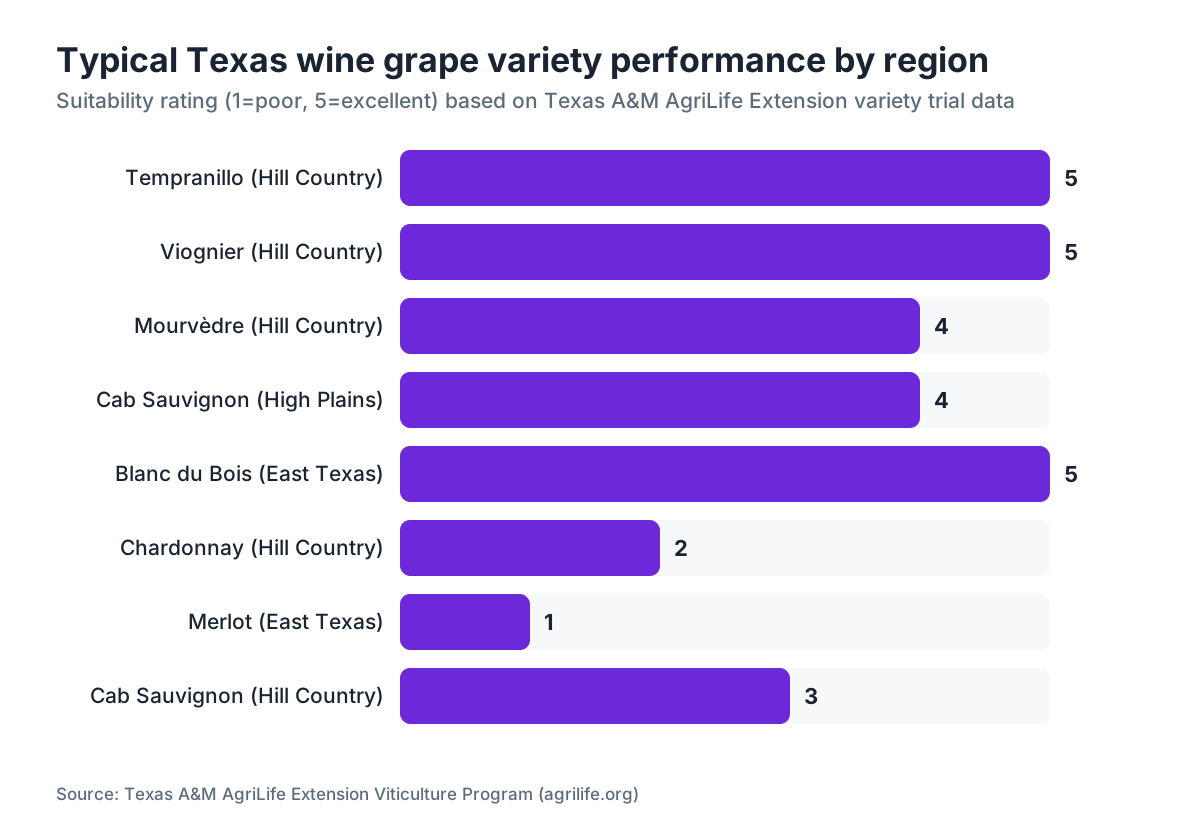
Tempranillo, Mourvèdre, Grenache, and Viognier are the top performers across most of Texas, based on decades of Texas A&M AgriLife Extension variety trials in the Hill Country and High Plains [2]. Heat-adapted Iberian and Mediterranean varieties consistently beat Bordeaux and Burgundy classics on both fruit quality and vine health.
For reds, Tempranillo leads. It takes the heat, holds acid reasonably well, and makes wines that Texans and outside critics both respond to. Mourvèdre and Grenache follow close behind, both handling drought stress better than thin-skinned varieties. Sangiovese works but needs careful site selection so it doesn't stack up sugar before harvest. Cabernet Franc beats Cabernet Sauvignon because it ripens earlier and holds more natural acid through a Texas August.
For whites, Viognier is probably the best-adapted noble variety in the state. It takes the heat, makes aromatic wines with real structure, and sells well in Texas tasting rooms. Roussanne and Marsanne are worth trialing in the Hill Country. Blanc du Bois is a hybrid bred for humid, Pierce's disease-prone country, and it's the dominant commercial white in East Texas [3].
Muscadine varieties (Vitis rotundifolia) are PD-immune, but they're a different market. They make distinctive wines that some drinkers love, and they don't compete on the same shelf as vinifera-style wines.
Varieties to approach carefully:
| Variety | Texas challenge | Notes |
|---|---|---|
| Cabernet Sauvignon | Ripens too fast, loses acid | Works in High Plains with careful canopy management |
| Merlot | Susceptible to PD vectors, heat stress | Avoid East Texas entirely |
| Chardonnay | Low-acid, flabby in heat | Possible at High Plains elevations only |
| Pinot Noir | Poor heat tolerance | Generally not viable except at extreme elevation |
| Tempranillo | Occasional botrytis in wet years | Best overall red for most Texas regions |
| Blanc du Bois | Hybrid, not vinifera | Essential for East Texas and Gulf Coast |
One honest note: nobody has clean long-term data across all 8 Texas AVAs. The Texas Wine and Grape Growers Association (TWGGA) tracks some trial data, and Texas A&M runs formal trials, but the dataset is smaller than what UC Davis has for California or Cornell CALS has for New York [4]. Plan to trial 3 to 5 varieties for 4 to 6 years before you commit to a large planting.
Which Texas AVAs are best suited for commercial vineyards?
The Texas High Plains and Texas Hill Country are the two AVAs where commercial vineyards make the most sense. The High Plains grows the fruit; the Hill Country sells the wine. Texas has 8 federally recognized American Viticultural Areas in total, each with genuinely different conditions [5].
The Texas Hill Country AVA is the largest, covering roughly 9 million acres across the Edwards Plateau between Austin and San Antonio. Elevations run 1,400 to 2,200 feet. Soils are mostly shallow, rocky, and limestone-derived, with pH often above 7.5 and sometimes above 8.0. That high pH drives iron and manganese deficiency (chlorosis) that gets severe on ungrafted vines or the wrong rootstock. Rainfall averages 25 to 30 inches, though drought years drop below 18. The Hill Country has the most active vineyard and winery development in the state right now.
The Texas High Plains AVA around Lubbock supplies an estimated 80 to 90 percent of all Texas-grown wine grapes, most of it trucked to Hill Country and other wineries for processing [2]. The elevation (3,000+ feet), semi-arid air, sandy loam soils, and wide diurnal swings (sometimes 40°F between day and night during harvest) produce excellent fruit quality. Hail is the major production risk, and some growers carry hail insurance as a standard cost of doing business.
Fredericksburg in the Texas Hill Country and the Bell Mountain AVA are smaller, tighter zones within or next to the larger Hill Country designation. Bell Mountain was the first Texas AVA, established in 1986.
The rest are Escondido Valley, Texas Davis Mountains, Mesilla Valley (shared with New Mexico), and Texoma (on the Oklahoma border). The Davis Mountains, at 5,000+ feet, may be the coolest AVA in Texas and can carry varieties like Cabernet Franc and even some Pinot-adjacent experiments.
Starting from scratch? The High Plains has the best-documented viticultural history and the most predictable fruit, but it's far from population centers. The Hill Country puts you next to Austin and San Antonio tourism, but demands serious money spent on soil management.
How do you manage soils and irrigation in Texas vineyards?
Rootstock selection and drip irrigation are the two decisions that make or break a Texas vineyard. The high-pH, calcareous soils across the Hill Country and central Texas cause chronic iron and manganese deficiency, and the fix is the right rootstock, not endless foliar sprays. Soil management is where a lot of outside growers get humbled. California or Washington experience does not transfer cleanly.
Calcareous (high-calcium, high-pH) soils show up as interveinal chlorosis on young leaves, stunted growth, and eventual yield collapse if you ignore it. Foliar iron sprays help short-term. The real fix is rootstock. 1103 Paulsen and 110 Richter both tolerate high pH and calcium stress well. 3309 Couderc and 101-14 Mgt, popular in cooler climates, fall apart on Texas limestone. Texas A&M's guidance points to 1103P or 140 Ruggeri as starting points for alkaline Hill Country soils [2].
Irrigation is not optional in most Texas wine grape zones. Even areas getting 25 to 28 inches of annual rain distribute it badly for grapevines, since most falls in spring and fall, not summer. Drip is the standard. Figure 12 to 18 acre-inches per year in the Hill Country and 20 to 28 in the High Plains where rain is scarcer [2]. Over-irrigating is a real trap: wet soil late in the season pushes vegetative growth when you want the vine stressed toward ripening. Most experienced Texas growers run regulated deficit irrigation (RDI) starting at veraison to concentrate fruit.
Soil prep before planting should include deep ripping (18 to 24 inches) to break hardpan, especially on rocky Hill Country sites. Pre-plant tests for pH, CEC, calcium, phosphorus, and micronutrients are not optional. Budget $300 to $600 per acre for amendments before the first vine goes in.
Cover cropping between rows helps with erosion and organic matter, but watch water competition in dry years. Mowing or rolling instead of tilling keeps mycorrhizal networks intact and holds the dust down.
What pests and diseases should Texas growers expect?
Pierce's disease is the existential threat for Texas viticulture east of roughly I-35. PD comes from the bacterium Xylella fastidiosa, spread by sharpshooter leafhoppers, mainly the glassy-winged sharpshooter (Homalodisca vitripennis) [6]. Once a vine is infected, there's no cure. It dies, usually within 1 to 5 years. In the Hill Country, winters get cold enough to knock back some of the bacterial titer in the vine's xylem, so infected vines decline slower and sometimes partly recover. East of I-35 and along the Gulf Coast, winters never get that cold, and vinifera vineyards are not commercially viable without PD-resistant varieties.
The EPA's Worker Protection Standard (WPS), revised in 2015, applies to all pesticide applications in commercial vineyards, including the insecticide programs Texas growers run against sharpshooters [7]. You have to post application information, provide workers with the right personal protective equipment, and meet the re-entry intervals (REIs) on the label. Anyone hiring farm labor for spray operations needs a current WPS compliance program in place.
Beyond PD, Texas growers deal with:
- Cotton root rot (Phymatotrichopsis omnivora): a soil fungus that kills vines suddenly, more common in alkaline soils with high organic matter. No effective chemical control exists. Resistant rootstocks and pre-plant soil fumigation are the main tools.
- Bunch rots (Botrytis cinerea, sour rot): worse in wet harvest years, especially on thick-skinned varieties in the Hill Country. Canopy management for airflow is the cheapest prevention.
- Grape berry moth: less of a problem in Texas than in eastern states, but present in some zones.
- Leafroll viruses: spread by mealybugs, and increasingly documented in Texas. Certified virus-indexed planting material is non-negotiable.
- Hail: not a disease but an economic reality, especially in the High Plains. Hail netting costs $3,000 to $6,000 per acre installed and is a legitimate ROI calculation for High Plains growers.
For spray records, Texas growers must meet Texas Department of Agriculture requirements and keep pesticide application records for 2 years [8]. The minimum is applicator license number, product EPA registration number, rate, date, crop, and REI compliance. Digital record systems cut the paperwork way down, and this is exactly where a tool like VitiScribe earns its keep, letting you log spray events in the field and auto-populate compliance reports.
How much does it cost to plant a Texas vineyard?
All-in establishment for a new Texas wine grape vineyard runs $12,000 to $20,000 per acre through year three, before any meaningful crop. Costs vary a lot by region, planting density, and whether you're developing raw land or improving an existing farm. The figures below come from Texas A&M AgriLife Extension enterprise budgets and industry surveys, not guesses [2].
Site prep (ripping, soil amendments, irrigation infrastructure) runs $2,000 to $5,000 per acre depending on soil and what's already there. Trellising materials run $2,500 to $4,500 per acre for a standard VSP (vertical shoot positioning) system. Vine cost depends on variety and whether you buy certified material: budget $2.50 to $5.00 per vine for certified grafted vines. At typical Texas densities of 726 to 1,089 vines per acre (roughly 6x8 or 5x8 spacing), that's $1,800 to $5,400 per acre in plant material alone.
The vine doesn't produce a commercial crop until year 3 or 4. So you carry 3 to 4 years of operating cost before revenue, which is why almost every Texas winery supplements estate fruit with purchased High Plains grapes during those early years.
Ongoing annual operating cost for a mature Texas vineyard runs $3,500 to $6,000 per acre, covering labor, water, inputs, and equipment. Texas A&M publishes updated enterprise budget worksheets that are the most reliable reference for current numbers [2].
Wine grape prices in Texas range widely. High Plains Cabernet Sauvignon has sold for $600 to $900 per ton in recent years. Hill Country estate fruit from established vineyards can command $1,200 to $2,000+ per ton. A mature, well-run Texas vineyard at Hill Country yields of 2 to 4 tons per acre can pencil out, but the margin is thin enough that tasting room revenue matters enormously to the economics.
What trellis systems and canopy management work best in Texas heat?
VSP with a fuller west-facing canopy is the workhorse system for most of Texas, because sunburn and heat stress are real production problems here. Canopy strategy has to account for that explicitly. This is the opposite of cooler climates, where the goal is usually maximum sun exposure.
VSP (Vertical Shoot Positioning) is the most common system and works fine in the Hill Country and High Plains. The Texas twist is keeping a fuller canopy on the afternoon (west-facing) side to shade fruit from the worst heat of the day. Texas afternoons in July and August routinely pass 100°F, and berries in direct afternoon sun can hit 120°F or more. That kills yeast on the skin, shrinks berries, and bakes in raisined, jammy flavors you can't fix in the winery.
Gable and high-wire cordon systems are popular in some High Plains operations because they carry more canopy volume without shading the fruit zone. The tradeoff is higher establishment cost and more labor for shoot positioning.
Texas extension guidance generally recommends shoot spacing of 3 to 4 inches at the cordon, balancing airflow (for disease control) against the shade benefit of a slightly denser canopy [2]. Aggressive hedging and leaf removal on the east side (morning sun, lower temperature) can happen without the sunburn risk the same work would create on the west side.
Wind gets ignored too often. West Texas and the Hill Country both get steady spring winds that desiccate new shoots, snap them at the base, and damage flower clusters during bloom. A windbreak on the windward side of a block makes a measurable difference in set and early-season vigor, though windbreaks also create frost pockets in low spots.
How do Texas frost and freeze events affect the growing season?
Late spring freezes are the most economically damaging weather event in Texas viticulture, and growers coming from California or the Pacific Northwest tend to underestimate them. A single April freeze can cut a vintage in half.
The Hill Country averages a last frost date of March 15 to April 1 depending on elevation and location, but killing freezes (below 28°F for 4+ hours) have landed as late as April 20 in some Hill Country spots. Grapes push bud break early in Texas because of warm winters, and once primary buds have broken and shoots are 2 to 4 inches long, a 28°F freeze destroys the primary crop. Secondary buds are less fruitful, so a late March or April freeze can cut yields by 50 to 80 percent for that vintage.
Freeze protection options used in Texas:
- Wind machines: work when the freeze is an inversion (cold air pooling at ground level). Weak against advective freezes (a cold air mass moving through). Cost runs $15,000 to $30,000 per unit, covering 10 to 30 acres.
- Overhead sprinkler irrigation: uses the latent heat of freezing water to protect buds. Needs high water volumes (roughly 0.1 inch per hour, continuously, while below 32°F) and a big water supply. Uncommon in Texas given water constraints.
- Delayed pruning (double pruning): leave extra canes through early spring until the freeze risk passes, then prune down to one or two buds per spur. This delays bud break by 10 to 14 days, moving the vulnerable window past the most likely freeze dates. It's the most widely adopted low-cost strategy in Hill Country vineyards.
Site selection matters just as much. Cold air drains downhill, so a hillside site 50 to 100 feet above a valley floor can run 3 to 5°F warmer on a clear, calm freeze night. Growers who understand topographic frost drainage build it into their site assessment before they plant a single vine.
What licenses and compliance steps do Texas grape growers need?
Commercial Texas grape growers face compliance on three fronts: pesticide applicator licensing, EPA worker protection, and (if they make wine) TABC and federal TTB permits. Spray records and worker safety documentation are the ongoing burden that trips people up.
For pesticide applications, Texas requires a Commercial Pesticide Applicator License from the Texas Department of Agriculture (TDA) for anyone applying restricted-use pesticides for compensation. The license takes an exam, a fee (currently around $100 for most categories), and continuing education for renewal [8]. Growers applying only general-use pesticides on their own land are exempt from the license but still have to keep application records.
The EPA Worker Protection Standard applies to any agricultural employer using pesticides where workers may be exposed. That means posting the WPS safety poster in a central spot, training workers on pesticide safety, keeping application records accessible (product name, EPA Reg. No., rate, treated area, date, and REI), and providing decontamination supplies [7]. EPA guidance states that "agricultural employers must provide handlers and early-entry workers with information about pesticides they may encounter," which in practice means your spray records need to be current and easy to pull.
For winery licensing, the Texas Alcoholic Beverage Commission (TABC) handles winery permits. A winery permit in Texas takes a TABC application, a TTB (federal) basic permit, and in many cases local zoning approval. If you plan to sell direct to consumers from a tasting room, you need the right TABC permit class for it. The TABC website has current requirements [9].
Texas also has an agricultural exemption for property tax that applies to vineyards meeting minimum acreage and income thresholds, which vary by county. It can cut carrying costs noticeably. Check with your county appraisal district for current thresholds, since they're set locally.
Record-keeping for spray applications, water use (especially on a water right or permit), and labor (for WPS) is the core ongoing burden for most small Texas vineyards. Keeping digital records from day one pays off the day you get inspected. VitiScribe is built for this field-to-compliance workflow, and it's worth a trial once you're past 5 acres.
How do Texas growers manage water rights and irrigation regulations?
Water is the constraint that will ultimately cap how much Texas wine grape acreage can expand, especially in the Hill Country and western regions. Before you buy land, pull the local Groundwater Conservation District map and confirm whether your target property sits under an active district with permit requirements.
Texas follows the "rule of capture" for groundwater, which broadly means the landowner has the right to pump water from beneath their property. But Groundwater Conservation Districts (GCDs), which cover most of Texas, can impose permit requirements, production limits, and well spacing rules. The Hill Country sits over the Trinity and Edwards aquifers, and some counties run active GCDs with real restrictions on new agricultural wells.
Surface water rights in Texas follow the "prior appropriation" doctrine (first in time, first in right). New surface water appropriations are very hard to get in most Texas river basins. Most vineyards rely on groundwater wells or water bought from local suppliers.
Drip irrigation is more than good agronomy in Texas. It's edging toward a legal and practical necessity. Switching from overhead or furrow to drip saves roughly 30 to 40 percent of water use compared to sprinkler systems and cuts disease pressure from wet foliage at the same time.
The Texas Water Development Board maintains an aquifer viewer and a GCD directory on its website, which is the fastest way to check water availability for a target site [10].
What resources and extension programs exist for Texas grape growers?
Texas A&M AgriLife Extension is the most important technical resource for Texas grape growers, full stop. Its viticulture program publishes enterprise budgets, variety trial data, pest management guides, and rootstock recommendations calibrated to Texas conditions [2]. The Texas A&M viticulture and enology work at Fredericksburg includes a demonstration vineyard and short courses in most years.
The Texas Wine and Grape Growers Association (TWGGA) is the main industry group. It lobbies at the state level, publishes a grower magazine, and runs an annual conference in February that pulls in researchers, growers, and winery owners. Membership pays for itself on the network alone.
For pest management, the Texas A&M AgriLife Extension IPM program and USDA-ARS work on Pierce's disease produced most of the practical guidance out there. The UC Davis Pierce's Disease research program, funded partly by California's Pierce's Disease Research and Emergency Response Fund, produced the foundational work on Xylella fastidiosa biology that applies directly to Texas even though it started in California [6].
Cornell University's CALS viticulture program and Washington State University's viticulture extension are strong resources for general vine physiology, canopy management, and disease principles, even though their variety and climate recommendations don't always transfer to Texas [11][12]. For soil and rootstock work in calcareous soils, UC Davis's material on limestone Mediterranean sites fits Texas better than most eastern U.S. literature [1].
Want a useful comparison? California's Paso Robles wineries region shares plenty with Texas on heat, limestone soils, and water management, and there's real knowledge transfer happening between the two at the practitioner level. If you're curious how vertically integrated vineyard-to-winery operations run at larger scale, reading about estate operations like Gervasi Vineyard can sharpen your own business planning. For field operations more broadly, the vineyard overview on this site covers general setup and systems.
Frequently asked questions
Can you grow wine grapes in East Texas?
Vinifera wine grapes are generally not commercially viable in East Texas because Pierce's disease pressure is too high for sustained production. The exception is PD-tolerant hybrids like Blanc du Bois and Lenoir (Black Spanish), which are immune or highly resistant. East Texas growers using these varieties produce commercially and often do well in local and regional markets, though the wines are stylistically different from vinifera-based ones.
What rootstock should I use for Texas Hill Country soils?
1103 Paulsen and 110 Richter are the most widely recommended rootstocks for the Hill Country's high-pH, calcareous soils. Both tolerate the lime-induced chlorosis that weaker rootstocks suffer on shallow limestone. Texas A&M AgriLife Extension recommends trialing 140 Ruggeri on the most extreme alkaline sites. Avoid 3309 Couderc and 101-14 Mgt, which underperform here despite being popular in cooler, more acidic soils.
How many wineries are there in Texas?
Texas had more than 400 bonded wineries as of recent TABC licensing counts, making it the fifth-largest wine-producing state in the U.S. by volume. The number has grown fast since the early 2000s, driven mostly by Hill Country tasting room tourism and direct-to-consumer sales. The Texas Hill Country alone has over 50 wineries clustered on and around the Fredericksburg wine trail.
When is harvest time for Texas wine grapes?
Harvest timing depends on variety, region, and season. In the Hill Country, early whites like Viognier and Blanc du Bois usually come in from late July through August. Reds like Tempranillo and Mourvèdre typically harvest in August and September. High Plains harvest runs slightly later thanks to higher elevation and cooler nights. In unusually hot, dry years, harvest can run 2 to 3 weeks earlier than average.
Do I need a pesticide applicator license to spray my Texas vineyard?
If you apply restricted-use pesticides for compensation or operate commercially, yes, Texas requires a Commercial Pesticide Applicator License from the Texas Department of Agriculture. Growers applying only general-use pesticides on their own land are generally exempt from licensing but must still keep application records. The EPA Worker Protection Standard applies to any commercial vineyard using pesticides where workers may be present or re-enter treated areas.
What is the best irrigation method for Texas wine grapes?
Drip irrigation is the clear best practice for Texas vineyards. It conserves water (a big deal given aquifer constraints), keeps foliage dry (cutting disease pressure), and allows precise deficit irrigation during ripening. Most Hill Country vineyards apply 12 to 18 acre-inches per season through drip. Overhead irrigation shows up occasionally for freeze protection but not for routine water management.
How long does it take to establish a producing Texas vineyard?
Expect 3 to 4 years from planting to commercial-scale production. Year one is establishment: getting vines to the first wire with healthy roots. Year two trains the permanent cordon structure. Year three usually gives a partial crop. Full production typically arrives by year 4 or 5. Total establishment cost through year three runs $12,000 to $20,000 per acre depending on site prep and infrastructure.
Does Texas have any geographic indications or AVAs specific to wine grapes?
Texas has 8 federally recognized American Viticultural Areas: Texas Hill Country, Texas High Plains, Bell Mountain, Fredericksburg in the Texas Hill Country, Escondido Valley, Texas Davis Mountains, Mesilla Valley (shared with New Mexico), and Texoma. Bell Mountain, established in 1986, was the first. The Texas Hill Country AVA is one of the largest AVAs in the U.S. by area, covering roughly 9 million acres.
What is Pierce's disease and how serious is it for Texas vineyards?
Pierce's disease comes from the bacterium Xylella fastidiosa, spread by sharpshooter leafhoppers. It blocks xylem tissue and kills infected vines within 1 to 5 years with no cure. East of I-35, the disease makes commercial vinifera production essentially impossible. In the Hill Country, cold winters suppress the bacterium enough to slow vine decline. PD-tolerant and PD-resistant hybrids are the only viable options in high-pressure zones.
Can Texas grape growers get crop insurance for their vineyards?
Yes. The USDA Risk Management Agency offers crop insurance for wine grapes in several Texas counties, especially in the Hill Country and High Plains. Coverage options include Actual Production History (APH) and Whole Farm Revenue Protection (WFRP). Given hail risk in the High Plains and freeze risk in the Hill Country, most commercial growers carry some form of crop protection. Check the USDA RMA website for county-specific availability and coverage levels.
What cover crops work well between vineyard rows in Texas?
In drier western Texas and Hill Country zones, native or naturalized low-water species like buffalo grass, Texas bluegrass, or cereal rye work well. Mowing or rolling instead of tilling keeps soil structure and mycorrhizal networks intact. In wetter years or higher-rainfall sites, leguminous cover crops add organic matter and some nitrogen. The trick in Texas is managing water competition in drought years: you may need to terminate the cover early or disc it in before summer heat sets in.
How does the Texas climate affect wine style compared to California?
Texas wines generally show riper fruit, lower natural acidity, and higher potential alcohol than comparable California wines from cooler regions, because of higher degree-day accumulation. Growers who focus on heat-adapted varieties like Tempranillo, Mourvèdre, and Viognier make wines that compete on their own terms rather than imitating Napa or Burgundy. Acid adjustment in the winery is common practice in Texas, adding tartaric acid to hit target pH before fermentation.
Are there grants or financial assistance programs for Texas vineyard development?
USDA's Farm Service Agency (FSA) offers farm loans that can apply to vineyard establishment. USDA Rural Development runs grant and loan programs for rural agricultural businesses, including wineries. The Texas Department of Agriculture has historically offered some agricultural development grants. Texas A&M AgriLife Extension can point growers toward current programs. The Texas Wine and Grape Growers Association tracks industry-specific funding through its membership communications.
What should I look for when buying land for a Texas vineyard?
Start with water: confirm well yield, check the local Groundwater Conservation District for permit requirements, and test water quality for pH and salinity. Then soil: test pH, CEC, calcium, and micronutrients across multiple points, and probe for hardpan that needs deep ripping. Check frost drainage topography and prevailing wind direction. Verify zoning allows agricultural and winery use if that's the plan. And check proximity to the I-35 corridor, roughly the eastern limit of reliable vinifera production.
Sources
- UC Davis Viticulture and Enology, Climate Regions of California: Winkler degree-day classification system placing Texas growing regions in Region IV and V categories (3,000+ degree-days F, base 50F)
- Texas A&M AgriLife Extension, Viticulture and Enology Program: Variety trial data, rootstock recommendations, enterprise budgets, and irrigation guidance for Texas wine grape production
- Texas A&M AgriLife Extension, Blanc du Bois Variety Information: Blanc du Bois identified as dominant commercial white wine variety in PD-pressure zones of East Texas and Gulf Coast
- Cornell University CALS, Viticulture and Enology Program: Cornell maintains variety trial databases for New York and eastern U.S. viticulture; referenced for comparison dataset size
- TTB (Alcohol and Tobacco Tax and Trade Bureau), Approved American Viticultural Areas: Texas has 8 federally recognized American Viticultural Areas including Texas Hill Country, Texas High Plains, Bell Mountain, and others
- UC Davis Pierce's Disease Research Program: Pierce's disease caused by Xylella fastidiosa, transmitted by glassy-winged sharpshooter leafhoppers; no cure once infected
- EPA Worker Protection Standard for Agricultural Pesticides: EPA WPS requires agricultural employers to provide pesticide application information to workers and ensure re-entry interval compliance; quote: 'agricultural employers must provide handlers and early-entry workers with information about pesticides they may encounter'
- Texas Department of Agriculture, Pesticide Programs: Texas requires pesticide application records kept for 2 years; Commercial Pesticide Applicator License required for restricted-use pesticide applications for compensation
- Texas Alcoholic Beverage Commission, Winery Permits: TABC handles winery permits in Texas; winery tasting room sales require specific permit class in addition to federal TTB basic permit
- Texas Water Development Board, Groundwater Resources: TWDB maintains aquifer viewer and Groundwater Conservation District directory for assessing water availability by county
- Washington State University Viticulture and Enology Extension: WSU extension provides general viticulture resources on vine physiology, canopy management, and disease management applicable to principles (not all varieties) used in Texas
- Cornell University CALS, Viticulture Extension Publications: Cornell viticulture extension provides canopy management and disease management principles referenced for general vineyard management guidance
Last updated 2026-07-09