Growing grapes: a practical guide from planting to first harvest
TL;DR
- Grapes take 3 to 5 years from planting to a first commercial-quality harvest, and 5 to 8 years to break even.
- Success comes down to matching variety to your climate and soil, planting certified virus-free material, and building your trellis before the vines need it.
- This guide covers variety selection, site prep, training, canopy and pest management, and the compliance records every serious vineyard keeps.
What do grapes actually need to grow well?
Grapes are more forgiving than their reputation suggests, but they have a few non-negotiable needs. Full sun. At least 150 to 180 frost-free days depending on variety. Well-drained soil. Enough winter chill to break dormancy cleanly. [1] Get those four right and you have a real shot. Miss one and you'll fight the vine your entire career.
Drainage matters more than fertility. Vitis vinifera especially hates wet feet. A perched water table, even a seasonal one, invites Phytophthora root rot and forces vines into shallow, weak roots. Before you plant anything, dig a hole 24 inches deep, fill it with water, and time the drop. If it's still full after 12 hours, you need a different site or a serious investment in subsurface drainage.
Most wine grapes want soil pH between 5.5 and 6.5. [1] Muscadine grapes (Vitis rotundifolia) tolerate slightly lower pH and much higher humidity than European varieties, which is why they dominate the American South. Knowing your pH before planting saves you from correcting it after the vine is already in the ground, which is slow and imprecise.
Chill hours, measured as hours below 45°F, trigger dormancy break in spring. Most vinifera cultivars need 800 to 1,200 chill hours a year. [2] Warm-climate varieties need fewer. But if your site reliably logs under 500 hours, standard European varieties will struggle badly.
Wind cuts both ways. Moderate airflow through the canopy dries leaves after rain and lowers disease pressure. Severe wind tears shoots, scatters pollen, and desiccates clusters. Topography, prevailing wind direction, and whether you have a windbreak all decide whether a site is viable.
How do you choose the right grape variety for your site?
Variety is the one decision you can least afford to botch. You're committing to a plant that could be in the ground for 30 years, so a bad match compounds for decades.
Start with what already grows well nearby. That's not lazy thinking. It's empirical data. If a variety is thriving five miles away in similar soil, that beats any catalog description. University extension trials come next. UC Davis has variety trial results going back decades for California conditions. [3] Cornell's viticulture program has done the same for cool-climate cultivars in the Northeast. [4] Washington State University covers the Columbia Valley and the dry inland climates. [5]
For classic wine regions: Cabernet Sauvignon, Chardonnay, and Merlot own the warm-to-moderate sites. Riesling, Gewürztraminer, and Pinot Noir push into cooler ground. Hybrids like Marquette, La Crescent, and Frontenac survive winters to -30°F and open serious viticulture to Minnesota, Wisconsin, and Michigan's Upper Peninsula.
For fresh-market or home planting: Concord, a Vitis labrusca hybrid, is the most cold-hardy and forgiving option in the eastern US, and it's the dominant juice grape. Seedless table varieties like Thompson Seedless and Crimson Seedless rule California's Central Valley, but they need 110 to 120 frost-free days and don't take hard winters.
Growing muscadine grapes from seed is popular with Southeast home gardeners. For commercial work, almost nobody does it. Seed-grown muscadines vary wildly in berry quality, flavor, and yield. Named varieties propagated by cuttings or layering are the standard for any serious planting. The same logic covers vinifera: the variety name assumes a specific clonal selection, and that clonal identity survives only through vegetative propagation.
Rootstock is a separate choice layered on top of variety. If phylloxera (Daktulosphaira vitifoliae) is in your soil, and in most of California and many other regions it is, you plant on resistant rootstock. [3] A grafted vine costs more upfront than an own-rooted one. Phylloxera can kill an own-rooted vinifera planting in three to seven years. The math is not close.
| Variety group | Cold hardiness | Key disease pressure | Best region examples |
|---|---|---|---|
| Vitis vinifera (e.g., Cab Sauv) | Moderate (min ~15°F) | Powdery mildew, botrytis | CA, WA, OR, parts of NY |
| American hybrids (e.g., Concord) | High (to -20°F) | Black rot, downy mildew | Eastern US, Midwest |
| Cold-climate hybrids (e.g., Marquette) | Very high (to -30°F) | Moderate | MN, WI, MI Upper Peninsula |
| Muscadine (Vitis rotundifolia) | Moderate south only | Pierce's disease resistant | SE US, Gulf Coast |
| Seedless table grapes | Low to moderate | Botrytis, mildew | Central Valley CA, hot arid |
See how site conditions interact with variety at vineyard and through the extension links cited below.
Can you grow grapes from seed, and should you?
Yes, you can grow grapes from seed. For commercial purposes, almost no one should.
Seeds produce plants genetically distinct from the parent variety. Grapes are highly heterozygous, so a seed from a Cabernet Sauvignon berry does not grow a Cabernet Sauvignon vine. It grows a variable seedling, and most of those seedlings make inferior fruit. This is exactly how breeders create new varieties, which is the one legitimate reason to bother.
If you want to grow grapes from seed for a school project, a home trellis, or your own breeding work, the process runs like this. Harvest ripe berries, extract the seeds, cold-moist stratify them at around 35 to 40°F for 90 to 120 days, then sow in seed-starting mix. [6] Germination is all over the map, from 20 to 80% depending on variety and seed viability. Seedlings then need 2 to 3 years in the nursery before they're big enough to plant out.
Muscadine grapes from seed follow the same recipe. They need cold stratification, and germination is erratic. NC State Extension notes that muscadine seedlings are commonly used as rootstock or for breeding, while named fruiting varieties should be propagated vegetatively. [6]
A first-year seedling looks nothing like an established vine. Thin stems, small leaves, almost no root mass. It's genuinely fragile in ways a dormant hardwood cutting is not, so it needs babying through its first summer.
For commercial planting, buy certified virus-indexed, true-to-variety cuttings or grafted vines from a reputable nursery. The California Department of Food and Agriculture runs a Grapevine Registration and Certification program for one reason: viral diseases like leafroll and fanleaf spread through infected planting material and can cut productivity in half for the life of the vineyard. [7] The price gap between certified and non-certified stock vanishes the moment you compare it to the cost of a diseased block.
How do you prepare soil and plant a new vineyard?
Site prep is the work you do before a single vine goes in. It's also the work most people rush when they get excited about planting.
Start with a real soil test, deeper than a standard agricultural panel. You want organic matter, pH, macro and micronutrients, and a nematode assessment if you're in a region where nematodes hit vineyards. Your local cooperative extension can point you to labs. Cornell Cooperative Extension recommends testing at least one full growing season before planting, so you have time to work in lime and amendments. [4]
Subsoil ripping, also called deep tillage or subsoiling, breaks up hardpan and improves drainage. Most viticulture advisors recommend ripping to 24 to 36 inches. On a virgin site that was previously row-cropped, hardpan compaction at 18 to 24 inches is very common and worth ripping through.
A cover crop the year before planting earns its keep. It builds organic matter, holds down weeds, and gives you a season to watch how the site drains and where pests turn up. Mustard cover crops suppress some soil pathogens, but they won't replace fumigation on a high-nematode site.
Planting density runs from about 454 to 1,210 vines per acre depending on trellis system, row spacing, and in-row vine spacing. [3] High-density planting near 1,200 vines per acre is common in European systems and makes smaller, more intense fruit at higher establishment cost. Low density near 450 vines per acre is standard for machine-harvested California blocks.
Vines go in dormant, in late winter or very early spring, as soon as you can work the ground. In California's Central Valley that can mean January. In New York's Finger Lakes it might be late April. Plant bare-root stock at the depth it grew in the nursery, and firm the soil around the roots to knock out air pockets. Potted vines give you more slack on timing but cost more.
Irrigation from day one earns back its install cost in dry climates. Even in humid regions, drip through establishment lowers stress and speeds vine growth. WSU Extension recommends drip at establishment for most Pacific Northwest sites to hold enough soil moisture through the vine's first two summers. [5]
What trellis and training system should you use?
The trellis defines your vine's architecture for its whole life. Changing it later is expensive and disruptive, so pick with the next 25 years in mind.
Three systems dominate US commercial viticulture. Vertical shoot positioning (VSP) trains shoots straight up between catch wires and suits cool-climate varieties. Scott Henry splits the canopy to push more light into vigorous sites. The Geneva Double Curtain (GDC), developed at Cornell, divides the canopy into two downward curtains and works especially well for high-vigor American varieties like Concord. [4]
For a home garden or small planting, a simple two-wire trellis with a cordon wire at about 36 to 42 inches and a training wire near 60 inches handles most varieties fine.
Post material decides longevity. Pressure-treated wooden posts last 20 to 30 years. Steel posts last longer but cost more upfront and conduct heat in a way some growers dislike in hot climates. End posts carry the full wire tension and need proper anchoring with dead-man anchors or diagonal bracing, or the whole run sags over time.
Line post spacing of 18 to 24 feet is standard, with intermediate posts on runs longer than about 200 feet. Wire tension matters more than beginners think. Loose wires sway in wind, whip young shoots, and leave the canopy uneven.
Don't train first-year vines to the trellis. Let them grow freely that first summer to build root mass. In year two, pick the strongest shoot, train it as the trunk, and tie it loosely to a stake. Cordon establishment usually lands in year two or three. Most growers put the trellis up just before or during planting, since posts and wire go in far easier before the canopy fills the row.
Labor is the biggest trellis cost. Materials for a basic two-wire VSP system run roughly $2,000 to $4,000 per acre depending on post type and wire gauge. Add another $800 to $1,500 per acre for labor in most regions. Budget that number before any vines go in the ground.
How do you manage pests, diseases, and spray programs for grapes?
Disease management is where most new grape growers get humbled. Grapes are not a low-spray crop in humid climates, no matter what the seed catalog implies.
The big fungal diseases in eastern US viticulture are powdery mildew (Erysiphe necator), downy mildew (Plasmopara viticola), and black rot (Guignardia bidwellii). In the West, powdery mildew is the dominant threat, coast to coast, and it causes more vineyard loss than any other single pathogen. Botrytis bunch rot (Botrytis cinerea) shows up during wet harvest seasons everywhere.
Good spray programs start with calendar timing and then get refined by disease models. The UC Statewide IPM program's grape disease models predict infection periods from temperature and leaf wetness. [8] Spraying to the weather model instead of the calendar cuts both spray events and resistance pressure.
Commercial spray intervals in a humid region run 7 to 14 days from bud swell through veraison, then taper as berries harden and the canopy opens with shoot trimming. In a dry eastern Washington year, a grower might get by with four or five sprays. In a wet Ohio or Virginia season, twenty-plus applications is not unusual.
Fungicide resistance is a live problem. Rotate mode-of-action groups (FRAC codes) to slow it down, and never apply the same FRAC code back-to-back. Your local extension disease guide lists registered materials and their resistance-risk ratings.
The EPA Worker Protection Standard (WPS) governs how pesticides get handled and how workers stay protected during and after spraying. WPS requires you to post application information, provide personal protective equipment, run a pesticide safety training program, and observe restricted-entry intervals (REIs) before anyone re-enters treated areas. [9] EPA last revised the rule in 2015, effective January 2, 2017. Any grower with even one hired worker has to comply.
Accurate spray records aren't just good practice. In most states they're the law. Records typically must include product name, EPA registration number, target pest, application date, application rate, and treated area. Some states add operator credentials and equipment calibration records. VitiScribe's spray log tools are built around these WPS fields, which saves real time when a state inspector or a crop insurance adjuster asks for documentation.
For organic or reduced-spray programs, sulfur and copper are the backbone. Sulfur controls powdery mildew well when applied before infection. Copper handles downy mildew and black rot. Both come with their own label limits, resistance risks (copper builds up in soil over years), and REIs you have to track.
Pierce's disease, caused by the bacterium Xylella fastidiosa and spread by the glassy-winged sharpshooter, is fatal to most vinifera. It effectively bars vinifera production in California's Central Valley south of Fresno and across much of the Deep South. Muscadine varieties are resistant. That single constraint is a main reason muscadines dominate the Southeast instead of vinifera.
How do you irrigate and fertilize a grape vineyard?
Grapes don't need much water once established, but they need it at the right moments. Timing beats volume.
In California and the Pacific Northwest, irrigation is how you control vine size and fruit quality. Regulated deficit irrigation (RDI) after fruit set is standard for quality wine grapes. You stress the vine slightly during berry development to limit berry size, concentrate flavor, and pull ripening earlier. WSU Extension research on Columbia Valley Riesling found that cutting irrigation by 50% between berry set and veraison lowered berry weight by 15 to 20% while improving the sugar accumulation rate. [5]
In humid eastern regions, many established vineyards run on rainfall alone. But drip through the first two to three establishment years sharply speeds vine growth and lowers the odds of losing a vine.
Fertility is an exercise in restraint. High nitrogen makes big, vigorous vines with huge canopies and dilute fruit. Low nitrogen makes small, stressed vines with poor set and low yields. The target, as UC Davis extension puts it, is "balanced vine nutrition," with petiole analysis as the main diagnostic tool. [3] Petiole sampling at bloom is standard: pull 60 to 100 petioles per block at full bloom, send them to an accredited lab, and compare against established sufficiency ranges.
Nitrogen applications for bearing vineyards run 20 to 60 lbs of actual N per acre per year, delivered through fertigation or surface granulars. Potassium management matters a lot for wine grapes, because high soil potassium raises juice pH, which shifts acid levels and wine stability. That's a real quality issue in California coastal soils.
Boron deficiency causes poor fruit set. Zinc deficiency causes shot berries, the small seedless berries mixed in with normal fruit. Both correct with foliar sprays timed to bloom, but only if you've actually measured the deficiency. Don't guess at micronutrients.
When and how do you prune grapevines?
Pruning is where you make next year's crop. Get it wrong and you either overload the vine or starve it.
Grapes fruit on one-year-old wood, the canes that grew the previous season. Pruning strips away most of that wood, leaving only the buds and canes you want carrying fruit next year. Two main systems exist. Cane pruning keeps two to four whole canes each year and removes the rest. Spur pruning cuts back short stubs (spurs) of two to three buds each on permanent arms called cordons.
Cane pruning gives you more flexibility each year to dial in crop load, and it suits varieties like Riesling and Pinot Noir that fruit better from basal buds on long canes. Spur pruning is faster, works well with machines, and fits varieties that carry reliable buds at every position.
Prune during dormancy, after the coldest temperatures pass, so fresh pruning wounds aren't exposed to a hard freeze. Across most of California, January and February are peak pruning months. In New York, March and early April are more typical.
You can't fully control budbreak timing, but spur removal and delayed pruning both push budbreak back a week or two on frost-prone sites. Some growers deliberately leave extra buds as frost insurance, then go back and adjust shoot count once the frost risk passes.
Crop load, measured as pounds of fruit per foot of cordon or per vine, is the real output you're steering with every pruning cut. A vine that's chronically overcropped makes poor wine and weakens over time. Cornell recommends a yield-to-pruning-weight ratio (the Ravaz Index) of 5:1 to 10:1 for most wine grapes as a rough balance indicator. [4]
What records do you need to keep, and why does it matter?
Compliance paperwork is the part of grape growing most people ignore until it burns them. Then it costs money, more than time.
The minimum records most states require for commercial vineyards include pesticide application records (product, rate, date, applicator, treated acreage, pre-harvest interval), water use records if your state reports water rights, and worker training and safety records under the EPA WPS. [9] Some states pile on more. California's Department of Pesticide Regulation, for example, requires county Agricultural Commissioner filings for certain restricted materials. [10]
Growers who sell to wineries face contracts that often demand block-level production records: yield by variety, Brix at harvest, and full spray history. Wineries in food safety programs (GAPs, SQF, GlobalG.A.P.) may require that documentation as a condition of purchase.
Crop insurance, run through USDA's Risk Management Agency, requires production records that build your Actual Production History (APH). [11] Miss even one year and your APH base drops, which directly cuts your coverage. That's money walking out the door.
Field scouting records and phenology notes (when budbreak hit, when bloom happened, when veraison started) aren't legally required, but they're some of the most useful data you'll ever keep. A year-over-year phenology log tells you how management changes shift vine timing, which no calendar can.
This is where a platform like VitiScribe earns its keep. Spray logs that auto-fill REIs from the label database, block maps tied to scouting notes, and export-ready reports for crop insurance or state filing pull real hours off your desk during the season, when you have none to spare. That's not a sales pitch. It's the same reason you keep fuel receipts in a folder instead of a shoebox.
For a closer look at how full-scale operations structure records and facilities, the operations at gervasi vineyard and ponte winery show production-scale management.
See allegretto vineyard resort or mountain winery for how estate vineyards fold operations into a visitor experience, which adds its own compliance layers.
How long until your vines produce a harvest, and what yields should you expect?
Year one, you're building roots. No fruit. That's hard to swallow when you're itching to make wine.
Year two, most growers allow a very light crop, a few clusters per vine, to start the vine's annual fruitfulness cycle without straining young roots. Some advisors strip all fruit in year two. Neither is wrong. It depends on vine vigor and rootstock.
Year three, you get a meaningful first crop. Wine grapes might yield 1 to 3 tons per acre on a young vine. Concord juice grapes can reach closer to 5 tons per acre in their first bearing year. These numbers stay rough because variety, rootstock, irrigation, soil, and training system all pull on each other.
Mature yields range from about 2 to 4 tons per acre for premium wine grapes in cool coastal climates, up to 12 to 15 tons per acre for high-input Concord in the Finger Lakes. California San Joaquin Valley table and raisin grape yields can top 20 tons per acre on high-vigor sites with full irrigation.
Economic breakeven for a new US vineyard usually takes 5 to 8 years after planting, depending on establishment cost, variety value, and whether you sell fruit or make wine. UC Davis budgets put wine grape establishment cost at $15,000 to $30,000 per acre in California, with heavy regional variation. [3] That range is wide because trellis system, density, irrigation, and land prep costs swing enormously.
Nobody has clean universal data on average returns by variety across all regions. The best published numbers come from state extension farm budgets, updated every few years, and it's worth pulling the one for your own state.
What are the differences between growing wine grapes, table grapes, and muscadines?
These three categories are different crops in ways that touch every decision you make.
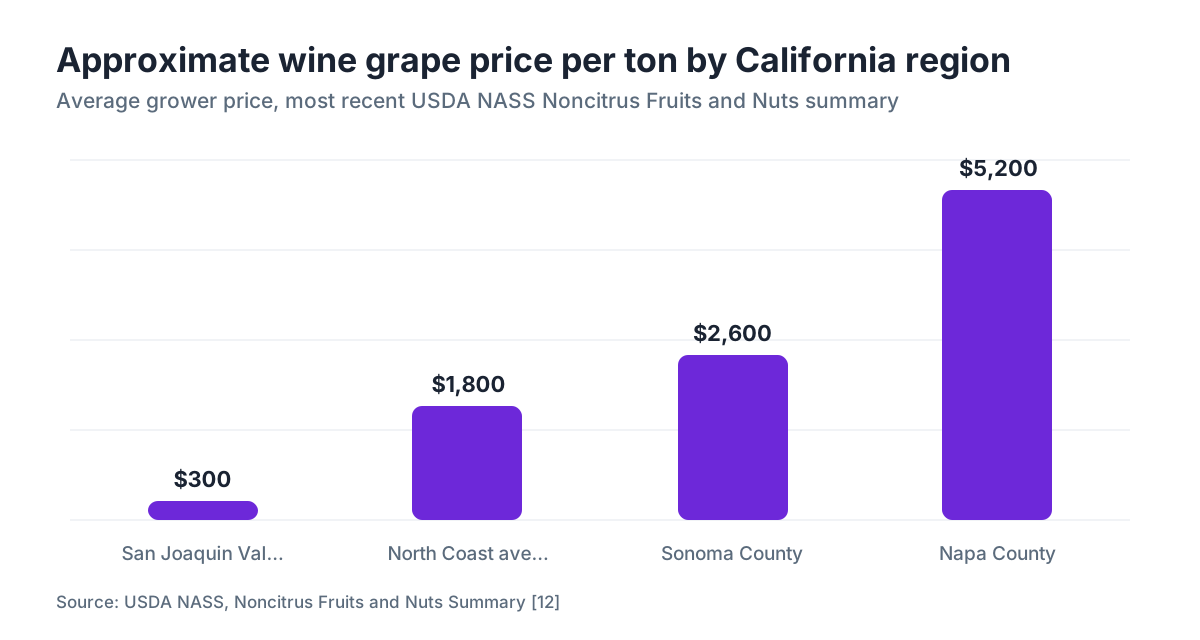
Wine grapes (mostly Vitis vinifera and cold-hardy hybrids) are bred for high sugar, complex flavor compounds, and small, thick-skinned berries. They're harvested at 20 to 28 degrees Brix depending on style, and they need careful canopy work to balance sugar against acid. Grower price per ton runs from about $300 for bulk San Joaquin Valley fruit to well over $5,000 per ton for premium Napa Valley Cabernet, per USDA NASS data. [12]
Table grapes are bred for big berries, seedlessness in most commercial varieties, firm texture, mild sweetness, and long shelf life. They're picked earlier, typically 16 to 18 Brix, and demand a completely different post-harvest system. Cold chain from harvest to retail is a major capital line. Sulfur dioxide generator pads in cold storage hold back Botrytis during shipping.
Muscadine grapes are a separate species. They have thicker skins, a musky aroma, and higher resveratrol content than most vinifera. [6] They resist Pierce's disease and most fungal diseases that flatten vinifera in the Southeast. They don't graft easily onto standard vinifera rootstocks, so own-rooted planting is the norm. Commercial muscadine production centers on North Carolina, Georgia, and Mississippi, with fresh-market, juice, and wine uses all real.
For the home grower, climate makes the call. In the South, muscadines are the path of least resistance. In the Northeast, cold-hardy hybrids give you the best odds. In a classic wine region with the right climate, vinifera is the obvious target.
Regions like paso robles wineries and south coast winery show what full vinifera production looks like at scale in warm California conditions.
What do beginner grape growers most commonly get wrong?
Too many vines, too little planning. That's the number one mistake, by a wide margin.
People plant 50 or 100 vines with no trellis plan, no spray plan, no variety rationale, and no clear picture of what harvest even looks like. Year three arrives with real fruit and no protocol for managing it.
Planting the wrong variety for the climate is number two. A grower in North Carolina planting Cabernet Sauvignon because they love the wine is in for a rough decade. Pierce's disease, humidity, and late-season rain make Southeast vinifera genuinely hard. Muscadines and disease-tolerant hybrids aren't a consolation prize. They're the correct answer for that climate.
Skipping virus-indexed planting material is the quiet mistake that takes years to surface. A leafroll-infected vine can look fine at planting and produce for two or three seasons before decline gets obvious. By then you've built trellis, spent labor, and sunk money into a block that has to come out.
Delaying trellis installation until after the vines need it damages vine architecture and creates months of tie-up frustration. Build the trellis before or at planting, not after.
Over-irrigating young vines keeps roots shallow. Shallow roots buckle under later drought and cut vine longevity. Water enough to establish the vine, then make it reach.
Underrating the spray program in a humid region causes real losses. A first-year grower who skips summer sprays because the vines look healthy often finds black rot has taken 70% of the first real crop. There's no getting that back.
Frequently asked questions
How long does it take to grow grapes from planting to first harvest?
Expect 3 years to a meaningful first crop from bare-root vines, and 4 to 5 years to full production. Year one goes entirely to root establishment. Year two allows very light cropping if the vine is vigorous enough. Economic breakeven for a commercial vineyard usually takes 5 to 8 years after planting, depending on variety value and establishment costs.
Can you grow grapes from seeds you find in a grocery store grape?
Yes, technically. Most commercial table grapes are seedless, so seeds are rare. If you find a seeded variety, extract the seeds, cold-stratify them for 90 to 120 days at 35 to 40°F, and sow in seed-starting mix. Germination runs 20 to 80%. The seedlings won't be the same variety as the parent grape. For commercial production this method is not practical; use certified cuttings instead.
What is the easiest grape to grow for beginners?
Concord, a Vitis labrusca hybrid, is the most forgiving option for beginners in the eastern and central US. It's cold-hardy to about -20°F, disease-tolerant compared to vinifera, and productive. Muscadine varieties like Carlos and Noble are the easiest choice for the Southeast. In California home gardens, Thompson Seedless suits warm climates and needs little maintenance once established.
How many grape vines do you need per acre?
Typical commercial densities run from about 454 to 1,210 vines per acre. High-density European-style plantings push toward 1,200 vines per acre with 3-foot vine spacing in rows 6 feet apart. Standard California machine-harvest plantings use 8-by-12-foot spacing, around 454 vines per acre. Home plantings can go wider if labor is limited. Density affects yield per vine, fruit quality, and total establishment cost significantly.
What is the best soil for growing grapes?
Well-drained loamy to sandy-loam soils with pH between 5.5 and 6.5 are ideal for most wine grapes. Drainage matters more than fertility; grapes tolerate poor soils far better than wet ones. Avoid heavy clay or sites with high water tables. Muscadines handle slightly lower pH and more humidity than vinifera. Always soil-test at least one season before planting.
Do grapevines need a lot of water?
Established wine grapevines are relatively drought-tolerant and actually make better fruit under moderate water stress during berry development. During establishment (years one through three), regular irrigation speeds growth and reduces failure risk. In dry climates like California and eastern Washington, drip irrigation is standard. In humid eastern regions, most established vineyards run mainly on rainfall, supplemented during establishment.
What spray program do grapes need, and how often do you spray?
Spray frequency depends heavily on climate. In dry western regions, 4 to 10 applications per season is typical for powdery mildew control. In humid eastern regions, 12 to 20-plus applications covering powdery mildew, downy mildew, and black rot is common. Applications run every 7 to 14 days from bud swell through veraison. Use disease models from UC IPM or your local extension to time sprays to actual infection risk, not a fixed calendar.
What records are legally required for a commercial vineyard?
At minimum: pesticide application records with product name, EPA registration number, rate, date, treated area, applicator name, and restricted-entry interval. The EPA Worker Protection Standard requires these plus worker training records and posting of application information. Many states add more; California requires county Agricultural Commissioner filings for restricted materials. USDA crop insurance requires annual production records. Missing records can cut insurance coverage or trigger compliance penalties.
Can you grow grapes in containers or pots?
Yes, grapes grow reasonably well in large containers, especially table varieties like Patio Crimson or compact muscadines. Use a container of at least 15 to 20 gallons. Container vines need more frequent water and fertilizer than in-ground vines, and roots need winter protection in cold climates since they lack the insulation of surrounding soil. Container growing limits vine size and long-term yield but works for patios or areas with poor soil.
How do you grow muscadine grapes from seeds?
Harvest fully ripe muscadine berries in late summer, extract the seeds, clean them, and cold-moist stratify at 35 to 40°F for 90 to 120 days. Sow in well-drained seed-starting mix afterward. Germination is variable and slow. Seed-grown muscadines are genetically variable and usually not equal to named varieties in fruit quality. For commercial production, propagate named varieties vegetatively. Seed-grown plants are most useful as rootstocks or for breeding.
What is phylloxera and how do you protect against it?
Phylloxera (Daktulosphaira vitifoliae) is an aphid-like root pest that destroys the roots of Vitis vinifera vines. It devastated European and California vineyards historically and remains a serious threat. No field chemical treatment works. The only effective protection is planting vinifera grafted onto resistant rootstocks derived from North American Vitis species. Own-rooted vinifera should go in only where soil is confirmed free of phylloxera, which is increasingly rare in established wine regions.
When is the right time to harvest wine grapes?
Harvest timing depends on your wine style and variety. Most wine grapes come off between 20 and 28 degrees Brix (sugar measured by refractometer). Brix alone isn't enough; also track titratable acidity, pH, and, for reds, seed and skin tannin ripeness. Many growers taste clusters across a block daily in the week before harvest. Cool nights and early-morning picks preserve aroma compounds and hold down fermentation temperature problems.
How do you manage frost risk in a young vineyard?
Spring frost after budbreak is one of the most damaging events a grower faces. Protection options include wind machines that mix warmer air from above the inversion layer, overhead sprinklers that release latent heat as water freezes on buds, and smudge pots (used less now due to emissions rules). Site selection is the cheapest defense: avoid low spots where cold air pools. Delayed pruning can push budbreak back 5 to 10 days, sometimes clearing the worst frost window.
Do grapes need full sun or do they tolerate shade?
Full sun is a genuine requirement. Grapes need at least 6 to 8 hours of direct sunlight daily for photosynthesis, sugar accumulation, and disease drying. Partial shade cuts yield, delays ripening, and raises disease pressure because shaded canopies stay wet longer after rain. Row orientation, usually north-south in the Northern Hemisphere, spreads sun exposure evenly. Shoot thinning and leaf removal improve light penetration in dense canopies.
Sources
- UC Davis ANR Publication 3483, Grape Pest Management: Grapes require well-drained soil, pH 5.5 to 6.5, and at least 150 to 180 frost-free days depending on variety
- Washington State University Viticulture and Enology Extension: Most vinifera cultivars require roughly 800 to 1,200 chill hours below 45°F to break dormancy properly
- UC Davis ANR, Sample Costs to Establish a Vineyard and Produce Wine Grapes: Establishment costs run $15,000 to $30,000 per acre for wine grapes in California; planting density ranges from about 454 to 1,210 vines per acre; phylloxera-resistant rootstock is required where phylloxera is present
- Cornell Cooperative Extension, Viticulture and Enology: Cornell developed the Geneva Double Curtain system; recommends soil testing one season before planting; Ravaz Index of 5:1 to 10:1 as a balance indicator; Cornell maintains variety trial data for cool-climate cultivars
- Washington State University Viticulture and Enology Extension: WSU recommends drip irrigation at establishment for Pacific Northwest sites; Columbia Valley Riesling research showed reducing irrigation by 50% between berry set and veraison lowered berry weight 15 to 20% while improving sugar accumulation rate
- NC State Extension, Muscadine Grape Production Guide: Muscadine seeds require cold stratification for 90 to 120 days; seed-grown muscadines are used as rootstock or for breeding; named fruiting varieties should be propagated vegetatively; muscadines have higher resveratrol content than most vinifera
- California Department of Food and Agriculture, Grapevine Registration and Certification Program: CDFA maintains a Grapevine Registration and Certification program to prevent spread of viral diseases through infected planting material; leafroll and fanleaf viruses can halve vineyard productivity
- UC Statewide IPM Program, Grape Pest Management Guidelines: UC IPM provides grape disease models that predict infection periods based on temperature and leaf wetness, enabling growers to reduce spray events and resistance pressure
- U.S. EPA, Worker Protection Standard for Agricultural Pesticides: EPA WPS requires pesticide application records, posting, PPE provision, worker training, and restricted-entry interval compliance; revised rule effective January 2, 2017
- California Department of Pesticide Regulation, Pesticide Use Reporting: California requires growers to file pesticide use reports with the county Agricultural Commissioner for restricted-use materials
- USDA Risk Management Agency, Crop Insurance for Grapes: USDA crop insurance requires annual production records to establish Actual Production History; missing records reduce APH base and coverage
- USDA National Agricultural Statistics Service, Noncitrus Fruits and Nuts Summary: Wine grape prices per ton range from roughly $300 for bulk San Joaquin Valley fruit to over $5,000 per ton for premium Napa Valley Cabernet Sauvignon
Last updated 2026-07-09