The science of growing grapes: what viticulture research actually says
TL;DR
- Growing grapes well means managing how vine physiology, soil chemistry, water status, and climate act on each other.
- Research from UC Davis, Cornell, and WSU shows that canopy architecture, deficit irrigation, and nutrient timing have the biggest measurable effect on fruit quality.
- No single factor wins.
- Viticulture is applied plant science, and the best growers treat it that way.
What is the science behind growing grapes?
Viticulture is horticulture with unusually high stakes. The vine, Vitis vinifera for most wine grapes, is a perennial woody plant that responds to its environment over decades, more than seasons. What happens in the canopy in July shapes what's in the berry in September, and what happened to root architecture three years ago shapes how the vine handles drought today.
The science breaks into a handful of connected systems: vine physiology (how the plant grows, stores carbohydrates, and moves water), soil science (texture, chemistry, microbiology), climatology (heat accumulation, frost risk, humidity), and plant pathology (fungal and bacterial diseases, pest pressure). None of these work alone. A vine under moderate water stress may concentrate flavors well if the canopy is open and disease pressure is low, but the same deficit irrigation in a thick, humid canopy is a recipe for Botrytis and uneven ripening [1].
Grape growing at its best is adaptive management. You form a hypothesis about what the vine needs, you measure, and you adjust. UC Davis's Department of Viticulture and Enology has published on this since the 1950s, and the body of peer-reviewed work is deep [2]. Cornell's viticulture program at Geneva works heavily on cold-climate varieties and canopy management for the Northeast [3]. WSU's wine science center at Tri-Cities covers the arid-climate questions most relevant to the Pacific Northwest [4]. Between those three programs alone, you have the scientific foundation for most commercial American viticulture.
How does vine physiology affect grape quality?
A grapevine allocates energy through carbon partitioning. The vine fixes carbon through photosynthesis in its leaves, then sends that carbon to growing shoots, roots, developing fruit, and long-term storage in the trunk and cordons. Your job, mechanically speaking, is to push that allocation toward fruit quality instead of runaway vegetative growth.
The shoot apex is a strong carbon sink early in the season. Leave too many shoots on a vine and the competition for carbohydrates gets intense, so fruit development suffers. This is the physiological reason behind shoot thinning. It isn't cosmetic. It's arithmetic [5].
Veraison, the shift in berry color and softening, marks the moment the berry changes from a carbon sink to an active sugar accumulator. Before veraison, berries build up malic and tartaric acids. After it, sugars (mainly glucose and fructose) flood in through the phloem while malic acid degrades through respiration. That malic degradation rate depends on temperature, which is why warm nights late in the season wreck acid balance in warm climates.
Leaf-to-fruit ratio matters in a way you can measure. Research from UC Davis puts a functional target range at roughly 7 to 15 cm² of leaf area per gram of fruit, though the right number shifts by variety and desired style [2]. Too far below that, and the fruit is starved of sugar. Too far above, and you're running a vegetative vine that produces green, dilute grapes.
Here's something growers underestimate. The trunk and permanent wood work as a carbohydrate bank. Vines draw on that bank hard during spring budbreak and early shoot growth, before the canopy is large enough to feed itself. Vines that got hit by disease, overcropping, or poor nutrition in prior seasons have a depleted bank, and they show it the next spring with weak, uneven budbreak.
What does soil science tell us about growing better grapes?
The old saying that vines need to struggle is partly true and mostly misread. What vines actually benefit from is moderate, well-distributed stress, especially water stress. Truly poor soils, the shallow, compacted, or nutritionally depleted kind, produce vines that are chronically stressed in ways that hurt quality rather than help it.
Soil texture governs water-holding capacity and aeration. Clay soils hold more water but drain poorly and can suffocate roots. Sandy soils drain fast but hold few nutrients. Loam sits between them and often works well, though many excellent wine regions have rocky or gravelly soils that drain quick and force roots deep [6].
Deep rooting matters. A vine with roots at 1.5 to 3 meters or deeper has access to subsoil moisture and minerals that shallow roots never reach. This is part of why older vines often behave differently than younger ones: the root system has had decades to explore the soil profile. The concept of terroir, for all its mystical framing, has a real physical basis in how differently rooted vines tap soil layers with distinct mineral and water traits.
Soil pH sets nutrient availability. Most grape varieties do well in the 5.5 to 7.0 range. Below pH 5.5, aluminum and manganese can turn toxic and phosphorus availability drops. Above 7.5, iron and zinc deficiencies get common. Adjusting pH with lime (to raise) or sulfur (to lower) is slow, especially in established vineyards, so getting it right at planting beats correcting it later by a wide margin.
Organic matter in vineyard soils is usually low, often under 2%. Cover crops and compost help, but the decomposition environment in a well-drained, tilled vineyard floor isn't built to grow organic matter fast. The realistic goal is maintenance, not dramatic gains. WSU's extension publications on vineyard floor management give practical benchmarks for the Pacific Northwest [4].
How does climate and heat accumulation affect grape ripening?
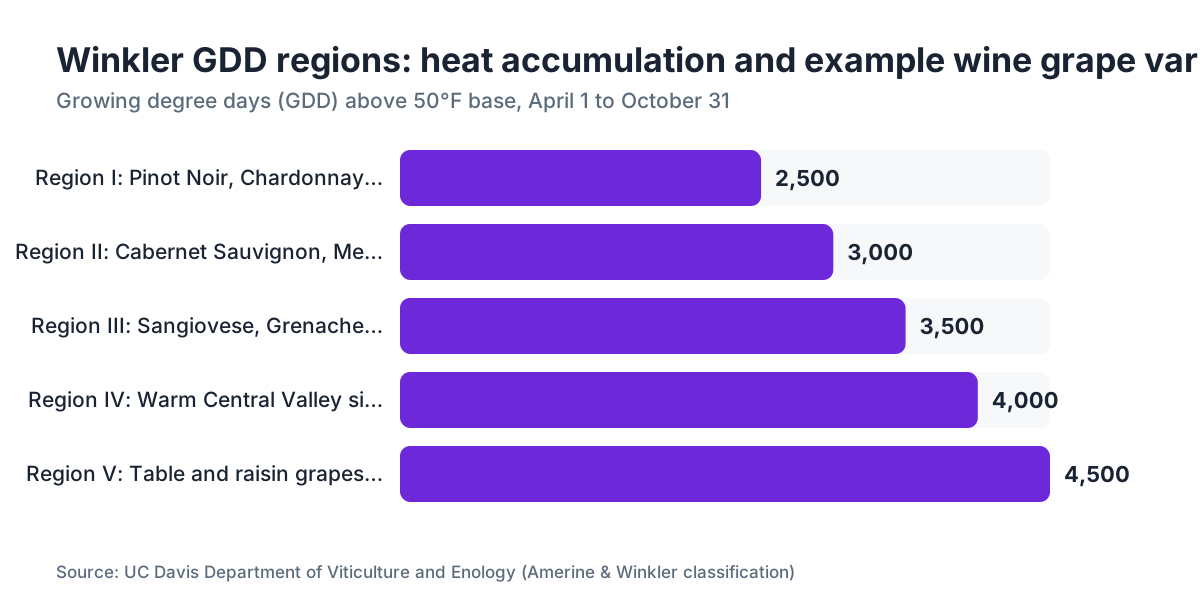
Grapevines need heat to ripen fruit. The most common measure is growing degree days (GDD), calculated by summing the daily average temperature above a 50°F (10°C) base from April 1 through October 31. Amerine and Winkler at UC Davis built the five-region GDD classification in 1944, and it's still the most widely cited framework for matching varieties to climates [2].
The Winkler scale looks like this:
| Region | GDD (°F base 50) | Example varieties and regions |
|---|---|---|
| I | Under 2,500 | Pinot Noir, Chardonnay (Carneros, Anderson Valley) |
| II | 2,500 to 3,000 | Cabernet Sauvignon, Merlot (Napa Valley average) |
| III | 3,000 to 3,500 | Sangiovese, Grenache (parts of Paso Robles) |
| IV | 3,500 to 4,000 | Warm Central Valley sites |
| V | Over 4,000 | Table grape and raisin production |
Diurnal temperature variation, the swing between daytime high and nighttime low, is a major quality factor. Large swings (15°F or more) slow sugar accumulation at night, buying time for flavor compound development and acid retention. This is why Paso Robles, where cool Pacific air rolls in through the Templeton Gap, can ripen fruit at fairly warm GDD totals while holding acid structure. You can read more about how that geography shapes production at Paso Robles wineries.
Frost is the other climate variable that keeps growers up at night. Spring frost after budbreak can wipe out a crop in hours. Frost damage to young shoots is irreversible because the primary buds are gone. Secondary buds push but usually carry 30 to 70% of a normal crop depending on variety. Managing frost risk means choosing sites with good air drainage, avoiding frost pockets, and keeping wind machines or overhead sprinklers ready [7].
What are the most important canopy management practices, and why?
Canopy management is where science meets daily labor, and it moves yield and quality more than almost any other management category. The core idea: sunlight and airflow inside the canopy directly set berry ripeness, disease pressure, and fruit composition.
Shaded berries have lower sugar, higher pH, higher malic acid, and higher concentrations of methoxypyrazines (green, bell-pepper aromatics). Sunlight exposure in the last four to six weeks before harvest is especially important for anthocyanin development in red varieties. A study in the American Journal of Enology and Viticulture found that direct sun exposure of berry clusters raised anthocyanin content significantly compared to shaded clusters of the same variety [1].
The key practices: shoot positioning (training young shoots upward for light), leaf removal (pulling leaves near the fruiting zone, usually on the morning-sun side in hot climates), shoot thinning (removing excess shoots at the base), and hedging (trimming shoot tips to limit terminal growth). Timing on leaf removal matters a lot. Early leaf removal, done shortly after fruit set, improves fruit composition and cuts Botrytis susceptibility more reliably than late-season removal [5].
Trellis choice decides what canopy management is even possible. A vertical shoot positioning (VSP) system with a narrow canopy is easy to mechanize but caps crop potential. A split-canopy system like the Geneva Double Curtain or Scott Henry can double or triple exposed canopy area and often pays off on high-vigor sites. Cornell's work on trellis systems for New York vineyards is authoritative here [3].
A common mistake in young vineyards is over-cropping. It's tempting to let a third- or fourth-year vine carry a full crop. The science says resist. Full cropping before the vine has a settled root system and trunk reserves delays canopy maturity and produces thin, undeveloped wood heading into winter.
How does water management and irrigation science work in vineyards?
Water management is probably the most actively researched area in viticulture right now. The practical consensus from the last two decades: regulated deficit irrigation (RDI) and partial rootzone drying (PRD) both beat either full irrigation or severe water stress for quality wine grapes in arid and semi-arid climates [8].
The vine tells you its water status through stem water potential, measured with a pressure chamber (pressure bomb). UC Davis work established that midday stem water potential between -8 and -12 bars is mild to moderate stress, the range that tends to improve berry quality in warm climates without triggering irreversible damage [2]. Below -14 to -16 bars you're into stress severe enough to close stomata completely, stop photosynthesis, and risk permanent harm.
Timing of the deficit matters as much as its size. Applying stress after veraison and before harvest is the classic wine-grape approach because it slows berry expansion (smaller berries, higher skin-to-juice ratio) without limiting sugar. Pre-veraison deficit can reduce berry size and crop load, useful on high-vigor sites but risky if you push it too hard.
Drip irrigation is standard in new plantings because it puts water precisely at the root zone and allows fertigation (soluble nutrients through the drip line). Overhead sprinklers, where they exist, give frost protection but waste water on routine irrigation. In regions with enough winter rainfall and deep soils, some dry-farmed vineyards produce excellent wine grapes with no supplemental water at all. Dry farming only works where enough subsoil moisture carries the vine through a warm summer.
Keep your pressure chamber records and irrigation logs. They're exactly the data regulators and buyers may ask for. If you're tracking those readings alongside spray and fertilizer records, a field operations platform like VitiScribe keeps them in one place instead of spread across three notebooks.
What do growers need to know about vine nutrition and fertilizer science?
Grapevines have modest nutrient needs compared to row crops, but deficiencies in specific elements cause serious problems. Nitrogen is the most commonly adjusted nutrient, and over-applying it is at least as common a mistake as under-applying.
Excess nitrogen drives vegetative growth: long shoots, dense canopies, delayed maturity, high Botrytis susceptibility. In most California wine grape vineyards, total annual nitrogen runs 30 to 60 pounds per acre. The right amount depends heavily on petiole or leaf blade tissue analysis, taken at bloom as a standardized snapshot of vine nutrition [6].
Potassium loads sugar into berries (it's the dominant cation in the phloem), but too much of it raises berry pH by competing with tartrate for anion balance. High-potassium wines are hard to acidify to a stable pH, which is why managing soil potassium matters specifically in wine grape production.
Boron deficiency causes poor fruit set (shatter), showing as loose clusters with many small, seedless berries next to larger seeded ones. In boron-deficient soils, a foliar spray at early bloom (5 to 20% cap fall) is a fast, direct fix. Zinc deficiency causes millerandage: small, hard, undeveloped berries, worst in cold, wet springs.
The most reliable diagnostic is an annual tissue analysis. Soil tests tell you what's in the ground. Tissue tests tell you what the vine is actually taking up. Run both and you get the full picture. UC Cooperative Extension publishes interpretation guidelines for California [6]; Cornell and WSU have equivalents for their regions [3][4].
What does the science say about grape disease and pest management?
Powdery mildew (Erysiphe necator) is the single most economically significant disease in most American wine regions. Unlike downy mildew, it doesn't need free water to infect, only moderate humidity and temperatures between 70 and 85°F. It overwinters as chasmothecia in bark and re-infects through ascospore release in spring. The trouble is that early infections are invisible, and by the time you see white mycelium the colony is already sporulating [9].
Sound powdery mildew management means starting protectant sprays before infection, not after. The powdery mildew risk index developed by UC Davis's Doug Gubler gives growers a degree-hour accumulation threshold that predicts when first infection is likely. Most spray advisory services and weather stations offer this index. Basing spray timing on it rather than a fixed calendar interval routinely cuts both disease pressure and total fungicide applications.
Botrytis cinerea (gray mold) is the other major fungal threat, worst in cool, humid climates. It infects through wounds, senescent tissue, and tight cluster architecture that traps humidity. Early leaf removal to open cluster exposure is one of the most effective Botrytis tools you have, with multiple studies confirming a 30 to 60% cut in incidence when done at the right time [5].
On the pest side, grape leafroll virus complex is getting worse in California and the Pacific Northwest. Mealybugs and soft scales vector it, and there's no cure once a vine is infected. Roguing infected vines and controlling vectors with well-timed insecticide applications is the standard response. Leafhoppers, spider mites, and, in eastern vineyards, grape berry moth round out the major pest list.
Pesticide applications in vineyards are federally regulated under the EPA's Worker Protection Standard (WPS), which sets restricted-entry interval (REI) posting, worker training, and record-keeping for all agricultural pesticide use [10]. California, New York, and Washington add their own registration requirements. If you run a commercial vineyard, spray records with product name, EPA registration number, rate, application date, and applicable REI are not optional. The penalty for missing records is real.
How do researchers measure grape and wine quality scientifically?
The industry has a well-established set of objective measures for grape quality at harvest: Brix (dissolved solids, mostly sugars, by refractometry), titratable acidity (TA), pH, and berry weight. Those four numbers together tell most of the harvest decision story for table wine. Targets vary by style and market, but for dry red wines in most American regions the common windows are 23 to 26°Brix, TA of 5.5 to 7.5 g/L, and pH of 3.3 to 3.6.
Beyond the basics, researchers use HPLC (high-performance liquid chromatography) to quantify individual anthocyanins, tannins, flavonols, and aroma compounds. This has produced genuinely useful science. Work on methoxypyrazines confirmed the mechanism behind the green-pepper character in Cabernet Sauvignon from under-ripe or over-shaded fruit: 3-isobutyl-2-methoxypyrazine (IBMP) is measurable at parts per trillion, above the sensory threshold of roughly 15 ng/L for most people. Leaf removal and fruit-zone sunlight measurably lower IBMP before harvest.
Sensory science is messier. Trained tasting panels can pick up differences that chemical analysis misses, and they can miss differences that instruments catch. The relationship between measured chemistry and perceived quality is not linear, which is why the most rigorous wine quality research runs both approaches side by side.
Wine grape research is funded partly through groups like the American Vineyard Foundation and through USDA's National Institute of Food and Agriculture (NIFA) competitive grant program [11]. A lot of the applied work happens at field stations in major production regions. Growers who want to see what's under study can search NIFA's active grants by crop and region.
For a ground-level look at how a working operation turns this research into daily practice, the Gervasi Vineyard and Mountain Winery operations both show what applied viticulture science looks like at scale.
What role does rootstock selection play in vine science?
Almost all commercial wine grapes in the world are grafted. The rootstock is a different Vitis species or hybrid, chosen for resistance to Phylloxera (Daktulosphaira vitifoliae), a soil-dwelling aphid-like insect that destroyed most of Europe's vineyards in the 1860s and 1870s. The scion (the wine grape variety) is grafted onto the rootstock, which contacts the soil and supplies the root system.
Rootstock choice has measurable effects on vigor, drought tolerance, water uptake, and nutrient absorption. High-vigor rootstocks like 110R and 140Ru have deep, aggressive root systems suited to dry, rocky soils. Low-vigor rootstocks like 101-14 and Riparia Gloire work better in fertile, high-water-table soils where you want to hold back shoot growth.
In California, the Phylloxera biotype B outbreak of the late 1980s and early 1990s, which devastated AXR1 rootstock plantings across Napa and Sonoma, is the clearest modern demonstration of why rootstock science matters. An estimated 25,000 to 30,000 acres had to be replanted at enormous cost. UC Davis Foundation Plant Services runs a strict clean plant program to keep viruses out of propagation material [12].
For growers planning new plantings or replants, rootstock choice should follow a site-specific look at soil depth, water-holding capacity, existing Phylloxera pressure, nematode populations, and target vigor. The California Association of Winegrape Growers and UC Cooperative Extension advisors are the practical resources. Nobody picks a rootstock from a textbook alone. You need soil profile data from your specific blocks.
How does the science of growing grapes translate to actual record-keeping and compliance?
Applied viticulture science generates a lot of data. Spray records, tissue tests, irrigation logs, yield records, weather data, and canopy measurements are all part of managing a vineyard by the science instead of by gut feel. Keeping those records isn't just good practice. For pesticides, it's federally and state mandated.
Under the EPA's Worker Protection Standard, pesticide application records must include the crop treated, location, product name, EPA registration number, active ingredient, total amount applied, the REI, and the application date [10]. Most states require retention for two years at minimum. California requires three years, and the records must be filed with the county agricultural commissioner within a week of application.
Beyond compliance, good records are how you learn season to season. Keep spray timing, weather conditions, and disease incidence in the same system, and after harvest you can ask whether the Gubler-model applications lined up with lower powdery mildew incidence versus calendar-spray years. That's how the science becomes useful instead of theoretical.
Field operations software earns its keep here. VitiScribe was built for vineyard managers who need spray records, field notes, and compliance documentation in one place, not scattered across spreadsheets, paper logs, and memory. If you're managing more than a few blocks, the time saved on spray record entry alone tends to cover the subscription in the first month.
For a look at how integrated operations work at destination properties with multiple vineyard blocks, see how South Coast Winery and Ponte Winery manage the connection between field operations and the finished wine.
What are the most important recent advances in viticulture science?
Remote sensing is probably the biggest practical advance of the last 15 years. Normalized Difference Vegetation Index (NDVI) imagery from drones or satellites lets you see vine vigor variation across a block at a resolution that would take weeks to measure on foot. High-NDVI zones get flagged for hedging or leaf removal; low-NDVI zones flag for nutrient or irrigation investigation. NDVI doesn't replace walking the vineyard. It tells you where to walk.
Precision viticulture, which pairs remote sensing with variable-rate irrigation, fertilizer, and harvest management, has moved from research concept to commercial practice in large operations. The payback is clearest on big, heterogeneous blocks where a single management prescription fits nobody well. Smaller operations with uniform soils and good observation habits often don't see a compelling return.
Genomics research has sped up variety development. UC Davis work on Vitis genome sequencing has clarified the genetic basis of disease resistance, cold hardiness, and aromatic compound biosynthesis [13]. That underpins the breeding of new varieties with built-in resistance to powdery mildew and downy mildew, the so-called PIWI varieties gaining commercial traction in Europe and in trials across American regions. The appeal is obvious. If the vine resists powdery mildew genetically, your spray program simplifies a lot.
Climate adaptation research is the other active frontier. As GDD accumulation trends upward in historically cooler regions and phenological events shift earlier, the variety-to-region matching that the Winkler scale built is under review. Cornell's program has done a lot of work on variety trials for warming northeastern climates [3]. The honest answer: nobody has good long-term data on exactly how particular varieties will perform in specific regions 30 years out. But the directional signals from existing phenology records are clear.
Frequently asked questions
What Brix level should wine grapes reach at harvest?
For dry table wine, the typical target is 23 to 26°Brix depending on variety and style. Sparkling wine grapes are picked earlier, often 18 to 21°Brix. Brix above 28° creates fermentation problems and very high alcohol. The final call always combines Brix with pH, titratable acidity, and a taste of the berries, never Brix alone.
How many growing degree days do grapevines need to ripen?
It depends heavily on variety. Early-ripening varieties like Pinot Noir or Chardonnay can ripen in Winkler Region I climates with fewer than 2,500 GDD (base 50°F). Late-ripening varieties like Cabernet Sauvignon need Region II or III conditions, generally 2,500 to 3,500 GDD. The Amerine and Winkler classification from UC Davis, developed in 1944, is still the standard reference.
What is the difference between powdery mildew and downy mildew in grapes?
Powdery mildew (Erysiphe necator) doesn't need free water to infect and shows as white, powdery mycelium on leaf surfaces and berries. Downy mildew (Plasmopara viticola) requires wet conditions and shows as yellow oil spots on leaf tops with gray-white sporulation underneath. Powdery mildew is the larger economic threat in most arid and semi-arid American wine regions. The two need different fungicide programs.
Why are most wine grape vines grafted onto rootstocks?
Because Phylloxera, a soil insect that feeds on Vitis vinifera roots, kills own-rooted vines over a few years. American Vitis species developed natural resistance, so hybrid rootstocks from those species protect the scion. The late 19th century Phylloxera epidemic across Europe made grafting the global standard. In California, the AXR1 rootstock failure in the 1990s showed what happens when rootstock resistance is incomplete.
How do you measure vine water stress in the field?
The most accurate field method is stem water potential measured with a pressure chamber, also called a pressure bomb. Vines are measured at midday after covering a leaf for 30 minutes to equilibrate it with stem pressure. UC Davis research established that -8 to -12 bars is mild to moderate stress, generally good for wine grape quality. Readings below -14 bars mean stress severe enough to close stomata and stop photosynthesis.
What soil pH is best for growing wine grapes?
Most wine grape varieties do well in the 5.5 to 7.0 pH range. Below 5.5, aluminum and manganese can turn toxic and phosphorus availability drops. Above 7.5, iron and zinc deficiencies are common. Adjusting established vineyard soils is slow: lime raises pH over one to three seasons, sulfur lowers it even slower. Getting pH right before planting is far easier than correcting a 20-year-old block.
What spray records do vineyards legally have to keep?
Under the EPA's Worker Protection Standard and most state rules, pesticide application records must include the treated crop, field location, product name, EPA registration number, active ingredient, amount applied, restricted-entry interval, and application date. California requires three-year retention and filing with the county agricultural commissioner within seven days. Missing records carry real penalties and create liability if a worker exposure incident happens.
How does leaf removal improve grape quality?
Removing leaves near the fruiting zone improves cluster sunlight exposure, cuts humidity around berries, and lowers Botrytis susceptibility. Studies show early leaf removal after fruit set reduces methoxypyrazine (green-pepper aroma) in red varieties, raises anthocyanins in the berry skin, and consistently cuts gray mold incidence by 30 to 60% versus unmanaged canopies. Timing matters: early removal outperforms late-season removal in most trials.
What is the Winkler scale and how do growers use it?
The Winkler scale sorts wine grape regions into five zones by growing degree day (GDD) accumulation above 50°F from April 1 through October 31. Developed at UC Davis in 1944, it helps match varieties to climates. Region I (under 2,500 GDD) suits early varieties like Pinot Noir. Region V (over 4,000 GDD) is mostly table and raisin territory. It's a planning tool, not a guarantee, but still the most widely cited regional classification.
How does diurnal temperature variation affect wine grape quality?
Large day-to-night swings (15°F or more) slow sugar accumulation at night while daytime warmth drives photosynthesis. This gives the vine more time to build flavor compounds and hold natural acids before harvest. Regions with pronounced diurnal variation, often at elevation or near marine air, can produce fully ripe fruit at moderate sugar with better acid structure than flat, warm inland sites at the same GDD total.
What nutrients are most commonly deficient in vineyards?
Boron and zinc are the most common micronutrient deficiencies in American vineyards. Boron deficiency causes poor fruit set and loose clusters. Zinc deficiency causes millerandage, with small, hard, undeveloped berries alongside normal ones. Potassium is sometimes deficient in light soils but more often excessive in heavy soils, where it raises berry pH and complicates acidification. Annual petiole tissue analysis at bloom is the reliable way to catch deficiencies before they hit the crop.
Can you dry-farm wine grapes in the United States?
Yes, in regions with enough winter rainfall and deep, water-retentive soils. Parts of coastal California, particularly older plantings in Sonoma, Mendocino, and the Sierra Foothills, have productive dry-farmed vines. It works reliably only where annual rainfall exceeds roughly 20 to 25 inches and subsoil moisture reaches deep roots. In arid regions like eastern Washington or the San Joaquin Valley, irrigation is not optional. Without it, vines fail.
What are PIWI grape varieties and are they worth planting?
PIWI is a German acronym for fungal-disease-resistant varieties bred with genetics from resistant wild Vitis species. They can sharply reduce fungicide spray programs compared to Vitis vinifera. Several are gaining traction in Germany, France, and Switzerland. In the U.S., trial plantings are underway through Cornell and other programs. Wine quality from the best PIWI varieties is improving fast, but most American wineries haven't built consumer recognition yet. Worth watching, not a replacement for established varieties yet.
How does vine age affect grape quality?
Old vines have larger, deeper root systems with better access to subsoil moisture and minerals, plus bigger carbohydrate reserves in permanent wood that buffer stress events. Research evidence for a specific quality inflection at any particular age is actually thin. The old-vine effect is real on some sites and irrelevant on others. Self-regulating crop load (which old vines often do naturally as trunk and cordon capacity limits fruitfulness) may explain much of the perceived difference.
Sources
- American Journal of Enology and Viticulture, Downey et al. 2004, 'Effect of timing and severity of water deficit on berry and wine quality': Sunlight exposure of berry clusters increases anthocyanin content significantly compared to shaded clusters of the same variety.
- UC Davis Department of Viticulture and Enology: The Amerine and Winkler GDD classification system developed at UC Davis; leaf-to-fruit ratio targets of 7 to 15 cm² per gram of fruit; midday stem water potential thresholds for irrigation management.
- Cornell Cooperative Extension, Viticulture and Enology Program, Geneva, NY: Cornell's program covers canopy management, trellis systems, cold-climate variety trials, and climate adaptation research for northeastern vineyards.
- Washington State University Extension, Wine Science Center: WSU publishes applied research on vineyard floor management, arid-climate viticulture, and nutrient management benchmarks for Pacific Northwest vineyards.
- Poni et al. 2006, 'Effects of Early Defoliation on Shoot Photosynthesis, Yield Components, and Grape Composition', American Journal of Enology and Viticulture: Early leaf removal after fruit set reduces Botrytis incidence by 30 to 60% and improves fruit composition more reliably than late-season removal.
- UC Cooperative Extension (UC ANR), Soil Management and Nutrition for Vineyards: Soil pH range of 5.5 to 7.0 for wine grapes; petiole tissue analysis at bloom as standard diagnostic for nutrient status; California nitrogen application ranges.
- UC ANR Cooperative Extension, Frost Protection for Vineyards: Spring frost damage to primary buds is irreversible; secondary buds produce 30 to 70% of normal crop depending on variety.
- Dry et al. 2001, 'Partial rootzone drying: An update', Australian Journal of Grape and Wine Research: Regulated deficit irrigation and partial rootzone drying outperform full irrigation or severe water stress for quality wine grape production in arid climates.
- UC IPM, Grape Powdery Mildew Management Guidelines: Powdery mildew (Erysiphe necator) infects without free water at 70 to 85°F; the UC Davis Gubler risk index predicts infection timing for spray scheduling.
- US EPA, Worker Protection Standard for Agricultural Pesticides: The WPS requires pesticide application records including EPA registration number, REI, rate, and application date; most states mandate retention of two to three years.
- UC Davis Foundation Plant Services, Grapevine Clean Plant Program: UC Davis FPS maintains certified clean planting material and documented the AXR1 rootstock failure from Phylloxera biotype B requiring replanting of an estimated 25,000 to 30,000 California acres.
- UC Davis Department of Viticulture and Enology, Grape Genomics Research: Vitis genome sequencing at UC Davis has clarified the genetic basis of disease resistance, cold hardiness, and aromatic compound biosynthesis, underpinning PIWI variety development.
Last updated 2026-07-09