Gypsum application rates for improving water penetration in vineyard soils
TL;DR
- Most vineyard water penetration problems come from sodium-affected or dispersive soils, and they respond to gypsum at 1 to 4 tons per acre, broadcast and moved into the profile before the season or after harvest.
- The right rate depends on your soil's exchangeable sodium percentage (ESP) and a gypsum requirement test.
- Blanket rates waste money.
- Test first, then apply.
Why does water stop penetrating vineyard soils in the first place?
Poor water penetration in vineyards almost always traces to one of two causes: sodium-driven clay dispersion, or physical crusting of fine-textured soils after rain and irrigation. Both look the same from the surface. Water pools, runs off, or just sits there while the row stays dusty two inches down. Which one you have matters, because gypsum fixes the sodium problem directly and only partly helps the physical one.
Sodium (Na) competes with calcium (Ca) and magnesium (Mg) for exchange sites on clay particles. When sodium takes over too many of those sites, the clays repel each other and structure collapses. That's clay dispersion, and it can drop saturated hydraulic conductivity by 90% or more in susceptible soils [1]. The usual threshold is exchangeable sodium percentage (ESP). Most western U.S. soils start showing dispersion above an ESP of 5 to 10%; California's fine-textured Yolo, Reiff, and Rincon series tend to disperse at the low end of that range [1].
Gypsum (calcium sulfate dihydrate, CaSO4·2H2O) floods the exchange complex with calcium, which kicks sodium off the clay surface. The freed sodium binds with sulfate and leaches down as sodium sulfate, a much more mobile salt. Clay particles re-flocculate, macro-pores reopen, and water moves again. UC Agriculture and Natural Resources describes gypsum as "the most economical source of soluble calcium for reclaiming sodic soils" [1].
Not every low-permeability vineyard is a sodium problem. If your soil test shows normal ESP but you have a lot of fine sand or silt, you're probably looking at surface sealing or a sub-surface hardpan. Gypsum still helps with surface sealing, because it keeps irrigation water ionic enough to stop clay deflocculation at the surface. It won't touch a mechanically compacted layer. That needs a ripper.
What soil tests do you need before choosing a gypsum rate?
Start with a saturated paste extract, not a routine 1:1 or 1:2 soil-water extract. The paste extract gives you electrical conductivity (EC), sodium adsorption ratio (SAR), and the ion concentrations you need to calculate ESP. Most labs serving western vineyards report these together.
The specific tests you want:
- Exchangeable sodium percentage (ESP): The direct measure of sodium saturation. Target for remediation is getting ESP below 5% in sensitive soils.
- Cation exchange capacity (CEC): Tells you how much calcium you need to displace the sodium. High-CEC soils (>20 meq/100g) need more gypsum for the same ESP drop.
- Soil pH: Soils above pH 8.5 often carry sodium problems, and high pH limits gypsum solubility somewhat.
- Gypsum requirement (GR) test: Some labs offer this directly. It measures how much gypsum (tons/acre) reduces ESP to a target level given your CEC and current ESP. Washington State University Extension recommends this test as the most reliable way to set rates for irrigated soils [2].
- Baseline hydraulic conductivity or infiltration rate: A simple field ring infiltrometer test before and after application tells you whether the treatment actually worked.
Send samples from two depths: 0 to 12 inches and 12 to 24 inches. Sub-surface sodium is common in vineyards where deep-rooted drip systems have pushed salts down over years. UC Davis extension recommends sampling at harvest before any amendments go on, so you capture baseline conditions before winter rains rearrange the profile [1].
One number worth remembering: an ESP of 15 is roughly equivalent to an SAR of 13 in most loam-textured soils, though the relationship shifts with clay type [1]. If your lab reports SAR but not ESP, use that conversion as a rough guide while you wait for a full CEC-based calculation.
What are the standard gypsum application rates for vineyard water penetration problems?
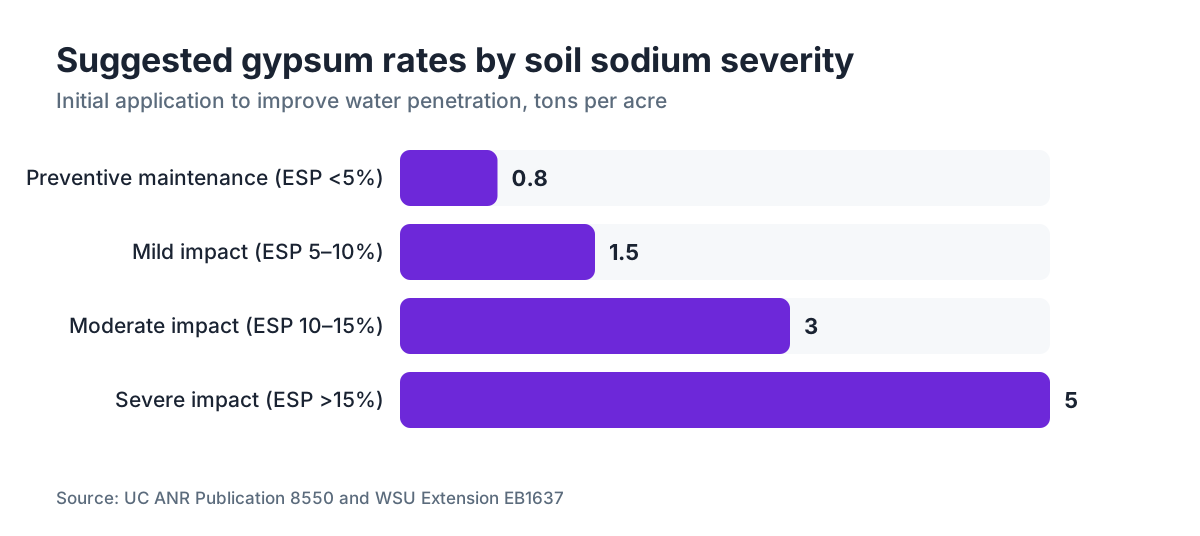
The most widely cited California guideline comes from UC Cooperative Extension: 1 to 4 tons per acre of agricultural gypsum for most water penetration problems in vineyard soils [1]. WSU Extension uses a similar range for Pacific Northwest irrigated soils. Mildly affected soils (ESP 5 to 10%) often respond to 1 to 2 tons/acre, while severely affected soils (ESP >15%) may need 3 to 6 tons/acre spread over multiple seasons [2].
Here's how most practitioners break it down by severity:
| Soil condition | Typical ESP range | Suggested gypsum rate | Expected seasons to respond |
|---|---|---|---|
| Mild sodium impact, light clay | 5 to 10% | 1 to 2 tons/acre | 1 to 2 seasons |
| Moderate impact, medium clay | 10 to 15% | 2 to 4 tons/acre | 2 to 3 seasons |
| Severe impact, heavy clay | >15% | 4 to 6 tons/acre | 3 to 5 seasons |
| Preventive / maintenance | <5% ESP, history of problems | 0.5 to 1 ton/acre every 2 to 4 years | Ongoing |
These are starting points, not prescriptions. Your actual gypsum requirement (GR) number may land outside these ranges depending on CEC. A 30 meq/100g clay soil needs roughly twice the gypsum of a 15 meq/100g loam to achieve the same ESP drop.
For preventive applications on vineyards with a history of water repellency or surface crusting, some San Joaquin Valley growers run 0.5 tons/acre annually to the drip lines. UC Cooperative Extension farm advisors generally treat this as reasonable for long-season drip systems on fine-textured soils, though peer-reviewed data on this exact preventive rate is thin. The mechanism is sound. The evidence is mostly observational.
For paso robles wineries and south coast winery operations in Southern California, soils tend to be fine-textured with elevated sodium from irrigation water, so a 2 to 4 ton/acre initial rate is common.
What form of gypsum works best: mined, synthetic FGD, or pelletized?
Three forms show up in supply catalogs: mined (crushed natural gypsum), synthetic FGD gypsum (from flue gas desulfurization at power plants), and pelletized (mined or FGD gypsum pressed into pellets for easier spreading). All three are calcium sulfate dihydrate. Chemically identical. The differences are physical.
Mined agricultural gypsum runs 70 to 90% CaSO4·2H2O purity, coarser ground, cheapest by the ton. FGD gypsum typically runs 95 to 99% purity and is finer, so it dissolves faster in soil water. The USDA Agricultural Research Service found FGD gypsum as effective as mined gypsum for improving infiltration in several surface-applied studies on southeastern U.S. soils [3]. The EPA has reviewed FGD gypsum and concluded it's safe for agricultural use, with average trace element concentrations below EPA thresholds for soil application [4]. FGD gypsum can cost 10 to 30% less than mined near coal plants, though freight often erases that edge in the West.
Pelletized gypsum is the easiest to spread with a standard spinner. It costs roughly 2 to 4 times more per ton than bulk agricultural gypsum. For most vineyards, that premium is hard to justify unless you're doing small spot treatments or you have equipment limits. Pellets also dissolve slower than finely ground material, which can blunt first-season response.
For broadcast applications at 2+ tons/acre, bulk agricultural gypsum with a lime spreader truck is almost always the cheapest path. For strip applications in the vine row, pelletized is more practical, because you can run it through a small belt or spinner spreader on a compact tractor.
Ground particle size matters more than most growers think. Material rated 80 to 100% passing a 100-mesh screen dissolves meaningfully faster than coarse product [1]. Ask your supplier for a guaranteed analysis that includes mesh screen data.
When should you apply gypsum in the vineyard calendar?
Timing depends on what you're trying to do and how you plan to move the calcium into the profile.
For pre-season establishment: apply in fall after harvest and before winter rains. Rain or irrigation dissolves the gypsum and carries calcium into the clay exchange zone. This is the most common approach in California and Oregon. A November application followed by 6 to 10 inches of winter rainfall usually moves enough calcium into the top 12 inches to show measurable ESP reduction by the following spring [1].
For mid-season correction, when you're watching water pond during irrigation: apply between irrigations and run a full set immediately after. The goal is to dissolve the gypsum and move calcium into the surface zone before the next stress event. This works best with finely ground material.
For maintenance in established vineyards: either timing works. Plenty of Napa Valley and Paso Robles growers apply every 2 to 4 years after harvest, synced with their floor management schedule.
One practical constraint is equipment access. If you're managing a vineyard with narrow rows or trellised cover crops, fall after harvest is usually the window when you have tractor access without canopy interference.
Don't broadcast in the row during bloom or heavy shoot growth. Dry gypsum dust on foliage isn't a direct phytotoxicity risk at normal rates, but it's needless exposure and can clog stomata for a while. Use common sense.
How do you apply gypsum in the vineyard, and does placement matter?
Broadcast versus banded is the central decision.
Broadcast (whole-vineyard surface application) makes sense when you have a widespread, uniform penetration problem, when it extends beyond the vine row, or when you're relying on rainfall rather than irrigation to move the gypsum in. A lime spreader truck with a front-mounted spinner is the standard tool. At 2 to 4 tons/acre, expect about 100 to 200 lbs per 1,000 square feet across the full floor.
Banded or strip applications in the vine row make sense when drip emitters are the main water delivery point and the problem sits near the vine. Apply a 12 to 24 inch band centered on the row at the same overall rate, now concentrated on 25 to 40% of the total surface. The effective per-square-foot rate in the treated zone is 2.5 to 4 times higher, which can speed soil response. WSU Extension notes that subsurface banding (working gypsum into the top 6 inches during vine row cultivation) moves calcium deeper faster than surface-only application [2].
For established vineyards where you can't cultivate without tearing up roots, surface broadcast with rainfall or irrigation doing the incorporation is your main option. Depth of penetration after a single season is usually 6 to 12 inches with adequate rainfall (>8 inches). Severely compacted or structured soils may need 2 to 3 seasons of repeated application to show improvement below 12 inches.
Calibrate the spreader. Run it over a tarp or catch pan before you go into the rows, weigh what lands per square foot, and calculate your real rate. Lime spreader calibrations drift. It's easy to be off by 20 to 30% with an unchecked machine. Set your target weight per acre, calibrate, then go.
How long does it take to see improved water penetration after gypsum application?
The honest answer: faster than most growers expect for the surface, slower than most growers want for the sub-surface.
Surface infiltration can improve in as little as 4 to 8 weeks after application if the gypsum dissolves fully and enough water moves through the profile [1]. A ring infiltrometer test before and 60 days after is a clean way to measure it. A UC Cooperative Extension study on Fresno County soils found infiltration rates improved 50 to 130% after a single season of gypsum at 2 to 4 tons/acre, depending on initial ESP [10].
Deeper improvement takes longer. Cutting ESP below 12 inches usually takes multiple seasons of application plus leaching. Plan on 2 to 3 years for real change in severely affected soils.
Factors that speed response:
- Higher gypsum solubility (finer particle size)
- More leaching water (wet winters or heavy irrigation after application)
- Lower CEC soils (less calcium needed per percentage point of ESP reduction)
- Lower initial ESP (less displacement needed)
Factors that slow response:
- Shallow water table that limits downward salt movement
- High-bicarbonate irrigation water that re-sodifies the profile
- No rainfall or irrigation after application (gypsum that doesn't dissolve doesn't work)
- Physical compaction layers that block water regardless of chemistry
If you see no infiltration improvement after two seasons at the recommended rate, run the soil analysis again. Either the rate is too low, the problem is physical rather than chemical, or your irrigation water is re-introducing sodium faster than gypsum can displace it.
Does gypsum affect soil salinity, and can you over-apply?
Yes to both.
Gypsum is a salt. Calcium sulfate is far less of a problem for plants than sodium salts, but at high rates it temporarily raises soil EC. A single 4 ton/acre application bumps soil EC by roughly 0.3 to 0.8 dS/m in the short term, depending on soil moisture and CEC [1]. For most grape varieties that sits well within tolerance (the EC threshold for growth reduction is around 1.5 dS/m for many common rootstocks, though it varies by variety and rootstock [5]). Still, dropping a very heavy application right before budbreak isn't smart.
The sulfate released from gypsum can build up in anaerobic sub-soils and in poorly drained ground. There, sulfate-reducing bacteria turn it into hydrogen sulfide. You probably won't smell it under normal vineyard conditions, but in waterlogged or low-oxygen zones it becomes a problem. If your vineyard has spots that pond seasonally or a shallow water table, go easy on the high end of the rate range.
Can you over-apply? A single 6 ton/acre shot on well-drained soil is unlikely to cause toxicity. But there's no agronomic reason to go past your GR test number. Above the GR-calculated rate you're just raising soil EC with zero additional sodium displacement. Keep the money.
For record-keeping, logging your application dates, rates, and post-application soil tests over time is exactly the kind of data that makes the next decision easier. A field records platform like VitiScribe lets you line up amendment history against infiltration measurements year over year without digging through binders.
For mountain winery operations on steep hillside soils, over-application carries an extra risk. Rain-dissolved gypsum can run off before it's incorporated, giving no soil benefit while adding sulfate to drainage water.
What does gypsum cost, and is it worth it compared to other treatments?
Bulk agricultural gypsum runs roughly $30 to $70 per ton at the supply source in most western states (2023 to 2024 pricing; freight varies widely by region). At 2 tons/acre that's $60 to $140/acre in product, plus spreading, which adds $15 to $40/acre depending on equipment and contractor.
FGD gypsum is sometimes available at $15 to $50/ton where power plants have a surplus, but availability is uneven in the West and freight can push total cost above mined gypsum.
Pelletized gypsum runs $180 to $350/ton. At 1 ton/acre that's $180 to $350/acre in product alone. Hard to justify at field scale unless you need the handling convenience.
Compared to alternatives:
- Liquid calcium treatments (calcium chloride, calcium thiosulfate): $80 to $200/acre per application, more frequent use, and no sulfate leaching benefit. Useful for pre-plant or urgent spot treatments, not for whole-vineyard remediation.
- Deep ripping: $80 to $200/acre per pass. Fixes compaction but does nothing for sodium chemistry. Often needed alongside gypsum in badly degraded soils.
- Gypsum plus ripping: $150 to $350/acre, probably the best combination for severe penetration problems with both physical and chemical causes.
For most vineyards the ROI on gypsum is easy. If you're losing vine performance or wasting irrigation water on poor infiltration, a $100 to $180/acre treatment that improves uptake over 2 to 3 seasons is rarely a hard sell. The higher your per-acre revenue, the better the payback.
Are there worker protection or environmental compliance requirements for gypsum?
Agricultural gypsum is not a federally regulated pesticide. It's a soil amendment. So it doesn't fall under the EPA Worker Protection Standard (WPS), which covers pesticides, not fertilizers or amendments [6]. No restricted-entry interval, no PPE requirements beyond what's sensible for dust (a dust mask is common sense around bulk dry material, regulation or not).
Check your state's right-to-know or hazard communication rules anyway. California's Cal/OSHA requires a Safety Data Sheet on file for any chemical material used in the workplace, including soil amendments, under Title 8, Section 5194 [7]. You should have an SDS from your gypsum supplier on file regardless.
FGD gypsum has been reviewed by the EPA specifically for agricultural use. The agency concluded FGD gypsum "does not present an unreasonable risk to human health or the environment when used as a soil amendment" [4]. But FGD gypsum from different power plants can carry variable trace element profiles. Ask for a guaranteed analysis and compare boron, selenium, and arsenic levels against your state's soil amendment standards before applying.
For organic operations: mined gypsum (calcium sulfate) is allowed under USDA National Organic Program rules without restriction when it's mined and not fortified with synthetic additives [8]. FGD synthetic gypsum is not allowed in certified organic production. Confirm your source before applying on organic blocks.
Keep records of every application: date, rate, product, lot number, field. That's standard documentation for organic certification audits and for any state environmental program that tracks soil amendment inputs. Cornell Cooperative Extension recommends keeping at least 3 years of amendment records for audit readiness and agronomic tracking [9].
How do irrigation water quality and gypsum interact?
Your irrigation water chemistry can undo gypsum's work. This is the most underappreciated part of gypsum management in vineyards.
Water with a high sodium adsorption ratio (SAR > 6) and low EC (below 0.5 dS/m) is the most damaging combination. Low-ionic-strength water causes clay deflocculation on its own, even without high sodium, because there aren't enough dissolved ions to hold the clay together [1]. This shows up with filtered mountain water or recaptured rainwater. Gypsum helps by raising the EC and calcium concentration of the applied water, but stop applying and the damage comes back.
Water with high bicarbonate (above 3 meq/L) steadily re-sodifies soil by precipitating calcium as calcium carbonate, pulling it out of the exchange complex and leaving sodium in charge. The adjusted SAR (adj.SAR or RNa) accounts for bicarbonate and gives a truer picture of long-term sodium hazard than SAR alone. If your water carries high bicarbonate, gypsum applied to the soil is fighting an ongoing battle. Some Central Valley growers inject gypsum straight into drip lines to treat the applied water continuously; calcium additions of 0.5 to 1.5 meq/L are typical.
WSU Extension notes that the "leaching requirement" for removing sodium depends heavily on the ratio between the EC of applied water and the EC threshold for crop damage [2]. Vines on sensitive rootstocks under low-EC water need more gypsum (and more leaching water) to hold soil structure than vines on tolerant rootstocks with moderate-EC water.
Get a water quality report from your well or irrigation district at least once a year. Seasonal swings in SAR and bicarbonate are real, and they change how much gypsum your soil needs.
How do you track gypsum applications and confirm they're working?
Three measurements tell you whether your gypsum program is working: soil ESP, infiltration rate, and vine water stress.
Soil ESP: run a baseline paste extract before the first application, then retest at the same depth at 12 months and 24 months. You want a downward trend in ESP toward the target zone (below 5 to 8% for most soils). If ESP isn't dropping, either the rate is too low, leaching is inadequate, or your water is re-sodifying faster than you're amending.
Infiltration rate: a double-ring or single-ring infiltrometer test is cheap and you can do it in-house. Test at least three representative spots per management zone. A 50% or greater improvement in steady-state infiltration within one season is a realistic goal for mildly to moderately affected soils.
Vine stress: if the program is working, you should see less irrigation-induced stress (measured by pressure bomb midday stem water potential, or by watching the canopy) at comparable irrigation volumes. This is a longer feedback loop, but it's the one that connects soil chemistry to vine performance.
For record-keeping across seasons and blocks, having amendment records, soil tests, and irrigation logs in one place makes patterns obvious. VitiScribe is built for this kind of multi-year field data. You log each application by block, attach soil test PDFs, and pull a timeline of ESP measurements against amendment history without building a spreadsheet from scratch.
Cornell Cooperative Extension's viticulture program recommends integrating soil amendment records with irrigation scheduling logs, noting that "amendment applications documented alongside irrigation events provide the clearest picture of soil response" [9]. That's practical advice regardless of the tools you use.
Frequently asked questions
Can I apply gypsum to established grapevines without harming roots?
Yes. Gypsum isn't phytotoxic at vineyard rates of 1 to 4 tons/acre, and it won't burn roots. The temporary EC increase from a 2 ton/acre application (roughly 0.3 to 0.5 dS/m) is well below the grapevine stress threshold of 1.5 dS/m for most varieties and rootstocks. Surface broadcast without incorporation is standard in established vineyards. Root damage from spreading equipment is the real risk to manage, not the amendment.
How is gypsum different from lime for vineyard soil problems?
Lime (calcium carbonate) raises soil pH and adds calcium, but it's essentially insoluble at normal soil pH and contributes almost no calcium to the exchange complex in the short term. Gypsum is about 200 times more soluble than lime, so it delivers calcium to clay exchange sites fast. Gypsum doesn't raise pH much, which matters in alkaline soils where lime is contraindicated. For sodic soil remediation and water penetration, gypsum is the right tool. Lime is for pH correction.
Does gypsum help with water repellent soils (hydrophobicity)?
Gypsum addresses sodium-driven water repellency by re-flocculating dispersed clay. It won't fix true hydrophobicity caused by waxy organic compounds coating soil particles, which is common in some sandy soils after dry summers. Those soils need wetting agents or organic matter. If your soil wets unevenly after the first few millimeters of rain but then penetrates normally, you likely have true hydrophobicity rather than sodium dispersion, and gypsum alone won't fix it.
Can I apply gypsum through my drip irrigation system?
Not practical in typical concentrations, because gypsum's solubility limit is about 2 g/L in water. You'd need to dissolve enormous amounts to treat a whole vineyard through drip. Some growers use gypsum slurry injectors to raise the calcium concentration of drip water by 0.5 to 1 meq/L, which helps prevent clay deflocculation at the emitter wetting front. More commonly, drip-irrigated vineyards get surface-broadcast gypsum and rely on irrigation events to dissolve and move it into the profile.
What's the difference between gypsum requirement (GR) and a standard soil test?
A standard soil test gives you ESP, CEC, and ion concentrations but doesn't calculate how much gypsum you need. The gypsum requirement (GR) test does that math: it measures the meq of calcium needed per 100g of soil to reduce ESP to a target level, then converts that to tons of gypsum per acre for a specific treatment depth. Some UC Cooperative Extension labs and private California soil labs offer it. WSU Extension recommends it for irrigated cropland amendment decisions.
How often do vineyards need to re-apply gypsum?
Maintenance frequency depends on irrigation water SAR and how quickly the treated soil re-accumulates sodium. On good-quality water (SAR < 3, EC > 0.5 dS/m), one application may hold the soil in good structural shape for 3 to 5 years. On high-SAR or high-bicarbonate water, annual or biennial applications may be needed. Run a soil paste extract at years 1, 2, and 3 after your initial treatment. The ESP trend tells you how fast the soil is reverting.
Is FGD (synthetic) gypsum safe for vineyard soils?
The EPA reviewed FGD gypsum for agricultural use and found it does not present unreasonable risk to human health or the environment at standard soil amendment rates, with average trace element concentrations below EPA risk thresholds. FGD product quality varies by source power plant. Always get a guaranteed analysis showing boron, selenium, and arsenic levels, and compare against your state's soil amendment standards. FGD gypsum is not approved for certified organic production.
Can gypsum fix a hardpan or compacted sub-soil layer?
No. Gypsum addresses sodium-induced clay dispersion chemically but can't break up mechanically compacted or cemented layers. If you have a Bk or Bt horizon (calcium carbonate or clay-enriched layer) physically blocking water, you need sub-soil ripping or a sub-soiler pass first. In many California and Pacific Northwest vineyards, the best treatment for severe penetration problems combines mechanical sub-soiling with a follow-up gypsum application to handle any residual sodium chemistry.
Does gypsum application count as a soil amendment that needs to be recorded for organic certification?
Yes. USDA NOP certified organic operations must document all materials applied to soil. Mined gypsum is on the National Organic Program's allowed materials list without restriction. FGD synthetic gypsum is not allowed. Keep product name, source, lot number, application rate, and date on file. Your certifier will typically review amendment records during the annual inspection, and most certifiers expect at least three years of records to be available.
What application equipment is best for spreading gypsum in vineyard rows?
For bulk agricultural gypsum at 1 to 4 tons/acre across a full vineyard, a spinner-disc lime spreader truck calibrated for fine material is the most efficient option. For in-row band applications or smaller blocks, a tractor-mounted spinner or belt spreader works. Pelletized gypsum runs through standard fertilizer spreaders cleanly. Always calibrate with a tarp-and-catch-pan check before entering the vineyard, since spreader output shifts with material moisture and hopper vibration settings.
Will gypsum change my soil pH?
Minimally. Gypsum is pH-neutral in most soils. Unlike lime, it doesn't raise pH. In highly alkaline soils (pH > 8.5) with free sodium carbonate, gypsum can slightly lower pH as it replaces sodium on exchange sites, but the effect is usually less than 0.3 pH units. If your goal is pH adjustment, you need elemental sulfur or lime depending on direction. If your goal is sodium displacement and better water penetration, gypsum is the right material.
How much gypsum do I need per acre for a preventive maintenance program on a vineyard with no current sodium problem?
Most UC Cooperative Extension advisors recommend 0.5 to 1 ton per acre every 2 to 4 years as a preventive rate for vineyards on moderate-SAR irrigation water. This keeps calcium concentrations high enough in the soil solution to prevent clay deflocculation at the surface and holds structural stability before a visible problem develops. Apply in fall after harvest, when you have tractor access and winter rains will dissolve the material.
Sources
- UC Agriculture and Natural Resources, Publication 8550: Water Penetration Problems in California Soils: Gypsum is the most economical source of soluble calcium for reclaiming sodic soils; typical vineyard rates of 1 to 4 tons/acre; ESP thresholds for clay dispersion in California soils; paste extract sampling recommendations
- Washington State University Extension, EB1637: Soil Salinity Management for Irrigated Agriculture: Gypsum requirement test recommended as most reliable method; rates for mildly affected soils 1 to 2 tons/acre, severely affected up to 6 tons/acre; adjusted SAR for bicarbonate; leaching requirement calculation
- USDA Agricultural Research Service, study on FGD gypsum soil application published in the Journal of Environmental Quality: FGD gypsum as effective as mined gypsum for improving infiltration rates in surface-applied studies
- US Environmental Protection Agency, FGD Gypsum Agricultural Use Review: EPA concluded FGD gypsum does not present unreasonable risk to human health or the environment when used as a soil amendment; average trace element concentrations below thresholds
- USDA Agricultural Research Service, Salinity Laboratory, crop salt tolerance data for grapevine: EC threshold for grapevine growth reduction is around 1.5 dS/m for many common rootstocks, varying by variety and rootstock
- US Environmental Protection Agency, Worker Protection Standard (40 CFR Part 170): EPA Worker Protection Standard covers pesticides, not soil amendments such as gypsum; no REI or PPE requirements apply to gypsum under WPS
- California Division of Occupational Safety and Health (Cal/OSHA), Title 8 Section 5194 Hazard Communication: Cal/OSHA requires a Safety Data Sheet on file for any chemical material used in the workplace, including soil amendments
- USDA National Organic Program, 7 CFR Part 205, National List of Allowed and Prohibited Substances: Mined gypsum (calcium sulfate) is allowed without restriction in certified organic production; FGD synthetic gypsum is not on the allowed list
- Cornell Cooperative Extension, Viticulture Program, Soil Amendment Record-Keeping Guidance: Amendment applications documented alongside irrigation events provide the clearest picture of soil response; at least 3 years of amendment records recommended for audit readiness
- UC Cooperative Extension Fresno County, Infiltration Rate Study on San Joaquin Valley Soils: Infiltration rates improved 50 to 130% after a single season of gypsum application at 2 to 4 tons/acre in Fresno County soils with elevated ESP
Last updated 2026-07-11