Housing inspection records for farm labor contractor compliance

TL;DR
- Farm labor contractors must keep housing inspection certificates, occupancy records, and sanitation logs under the Migrant and Seasonal Agricultural Worker Protection Act (MSPA) and DOL ETA 456 disclosure rules.
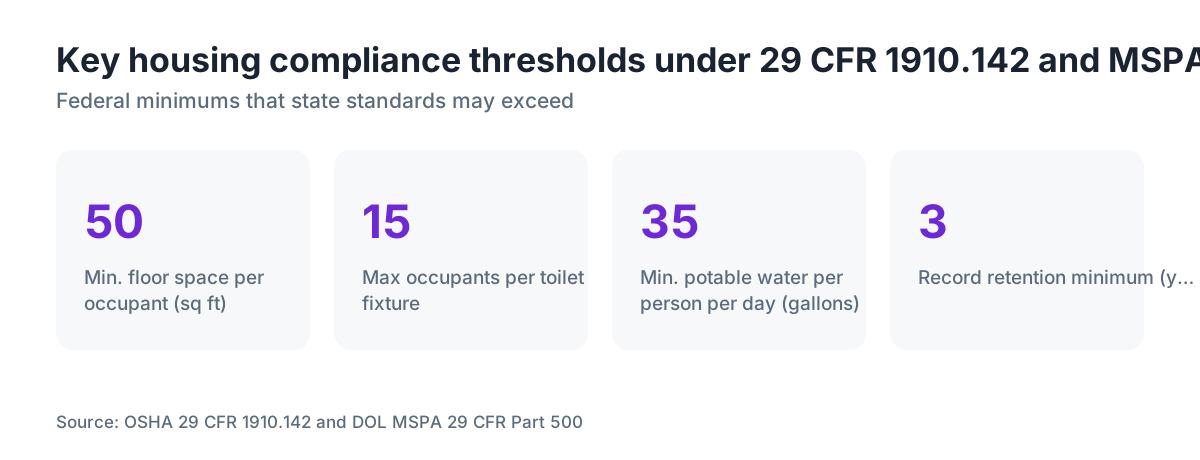
- Keep records at least three years.
- State agencies (Cal/OSHA, Washington L&I, New York DOL) add inspection and posting rules on top of federal minimums.
- Missing paperwork is one of the top FLC audit findings.
What federal law actually requires FLCs to document about housing?
The Migrant and Seasonal Agricultural Worker Protection Act (MSPA), 29 U.S.C. §§ 1801-1872, is the backbone of federal farm labor contractor rules. For housing, section 1823 says that any person who owns or controls housing used by migrant agricultural workers has to make sure it meets federal and state safety and health standards before anyone moves in, and has to post or hand over a written description of the housing terms. [1]
The disclosure part trips up most operators.
The DOL's ETA 456 form (the Agricultural Clearance Order) asks you to describe the type of housing, whether it's employer-provided or employer-arranged, what it costs the worker (if anything), and where it physically is. That form, or a document with the same information, has to reach each migrant worker before they commit to the job. [2]
Three documentation duties flow out of MSPA:
- A current inspection certificate from the right federal or state agency showing the housing meets the applicable standard. This certificate has to exist before occupancy, not after.
- Written disclosure of housing terms given to workers, with a signed acknowledgment if your state wants one.
- Payroll and deduction records if any housing cost comes out of wages, because MSPA's anti-kickback provisions and the FLSA both make you prove the deduction was voluntary and didn't push net pay below minimum wage.
Record retention under MSPA is three years from the date each record is created. DOL Wage and Hour Division investigators routinely ask for the last two full seasons plus the current one, so treat three years as the real floor, not a rough target. [1]
What does a housing inspection certificate need to contain?
A housing inspection certificate is not a checklist you fill out yourself. It's a document issued by the agency with jurisdiction: OSHA, your state labor department, your state housing department, or sometimes a county health department, depending on which program applies to you.
At the federal level, OSHA's Field Sanitation Standard (29 CFR 1928.110) covers field conditions, and the temporary labor camp standard (29 CFR 1910.142) covers the physical housing structure. [3] Housing that falls under USDA's Rural Housing Service programs runs through a separate inspection process.
A certificate that holds up in an audit shows:
- The name and address of the housing facility
- The maximum occupancy the inspector approved (this number matters, because overcrowding gets cited on its own)
- The date of inspection and the date the certificate expires
- The name and credential of the inspecting official or agency
- A statement that the facility meets the applicable standard, by citation (for example, "29 CFR 1910.142" or the relevant California Labor Code section)
Keep the original. Some inspectors hand over a carbon or a scanned PDF now, which is fine, but keep a backup offsite or in a cloud folder you can actually open during a field audit. Investigators have shown up unannounced during harvest, and "the original is back at the office" is not a defense.
Certificates in California expire annually and have to be renewed before workers arrive for the next season. Washington's Department of Labor and Industries issues a similar annual certificate under WAC 296-307. [4] New York issues certificates through its Department of Labor Division of Safety and Health. Check your state's exact expiration cycle, because missing a renewal by a single day is a citable violation.
Which state agencies inspect farm worker housing and issue certificates?
This table lists the main state agency responsible for farm worker housing inspection in the major wine-grape states. Federal OSHA jurisdiction applies where a state lacks an approved state plan.
| State | Primary Inspection Agency | Key Regulation | Certificate Renewal |
|---|---|---|---|
| California | Cal/OSHA (DOSH) | Cal. Labor Code; 8 CCR 3441 | Annual, before occupancy |
| Washington | L&I Division of Occupational Safety & Health | WAC 296-307 | Annual |
| Oregon | Oregon OSHA | OAR Chapter 437 | Annual |
| New York | NY DOL Division of Safety and Health | 12 NYCRR Part 841 | Annual |
| Michigan | Michigan LARA (MIOSHA) | MIOSHA Part 611 | Annual |
| Texas | Texas DSHS (county health in some areas) | 25 TAC Chapter 137 | Annual or per-occupancy |
California earns its own paragraph because it layers agencies. Cal/OSHA handles structural and electrical standards, the Department of Housing and Community Development handles building permits for some camp types under the state Health and Safety Code, and county environmental health departments sometimes issue separate sanitation approvals. Run a vineyard in Napa, Sonoma, or San Luis Obispo and you may need sign-off from two agencies before your certificate package is done. [5]
WSU Extension publishes a plain-language summary of Washington's agricultural housing rules that's worth a bookmark. UC Cooperative Extension (UC Davis) has similar guidance for California growers. [6] Cornell's worker protection materials cover New York. None of these carry legal weight. They're useful for building a checklist you can hand a new supervisor.
What records does an FLC audit actually look for?
When the DOL Wage and Hour Division audits an FLC, the investigator works from a standard protocol. Housing documentation is one of four areas they check (the others are worker protections, vehicle safety, and wage/hour records).
The investigator asks for:
- Current inspection certificates for every facility where workers were housed
- The ETA 456 or equivalent disclosure document, with worker signatures or distribution records
- Any lease or sublease between the FLC and the housing owner (MSPA requires written contracts between agricultural employers and FLCs, and housing terms belong in that contract)
- Occupancy logs showing the dates workers were in the facility and the number of occupants per structure
- Maintenance and repair logs, especially for any complaint a worker raised in writing
- Records of housing deductions from paychecks, cross-referenced to payroll
WHD spelled out its FLC investigation procedures in its Field Operations Handbook (FOH), Chapter 55. The handbook is public. You can read it to see exactly what an investigator is trained to look for. [7]
One finding shows up in WHD press releases again and again: FLCs that never gave workers a written statement of housing terms before work started. That's a per-worker violation under MSPA, and penalties stack. The MSPA civil money penalty runs up to $2,678 per violation as of the 2024 inflation adjustment, and it changes every January, so check the current WHD penalty schedule before you rely on any figure. [8]
A tool like VitiScribe gives vineyard managers one place to attach scanned certificates, log occupancy by date, and store signed ETA 456 acknowledgments. That makes pulling a record set for an audit faster than digging through filing cabinets the day the investigator calls.
How long do you have to keep housing inspection records?
Three years is the MSPA floor. Under 29 CFR Part 500, the rules that implement MSPA, every record the act requires has to be preserved for three years from the date it was created. [1]
Some states set longer windows. California's wage orders and Agricultural Labor Relations Board guidance point toward keeping worker housing and payroll records for four years, because the state statute of limitations for wage claims runs that long. Oregon OSHA's general industry standards require three years for most safety records, and longer for certain exposure records that could touch on housing conditions.
Keep everything for four years. The extra year costs you almost nothing (a PDF folder) and it protects you against a state wage claim filed right before the statute runs out.
Store records so a stand-in manager or your attorney can find them without you in the room. Name them by season and facility, not by a private filing logic only you understand. A folder path like "2024 / Vineyard Housing / Santa Rosa Camp A / Inspection Certificate" takes thirty seconds to build and saves hours in a pinch.
What are the EPA Worker Protection Standard requirements that overlap with housing?
The EPA Worker Protection Standard (WPS), 40 CFR Part 170, is mostly about pesticide safety, but it overlaps with housing in one specific, often-missed spot: decontamination facilities. [9]
Under the WPS, agricultural employers have to keep decontamination supplies (water, soap, single-use towels) at or near housing when workers have handled pesticides or worked in treated areas. The 2015 revised WPS (effective January 2, 2017) tightened these duties and added a requirement that housing occupied by workers get counted in Application Exclusion Zone (AEZ) calculations. If a pesticide application's exclusion zone reaches a housing structure, you can't apply until the housing is clear.
For record-keeping, the WPS makes you keep pesticide application records accessible to workers and their designated representatives for two years. Those records name the product, the rate, the location, and the date. [9] If housing sits next to treated blocks, cross-reference application records against occupancy logs to show no workers were in housing inside the AEZ during application. That cross-reference isn't a formal regulatory requirement, but it's exactly what an investigator wants to see after a complaint.
The EPA's WPS training materials and UC Davis's IPM program both cover how to set up records that satisfy WPS and MSPA at the same time, which matters because these programs often draw different inspectors, each convinced their program is the one you're mainly complying with. [6]
What standards does farm worker housing actually have to meet before it gets certified?
The physical standards for farm worker housing come from OSHA's temporary labor camp standard at 29 CFR 1910.142, unless a state standard is stricter, in which case the state standard wins. The OSHA standard covers: [3]
- Site and drainage: no camps in floodplains, drainage good enough to keep water from pooling
- Water supply: potable water, at least 35 gallons per person per day
- Toilets: one toilet for every 15 occupants, and separate facilities by sex when occupancy hits 6 or more
- Showers: one shower for every 10 occupants
- Sleeping areas: at least 50 square feet of floor space per occupant (some states go higher, and California adds ceiling height and ventilation minimums under 8 CCR 3441)
- Cooking and eating: if you don't provide meals, workers need cooking facilities and adequate refrigeration
- Lighting and ventilation: specific foot-candle minimums for interior spaces
- Fire safety: extinguishers, exits, alarms
California's Cal/OSHA Title 8 standards run stricter than the federal baseline, especially on square footage, heating, and sanitation ratios. Washington's WAC 296-307 also exceeds federal minimums in several places. [4]
If your housing gets inspected and certified, the certificate is your proof. If it gets inspected and found deficient, the deficiency notice is a record you keep too, along with the corrective-action documentation and the re-inspection certificate. An incomplete file (a certificate but no follow-through on the fixes) can make your legal exposure worse than having no certificate at all, because it shows you knew about a problem and left it.
How do MSPA written disclosure requirements apply to housing terms?
MSPA section 1821 requires that each migrant agricultural worker get a written disclosure statement at recruitment, before they agree to the job. Housing disclosure is part of that statement. The statute says the disclosure has to include the location of the housing, whether the employer or the FLC provides it, and any charge for it. [1]
The DOL's ETA 456 form covers this if you fill it out completely. The form lives on the DOL's foreign labor certification pages, and most state workforce agencies accept it. Some FLCs use their own form, which is fine as long as it holds every required field. The trouble is that homegrown forms often leave out the specific location (a real street address, not "the vineyard") or the cost breakdown.
The regulation at 29 CFR 500.75 requires the disclosure to be given "in a language common to the migrant agricultural workers," in the words of the rule. [1] So if you recruit Spanish-speaking workers and hand them an English-only document, you're out of compliance even after they sign it. Spanish translations of the ETA 456 come from DOL, and some state agencies provide more languages.
Here's the vineyard angle: if you hire an FLC that arranges housing for you, you still carry MSPA liability as the agricultural employer when the FLC fails to disclose properly. Agricultural employers and FLCs share joint liability under MSPA for housing violations when the employer controls or benefits from the arrangement. Get copies of the FLC's disclosure forms and inspection certificates written into your contractor agreement, not tacked on as an afterthought.
What happens if an FLC fails a housing inspection or loses its certificate?
An FLC operating housing without a current, valid certificate violates MSPA section 1823 and faces civil money penalties, criminal prosecution for willful or repeated violations, and debarment from future federal contracts. The Secretary of Labor can also seek an injunction to close housing that poses an imminent danger. [1]
For vineyard operators who hire FLCs: MSPA puts joint liability on agricultural employers when they knew or should have known the FLC was violating housing rules. Courts have held that a vineyard owner who provides housing to an FLC for migrant workers is an "agricultural employer" under MSPA for housing purposes, and DOL guidance treats knowing provision of substandard housing as direct exposure for the landowner.
If an inspection fails:
- Stop housing workers there right away (or fix the specific deficiency if it's minor and correctable within hours).
- Document the failure notice and your corrective actions with dates and photos.
- Arrange alternative housing and document where workers moved.
- Schedule a re-inspection and get the new certificate before anyone moves back in.
- Notify your FLC and your agricultural employer in writing if you sit in a chain of responsibility.
MSPA civil money penalties currently cap at $2,678 per violation as of the 2024 adjustment, but each worker, each day, or each undisclosed housing condition can count as a separate violation depending on how WHD tallies it. [8] State penalties stack on top of the federal ones.
How should vineyard managers build a housing compliance file that survives an audit?
A file that survives an audit is organized, complete, and openable by someone other than you. Here's the structure that works.
One folder per housing facility per season. Inside it:
- Current inspection certificate (original or certified copy)
- Prior season's certificate for comparison (shows the renewal pattern)
- Floor plan or site map with maximum occupancy marked
- Lease or agreement under which the FLC occupies the facility
- Signed worker disclosure forms (ETA 456 or equivalent) by season and cohort
- Occupancy log: dates, number of occupants, names if your state requires them
- Maintenance log: dates, work performed, who did it
- Complaint records and your response
- Pesticide application records for adjacent blocks (for the WPS cross-reference)
Scan everything. Paper is fine as a primary, but a scan saves you when a fire, a flood, or plain disorganization makes the paper unavailable. Three years back, minimum.
WSU Extension's farm worker housing guides suggest auditing your own file at the start of each season, before workers arrive, instead of reconstructing records when an investigator shows up. [6] That's the right move. A 30-minute self-audit in February is worth hours of scrambling in August.
If you manage records across several vineyard properties and housing facilities, a central system earns its keep. VitiScribe was built for that kind of multi-property operation, with document storage tied to specific parcels and compliance categories, so your inspection certificates and occupancy logs sit next to your spray records instead of in a separate system nobody keeps up.
Are there specific requirements for posting notices inside farm worker housing?
Yes, and this is one of the most commonly cited deficiencies. MSPA requires a copy of the housing inspection certificate, or a notice that it exists, posted in a conspicuous spot in the facility. The posting has to be in a language the occupants understand. [1]
Beyond MSPA, the EPA WPS requires posting of pesticide safety information (including the Safety Data Sheet for any pesticide applied nearby) in a central location workers can reach. Cal/OSHA requires its poster (English and Spanish) in any farm labor housing. Washington L&I requires similar postings under WAC 296-307.
A posting checklist for each facility:
- MSPA housing inspection certificate (or required summary)
- OSHA "Job Safety and Health: It's the Law" poster (federal) or the state equivalent
- WPS pesticide safety information for recent applications in adjacent blocks
- Emergency contact numbers (site supervisor, local hospital, poison control)
- Water source information (potability test results if your state requires them)
- The WHD "Employee Rights Under MSPA" poster [7]
Replace posters when they get illegible or damaged. Investigators photograph the posting area. A faded, torn, or water-stained poster in an otherwise compliant facility is still a citable violation. Keep spares.
Frequently asked questions
What is the difference between an FLC housing inspection certificate and a general business license?
A housing inspection certificate comes from a safety or health agency (OSHA, a state labor department, or county health) and certifies that the physical structure meets specific occupancy, sanitation, and safety standards. A business license comes from a municipality and says nothing about housing safety. MSPA requires the inspection certificate specifically. A business license does not substitute for it.
Does a vineyard owner need a housing inspection certificate if the FLC arranges its own housing off-site?
Not directly, but you're not off the hook. Under MSPA, agricultural employers share liability with FLCs when workers are housed in connection with work on their property. Contractually require your FLC to give you copies of their current inspection certificates and worker disclosure forms, and keep those copies in your own file. If the FLC can't produce them, that's a red flag.
How often does farm worker housing need to be inspected?
Federal OSHA requires inspection before occupancy each season. Most state agencies, including Cal/OSHA, Washington L&I, and Oregon OSHA, issue annual certificates that have to be renewed before workers arrive each year. Some states require an inspection for each new occupancy period even within a season if the facility was vacated. Check your state's renewal cycle, because missing it by a single day is citable.
Can an FLC use the same housing inspection certificate across multiple growing seasons?
No. Certificates are issued for a specific inspection date and typically expire after one year or at the end of the season they cover. Using a prior season's certificate is a violation even if the housing hasn't changed. You need a fresh inspection and a new certificate before each season's occupancy begins.
What does the DOL ETA 456 form require for housing disclosure?
The ETA 456 Agricultural Clearance Order requires disclosure of the type of housing (barracks, dormitory, individual unit), whether it's employer-provided or employer-arranged, the exact location (street address), the cost to the worker (if any), and the applicable housing standards. It has to reach each migrant worker before they commit to the job, and it has to be in a language the worker understands.
What is the penalty for an FLC that houses workers without a valid inspection certificate?
Under MSPA, civil money penalties can reach $2,678 per violation as of the 2024 adjustment, and WHD may treat each worker housed or each day of non-compliance as a separate violation. Willful or repeated violations can bring criminal prosecution and debarment. State penalties stack on top. California and Washington both run independent penalty structures that add substantial exposure.
Does the EPA Worker Protection Standard require any housing-related records?
Yes. The WPS requires employers to keep pesticide application records for two years, accessible to workers. When housing sits near treated blocks, cross-reference application records with occupancy logs to show no workers were in an Application Exclusion Zone during a pesticide application. The WPS also requires decontamination supplies near housing when workers have handled pesticides.
What minimum square footage is required per worker in farm labor housing?
The federal OSHA temporary labor camp standard at 29 CFR 1910.142 requires at least 50 square feet of floor space per occupant. California meets this minimum and adds ceiling height and ventilation requirements under 8 CCR 3441. Washington and Oregon set similar minimums with extra specification. The maximum approved occupancy on the inspection certificate is the controlling number, and exceeding it gets cited separately.
Are farm worker housing records subject to public records requests?
Records held by state agencies (inspection certificates, deficiency notices) are generally subject to state public records laws and can be obtained by workers, advocates, or journalists. Records you keep privately (your own occupancy logs, payroll deduction records) aren't public, but you have to hand them to DOL investigators on request, and they're discoverable in litigation. Workers have a right under MSPA to see records about their own employment.
What extension resources are available to help FLCs and vineyard managers with housing compliance?
UC Cooperative Extension (UC Davis) publishes housing compliance guides for California agricultural employers. WSU Extension has materials on Washington's requirements. Cornell University's worker protection program covers New York. None carry legal authority, but they translate regulatory language into operational checklists. The DOL's WHD website also has compliance assistance guides for MSPA.
How do you document corrective actions after a housing inspection deficiency?
Keep the original deficiency notice from the inspecting agency. For each deficiency listed, document the corrective action in writing, the date completed, who did the work, and any materials or permits involved. Photograph the corrected condition. Request a re-inspection and keep the new certificate alongside the deficiency notice. This paper trail shows good faith and is your main defense against escalated penalties.
Does MSPA apply to seasonal agricultural workers who commute daily, or only to workers living in employer-provided housing?
MSPA's housing provisions (section 1823) apply to migrant agricultural workers, defined as those who travel away from their permanent residence for agricultural work. Workers who commute daily from their own homes are generally 'seasonal' workers under MSPA and get other MSPA protections (wages, working conditions, disclosure) but not the housing inspection requirements. The distinction decides which obligations apply.
Sources
- DOL Wage and Hour Division, Migrant and Seasonal Agricultural Worker Protection Act (MSPA) statute and regulations, 29 CFR Part 500: MSPA Section 1823 requires housing inspection certificates before occupancy; disclosure must be in a language workers understand; records retained three years under 29 CFR 500
- DOL Employment and Training Administration, Form ETA 456 Agricultural Clearance Order: ETA 456 requires description of housing type, location, and cost to worker as part of migrant worker disclosure
- OSHA, Temporary Labor Camps Standard, 29 CFR 1910.142: Federal standard requires 50 sq ft per occupant, one toilet per 15 occupants, 35 gallons potable water per person per day in farm worker housing
- Washington State Department of Labor and Industries, Agricultural Housing Rules, WAC 296-307: Washington issues annual housing inspection certificates and sets farm worker housing standards that in several areas exceed federal OSHA minimums
- UC Cooperative Extension and WSU Extension, Farm Worker Housing Compliance Resources: UC Cooperative Extension and WSU Extension publish plain-language compliance guides for agricultural housing requirements in California and Washington
- DOL Wage and Hour Division, Field Operations Handbook Chapter 55, FLC Investigation Procedures: WHD investigators use FOH Chapter 55 as the standard protocol for FLC audits, including review of housing certificates, disclosure forms, and occupancy records
- DOL Wage and Hour Division, Civil Money Penalty Inflation Adjustments: MSPA civil money penalties are up to $2,678 per violation as of the 2024 inflation adjustment, and the figure changes each January
- EPA Worker Protection Standard, 40 CFR Part 170 (revised 2015, effective January 2, 2017): WPS requires pesticide application records accessible to workers for two years; Application Exclusion Zone calculations must account for worker housing
- OSHA Field Sanitation Standard, 29 CFR 1928.110: OSHA field sanitation standard covers potable water, toilet, and handwashing requirements for agricultural field operations adjacent to housing
- Cornell University ILR School, Worker Protection and Agricultural Labor Law resources: Cornell's worker protection program provides New York-specific guidance on MSPA housing compliance and worker rights posting requirements
Last updated 2026-07-10