How to document piece-rate harvest pay compliance under California labor law

TL;DR
- California Labor Code section 226.2, effective January 1, 2016, requires employers paying piece-rate to compensate rest and recovery periods separately at the average piece-rate hourly rate, provide itemized wage statements showing those periods, and keep payroll records for at least three years.
- Vineyards that skip this documentation face back-pay liability plus civil penalties up to $250 per employee per pay period.
What does California law actually require for piece-rate harvest pay?
California Labor Code section 226.2 is the governing statute. It took effect January 1, 2016, and it changed the math for every vineyard paying pickers, pruners, or shoot-thinners by the bin, box, or row. [1]
The law requires three separate things. First, rest and recovery periods must be compensated at a separate, calculated rate, not absorbed into the piece-rate total. Second, that rate must equal the higher of (a) the employee's average piece-rate earnings during the workweek or (b) the applicable minimum wage. Third, every wage statement must itemize: total pieces, the applicable piece rate, total piece-rate compensation, total rest/recovery period minutes, and the separate rest/recovery pay. [1]
One sentence trips up a lot of growers: the law does not let you claim rest time is "built into" your piece rate. The California Supreme Court settled the underlying principle in Brinker Restaurant Corp. v. Superior Court (2012), which held employees are relieved of all duties during rest periods and cannot be forced to work through them uncompensated. Section 226.2 codified that principle specifically for piece-rate workers. [2]
Non-productive time, meaning time under employer control that is not piece-rate work and is not rest or recovery, must also be paid separately at no less than minimum wage. Think pre-shift safety briefings, waiting while bins are moved, or standing idle while a broken harvester gets fixed. If your crew stands around for 20 minutes waiting for the forklift, that time is compensable and must be recorded. [1]
If you run piece-rate work of any kind, read the statute once and keep it near your payroll files. The whole compliance job flows from those requirements. Our vineyard operations guide walks through how spray records and field time logs fit alongside this.
How do you calculate the correct rest period pay rate for harvest workers?
The formula is short once you see it. Take total piece-rate compensation earned during the workweek, divide by total hours of productive piece-rate work (excluding rest periods and non-productive time), and you get the average piece-rate hourly rate for that week. [1]
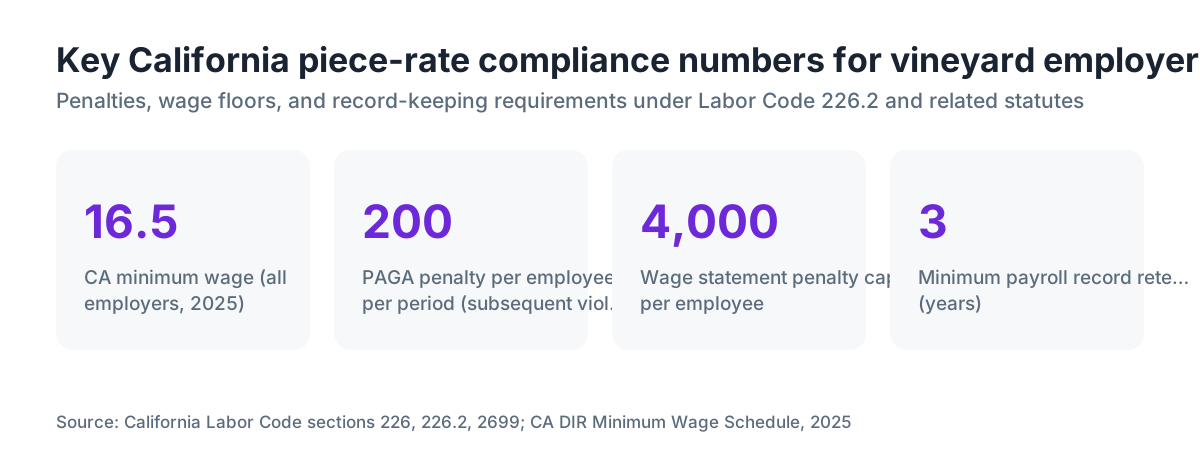
Here is a concrete example. A picker earns $320 in piece-rate pay over a week on 40 hours of total scheduled time. If she takes four 10-minute rest breaks per day across five days, that is 200 minutes (3.33 hours) of rest time. Her productive piece-rate hours are 40 minus 3.33, or 36.67 hours. Average piece-rate hourly rate: $320 divided by 36.67 = $8.73/hour (ignoring rounding for illustration). California minimum wage in 2025 is $16.50 for most employers. [3] Because $16.50 exceeds $8.73, you pay rest time at $16.50/hour, not $8.73. The picker's rest pay for that week: 3.33 hours times $16.50 = $54.95, on top of the $320.
The minimum wage floor matters a lot in harvest. Piece-rate workers in a slow vintage, where bins run light, will often show an average piece-rate hourly rate below minimum wage. Compare both numbers every single week. [3]
California once had a separate minimum wage track for small employers (25 or fewer employees), but those tracks converged in 2023. Check the current rate on the California Department of Industrial Relations minimum wage page each January, because it updates. [3] Our harvest labor cost planning guide shows how these weekly rate swings hit your season budget.
What records do you need to keep to prove compliance?
Think of your documentation in four layers.
Layer one is the time record. You need a daily log per worker showing clock-in, clock-out, rest period start and end times, and any non-productive waiting time with a reason code. Paper time cards are legal, but they are genuinely hard to audit. A simple spreadsheet or field tablet entry that captures timestamps is much easier to defend. California Labor Code section 1174 requires payroll records be kept three years minimum. [4]
Layer two is the piece-count record. This must tie each employee to a specific quantity, unit type (bins, lugs, rows), and field or block location, by day. In a vineyard, that often means block-by-block picking tickets signed by the forklift driver or row boss. If you can not show exactly how many bins employee #47 picked in block 12 on a given date, you have no defensible piece-rate basis.
Layer three is the wage calculation worksheet. This is the document that shows the weekly math: total piece-rate earnings, productive hours, average piece-rate rate, comparison to minimum wage, rest period minutes, rest period pay, non-productive pay, and gross total. Keep it for every employee every pay period. DLSE (Division of Labor Standards Enforcement) investigators ask for this first.
Layer four is the wage statement itself. California Labor Code section 226(a) lists nine required items for any wage statement, and section 226.2 adds the piece-rate-specific fields on top. [1][4] A missing line item on the pay stub is a violation carrying a $50 penalty for the first pay period and $100 per employee per period after that, up to $4,000 per employee.
Run the numbers on that. For a vineyard with 40 harvest workers, a single audit finding wage statement deficiencies across a four-week harvest could cost $40,000 in penalties before any back-pay calculation begins.
What should a compliant piece-rate wage statement include?
California Labor Code section 226(a) requires that every itemized statement include the employee's name and last four digits of SSN (or employee ID), the employer's name and address, pay period dates, gross wages, total hours worked, all applicable hourly rates and hours at each rate, and all deductions. [4]
Section 226.2 adds for piece-rate workers: total pieces completed and the applicable piece rate for each type; total piece-rate compensation; total rest/recovery period minutes and the rate paid; total non-productive time minutes and the rate paid. [1]
Here is what that looks like on a real stub:
| Pay stub line item | Example value |
|---|---|
| Piece-rate bins (145 bins @ $2.25) | $326.25 |
| Rest period (200 min @ $16.50/hr) | $55.00 |
| Non-productive time (30 min @ $16.50/hr) | $8.25 |
| Total gross wages | $389.50 |
| Pay period dates | 9/2/2025 - 9/8/2025 |
| Employee name + last 4 SSN | Yes |
| Employer name + address | Yes |
If your payroll software does not produce these line items automatically, you either customize it or attach a separate itemized sheet to every paycheck. Courts have not accepted "the total was right" as a defense for missing line items. The itemization requirement stands apart from the math requirement.
How does the affirmative defense provision work for past wage claims?
Section 226.2 included a one-time safe harbor for wage claims that accrued before January 1, 2016. Employers who paid the back wages owed by December 15, 2016 under a specific calculation method avoided civil penalties and class action exposure for that historical period. That window is long closed. [1]
For post-2016 liability, there is no safe harbor. If a DLSE investigation or a class action finds you underpaid rest periods, you owe the unpaid wages plus interest (generally 7% per year for wages under California Civil Code 3289), plus civil penalties, plus potential attorney fees if a Private Attorneys General Act (PAGA) claim is added. PAGA penalties under Labor Code section 2699 are $100 per employee per pay period for initial violations and $200 per employee per period for subsequent violations. [5]
For a 40-person harvest crew over six pay periods, a first-time PAGA finding alone could generate $24,000 in penalties, and that is before back wages. The math is why plaintiffs' attorneys pursue agricultural piece-rate cases aggressively.
So fix problems going forward and document the correction. If you discover a calculation error mid-season, correct it on the very next paycheck and keep a memo in the file explaining what changed and why. Showing good faith after finding an error is not a legal defense, but it shapes how DLSE treats the case.
What forms and systems work best for tracking picker time and piece counts in the field?
The honest answer is that no single system fits every operation, and anyone who says otherwise is selling you something.
For very small operations (under 10 harvest workers), a well-designed paper form works if someone fills it out completely, every day, without exception. UC Cooperative Extension publishes farm labor cost templates that include time and piece-count fields. [6] Print them, laminate a reference copy, and keep a stack in the truck.
For operations with 20 or more workers, paper breaks down fast. You end up with illegible tallies, missing dates, and bin counts that don't reconcile to the forklift log. A tablet-based field entry system that captures GPS location, timestamp, worker ID, and bin count per load is much harder to challenge. Some operations use barcode or QR-code picking tickets where the row boss scans each worker's ID badge when a bin is called full, logging the count automatically.
Whatever you use, the payroll processor (a farm labor contractor, your bookkeeper, or you at the kitchen table at 10pm) needs to receive the raw field data and do the section 226.2 math before generating checks. A platform like VitiScribe can connect field time logs to the compliance calculation layer so the rest-period rate comparison happens automatically rather than in a spreadsheet someone updates inconsistently.
Farm labor contractors add complexity. If you use a licensed FLC, the FLC is the employer of record and is primarily responsible for wage statement compliance. But California Labor Code section 2810.3 makes you jointly liable if the FLC does not pay correctly. [7] Get a written indemnification agreement with any FLC, and ask to see sample wage statements before the contract season begins.
How do agricultural minimum wage exemptions interact with piece-rate rules?
California abolished most agricultural minimum wage exemptions with AB 1066 in 2016. The phase-in for small agricultural employers (25 or fewer employees) completed in 2023, meaning as of January 1, 2023, all California agricultural employers face the same minimum wage as everyone else. [8]
There is no longer a separate "agricultural piece-rate worker" minimum wage in California. The floor is the statewide minimum wage, which is $16.50/hour as of January 1, 2025 for all employers regardless of size. [3] Some cities and counties set higher local minimums. Napa County follows the state rate; San Francisco would be higher if you had workers there.
The federal Fair Labor Standards Act still has an agricultural exemption for certain small farms under 29 U.S.C. section 213(a)(6), but California law is more protective and California law controls for work performed in California. Federal law is a floor, not a ceiling, and California built a higher ceiling years ago. [9]
One point confuses growers: the piece rate itself has no minimum. You can pay $1.50 per lug legally, as long as total compensation for every hour worked (including rest time and non-productive time) adds up to at least minimum wage for that hour. But section 226.2 rest-period pay must be calculated and paid separately. A worker who picks fast enough that her piece-rate average beats minimum wage still gets a separate rest-period line item on her pay stub, even if the dollar amount happens to equal what her piece rate would have covered.
What are the most common piece-rate documentation mistakes that trigger DLSE audits?
Four mistakes come up constantly in agricultural labor enforcement, and all four are fixable with better recordkeeping.
First: lumping rest time into the piece-rate total. The stub shows only a piece-rate line with no separate rest period entry. This is the most direct section 226.2 violation and the easiest for an investigator to spot in 30 seconds.
Second: using a flat hourly rate for rest periods instead of calculating the average piece-rate rate. Some employers default to paying rest at minimum wage always, which is legally sufficient only when minimum wage exceeds the average piece-rate rate. If a fast picker's average piece-rate rate is $22/hour, she is entitled to rest pay at $22/hour, not $16.50. Using the lower rate is an underpayment.
Third: no record of non-productive time. Pre-shift safety meetings, travel time from a parking area to the block, mandatory waiting while equipment gets set up, all of it must be logged and paid at minimum wage minimum. If you can not show the time records, you can not show you paid for it.
Fourth: inconsistent piece-count documentation. If the forklift log shows 200 bins from block 14 on a Tuesday and your payroll records show 180 bins paid out, an investigator will ask where the other 20 bins went. Bin count reconciliation between field records and payroll is not optional.
UC Cooperative Extension and WSU Extension both publish guides on agricultural employer recordkeeping obligations. [6][10] Read one of them once a year, before harvest. That is a reasonable precaution and it costs nothing.
Does the EPA Worker Protection Standard add any documentation requirements for harvest crews?
Yes, and it overlaps with piece-rate recordkeeping in ways growers sometimes miss.
The EPA Worker Protection Standard (WPS), revised in 2015 and administered by EPA and the California Department of Pesticide Regulation, requires employers to provide specific protections to agricultural workers who enter treated fields. [11] The WPS requires you to keep pesticide application records accessible to workers and their representatives, and to provide safety training before workers enter treated areas.
Here is where it intersects with piece-rate documentation. If a crew cannot enter a block because of a restricted-entry interval (REI) and must wait, that waiting time is non-productive time under section 226.2. You must pay it at minimum wage and record it. The WPS application log that shows when the REI expires is the same document that proves why workers were waiting. Keep your spray records and your field time logs in the same system, or at least cross-referenced.
California DPR requires pesticide use reports filed monthly with the county agricultural commissioner. [12] Those reports include block-level application dates and products. A DLSE investigator who also pulls your pesticide use records will notice if a block had an active REI on the same day your payroll shows piece-rate picking from that block. The mismatch raises questions about whether workers entered under REI (a WPS violation) or whether your piece-count records are wrong (a wage violation).
Keep your records consistent across spray logs, field time logs, and payroll. They will be compared. Our spray record keeping guide covers how to link pesticide application logs to the rest of your field paperwork.
How long do you need to keep piece-rate payroll records?
California Labor Code section 1174 requires employers to keep payroll records for three years and make them available for inspection by the Labor Commissioner. [4] Those records must include the employee name, address, occupation, time worked each day, total wages paid, and all deductions.
For piece-rate, add to that list the piece-count logs, the weekly average piece-rate rate calculation worksheets, and copies of every wage statement. The retention window most employment attorneys recommend is four years, because California's statute of limitations for unpaid wage claims is three years under Code of Civil Procedure section 338, and PAGA claims can extend the effective look-back in some circumstances.
Store records somewhere you can actually find them. A box of crumpled picking tickets in the barn does not meet the "available for inspection" standard if you cannot produce a specific employee's records within a reasonable time. Digitize them. Even a phone photo of each day's field tally sheet, stored in a folder organized by date and employee, beats paper in a box.
If you use a farm labor contractor, California law requires the FLC to keep these records too, but your joint liability means you want copies. Ask your FLC for payroll records monthly and file them. If the FLC disappears after harvest, you want documentation showing what the FLC actually paid.
What's the practical audit preparation checklist for piece-rate compliance?
A DLSE field audit can arrive with little warning. Here is what investigators typically request in the first 24 hours, drawn from the Division's published enforcement procedures. [13]
Employee list with dates of employment during the audit period. Payroll records by employee and pay period. Wage statements (copies of pay stubs) for each employee. Time records including daily in/out and rest period logs. Piece-count logs tied to specific employees, dates, and fields. Any farm labor contractor agreements and proof of FLC licensure. Proof of workers' compensation coverage. I-9 forms (though technically that is a federal ICE matter, not DLSE).
Run through this list before harvest starts, not after. Pick one week's records from last season and audit yourself. Pull records for three employees at random, rebuild the section 226.2 calculation from the raw field data, and verify that the number on the pay stub matches. If it does not, find out why before an investigator does.
A tool like VitiScribe built for vineyard field operations can hold spray records, block-level piece counts, and worker time logs in one place, which makes the reconciliation step faster. But the compliance math still requires someone who understands the statute to set up the system correctly. Software does not replace legal knowledge; it just removes the excuse of disorganization.
For growers in Paso Robles wine country, harvest often runs tight on labor, which creates pressure to shortcut documentation. That pressure is real and so is the liability.
Are there good training resources for vineyard managers on piece-rate compliance?
A few genuinely useful ones exist.
UC Cooperative Extension publishes farm labor cost and compliance resources through its statewide network. The UC Agriculture and Natural Resources website covers agricultural labor law topics including wage and hour requirements. [6] Their farm advisor network includes people familiar with Napa, Sonoma, San Joaquin, and Central Coast operations specifically.
The California Labor Commissioner's Office publishes a free guide titled "Wage Theft Is a Crime" and maintains a website with wage and hour FAQ pages in English and Spanish. [13] The Spanish-language resources matter because most harvest workers in California speak Spanish as a first language, and the WPS and DLSE both require certain postings and communications in a language workers understand.
The Western Growers Association and California Farm Bureau Federation both offer labor compliance workshops aimed at small agricultural employers. They run these in Fresno, Salinas, and Bakersfield, typically in late summer before harvest begins.
Cornell's ILR School has published research on piece-rate pay structures in agriculture, though the case studies tend toward the Northeast. [14] The legal framework differs by state, so use Cornell for conceptual grounding and check California-specific guidance from DLSE or a California employment attorney for the actual rules.
Spending $500 on a two-hour consultation with an agricultural employment attorney before your first harvest is the single best investment a new vineyard manager can make here. The consultation cost is trivial against the exposure.
Frequently asked questions
Does California piece-rate law apply to vineyard pruning, more than harvest picking?
Yes. Labor Code section 226.2 applies to any employee paid by piece rate, regardless of the agricultural task. Pruning, shoot thinning, suckering, and cane tying all qualify if the compensation is based on a per-unit rate. The same rest-period calculation, wage statement requirements, and recordkeeping obligations apply year-round for any piece-rate work.
Can a farm labor contractor handle all piece-rate compliance so I don't have to worry about it?
A licensed FLC is the employer of record and primarily responsible, but California Labor Code section 2810.3 makes you jointly liable if the FLC does not pay workers correctly. That means you can be held responsible for back wages even if you paid the FLC every invoice. Get written indemnification, ask to see sample pay stubs before the season, and request monthly payroll records from the FLC as a safeguard.
What is the penalty for missing line items on a piece-rate wage statement?
Under Labor Code section 226(e), the penalty is $50 per employee for the first pay period with a deficient statement and $100 per employee per pay period after that, up to $4,000 per employee. A PAGA claim adds $100 per employee per pay period for initial violations and $200 for subsequent ones, with 75% of PAGA penalties going to the Labor and Workforce Development Agency.
How do I calculate rest period pay when a worker's piece-rate average changes week to week?
You recalculate every workweek. The average piece-rate hourly rate is the total piece-rate earnings for that week divided by the total productive piece-rate hours for that week. Because harvest production varies daily based on fruit set and crew size, the rate almost always differs week to week. There is no legal shortcut of using a seasonal average; the weekly calculation is required by the statute.
Does travel time from the vineyard parking lot to the picking block count as non-productive time?
Generally yes, if the travel is required by the employer and the employee is under the employer's control during that time. California IWC Wage Order 14, which covers agricultural workers, requires compensation for all hours under employer control. If workers must report to a central staging area and then ride a company vehicle to the block, that ride time is compensable non-productive time requiring minimum wage pay and documentation.
What if a worker's piece-rate earnings already exceed minimum wage for the whole shift, do I still owe separate rest period pay?
Yes. Section 226.2 requires rest periods to be separately calculated and separately itemized on the wage statement even when the worker's total piece-rate earnings exceed what minimum wage would produce. The separate line item is both a pay requirement and a recordkeeping requirement. A single gross piece-rate total that mathematically covers rest time does not satisfy the statute.
How do I handle piece-rate pay for workers who switch between piece-rate and hourly tasks in the same day?
Track the hours separately. Time spent on an hourly task (such as operating a tractor or doing pesticide applications) is paid at the hourly rate for those hours, with no piece-rate component. Rest periods taken during a piece-rate portion of the day are calculated under section 226.2. Rest periods during a straight-hourly portion are simply compensated at the hourly rate. The wage statement should itemize each rate and time block separately.
Are there any federal piece-rate rules that differ from California requirements?
Federal FLSA requires piece-rate workers' total compensation to equal at least federal minimum wage ($7.25/hour as of 2025) for all hours worked, but it does not require separate rest-period calculations the way California does. California law is significantly more protective, and for work performed in California, state law controls. You should build your system to meet California requirements; federal compliance follows automatically.
Do I need to post anything in the vineyard about piece-rate rights for workers?
California IWC Wage Order 14 must be posted in a place accessible to agricultural workers, in English and Spanish. The DLSE provides a free printable version at its website. EPA WPS also requires a pesticide safety posting near the field entry point or a central location. Neither posting substitutes for the itemized wage statement, but missing postings are separate violations with their own penalties.
How far back can a worker sue for underpaid piece-rate wages in California?
The statute of limitations for unpaid wage claims under California Code of Civil Procedure section 338 is three years. A PAGA claim, which can piggyback on the wage violation, looks back one year under Labor Code section 2699.3. In practice, workers often file both claims, giving you exposure across three years of pay periods. Keeping records for at least four years gives you a buffer.
What does the DLSE actually look at during a field audit of a vineyard?
DLSE investigators typically request employee lists, payroll records, wage statements, daily time logs, piece-count field records, FLC agreements and license numbers, and proof of workers' comp coverage. They cross-check piece counts against payroll totals, verify rest-period calculations, and confirm wage statement line items. Audits can be triggered by a worker complaint, a random selection, or a referral from another agency such as DPR or CalOSHA.
Does California piece-rate law apply to H-2A visa workers?
Yes. H-2A workers are entitled to the same California wage and hour protections as domestic workers, including Labor Code section 226.2. The H-2A program sets a separate Adverse Effect Wage Rate floor under federal rules, and if that rate exceeds California minimum wage, you use the H-2A rate as the floor for the rest-period comparison. All documentation requirements, including itemized wage statements, apply fully.
Can I use a daily rate instead of a per-bin rate to avoid piece-rate rules?
A daily rate is not a piece rate and does not trigger section 226.2, but it must still meet minimum wage for all hours actually worked, including overtime under the agricultural overtime rules phased in by AB 1066. If the daily rate divided by hours worked in any given day falls below minimum wage, you have a wage violation. Daily rates also remove your ability to tie pay to productivity, which is the main reason growers choose piece rate.
Sources
- California Legislative Information, Labor Code section 226.2: Section 226.2 requires piece-rate rest and recovery periods to be separately compensated at the higher of the average piece-rate hourly rate or minimum wage, effective January 1, 2016, with specific wage statement itemization requirements.
- California Courts, Brinker Restaurant Corp. v. Superior Court (2012) 53 Cal.4th 1004: Held that employees are relieved of all duties during rest periods and cannot be required to work through them uncompensated, a principle California Labor Code 226.2 later codified for piece-rate workers.
- California Legislative Information, Labor Code sections 226 and 1174: Labor Code 226(a) lists nine required wage statement items; Labor Code 1174 requires payroll records be kept a minimum of three years and made available for inspection.
- California Legislative Information, Labor Code section 2699 (PAGA): PAGA penalties are $100 per employee per pay period for initial violations and $200 per employee per pay period for subsequent violations, with 75% remitted to the Labor and Workforce Development Agency.
- UC Agriculture and Natural Resources, Agricultural Labor and Employment: UC Cooperative Extension publishes farm labor cost templates and agricultural employer compliance resources for California growers.
- California Legislative Information, Labor Code section 2810.3: Labor Code 2810.3 imposes joint liability on client employers when farm labor contractors fail to pay workers correctly for labor supplied to those employers.
- California Legislative Information, AB 1066 (2016), Agricultural Overtime and Minimum Wage: AB 1066 phased out separate agricultural minimum wage tracks, with the phase-in for small agricultural employers (25 or fewer) completing in 2023.
- U.S. Department of Labor, Fair Labor Standards Act, 29 U.S.C. section 213(a)(6): Federal FLSA still contains an agricultural exemption for certain small farms, but California's more protective state law supersedes federal law for work performed in California.
- Washington State University Extension, Agricultural Labor Management: WSU Extension farm labor program publishes guides on agricultural employer recordkeeping obligations including time and wage documentation.
- U.S. Environmental Protection Agency, Agricultural Worker Protection Standard: The EPA Worker Protection Standard, revised in 2015, requires agricultural employers to keep accessible pesticide application records and provide worker safety training before entry into treated areas.
- California Department of Pesticide Regulation, Pesticide Use Reporting: California requires monthly pesticide use reports filed with the county agricultural commissioner, including block-level application dates and products used.
- Cornell University ILR School, Labor Relations and Agriculture: Cornell ILR has published research on piece-rate pay structures in agricultural settings, useful for conceptual understanding of piece-rate labor economics.
Last updated 2026-07-10