How to keep grapes from getting powdery mildew
TL;DR
- Stop powdery mildew (Erysiphe necator) by starting sulfur or DMI sprays at budbreak, opening the canopy for airflow, and scouting every 7 to 10 days.
- The Gubler-Thomas Risk Index from UC Davis sets your spray interval by 6-hour temperature blocks.
- Miss the pre-bloom window and no amount of summer spraying fully recovers the crop.
What is powdery mildew and why is it so hard to control in grapes?
Powdery mildew is caused by Erysiphe necator (formerly Uncinula necator), a fungus that only lives on living grape tissue. It can't survive on dead wood or in soil the way some pathogens do. That biology makes it a permanent tenant in any vineyard where it's taken hold. The fungus overwinters as cleistothecia tucked into bark crevices or as dormant mycelium inside buds, then wakes up the moment spring temperatures climb [1].
The disease shows up as a white-gray dust on young leaves, shoot tips, flower clusters, and berries. On berries before veraison it's a disaster. The infected skin stops expanding while the pulp keeps swelling, so the berry splits, Botrytis moves into the wound, and premium fruit turns to compost. UC Davis research on the powdery mildew index found that a single missed spray window before bloom can set up severe crop loss even if you spray hard the rest of the season [1].
So why is it so hard to beat? Three reasons. The pathogen races through a full infection cycle in as few as 5 to 7 days when conditions sit between 65 and 77 degrees F [11]. Because the fungus feeds without killing tissue outright, symptoms lag the actual infection by a week or more, so you're always reading the past, not the present. And resistance to whole fungicide classes, especially the sterol demethylation inhibitors, is documented and spreading across California, Oregon, and Washington [3].
When does powdery mildew season start and when is the highest-risk period?
The season starts earlier than most growers expect. Overwintering cleistothecia release their first spores at or just after budbreak, often right around the quarter-inch shoot stage. UC Davis research established that the stretch from budbreak through bloom is the single most dangerous window, because young tissue is wide open to infection and the clusters are still forming [1].
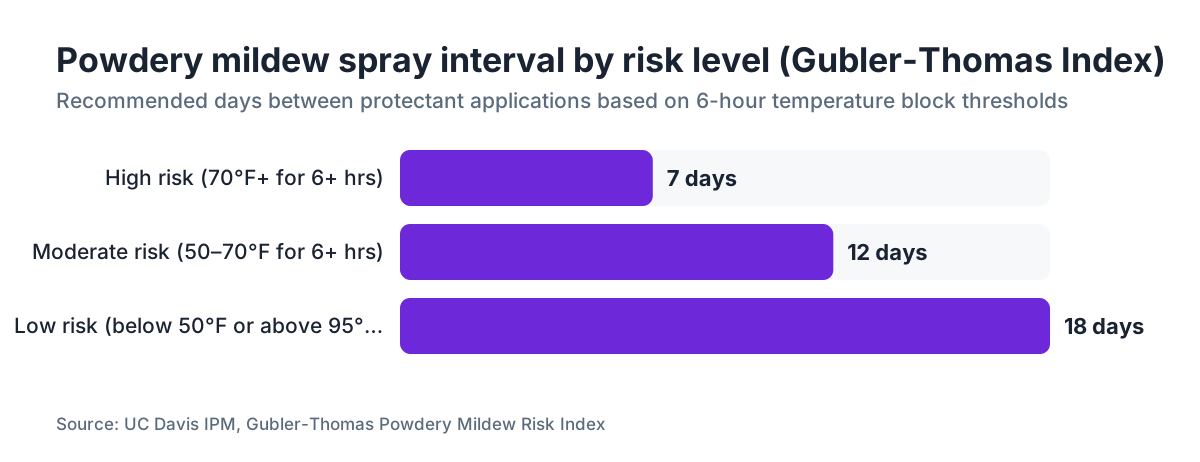
The Gubler-Thomas Powdery Mildew Risk Index (also called the UC Powdery Mildew Index) turns temperature into a spray decision. It sorts conditions into three bands:
| 6-hour temperature block (°F) | Risk category | Spray interval |
|---|---|---|
| At or above 70°F for 6 or more consecutive hours | High (index 60+) | Every 7 days |
| 50 to 70°F for 6+ hours | Moderate | Every 10 to 14 days |
| Below 50°F or above 95°F | Low or no infection | Can extend interval |
Temperatures above 95 degrees F actually shut down spore germination, which hands desert regions a natural break through the hottest stretch of summer. At 100 degrees F, established mycelium doesn't die, it just pauses. Cornell University's IPM program notes that Northeast humidity keeps the moderate-risk window running almost nonstop from late April through harvest, so spray intervals in New York or Pennsylvania rarely stretch past 10 days [2].
Here's the timing rule worth taping to the sprayer: if you're not applying a protectant by the time shoots hit 3 to 6 inches, you're already behind.
What fungicides actually work against grape powdery mildew?
Five fungicide classes carry the load against E. necator, and rotating among them isn't a preference. It's the only thing that delays resistance [3][9].
Sulfur is the backbone of nearly every program. Wettable and micronized sulfur are cheap, they work, and after more than 150 years of use the fungus has never developed field resistance to them [1]. The catch: sulfur turns phytotoxic above 95 degrees F and can russet berries or burn leaves if you apply it within two weeks of an oil spray. Rates run 3 to 6 lb per acre per application. Cornell and WSU both list sulfur as the default material for certified organic programs [2][4].
DMI fungicides (FRAC code 3) include myclobutanil (Rally), tebuconazole (Elite), and related materials. They're systemic and curative within 72 to 96 hours of infection at label rates. Resistance is confirmed in California, Oregon, and other states, so hold to two or three consecutive applications at most and rotate to a different FRAC group [3].
SDHI fungicides (FRAC code 7) include boscalid (Endura) and fluxapyroxad. Newer and effective, but resistance has already turned up in some California populations. Same rule: rotate.
QoI fungicides (FRAC code 11) include azoxystrobin (Abound) and trifloxystrobin (Flint). Resistance is widespread in E. necator across the eastern US. WSU's guide recommends holding QoI materials to one application per season, or dropping them entirely where resistance is suspected [4].
Potassium bicarbonate (Kaligreen, MilStop) is a contact material for organic programs. It works mostly by raising leaf-surface pH. No curative activity, so it needs full coverage every 5 to 7 days under heavy pressure.
A workable non-organic rotation: sulfur early, a DMI at bloom, an SDHI mid-season, then back to sulfur post-veraison. Washington State University's pest management guide for wine grapes lays out spray schedules by growth stage that carry over well to most western regions [4].
How does canopy management reduce powdery mildew pressure?
A spray program can't fix a jungle. If you've got double-overlapping shoots, shaded interior clusters, and a shoot wall so dense that droplets bounce off the outer leaves and never reach the fruit, you'll get disease no matter what's in the tank.
Basal leaf removal in the cluster zone, done at or just after fruit set, is probably the most cost-effective cultural move against mildew. Research from Cornell's New York State Agricultural Experiment Station showed that early leaf pulling reduced cluster mildew and improved spray penetration in both Riesling and Concord trials [2]. The target isn't naked clusters. It's one leaf layer between the fruit and open air.
Trellis and training choices matter too. Vertical shoot positioning with proper catch-wire spacing and regular hedging keeps the canopy disciplined. Wide rows (9 feet or more) and an open vine shape move enough air to shorten how long leaves stay wet after rain or fog. In tight plantings, a morning-facing row orientation helps the canopy dry sooner after sunrise.
Summer hedging strips off actively growing shoot tips, which are the most susceptible tissue on the vine. It won't erase new infection sites, but it cuts the total volume of vulnerable tissue. The trade-off: hedging triggers a flush of lateral shoots, themselves susceptible, so your hedge timing and your next spray need to line up.
No canopy geometry makes powdery mildew vanish. But a clean, open canopy lets your spray program do its job, and that shows up as real money in the tank come harvest.
What cultural and organic practices help prevent powdery mildew?
Organic and low-input growers have fewer synthetic tools, but the logic doesn't change: knock down inoculum early, protect susceptible tissue, and never let disease get established before you react.
Dormant copper (copper hydroxide or Bordeaux mixture) applied at or just after budbreak can reduce the viability of overwintering chasmothecia on bark. The evidence for this against powdery mildew specifically is mixed and better documented for downy mildew, but organic programs usually apply it anyway for broader disease suppression.
Mineral oils (JMS Stylet-Oil and similar) have good efficacy against E. necator. They suffocate mycelium and disrupt germination. Rotated with sulfur and potassium bicarbonate, they can hold a program together through a wet season. The hard rule stands: never apply oil within two weeks of sulfur, or you'll burn the vine.
Resistant varieties are the longest game. Marquette, Frontenac, and several Geneva hybrids from Cornell carry partial resistance. UC Davis Foundation Plant Services has spent decades evaluating powdery mildew resistance in Vitis vinifera accessions [5]. For a vineyard already planted to susceptible vinifera, this matters mainly at replant or when you're laying out new blocks.
Sanitation gets less respect than it deserves. Pulling mummified fruit and infected shoot debris after harvest lowers the overwintering chasmothecial load. It won't clear the problem, but it shrinks next season's starting inoculum.
How do you scout for powdery mildew and know if your program is working?
Scouting is where most programs quietly fall apart. Growers spray on a calendar and don't really look at the vines in between. Then they find disease at the point where it's already hard to stop.
A practical routine for a 20-acre block: walk a W pattern, stop at 10 vines per acre or 50 vines per block (whichever is more), and check both sides of five leaves per vine plus the cluster zone. Record the share of leaves with symptoms and the share of clusters affected. Do it every 7 to 10 days from budbreak through veraison [1].
Early symptoms look like a faint oil-spot or silvery patch on the upper leaf surface. Flip the leaf and you'll find the white powdery coating of sporulating mycelium underneath. On clusters around bloom the signs are subtle: a slight discoloration or dusty cast on flower caps or young berries. By the time obvious white growth covers the berries, the damage to those clusters is already done.
On thresholds: UC Davis IPM doesn't publish a single economic threshold for powdery mildew the way it does for insects, because the link between early infection and final crop damage is sharply nonlinear. The working threshold pre-bloom is essentially zero tolerance. Post-veraison the skins have hardened and susceptibility drops fast.
Accurate scouting records, with dates, growth stages, and incidence percentages, are the only way to tell whether your program is holding or whether breakthrough disease is signaling resistance or bad coverage. A digital spray and scouting system like VitiScribe makes it easier to line up application dates against temperature data and flag trouble before it becomes crop loss.
What are the spray timing intervals and how does weather affect them?
Spray intervals aren't fixed dates. They're windows set by temperature, growth rate, and the protection window of whatever you're applying.
For protectant materials (sulfur, potassium bicarbonate, copper), the protection window runs 7 to 14 days under normal conditions and collapses to 5 to 7 days during rapid shoot growth or after rain washes off residue. DMI fungicides carry both protectant and curative activity: the curative window is about 72 to 96 hours post-infection, and their field protectant window runs roughly 10 to 14 days.
Rain works against you two ways. It strips off contact materials, so more than an inch within 3 to 4 days of a sulfur spray usually means reapplying sooner than planned. It also raises leaf wetness. But unlike downy mildew, E. necator doesn't need free water to germinate. Relative humidity above 40 percent is enough [11]. That's why dry, windy regions still see real disease pressure when nighttime humidity climbs.
WSU's pest management guide for wine grapes recommends starting applications at budbreak (2 to 4 inch shoots) no matter what you see, because some overwintering inoculum is always present, and waiting for symptoms guarantees you're reacting instead of preventing [4].
For compliance, every application needs a dated record with the product name, EPA registration number, rate, water volume, growth stage, and applicator name. The EPA's Worker Protection Standard requires that pesticide application records be kept for two years and be accessible to workers requesting safety information [6].
How do you manage fungicide resistance to powdery mildew?
Resistance is real and getting worse in California and parts of the Pacific Northwest. A 2019 UC Davis survey found DMI resistance in E. necator populations across multiple California wine regions, with some populations showing reduced sensitivity to myclobutanil specifically [3].
The rules aren't complicated. They just take discipline.
Rotate FRAC groups. Never apply two sprays in a row from the same FRAC code without inserting a material from a different group between them. The code is printed on every fungicide label [9].
Limit DMI applications to two or three per season. Some labels allow more. From a resistance standpoint, more is worse, not better.
Use full labeled rates. Cutting rates to save money is a documented path to faster resistance. The fungi that survive a sublethal dose are exactly the ones carrying partial resistance.
If a material that worked last year starts letting disease through, don't crank up the rate. Stop that class and switch to a different mode of action. Send a sample to your local extension plant pathologist if you can; some labs run sensitivity assays.
Keep sulfur as the resistance-proof backbone. E. necator has never developed field resistance to sulfur in over 150 years of vineyard use [1][9]. That's not a reason to spray sulfur alone. It's a reason to never drop it from the rotation.
What are the EPA Worker Protection Standard requirements for vineyard fungicide applications?
If you have employees in the vineyard, the EPA's Worker Protection Standard applies to every pesticide application, fungicides included [6]. It's not optional, and the penalties are real.
The restricted-entry interval (REI) is printed on every label and has to be honored. For most sulfur products the REI is 24 hours. For some systemic fungicides it runs 12 to 24 hours. Workers can't enter treated areas during the REI without the specific PPE the label calls for.
Application records must include the product name, EPA registration number, active ingredient, location treated, rate, and the date and time of application. Keep them for two years and show them to workers or their representatives on request [6].
You also have to post pesticide safety information (the WPS safety poster) in a central spot every worker can reach, and designate an application exclusion zone around equipment during applications.
Training is its own requirement. Agricultural workers and pesticide handlers must get WPS safety training before entering treated areas for the first time, and it renews every year. Keep those training records too.
For a manager juggling multiple blocks and crews, keeping all this straight without a paper avalanche is exactly where digital record-keeping pays for itself. VitiScribe's spray record module is built around the WPS fields, so records come out complete by default instead of getting patched together later.
How is powdery mildew management different for organic vineyards?
Organic programs have real limits but they aren't helpless. The approved materials (sulfur, copper, mineral oils, potassium bicarbonate, kaolin clay) genuinely work when you apply them on the right schedule.
The biggest gap from conventional programs is the loss of systemic curative activity. None of the organic materials give you the 72 to 96 hour post-infection rescue window that DMI fungicides do. So you can't fall behind and catch up. Every stretched interval during a high-pressure stretch carries more risk than it would in a conventional program.
Sulfur rates in organic programs often run at the top of the labeled range (5 to 6 lb per acre) to push contact efficacy. Some certifiers have specific documentation rules for sulfur and copper, since copper is allowed but builds up in soil over time. The National Organic Program requires that copper inputs be managed to minimize accumulation [7].
Kaolin clay (Surround WP) works as a physical barrier for some growers. Its efficacy against powdery mildew is modest and it does more against leafhoppers and mites, but inside a dense spray program it can trim overall disease pressure.
UC's organic viticulture materials and Cornell's organic program both carry updated powdery mildew recommendations [1][2]. WSU's guide covers the Pacific Northwest [4]. If you're transitioning to organic, get your program reviewed by your certifier before the season starts, not after three applications are already in the ground.
What does powdery mildew cost in lost yield and quality, and is prevention worth the money?
Direct yield losses from severe powdery mildew run 30 percent to over 90 percent depending on variety, infection timing, and region [1]. The more common hit isn't a wiped-out crop, though. It's downgraded quality: cracked berries, volatile acidity from secondary infections, and wine faults that surface months later in the bottle.
On the cost side, a conventional powdery mildew program runs roughly $150 to $400 per acre per season depending on materials, application count, and local labor. Sulfur programs sit at the low end. Programs leaning on newer SDHI or DMI materials cost more per pass but often buy longer intervals.
There's no clean national cost-benefit dataset for vineyard disease management, and regional swings in pressure, variety, and market value make any single figure meaningless. But the math is easy to run for your own block. Sell fruit at $1,500 per ton, lose 20 percent of a 4-ton-per-acre yield to mildew downgrade or culls, and that's $1,200 per acre gone against a $200 to $300 spray program. Prevention wins by a mile.
For high-value blocks at $3,000-plus per ton, the case for aggressive programs (pricier SDHI materials, tighter intervals) is obvious. For lower-value juice or raisin operations, sulfur plus good canopy management is often the sensible ceiling on spend.
For how vineyard economics and block-level calls stack up in practice, see how other growers approach input budgeting at vineyards.
Frequently asked questions
What is the very first spray you should apply for powdery mildew prevention?
Apply a sulfur-based protectant when shoots are 3 to 6 inches long, at or just after budbreak, before any symptoms show. UC Davis research shows the pre-bloom window is the highest-risk period, and skipping this first application puts you behind in ways later sprays often can't fix. Wettable sulfur at 3 to 5 lb per acre is the standard first pass in both organic and conventional programs.
Can powdery mildew spread without rain?
Yes. Unlike downy mildew, Erysiphe necator doesn't need free water to germinate and infect. It spreads through dry airborne conidia and only needs relative humidity above about 40 percent to proceed. Warm, dry weather with cool nights sits close to ideal for the pathogen. That's why arid regions like parts of California still see heavy mildew pressure despite low rainfall.
What temperature kills powdery mildew on grapevines?
Temperatures above 95 degrees F shut down conidial germination and new infections. Above 104 degrees F, exposed mycelium can die. But mycelium already inside plant tissue is somewhat shielded, so high heat slows spread without clearing established infections. Below 50 degrees F the fungus essentially stops growing but survives. The comfortable range for active infection is roughly 65 to 77 degrees F.
How often should you spray for powdery mildew in a high-pressure year?
Every 7 days for protectant materials (sulfur, potassium bicarbonate) during high-risk periods, especially pre-bloom through fruit set. DMI fungicides can stretch to 10 to 14 days under moderate pressure. The UC Davis Powdery Mildew Risk Index, built on 6-hour temperature blocks, is the best free tool for setting your interval to real conditions instead of a fixed calendar.
Is sulfur safe to use on all grape varieties?
Most vinifera varieties tolerate sulfur well within labeled rates and temperature limits. The key restrictions: don't apply when temperatures will top 95 degrees F within 24 to 48 hours, and don't apply within two weeks of an oil spray. Some varieties, notably Concord and several native American types, show sulfur sensitivity. Check the label and your variety's known tolerance before the first application.
What's the difference between powdery mildew and downy mildew on grapes?
Powdery mildew (Erysiphe necator) produces white powdery growth on the upper leaf surface, needs no free water to spread, and peaks in warm dry weather with moderate humidity. Downy mildew (Plasmopara viticola) produces oily yellow spots on upper surfaces with white sporulation underneath, and needs free water or heavy dew to infect. They call for different fungicide classes and often different spray timing.
Can you eat grapes with powdery mildew on them?
Mildewed grapes are safe to eat in the sense that E. necator isn't toxic to humans. The quality problem is real, though: infected berries often crack, develop off-flavors, and carry secondary infections like Botrytis or sour rot. Wine from heavily mildewed fruit usually shows musty or bitter character that doesn't age out. For table fruit, cosmetic standards mean mildewed clusters get culled entirely.
What FRAC codes should you rotate for grape powdery mildew resistance management?
The main groups against E. necator are FRAC 3 (DMIs like myclobutanil, tebuconazole), FRAC 7 (SDHIs like boscalid), FRAC 11 (QoIs like azoxystrobin, though resistance is widespread in the eastern US), FRAC M2 (sulfur, no resistance), and FRAC M1 (copper). Never apply two sprays in a row from the same FRAC group. Use full labeled rates, and treat sulfur as the non-negotiable backbone of the rotation.
How do you treat powdery mildew that has already appeared on clusters?
Once symptoms hit clusters, switch immediately to a DMI fungicide with curative activity. Myclobutanil or tebuconazole applied within 72 to 96 hours of infection can stop spread. Past that window, you're protecting healthy clusters, not reversing damage to infected ones. Remove and destroy infected clusters where practical in small or high-value blocks. Tighten spray frequency to 7 days and review coverage, because visible cluster disease usually means canopy penetration was inadequate.
Do you need to spray for powdery mildew after veraison?
Generally no, or at much reduced frequency. After veraison berry skins thicken and susceptibility drops sharply. But if you have heavy leaf disease, a reduced program through harvest can limit defoliation and protect vine health for next season. Leaves stay susceptible, and severe late-season leaf infection cuts carbohydrate storage going into dormancy. Most programs taper to one or two post-veraison applications rather than stopping cold.
How long do you need to keep pesticide application records in a vineyard?
Under the EPA's Worker Protection Standard, pesticide application records must be kept a minimum of two years and be accessible to workers or their representatives on request. Some states go further: California requires pesticide use reports filed with the county agricultural commissioner within 7 days of application, with records kept for three years under state law. Check your state's requirements alongside the federal WPS.
What grape varieties are most resistant to powdery mildew?
Most Vitis vinifera varieties (Chardonnay, Cabernet Sauvignon, Pinot Noir) are highly susceptible. Varieties bred with resistance genes from Muscadinia rotundifolia or other species show partial or good resistance: Marquette, Frontenac, La Crescent, and Geneva hybrids from Cornell's breeding program. These are mostly cold-climate hybrids. No major commercial vinifera variety is fully resistant, though UC Davis Foundation Plant Services keeps evaluating accessions with partial resistance traits.
How does leaf removal help prevent powdery mildew?
Basal leaf removal in the cluster zone, done at or just after fruit set, increases air circulation around clusters, lowers humidity at the fruit level, and improves spray penetration. Cornell research showed it reduced cluster mildew and improved coverage across multiple trials. The recommendation is to pull leaves on the east-facing or morning-sun side so clusters get early sun to dry dew without the afternoon heat that causes sunburn.
What records do I need for a powdery mildew spray program under the EPA WPS?
Every record must include the product name, EPA registration number, active ingredient, crop and location treated, total amount applied, application date and time, and the name of the certified applicator or handler. Keep records for two years minimum and make them available to workers requesting safety information. Posting the central pesticide safety information display, including the WPS safety poster, is a separate but simultaneous requirement under 40 CFR Part 170.
Sources
- UC Davis IPM, Powdery Mildew of Grape: Erysiphe necator overwinters as cleistothecia in bark and as mycelium in buds; the Gubler-Thomas risk index defines spray intervals by 6-hour temperature blocks; the pre-bloom window is the highest-risk period
- Cornell University Integrated Pest Management Program: Northeast humidity keeps the moderate-risk infection window nearly constant from late April through harvest; early basal leaf removal reduced cluster mildew and improved spray penetration in Riesling and Concord trials
- UC Agriculture and Natural Resources, DMI Resistance in Erysiphe necator (2019 California survey): DMI resistance confirmed in E. necator populations in multiple California wine regions; reduced sensitivity to myclobutanil documented
- Washington State University Extension, Pest Management Guide for Wine Grapes in Washington: QoI materials recommended limited to one application per season due to widespread resistance; programs should begin at budbreak regardless of visible disease pressure
- UC Davis Foundation Plant Services, Grapevine Disease and Variety Evaluation: UC Davis FPS evaluates powdery mildew resistance in Vitis vinifera accessions; no major commercial vinifera variety is fully resistant
- EPA Worker Protection Standard, 40 CFR Part 170: Pesticide application records must be kept for two years minimum and be accessible to workers requesting safety information; REI and AEZ requirements apply to all WPS-covered applications
- USDA National Organic Program: NOP requires that copper inputs be managed to minimize soil accumulation in certified organic operations
- California Department of Pesticide Regulation, Pesticide Use Reporting Requirements: California requires pesticide use reports filed with county agricultural commissioner within 7 days of application; records must be kept for three years
- Fungicide Resistance Action Committee (FRAC), FRAC Code List for Plant Pathogens: FRAC codes 3 (DMI), 7 (SDHI), 11 (QoI), M2 (sulfur), and M1 (copper) are the primary resistance management groups for grape powdery mildew; sulfur (M2) has no documented field resistance
- UC Davis IPM, Gubler-Thomas Powdery Mildew Risk Index Model Description: Temperatures above 95°F inhibit conidial germination; the infection cycle can complete in 5-7 days under ideal conditions (65-77°F, 40-100% RH)
Last updated 2026-07-09