How irrigation affects vineyard soil health and structure
TL;DR
- Irrigation shapes vineyard soil chemistry, structure, and biology.
- Overwatering raises salinity, breaks down aggregates, and pushes out beneficial microbes.
- Deficit irrigation, done right, deepens roots and improves water-use efficiency.
- The right amount depends on your soil texture, rootstock, and regional ET data.
- Get it wrong and the damage compounds season over season.
What does irrigation actually do to vineyard soil?
Irrigation does far more than wet the ground. Every time you run a drip line or flood an alley, you move salts, reshape pore structure, feed or starve microbes, and shift the pH that decides which nutrients your vines can reach. Most of it happens where you cannot see it, and it accumulates for years before it shows.
Healthy soil is mostly space. A good loam at field capacity holds roughly 50 percent solids, 25 percent water, and 25 percent air-filled pores [1]. Chronic overwatering wrecks that balance. Macro-pores fill, oxygen drops, and the block starts favoring anaerobic bacteria and root pathogens over the aerobic organisms that cycle nutrients.
Three mechanisms matter most: physical breakdown of soil aggregates, salt buildup from irrigation water and fertilizers, and shifts in the soil food web. Each one drives the others. Salty water disperses clay, which collapses aggregates, which slows drainage, which keeps soil wetter longer, which shuts down aerobic microbes. That chain runs both directions depending on how you manage water. Manage it well and the same feedback loop works in your favor.
How does irrigation water quality affect soil salinity in vineyards?
Water quality is the variable most managers underestimate. Irrigation water carries dissolved salts, and every application leaves a small share of them in the root zone as the water evaporates or gets pulled into the vine. Over a season, it adds up fast.
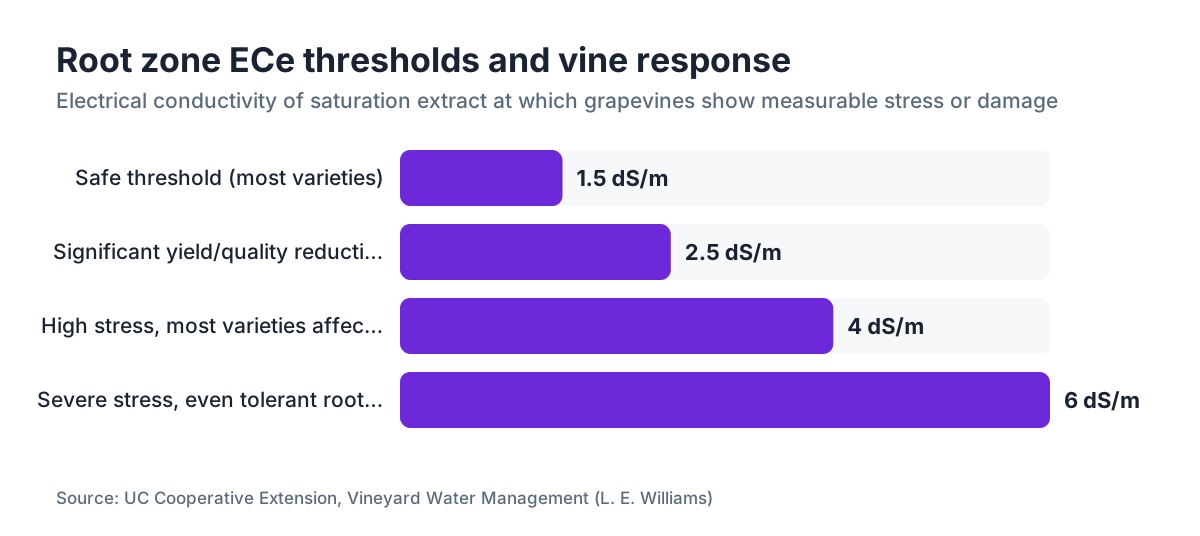
Measure the electrical conductivity (EC) of your irrigation water and compare it to your soil's saturation extract EC (ECe). UC Davis guidelines say grapevines lose yield and quality once ECe passes 1.5 dS/m in the root zone, and most wine grape varieties hit serious stress above 4.0 dS/m [2]. Some rootstocks handle more. None handle it forever.
Sodium is the ion to watch beyond general salinity. High sodium raises the Sodium Adsorption Ratio (SAR) of the soil. Once SAR climbs past roughly 13 (the exact threshold shifts with soil texture), sodium shoves calcium and magnesium off clay exchange sites, clay particles disperse, and aggregates fall apart. You end up with a surface crust that sheds water and a compacted subsurface layer that chokes drainage. Washington State University Extension has documented this in Columbia Basin vineyards, where irrigation water SAR above 6 caused measurable structural damage within three to five years [3].
Calcium amendments, gypsum especially, push back against sodium. One to two tons of gypsum per acre improves infiltration in sodium-affected soils, though the repair runs far slower than the damage did. Get a water quality report from your irrigation district every year, and test your well if you pull from groundwater. Do not skip it. The problem stays invisible right up until the drainage fails.
Does drip versus flood irrigation affect soil structure differently?
Yes, and the gap is wide enough to change your long-term management.
Flood irrigation saturates large volumes of soil over and over. That fast wet-dry cycle is hard on aggregates, especially in clay-heavy ground. The wetting front swells clay particles, and as they dry they shrink back unevenly, slowly breaking down the granular structure that keeps soil porous. In UC Davis research plots, flood-irrigated blocks showed measurably lower macroporosity than drip-irrigated blocks on the same soil after five years [4].
Drip applies water slowly and locally, holding more of the soil at moderate moisture. That protects aggregate stability. But drip brings its own headaches. Salt piles up at the edge of the wetted bulb, and if emitter spacing does not match vine spacing, you leave dry zones between vines where roots struggle to establish. You also concentrate whatever chloride or sodium your water carries into a few predictable spots.
Micro-sprinklers land between the two. They wet a wider area than drip at lower volumes than flood, which helps on coarse, sandy soils where a drip bulb will not spread far enough sideways to feed the whole root zone.
The practical call: on medium to fine-textured soils in dry regions, drip is better for soil structure. It just demands better filtration, more monitoring, and real attention to leaching fractions so salt does not build up. Pick drip and commit to the maintenance, or the structure advantage evaporates.
How does over-irrigation cause soil compaction and drainage problems?
Compaction from irrigation is part direct, part secondary. Direct compaction happens when heavy equipment rolls over wet soil, and most irrigation events leave the soil wet. Secondary compaction happens as chronic saturation kills off the biology and chemistry that keep soil loose.
Earthworms, fungal hyphae, and roots build soil structure in a well-run vineyard. Earthworm populations crash in soils that stay saturated, because their burrows flood and oxygen drops [5]. Those burrows are macropores that move water straight down. Lose the worms, lose the vertical drainage. Fungal hyphae, mycorrhizal networks in particular, glue soil particles into aggregates with glomalin and other exudates. Anaerobic conditions shut fungal activity down and cut glomalin output, so aggregates weaken.
Here is the field sign of a saturation problem: ponding that lasts more than four to six hours after irrigation on a slope, or twelve to twenty-four hours on a flat block. Seeing that? Pull a soil probe in the wet spot and read the profile. A gray or bluish mottled zone in the subsoil means periodic anoxia, a condition called gleying, and it tells you drainage is broken at depth.
Gypsum helps on sodic soils. Deep ripping (24 to 36 inches) opens compacted layers, but it only buys time unless you change whatever caused the compaction. Fix the water first. Everything else is a bandage.
What happens to soil microbiology when vineyards are irrigated?
The science here has moved fast in the last decade, and the headline is blunt: soil moisture regime shapes microbial community composition more than almost any other single management factor.
A 2019 study in Applied Soil Ecology compared drip-irrigated, flood-irrigated, and dry-farmed vineyard blocks on California's Central Coast. Dry-farmed blocks had higher fungal-to-bacterial ratios and more mycorrhizal fungi, both tied to better nutrient cycling and drought adaptation [6]. Irrigated blocks, flood especially, tilted bacterial and showed lower mycorrhizal colonization.
That does not make irrigation bad for soil biology. It makes timing and volume everything. Mild water stress between irrigations, meaning you let the soil dry to a moderate deficit before the next event, raises microbial diversity in most studies. Constant high moisture flattens diversity toward the few organisms that tolerate wet feet.
Nitrogen cycling is the most sensitive piece. Denitrification, where bacteria turn nitrate into nitrogen gas and vent it to the air, jumps sharply once soil moisture passes 60 percent of water-holding capacity. In an over-irrigated block you can lose a big share of applied nitrogen as gas before the vine touches it. Cornell's viticulture program has documented denitrification losses of 15 to 30 percent of applied nitrogen fertilizer in over-irrigated Finger Lakes vineyard soils [7].
Irrigate to support the vine, not to hold soil at constant high moisture, and you keep more of your soil's biological capital in the bank.
How does deficit irrigation change root depth and soil exploration?
Regulated deficit irrigation (RDI) and partial rootzone drying (PRD) do more than save water. They reshape the whole root architecture, and with it, which soil layers the vine works.
Keep the upper soil consistently moist and the vine has no reason to root deep. Shallow roots face wider temperature swings, more salt near the surface, and more competition from cover crops. They also fail first if your irrigation goes down during a heat event.
Deficit irrigation pulls roots toward water at depth. WSU's irrigated viticulture program found vines under moderate RDI between berry set and veraison grew root systems 20 to 30 percent deeper than fully irrigated controls on the same soil, measured over three years [3]. Deeper roots tap subsoil mineral reserves that never show up in a fertilizer plan, and they buffer the vine against surface chemistry problems.
The catch: deficit irrigation on shallow soils, or soils with a restrictive hardpan, drives roots into a zone they cannot get past, which concentrates stress instead of relieving it. Know your profile before you commit. Dig a hole. That costs a shovel and an hour. A failed season costs a lot more.
For the record, logging irrigation events next to soil moisture readings and vine stress indicators like stem water potential gives you the data trail that makes year-over-year comparisons real. That is the kind of field log VitiScribe is built to organize, tying irrigation records to vine and soil data in one place.
How does irrigation affect soil pH and nutrient availability in vineyards?
Irrigation moves pH two ways: the pH of the water itself, and the salt and bicarbonate load it carries.
Bicarbonate-rich water is common across Western irrigation districts, California and the Pacific Northwest especially. Wet the root zone repeatedly with high-bicarbonate water and soil pH climbs over time. Above pH 7.5, iron, manganese, and zinc lock into forms the vine cannot absorb, even when those elements sit abundant in the soil. You see interveinal chlorosis that ignores foliar iron sprays, because the problem lives at the root, not the leaf.
Acidic water is rarer, but it shows up in some coastal regions with high organic-acid runoff, and it drags pH down. Below pH 5.5, aluminum and manganese turn soluble and potentially toxic. Below pH 5.0, phosphorus fixation rises and some beneficial bacteria decline.
The fix for high-bicarbonate water is acid injection, usually sulfuric or citric acid through a Venturi injector, to neutralize bicarbonate before it hits the root zone. Aim for water pH of 6.0 to 7.0 at the emitter. UC Cooperative Extension's vineyard water management guide walks through acid injection rates based on your water's bicarbonate concentration [2].
Nutrient mobility shifts with moisture too. Boron moves easily in water and leaches under high volumes. Potassium moves less but stacks up at the soil surface under drip when rainfall is low. Calcium and magnesium ride the wetting front. Match your amendments and fertigation to your irrigation system type, or your nutrition program will keep surprising you.
| Nutrient | Behavior under high irrigation | Behavior under deficit irrigation |
|---|---|---|
| Nitrogen (nitrate) | High mobility, leaching risk | Moderate mobility, less loss |
| Potassium | Surface accumulation under drip | Deeper distribution with wetting front |
| Boron | Leaches readily | Concentrated in drying zone |
| Iron | Reduced availability if pH rises | Generally stable |
| Calcium | Moves with wetting front | Concentrated near emitter |
| Sodium | Accumulates in root zone | Accumulates at drying boundary |
What soil moisture sensors actually tell you about irrigation timing?
The gap between guessing and knowing your irrigation timing is mostly a sensor problem. Tensiometers, capacitance probes, and gypsum blocks each measure something a little different, and which one fits depends on your soil texture and how much maintenance you will tolerate.
Tensiometers read matric potential directly, in centibars. They shine in sandy to loamy soils and stay reliable from 0 to about 80 centibars. Most wine grapes get irrigated to hold matric potential between 20 and 50 centibars in the active root zone during the season, with stress windows intentionally letting values reach 60 to 80 centibars [8]. Tensiometers need regular refilling and quit working below 80 centibars because the water column breaks.
Capacitance probes read volumetric water content across the full range, saturation to air-dry. They shrug off soil salinity better than tensiometers, but they need calibration to your specific soil. A probe calibrated for loam will lie to you in a sandy clay loam.
Gypsum blocks are cheap and low-maintenance, which suits smaller operations, but they respond slowly and read best in the 20 to 100 centibar range. They are poor on fast-drying sand.
Here is where any sensor earns its keep: put one at 12 inches for the active root zone and another at 24 to 30 inches for the subsoil. The gap between the two readings tells you whether water moves through the profile or stalls in a compacted layer. If the deep sensor never wets during irrigation, you are not reaching the full root zone. If it wets instantly and stays wet, drainage is poor and you are over-applying.
How does irrigation interact with cover crops and organic matter in vineyard soil?
Cover crops and irrigation are not separate decisions. How you manage water decides whether your cover crop is an asset or a drain.
In dry climates, a resident cover crop competes with vines for water head to head. Research in California's San Joaquin Valley found mowed cover crops in every row raised vine water stress by an amount equal to about 20 percent of vine water use during the driest stretch of the season [9]. You can manage that with irrigation, but it means the cover crop draws from your water budget, not from rainfall.
Cover crops build organic matter, and organic matter changes how irrigation behaves. Soil at 2 to 3 percent organic matter holds roughly twice the plant-available water per inch of depth as soil at 0.5 to 1 percent [1]. That buffer changes your irrigation frequency math. It also stiffens aggregate stability, so cover-cropped soils survive wet-dry cycles with less structural damage.
Timed termination is the tool that ties it together. Kill the cover crop in spring, before peak vine water demand in summer, and you keep the organic matter benefit without the mid-season competition. Where you are already water-limited, that timing carries real weight. Where summer irrigation runs freely, you get more room to leave covers growing.
Organic matter also feeds the microbes. Irrigation schedules control how fast organic matter decomposes, since wetter and warmer soils burn it faster, so your water choices set your organic matter trajectory whether you plan for it or not. A block held chronically wet through summer heat can burn through organic matter inputs faster than the cover crop replaces them.
What do EPA and worker protection rules say about irrigation in spray record and chemical management contexts?
Irrigation runs into compliance in two spots that are easy to miss if you are only thinking about water.
First, the EPA's Worker Protection Standard (WPS) restricts entry into treated fields during restricted-entry intervals (REIs). Irrigation workers who go into a block to service drip lines or move equipment during an active REI have to meet the same WPS requirements as spray crews, PPE and handler training included [10]. This is where record-keeping gaps become compliance problems, because the irrigation log and the spray record usually sit with different people.
Second, some pesticides carry specific instructions on irrigation timing after application. Soil-applied herbicides often need irrigation to activate, with a set window of a quarter to one inch within 24 to 72 hours. Foliar fungicides can require a minimum dry period before irrigation to prevent washoff. These are label requirements, which carry the force of federal law under FIFRA. Ignoring them is more than an agronomic miss. It is a violation.
Many California vineyard operators enrolled in the Irrigated Lands Regulatory Program also have to keep irrigation logs documenting water application volumes and timing for Regional Water Quality Control Board compliance. Requirements shift by region and permit tier, but the general rule holds: if your operation clears the enrollment threshold, your irrigation records become regulatory documents.
Keeping spray and irrigation records in one system, time-stamped and tied to specific field blocks, is the cleanest way to catch these overlaps. VitiScribe links spray events to field-level calendars, so the connection between chemical applications and irrigation timing shows up in a single record.
The federal WPS text lives at 40 CFR Part 170 [10]. California's Irrigated Lands program runs through the State Water Resources Control Board [11].
How do arid and humid vineyard regions differ in irrigation's soil effects?
The soil moisture you start with, before a drop of irrigation, decides how much damage or benefit you can do.
In arid regions like Washington's Columbia Valley, California's Coachella Valley, or southeastern Australia, growing-season rainfall is minimal and soils often run slightly to moderately saline on their own. Every irrigation event is the main water input, so salt management dominates. Without a leaching fraction, usually 10 to 15 percent of total water applied beyond crop demand, salts pile up in the root zone steadily [3]. Annual leaching events, scheduled in late fall when vines sit dormant, are standard.
In humid regions like the Finger Lakes, the Willamette Valley, or Bordeaux, rainfall covers a real chunk of vine water needs and irrigation only fills the dry spells. Here the compaction and drainage effects get amplified, because soils already sit at higher moisture from rain. Add irrigation on top and you push toward saturation fast. The biology concern flips too: humid-region soils carry richer native microbial communities, so chronic over-irrigation does more damage to that community than the same mistake would in an arid region where baseline microbial density is lower.
Dry farming, no irrigation at all, works in parts of humid regions and coastal California. It generally builds deeper roots and lower yields with higher solute concentration in the berries, which some winemakers chase. The soil effects run consistently positive on structure and biology, though vine stress in drought years can turn severe depending on rootstock and soil depth.
Neither system wins across the board. Your answer comes from your soil, your water source, your target yield, and your climate.
What soil tests should vineyard managers run to track irrigation's effects over time?
One soil test taken once tells you where you are. Annual or biennial tests from the same spots tell you where you are headed, and the trend is what actually drives decisions.
The core panel for tracking irrigation effects: EC and pH of the saturation extract (ECe and pHe), sodium and SAR, available calcium, magnesium, and potassium, boron, and organic matter percentage [2]. Run these at two depths, 0 to 12 inches and 12 to 24 inches, because irrigation stratifies chemistry vertically in ways a single sample hides.
For biology, baseline measurements of total organic carbon, active carbon (which responds faster to management than total organic matter), and if the budget allows, microbial biomass carbon or a biological activity index like the Haney test, give you leading indicators of whether your soil is gaining or losing function.
Sample consistently: same time of year (post-harvest is common), same moisture conditions, same grid location. GPS-mark your sampling spots and pull a historical report each year. That is the only way to see whether soil EC is trending up or down against your water management. A three-year trend in the wrong direction is usually reversible. A ten-year trend is not.
Water testing belongs on the same schedule. Test your source annually for EC, pH, SAR, chloride, bicarbonate, and boron. On a canal system, test at the start and end of the season separately, because surface-source water quality often shifts hard between spring runoff and late summer.
Frequently asked questions
How much water do wine grapes actually need per acre per season?
Total seasonal water use for wine grapes runs about 12 to 30 inches per acre, depending on climate, canopy size, and variety. Arid regions like eastern Washington or California's Central Valley sit on the high end. Cool coastal sites run much lower. UC Cooperative Extension publishes reference evapotranspiration (ET) data by region, letting you calculate vine water demand week by week using a crop coefficient of roughly 0.35 to 0.85 depending on growth stage. [2]
Can you over-irrigate a vineyard on sandy soil?
Yes, though the mechanism differs from clay. Sandy soils drain fast, so water moves below the root zone before the vine uses it, carrying nitrate and other mobile nutrients along. Over-irrigation on sand causes leaching losses and can raise the water table in low-lying spots. Frequent light applications matched to vine ET beat infrequent heavy sets on sand. A sensor at 18 to 24 inches confirms whether water is dropping below the root zone.
What is a safe electrical conductivity level for vineyard irrigation water?
UC Davis guidelines say irrigation water EC below 0.75 dS/m is generally safe for most wine grape varieties. Between 0.75 and 1.5 dS/m, monitor root zone EC and maintain an adequate leaching fraction. Above 1.5 dS/m, root zone salt accumulation becomes a real risk over time, and rootstock selection and leaching management start to matter. The threshold varies by rootstock; some tolerate higher EC than others. [2]
Does irrigation timing during the day affect soil and vine health?
Early morning irrigation is generally best because it limits leaf wetness, cutting fungal disease pressure, and takes advantage of lower evaporation before temperatures climb. Nighttime irrigation works well for drip, where emitter-area evaporation is not a concern. Midday irrigation during heat can cause thermal shock in shallow root zones where wet surface soil heats fast. The soil surface temperature gap between irrigated and non-irrigated zones can top 10 to 15 degrees Fahrenheit.
How does irrigation affect soil-borne diseases like Phytophthora in vineyards?
Phytophthora cinnamomi and related water molds need free water in soil pores to produce and move zoospores. Chronic over-irrigation that holds soils near saturation for long stretches sharply raises Phytophthora pressure. Root rot from Phytophthora is one of the most common irrigation-linked disease problems in California and Pacific Northwest vineyards. Keeping soil moisture below saturation, improving drainage, and avoiding irrigation right after rainfall are the main management tools.
Is dry farming really better for vineyard soil than irrigation?
Dry farming generally builds better soil structure and higher biological diversity over time, because it avoids the aggregate breakdown and salt buildup irrigation brings. Studies consistently show deeper roots and higher mycorrhizal colonization under dry-farmed vines. The tradeoff is yield, which can run 30 to 60 percent lower in drier years, plus a longer establishment period without supplemental water. Dry farming works only where seasonal rainfall clears about 16 to 20 inches and soils hold adequate water-holding depth.
How often should vineyard soil be tested to catch irrigation-related problems early?
Annual testing is ideal for the first three to five years after any major change in irrigation system or schedule. After that, testing every two years from fixed GPS-marked spots is usually enough if nothing is trending wrong. Add a water quality test at the same interval. The numbers that matter most for irrigation effects are root zone ECe, SAR, and sodium, plus soil pH at two depths. Problems caught within one to two years of onset are almost always correctable.
What rootstocks handle salty irrigation water best?
Rootstocks vary meaningfully in chloride and sodium exclusion. 140 Ruggeri and 1103 Paulsen rate as more salt-tolerant, while Riparia Gloire and SO4 run more sensitive. Rootstock tolerance is no substitute for managing water quality, though. Even the most tolerant rootstocks show yield and quality hits at root zone ECe above 4 to 5 dS/m over multiple seasons. UC Davis's Foundation Plant Services publishes rootstock comparison data that includes salinity tolerance ratings.
What is a leaching fraction and do all vineyards need one?
A leaching fraction is the share of applied irrigation water that moves below the root zone, carrying salts out with it. It is the ratio of drainage water to applied water. Arid-region vineyards with irrigation water EC above about 0.5 dS/m generally need a leaching fraction of 10 to 20 percent to keep root zone salt in check. Humid-region vineyards that catch substantial rainfall often get enough leaching from rain and skip a deliberate leaching fraction during the season.
How do irrigation practices need to be documented for regulatory compliance?
Requirements vary by state and region. In California, operations enrolled in the Irrigated Lands Regulatory Program must keep records of water application volumes, timing, and source for management plan compliance. Nationally, EPA WPS compliance requires pesticide application records be coordinated with irrigation schedules when irrigation workers enter treated blocks during restricted-entry intervals. Irrigation logs that carry date, block, volume applied, and source make it simple to cross-reference against spray records during inspections.
Can fertigation through drip systems cause soil chemistry problems?
Yes. Injecting fertilizers through drip concentrates nutrients in the wetted bulb. Potassium in particular stacks up at the surface around emitters when application rates outrun vine uptake. That creates potassium-rich zones that can suppress magnesium and calcium uptake through ionic competition, causing deficiency symptoms even when soil tests show adequate total levels. Matching fertigation rates to weekly vine demand, instead of dumping large monthly doses, cuts this stratification sharply.
Does regulated deficit irrigation hurt berry quality?
Moderate deficit irrigation from berry set through veraison generally improves red wine grape quality by controlling berry size, concentrating anthocyanins and flavor compounds, and reining in excessive canopy growth. Research from WSU and UC Davis consistently shows stem water potentials held between negative 8 and negative 12 bars during this window produce better color and tannin than fully irrigated controls. Severe stress, below negative 14 bars, starts cutting photosynthesis and can cause permanent shoot damage.
What happens to soil carbon when irrigation is increased?
The relationship is not clean. Moderate irrigation boosts plant growth and root turnover, adding carbon to the soil. But high irrigation rates in warm climates also speed microbial decomposition of existing organic matter, which can cause a net carbon loss even as inputs rise. The balance point depends on your temperature regime and the quality of organic inputs. Cool, well-irrigated soils tend to accumulate carbon. Hot, over-irrigated soils often do not, because decomposition outpaces input.
Sources
- UC Cooperative Extension, Vineyard Water Management publication (L. E. Williams): Grapevines show yield and quality reduction when ECe exceeds 1.5 dS/m; irrigation water EC below 0.75 dS/m is generally safe; bicarbonate management via acid injection targets pH 6.0 to 7.0 at emitter
- Washington State University Extension, Irrigated Viticulture program: SAR values above 6 in Columbia Basin irrigation water caused measurable soil structural damage within three to five years; deficit-irrigated vines developed root systems 20 to 30 percent deeper than fully irrigated controls over three years; leaching fraction of 10 to 15 percent recommended in arid regions
- UC Davis, Department of Viticulture and Enology: Flood-irrigated blocks showed measurably lower macroporosity than drip-irrigated blocks on the same soil type after five years
- Applied Soil Ecology (Elsevier), 2019 California Central Coast vineyard soil microbiology study: Dry-farmed blocks had higher fungal-to-bacterial ratios and greater mycorrhizal fungi abundance; irrigated blocks showed bacterial dominance and lower mycorrhizal colonization; soil moisture regime shapes microbial community composition more than almost any other single management factor
- Cornell University Grapes and Wine program (Cornell CALS): Denitrification losses of 15 to 30 percent of applied nitrogen fertilizer documented in over-irrigated vineyard soils in the Finger Lakes region
- UC Cooperative Extension, Soil Moisture Monitoring for Irrigated Agriculture: Most wine grape varieties are irrigated to maintain matric potential between 20 and 50 centibars in the active root zone; stress periods intentionally allow values to climb to 60 to 80 centibars
- UC Cooperative Extension, Cover Crops and Water Use in California Vineyards: Mowed cover crops in every row increased vine water stress by an amount equivalent to about 20 percent of vine water use during the driest part of the season in San Joaquin Valley research plots
- U.S. EPA, Agricultural Worker Protection Standard, 40 CFR Part 170: Irrigation workers who enter a treated field during an active restricted-entry interval must meet the same WPS requirements as handler workers, including PPE and training
- California State Water Resources Control Board, Irrigated Lands Regulatory Program: California vineyard operators subject to the Irrigated Lands Regulatory Program must maintain irrigation logs documenting water application volumes and timing as part of Regional Water Quality Control Board compliance
- WSU Extension, Deficit Irrigation and Vine Water Status in Wine Grapes: Stem water potentials maintained between negative 8 and negative 12 bars during berry set to veraison produce better color and tannin development than fully irrigated controls; severe stress below negative 14 bars reduces photosynthesis and can cause permanent shoot damage
Last updated 2026-07-09