How long from veraison to picking Noiret grapes
TL;DR
- Noiret reaches harvest 45 to 55 days after veraison, putting the pick window in late September to mid-October across most northeastern and Great Lakes regions.
- Cornell's Geneva station, which released the variety in 2006, ranks Noiret as a mid-to-late ripener.
- Target 22 to 25 Brix, pH 3.3 to 3.6, and TA around 6 to 8 g/L before you pull fruit.
What is veraison in Noiret and why does it matter for timing your harvest?
Veraison is the moment Noiret berries shift from hard and green to soft and dark, the point where sugar accumulation takes over from growth as the berry's main job. It's the starting gun for your harvest countdown. Get the veraison date wrong and every downstream estimate is off.
In most northeastern and Great Lakes plantings, Noiret hits veraison between late July and mid-August, depending on growing degree day accumulation and the site. Cornell's New York State Agricultural Experiment Station at Geneva, which released Noiret in 2006 after more than two decades of breeding, puts veraison for this variety roughly 7 to 10 days after Concord at Geneva, New York [1]. That's a useful local benchmark if you grow both.
The practical rule: walk your rows and call veraison when roughly 50 percent of berries in the cluster have fully changed color and softened. Some growers use 80 percent, which adds a few days but gives a cleaner signal. Pick one threshold and stick to it every year. Your "days from veraison" number only means anything if veraison is defined the same way each season.
How many days does Noiret typically take from veraison to harvest?
Noiret runs about 45 to 55 days from veraison to optimal harvest, per Cornell's work with the variety [1]. That range is wider than it sounds in practice. Cool, cloudy late summers push toward 55 days; warm, sunny ones compress the window toward 45.
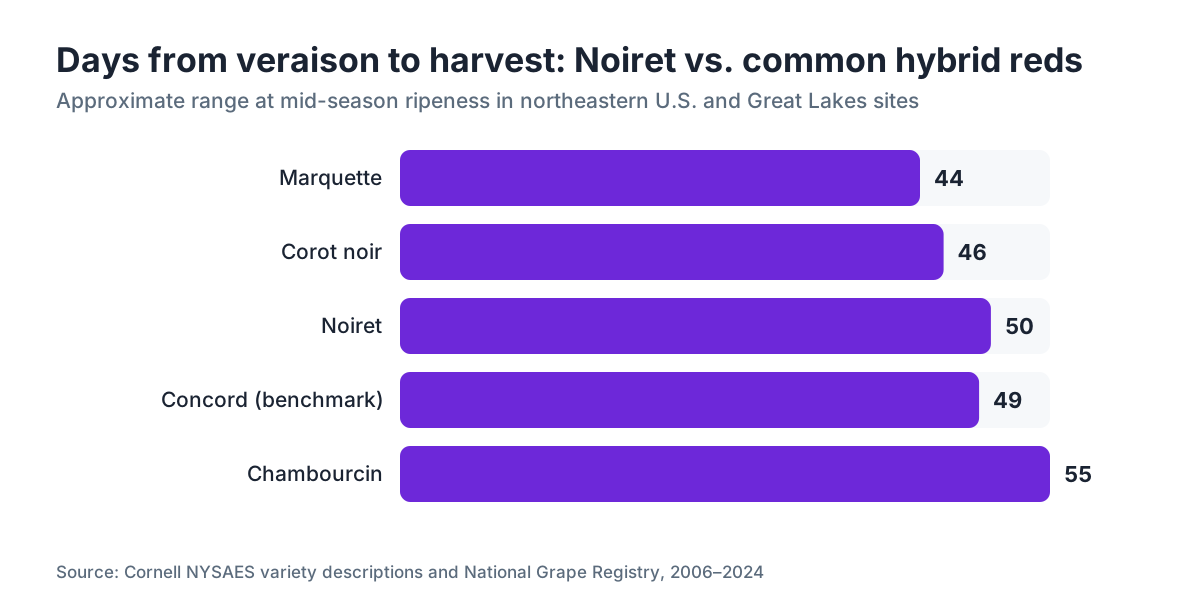
Here's how Noiret sits relative to other hybrid reds you might grow alongside it:
| Variety | Approx. days veraison to harvest | Ripening class |
|---|---|---|
| Marquette | 40 to 48 | Mid |
| Noiret | 45 to 55 | Mid-late |
| Chambourcin | 50 to 60 | Late |
| Corot noir | 42 to 50 | Mid |
| Concord (benchmark) | 45 to 52 | Mid-late |
Data drawn from Cornell extension variety trial records and the National Grape Registry [1][2].
Noiret's skin handles some hang time without falling apart, which is one of the variety's real advantages. That tolerance has limits. In wet autumns, Botrytis and sour rot can move through a cluster faster than Brix accumulation justifies waiting. You're watching two clocks at once.
What Brix, pH, and TA should Noiret hit before you pick?
Days-from-veraison is a planning tool, not a pick trigger. The real decision comes from chemistry and sensory evaluation together.
Cornell's published targets for Noiret dry red wine: 22 to 25 Brix, pH 3.3 to 3.6, titratable acidity (TA) 6 to 8 g/L as tartaric acid [1]. Those ranges are wide on purpose. Where you land depends on your style. A lighter, earlier-picked Noiret at 22 Brix and TA near 8 g/L gives you a brighter, more structured wine. Pushing to 24 to 25 Brix risks higher pH and lower TA as the season cools acids, so watch the pH-TA relationship closely in the final two weeks.
Sensory checks matter as much as the refractometer. Crush a cluster in your hand and taste the juice. Seeds should be fully brown (green seeds mean phenolic maturity is lagging), and the skins should release some tannin without tasting raw or astringent. Noiret is known for a black pepper and spice character, and that aroma tends to peak right around 23 to 24 Brix in most seasons.
Sample at least 100 berries from multiple spots in the block (ends, middles, low-vigor and high-vigor zones) for each chemistry reading. A single cluster pulled off the ends of rows can mislead you by two full Brix.
When does Noiret harvest typically fall on the calendar?
In the Finger Lakes and Hudson Valley of New York, Noiret harvest runs from late September through mid-October [1]. In Pennsylvania's Lake Erie region and similar Great Lakes climates, expect the same general window, sometimes a week earlier on warmer south-facing slopes.
In Virginia and Maryland, where some Noiret planting followed Cornell's release, the variety tends to be ready slightly earlier, sometimes mid-to-late September, because veraison arrives sooner in a warmer base climate. Nobody has published solid multi-site data across every Noiret-planted state, so these are informed estimates built on the Geneva station data and regional degree-day accumulations, not multi-year replicated trials.
Growing degree days (GDD, base 50°F) give you an earlier signal than the calendar. Cornell places Noiret harvest at roughly 2,400 to 2,600 GDD (base 50°F) accumulated from April 1 [1][3]. Track your site's GDD from the start of the season and you'll see the window coming two to three weeks out.
How do growing degree days predict the Noiret pick window?
GDD forecasting beats calendar date for Noiret because the variety responds to heat accumulation. The math is simple: add up the daily average temperature minus 50°F (ignore negative values) from April 1 onward. When your running total nears 2,400, start pulling fruit samples every three to four days.
NOAA's Climate Data Online tool and several state climate offices publish daily GDD summaries by station [3]. Cornell's Network for Environment and Weather Applications (NEWA) gives vineyard-specific degree-day tracking calibrated to New York and surrounding states [4]. If your state has no NEWA coverage, the nearest NOAA cooperative weather station is the next best thing.
One honest caveat: those GDD thresholds come from Geneva, NY data. If your site runs warmer or cooler than that benchmark, adjust. A south-facing hillside might hit the same Brix at 2,300 GDD; a frost pocket might need 2,700. Two or three seasons of paired GDD-plus-Brix records at your own site will beat any generic table.
How does Noiret's ripening compare to other hybrid reds you might be growing?
Noiret sits in the mid-to-late camp among hybrid reds, which matters for equipment scheduling and cellar readiness. Growing Marquette and Noiret in the same block or adjacent blocks? Expect Marquette to come in roughly a week earlier, giving you a natural stagger. Chambourcin usually runs a week or more behind Noiret.
That stagger helps small operations where harvesting everything in one week would be impossible. It also means Noiret is sitting in the vineyard into October at northern sites, which raises frost risk. Noiret has reasonable cold hardiness (dormant vines rated to about -5°F to -10°F at the primary bud), but a hard early frost in late September or early October can damage the fruit itself before you pick [1][2].
For vineyard planning, Noiret's mid-late slot means your spray program runs longer than for early varieties, and you need to account for that in the PHI (pre-harvest interval) calculations for any fungicide or pesticide applied during the season.
What pest and disease pressure should you watch in the final weeks before picking?
The five weeks between veraison and harvest are when Botrytis cinerea and sour rot can move fast, especially in tight-clustered vineyards with dense canopies. Noiret clusters are moderately compact, not as tight as some Vitis vinifera varieties, but tight enough to hold moisture after rain.
If you spray a fungicide during the pre-harvest window, PHI compliance is non-negotiable. Check the label of every product. EPA-registered fungicides like captan (PHI typically 0 days at certain rates, but read your specific label), sulfur (PHI 0 days for many formulations), and mancozeb (PHI 66 days for wine grapes under some labels) carry wildly different windows [5]. A 66-day PHI means an application at veraison could still be inside the restriction at 50 days out.
The EPA Worker Protection Standard (WPS) also applies here. Under the Agricultural Worker Protection Standard (40 CFR Part 170), you must post restricted-entry intervals (REI) in a central location, provide pesticide safety training before workers enter treated areas, and keep application records for at least two years [6]. These rules don't relax because harvest is close. If anything, harvest crews raise your exposure risk.
Scouting for spotted lanternfly (Lycorma delicatula) is worth doing in mid-Atlantic and northeastern states where it has established. Heavy infestations in the final ripening weeks cause juice leakage and secondary fungal issues.
How do you decide the exact day to pick Noiret?
Start sampling three weeks before your estimated harvest date. Pull 100-berry samples from at least three spots in the block (skip the end vines), crush and press them, then measure Brix with a calibrated refractometer or must hydrometer, pH with a calibrated pH meter, and TA by titration or a commercial lab. Log every reading with date and location.
When Brix climbs 0.3 to 0.5 per day and pH starts to rise more steeply, you're in the final week. A sudden rainfall can dilute Brix by 1 to 2 points temporarily; wait three to four days post-rain before drawing conclusions from a reading.
Taste. Walk the rows at the same time each morning. The black pepper and berry character should be clear and forward. Vegetal or herbaceous notes mean the fruit isn't there yet. Shriveling berries and raisiny flavors mean you've waited too long for a dry table wine (though that might be interesting for a late-harvest style).
For records, log your sample dates, locations, Brix, pH, TA, weather, and the initials of whoever pulled the sample. If you're using a field operations platform like VitiScribe to track sample data alongside your spray records, you can cross-reference PHI calculations with your chemistry trend lines in one place, which helps a lot in a compressed harvest window.
Call the pick when two consecutive readings across multiple sample points hit your target range and sensory evaluation agrees. Don't let a winery schedule override the fruit.
What records do you need to keep from veraison through harvest?
Compliance recordkeeping doesn't pause at harvest. It peaks. Under the EPA Worker Protection Standard, pesticide application records must be kept for at least two years and include the product name, EPA registration number, active ingredient, amount applied, date, time, location, and applicator [6]. If you applied anything in the 30 days before harvest, those records need to be current and accessible.
Beyond federal requirements, many state departments of agriculture require harvest records as part of annual grape crush reporting. New York, Pennsylvania, Virginia, Michigan, and Ohio all run mandatory crush report programs [7]. These typically ask for total tons harvested, Brix at harvest, and variety, filed within 30 to 60 days of harvest depending on the state.
For your own operation, keep a harvest log with the date fruit was picked, block ID, variety (Noiret), tons or pounds harvested, Brix at pick, pH, TA, picking crew size, and any field notes on disease or weather. This data feeds next year's planning and satisfies most state crush report requirements.
What does Noiret's ripening tell you about site selection and canopy management?
Cornell bred Noiret for northeastern and Great Lakes conditions, and its 45 to 55 day post-veraison window was designed to clear October frost dates in those regions [1]. That's the variety working as intended. If your average first frost falls before October 10, Noiret is pushing the edge, and you need to manage every variable to compress that window.
Canopy management is the biggest lever you have. Shoot positioning, leaf removal in the fruit zone (done at or shortly after fruit set, not at veraison), and cluster thinning all affect how quickly and evenly the fruit ripens. Removing one to two basal leaves on the east/morning-sun side of the canopy at fruit set can advance veraison by improving air circulation and cluster exposure. WSU's extension resources on canopy management for hybrid reds support this approach for improving ripening in short-season sites [8].
Cluster thinning to one cluster per shoot at veraison, on a vine carrying a heavy crop, can redirect energy and close the gap by three to five days in some seasons. Nobody has published a rigorous Noiret-specific thinning trial, but the principle is well established in the broader hybrid red literature and in practical grower experience across the Finger Lakes.
How has Cornell's breeding work shaped what we know about Noiret ripening?
Noiret (NY73.0136.17) was released by the Cornell University New York State Agricultural Experiment Station in 2006, after development work stretching back to the 1970s [1]. The parentage includes Chancellor, Steuben, and several other selections, which shapes its mid-late ripening character and disease resistance.
Cornell's published variety description is the primary source for Noiret's phenological data. The station describes it as ripening roughly one week after Concord at Geneva, with the black pepper aroma attributed to rotundone, the same compound behind that character in Syrah. Rotundone concentration in Noiret peaks at or just before full phenolic maturity, which lines up well with the 23 to 24 Brix harvest window [1][9].
The University of Minnesota and Penn State extension programs have also evaluated Noiret in their regions and generally confirm Cornell's baseline timing, though Minnesota sites tend to push harvest earlier because veraison comes sooner in their continental climate.
What should you do if a frost is coming before Noiret is fully ripe?
This is a real scenario at northern sites, and the answer is not always "pick immediately." A light frost at 29 to 31°F for a short duration usually causes limited berry damage if clusters are intact and the canopy gave any buffer. A hard frost at 27°F or below for two or more hours will cause cell damage and juice leakage that opens the door to rapid microbial spoilage.
If a hard frost is forecast and your Noiret is at 20 to 21 Brix with acceptable pH and TA, picking and making a lighter-bodied wine beats losing the crop. A Noiret at 21 Brix is still fermentable and can make a clean wine with the right cellar adjustments.
Wind machines and overhead irrigation (for frost protection) can buy you extra days, but the economics only pencil out if the infrastructure is already in place. Overhead irrigation during a freeze adds ice weight to the canopy, which can cause mechanical damage. It works by releasing latent heat as water freezes, but it demands continuous application until temperatures rise above 32°F.
If you do harvest under frost pressure, get the fruit to the winery or press pad fast. Don't let damaged clusters sit in bins in poor conditions.
Frequently asked questions
How long after veraison should I expect to pick Noiret?
Plan on 45 to 55 days after veraison for Noiret in most northeastern and Great Lakes sites. Warm, sunny late summers compress that to the lower end; cool, cloudy seasons push it toward 55 days. Cornell's Geneva station, which released the variety, puts harvest roughly one week after Concord, itself a 45 to 52 day post-veraison ripener. Use chemistry and sensory evaluation to call the actual pick date.
What Brix is Noiret typically at when it's ready to pick?
Cornell's target range for Noiret dry red wine is 22 to 25 Brix. Most growers making a balanced table wine aim for 23 to 24 Brix, where the variety's black pepper character is most pronounced. Check Brix with a calibrated refractometer on 100-berry samples from multiple points in the block. A single-cluster reading is not reliable.
What pH and TA should Noiret be at harvest?
Cornell's published targets: pH 3.3 to 3.6 and titratable acidity 6 to 8 g/L as tartaric acid. As Noiret approaches 24 to 25 Brix, pH tends to rise and TA tends to fall, so if you're pushing for maximum ripeness, check pH carefully in the final week. A pH above 3.6 at harvest raises your risk of microbial instability in the winery.
When on the calendar does Noiret harvest typically fall in New York?
At Cornell's Geneva, NY station and in most Finger Lakes and Hudson Valley vineyards, Noiret harvest falls in the last week of September through mid-October. Warmer sites and south-facing slopes can see it as early as the third week of September. In mid-Atlantic states like Virginia, expect the window to open roughly one to two weeks earlier than the Finger Lakes average.
How do growing degree days help predict Noiret harvest?
Noiret reaches harvest at roughly 2,400 to 2,600 growing degree days (base 50°F, accumulated from April 1). When your site's GDD total nears 2,400, begin pulling berry samples every three to four days. NOAA's Climate Data Online and Cornell's NEWA platform both provide vineyard-relevant GDD tracking. Calibrate the threshold to your own site over two to three seasons for the best accuracy.
How does Noiret's ripening timing compare to Marquette or Chambourcin?
Marquette comes in about one week before Noiret, making it a mid-ripener. Chambourcin runs roughly one to two weeks after Noiret, putting it in the late category. This natural stagger helps small operations that can't handle multiple varieties in the same week. Corot noir falls between Marquette and Noiret. Cornell extension and National Grape Registry trial data support these relative rankings.
Can Noiret hang too long on the vine?
Yes. Beyond about 55 days post-veraison in most years, you risk rising pH, falling TA, and raisiny overripe flavors that overwhelm Noiret's pepper and berry character. In wet autumns, Botrytis and sour rot can move through a cluster before visual symptoms are obvious. Hang time tolerance is one of Noiret's strengths, but it's not unlimited. Taste the fruit; don't rely only on the calendar.
What pre-harvest interval rules apply to fungicide applications on Noiret?
PHIs vary widely by product. Mancozeb carries a 66-day PHI for wine grapes under some label registrations, meaning an application at veraison could still be within the restriction at a 50-day harvest. Sulfur and captan have much shorter PHIs, often zero to seven days, depending on the specific product label. Always read the current label, which is the legal document. The EPA's pesticide label portal is at epa.gov.
What records do I need to keep through harvest for compliance?
Under the EPA Worker Protection Standard (40 CFR Part 170), pesticide application records must be retained for two years, including product name, EPA registration number, active ingredient, rate, date, and location. Most states with grape crush programs also require harvest reports within 30 to 60 days of harvest, covering tons, variety, and Brix. Keep a harvest log with date, block ID, chemistry readings, and crew size at minimum.
Does Noiret need cluster thinning to ripen in time?
In heavy crop years, thinning to one cluster per shoot at or just after veraison can advance ripening by roughly three to five days and improves evenness across the block. No published Noiret-specific thinning trial exists, but the response is consistent with other hybrid reds in the literature and is standard practice among experienced Noiret growers in the Finger Lakes. Thinning after veraison is too late to change fruit load economics meaningfully.
What should I do if a frost threatens before Noiret is fully ripe?
A hard frost at 27°F or below for more than two hours can cause cell damage and juice leakage that leads to rapid spoilage. If your Noiret is at 20 to 21 Brix and a hard frost is forecast, picking and adjusting in the winery is usually better than losing the crop. A light frost at 29 to 31°F for a short duration often causes minimal damage if clusters are intact. Get fruit to the winery quickly after any frost event.
How does leaf removal affect Noiret's ripening time?
Removing one to two basal leaves on the morning-sun side of the canopy at fruit set, not at veraison, improves air circulation and cluster sun exposure. This can advance veraison by a few days and promote more even ripening throughout the cluster. WSU extension recommends this approach for hybrid reds in short-season sites. Leaf removal done at veraison or later carries sunburn risk and has minimal ripening benefit.
Where was Noiret developed and who should I contact for regional trial data?
Noiret (NY73.0136.17) was released in 2006 by Cornell University's New York State Agricultural Experiment Station in Geneva, NY. The breeding program ran from the 1970s onward. For regional trial data, contact Cornell Cooperative Extension's viticulture team (cce.cornell.edu), Penn State Extension, or the University of Minnesota Horticultural Research Center, all of which have evaluated Noiret in their respective climates.
Is Noiret worth growing if I'm in a site that gets frost before October 15?
Noiret was designed for exactly that situation. Its 45 to 55 day post-veraison window and good cold hardiness make it one of the better hybrid red choices for sites with a first frost in early to mid-October. Marquette finishes faster if your frost risk is extreme. The real decision is whether the style Noiret produces fits your market. At sites with average first frost before October 10, focus on canopy and crop load management to keep the window as short as possible.
Sources
- USDA Agricultural Research Service, National Grape Registry: Noiret variety registration data, parentage, and comparative ripening class relative to other hybrid reds
- NOAA National Centers for Environmental Information, Climate Data Online: Growing degree day accumulation data by station, base 50°F, used to estimate crop phenology and harvest timing
- Cornell University Network for Environment and Weather Applications (NEWA): Vineyard-specific growing degree day tracking calibrated for New York and surrounding states
- EPA Pesticide Product Label System: Pre-harvest intervals for fungicides including mancozeb (66 days for wine grapes under some registrations), captan, and sulfur on wine grapes
- EPA Agricultural Worker Protection Standard, 40 CFR Part 170: Pesticide application records must be retained for at least two years; WPS posting, training, and REI requirements apply through harvest
- USDA National Agricultural Statistics Service, Grape Crush Reports: State mandatory grape crush report programs require harvest tonnage, variety, and Brix reporting within 30-60 days of harvest
- Washington State University Extension, Canopy Management for Wine Grapes: Leaf removal in the fruit zone at or shortly after fruit set improves air circulation and advances ripening in short-season hybrid red varieties
- American Journal of Enology and Viticulture, Rotundone in Noiret and Syrah: Rotundone concentration in Noiret peaks at or near full phenolic maturity, consistent with the 23-24 Brix harvest window and the variety's characteristic black pepper aroma
- Penn State Extension, Hybrid Grape Varieties for Pennsylvania: Noiret harvest timing evaluation in Pennsylvania sites confirming Cornell's baseline phenological data
- Cornell Cooperative Extension, Fruit Resources for Grape Growers: Regional viticulture guidance for Noiret and other hybrid reds in New York and northeastern states
Last updated 2026-07-10