How to document under-vine herbicide strip applications in block records

TL;DR
- Every under-vine herbicide strip application needs the product name, EPA registration number, target site, application date, method, rate per treated acre (or per linear foot), operator name, and REI.
- EPA's Worker Protection Standard and most state ag departments require records kept at least two years.
- Forgetting the rate-per-acre conversion for the strip is the single most common audit finding.
Why under-vine strip applications get documented differently from full-block sprays
A full-block spray is easy paperwork: multiply the label rate by block acres, done. An under-vine herbicide strip is a partial-area treatment, and that changes almost everything about how you calculate, record, and defend the application on paper.
The strip covers a fraction of the block, usually the 18-to-36-inch band directly under the canopy wire. Record the label rate as if you sprayed the whole block and you've overstated the amount applied. Inspectors from your state department of agriculture or an organic certifier will catch that the moment they hold your purchase records against your field logs. That mismatch can trigger a formal notice of violation.
There's a liability side most managers ignore until something breaks. If a worker enters the treated zone during the restricted-entry interval (REI) and there's an incident, your application record is exhibit A. A record that can't say where inside the block the product went protects nobody.
Here's the good news. Once you build the right template, logging a strip application takes about as long as logging any other spray. The work is setting the system up correctly the first time.
What fields does a legally compliant herbicide application record have to include?
A compliant herbicide record has eight core fields at a minimum: product name, EPA registration number, application date, treated location, target pest, total product applied, applicator name, and the REI. The EPA Worker Protection Standard (40 CFR Part 170) sets the federal floor, and most states add to it [1].
Here are the fields that show up in nearly every state mandate and in WPS at the same time:
- Product name (as it reads on the label)
- EPA registration number
- Application date
- Location of application (block name or number, plus a description of the treated area)
- Pest(s) targeted
- Total amount of product applied
- Name of the certified applicator or operator
- Restricted-entry interval for workers
For a strip application, "location of application" has to say the treatment was limited to the under-vine strip, not the full block. Writing "Block 7" is not enough. Write "Block 7, under-vine herbicide strip, 24-inch band centered on vine row." That one sentence closes most audit gaps.
The rate field is where strip records break. You have two defensible options. Record the label rate (oz or lb per treated acre) next to the treated acreage you calculated for the strip, or record total product per linear foot of row and note the strip width. Either works, as long as the math is visible and matches the label.
California, Washington, and Oregon all require pesticide use reports filed with the county agricultural commissioner or state agency, and those forms have their own required fields that sometimes go past federal WPS minimums [2][3]. Check your state's ag commissioner or department of agriculture site for the exact form before your first application of the season.
How do you calculate treated acres for a strip instead of a full block?
Treated strip acres equal the strip width divided by the row spacing, times the block's gross acres. That's the whole formula. It's the math step most operators skip, and it's the one that causes trouble at audit time.
Treated strip acres = (strip width in feet / row spacing in feet) × block gross acres
Example: your block is 10 acres, rows are 8 feet apart, and you're treating a 2-foot under-vine strip. Treated fraction = 2 ÷ 8 = 0.25. Treated acres = 0.25 × 10 = 2.5 acres.
That 2.5 acres is the number you use to figure how much product to mix and what to report as treated acreage. It's also the number an auditor checks against your purchase history. If your records say 10 acres treated but you only bought enough herbicide for 2.5 acres, something won't add up.
Rows uneven or the block shaped oddly? Measure three representative row lengths, average them, multiply by strip width and row count. Write down how you got there. A note like "strip width measured 24 in, row spacing 8 ft, 210 rows at avg 310 ft = 2.38 treated acres" hands an inspector exactly what they need.
Some managers record in linear feet per row instead of converted acres, especially on small blocks. That's fine if your label allows a per-linear-foot rate. Many herbicide labels express rates per acre only, so you'll still do the conversion to confirm you're within the labeled rate no matter how you record it [4].
WSU Extension's pesticide education program publishes recordkeeping and rate-calculation guides aimed at Pacific Northwest operations [5].
What does the EPA Worker Protection Standard actually say about application records?
The 2015 revised Worker Protection Standard requires the agricultural employer to keep records of pesticide applications and make specific use information available to workers and their representatives [1]. On retention, EPA states plainly: pesticide application records must be kept "for 2 years from the date of the application."
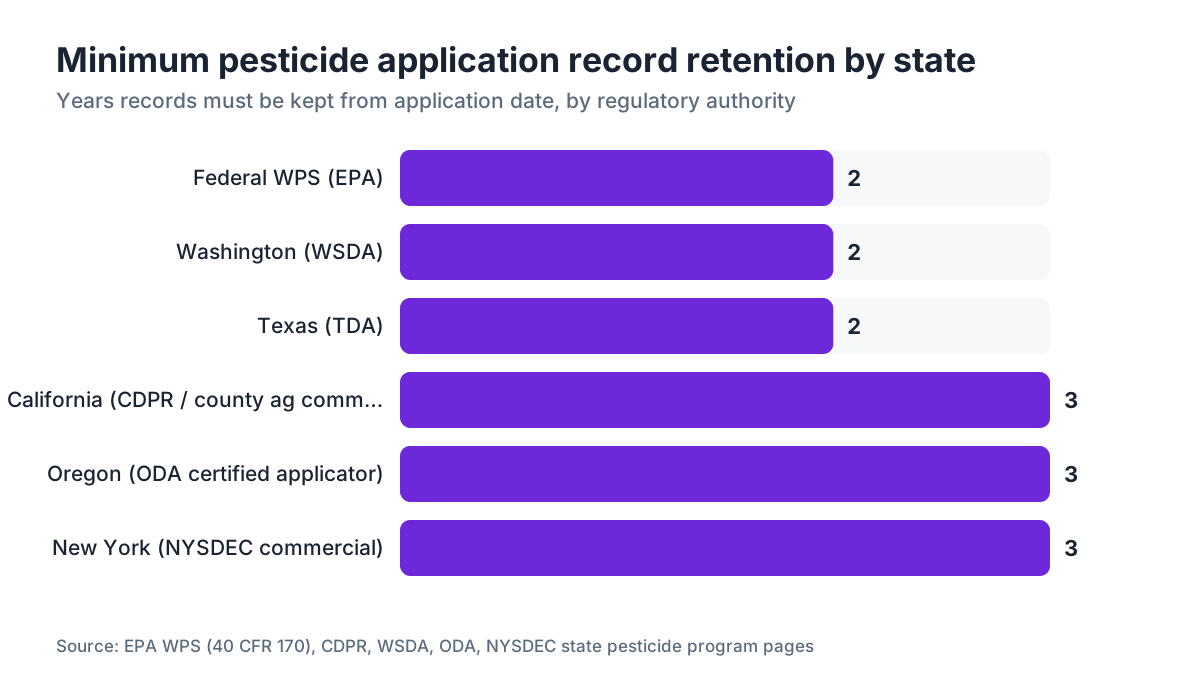
Two years is the federal floor. States can require longer. Oregon requires three years for certified applicator records [12]. California's pesticide use reporting system runs its own retention schedule, and county ag commissioners can pull records going back further during an investigation [2].
WPS also requires you to post or communicate certain facts before workers enter any treated area: product name, EPA registration number, application date and time, and the REI. For under-vine strips, that means your posting or central display has to mark the strip zone inside the block clearly enough that a worker knows whether their task (hand-suckering, irrigation repair) puts them inside the treated area [1].
The 2015 update added a provision many vineyard managers miss. Records must be accessible to workers' designated representatives on request, not only to regulators. So your record format has to be readable by someone who doesn't know your internal shorthand codes.
What information about the application method belongs in the block record?
"Herbicide strip, Block 7" tells you almost nothing six months later. A good application-method entry answers four questions: what equipment, what configuration, what speed or output, and who calibrated it.
Under-vine work usually runs on shielded sprayers, hooded sprayers, recirculating sprayers, or a directed wand. Record which one. If you used a shielded boom, note the shield type and whether it touched the vines. That detail matters if you later see vine injury and have to trace it.
Nozzle type and pressure belong here too. Log GPA (gallons per acre of treated area), because that number is your main tool for proving you hit the label rate. Say your record shows 2 oz per treated acre but you sprayed 5 GPA of a 5 oz/gal mix. The math says you applied 25 oz per acre, 12.5 times the stated rate. That's an over-application, and it's the kind of thing that surfaces in enforcement actions and drift investigations.
Speed is worth logging for strip work because many shielded systems are speed-sensitive. Change your mph and you change your rate even with the same pump setting. Write down the operating speed. A note like "Shielded sprayer, TeeJet 8004 nozzles, 20 PSI, 3.2 mph, calibrated 04/15" gives you a full audit trail and helps you chase efficacy problems later.
Operator name and license or certification number (if the product requires a licensed applicator in your state) belong in every record. Some states want the certified applicator number even for products that don't strictly require one, when the operation holds a pest control adviser license.
How should you handle REI and re-entry records for under-vine strips specifically?
The REI for an under-vine strip applies to the treated zone, which in practice means the strip and a reasonable buffer on either side. Workers doing trellis work at head height in the same block may not technically sit inside the REI area if the treatment went below them and they touch no treated surfaces. Most vineyard safety programs still treat any work in a block with an active REI as restricted across the whole block. That's the conservative call, and it's what UC's statewide IPM and pesticide safety guidance points toward for managing WPS liability [6].
Your block record should note the REI start time and the REI end time, more than the duration, because workers and supervisors need to know whether it's safe to enter without doing subtraction in their heads. Write the actual date and clock time: "REI expires 07/14/2025 at 0730" beats "REI 12 hours."
If any early-entry activity happens during the REI, keep a separate log for it: who entered, when, what PPE they wore, and whether the label's early-entry PPE requirements were met. That log doesn't have to live inside the main block record, but it has to be stored with it. Auditors look for both documents together.
Keep a copy of the product label in your records or in a binder in the spray shop. Under WPS the label has to be accessible to workers and handlers [1]. For a strip herbicide application, that usually means the label on-site during application and through the REI.
What does a well-built block record template look like for strip herbicide applications?
A strong template covers WPS, California and Washington reporting fields, and an organic certification audit in one structure. Here's one that does all three (for non-restricted zones treated before organic conversion, or for exempt materials):
| Field | Example entry |
|---|---|
| Block ID / Name | Block 7 / Hillside Cab |
| Treatment zone | Under-vine strip, 24-in band, Row 1 to Row 210 |
| Application date | 2025-06-12 |
| Start time | 0630 |
| End time | 0845 |
| Product name | Glyphosate 41% SL |
| EPA Reg. No. | 62719-176 |
| Target pest | Annual grasses, broadleaf weeds |
| Gross block acres | 10.0 ac |
| Strip width | 24 in |
| Row spacing | 8 ft |
| Treated acres (calculated) | 2.50 ac |
| Label rate | 2.25 lb ae/treated ac |
| Total product applied | 5.625 lb ae (calculated) |
| Dilution / mix ratio | 4 oz/gal in 200 gal water |
| Total mix volume | 200 gal |
| Equipment | Shielded sprayer, 3-pt hitch |
| Nozzle / pressure / speed | TeeJet 8003, 18 PSI, 3.0 mph |
| Applicator name | J. Rivera |
| Applicator cert. no. | CA-123456 |
| REI | 4 hours (expires 2025-06-12 at 1045) |
| Wind speed and direction | 5 mph SE at application |
| Temperature | 68°F |
| Adjuvants | None |
| Notes | Calibration verified 06/01/2025 |
You won't fill every field on every application, but keep them all in the template so nothing gets dropped under time pressure. Wind speed and temperature aren't required by WPS. They matter anyway, for defending against drift complaints and for diagnosing vine injury if it shows up.
A tool like VitiScribe can pre-populate block geometry and row spacing from your vineyard map, so treated acres compute themselves instead of you doing the math by hand in the field. That's the real time-saving argument for digital records: not less data, just less manual calculation.
How do organic certification and CCOF audits treat under-vine herbicide strip records?
On a mixed block where some rows are certified organic and adjacent rows got a synthetic herbicide, your certifier needs to see exactly which rows or zones received what. Under the USDA National Organic Program (7 CFR Part 205), prohibited substances applied to any part of a certified field can trigger decertification or restart the three-year transition period [7].
For blocks in organic transition, a record that says "herbicide applied to Block 7" without noting it was limited to a non-certified border row is an audit failure waiting to happen. The strip detail in your block record is literally what keeps a row in certification.
CCOF, OTCO, and similar certifiers ask to see your records during annual inspections and sometimes unannounced visits [8]. They look for product identity (to confirm the material is allowed under NOP), rate and calculation method, and treated-zone description. Cornell's viticulture and enology program has guidance on organic system plans that speaks to this record specificity [9].
One practical note. Treating a transition-block strip with an NOP-compliant material like a citric acid or clove oil product still needs the same documentation. Allowed materials still require proper records. Plenty of operators assume the compliance pressure disappears with synthetic-free products, then get surprised at inspection.
How long do you have to keep herbicide application records, and who can request them?
The federal WPS floor is two years from the application date [1]. Several major wine-grape states go longer. Here's how five compare:
| State | Minimum retention period | Primary authority |
|---|---|---|
| California | 3 years (PUR records) | CDPR / county ag commissioner |
| Washington | 2 years | WSDA Pesticide Management Division |
| Oregon | 3 years (certified applicator records) | ODA Pesticide Program |
| New York | 3 years (commercial applicator) | NYSDEC |
| Texas | 2 years | TDA Pesticide Programs |
Sources: CDPR [2], WSDA [3], ODA [12], NYSDEC.
Who can request these records? More people than most managers expect. Under WPS, workers and their designated representatives can request pesticide application information. County ag commissioners can subpoena records in a drift or injury investigation. Organic certifiers require access under your certification agreement. Sell grapes to a winery with a third-party audit requirement (LODI Rules, SIP Certified), and those auditors can request field records as part of their program too [10].
Store records so you can pull them by block, by date, and by product. A filing cabinet organized by block works. A spreadsheet with sortable columns works. A pile of handwritten notes in a box that eats an hour before you find one application does not. Digital records you can filter and export in minutes are the norm now, not a luxury.
What are the most common documentation errors found in herbicide strip application records?
The single most common error is treating the block as fully treated when calculating rate. State inspectors and organic certifiers see the same mistakes on repeat, and knowing them is the fastest way to fix your records before an audit.
Start with that big one. A record listing the full 10-acre block for a 2.5-acre strip treatment overstates the treated area by 4x. Inspectors hold your records against purchase invoices and catch it immediately.
Second: no treated-area description. "Block 7, herbicide" tells an auditor nothing about where in the block the product went. For strip applications, the description has to say strip.
Third: missing REI expiration time. Recording "12-hour REI" without a calculated expiration date and clock time means a worker showing up the next morning can't tell whether they're safe. That's a WPS violation.
Fourth: no applicator credential. Several states require the certified commercial applicator license number for any restricted-use pesticide, and some require it for general-use products when the operation holds a pest control business license.
Fifth: adjuvants left off. Many herbicide labels require or allow specific adjuvants, and some of those carry their own worker safety requirements. Add a methylated seed oil or non-ionic surfactant, record it by name and rate. It's a label compliance issue: some adjuvant specifications are mandatory label language, legally part of the application requirement [4].
UC's pesticide safety education material for agricultural workers covers several of these points and is worth walking through with your field crew once a year [6].
Should you keep strip application records digitally or on paper, and what does each cost you?
Paper works. Paper is also slow to search, easy to lose, and useless for auto-calculating treated acres. Managing three blocks with one spray date a year? Paper is fine. Managing 20 blocks with four to six herbicide passes a season plus insecticide and fungicide programs? Paper will cost you 30 to 60 minutes every time you rebuild a spray history for an audit or a certification renewal.
Digital records, spreadsheet or purpose-built platform, kill the search and calculation problems. They also make it easy to produce the formatted reports certifiers and auditors want. The trade is setup time and, for paid platforms, subscription cost. Most vineyard record-keeping software runs $300 to $1,200 per year for a small to mid-size operation, though prices swing widely with feature set.
Want to test a structured digital approach before you commit? VitiScribe's trial lets you log block records with strip-specific geometry fields and auto-calculates treated acres from the dimensions you enter. That's the exact friction point most paper users report.
One hybrid that works for small operations: keep a paper field log during application (you're in the tractor cab and it's faster), then move it to a spreadsheet or platform within 24 hours while the details are fresh. Date the entry with the application date, not the transfer date. Your log is the official record; the transfer date carries no legal weight.
How do state pesticide use reports interact with your block records for under-vine strips?
In California, nearly every pesticide application (with limited exceptions for certain minimum-risk materials) has to be reported to the county agricultural commissioner through the Department of Pesticide Regulation's pesticide use reporting system [2]. The report asks for site identification, treated commodity, application date, product and EPA reg number, amount applied, and acres treated. California's system asks specifically for the site-treated acreage, which for a strip is the calculated partial acreage, not the gross block.
Washington's Department of Agriculture requires pesticide application records for commercial operations. Not every application there triggers a formal report (unlike California's blanket reporting), but certified applicators still keep records matching WSDA's required fields [3].
Here's the practical catch. If your county ag commissioner gets a California report showing 2.5 treated acres for Block 7 on June 12, and your block record says 10 treated acres for Block 7 on June 12, you have two official documents that disagree. That's a problem even when neither number is fraudulent. It reads as a recordkeeping failure, which it is. Your block record and your report have to agree on treated acreage.
Simplest fix: fill out your block record first, compute the treated acreage there, and copy that number straight into your report. Don't recalculate it separately for each document.
Frequently asked questions
Do I have to record under-vine herbicide strips separately from my inter-row spray records?
Yes, and for good reason: the treated acreage, equipment, and product are usually different. Mixing them into one record makes it impossible to verify application rates for each zone. Keep a separate record entry for each application event, or at minimum clearly distinguish strip from inter-row in the same log using separate rows. Auditors and certifiers expect to see them separated.
What EPA registration number format should I record, and where do I find it?
The EPA registration number sits on the front panel of the pesticide label in the format XX-XXXX or XXXXX-XX. It identifies the specific registered product and formulation. Record it exactly as printed. If you're unsure which number is the EPA reg number versus the state registration number, the EPA number is always labeled 'EPA Reg. No.' on the label. You can also verify it through EPA's pesticide product label system at https://www.epa.gov/pesticide-registration.
Is there a federal form I should use, or does the format not matter as long as the fields are there?
There's no federally mandated form for WPS pesticide application records. The regulation specifies required fields, not format. You can use paper logs, spreadsheets, or purpose-built software. What matters is that all required fields are present and legible. Some states have their own forms for pesticide use reports (California's is handled through county ag commissioners), but those are filing forms, not your block record.
What happens if a worker enters the treated under-vine strip during the REI?
Under the EPA Worker Protection Standard, unauthorized entry into a treated area during the REI is a violation by the agricultural employer, whether or not harm occurs. You must document the incident: who entered, when, what they were doing, and what corrective action you took. If the worker reports any symptoms, that triggers additional WPS medical access requirements. Keep the application record and the incident report together. Contact your state department of agriculture if you're unsure about reporting obligations.
How do I record a strip application that covers multiple blocks in the same pass?
Create a separate record entry for each block, or a single record with a row per block showing each block's individual treated acreage. Don't aggregate multiple blocks into one treated-acreage figure. Auditors verify block-by-block, and your records need to match your vineyard map. If product, rate, method, and date are identical across all blocks, other fields can reference 'see Block 5 record,' but the acreage per block has to be listed individually.
Does a 12-hour REI mean workers can enter at any point after 12 hours, including at night?
The REI clock runs from the time the application is complete, regardless of time of day or night. A 12-hour REI on an application ending at 9 a.m. expires at 9 p.m. that day, and workers can enter after that. If your vineyard has a policy of no nighttime field entry for other safety reasons, that policy governs separately. Record the actual expiration date and clock time in your log so there's no ambiguity.
Do I need to record adjuvants and surfactants added to the herbicide tank mix?
Yes, for two reasons. First, many herbicide labels specify required or prohibited adjuvants, so what you add is part of label compliance. Second, some adjuvants carry their own worker safety implications or PPE disclosure. Record the adjuvant product name, its EPA registration number if it has one, and the rate used. Nonionic surfactants and methylated seed oils are the most common for herbicide strips, and both belong in your record.
Can I record treated acreage in linear feet instead of acres?
You can record linear feet as a supporting measurement, but if your label expresses the rate in ounces or pounds per treated acre (as most herbicide labels do), you also need the acre-based calculation to demonstrate label compliance. Linear feet on its own can't be compared against a per-acre label rate without the conversion. Show the math: linear feet, strip width, conversion to treated acres, and how that produces the product amount you mixed.
What records do I need if I hire a PCA or custom applicator to do the strip treatment?
The custom applicator keeps their own records under their commercial applicator license. You, as the agricultural employer, are still responsible under WPS for having application information accessible to workers at your site. Get a copy of the applicator's work order or application record and keep it in your block record file. That document plus your own REI posting record satisfies your WPS obligation. Don't assume the custom applicator's records substitute for your own site records.
How do I document strip applications in blocks that are split between conventional and organic certification?
Your record has to identify the exact rows or zones treated, more than the block. Specify row numbers or GPS coordinates of the treated strip. If any part of the treated strip falls within the certified organic rows, that's a potential NOP violation. Your organic system plan should describe the buffer between conventional and organic rows, and your application record should confirm the treatment stayed within the conventional zone. Keep this record with your organic system plan documents, not only in your spray log.
My state requires a pesticide use report. Is that the same as my block record?
No. A pesticide use report is a regulatory filing submitted to a county ag commissioner or state agency. Your block record is an internal operational document. They share many data fields but serve different purposes. The report is a legal submission; your block record is your working file. In California, reports are due to the county within set timeframes (generally monthly). Your block record should be completed the day of application. Don't use the report as your only record.
How do weather conditions at application time affect what I need to record?
Wind speed and direction, temperature, and humidity at application time aren't required by WPS, but most state pesticide labels and best-practice guidance recommend recording them. Several labels restrict application above certain wind speeds (commonly 10 to 15 mph) to prevent drift. If a drift complaint is filed or vine injury appears, weather records let you demonstrate label compliance. Ag weather stations log hourly data you can reference later, but a field-recorded reading at the time of application is stronger documentation.
Can I photograph the treated strip as part of my documentation?
Photographs aren't required but make useful supplementary evidence. A geotagged photo showing the shielded sprayer in the vine row, taken at the time of application, confirms equipment configuration and can support your log entry if there's a dispute about where or how the product went down. Store photos linked to the application record by date and block. Some digital record platforms allow photo attachments directly to application entries.
How often should I review and update my block record template to stay current with regulation changes?
Review your template at the start of each season, at minimum. WPS regulations don't change often, but state pesticide rules and label requirements do. If EPA reregisters a product or a label is updated (check EPA's pesticide registration pages), verify your recorded application information still matches the current label. Your state department of agriculture or cooperative extension office will usually alert registered operators to significant regulatory changes.
Sources
- EPA, Agricultural Worker Protection Standard (40 CFR Part 170): WPS requires pesticide application records be kept for two years and that specific application information be accessible to workers and their designated representatives.
- California Department of Pesticide Regulation, Pesticide Use Reporting: California requires pesticide use reports filed with county ag commissioners for virtually all pesticide applications; records must be kept three years.
- Washington State Department of Agriculture, Pesticides: WSDA requires certified commercial applicators to maintain pesticide application records for two years.
- EPA, Pesticide Registration and Labeling: The pesticide label is a legal document; required adjuvant language and rate expressions on the label constitute mandatory application requirements.
- Washington State University, Urban IPM and Pesticide Safety Education Program: WSU Extension guidance covers pesticide application recordkeeping requirements and rate calculation methods for Pacific Northwest growers.
- University of California, Statewide IPM Program (UC IPM): UC guidance recommends treating any work in a block with an active REI as restricted across the entire block as a conservative WPS liability management approach.
- USDA Agricultural Marketing Service, National Organic Program (7 CFR Part 205): NOP rules require a three-year transition period after prohibited substances are applied to any part of a certified field; application records must specify treated zones.
- CCOF Certification Services, Organic Certification: CCOF inspectors review pesticide application records during annual inspections and unannounced visits, requiring specific treatment zone identification.
- Cornell University College of Agriculture and Life Sciences, Viticulture and Enology: Cornell extension guidance on organic system plans addresses record specificity requirements for vineyard pesticide applications in transition and certified blocks.
- SIP Certified, Sustainability in Practice Standards: SIP Certified auditors can request field application records as part of sustainability certification program compliance verification.
- EPA, Pesticide Product and Label System: EPA registration numbers for pesticide products can be verified through EPA's pesticide product label system.
- Oregon Department of Agriculture, Pesticides Program: Oregon requires certified commercial applicator pesticide records to be retained for three years.
Last updated 2026-07-09