How to assess and document smoke taint risk from wildfire events
TL;DR
- Smoke taint risk depends on smoke intensity, grape development stage, and exposure length.
- Log air quality data (AQI records, fire perimeter maps), collect leaf and berry samples within days of the event, and submit to an accredited lab for free volatile phenol and glycoconjugate analysis.
- Good records protect insurance claims, TTB submissions, and buyer negotiations.
Why does wildfire smoke damage grapes in the first place?
Burning wood, brush, and vegetation releases a mix of volatile phenols, mainly guaiacol, 4-methylguaiacol, syringol, and their relatives. Grape berries absorb these compounds through the skin and, more efficiently, through the stomata on leaves. Once inside, the plant's own enzymes bind the volatile phenols to grape sugars, creating glycoconjugates. Those conjugates are odorless in the fruit. That is part of what makes smoke taint so deceptive in the vineyard.
The problem surfaces during fermentation. Yeast and bacteria cleave the sugar bonds and release the free volatile phenols back into the wine. You get the ashtray, medicinal, cold-campfire flavor that buyers reject. Research from the Australian Wine Research Institute, widely cited by UC Davis Cooperative Extension, found smoke impacts detectable in wines at guaiacol concentrations as low as 9 micrograms per liter, depending on the matrix [1].
Growth stage matters enormously. Grapes are most exposed from about 30 days before veraison through harvest. Before veraison, berry skins are thinner, stomata are still partially active, and the berry's water content is high, all of which speed phenol uptake. Post-veraison, sugar accumulation actually helps conjugate formation, which locks in the damage. If smoke hits after crush, fermentation risk still exists, though the mechanism shifts to direct absorption by juice and must.
What smoke exposure factors should you evaluate first?
Not every wildfire event leads to tainted wine. Your first job after a smoke event is fast triage, before you spend money on lab work. Four factors decide whether you actually have a problem.
Start with smoke density and duration. Light haze for a few hours is far less damaging than a thick, low-lying smoke layer that sits in a valley for two or three days. AQI readings above 150 (Unhealthy) sustained for more than 24 hours near the vineyard are a real warning sign. EPA's AirNow tool archives hourly AQI data by ZIP code, so you can retrieve historical readings days after the event [2].
Next, proximity to the fire. Smoke composition changes as it travels. Fresh smoke, within roughly 20 miles of the fire perimeter, carries higher concentrations of the specific volatile phenols that damage grapes. Aged smoke that has traveled 100 miles has partially oxidized and tends to be less phytotoxic, though it still deserves documentation.
Third, grape development stage, covered above. If smoke hits two weeks post-harvest, you're mostly dealing with worker safety and winery intake questions, not field taint.
Fourth, canopy architecture and airflow. Tight, high-density canopies with poor airflow trap smoke and hold it longer. Open-lyre or Scott Henry systems with good air circulation often show lower uptake under equivalent smoke conditions, according to extension guidance from Washington State University's viticulture program [3].
Do a quick drive of every block within 24 to 48 hours. Note smoke smell in the canopy, ash on leaves, any residue on berry surfaces, and the color of the air during the event. Take photos. This walk-through costs nothing and can anchor your entire documentation file.
How do you sample grapes and leaves for smoke taint testing?
Sampling is where a lot of growers make their first mistake. They collect too few berries, mix blocks that behaved differently, or wait too long. Here's what the science actually supports.
For berries, collect a minimum of 200 to 400 individual berries per block, pulling randomly from many vine positions (inside canopy, outside canopy, cluster top and bottom) to get representative material [1]. Put samples in a sealed plastic bag, keep cold with ice packs, and deliver to the lab within 24 hours of collection. Freezing at minus 20 Celsius is acceptable if same-day or next-day shipping isn't possible. Label every sample with block ID, date and time of collection, and the name of the person who collected it.
Leaves work as an early warning proxy before berries show detectable levels. Collect 20 to 30 mature leaves per block from the mid-canopy. Leaf volatile phenol content rises faster than berry content in the days right after exposure. Some labs offer leaf screening as a cheaper first-pass test before you commit to a full berry panel.
For juice or must at intake, collect at least 100 mL in a clean glass vial with no headspace. If you run a winery intake operation, see guidance from Paso Robles wineries and similar high-fire-risk regions on how they handle multi-vineyard sourcing decisions under smoke conditions.
Document the chain of custody. Write down who collected, who transported, what time samples left the vineyard, and what temperature they were held at. If this ends up in an insurance claim or buyer dispute, that chain of custody is what makes your data credible.
Which lab tests actually tell you if your grapes are tainted?
Two test categories matter, and they answer different questions.
Free volatile phenols (FVP) measure what's present in the berry right now, in unbound, aromatic-active form. This is a lower number than total phenol load and reflects immediate sensory risk. The primary compounds to test are guaiacol, 4-methylguaiacol, syringol, 4-methylsyringol, cresols, and furfural. Results come back in micrograms per kilogram of fruit.
Glycoconjugates (bound forms) are the more important number for winemaking decisions. Since yeast cleaves these compounds during fermentation, glycoconjugate levels tell you how much taint potential is hiding in the fruit. A sample with low free phenols but high glycoconjugates is the worst case. It smells fine in the vineyard and in fresh must, but the wine will be ruined. UC Davis Cooperative Extension has published threshold guidance suggesting glycoconjugate guaiacol equivalents above 20 to 50 micrograms per kilogram of fruit represent meaningful taint risk, though sensory outcomes vary by variety and winemaking style [4].
Small-scale trial fermentations are the most definitive test. Take about two to four kilograms of suspect fruit, ferment under controlled conditions, and taste the resulting micro-wine. Several commercial labs and the UC Davis teaching winery offer this. It takes seven to ten days, which may or may not fit your harvest window, but it's the closest thing to a real answer.
Sensory panels on the juice alone are unreliable because the glycoconjugates haven't been cleaved yet. Don't let someone reassure you by smelling the must.
What threshold numbers determine if fruit is acceptable or reject-grade?
There are no legally binding federal thresholds for smoke taint in wine grapes as of 2025. The TTB does not set a maximum allowable guaiacol or glycoconjugate level. What exists is a growing body of research-based guidance from extension programs and commercial labs.
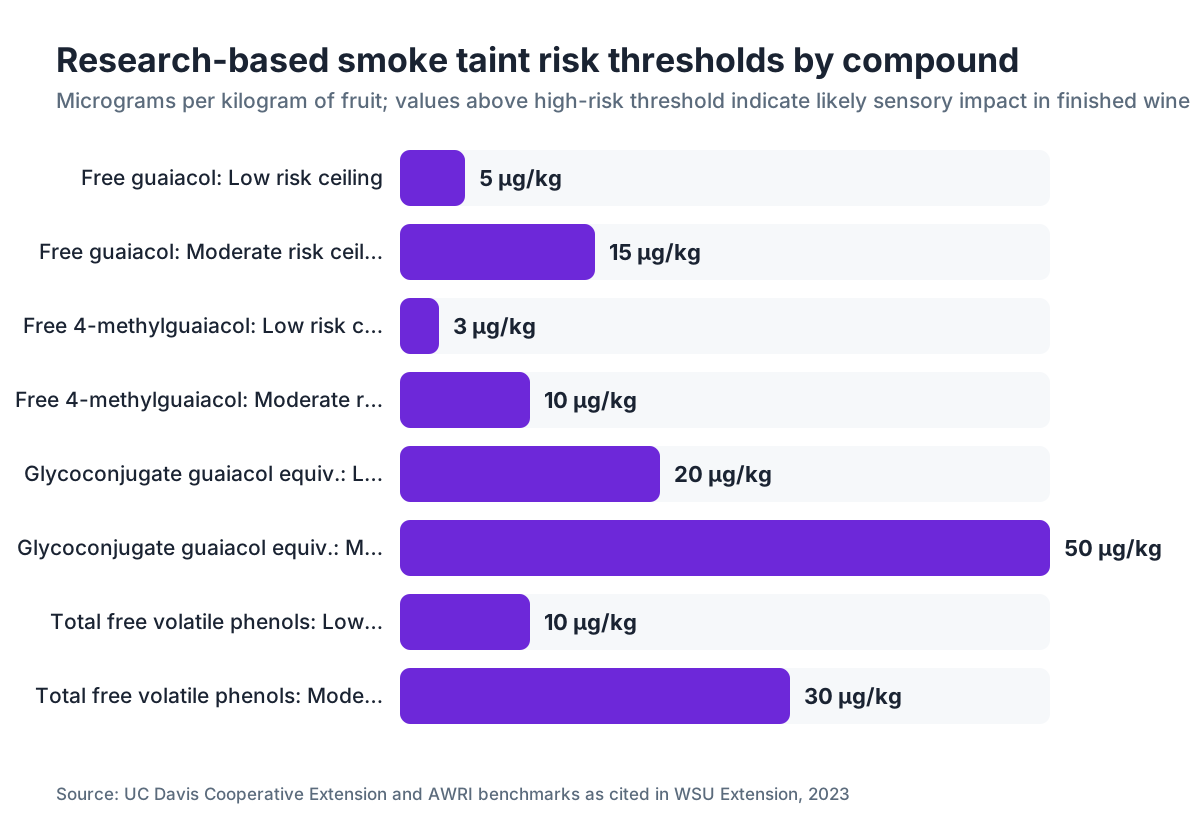
The table below summarizes current research-based benchmarks:
| Compound | Low Risk | Moderate Risk | High Risk |
|---|---|---|---|
| Free guaiacol (µg/kg fruit) | <5 | 5-15 | >15 |
| Free 4-methylguaiacol (µg/kg fruit) | <3 | 3-10 | >10 |
| Glycoconjugate guaiacol equiv. (µg/kg fruit) | <20 | 20-50 | >50 |
| Total free volatile phenols (µg/kg fruit) | <10 | 10-30 | >30 |
Sources: UC Davis Cooperative Extension [4]; Australian Wine Research Institute benchmarks as cited in WSU extension [3].
These are decision-support numbers, not bright lines. A block at 45 µg/kg glycoconjugate equivalent from a thick-skinned Cabernet might produce a wine with detectable but not reject-level taint. The same number from a thin-skinned Pinot Gris could be unacceptable. Variety, winemaking intervention, and your buyer's tolerance all shift the math.
Document where your fruit lands on this scale even if you decide to proceed. If a buyer comes back six months post-harvest claiming the wine is off, your lab results showing you were in the moderate-risk zone, combined with your decision to harvest anyway, is a record of an informed choice rather than negligence.
How do you document a smoke event for insurance or buyer claims?
Documentation for smoke taint has to happen in real time, not reconstructed after the fact. Start a dedicated smoke event log the moment you learn a fire is burning within 50 miles of your vineyard.
The log should capture, at minimum: date and time the smoke was first visible or smelled in the vineyard; estimated AQI at that moment (screenshot AirNow and save the file with a timestamp) [2]; wind direction and speed from your on-site weather station or a nearby RAWS station; timestamped photos of the vineyard under smoke; block-by-block phenological stage at time of exposure; and any wash-down or irrigation you ran in response.
For insurance, your crop insurance adjuster will ask for third-party evidence that the event happened and was significant. USDA Risk Management Agency (RMA) policy language for Actual Production History (APH) policies treats smoke damage as a potential cause of loss under certain conditions [5]. Pull the NOAA Hazard Mapping System fire and smoke product for the relevant dates. It generates satellite-derived smoke density maps that count as independent, third-party evidence of your exposure [6].
For buyer contracts, read your grape purchase agreement before harvest. Many California contracts now include smoke taint provisions that specify testing protocols, acceptable thresholds, and rejection rights. If yours doesn't, get any agreement about smoke-exposed lots in writing before delivery, not during crush.
If you use a digital field operations platform like VitiScribe, attach timestamped photos, AQI screenshots, and lab PDFs directly to the block record so the whole file is in one place when your adjuster or buyer asks for it.
For mountain winery and high-elevation operations in California and Oregon, the mix of proximity to fire corridors and steep terrain airflow makes this documentation practice worth building into your standard seasonal protocol.
What are the worker safety obligations during a wildfire smoke event?
Field crew health is a separate obligation from grape quality assessment, and it carries legal weight. Under California's Heat Illness Prevention standard (CCR Title 8, Section 3396) and the separate Wildfire Smoke Protection Standard (CCR Title 8, Section 5141.1, effective July 2021), California employers must take specific actions when outdoor AQI for PM2.5 reaches 151 or above [7].
At AQI 151 or above, you must provide N95 respirators to all outdoor workers and encourage their use. At AQI 500 or above (Hazardous), respirator use is effectively mandatory and you have to consider suspending outdoor work. You also have to communicate air quality information to workers in a language they understand.
The EPA Worker Protection Standard (WPS), which applies to agricultural pesticide use, connects to smoke events indirectly. If you're spraying during a smoke period for disease prevention (many growers do, since canopy stress raises disease susceptibility), your WPS respiratory protection obligations stack on top of the smoke standard [8].
Document worker safety decisions the same way you document crop decisions. Record the AQI reading at the start of each shift, whether respirators were distributed, and any work stoppages. This record protects you in both Cal/OSHA inspections and workers' compensation claims.
WSU extension has published guidance on PM2.5 monitoring for agricultural workers in wildfire-prone areas that's worth downloading and keeping on file [3].
Can winemaking interventions reduce smoke taint in affected fruit?
The honest answer: somewhat, for borderline fruit, with real effort and cost. No intervention reliably rescues heavily tainted fruit.
For fruit in the low-to-moderate risk range, the common approaches include the following.
Cold soak limitation. Cutting pre-fermentation skin contact reduces extraction of bound phenols. For whites, pressing immediately without skin contact lowers glycoconjugate extraction versus even a short cold soak.
Fining agents. Activated carbon (charcoal) can strip free volatile phenols from juice or wine, but it also strips color and aroma. It works better on whites than reds. Doses of 50 to 200 grams per hectoliter are typical, though higher doses damage wine character. Bentonite, PVPP, and certain plant-based proteins have shown modest effects in published trials.
Reverse osmosis and spinning cone column. Both can selectively remove volatile phenols from wine. They're expensive (contract services often run $0.50 to $2.00 per gallon depending on volume and severity) and imperfect, but they're the highest-efficacy physical interventions for already-fermented wine.
Blending. Diluting smoke-affected lots with clean fruit is the oldest and, honestly, often the most practical move for small-to-medium operations. A 20 to 30 percent inclusion of tainted fruit in a clean blend may fall below sensory threshold if the taint level is borderline.
None of these substitute for honest pre-harvest assessment. The growers who make the best decisions know their glycoconjugate numbers before they pick, not after fermentation turns out wrong.
How do you build a smoke event response plan before fire season starts?
Reactive documentation is always weaker than a system you built when you weren't panicking. Here's what a working pre-season plan looks like.
Before June 1 in California or July 1 in the Pacific Northwest, do these things. Subscribe to AirNow's notification service for your county and set an alert at AQI 100 for early warning [2]. Identify two accredited labs that accept smoke taint samples and confirm their current turnaround time. Pre-negotiate a rush-analysis option. Most labs can turn results in 48 to 72 hours for a surcharge, but you need that conversation before you're shipping samples at 11 PM on a Tuesday in August. Download a USDA RMA crop insurance summary sheet and know your policy's reporting deadlines for potential losses [5].
Map your blocks by vulnerability: phenological stage by expected date, canopy architecture risk, distance from fire-prone wildland-urban interface. Blocks that hit veraison earliest and sit in low-drainage air pockets are your highest-priority monitoring units.
Assign someone as the smoke event documentation lead. That person's job during an event is to capture AQI data every two to four hours, take timestamped canopy photos, and log any worker protection actions. It doesn't have to be the vineyard manager. A trusted crew lead with a smartphone and a simple checklist can handle it.
For growers sourcing from multiple sites, like the operations common across south coast winery appellations in Southern California, a centralized block-level record system makes it far easier to triage which sites need immediate lab work and which can wait. VitiScribe's block-level event logging was built for exactly this kind of multi-site documentation.
Finally, talk to your grape buyers now. Ask whether their contracts have smoke taint clauses, what testing they'll require, and who pays for lab work. Get the answers in writing. That conversation is much harder to have when you're in the middle of a smoke event and crush is two weeks away.
What records should you keep after the event is over?
Once the smoke clears, you're not done. The documentation file you build in the weeks after an event is what actually protects you.
Keep all of the following in one organized file, physical or digital: your AQI logs with timestamps, screenshots of AirNow or NOAA data for the event dates, your field photos with embedded timestamps, every lab report in the original PDF with the lab's accreditation information, your sample chain-of-custody forms, any communications with your crop insurance agent (note dates and what was said), written agreements with buyers about smoke-exposed lots, and records of any winemaking interventions applied with dates, products, and doses.
For TTB compliance, if you label a wine from a smoke-affected vintage, there are no specific smoke taint disclosure requirements as of 2025. Your production records, required under 27 CFR Part 19, need to accurately reflect the fruit you used and any processing steps taken [9]. If you apply activated carbon treatment, that's a cellar treatment that belongs in your production log.
State-level requirements vary. California's Department of Food and Agriculture doesn't mandate smoke taint testing or disclosure, but crop insurance claims through USDA RMA require you to notify your agent within a reasonable time after discovering a potential loss and to keep records supporting the claim for three years [5].
Cornell Cooperative Extension has noted that inadequate documentation is the single most common reason growers fail to recover insurance losses from weather events, and smoke taint claims follow the same pattern [10]. Over-document during an event, because you genuinely cannot know which detail will matter six months later.
Frequently asked questions
How quickly do I need to sample grapes after a smoke event?
Collect berry samples within two to five days of significant smoke exposure. Volatile phenol uptake happens fast, especially pre-veraison, but the glycoconjugate pool keeps building for days after the smoke clears. Waiting more than a week risks missing the peak concentration period and underestimating your real risk. Keep samples cold and get them to an accredited lab within 24 hours of collection.
Does rain or irrigation after a smoke event wash off the taint?
Washing the outside of berries removes ash and surface residue but does essentially nothing for the volatile phenols already absorbed into the skin and pulp. Surface deposition accounts for a small fraction of uptake. The damage from a significant smoke event is already inside the berry within hours of exposure. Overhead irrigation during a smoke event may slightly reduce ongoing uptake, but it doesn't reverse what already happened.
Which grape varieties are most sensitive to smoke taint?
Thin-skinned varieties with higher surface-area-to-volume ratios, like Pinot Noir, Pinot Gris, and Chardonnay, tend to show higher phenol uptake under equivalent exposure. Thick-skinned varieties like Cabernet Sauvignon and Petite Sirah absorb less per unit of smoke exposure. That said, a severe smoke event will compromise any variety, and no variety should be treated as immune.
What AQI level should trigger immediate vineyard action?
An AQI for PM2.5 above 150 (Unhealthy) sustained for more than 12 hours during berry development warrants immediate sampling and worker protection. California law requires N95 respirator distribution at AQI 151 for outdoor workers. For grape quality, even shorter exposures at AQI 200-plus (Very Unhealthy) in the pre-veraison to harvest window deserve lab testing, especially for thin-skinned varieties.
Can I do a simple smell test to decide whether my grapes are safe to harvest?
No. This is one of the most dangerous misconceptions in smoke taint management. The glycoconjugate forms of smoke phenols are odorless in the fruit. Grapes and must can smell clean and still produce wines with severe taint after fermentation. Sensory evaluation of fruit and fresh juice is not a reliable screen. You need lab analysis of glycoconjugate levels before making a harvest call.
Who pays for smoke taint lab testing, the grower or the winery?
It depends on the contract. Many grape purchase agreements are silent on this, which means the cost usually falls on whoever requests the test. Testing runs roughly $150 to $400 per sample for a full volatile phenol panel, depending on the lab and whether you include glycoconjugates. Negotiate cost allocation in writing before harvest. If you're filing a crop insurance claim, testing costs may be recoverable as part of the documented loss.
How do I get historical AQI data to document a smoke event that already happened?
EPA's AirNow AQS Data Mart and the AirNow Historical Data Download tool let you pull hourly PM2.5 and AQI readings for any monitor by date and ZIP code. Data goes back years. The NOAA Hazard Mapping System provides satellite smoke density maps archived by date. Both are free and produce downloadable files suitable for insurance claims or buyer documentation.
Does smoke taint affect wine value enough to justify rejecting a whole block?
At glycoconjugate levels above 50 µg/kg guaiacol equivalents in a thin-skinned variety, bulk wine values can drop by 50 percent or more, and some buyers will reject the lot outright. At moderate levels, a price reduction of 20 to 40 percent per ton is common in negotiated contracts. Whether to harvest, how to process, or whether to let insurance cover the loss depends on your specific numbers, not a rule of thumb.
What USDA programs cover smoke taint crop losses?
USDA Risk Management Agency's Actual Production History (APH) policy covers quality losses from smoke taint if the damage meets the policy's definition of a covered cause of loss. The Non-insured Crop Disaster Assistance Program (NAP) is available for growers without APH coverage. Contact your crop insurance agent immediately after a smoke event, before harvest, since most policies have strict reporting deadlines for potential losses.
Are there TTB labeling requirements for wines made from smoke-tainted grapes?
As of 2025, the TTB has no specific labeling requirements or disclosure obligations for smoke-tainted wine. Your obligation is accurate production records under 27 CFR Part 19, including any cellar treatments like activated carbon. State rules vary. Check with your state's ABC or agriculture department for any local disclosure requirements before releasing wine from a smoke-affected vintage.
How does smoke taint documentation help with contract disputes?
If a buyer rejects a lot or demands a price cut after delivery, your documentation file turns a he-said-she-said dispute into a paper record. AQI logs establish the event happened. Lab reports show what your fruit tested at before harvest. A written pre-delivery agreement about how smoke-exposed lots would be handled locks in the terms both parties accepted. Without that paper trail, you negotiate from a weak position.
Is there a way to test for smoke taint risk during fermentation, more than pre-harvest?
Yes. Labs can test fermenting must for free volatile phenols as fermentation progresses. This gives you real-time data on how much taint is being expressed as yeast cleaves the glycoconjugates. It won't undo the decision to ferment, but it can inform blending proportions, fining treatment timing, and whether to abandon a lot early rather than commit more cellar resources to it.
How do I find an accredited lab for smoke taint analysis?
University extension programs at UC Davis, WSU, and Cornell maintain lists of accredited agricultural and enological labs. Eurofins, ETS Laboratories in St. Helena, Vinquiry, and the WSU Wine Science Center are commonly used by Pacific Coast growers. Confirm before submitting that the lab runs glycoconjugate analysis specifically, more than free volatile phenols, since the free panel alone understates your fermentation risk.
Sources
- Australian Wine Research Institute, Smoke Taint in Wine: Smoke taint in wine is detectable at guaiacol concentrations as low as 9 micrograms per liter; berry sampling protocol recommends 200-400 berries per block for representative results.
- US EPA, AirNow Air Quality Index (AQI) Basics: AirNow archives hourly AQI data by ZIP code and offers historical data download; AQI above 150 is classified Unhealthy for all groups.
- Washington State University Extension, Wildfire Smoke and Viticulture: Open canopy architecture (Scott Henry, open-lyre) shows lower volatile phenol uptake under equivalent smoke conditions; PM2.5 monitoring guidance for agricultural workers in wildfire-prone areas.
- UC Davis Cooperative Extension, Smoke Taint Resources for Viticulture: Glycoconjugate guaiacol equivalents above 20-50 micrograms per kilogram of fruit represent meaningful taint risk; sensory outcomes vary by variety and winemaking style.
- USDA Risk Management Agency, Actual Production History (APH) Policy: APH crop insurance treats smoke damage as a potential covered cause of loss; claimants must notify agent promptly and retain supporting records for three years.
- NOAA Hazard Mapping System Fire and Smoke Product: Satellite-derived smoke density maps archived by date provide third-party evidence of smoke exposure events suitable for insurance claims.
- US EPA Worker Protection Standard for Agricultural Pesticides: EPA Worker Protection Standard sets respiratory protection requirements for pesticide application that stack on top of smoke-related worker protection obligations.
- Alcohol and Tobacco Tax and Trade Bureau (TTB), Winery Production Records, 27 CFR Part 19: TTB requires bonded wineries to accurately record fruit used and cellar treatments including activated carbon fining under 27 CFR Part 19; no specific smoke taint disclosure requirement as of 2025.
- Cornell Cooperative Extension, Crop Insurance Documentation for Grape Growers: Inadequate documentation is the most common reason growers fail to recover insurance losses from weather events; applies equally to smoke taint claims.
Last updated 2026-07-10