How to build a pesticide use budget for a small vineyard
TL;DR
- A pesticide budget for a small vineyard starts with your disease pressure calendar, then adds product costs, equipment, labor, and compliance overhead.
- Most small operations spend $300 to $800 per acre per season on fungicides alone.
- Get the structure right before budbreak and you'll see fewer surprise invoices and cleaner spray records when an inspector shows up.
Why does a pesticide budget matter for a small vineyard?
Plenty of small vineyard owners treat spray costs as a number they figure out after the season ends. That's a reliable way to overspend by 20 to 40 percent and never know why. A budget forces you to think through your spray program before you buy anything, which is where the real cost decisions actually live.
The budget also gives you a paper trail that overlaps with your required pesticide use records. In California, licensed applicators must keep records of every application for two years under Food and Agricultural Code Section 12981 [1]. Oregon, Washington, and New York have parallel rules. If your budget spreadsheet already captures product names, application dates, and acres treated, you're most of the way to a compliant record.
There's regulatory pressure here too. Under the EPA Worker Protection Standard (WPS), you have to notify workers of applications and keep records accessible to workers, their representatives, and handlers [2]. Managing those records inside one budgeting system beats keeping two separate piles of paper.
And if you're applying for a farm operating loan or talking to a bank about equipment financing, a documented spray budget signals that you run a business, not a hobby. Lenders notice.
What are the main cost categories in a vineyard pesticide budget?
There are five real buckets. Some managers collapse them into two or three, but separating them out shows you exactly where overruns happen.
1. Products (materials cost)
This is the largest single line for most operations. Fungicides dominate in humid regions. In Napa and Sonoma, a full powdery mildew program running from budbreak through veraison can use 8 to 14 applications depending on the year [3]. A systemic like Quintec or Luna Experience costs $50 to $90 per acre per application at typical use rates. A contact sulfur application runs $8 to $18 per acre. Your product mix matters enormously.
2. Application labor
Whether you run your own tractor or hire a PCA-licensed contractor, labor is real money. Custom spray contractor rates in California wine country run roughly $35 to $65 per acre per application in recent UC Cooperative Extension cost studies [4]. Ten acres sprayed 12 times is $4,200 to $7,800 in contractor labor alone, before a drop of product.
3. Equipment and maintenance
For owner-operators, amortize your airblast sprayer over its useful life (typically 10 to 15 years) and add annual maintenance, calibration, and filter costs. A used 200-gallon airblast unit runs $8,000 to $20,000. A new one is $25,000 to $60,000 depending on brand and automation. Depreciation on a $30,000 sprayer over 12 years is $2,500 per year before fuel and repairs.
4. PPE and safety supplies
Chemical-resistant gloves, respirators with the correct cartridge rating, eye protection, coveralls, and washing facilities all carry a price. A compliant PPE set for one applicator runs $150 to $400 per season depending on what you're applying. WPS rules require that you provide this, not suggest it [2].
5. Compliance and record-keeping overhead
Licensing fees, PCA consultation time, posting and notification supplies, and the hours spent filling out spray records. This is the line people underestimate most. A PCA consultation agreement for a small California vineyard typically runs $500 to $2,000 per season depending on acreage and visit frequency.
What does a typical fungicide program actually cost per acre?
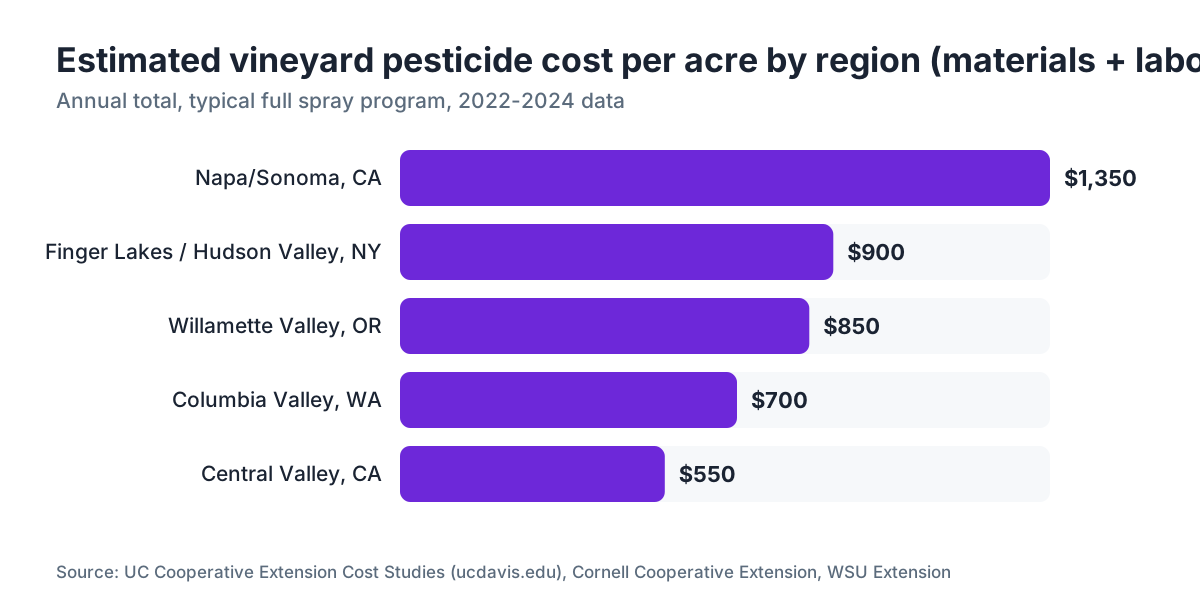
Regional disease pressure drives everything, so the range is wide. Materials-only costs run from about $150 per acre in a dry California block to $650 in a humid New York one. Add labor and the total climbs past $1,600 per acre in Napa. Here's how the regions stack up.
The University of California Cooperative Extension publishes annual cost-of-production studies for winegrapes by region [4]. Their Napa County study shows pest management costs including fungicides running $1,100 to $1,600 per acre per year for a full program, covering materials and labor. The Central Valley runs closer to $400 to $700 per acre because powdery mildew pressure is lower there.
Cornell's viticulture extension team publishes similar benchmarks for New York's Finger Lakes and Hudson Valley, where downy mildew is a serious driver and Botrytis management adds real late-season cost [5]. Cornell data puts materials-only spray costs in the $350 to $650 per acre range for a disease-focused program, before labor.
| Region | Materials only ($/acre/yr) | Materials + labor ($/acre/yr) | Key diseases |
|---|---|---|---|
| Napa/Sonoma, CA | $400-700 | $1,100-1,600 | Powdery mildew |
| Central Valley, CA | $150-300 | $400-700 | Powdery mildew (lower pressure) |
| Finger Lakes / Hudson Valley, NY | $350-650 | $700-1,100 | Downy mildew, Botrytis, PM |
| Willamette Valley, OR | $300-550 | $650-1,050 | Botrytis, PM |
| Columbia Valley, WA | $200-400 | $500-900 | PM, mites |
These are ranges, not guarantees. A bad Botrytis year can push an Oregon grower $200 per acre over their normal program. That's exactly why your budget needs a contingency line.
WSU's grape pest management resources cover Washington and Oregon economics in detail and are worth bookmarking [6].
How do you build the spray calendar that drives the budget?
Your spray calendar is the engine. The budget is just arithmetic on top of it.
Start with your disease pressure map. Powdery mildew pressure from elevation and canopy density. Downy mildew if you're in a humid region. Botrytis risk from tight clusters or late rains. Leafroll virus pressure that drives your need for leafhopper or mealybug control. Be honest about your block history.
Then block out your growth stage windows. UC guidance maps critical application timing to Eichhorn-Lorenz (E-L) stages [3]. Powdery mildew risk is highest from E-L 9 (3 to 5 leaves separated) through E-L 29 (berry pea-size). Botrytis risk peaks at bloom and again pre-harvest. Most programs have windows where you're almost certain to spray and others where the decision waits on weather.
Build the calendar in two columns. The first is your base program: the sprays you're near-certain to make every season regardless of conditions. This is the floor of your budget. The second is your contingency program: extra sprays triggered by rainfall thresholds, disease forecasting models, or scouting. This is the ceiling.
For a 10-acre Napa operation running a standard sulfur-plus-systemic powdery mildew program, a realistic base calendar might look like this:
- Dormant copper application: 1 spray
- Budbreak through bloom (E-L 9 to E-L 23): 4 to 6 sprays, mix of sulfur and systemic fungicide
- Post-bloom through veraison: 3 to 5 sprays, systemic-focused
- Pre-harvest Botrytis protection (if applicable): 1 to 2 sprays
That's 9 to 14 base applications. Each one needs a product cost, a water and adjuvant cost, a labor cost, and a PPE cost.
How do you estimate product costs accurately before the season?
The easiest mistake is pricing products at last year's invoice and assuming nothing moved. Fungicide prices shifted noticeably from 2021 to 2023 on supply chain problems, and active ingredient costs can vary 10 to 25 percent from one distributor to the next.
Get quotes in January or February, before the spring rush. Your ag chem distributor or local farm supply will hand you price lists for the season. Lock in prices on products you're certain to use, especially bulk sulfur and any FRAC Group 3 or Group 7 fungicides you've committed to.
For each product, you need three numbers: the per-unit price (per gallon or per pound), the label use rate per acre (work from the actual label, not memory), and the number of applications. Multiply those and you have your materials cost per product line.
Add a 10 to 15 percent buffer for products you might use but aren't sure about, plus a separate line for emergency or rescue applications. Fungicides like Revus or Presidio for downy mildew, or Elevate for Botrytis, are expensive rescue tools ($80 to $150 per acre per application). You might buy them zero times in a good year and three times in a bad one.
One pricing reality catches people. Some of the most effective SDHI fungicides (FRAC Group 7) only come in larger pack sizes. Luna Experience comes in 2.5-gallon jugs. If you farm 8 acres and one jug covers 20 applications, you're pricing a shared resource. Build in the actual per-application cost, not the jug cost.
How do you account for labor in your spray budget?
Labor is where small operations consistently undercount. If you're the one on the tractor, your time still has value, and that value belongs in the budget even if you never write yourself a check.
For owner-operator labor, estimate hours per application and multiply by what you'd pay a skilled equipment operator in your region. California's minimum wage for agricultural workers was $16.90 per hour as of 2024 [7], and a skilled tractor operator in wine country often earns $20 to $28 per hour. A 10-acre block with a well-calibrated airblast sprayer might take 2 to 3 hours per application including mix, spray, and cleanup. That's $40 to $84 per application at the low end of skilled labor rates.
For hired contractors, get a written quote that specifies price per acre, what's included (product or labor only), minimum charges, and cancellation terms. Contractor minimums on small blocks distort your per-acre economics fast. A contractor with a $300 minimum who charges $45/acre means your 5-acre block costs $300, not $225.
If you use seasonal employees who also handle other vineyard tasks, time their spray applications separately. The WPS requires you to track pesticide application records and handler training separately anyway [2], so attach the labor to the right activity in your books.
What contingency allowance should a small vineyard budget carry?
It depends on your region and how much weather volatility you typically see. No single answer fits everyone.
In high-pressure regions like New York's Finger Lakes or Oregon's Willamette Valley, a 20 to 30 percent contingency on top of your base program is not excessive. A wet May in those places can add two to three unplanned applications before bloom. In drier regions like Washington's Columbia Valley or California's Central Valley, 10 to 15 percent is more typical.
Build contingency as a real dollar line, not a vague mental cushion. If your base program costs $6,000, your contingency line for a moderate-risk region might be $900 to $1,500. At season's end, whatever you didn't spend stays in your pocket. It's fine if you never touch it.
Some operations keep a rapid-response product inventory, a jug of rescue fungicide on hand rather than scrambling to source it during an outbreak. That inventory has a cash cost that belongs in your budget as a capital item, not a surprise expense.
How do compliance and record-keeping costs fit into the budget?
They're real costs, and most small operations ignore them until they're scrambling during an inspection. Line them up before the season so they don't ambush you.
In California, anyone applying restricted materials must hold a Qualified Applicator License or Certificate (QAL/QAC) or work under a licensed PCA [1]. The QAL exam costs $75 per category as of 2024, and keeping the license requires continuing education credits. If you pay a PCA, that fee (typically $500 to $2,000 per season, as noted earlier) is a compliance cost that belongs in your budget.
Spray record forms, posting supplies for field application notices, and WPS safety data sheet binders are small-ticket items ($50 to $200 per year), but they're not zero. Under the WPS final rule updated in 2015, you must keep pesticide application records for two years and make them available to workers, handlers, and their designated representatives on request [2].
If you want this streamlined, record-keeping platforms built for vineyard operations (VitiScribe is one option designed for this workflow) let you capture application details in the field and generate compliant reports without rebuilding records at audit time. The cost of such tools is a legitimate budget line, and the time savings are real.
Don't forget label downloads and SDS maintenance. You're required to have access to the current SDS for every product in use. Keeping a binder current takes time, and outdated labels have created compliance headaches during Cal/OSHA inspections.
How should you structure the actual budget spreadsheet?
You want a format that stays useful during the season, not a plan you make in December and never open again.
The structure that works best uses rows for individual spray events and columns for: planned date, growth stage, product(s), acres treated, product cost per acre, total product cost, labor cost, equipment cost allocation, PPE cost, total event cost, and a column for actual versus budget variance. Fill in the planned columns before the season. Fill in the actuals after each spray.
Group events into phenological windows (dormant, pre-bloom, post-bloom, pre-harvest) so you can see where you're running over or under. This is where the budget turns into a management tool instead of accounting.
Below the event rows, carry summary lines for:
- Total base program cost (planned)
- Contingency allowance
- Compliance and record-keeping overhead
- Equipment depreciation allocation
- Total season budget
- Running actual spend
- Variance
Keep it somewhere shared so your spray manager or PCA can update it after each application. If it lives on paper in a binder in the barn, it won't get updated. In a shared spreadsheet or field operations platform, it will.
For a vineyard handling multiple blocks, run a separate summary tab that aggregates by block, because disease pressure and spray intensity often differ a lot across a property.
How do you review and improve the budget after the season ends?
The end-of-season review is the most skipped step and the most valuable one. This is where next year's budget actually gets built.
Pull your spray records alongside your budget. For every event, note whether you sprayed as planned, skipped it, or added an unplanned application, and what drove the call. After two or three seasons, patterns show up. Maybe you consistently skip the second dormant application, which means it doesn't belong in your base program. Maybe Botrytis forces an unplanned application in 7 of 10 years, which means it does.
Compare your per-acre spend to UCCE or Cornell benchmarks for your region. If you're well above benchmark, look at which category is high: product choice, contractor rates, or application frequency. If you're below benchmark and your disease control held, you found an efficiency worth understanding.
Review your product efficacy data too. If a particular FRAC group fungicide didn't perform, that's a budget question as much as a biological one, because you spent money on something that underperformed. WSU's fungicide efficacy ratings for grapevine diseases [6] are updated regularly and give you a basis for comparing what you used against what the current evidence supports.
Update your equipment depreciation line from actual repair costs. Older sprayers often cost more in maintenance than your initial depreciation assumption allows for. A season where you spent $1,200 on sprayer repairs is data for next year's budget.
Are there ways to reduce pesticide costs without increasing disease risk?
Yes, and it's worth taking seriously before you lock in a budget, because the cheapest program isn't always the cheapest approach.
Canopy management is the single highest-return investment for cutting spray costs over the long run. A well-shoot-thinned, leaf-pulled canopy dries faster, takes spray better, and needs fewer applications for the same disease control. Cornell research on canopy management and disease incidence is clear: open canopies reduce Botrytis incidence and can reduce spray frequency [5]. It's a labor investment that pays back in spray costs year after year.
Disease forecasting tools let you time applications to actual risk rather than a fixed calendar. The UC IPM powdery mildew risk model, available through the UC IPM website [8], lets you decide whether to spray based on temperature and humidity data. In a dry spring, you might skip one or two early sprays the calendar would have called for. That's $150 to $300 per acre in product and labor savings.
Resistance management is a budget concern, not only a biological one. Rotating FRAC groups properly (don't use the same mode of action more than twice per season) prevents the resistance that forces expensive rescue treatments [9]. Once you've lost efficacy in a chemistry, you pay more to control the same disease.
Buying in bulk for products you use every year (sulfur especially) can save 10 to 20 percent over single-jug pricing. But only buy what you'll use. A product sitting on a shelf three years past label registration is a compliance problem, not a savings.
A platform like VitiScribe that logs every application in real time lets you spot inefficiencies mid-season instead of finding them in December, which means you still have time to act on them.
Frequently asked questions
How much should a small vineyard budget per acre for pesticides each year?
It depends heavily on region and disease pressure. Materials-only costs run $150 to $700 per acre per year. Add contractor labor and you're at $400 to $1,600 per acre in high-pressure regions like Napa or the Finger Lakes. UC Cooperative Extension publishes regional cost-of-production studies that give the most reliable benchmarks for your area. Start with those numbers and adjust to your actual spray history.
Do I need a pesticide applicator license to spray my own vineyard?
It depends on which products you apply. In California, applying any restricted-use pesticide requires a Qualified Applicator License or Certificate, or supervision by a licensed PCA. General-use pesticides can be applied by the property owner. Most states have similar distinctions. Check your state department of agriculture's pesticide regulation division before your first spray of the season, because penalties for unlicensed application of restricted materials are serious.
What records am I legally required to keep for vineyard pesticide applications?
California requires licensed applicators to keep records for two years under Food and Agricultural Code Section 12981, including product name, registration number, application date, site, acres treated, amount applied, and applicator name. The EPA Worker Protection Standard requires keeping application records and making them accessible to workers and their representatives. Most other major wine states have parallel rules. Safest practice is to keep both purchase records and field application records.
What is the EPA Worker Protection Standard and does it apply to small vineyards?
The WPS is a federal regulation (40 CFR Part 170) that requires agricultural employers to protect workers and pesticide handlers from exposure. It applies to any agricultural establishment where pesticides are used to produce agricultural plants. That includes every commercial vineyard, regardless of size. Requirements include giving workers pesticide application information, safety training, PPE, and decontamination supplies. The EPA updated the WPS in 2015 with stronger notification and record-keeping provisions.
How do I build a contingency line into a vineyard pesticide budget?
Calculate your base program cost first, covering all sprays you're near-certain to make. Then add a contingency percentage on top: 10 to 15 percent for dry regions, 20 to 30 percent for humid regions with high disease pressure. Put it as a real dollar line in your spreadsheet. In a good year you won't spend it. In a bad Botrytis year or a wet spring you'll need it. Don't treat contingency as a vague buffer. Give it a number.
How do I compare spray contractor quotes fairly?
Get quotes that clearly state whether product is included or labor-only, the price per acre, any minimum charge per visit, and cancellation terms. A $45/acre quote with a $300 minimum on a 5-acre block costs $300, not $225. Ask whether they carry their own liability insurance and applicator license, because under WPS you're still responsible for proper application. Compare at least two or three contractors and factor in their familiarity with your crops and pest issues.
What are FRAC groups and why do they matter for my spray budget?
FRAC (Fungicide Resistance Action Committee) groups classify fungicides by mode of action. Using the same group more than twice per season in the same crop can accelerate resistance, meaning the fungicide stops working. Once you've lost efficacy in a product group, you're forced into more expensive rescue programs or alternative chemistries. Rotating groups is good biology and good economics. UC and WSU extension both publish fungicide efficacy and resistance management guides for grapevines.
Can disease forecasting models actually save me money on spray costs?
Yes, in real terms. The UC IPM powdery mildew risk model and similar tools let you time applications to actual infection risk from temperature and humidity data. In a dry spring, that might mean skipping one or two early applications a fixed calendar would call for. At $100 to $300 per acre per application including product and labor, skipping one justified spray on 10 acres is $1,000 to $3,000 in real savings.
How often should I update my vineyard pesticide budget during the season?
After every spray event. That isn't onerous if your record structure captures application data and maps it to a budget line. Wait until season's end and the budget stops being a management tool and becomes accounting. Mid-season variance tracking lets you catch overruns while you still have sprays left to adjust, or spot where you're running under budget and might redirect resources. Monthly at an absolute minimum, weekly during peak spray season.
What PPE costs should I include in my pesticide budget?
Budget $150 to $400 per applicator per season for a compliant kit: chemical-resistant gloves (replace often), respiratory protection with correct cartridges rated for the active ingredients in use, chemical splash goggles, and protective coveralls. Some products require specific PPE the label mandates, and the EPA WPS requires you to provide and maintain it. Don't forget eyewash supplies and decontamination water, which add a small but real cost.
How do I account for equipment depreciation in a vineyard spray budget?
Take your sprayer's purchase price, subtract a realistic salvage value, and divide by the expected useful life in years (typically 10 to 15 for an airblast unit). A $30,000 sprayer with a $3,000 salvage value over 12 years depreciates at $2,250 per year. Add annual maintenance, calibration, and filter costs, commonly $500 to $1,500 per year on older equipment. Assign that total across your sprayed acres. Don't ignore it just because it's not a cash payment each month.
Where can I find regional cost benchmarks for vineyard pesticide programs?
UC Cooperative Extension publishes cost-of-production studies by crop and region on its website, updated roughly every two to three years. Cornell Cooperative Extension covers New York wine regions. WSU Extension covers Washington and Oregon. These studies break out pest management costs separately and are the most credible public benchmarks available. They aren't perfect (they're retrospective regional averages), but they beat guessing.
Should I include PCA consultation fees in my pesticide budget?
Yes. PCA consultation is a real cost of running a compliant spray program, not an optional extra. In California, a PCA must sign off on recommendations for restricted-use pesticide applications. Annual agreements for small vineyards (under 20 acres) typically run $500 to $2,000 depending on visit frequency and program complexity. Some PCAs also provide scouting, which can reduce application frequency enough to offset their fee.
Sources
- California Department of Pesticide Regulation: California Food and Agricultural Code Section 12981 requires licensed applicators to keep pesticide use records for two years
- U.S. EPA, Agricultural Worker Protection Standard (40 CFR Part 170): EPA WPS requires agricultural employers to notify workers of pesticide applications, provide PPE, and maintain application records accessible to workers and their representatives
- UC Integrated Pest Management, Grape Pest Management Guidelines: UC guidance maps critical application timing to Eichhorn-Lorenz stages, with powdery mildew risk highest from E-L 9 through E-L 29, and addresses fungicide resistance management
- UC Davis Agricultural and Resource Economics, Cost and Return Studies: UC Cooperative Extension cost-of-production studies show pest management costs including fungicides running $1,100 to $1,600 per acre per year for a full program in Napa Valley, and custom spray contractor rates of roughly $35 to $65 per acre per application
- Cornell College of Agriculture and Life Sciences: Cornell extension publishes spray cost benchmarks for New York wine regions showing materials-only spray costs of $350 to $650 per acre per year, and documents that open canopies reduce Botrytis incidence
- Washington State University Extension: WSU Extension publishes fungicide efficacy ratings for grapevine diseases and economic benchmarks for Washington and Oregon wine regions
- California Department of Industrial Relations, Minimum Wage: California's minimum wage for agricultural workers was $16.90 per hour as of 2024
- UC Integrated Pest Management, Grape Powdery Mildew Risk Index: UC IPM provides a powdery mildew risk model for grapevines that allows growers to time applications to actual infection risk based on temperature and humidity data
- Fungicide Resistance Action Committee (FRAC): FRAC classifies fungicides by mode of action into numbered groups; overuse of a single group in a single season accelerates resistance
- Oregon Department of Agriculture: Oregon requires pesticide application records to be maintained for a set retention period for licensed commercial applicators
Last updated 2026-07-10