How to calculate adjuvant rates when recording pesticide applications
TL;DR
- Adjuvant rates are calculated from the tank mix volume you'll actually spray, using the label percentage or fl oz per acre recommendation.
- Multiply the adjuvant rate per gallon (or per acre) by your total tank volume or acreage.
- Record the product name, EPA registration number if it has one, rate per acre, and total volume used alongside your pesticide entry.
- Most states require this on the same record.
Why adjuvant math matters for compliance records
Adjuvant calculation errors are one of the most common gaps auditors find in vineyard pesticide records. Not because vineyard managers are careless. It's because adjuvants feel like an afterthought next to the fungicide or herbicide they're riding into the tank with. They're not.
California's Department of Pesticide Regulation requires that any pesticide application record include "the names and amounts of all pesticides and adjuvants used" [1]. Washington State's Department of Agriculture has similar language under WAC 16-228-1310, which covers commercial applicator records [2]. EPA's Worker Protection Standard doesn't mandate adjuvant recording directly, but it does require that handlers have access to the pesticide product information, and if the adjuvant has label precautions, those precautions apply to the whole tank mix [3].
The practical problem is that adjuvant labels often give you a percentage of the total spray volume, a fluid ounces per 100 gallons rate, or sometimes both. Translating that to what actually went in the tank, and recording it in a way that survives a compliance audit, takes a deliberate calculation step. Skip it and you're either guessing on your records or recording nothing at all.
Get this right and your records genuinely reflect what was applied. That matters if you're ever tracing a spray failure, answering a neighbor complaint, or handing files to a buyer's due diligence team.
What information do you need before you start the math?
Before you touch a calculator, pull four things together.
First, the adjuvant label. Look for the use rate section. It will express the rate one of three ways: as a percentage of total spray volume (e.g., 0.25%), as a volume per volume ratio (e.g., 1 fl oz per gallon of spray solution), or as a volume per acre (e.g., 4 fl oz per acre). Some labels give you two options depending on equipment type. Use the one that matches your application method.
Second, your tank size and the number of tanks you plan to mix. Run a 200-gallon sprayer over 8 acres and refill once, and your total spray volume is 400 gallons. Your record needs to reflect the total used across the whole application, more than one tankful.
Third, your target acres. Even if you calculate from tank volume, you'll also want rate per acre for the record. Auditors and crop advisors both look at per-acre rates.
Fourth, the adjuvant's EPA registration number, if it has one. Many adjuvants are exempt from federal pesticide registration under FIFRA Section 25(b) or are classified as inert ingredients, but some adjuvants, particularly organosilicone surfactants and certain spray oils, do carry an EPA Reg number [4]. Record it when it exists. When it doesn't, write the product name and manufacturer.
One thing that trips people up: "adjuvant" is a broad category. Surfactants, spreader-stickers, anti-foam agents, drift retardants, pH buffers, and oils can all show up in a tank mix. Each one that carries a label with application directions should get its own line on the record.
How do you convert a percentage rate to fluid ounces or gallons?
This is the calculation most people need, because a lot of adjuvant labels express the rate as a percentage of the finished spray volume.
The formula is short:
Adjuvant volume (fl oz) = Tank volume (gallons) × rate (%) × 128
Why 128? There are 128 fl oz in a gallon. Multiply gallons by a decimal percentage and then by 128, and you get fluid ounces of adjuvant needed.
Example: Your label says use 0.25% v/v of a non-ionic surfactant. Your tank holds 200 gallons.
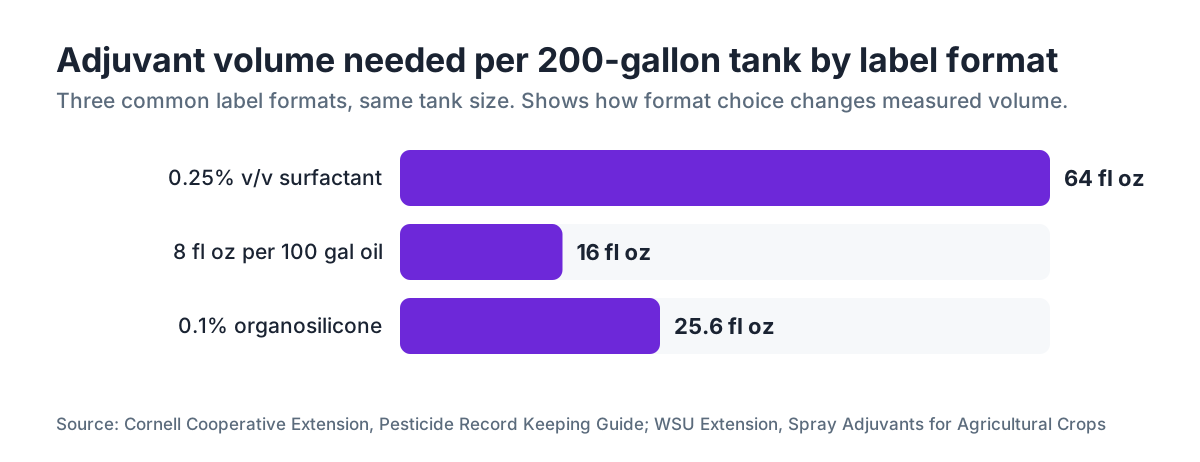
200 × 0.0025 × 128 = 64 fl oz
That's half a gallon of surfactant per 200-gallon tank. For a two-tank day (400 gallons total), you'd use 128 fl oz, which is 1 gallon.
To express this as a per-acre rate for your record, divide the total adjuvant volume by total acres treated:
Per-acre rate = Total adjuvant volume ÷ Acres treated
If those 400 gallons covered 8 acres, your per-acre adjuvant rate is 128 fl oz ÷ 8 = 16 fl oz per acre.
Record both: the per-acre rate for trend analysis and the total used for inventory. Some states require only one. Having both takes thirty seconds and saves you from back-calculating later.
How do you convert a "per 100 gallons" label rate to your tank size?
Many older adjuvant labels, and quite a few newer oils and copper-sticker products, express rates as fluid ounces per 100 gallons of spray. This is actually easier to scale than a percentage.
Adjuvant needed = (Tank volume ÷ 100) × label rate per 100 gallons
Example: Label says 8 fl oz per 100 gallons. Your tank is 300 gallons.
(300 ÷ 100) × 8 = 24 fl oz
For a day where you run three full tanks (900 gallons total):
(900 ÷ 100) × 8 = 72 fl oz
Again, translate to per-acre: 72 fl oz over however many acres those 900 gallons covered.
A quick sanity check: if the label also gives a per-acre rate as an alternative, check that your calculated per-acre number falls within that range. If it doesn't, you have a mismatch between your intended gallons-per-acre application volume and the label's assumed volume. This is common with row-crop labels applied in a canopy-adjusted vineyard system. Use your own application volume and the percentage or per-100-gallon formula. The per-acre figure on the label assumes a specific spray volume that may not be yours [5].
What if the adjuvant label only gives a per-acre rate?
Some adjuvants, particularly registered spray oils and some organosilicone products, give you only a per-acre rate. This is the simplest case for record-keeping because you're already in the units your pesticide record wants.
Calculation:
Total adjuvant needed = Acres to treat × label rate per acre
If you're treating 12 acres and the label says 10 fl oz per acre:
12 × 10 = 120 fl oz total
For the tank, figure out how many acres each tank covers (your application volume divided into your tank size), then multiply:
Adjuvant per tank = Acres per tank × label rate per acre
If each 200-gallon tank covers 4 acres at your spray volume of 50 gallons per acre:
4 × 10 = 40 fl oz per tank
The per-acre rate goes straight onto the record. Total used gets noted for inventory. Done.
For vineyard-specific spray volumes, UC Cooperative Extension's viticulture resources are worth bookmarking. Their spray efficiency work (and the tree row volume method adapted for vines) gives you a more accurate gallons-per-acre figure than guessing, which in turn makes all your adjuvant math more defensible [5].
What's the calculation for organosilicone surfactants, which have tighter rate windows?
Organosilicones get their own section because the rate windows are narrow and going over is a real phytotoxicity risk, more than a compliance concern. Products like Silwet L-77 and its generics typically run 0.05% to 0.25% v/v depending on the tank mix partner, and some fungicide labels flatly prohibit use above 0.1% when tank-mixed with certain products.
Always use the lower of: (a) the adjuvant label maximum, or (b) any restriction stated on the pesticide label you're mixing with. WSU Extension's spray adjuvant guide makes this point explicitly and lists common incompatibilities [6].
Calculation at 0.1% for a 200-gallon tank:
200 × 0.001 × 128 = 25.6 fl oz
Round to 25 or 26 and note which on the record. Record the exact percentage used, more than the product name, because the same product at 0.05% versus 0.2% is a different application. This also matters if you ever have to explain a spray injury.
One honest caveat: there's no federal standard mandating you record the percentage concentration separately from the volume used. But any state auditor or crop consultant who looks at your records for a drift complaint or a crop injury claim will want to know it. Put it in the notes field.
How do you record adjuvants in a tank mix with multiple pesticides?
This is where vineyard records get messy. A typical spring fungicide application might carry a DMI fungicide, a protectant, a copper product, a non-ionic surfactant, and an anti-foam agent. Five products in one tank.
The record structure that holds up best in California and Washington audits lists each product on a separate line (or row in a table) with its own rate, unit, and total used. They all share the same date, block, applicator, and equipment fields. Some growers use a single-application header and attach a product table below it.
What each adjuvant line should include:
- Product name (as it appears on the label)
- EPA Reg number or "exempt" notation
- Rate per gallon, per 100 gallons, or per acre (whatever the label uses)
- Total amount used (in consistent units, fl oz or gallons)
- Lot number if you have it (not always required, but useful for recalls)
California DPR's pesticide use reporting system (PUR) requires that adjuvants with EPA registration numbers be reported separately. Exempt adjuvants, those without an EPA Reg number, must still appear in your on-farm records even if they don't appear in PUR submissions [1].
If you're managing records in a digital system, VitiScribe's application entry screen has a tank mix section that lets you add multiple products per application and auto-calculates totals against your block acreage. That structure makes the math above automatic rather than manual.
For a well-maintained vineyard operation, consistent tank mix records also become the foundation for efficacy tracking year over year.
Rate calculation comparison table: three common label formats
Here's how the same adjuvant scenario plays out across the three label formats you'll meet. Scenario: you're spraying 8 acres, your sprayer applies 50 gallons per acre, so total spray volume is 400 gallons.
| Label format | Example rate | Calculation | Total adjuvant | Per-acre rate |
|---|---|---|---|---|
| % of spray volume | 0.25% v/v | 400 × 0.0025 × 128 | 128 fl oz (1 gal) | 16 fl oz/ac |
| Per 100 gallons | 8 fl oz / 100 gal | (400 ÷ 100) × 8 | 32 fl oz | 4 fl oz/ac |
| Per acre | 10 fl oz / ac | 8 × 10 | 80 fl oz | 10 fl oz/ac |
The per-acre rates look different because these are three different products with three different label rates. The point is that each label type needs its own formula, and recording the final answer in per-acre and total-used columns covers what both state auditors and your own agronomic review need.
Keep this table somewhere accessible during spray prep. Cornell's integrated pest management program for grapes includes a similar breakdown in their spray guide for New York vineyards, and they recommend expressing all tank mix components in the same final units before recording [7].
What does EPA's Worker Protection Standard say about adjuvant labeling and records?
The WPS (40 CFR Part 170) doesn't have a section that says "record your adjuvants." What it does say is that workers and handlers must have access to the product label information for anything applied in areas where they work, and that the central display must include pesticide safety information for any product used in the preceding 30 days [3].
For registered adjuvants with their own EPA Reg numbers, their labels need to be on file and accessible. For exempt adjuvants, the practical answer is that their SDS sheets should be readily available, even if WPS doesn't spell it out for exempt products.
The WPS also requires that application records be kept for two years and include the product name, EPA registration number, active ingredient, date, location, and amount applied. EPA's 2015 revision to the WPS, which took full effect January 2, 2017, expanded the record-keeping requirements somewhat but still focuses on the pesticidal products rather than exempt adjuvants [3].
State requirements layer on top of this. California is the strictest: DPR's regulations under CCR Title 3, Division 6 require that all adjuvants with EPA registration numbers appear on the pesticide use report, and all adjuvants (including exempt ones) appear in the on-farm written record [1]. If you operate in California, that's your floor. If you operate in Washington, Oregon, or New York, check your state's department of agriculture site for the specific language, because these rules do differ.
How do you handle adjuvant rates when you're using a spray-to-wet or canopy-adjusted volume?
Vineyards almost never spray at the rates the adjuvant label assumes, which was written for agronomic row crops at 20-30 gallons per acre. A tightly managed wine grape program might use 30-80 gallons per acre depending on canopy size and growth stage, and a concentrate application might use 10-15 gallons per acre.
When your spray volume per acre differs from what the label quietly assumes, always calculate from your actual volume. If the label says "0.25% of spray volume," your spray volume is the number that matters, whatever it is. The percentage stays the same.
The tree row volume (TRV) method, well documented in UC Cooperative Extension materials on canopy management, gives you a defensible, site-specific spray volume based on your vine row spacing, canopy height, and leaf wall area [5]. TRV improves efficacy, and it gives you a documented basis for your spray volume number, which in turn makes your adjuvant calculation auditable.
Adjusting spray volumes mid-season because canopy has expanded? Update your rate calculations. An adjuvant correctly dosed at 0.25% in May at 30 gallons per acre means something different in August at 60 gallons per acre. Same percentage, double the volume. Your record should reflect the actual calculation made on the day of application, not a season-opening assumption.
What should you actually write on the pesticide application record?
A compliant record entry for an adjuvant in most states includes seven things: application date, treated location (block or field ID), product name, EPA Reg number or exempt notation, amount used per acre, total amount used, and the applicator's name or certificate number.
The most useful thing to add that's not explicitly required in most states is the tank mix concentration you actually achieved: the percentage or per-100-gallon number, worked out before the spray. This gives you a check against the label range and documents your intent, which matters for any post-spray inquiry.
Here's what a clean adjuvant line on a paper or digital record looks like:
Date: 2025-05-14
Block: Estate South, 4.2 ac
Product: Regulaid (non-ionic surfactant)
EPA Reg: exempt under FIFRA 25(b)
Label rate used: 0.25% v/v
Total spray volume: 210 gal (50 gal/ac)
Adjuvant calculated: 210 × 0.0025 × 128 = 67.2 fl oz used
Per-acre: 16 fl oz/ac
Applicator: [name / cert number]
Keep a copy of the label (or a label link) attached to or filed with the record. For digital records, VitiScribe's spray record module lets you attach the label PDF and saves the per-acre calculation against the block acreage automatically, which cuts transcription errors on multi-block days.
To dig deeper into field record structures for your whole operation, Cornell's pesticide record-keeping guide for growers is one of the clearest plain-language summaries around [7].
What are common calculation mistakes and how do you catch them?
The most frequent error is applying the label's per-acre rate without adjusting for your actual spray volume. A label that says "4 fl oz per acre" based on 20 gallons per acre gives you a 0.016 fl oz per gallon concentration. Spray at 50 gallons per acre and still add 4 fl oz per acre total, and you've cut the concentration to less than a third of what was intended. Efficacy drops. Add 4 fl oz per gallon instead of per acre and you're massively overdosing.
Second common error: confusing percent weight by weight (w/w) and percent volume by volume (v/v). Almost all liquid adjuvant labels use v/v. If a label says 0.25% and gives no qualifier, assume v/v. The math above holds.
Third: not accounting for the water already in the tank before you add the adjuvant. For most surfactants this doesn't matter (the percentage is against total finished volume, not pre-adjuvant volume). But for highly foaming adjuvants, adding them to a tank that's already 90% full and agitating hard is a practical problem that will make your calculated volume unreliable. Add them slowly with agitation running, then check foam before closing the tank.
Fourth error, and the one most likely to cause an audit problem: recording the label rate rather than the actual rate used. If the label says up to 0.25% and you used 0.1% because you were also applying a captan product with a compatibility concern, record 0.1%. Your record should reflect what happened, not the label's maximum.
How long do you need to keep adjuvant records, and who can ask to see them?
Federal WPS record-keeping requires two years of retention for pesticide application records [3]. California DPR requires three years for all pesticide use records, including adjuvants, under California Food and Agricultural Code Section 12981 [1]. Washington requires two years under WAC 16-228-1310 [2]. When state and federal rules differ, keep records for the longer period.
Who can ask: county agricultural commissioners in California, state department of agriculture inspectors in Washington and Oregon, your third-party audit auditor (SCS Global, CCOF, Primus, etc.), the pesticide handlers' WPS training records auditor, and in rare cases a regulatory attorney in a civil matter. Buyers doing supply chain audits, more common now in the premium wine segment, may also request them.
Some growers are surprised to find that spray records, including adjuvants, can be subject to public records requests in certain states when they're submitted to a state database. California's Pesticide Use Reporting (PUR) data is public, though it reports by township-range section rather than individual farm [1]. Your on-farm written records generally are not public unless you're subject to a regulatory action.
Keep the records organized by year, then by application date within year. Physical records should be in a binder with a cover sheet index. Digital records should be exportable to PDF or CSV on demand. An audit examiner who has to wait for you to reconstruct records from scattered notes will not give you the benefit of the doubt on ambiguous entries.
Frequently asked questions
Do I have to record adjuvants that are exempt from EPA registration?
In California, yes. DPR regulations require that all adjuvants, whether or not they carry an EPA registration number, appear in the on-farm pesticide application record. FIFRA Section 25(b) exempt products don't go into the Pesticide Use Report database, but they must be in your written records. Most other states require records only for registered adjuvants, but check your state ag department's current rules.
What units should I record adjuvant amounts in?
Use the units that match the label (fl oz, pints, gallons) and record both the per-acre rate and the total amount used for the application. California DPR wants totals reported in pounds of active ingredient for registered pesticides, but for adjuvants it accepts product volume. Keeping both per-acre and total-used gives you the most flexible record for audits and for your own trend analysis.
Can I use one record entry for multiple adjuvants in the same tank?
You can list them on one application record as long as each product gets its own line with its own rate and total used. Think of it as one application header with a multi-row product table. California DPR and Washington WSDA both expect a distinct entry per product, even when the date, block, and applicator are the same.
How do I calculate the adjuvant rate if I don't finish a tank?
Record what you actually mixed and what you actually applied. If you mixed a full 200-gallon tank, applied 160 gallons, and had 40 gallons remaining that you rinsed out, your applied volume is 160 gallons, and your adjuvant applied is 80% of what you mixed. Note the partial tank situation in the record. Estimating is acceptable as long as you document the basis for the estimate.
What is the difference between a surfactant and an adjuvant for record-keeping purposes?
A surfactant is one type of adjuvant. Adjuvant is the broad category that includes surfactants, oils, spreader-stickers, drift retardants, pH buffers, and anti-foam agents. For record-keeping, treat any product that goes into the tank alongside a pesticide as an adjuvant and record it accordingly, regardless of what category its label puts it in.
Does the WPS require me to post adjuvant information on the central display?
The EPA Worker Protection Standard requires that the central display include safety information for any pesticide (as defined by FIFRA) applied in the last 30 days. Registered adjuvants with EPA Reg numbers fall under this. Exempt adjuvants technically don't, but having their SDS posted is good practice and may be required by your state's right-to-know regulations under OSHA's Hazard Communication Standard.
How do spray oils differ from surfactants for rate calculations?
Most spray oils, including horticultural oils and narrow-range oils used in vineyards for mite and scale management, are expressed in percent v/v or gallons per acre on the label. The math is the same as for any percentage-based adjuvant. The key difference is that spray oils often have their own EPA registration numbers, so they need to appear in California PUR reports separately, more than in on-farm records.
How do I calculate adjuvant rates for a concentrate sprayer that applies less water per acre?
Use your actual gallons per acre and your actual total spray volume. A concentrate application at 15 gallons per acre means your per-tank coverage is higher relative to volume. Apply the percentage formula to your actual tank volume, then divide total adjuvant by actual acres covered. The label percentage holds regardless of dilution. What changes is the total volume you need to cover a given acreage.
Is there a formula for converting fl oz of adjuvant to pounds for state reporting?
For liquid adjuvants, convert fl oz to gallons (divide by 128), then multiply by the product's density, which is usually between 7.5 and 9 lb/gallon for most surfactants and oils. The SDS or label technical data section will list the specific gravity or density. For California PUR reporting of registered adjuvants, lbs of active ingredient is what matters, and that requires the AI percentage from the label.
What happens during an audit if my adjuvant records are missing or incomplete?
In California, missing or incomplete adjuvant records can result in a notice of violation from the county agricultural commissioner and civil penalties. First-time violations with no apparent harm are typically resolved with corrective action agreements rather than fines, but repeat issues escalate. Missing records for registered adjuvants during a WPS inspection can also trigger a formal notice of violation under federal FIFRA.
Do I need to record the lot number of the adjuvant?
Most state regulations don't require lot numbers for adjuvants in the application record. California DPR does not list it as a required field. That said, if a product is subject to a recall or if you're tracking a spray failure to a specific product batch, having the lot number is valuable. It takes ten seconds to write down and costs nothing. Write it in the notes field.
Are there software tools that calculate adjuvant rates automatically?
Yes. Digital spray record tools like VitiScribe can calculate adjuvant amounts from your tank size, application volume, and label rate input. The advantage is fewer arithmetic errors on multi-product, multi-block days. Whatever tool you use, make sure you can export the records to a format your county or state office will accept, typically PDF or CSV, and that the exported record shows the calculated rates, more than the inputs.
How does the tree row volume method change my adjuvant calculation?
Tree row volume (TRV) gives you a defensible, canopy-based gallons-per-acre figure instead of a guessed number. Once you have your TRV-based spray volume, your adjuvant math is identical: use that volume as the basis for percentage or per-100-gallon calculations. UC Cooperative Extension has TRV tables and calculation tools for California wine grape vineyards. Using TRV makes your spray volume, and therefore your adjuvant rate, auditable and agronomically justified.
Sources
- California Department of Pesticide Regulation, Pesticide Use Reporting: California DPR requires that pesticide application records include the names and amounts of all pesticides and adjuvants used, with registered adjuvants reported in PUR and all adjuvants in on-farm records retained for three years under California Food and Agricultural Code Section 12981.
- Washington State Legislature, Commercial Pesticide Applicator Records WAC 16-228-1310: WAC 16-228-1310 specifies record-keeping requirements for commercial pesticide applicators in Washington, including application location, product, and rate, with two-year retention.
- U.S. EPA, Agricultural Worker Protection Standard (40 CFR Part 170): EPA's Worker Protection Standard requires pesticide application records be kept for two years and includes requirements for central display of product safety information for any pesticide applied in the prior 30 days.
- U.S. EPA, Minimum Risk Pesticides Exempted Under FIFRA Section 25(b): Many adjuvants are exempt from federal pesticide registration under FIFRA Section 25(b) or classified as inert ingredients; those that carry an EPA registration number must be recorded and reported separately.
- UC Statewide Integrated Pest Management Program, Grape Pest Management Guidelines: UC Cooperative Extension documents the tree row volume (TRV) method for calculating site-specific spray volumes in wine grape vineyards, which provides a defensible basis for adjuvant rate calculations.
- Washington State University Extension, Spray Adjuvants for Agricultural Crops: WSU Extension's spray adjuvant guide documents organosilicone surfactant rate windows, compatibility concerns with common tank mix partners, and cautions against exceeding label maximums when mixing with certain fungicides.
- Cornell Cooperative Extension, Pesticide Record Keeping Guide for Growers: Cornell's IPM program for grapes recommends expressing all tank mix components in consistent final units before recording and provides a breakdown of how different label rate formats convert to per-acre and total-used figures.
- UC Davis Viticulture and Enology: UC Davis viticulture resources document that vineyard spray volumes often differ substantially from agronomic row-crop label assumptions, requiring growers to calculate adjuvant amounts from their actual application volume rather than label-implied volumes.
- U.S. EPA, Inert Ingredients Overview and Guidance: EPA classifies adjuvant components as inert ingredients and maintains lists of approved, acceptable, and unacceptable inert ingredients; some adjuvants carry full EPA registration numbers and must be tracked in records accordingly.
- California Legislative Information, Food and Agricultural Code Section 12981: California Food and Agricultural Code Section 12981 requires pesticide application records to be retained for three years and made available to the county agricultural commissioner on request.
Last updated 2026-07-11