How to link a late-season fungicide application to a pre-harvest interval check

TL;DR
- Every fungicide label carries a pre-harvest interval (PHI), the minimum days that must pass between your last application and harvest.
- Miss that window on a late-season spray and you're looking at residue violations, rejected fruit, or EPA enforcement.
- Check the label, log the application date, count forward to harvest, keep the written record.
- Simple math, serious consequences.
What is a pre-harvest interval and why does it matter in vineyards?
A pre-harvest interval, or PHI, is the number of days stated on a registered pesticide label during which harvesting the treated crop is prohibited. EPA sets the number during registration, based on residue decline studies that show how long the active ingredient takes to break down to a level at or below the established tolerance. It is not a suggestion. Federal law under FIFRA (the Federal Insecticide, Fungicide, and Rodenticide Act) makes the label a legally binding document [1].
For wine grapes, this matters more at the end of the season than at any other point. That's when disease pressure from Botrytis cinerea, powdery mildew, and downy mildew peaks, right as your fruit ripens and your harvest window narrows. You feel pressure to spray close to pick. The PHI is the hard stop that tells you how close is too close.
Residues above established tolerances can trigger rejection by wineries, failed post-harvest residue testing, or USDA market surveillance action. The financial exposure is real. A rejected load of Cabernet Sauvignon at commercial prices can represent tens of thousands of dollars lost in a single morning. And if you sell to a winery with third-party sustainability certification requirements (Lodi Rules, CCOF, SIP, etc.), your residue records get audited.
How do you find the PHI for a specific fungicide product?
The PHI is always on the label. Look in the Directions for Use section, often under a heading called "Restrictions" or "Limitations." For many common wine grape fungicides the language reads something like "Do not apply within X days of harvest." That X is your PHI [2].
A few practical points. First, the PHI can differ by crop. A label might say 7 days for apples and 14 days for grapes, listed in separate crop sections. Always read the grape-specific entry. Second, some products list different PHIs depending on the application rate or the disease target. Third, OMRI-listed or "organic" products are not automatically zero-day PHI products. Sulfur-based materials often carry 0-day PHIs for grapes, but copper products can carry PHIs of 0 to 7 days depending on formulation [3]. Kaolin clay (Surround) has a 0-day PHI for grapes. A material like Quintec (quinoxyfen) carries a 7-day PHI [4]. Luna Experience (fluopyram + tebuconazole) carries a 7-day PHI. Elevate (fenhexamid) is 0 days. Vangard (cyprodinil) is 7 days.
If you've lost the paper label, the National Pesticide Information Center (NPIC) can help, and the Greenbook or CDMS label databases carry current labels for most registered products [5]. UC Davis Extension maintains a Grape Pest Management guide that tables PHIs for the most common wine grape fungicides [6]. Cornell's Viticulture and Enology program and WSU Extension both publish regionally adapted spray guides [7][8].
Do not rely on memory. Labels get revised. The PHI on the product you bought three seasons ago may have changed on the current registration.
What is the step-by-step process for linking a spray date to your harvest date?
The math is simple. What trips people up is doing it before the spray, not after.
Step 1. Confirm your target harvest date. It doesn't have to be exact to the day, but you need a reasonable estimate. Talk to your winemaker. Look at your Brix progression from the last two seasons. If you're at veraison in early August and you historically pick Zinfandel in late September, you have roughly 50 to 60 days. That buffer matters.
Step 2. Pull the label for the product you plan to use. Write down the PHI in days.
Step 3. Count backward from your target harvest date by the PHI number of days. That date is your last-possible application day for that product. If your target harvest is September 28 and the PHI is 14 days, your last acceptable spray date is September 14.
Step 4. Compare that date against your current disease pressure and spray schedule. If you're on a 10-day interval and September 14 still leaves you adequate coverage, proceed. If disease pressure is spiking and you want to spray September 18, you either need a product with a shorter PHI or you accept that you're pushing harvest back to October 2 minimum.
Step 5. Log the application in your spray record the same day. Record the product name, EPA registration number, rate applied, application method, application date, and the PHI from the label. Many state departments of agriculture and the EPA Worker Protection Standard require records be kept for at least two years [9].
Run that five-step check on every late-season application. Every single one.
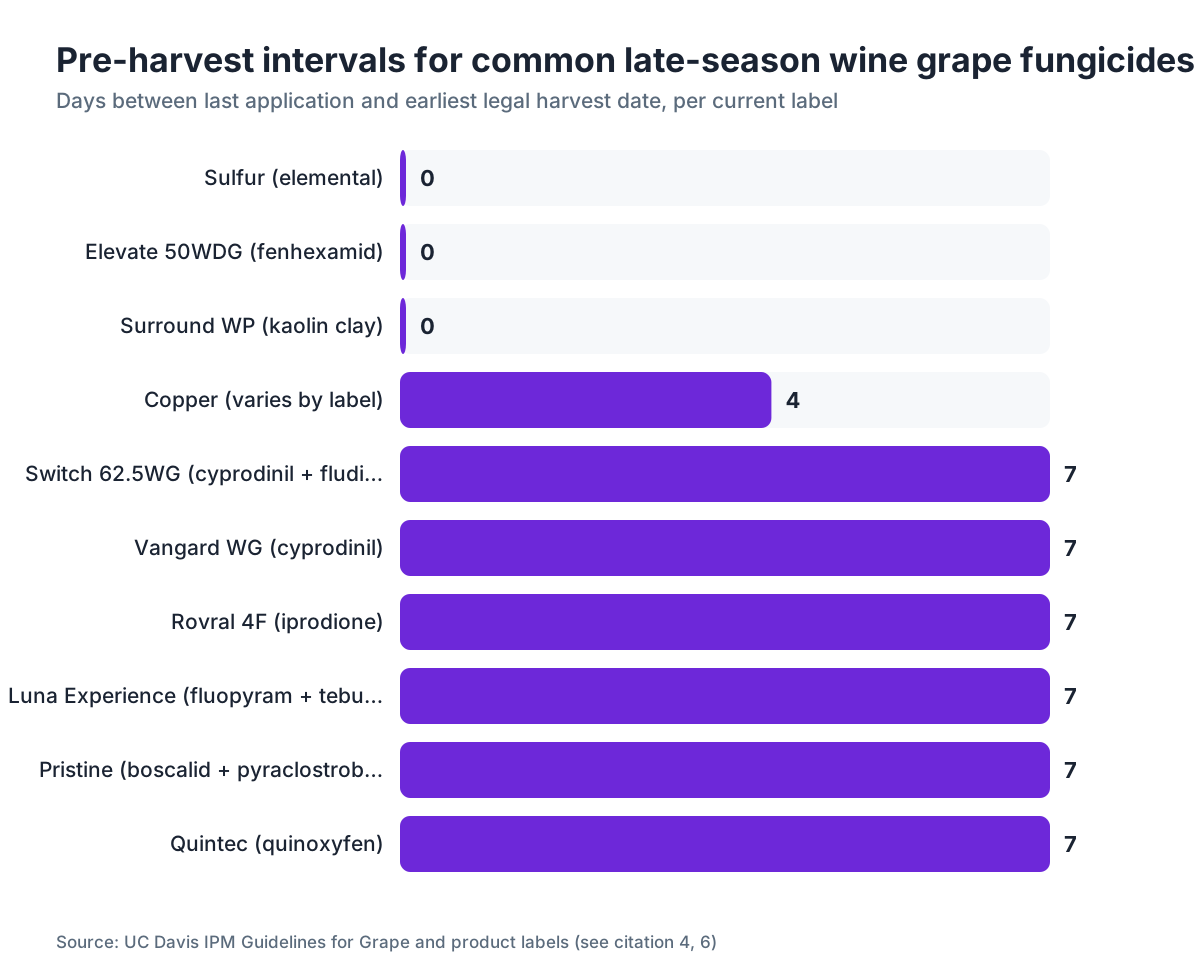
PHIs for common wine grape fungicides at a glance
The table below covers the most frequently used late-season fungicides in California, Oregon, Washington, and New York vineyards. Always verify against the current registered label before application. PHIs can change when registrations are renewed.
| Product (active ingredient) | PHI for grapes (days) | Key late-season use |
|---|---|---|
| Sulfur (elemental, various) | 0 | Powdery mildew |
| Microthiol Disperss (sulfur) | 0 | Powdery mildew |
| Cueva / Kocide (copper) | 0 to 7* | Downy mildew, Botrytis |
| Surround WP (kaolin clay) | 0 | Sunburn, leafhopper barrier |
| Elevate 50WDG (fenhexamid) | 0 | Botrytis |
| Rovral 4F (iprodione) | 7 | Botrytis |
| Vangard WG (cyprodinil) | 7 | Botrytis |
| Switch 62.5WG (cyprodinil + fludioxonil) | 7 | Botrytis |
| Luna Experience (fluopyram + tebuconazole) | 7 | Powdery mildew, Botrytis |
| Pristine (boscalid + pyraclostrobin) | 7 | Powdery mildew, Botrytis |
| Quintec (quinoxyfen) | 7 | Powdery mildew |
| Presidio (fluopicolide) | 14 | Downy mildew |
| Revus (mandipropamid) | 14 | Downy mildew |
| Ranman (cyazofamid) | 7 | Downy mildew |
*Copper PHI varies by formulation and state registration. Check label.
The pattern to notice: most Botrytis products aimed at pre-harvest protection carry 0 or 7-day PHIs, which is why they're built for late use. Downy mildew systemic chemistry tends to run longer.
What records do you actually need to keep, and for how long?
Federal requirements under the EPA Worker Protection Standard (WPS) require handlers and agricultural employers to maintain pesticide application records that include the product name, EPA registration number, active ingredient, location treated, date and time of application, and the name of the person who applied it [9]. California's DPR requires a Pesticide Use Report (PUR) filed with the county agricultural commissioner within 30 days of each application, and records must be retained for three years [10]. Oregon, Washington, and New York have their own parallel requirements. The minimum across all states is generally two years, but three is safer, and many certifying bodies (organic, sustainability programs) ask for five.
Beyond the legal minimum, your spray record is your defense. If a winery questions a residue test result or a state inspector arrives, you want a timestamped log showing the product, rate, date, and calculated PHI clearance. "I'm pretty sure we sprayed at least two weeks before pick" does not hold up.
The record should state the PHI from the label and the calculated clearance date. A sample log entry might read: "Switch 62.5WG, EPA Reg. 100-1246, 11 oz/acre, Block 4 (Syrah), September 10, 2025. PHI per label: 7 days. Earliest harvest clearance: September 17, 2025. Applied by: J. Ramirez." That one line answers every compliance question before anyone can ask it.
If your operation runs more than a few blocks, a digital record system becomes worth the time investment. VitiScribe is built for this kind of field-to-file logging, letting you attach the product label and calculate the clearance date automatically as you enter each spray event.
What happens if you spray inside the PHI window by accident?
First, don't panic. Then be honest with yourself about your options.
Catch it before harvest and you have one real choice: wait. Push the harvest date out until the PHI clears. Yes, that may change your sugar, acid, and flavor profile. Yes, it may conflict with your winemaker's schedule. Those are real costs, but they're recoverable. Harvesting within a prohibited interval is a federal violation.
If the fruit is already harvested and processed, this becomes a food safety issue. Depending on the residue level and the specific compound, FDA and EPA enforcement pathways can include product recall, financial penalties, and loss of license to apply restricted-use pesticides. The winery that received the fruit also carries liability exposure.
The practical reality is that most within-PHI incidents are never detected, because residue testing on wine grapes is not routine at the vineyard level. But "usually not caught" is a genuinely bad reason to take the risk. Winery sustainability programs keep expanding residue testing requirements. The EU sets tighter MRLs than the US for many fungicide residues on wine grapes, and if any portion of the wine is destined for export, that gap matters enormously [11].
Realize you've sprayed within a PHI? Document everything immediately and contact your county agricultural commissioner or state Department of Agriculture for guidance. Proactive disclosure beats a discovered violation nearly every time.
How do different states handle PHI compliance differently?
The federal PHI on the label is the floor everywhere. States can be stricter but never more permissive.
California runs the most aggressive pesticide oversight system in the country. The Department of Pesticide Regulation (CDPR) mandates monthly PUR filings, and county agricultural commissioners conduct field inspections. California also restricts certain active ingredients that are federally registered, so a product legal under EPA registration may still be banned in some California counties [10].
Washington State regulates under the Washington Pesticide Control Act and requires application records kept for two years. WSU Extension publishes an annual Pest Management Guide for Grapes, the operational reference for timing and PHI compliance across the Pacific Northwest [8].
New York requires licensed applicators to maintain spray records for three years under Part 76 of the Environmental Conservation Law. Cornell Cooperative Extension's viticulture team updates its spray timing recommendations annually and flags late-season PHI risks for Finger Lakes and Hudson Valley operations facing compressed harvest windows [7].
Oregon follows the Pesticide Control Act administered by the Oregon Department of Agriculture, with two-year record retention minimums. Because Oregon's harvest dates can shift by variety and vintage, the ODA advises growers to recalculate their PHI clearance dates if harvest moves earlier than planned.
The safest rule across all jurisdictions: if your harvest moves up, recalculate. Every time.
How do you handle a PHI conflict when harvest timing shifts unexpectedly?
This is where late-season viticulture gets genuinely hard. You spray on September 10 using a 14-day PHI product, planning for an October 1 harvest. Then a heat event accelerates ripening and your winemaker wants to pick September 20. You now have a problem.
Your options:
Option A. Push back on the harvest date. If the heat event is transient and the fruit can hold without significant quality loss, waiting to September 24 (14 days from September 10) keeps you legal. Talk honestly with your winemaker about what the hold costs in quality versus what the violation costs in liability.
Option B. Assess whether you actually need to pick as early as the heat event suggests. Grapes don't ripen uniformly across a block. Recheck Brix in multiple locations. Sometimes the urgency is overstated.
Option C. If you haven't sprayed yet and you see a heat event in the forecast, choose a product with a shorter PHI for the next application. Switch 62.5WG or Elevate at 0 to 7 days gives you more flexibility than a 14-day material.
Option D. Contact your county ag commissioner if you genuinely don't know what to do. They're not there to catch you. They're also a resource.
Proactive season planning beats reactive scrambling every time. If you know your average first-pick date for each variety, you can work backward and set a personal cutoff date for longer-PHI products. That self-imposed deadline, set in July or early August, takes the pressure off September decisions.
Does re-entry interval (REI) affect your PHI planning, and how?
Yes, and people confuse these two terms regularly.
The REI (Restricted Entry Interval) is the period after application during which entry into the treated area is restricted for worker safety. It protects field workers, not the crop from residue. The PHI is about food safety and residue tolerances.
For most wine grape fungicides, the REI ranges from 4 to 24 hours. Some SDHI and strobilurin-containing products carry a 12-hour REI. Captan carries a 24-hour REI [12]. The EPA Worker Protection Standard requires you to post the REI at a central location and keep workers out of the treated area until it expires [9].
REI and PHI are independent. A product can have a 24-hour REI and a 0-day PHI (workers stay out for a day, but you could technically harvest the next morning). Or it can have a 4-hour REI and a 7-day PHI (workers re-enter quickly, but fruit needs a week before pick). Your spray record should log both numbers for every application. They answer different compliance questions, and an inspector may ask about either.
One practical implication: if you're hand-picking and you spray late in the season, the REI affects how soon your harvest crew can legally enter the vineyard. For a 4-hour REI product applied at 7 AM, crew entry is fine by 11 AM if the block is dry. For a 24-hour REI product applied the day before a planned morning pick, you may need to either delay the application or restructure crew scheduling.
How do you build a season-end spray plan that keeps PHIs under control from the start?
Reactive PHI management is exhausting. The better approach builds PHI constraints into your spray plan before veraison.
Start with your estimated harvest dates by variety and block. These should be in your records from prior seasons. Assign a range: early, average, late. Use the early date as your safety margin.
Work backward from the early harvest estimate for each block. Draw a line on your spray calendar: "14-day PHI cutoff," "7-day PHI cutoff," "0-day products only beyond here." This turns an invisible compliance rule into a visible planning tool.
Choose your late-season product lineup with PHI as a primary criterion, not an afterthought. For Botrytis, the standard practice is to make your last protective application at or before bunch closure, leaving enough time that even a 7-day PHI clears comfortably. UC Davis Cooperative Extension recommends timing Botrytis applications at early bunch closure and again pre-harvest if needed, noting that fenhexamid (Elevate) and cyprodinil/fludioxonil (Switch) are preferred for late applications because of their 0 and 7-day PHIs [6].
For powdery mildew, late-season pressure often means one more sulfur application is warranted, and the 0-day PHI on sulfur makes this easy. But heat events above 90F can hurt sulfur efficacy and cause fruit burn, so timing matters for more than compliance reasons.
For downy mildew, if you're in a high-pressure region and rain is forecast late in the season, you may need a late systemic application. Revus or Presidio carry 14-day PHIs. Factor that into your timing when you choose the product.
For operations running multiple blocks across varieties that harvest anywhere from early September to mid-October, a simple block-level calendar with PHI cutoff dates for each product class is genuinely useful. It doesn't need to be complex. A spreadsheet or a whiteboard in the shop works. The structure matters, not the tool.
If you want a purpose-built system, VitiScribe handles exactly this kind of block-by-block PHI tracking alongside your spray records, letting you see at a glance which blocks are cleared and which aren't as harvest approaches.
Are there any fungicide resistance considerations that interact with late-season PHI choices?
Yes, and this is where PHI planning and agronomic planning run into each other.
Botrytis cinerea has documented resistance to multiple fungicide classes, including benzimidazoles, dicarboximides (iprodione, Rovral), and increasingly to SDHIs and phenylpyrroles [11]. The resistance management guidance from FRAC (Fungicide Resistance Action Committee) recommends rotating between mode-of-action groups, not repeating the same class in consecutive applications.
For late-season Botrytis management, this means your last one or two pre-harvest applications should include products from different FRAC codes. If you used an SDHI (FRAC Group 7) earlier in the season, finish with a phenylpyrrole (FRAC Group 12) or anilinopyrimidine (FRAC Group 9). Switch 62.5WG combines cyprodinil (Group 9) and fludioxonil (Group 12) in one product, which is why it's so widely used as a final pre-harvest application. Its 7-day PHI still gives you some scheduling room.
Here's the interaction with PHI planning: if resistance concerns push you toward a product with a longer PHI, you need to account for that in your scheduling. Don't let resistance management and PHI management be two separate conversations. They're the same decision.
Frequently asked questions
What does PHI stand for in vineyard spray records?
PHI stands for Pre-Harvest Interval. It's the number of days that must pass between the last fungicide (or pesticide) application and the harvest date, as stated on the product label. EPA sets the number during pesticide registration based on residue decline data. Harvesting before the PHI expires is a violation of federal law under FIFRA.
How do I calculate the PHI clearance date for a spray application?
Take the date of your application and add the PHI in days. If you spray on September 10 with a product that has a 7-day PHI, your earliest legal harvest date for that block is September 17. Do the calculation per block and per product, because different areas of your vineyard may receive different materials with different PHI lengths.
Can I harvest early if the fruit looks ready before the PHI clears?
No. The PHI is a legal prohibition, not a quality recommendation. Even if your Brix, pH, and TA are ideal for harvest, you cannot legally pick before the PHI expires. If the fruit must come off early due to disease, weather, or other pressure, the responsible step is to contact your county agricultural commissioner and document everything.
Do organic or OMRI-listed fungicides have PHIs too?
Yes, though many are short. Elemental sulfur, widely used in both conventional and organic vineyards, typically carries a 0-day PHI for grapes. Some copper formulations carry 0 to 7-day PHIs depending on product and label version. Always check the current label even for materials you consider 'safe,' because PHIs are set per registration and can change.
How long do I need to keep spray records that include PHI information?
The federal EPA Worker Protection Standard requires records for at least two years. California DPR requires three years and monthly Pesticide Use Reports. Many organic certifiers and sustainability programs require five years. The safest practice is to keep spray records, including logged PHI clearance dates, for at least five years and back them up digitally.
What's the difference between REI and PHI on a fungicide label?
REI (Restricted Entry Interval) protects workers by restricting field entry after application, typically 4 to 24 hours. PHI (Pre-Harvest Interval) protects consumers by prohibiting harvest before residues decline to safe levels, typically 0 to 14 days. Both numbers appear on the label. Both must be logged in your spray records. They are separate legal requirements with separate timelines.
What should a legally compliant late-season spray record entry look like?
It should include: product name, EPA registration number, active ingredient, block or location, application date, rate per acre, application method, name of the applicator, the PHI stated on the label, and the calculated clearance date (application date plus PHI days). Some states also require start and end times. That one record entry answers most compliance and liability questions before they're asked.
Which late-season Botrytis fungicides have the shortest PHIs?
Elevate 50WDG (fenhexamid) has a 0-day PHI for grapes and is widely used as the final pre-harvest Botrytis spray. Switch 62.5WG (cyprodinil plus fludioxonil) has a 7-day PHI and is also common for final applications because it combines two FRAC groups, helping with resistance management. UC Davis Extension specifically recommends these two for late-season Botrytis timing.
If I move my harvest date earlier than planned, do I need to recalculate my PHI compliance?
Yes, every time. PHI compliance is calculated from the application date forward to the actual harvest date. If harvest moves up by a week due to heat or disease, any applications made within that compressed window may now sit inside the PHI. This is one of the most common late-season compliance errors. Always recalculate after any change to your harvest schedule.
Do EU export requirements affect PHI compliance for US wine grapes?
Indirectly, yes. The EU sets its own maximum residue limits (MRLs) for pesticides on wine grapes, and some are lower than US tolerances. If any wine made from your grapes will be exported to Europe, the winery or importer may impose additional restrictions on which fungicides can be used and when. Those are contractual obligations on top of US federal PHI requirements, and they can be stricter.
How do state pesticide regulations interact with the federal PHI on the label?
Federal law sets the minimum: you cannot harvest before the label PHI expires. States can add restrictions on top of that, such as shorter windows, additional reporting requirements, or bans on certain active ingredients within their borders. California, for example, restricts some federally registered pesticides at the county level. Always check both the federal label and your state's pesticide registration database.
Can I use a product with a longer PHI earlier in the season to avoid late-season conflicts?
Yes, and this is good practice. Systemic downy mildew materials like Revus and Presidio, which carry 14-day PHIs, work best when used in early to mid-season during rapid shoot growth and before bunch closure. Reserving them for early-season use avoids the harvest timing conflict entirely and matches resistance management rotations too.
What if I accidentally apply a fungicide inside the PHI window?
Document it immediately. Do not harvest until the PHI clears from the actual application date. If fruit has already been harvested, contact your county agricultural commissioner and state Department of Agriculture proactively. Voluntary disclosure consistently produces better outcomes than a discovered violation. The winery receiving the fruit should also be notified, since they share liability exposure for residue violations.
Are there vineyard record-keeping tools that track PHI compliance automatically?
Yes. Several digital tools built for vineyard operations let you enter the product name, application date, and label PHI, then automatically calculate the clearance date and flag blocks that are not yet cleared as harvest approaches. This is far more reliable than manual calendar calculations across multiple blocks, varieties, and spray products during the busy late-season period.
Sources
- EPA, Federal Insecticide Fungicide and Rodenticide Act (FIFRA) Overview: FIFRA makes the pesticide label a legally binding document; use inconsistent with label directions is a federal violation
- EPA, How to Read a Pesticide Label: Pre-harvest intervals appear in the Directions for Use section of registered pesticide labels under Restrictions or Limitations
- UC Davis Cooperative Extension, Grape Pest Management (Integrated Pest Management for Grapes): Copper formulation PHIs for grapes range from 0 to 7 days depending on the product and application rate
- UC Davis Cooperative Extension, Grape Pest Management (Integrated Pest Management for Grapes): Quintec (quinoxyfen) carries a 7-day PHI for wine grapes; fenhexamid (Elevate) and cyprodinil/fludioxonil (Switch) are recommended for late Botrytis applications based on PHI and efficacy
- National Pesticide Information Center (NPIC), Oregon State University: NPIC provides access to current pesticide label information and PHI data for registered products
- UC Davis Cooperative Extension, UC IPM Pest Management Guidelines for Grape: UC Davis recommends fenhexamid (Elevate) and cyprodinil/fludioxonil (Switch) for late-season Botrytis applications at early bunch closure, citing their 0 and 7-day PHIs
- Cornell Cooperative Extension, Viticulture and Enology Program, New York and Pennsylvania Pest Management Guidelines for Grapes: Cornell Extension updates spray timing recommendations annually and flags late-season PHI risks for Finger Lakes and Hudson Valley grape growers
- Washington State University Extension, Pest Management Guide for Grapes in Washington: WSU Extension publishes an annual grape pest management guide used as the operational reference for PHI compliance in Pacific Northwest vineyards; Washington requires application records for two years
- EPA, Worker Protection Standard for Agricultural Pesticides: The EPA Worker Protection Standard requires pesticide application records including product name, EPA registration number, active ingredient, location, date, and applicator name, retained for at least two years; REI posting requirements are also mandated
- California Department of Pesticide Regulation (CDPR), Pesticide Use Reporting: California DPR requires Pesticide Use Reports filed within 30 days of application with the county agricultural commissioner, with records retained for three years; CDPR also restricts some federally registered pesticides at the county level
- FRAC (Fungicide Resistance Action Committee), Botrytis Resistance Management Guidelines: Botrytis cinerea has documented resistance to benzimidazoles, dicarboximides, and increasingly to SDHIs; FRAC recommends rotating FRAC code groups to manage resistance in late-season Botrytis programs
- EPA, Worker Protection Standard for Agricultural Pesticides, REI Requirements: Captan carries a 24-hour REI; most SDHI and strobilurin-containing products carry a 12-hour REI under WPS requirements
Last updated 2026-07-11