How to record spray applications where the label requires specific water pH

TL;DR
- When a pesticide label specifies a water pH range, your spray record must show the pH of the tank mix as prepared, the method you used to test it, any acidifying or buffering agent added, and the rate applied.
- The federal Worker Protection Standard sets a two-year retention floor.
- Skipping pH documentation when the label demands it can void your legal protection under FIFRA.
Why does water pH show up on pesticide labels at all?
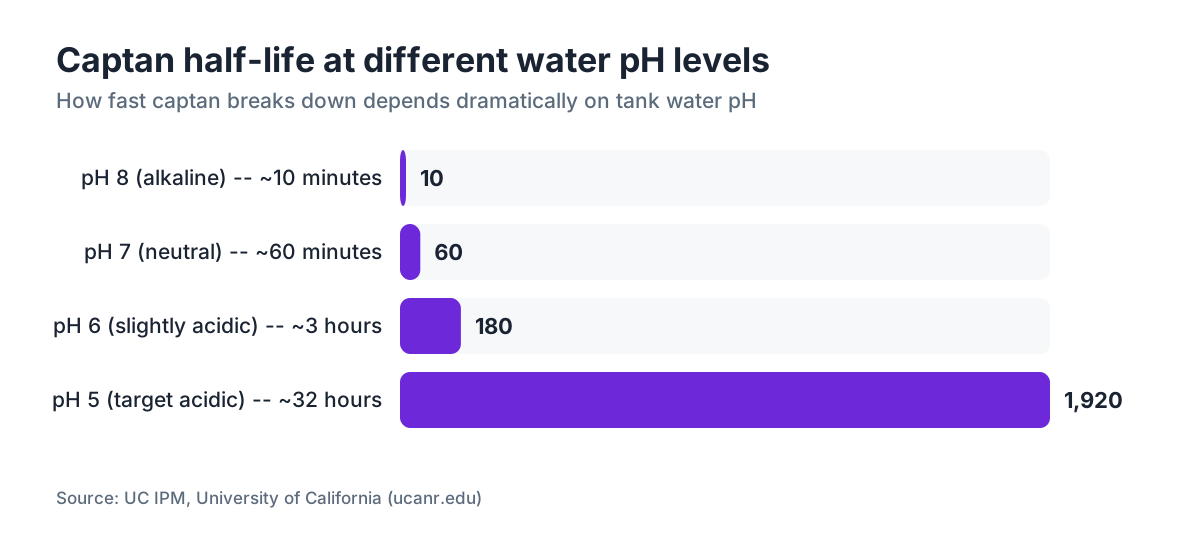
Many fungicides, insecticides, and foliar nutrients break down faster in high-pH water than the label rate assumes. The chemistry is alkaline hydrolysis. Some active ingredients lose half their potency within hours at pH 8 or above. Captan is the classic example. Its half-life runs roughly 10 minutes at pH 8 but about 32 hours at pH 5, according to University of California Integrated Pest Management program data [1]. That gap is big enough to make the product useless before it ever reaches the vine.
So the label pH requirement isn't a suggestion. When a manufacturer writes "mix in water buffered to pH 5.5 to 6.5" or similar language, that language is part of the legal use directions under FIFRA. Applying a product in a way that contradicts the label is a federal violation [2]. More to the point, if you spray at pH 8.5 and the product fails, you have no recourse with the manufacturer and no documented defense with a regulator.
For vineyard managers, this comes up most often with captan, sulfur-based tank mixes, and some newer SDHI fungicides. It also appears on certain insecticide and miticide combinations that need neutral or slightly acidic water to keep the emulsion stable. The label is the only place to confirm the requirement for a given product. Read it every season. Labels get revised.
What does FIFRA actually require you to record for pesticide applications?
FIFRA Section 8(a) gives EPA the authority to require recordkeeping, and the EPA Worker Protection Standard requires agricultural employers to keep application records for at least two years [3][10]. Many states go further. California, Washington, Oregon, and New York all require commercial applicators to keep pesticide use records for two to five years depending on the license category [4].
Every application record carries a core set of fields: product name, EPA registration number, target pest, site treated, date and time, rate applied, total amount applied, and applicator name. When the label adds a water pH requirement, regulators in states like California treat that requirement as a material condition of use. Your record then has to show you met it. No single federal statute spells that out in the word "pH," but it flows straight from the obligation to apply products consistent with the labeling [2].
The California Department of Pesticide Regulation directs its field staff to check whether records document compliance with label-required conditions, and pH is one of them [4]. Picture a record that lists a product carrying a pH 5 to 7 requirement, with no pH entry anywhere on the page. An inspector can only conclude one of two things: you didn't test, or you tested and ignored the result. Neither one helps you.
The two-year federal floor and the longer state floors matter because audits rarely land the week after you spray. A county agricultural commissioner working a drift complaint or a residue problem eighteen months later still wants that record, and it needs to hold up.
How should you test and document tank water pH before spraying?
You have three realistic options: pH strips, a handheld digital pH meter, or an inline flow-through pH probe on larger rigs. Each has tradeoffs.
pH strips are cheap, roughly $10 to $25 for a pack, and they give you a reading in seconds. The catch is they're hard to read precisely in the 5.5 to 7.0 window most labels target, and they leave no instrument trail. If strips are what you have, note the brand, the strip range, and the color you matched.
A handheld digital meter runs $30 to $200 depending on resolution and how waterproof it is [5]. These read to plus or minus 0.1 pH unit when calibrated with fresh buffer solution, which you should do at the start of every spray day. Log the calibration. Some managers photograph the meter display against the tank while it fills. A timestamped photo like that is strong documentation.
Inline probes on commercial sprayers give continuous readings, and some export the data directly. If your rig has one, download the log file after each application and attach it to the spray record. That's about as solid as documentation gets.
| Method | Accuracy | Cost | Record format |
|---|---|---|---|
| pH test strips | ±0.5 to 1.0 | $10-25 | Written log |
| Handheld digital meter | ±0.1 (when calibrated) | $30-200 | Written log or photo |
| Inline probe with datalogger | ±0.05 | $200-800+ | Electronic file |
One rule cuts across all three methods. Measure pH after every tank-mix component is in, never on the raw water alone. Emulsifiable concentrates, wettable powders, and surfactants all shift pH. The number that matters is the final mix.
What buffering agents do vineyard managers actually use, and how do you record them?
Citric acid is the common pick. It's cheap, food-grade, and every ag supplier stocks it. Phosphoric acid-based buffers show up a lot too. Commercial tank conditioners often pair an acid with a surfactant and add a pH indicator dye that changes color when the water hits the target range. The color change is a handy field check. It doesn't replace a meter reading.
When you add a buffering agent, log it the same way you log any tank-mix additive: product name, EPA registration number if the buffer is a registered pesticide (some are, some aren't), rate added, and final tank pH after the addition. If the buffer isn't a registered pesticide, it still belongs in the record as an adjuvant or tank additive, because it changes the application.
WSU Extension has noted that the amount of acidifier you need tracks with the alkalinity, the bicarbonate content, of your source water more than with its pH [6]. Water at pH 7.5 loaded with bicarbonate is far harder to buffer than water at the same pH with low alkalinity. Pull from a high-bicarbonate well and you might need two to three times the acidifier a low-alkalinity municipal source would take. The only way to know is to test and log it.
Some applicators run a water profile test at the start of each season and keep it on file. That isn't a substitute for per-batch records. It does tell you roughly how much buffer to start with.
What exactly should a complete spray record look like when the label requires water pH?
A compliant record for a pH-sensitive application should have at least these fields filled in:
- Product name and EPA registration number
- Application date and time (start and finish)
- Block or field identifier (acres treated)
- Target pest or disease
- Application rate (oz or lb per acre, or per 100 gallons)
- Total product used
- Water source
- Water pH before buffer addition
- Buffer or acidifier product name (and EPA reg number if applicable), rate added
- Tank mix final pH after all additions
- pH test method (meter model and calibration date, strip brand, or probe ID)
- Applicator name and, where required, license number
- Wind speed and direction, temperature, and relative humidity (required by many labels and by the WPS restricted-use provisions)
Fields 8 through 11 are the ones most paper records leave blank. If you use a paper form, add a boxed section at the bottom labeled "Water quality" with lines for source pH, buffer added, final pH, and test method. It takes thirty seconds to fill. It's also the exact section an inspector reaches for on a pH-sensitive product.
Running several blocks off the same tank mix on the same day? One water quality entry covers the batch, as long as you note that the batch covered all the listed blocks. Refill partway through the day with water from a different source, and you need a fresh pH reading and a new entry.
How long do you need to keep these records, and who can ask to see them?
The federal floor is two years, set under FIFRA regulations and reinforced by the EPA Worker Protection Standard [3]. California runs longer for some categories: under California Food and Agricultural Code Section 12981, certified applicators must retain pesticide use records for three years and submit them monthly to the county agricultural commissioner [4]. Washington State requires two years for private applicators and three for commercial ones [7].
The EPA Worker Protection Standard requires employers to keep records of each application for two years and to make them available to handlers, workers, and their representatives on request [3]. In plain terms, an employee who worked a treated block can ask to see the spray record.
Beyond employee requests, the list of people who can pull your records includes county agricultural commissioners in California, state department of agriculture inspectors, EPA inspectors, and crop insurance adjusters. Certified organic? Your certifier reviews pesticide records as part of the audit too.
Keep records in a format that stays readable. A folder of dog-eared paper is legal and tends to disappear. A PDF scan of each record in a shared folder, named something like YYYY-MM-DD_Block_Product, is far easier to find two years out, when you barely remember the day you sprayed.
What happens if you skip the pH documentation and an inspector finds out?
The immediate consequence depends on the state. California issues written warnings for a first recordkeeping slip, but it can escalate to civil penalties of up to $5,000 per violation per day under California Food and Agricultural Code Section 12999 [4]. A blank pH field on a product with a clear label requirement is a prime candidate for a finding of "application inconsistent with labeling," which carries its own penalty track separate from recordkeeping.
Fines aren't the real risk. The real risk shows up when something goes wrong. A neighboring vineyard claims drift damage. A worker reports a health concern. Your fruit fails a residue test. In every one of those situations, your spray records are the first thing anyone reaches for. A record showing you verified and documented pH compliance reads very differently from one with a blank where that number belongs. Regulators and courts look at whether you followed the label in good faith. A complete record is that evidence.
Say you realize after the fact that you sprayed a product without testing pH. The honest move is to add a corrective note explaining what you know and don't know about that batch. Don't touch the original record. A dated addendum flagging the gap beats silence every time.
Does pH documentation differ for organic-approved inputs?
Organic-approved inputs like copper-based fungicides, sulfur, and biological products are still pesticides for recordkeeping in most states. OMRI listing doesn't exempt a product from pesticide use reporting, and California folds organic inputs into its pesticide use reporting system explicitly [4].
Sulfur is pH-sensitive in a different direction. Sulfur sprays applied when water pH sits outside the label range can raise phytotoxicity risk, and certain sulfur and copper combinations turn more aggressive at lower pH values. Cornell Cooperative Extension notes that copper-sulfur tank mixes need careful attention to both pH and water hardness to avoid precipitation and phytotoxicity [8].
For organic operations, your certifier reviews all spray records at annual certification. National Organic Program regulations under 7 CFR Part 205 require organic operations to keep records sufficient to demonstrate compliance with NOP standards [9]. If your records show a product applied with no pH verification for a label that demands it, your certifier can flag it as an incomplete record, which can trigger a closer look at that application's compliance.
Can you use digital tools or apps to keep spray records with pH fields?
Yes, and it makes the whole thing more reliable than paper. A good digital tool lets you build a template for each product in your program, with the label-required pH range baked into the entry form. When an applicator fills in the record on a tablet or phone, a pH value outside the acceptable range can flag as a warning before submission. Paper can't do that.
VitiScribe, for instance, lets vineyard managers build custom field sets for each spray event, so the pH source, pre-buffer result, buffer added, and final pH each get their own line. Records export as PDFs that match California DPR and county ag commissioner formatting.
Whatever tool you choose, the thing that matters is that it stores records with timestamps you can't quietly edit, or at minimum logs edits when you can. Audit trails carry weight. A system that lets you change a pH entry six months later with no record of the change is a liability, not an asset. Before you buy, ask the vendor exactly how it handles amendments and whether it generates a change log.
WSU Extension's Pesticide Management Education Program recommends keeping a full set of product labels and SDS sheets alongside application records, so the label version in effect on the day of application is on file [7]. Digital makes that easy. Upload the label PDF the day you buy the product.
What if the label doesn't state a specific pH range but mentions pH sensitivity?
Some labels use language like "best results achieved in slightly acidic water" or "avoid application with hard or alkaline water" without giving a number. That's guidance, not a strict condition of use, but it still earns a spot in your record. Log it as a note and write down what your water pH actually was.
Here's why that pays off. If the product underperforms and you later want to file a claim with the manufacturer or just understand what went wrong, pH data from the day beats trying to reconstruct it from memory. You can also check whether your local extension service has water compatibility data for the product. UC Davis IPM advises applicators to consult product labels and UC guidelines for specific pH recommendations, since degradation rates for some products are documented in published literature even when the label stays quiet on a number [1].
Testing and logging water pH on a spray day takes about two minutes. That two minutes is worth it whether or not the label requires it. It gives you a full picture of application conditions, which is often what explains why one spray worked and the next one didn't.
How do you train spray crew members to handle pH testing and recording correctly?
Training on pH documentation has to cover three things: why it matters, how to test, and how to record. Skip the "why" and the crew skips the step.
Start with money. If the product breaks down before it hits the vine because the water was too alkaline, you paid for nothing and the disease keeps running. That's a real cost, not a regulatory abstraction. Most crew members hear that framing a lot better than a compliance lecture.
For the mechanics, have every crew member who mixes tanks demonstrate a meter calibration and a tank reading before the season opens. Have them fill out one complete practice spray record, pH fields and all. The EPA Worker Protection Standard requires handlers to be trained before handling pesticides, and the training must cover label requirements including safe use directions [3]. pH testing is part of safe use for pH-sensitive products, so it belongs in your handler training documentation.
Keep the calibration log for your pH meter in the same place as your spray records. If a meter gets dropped or hasn't been calibrated in more than two weeks, treat its reading as approximate and note that in the record. A $10 set of replacement buffer ampules every few months is cheap insurance.
For larger operations running multiple applicators, a laminated card on the spray rig showing the required pH range for the products in that block's rotation cuts errors. Pull the ranges from the labels before the season and post them where the mixer can read them.
Frequently asked questions
Is pH documentation legally required on every spray record, or only when the label specifically mentions it?
pH documentation is required when the label specifies a pH range or condition as part of use directions, because applying a product inconsistently with the label is a federal FIFRA violation. If the label is silent on pH, no regulation specifically mandates logging it, though it's good practice. When in doubt, include it. It adds almost no time and gives you useful performance data.
What is the minimum pH information I need to record to satisfy a California DPR inspection?
California DPR expects records to document compliance with all material label conditions. For a pH-sensitive product, that means at minimum the final tank pH after buffering, the test method used, and any buffering agent added. Recording pre-buffer pH and the buffer rate is strongly advisable. Omitting these when the label requires a specific pH range can result in a finding of application inconsistent with labeling.
How often should I calibrate my pH meter when doing spray season records?
Calibrate before the first use of the day, any time the meter is dropped or exposed to extreme temperatures, and if more than two weeks pass between uses. Use fresh two-point buffer solution covering the range you're testing (typically pH 4 and pH 7 buffers). Log each calibration date in your records. An uncalibrated meter reading is not defensible documentation.
Can I use one tank pH reading for multiple spray blocks filled from the same batch?
Yes, if all blocks are sprayed from a single tank batch mixed at once, one pH measurement taken after all components are added covers all those blocks. Note in the record that the single batch covered all listed blocks. If you refill from a different water source or remix the tank mid-day, you need a new pH measurement and a new entry.
What buffering agents are safe to use in a tank mix with captan or mancozeb?
Citric acid is widely used and compatible with most fungicides including captan and mancozeb. Phosphoric acid-based commercial buffers also work well. Avoid strong mineral acids like muriatic acid in spray equipment. Always add the buffer to water before adding the fungicide, and test final pH after all components are in. WSU Extension recommends checking compatibility of all tank-mix partners including the buffer agent before use.
Do organic inputs like copper and sulfur need pH documentation in spray records?
Yes. Organic-approved inputs are still regulated pesticides for recordkeeping purposes in most states, including California's mandatory pesticide use reporting system. OMRI listing does not exempt a product from use record requirements. For copper-sulfur tank mixes specifically, Cornell Cooperative Extension notes that pH and water hardness both affect phytotoxicity risk, making documentation of those conditions particularly useful.
How does water alkalinity differ from water pH, and does it matter for spray records?
pH measures the concentration of hydrogen ions; alkalinity measures the water's capacity to neutralize acid, driven mainly by bicarbonate content. High alkalinity water can resist pH adjustment and bounce back after buffering. For records, log both the starting pH and the amount of buffer needed to reach the target range. WSU Extension has noted that alkalinity, more than pH, determines how much acidifier is required to stabilize a tank mix.
What happens to my crop insurance or liability coverage if I can't document that I met the label's pH requirement?
Crop insurance adjusters reviewing a pesticide failure claim will ask for spray records. A missing pH entry for a label that required a specific range gives the adjuster grounds to question whether the product was used correctly, potentially reducing or denying the claim. Manufacturer warranties on pesticide performance typically specify that the product must be mixed according to label directions, including pH conditions, so a gap in documentation removes that recourse.
Are there any federal rules that require employers to share spray records with workers?
Yes. The EPA Worker Protection Standard requires that employers make application records available to agricultural workers and handlers who may have been exposed. Under 40 CFR Part 170, handlers have the right to see the records for applications they were involved in. Records must be retained for two years. Workers can request the information through their employer or through the designated representative system described in the WPS.
What's the right way to correct a spray record where the pH field was left blank?
Do not alter the original entry. Add a dated, signed addendum attached to the original record explaining what information is missing, what you do and don't know about conditions that day, and what corrective steps you're taking going forward. Some state regulations specifically address record amendments; California DPR requires that any corrections be clearly identified as corrections with the date made. Falsifying a record is a much more serious violation than having an incomplete one.
Does the two-year federal record retention rule apply to private (non-commercial) pesticide applicators?
The federal WPS two-year rule applies to agricultural employers using any pesticide in the WPS program, regardless of commercial license status. For restricted-use pesticides, federal regulations under FIFRA require certified applicators to maintain records regardless of whether they are commercial or private. State rules may set longer retention periods. California, for instance, requires three years for certified applicators under state law.
What should I do if my well water pH varies significantly between the start and end of the irrigation season?
Test your well water pH at the start of each spray day during the season and log the result as part of your water source record. Some vineyards do quarterly alkalinity tests from a certified lab and keep those reports on file alongside spray records. Knowing your water's seasonal variation lets you plan buffer quantities more accurately and documents due diligence if water quality becomes an issue during an inspection or audit.
How do I record pH adjustments when I'm mixing a tank with multiple active ingredients that each have different pH requirements?
Find the overlapping pH range that satisfies all label requirements, buffer to that range, and record the final tank pH along with all label-required ranges. If two products have incompatible pH requirements, you cannot legally mix them in a single tank. Document your review of compatibility in the record as a note. WSU and Cornell both provide tank-mix compatibility resources that can help identify conflicts before mixing.
Sources
- UC IPM, University of California -- Pesticide Application and Safety: Captan has a half-life of roughly 10 minutes at pH 8 but about 32 hours at pH 5, illustrating the alkaline hydrolysis problem with many fungicides
- EPA -- Federal Insecticide, Fungicide, and Rodenticide Act (FIFRA) Overview: Using a pesticide in a manner inconsistent with its labeling is a federal violation under FIFRA Section 12
- EPA -- Worker Protection Standard (40 CFR Part 170): Employers must retain records of each pesticide application for 2 years after the date of the application and make them available to handlers, workers, and their representatives
- California Department of Pesticide Regulation -- Pesticide Use Reporting: California certified applicators must retain pesticide use records for three years and submit monthly reports to the county agricultural commissioner; penalties for violations can reach $5,000 per violation per day under California Food and Agricultural Code Section 12999
- Penn State Extension -- Field Scouting and Spray Equipment Resources: Handheld digital pH meters accurate to ±0.1 pH unit when calibrated cost roughly $30 to $200 depending on resolution and waterproofing
- Washington State University Extension -- Pesticide Management Education Program: The rate of acidifier needed varies significantly with the alkalinity (bicarbonate content) of source water, not just its pH, and high-bicarbonate water may require two to three times the acidifier of low-alkalinity water
- Washington State University Extension -- Pesticide Record-Keeping Requirements: Washington State requires two years of records for private applicators and three years for commercial applicators; WSU recommends maintaining product labels and SDS sheets alongside application records
- Cornell Cooperative Extension -- New York State IPM Program: Copper-sulfur tank mixes require careful attention to both pH and water hardness to avoid precipitation and phytotoxicity in vineyards
- USDA Agricultural Marketing Service -- National Organic Program (7 CFR Part 205): Organic operations must maintain records sufficient to demonstrate compliance with NOP standards; organic certifiers review pesticide records annually including documentation of input conditions
- EPA -- FIFRA Section 8 Recordkeeping Requirements: FIFRA Section 8(a) gives EPA authority to require recordkeeping for pesticide applicators, forming the basis for two-year federal retention requirements
Last updated 2026-07-09