How to calculate sulfur spray interval based on temperature accumulation

TL;DR
- Sulfur burns grapevines when temperatures top 90°F within about 24 hours before or after you spray.
- Track heat as degree-days (base 50°F) from your biofix date.
- UC Davis advisors use 315 DD50 as the point to reassess your program, and treat 95°F as a hard stop for any application, regardless of formulation or timing.
Why does temperature matter for sulfur spray timing at all?
Elemental sulfur is the oldest fungicide in viticulture and still one of the best tools you have against powdery mildew (Erysiphe necator). It carries one built-in liability. At high temperatures, sulfur volatilizes fast enough to burn leaf and berry tissue before it moves off the plant. That burn is phytotoxicity. It shows up as bleached leaf margins, shot berries, and in bad cases, defoliation.
The threshold is not a precise line etched in stone. Most extension programs put it somewhere between 90°F and 95°F, and the real risk is less about a single spike than about the cumulative heat load the plant sees after you spray. A mild 88°F afternoon following a warm night is often more dangerous than one hour at 92°F that quickly cools.
That's why temperature accumulation matters more than any single reading on your weather station. Degree-days (DD) turn a running tally of heat into a number that predicts when the vine will show phytotoxic stress from residual sulfur. Learn the calculation and you stop guessing. You start scheduling.
What is the 315 degree-day rule and where does it come from?
The 315 degree-day threshold (base 50°F, written 315 DD50) is the point in the season where UC Davis and California advisors have historically told growers to reassess their sulfur program. Below 315 DD50 from your biofix date, afternoons are usually cool enough that phytotoxicity risk stays low and you can stretch the interval between sprays. Above it, you're entering the mid to late spring window when highs start touching the danger zone regularly. [1]
The threshold traces to phenological modeling associated with the UC Davis Department of Viticulture and Enology, which tied degree-day accumulation to vine growth stage and the odds of a warm afternoon landing on freshly applied sulfur. It is not a federal regulatory number. It's a practical heuristic built from California climate data. Growers in cooler regions like the Willamette Valley or the Finger Lakes will find their risk period shifted later on the calendar.
WSU Extension uses the same logic in its Pacific Northwest guides, framing timing around the forecast rather than a single DD number. The principle underneath is identical. You want residual sulfur on the canopy to miss the hottest part of the day. [2]
Cornell's New York State IPM program leans on the 7 to 10 day protective window of sulfur and re-checks that window against the 7-day forecast before every application. Different math, same result. [3]
How do you actually calculate degree-day accumulation for your vineyard?
The standard formula uses a base temperature of 50°F (10°C). You're measuring how much heat above that base accumulates over a period, then converting to degree-days.
The simplest version is the Average Method:
DD = ((Tmax + Tmin) / 2) - Tbase
So if Monday's high is 82°F and the low is 54°F, with a 50°F base:
DD = ((82 + 54) / 2) - 50 = 68 - 50 = 18 DD50
Add each day's result to a running total from your chosen start date. January 1 is most common in California. Some cooler-climate programs start March 1. When the total hits 315, you adjust your interval.
A sharper calculation is the Single Sine method, which fits a sine curve to daily Tmax and Tmin to estimate the real hourly temperature profile. This matters where you have wide diurnal swings, which is exactly the situation in most inland wine regions. The UC IPM website hosts a free degree-day calculator that uses this method and pulls CIMIS station data for California growers. [4]
Outside California, WSU's AgWeatherNet does the same for Washington and Oregon stations. [5] NEWA (Network for Environment and Weather Applications), run partly through Cornell, covers the Northeast and Midwest. [11]
One practical note. If you don't have an on-site station, use the nearest AgWeatherNet or CIMIS station instead of a regional airport ASOS. Vineyard microclimates routinely run 4 to 8°F warmer than the nearest official station. That gap is exactly the margin you're trying to measure.
| Method | Data needed | Accuracy | Best for |
|---|---|---|---|
| Average Method | Daily Tmax + Tmin | Moderate | Quick field estimate |
| Single Sine | Daily Tmax + Tmin | Higher | Planning spray schedules |
| Hourly Integration | Hourly station data | Highest | Research, disease modeling |
| Online calculator (UC IPM / NEWA) | Station selection | High | Practical daily use |
What spray interval should you use at different degree-day accumulations?
No single table gets universal agreement across every extension program, but the framework below pulls together guidance from UC Davis, WSU, and Cornell into decision points you can act on. [1][2][3]
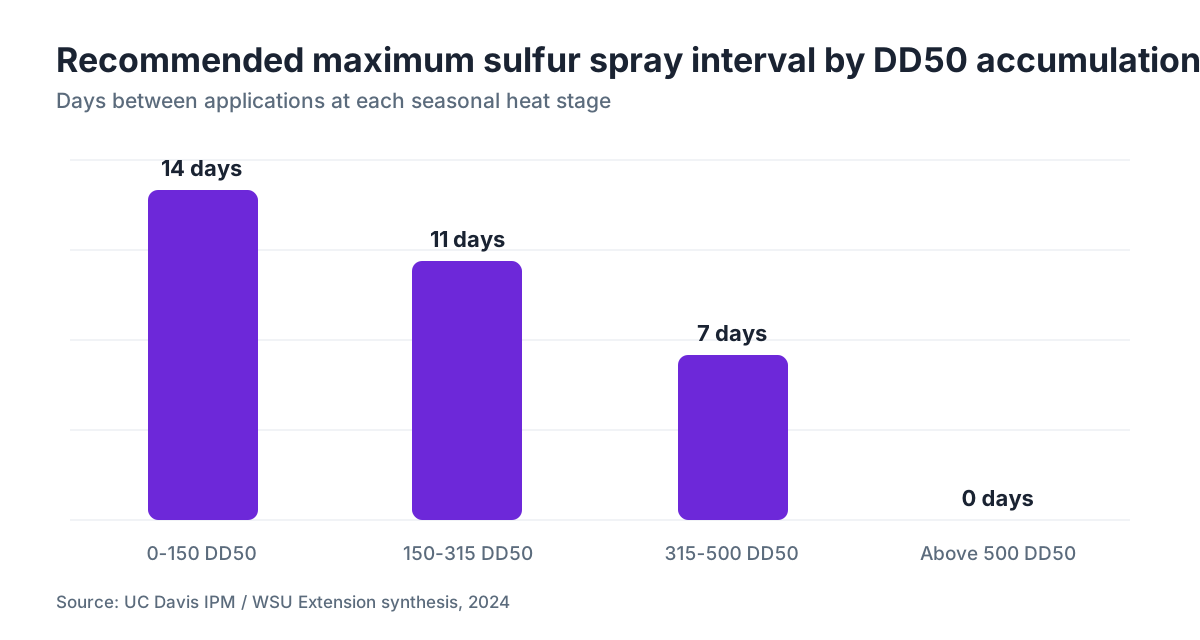
Below 150 DD50 (early spring, cool): 14-day intervals are usually fine. Disease pressure is low and afternoons rarely reach the phytotoxicity threshold. The protective window of sulfur runs longest here because rain and dew aren't volatilizing it fast.
150 to 315 DD50 (mid-spring, warming): Tighten to 10 to 12 days. Powdery mildew pressure is climbing and you want solid coverage into the critical 3 to 5 leaf stage through bloom. Heat spikes are still occasional rather than daily. Start checking the 7-day forecast before every application.
Above 315 DD50 (late spring into summer): UC Davis recommends a 7-day maximum interval and advises against applying sulfur when the next 24 hours are forecast above 90°F. Many growers shift to sterol inhibitor fungicides or potassium bicarbonate, or apply sulfur at first light so the bulk of it weathers off before peak heat. [1]
Above 500 DD50 and approaching harvest: Sulfur carries a 30-day pre-harvest interval on most wine grape labels. Heat-driven phytotoxicity risk is high and the residue window is tightening. Most programs move off elemental sulfur entirely by this stage.
| DD50 accumulation | Recommended max interval | Temperature concern | |
|---|---|---|---|
| 0 to 150 | 14 days | Low | |
| 150 to 315 | 10 to 12 days | Moderate, monitor forecasts | |
| 315 to 500 | 7 days, conditional | High: skip if next day > 90°F | |
| Above 500 | Consider alternatives | Very high phytotoxicity risk | [1][2] |
What is the 90°F rule and how do you apply it day-to-day?
The 90°F rule is the simplest field shorthand there is. Don't apply sulfur if the forecast shows temperatures above 90°F within the next 24 hours, and don't apply if it topped 90°F in the 24 hours before you spray. That second half gets ignored far more often than the first. It's where a lot of the phytotoxicity comes from.
Here's why. Sulfur going onto a vine that just came through a hot afternoon is landing on stressed tissue. The stomata have been working hard, the cuticle is warmer, and even if the next day cools off, you're stacking chemical stress on heat stress. The damage often doesn't show for 48 to 72 hours, so growers blame the application itself rather than the combination of heat plus sulfur.
In practice, the 90°F rule means checking a three-day window before every sulfur run: yesterday, today, tomorrow. If any of the three shows 90°F or above, delay. This matters most with wettable sulfur, which stays wetter on the canopy longer than dust and keeps the plant exposed longer.
The 95°F threshold some programs use is the absolute hard stop. At 95°F, UC Davis extension guidelines treat phytotoxicity risk with any sulfur formulation as severe, no matter when you applied. [1]
How does humidity and dew affect the calculation?
Degree-days tell you about heat load, but sulfur's behavior on the vine also turns on moisture. High relative humidity slows volatilization of elemental sulfur, which sounds like it should lower risk. It often does the opposite. The sulfur stays wet on the leaf longer, giving it more time to react with tissue before it weathers off.
That's why some advisors add a humidity adjustment to their timing calls. A day hitting 88°F at 80% relative humidity can carry more phytotoxicity risk than a day hitting 91°F at 30% humidity, especially after an overnight dew event.
European powdery mildew risk models combine temperature and leaf wetness duration directly. The UC IPM Powdery Mildew Risk Index folds both temperature and relative humidity into its calculations, which paints a fuller picture than degree-days alone. [4]
For day-to-day decisions, keep it simple. If you had dew or fog the morning you're spraying, go early, use the minimum label rate, and build in a heat-check buffer. If the next 48 hours forecast both heat and humidity, skip the sulfur and reach for a different mode of action.
Does the grape variety change the phytotoxicity threshold?
Yes, though published variety-specific thresholds are thin on the ground. The clearest documented difference is between Vitis vinifera and native American varieties. V. vinifera tends to be more sensitive to sulfur burn than Concord or Niagara. Within vinifera, thin-skinned varieties like Pinot Noir and Chardonnay are anecdotally more susceptible than thick-skinned ones like Cabernet Sauvignon.
Nobody has published a clean comparative study with hard numbers across varieties, at least not one publicly available. The closest guidance is in UC Davis's Grape Pest Management manual, which notes that sensitivity varies but stops short of specific degree-day cutoffs by variety. [1] WSU's materials echo it, telling growers to be extra careful with Pinot Gris and Riesling during heat events. [2]
So use the 90°F and 315 DD50 rules as your baseline, then adjust conservatively downward (lower temperature threshold, shorter interval) for thin-skinned varieties or any block with a history of sulfur burn. A block that burned once is telling you something about its microclimate. Listen to it.
How do you keep spray interval records that satisfy compliance requirements?
Every commercial sulfur application in the US needs a spray record, and for farms it has to meet your state Department of Agriculture standards plus the EPA Worker Protection Standard (WPS). The WPS, at 40 CFR Part 170, requires pesticide application records to be kept and made available to agricultural workers and handlers on request. [6]
For sulfur, your record needs at minimum: application date and time, product name and EPA registration number, rate applied (pounds or gallons per acre), target pest, crop and field ID, applicator name, and the restricted entry interval (REI) posted for that product.
Temperature-based timing shows up in compliance through liability. If you apply sulfur and the vineyard then shows burn, your spray records (including any temperature you logged at application) become evidence in an insurance claim or regulatory review. Log the ambient temperature and a short note on the 7-day forecast at application, and your documentation is far cleaner than a record that captures only the spray itself.
A field operations platform like VitiScribe lets you capture temperature, DD accumulation, and application details in one timestamped record instead of three separate spreadsheets. That saves you when you're reconstructing a season's spray history for a crop insurance audit or a third-party certification.
EPA's WPS training materials are available at no cost through the National Pesticide Safety Education Center and are required for anyone applying pesticides in agriculture. [7]
What are the most common mistakes growers make with sulfur timing?
The biggest one is applying on a day that looks fine, 78°F and overcast, without checking that 92°F is forecast for the next afternoon. Sulfur sprayed at 8am on a 78°F day is still largely on the canopy when tomorrow's 92°F arrives. This is probably the single most common source of sulfur burn in California's interior valleys.
Second most common: not tracking DD accumulation at all and running sulfur on a fixed calendar interval no matter the heat load. A 10-day interval that worked fine in April becomes a problem in June, when those same 10 days can pile up 200-plus degree-days above base 50.
Third: trusting regional forecasts over on-block or nearby station data. A 5°F difference is the line between safe and marginal, and south-facing inland blocks routinely run hotter than the nearest town.
Fourth, and this one catches newer growers, applying sulfur to water-stressed vines. Drought stress compromises the waxy cuticle that normally offers some protection against phytotoxic compounds. A vine that hasn't had adequate soil moisture for a week can burn at temperatures that would otherwise be safe.
One fix genuinely helps here. Write the ambient temperature straight onto the spray record, not as a side note but as a required field in the workflow. Make it a habit and you start spotting patterns, catching the risky days before they cost you a block.
Are there alternatives to sulfur when temperature accumulation makes it risky?
Yes, and knowing them before a weather bind hits is what separates a clean season from a scramble. The main alternatives growers reach for when sulfur is too risky are sterol inhibitor (SI/DMI) fungicides, potassium bicarbonate, and phosphonates (phosphorous acid products).
SI fungicides (myclobutanil, tebuconazole, trifloxystrobin) have no temperature phytotoxicity window like sulfur does, work at lower rates, and offer both protective and curative activity. The tradeoff is resistance management. You can't run them alone, and FRAC guidelines strongly recommend rotating modes of action. [8] They aren't cheap either. Myclobutanil products run roughly $40 to $80 per acre-application depending on formulation and region, against $8 to $15 per acre for sulfur. (Those ranges reflect common field-level costs and will move with vendor and year.)
Potassium bicarbonate (sold as Kaligreen, MilStop, and others) is OMRI-listed and has no phytotoxicity concerns at label rates, but its protective window is shorter than sulfur and it has no curative activity. Good option for organic programs during heat events.
Phosphonates work against downy mildew but do little against powdery mildew, so they aren't a straight swap.
Most integrated programs run sulfur as the backbone, switch to an SI fungicide for the two or three applications that fall in heat-risk periods, then return to sulfur once things moderate. That rotation also helps with resistance, a real long-term concern given the documented DMI-resistant E. necator populations in California. [9]
How do you set up a season-long temperature tracking system for your vineyard?
You don't need expensive infrastructure. A $60 to $120 wireless temperature/humidity datalogger mounted at canopy height in a representative block, paired with a spreadsheet or an online degree-day calculator, is enough for most operations under 50 acres.
For larger or multi-block properties, a dedicated on-site weather station ($600 to $2,500 depending on the sensor package) pays back fast in avoided burn and tighter spray timing. One avoided re-spray, or one block's worth of damage prevented, and the math is easy.
Here's a minimal workflow:
- Set your biofix date (January 1 for California, March 1 for cooler regions, or the first consistent 50°F day as a proxy for meaningful vine activity).
- Pull Tmax and Tmin daily from your station or the nearest CIMIS/AgWeatherNet station.
- Calculate DD50 with the average method and add it to a running cumulative total in a spreadsheet column.
- Flag the days your cumulative total crosses 150, 315, and 500 DD50.
- Before each sulfur application, note the cumulative DD total and the 48-hour forecast alongside your standard record fields.
That's a 5-minute-a-day habit that leaves you a season-long record you can actually defend if something goes wrong. If you want it inside your existing vineyard records, VitiScribe puts degree-day tracking and spray logging in the same interface, which kills the double-entry problem.
For the forecast step, the National Weather Service hourly forecast tool (forecast.weather.gov) gives hourly resolution out to seven days for any GPS coordinate. That beats a regional daily high/low for catching afternoon heat spikes. [12]
Frequently asked questions
What base temperature should I use to calculate degree-days for sulfur timing in vineyards?
Use base 50°F (10°C), written DD50. This is the standard base in UC Davis, WSU, and Cornell extension programs for grapevine degree-day models. It approximates the temperature below which grapevine-relevant fungal and physiological activity is minimal. Some European models state base 10°C, which is the same threshold in Celsius.
At what temperature does sulfur become phytotoxic to grapevines?
The commonly cited threshold is 90°F (32°C). UC Davis extension guidelines treat 95°F as a hard stop for any sulfur application. The risk isn't just a single spike. If temperatures top 90°F in the 24 hours before or after application, phytotoxicity risk is elevated even when the spray itself happened in cooler conditions.
Can I apply sulfur early in the morning to avoid high afternoon temperatures?
Yes, and many growers do. Applying at first light, ideally before 7am, gives the sulfur several hours to start weathering and drying before the afternoon peak. Still, if your 7-day forecast shows 90°F or above on the application day or the day after, early timing reduces but does not remove the risk. A dry, breezy morning helps residue come off faster.
Does the pre-harvest interval for sulfur change based on temperature?
No. The pre-harvest interval (PHI) on the label is fixed by the EPA registration, typically 30 days for most elemental sulfur products on wine grapes. Temperature accumulation affects phytotoxicity risk and interval decisions during the season, but it doesn't change the PHI. Always check the specific label for your product, since formulations vary.
How many degree-days typically accumulate per week in a California interior valley during June?
In the San Joaquin Valley and similar interior regions, a typical June week accumulates 100 to 140 DD50, based on average Tmax near 92°F and Tmin near 60°F. So a grower starting May 1 at around 200 DD50 cumulative can be well past 315 DD50 by late May or early June, ahead of the summer heat peak.
Is there a free online tool to calculate degree-days for vineyard spray scheduling?
Yes. UC IPM's degree-day calculator at ipm.ucanr.edu pulls from California CIMIS stations and uses the single-sine method. WSU's AgWeatherNet covers Washington, Oregon, and Idaho. Cornell's NEWA platform covers the Northeast, Mid-Atlantic, and Midwest. All three are free and updated daily from real station data.
Do I have to log temperature data in my pesticide application records?
The federal EPA Worker Protection Standard (40 CFR Part 170) doesn't explicitly require temperature in spray records, but state rules vary, and some states (including California under DPR) require conditions at time of application. Beyond compliance, logging temperature protects you. If phytotoxicity or off-target drift is ever disputed, a timestamped record of application conditions is your best defense.
How does powdery mildew risk change as degree-days accumulate?
Powdery mildew risk generally climbs with degree-day accumulation through bloom and early fruit set, roughly 200 to 400 DD50, because that period lines up with rapid tissue expansion and optimal infection temperatures for Erysiphe necator. Above 500 DD50, temperatures often get too hot for optimal spore germination, but the fungus persists on established infections and re-sporulates when heat moderates.
What should I do if I accidentally applied sulfur before a heat event?
Don't irrigate right away. Wet canopy plus heat and residual sulfur is worse than dry. If you have overhead irrigation, a light rinse before the heat peak can wash off residue, but this is situational and can backfire if humidity then climbs. Watch the block closely for 72 hours. If you see bleaching or marginal leaf burn, document it photographically with timestamps for your records.
How do I adjust my sulfur spray interval for organic certification requirements?
Elemental sulfur is approved for USDA National Organic Program (NOP) certified operations when used per the label. The temperature-based interval rules apply the same way. Organic certification doesn't exempt you from phytotoxicity risk. Your certifier may require documentation that no synthetic alternatives were available, so keeping temperature and degree-day records is part of the audit trail.
Does the formulation of sulfur (wettable powder vs. dust vs. flowable) affect when it's safe to apply?
Yes. Dust sulfur generally weathers off the canopy faster than wettable sulfur or liquid flowable, giving it a slightly shorter window of phytotoxicity exposure. Wettable and flowable formulations stay on the leaf longer. Most growers use wettable sulfur or flowable products, so the standard 90°F threshold applies. Dust applications are less common in modern vineyard operations.
Can I use a simple weather app to make sulfur timing decisions, or do I need a dedicated ag weather station?
A consumer weather app is enough for a rough go/no-go call on the 90°F rule. It's not accurate enough for precise degree-day tracking, especially in inland or hillside blocks where microclimates diverge from town readings. For serious scheduling, use CIMIS, AgWeatherNet, or NEWA, and ideally add an on-block datalogger for your specific microclimate.
Is the 315 DD50 threshold the same for all wine grape regions in the US?
No. The 315 DD50 threshold came from California climate data and phenological patterns. In cooler regions like the Willamette Valley, Finger Lakes, or Lake Erie AVA, the same accumulation may arrive later in the year and may not line up with the same disease pressure window. Extension programs there use the same degree-day math but calibrate risk thresholds to local climate norms.
How far in advance should I check the temperature forecast before scheduling a sulfur spray?
Check at least 48 hours out, and scan the 7-day forecast every time. Sulfur applied today is still on the vine in meaningful concentrations tomorrow and the day after, so a heat event 36 hours away matters as much as one this afternoon. NWS hourly forecasts at forecast.weather.gov give hourly resolution for any coordinates out to seven days.
Sources
- UC Davis Viticulture and Enology, Grape Pest Management guidelines: 315 DD50 threshold, 90°F and 95°F phytotoxicity thresholds, and 7-day maximum interval guidance for sulfur above 315 DD50
- Washington State University Extension, Pacific Northwest Pest Management Handbooks: WSU guidance on temperature-based sulfur timing and increased caution for Pinot Gris and Riesling
- Cornell Cooperative Extension, New York State IPM Program: 7-to-10-day protective window of sulfur and 7-day forecast evaluation before application
- UC IPM Online, Degree-Day Calculator and Powdery Mildew Risk Index: Free single-sine degree-day calculator using CIMIS data; UC IPM Powdery Mildew Risk Index incorporates temperature and relative humidity
- Washington State University, AgWeatherNet: Free degree-day tracking and weather data for Washington, Oregon, and Idaho vineyards
- US EPA, Worker Protection Standard, 40 CFR Part 170: Pesticide application records must be kept and be available to agricultural workers on request
- US EPA, National Pesticide Safety Education Center, WPS training materials: WPS training is required for pesticide handlers in agricultural settings
- Fungicide Resistance Action Committee (FRAC), Mode of Action Classification: FRAC guidelines recommend rotating modes of action to manage resistance in DMI/sterol inhibitor fungicides
- UC Davis Department of Plant Pathology, DMI resistance in Erysiphe necator: Documented development of DMI-resistant Erysiphe necator populations in California vineyards
- USDA National Organic Program, Allowed and Prohibited Substances: Elemental sulfur is approved for use in USDA NOP certified organic operations
- Cornell NEWA, Network for Environment and Weather Applications: Free weather and degree-day tracking platform covering Northeast, Mid-Atlantic, and Midwest agricultural regions
- National Weather Service, Hourly Forecast Tool: Hourly temperature forecasts available for any GPS coordinate out to seven days
Last updated 2026-07-11