How to care for grape vines: a full-season guide
TL;DR
- Caring for grape vines means getting five things right in sequence: dormant pruning in late winter, tying and training shoots in spring, managing the canopy through summer, running a rational spray program, and picking at the right Brix.
- Skip one and the rest work harder to cover for it.
- This guide walks the full calendar with real numbers.
What does caring for grape vines actually involve?
Grapevine care is a calendar job. The vine doesn't wait for convenient weather or a slow week. Every major task has a window, and that window closes whether you're ready or not.
At its core you're steering one perennial woody plant toward four overlapping goals: keep the permanent structure healthy for decades, push enough green growth to ripen fruit without letting the canopy turn into a jungle, protect the plant from disease and pests, and read the vine honestly enough to adjust in real time.
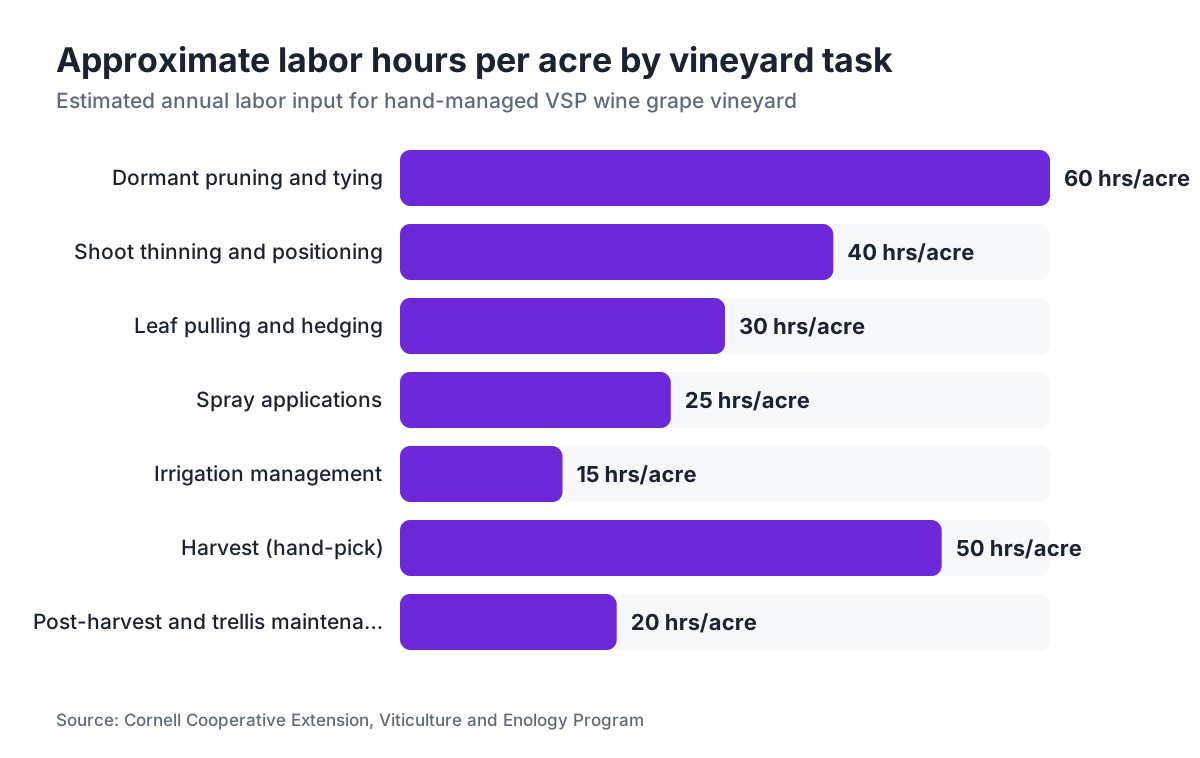
For a small hand-managed planting, labor estimates from Cornell Cooperative Extension run roughly 150 to 250 hours per acre per year, depending on training system and how much you do by hand [1]. Mechanized mowing and hedging cut that number hard on commercial blocks. The judgment calls don't mechanize.
The sections below follow the calendar from dormancy through post-harvest. Reading mid-season for one task? Jump straight to it. Every section stands on its own.
When should you prune grape vines and how do you do it?
Prune during full dormancy, after the coldest weather has passed but before buds swell. Across most of North America's wine regions that window runs from late January through early March, though it can open in December in warmer coastal areas [2]. Prune too early and a late freeze can take your wood. Prune too late and the vine burns stored carbohydrates on shoots it's about to lose.
The two dominant systems are cane pruning and spur pruning. Cane pruning suits Pinot Noir, Riesling, and other varieties that fruit poorly on basal nodes; it keeps one or two long canes (8 to 15 nodes each) plus a short renewal spur. Spur pruning, common for Cabernet Sauvignon, Syrah, and Zinfandel, shortens laterals to two-bud spurs along a permanent cordon.
For either system, the balanced pruning formula from UC Davis viticulture guidance works like this: weigh the removed canes, then keep roughly 20 to 40 buds for the first pound of prunings, plus 10 buds for each additional pound [3]. That links retained buds to what the vine actually did last year. A vine that threw 1.5 lbs of cane weight can carry about 35 buds. Push it to 60 and you get a diluted crop with poor color and weak sugars.
Tools matter. Bypass shears cut cleaner than anvil-style. Sanitize between vines if trunk diseases like Eutypa or Bot canker are in your block. A 10% bleach solution or a commercial sanitizer between cuts is cheap insurance.
Save a few count buds on each spur or cane as frost insurance. You can always rub off the extras in spring.
How do you train and trellis young grape vines in the first three years?
The first three years are infrastructure years. You're building a trunk and the first permanent arms (cordons or canes), not harvesting a paycheck.
Year one: let one or two shoots grow freely to train as the future trunk. Remove all flowers. Tie the strongest shoot loosely to a stake every 8 to 12 inches as it climbs. If it reaches the first wire by midsummer, pinch the tip and let laterals develop for the cordon. If it falls short, cut it back to two or three buds the following winter and try again.
Year two: the trunk is set. Train one or two arms along the fruiting wire. Strip the crop again, or leave a token bunch if you can't help yourself, but don't stress the vine. The goal is a plant that enters year three with a solid, well-anchored trunk and full cordon development.
Year three: a light crop is fine, maybe 1 to 2 lbs per vine on a well-grown plant. Washington State University extension guidance for Pacific Northwest vineyards recommends holding off the first full commercial crop until year four on most Vitis vinifera varieties, so you don't stunt permanent wood [4].
Trellis choice drives everything downstream: labor, canopy work, machine-harvest compatibility. Here are the systems you'll see most in U.S. wine vineyards.
| System | Best suited for | Labor intensity | Machine harvestable? |
|---|---|---|---|
| Vertical Shoot Position (VSP) | Cool climates, premium reds and whites | High | Yes (shake) |
| Geneva Double Curtain (GDC) | High-vigor sites, juice grapes | Medium | Yes |
| Scott Henry | Moderate-vigor, warm climates | High | Harder |
| Gobelet (head-trained) | Low-vigor, dry-farmed | Low | No |
Post spacing, wire height, and stake depth get locked in during year one and cost a fortune to change later. Get them right the first time.
What are the key canopy management tasks during the growing season?
Shoot thinning, leaf pulling, hedging, and positioning are the four tools that shape the canopy from budbreak through veraison. Done well, they move sunlight and airflow into the fruit zone. Done poorly, they feed shoot growth at the expense of ripening.
Shoot thinning happens at 4 to 6 inches of shoot growth, usually 2 to 4 weeks after budbreak. Pull doubles (two shoots from one spur position), water shoots off the trunk, and any shoot heading toward the row instead of away from it. Target 4 to 6 shoots per foot of canopy on VSP, fewer on more vigorous systems.
Leaf pulling in the fruit zone (2 to 4 basal leaves off the east or morning-sun side in warm climates) improves spray penetration a lot. UC Davis research consistently finds that moderate leaf removal before bloom cuts botrytis bunch rot compared to dense canopies, especially in tight-clustered varieties like Pinot Noir [7]. Don't over-pull in the heat. Afternoon sun on exposed clusters above 95°F will cook your Chardonnay.
Hedging (cutting the shoot tips once they climb above the top wire or past your canopy-width target) happens 1 to 3 times a season. It sends energy back to the clusters and stops the canopy from shading itself. Cut clean rather than ragged; clean cuts are less hospitable to powdery mildew.
Positioning, or tucking shoots into the foliage wires, keeps them upright and evenly spaced. It eats time. On a hand-managed VSP block, plan on 8 to 12 hours per acre for a single tucking pass.
How do you water grape vines and manage irrigation?
Vitis vinifera evolved in a Mediterranean climate with dry summers, and most wine grapes respond well to mild water stress at specific growth stages. Severe stress during berry development shrinks yield, and if it lands at the wrong moment it stops ripening cold.
The framework from WSU and UC Davis extension guidance is to manage irrigation by monitoring vine water status, not by running a fixed schedule [4][3]. The most practical tool is a pressure bomb (Scholander pressure chamber), which reads stem water potential. A reading of negative 1.2 to negative 1.4 MPa at solar noon signals moderate stress, the sweet spot for many premium programs in warm climates. Wetter than negative 1.0 MPa and you're likely feeding excess vigor. Drier than negative 1.6 MPa and the vine is shutting down.
No pressure bomb? Canopy temperature with an infrared thermometer is a rougher stand-in. Leaves cooler than air are transpiring well. Leaves at or above air temperature are stressed.
Don't stress newly planted vines. They need steady moisture to build root systems. In years one and two, irrigate to keep the rooting zone moist without waterlogging it.
Most regulated deficit irrigation (RDI) programs for premium wine grapes apply roughly 6 to 18 inches of water per season, depending on evapotranspiration demand and soil type, with the bulk going on between fruit set and veraison [3]. After veraison, growers often cut irrigation sharply to speed ripening and keep from diluting sugars.
Drip is the near-universal choice for established vineyards in water-limited regions. It puts water right at the root zone, keeps foliage drier, and lets you fertigate.
What fertilizer and soil nutrition do grape vines need?
Grapes are light feeders. A well-balanced vine on decent soil often needs very little added nitrogen. Over-fertilizing, especially with nitrogen, is one of the most common rookie mistakes. It pushes shoot growth over fruit quality and builds dense, disease-prone canopies.
The most reliable read on vine nutrition is a tissue test. Pull petioles (leaf stems) at bloom, the standard timing most university extension programs recommend, and compare against published sufficiency ranges [1]. UC Davis and Cornell both publish petiole sufficiency ranges by variety and growth stage. Petiole nitrogen at bloom usually lands between 0.8 and 1.2% dry weight, depending on variety and target yield.
For established wine grape vineyards, common nitrogen rates run 20 to 60 lbs of actual nitrogen per acre per year, lower on high-organic-matter soils and higher on sandy, low-organic ground [3]. Apply after budbreak, not before, so the vine can use it. Late-season nitrogen pushes growth at the wrong time and delays dormancy.
Potassium deficiency is the second most common nutrient problem. Watch for marginal leaf scorch and low tartaric acid, which drives harvest pH too high. Magnesium and boron deficiencies show up regularly in certain soils too. None of these read reliably by eye. Get tissue tests and a full soil test (pH, organic matter, macro and micronutrients) before you spend a dollar on fertilizer.
What pests and diseases threaten grape vines and how do you manage them?
Three diseases do the most economic damage in North American vineyards: powdery mildew (Erysiphe necator), downy mildew (Plasmopara viticola), and Botrytis bunch rot (Botrytis cinerea). All three are fungal or fungal-like, and all three come down to a mix of spray timing and canopy work.
Powdery mildew is the most widespread. It infects green tissue between 50 and 90°F whenever humidity is moderate, and it doesn't need free water to germinate. Cornell's grape IPM resources point to the 0.5-inch shoot growth stage as the moment to start a protective spray program [8]. Let it establish early and you lose most of the year's control options.
Downy mildew needs free water and hits primary leaves and clusters during wet springs. The 10-10-10 rule from University of California guidance (10°C soil temperature, 10 inches of cumulative rainfall, 10 days before primary infection) gives a rough first-spray guide [9].
Common pests include grape berry moth (Paralobesia viteana) in eastern vineyards, leafhoppers across most regions, spider mites in hot dry stretches, and phylloxera (Daktulosphaira vitifoliae) nearly everywhere, managed through rootstock selection rather than sprays.
Spray records are a legal requirement under the EPA Worker Protection Standard (WPS) for any vineyard where workers reenter treated areas [5]. The WPS requires that pesticide application records be kept for two years and be accessible to workers and handlers on request. If you're running more than a backyard planting, this isn't optional.
For growers tracking spray records across several blocks, a field operations platform like VitiScribe keeps spray logs timestamped and tied to block maps, which shortens WPS audits and cuts the scramble to find records during an inspection.
Organic programs work. Sulfur, copper, and biofungicides (Bacillus subtilis, potassium bicarbonate) are the backbone. They need more frequent applications than synthetics, especially after rain, but they hold up when you time them well.
How do you know when to harvest grape vines?
Harvest timing is the single most consequential call of the season. Pick too early and you lose flavor complexity but keep bright acid. Pick too late and you lose structure and freshness but gain sugar.
The standard metrics are Brix (sugar), titratable acidity (TA), and pH. For most dry reds, targets cluster around 23 to 26 Brix, TA of 5.5 to 7.5 g/L, and pH of 3.3 to 3.6 [3]. Whites usually come off earlier, 20 to 24 Brix, to hold aromatics and acid. These are ranges, not rules, and your winemaker's target should set the number.
The one tool that beats a refractometer is a palate. Walk the rows and taste berries from different vine positions (head, middle, and end of row; sunny side and shaded side). Seeds should be brown, not green. Skins should slip off the pulp clean. The flavors should taste like the grape, not sugar water.
Sample across blocks and vine positions. Cornell's grape extension recommends random berry samples of at least 100 to 200 berries per distinct block, pulled from both sun and shade, for a reliable average [8]. A single refractometer reading off the most convenient cluster at the row end tells you almost nothing.
Line up your logistics with ripeness: picking crew, bins, cooling, winery receiving slot. Plan 2 to 3 weeks ahead of your expected date so you're not making ripeness compromises because the crew is booked somewhere else.
What do you need to do for grape vines after harvest?
Most growers treat post-harvest as downtime. It isn't.
The vine keeps photosynthesizing until the leaves drop, and those last weeks of carbon go straight into root and trunk starch reserves that fuel next spring's budbreak and early shoot growth. Don't strip leaves early. Don't mow hard under the vine. Let the plant finish on its own clock.
If your program includes trunk disease management (Eutypa, Phomopsis, or Bot canker), the post-harvest window before dormancy is a good time for wound treatments. Wound protectants applied within 24 hours of pruning cuts in fall or winter reduce infection significantly, according to UC Davis trunk disease research [3].
After leaf drop, survey the block. Flag the vines that underperformed, the ones with trunk cracking or cordon dieback, and any disease pressure that surprised you. Do it while you can still read the vine architecture. Dictate your notes into your phone or write them in your field log now, because you won't remember in February.
Fall is also trellis repair season: broken posts, loose wires, missing drip emitters. Everything is cheaper to fix in November than in April when you're juggling a dozen other jobs.
On records and compliance, close out the season's spray log, harvest records, and any water-use reports before the calendar flips. Most state pesticide reporting deadlines fall in December or January for the prior season.
How do you manage grape vines in cold climates where winter injury is a risk?
Cold injury is one of the most underrated risks for growers outside California and the Pacific Northwest. A single hard freeze in early spring, after budbreak, can erase an entire vintage. Deep winter cold can kill primary buds, secondary buds, canes, cordons, and at the extreme, whole trunks.
Vitis vinifera acclimates in two stages: an early hardening triggered by shortening fall days, then a deeper hardening driven by cold temperatures. Maximum cold hardiness for most vinifera varieties lands between January and early February, then drops fast as late-winter temperatures warm [4]. Cornell's viticulture program tracks critical lethal temperatures (LT50, the point where 50% of primary buds die) by variety. Riesling, for example, sits around negative 10 to negative 15°F in mid-winter, while Cabernet Sauvignon is closer to negative 5 to negative 8°F [1].
Management options include burial (hilling soil over the graft union in fall, uncovering in spring), wrapping trunks and low cordons in insulating material, or planting cold-hardy hybrids like Marquette, Frontenac, or Niagara on your most brutal sites.
For frost risk rather than lethal winter cold, site selection is your first defense. Cold air drains downhill. Avoid frost pockets at the base of slopes. Wind machines, heaters, and overhead irrigation (which releases latent heat as water freezes) are active frost tools, but they cost real money to install and run.
Take spring cold injury and you assess bud damage by cutting through the bud and checking the green cross-section under a hand lens. That tells you whether your primary, secondary, or tertiary buds are alive. Secondary and tertiary buds still push shoots but usually carry smaller crops. Adjust your yield expectations and prune more conservatively.
How do you keep vineyard records and stay compliant?
The recordkeeping load on a working vineyard is real. Under federal law, any vineyard where agricultural workers or handlers reenter treated areas must keep pesticide application records for at least two years under the EPA Worker Protection Standard [5]. Many states require longer retention, separate reporting to the state department of agriculture, and extra records for restricted-use pesticides.
Beyond WPS, organic certification needs a full paper trail for every input. Water-district reporting is mandatory across much of the West. TTB and state alcohol boards want harvest records. Food safety rules under the FDA Food Safety Modernization Act apply to covered produce operations, including grapes grown for fresh market [6].
The minimum every vineyard should keep: a dated spray log with product name, EPA registration number, rate, target pest, block, operator, and reentry interval; harvest records by block (date, tons, Brix, disposition); and irrigation logs if you're in a metered district.
For growers who want one place for all of it, VitiScribe is built for vineyard field records and compliance logs. Try it free if you're wrangling records in spreadsheets or paper binders.
Even with software, the habit of recording in the field, not from memory on Friday, is what makes records accurate and defensible. A timestamped note taken at the sprayer beats 10 reconstructed entries scribbled at the end of the week.
Frequently asked questions
How often should you water grape vines?
For established wine grapes, frequency depends on soil type, evapotranspiration demand, and your target stress level, not a fixed schedule. In summer heat that might mean drip running 2 to 4 times a week for short durations on sandy soil, or once a week on clay loam. Monitor vine water status with a pressure bomb or watch for midday leaf droop. Young vines in their first two years need steady moisture and shouldn't be stressed.
How much sun do grape vines need?
Vitis vinifera needs at least 6 to 8 hours of direct sun per day to ripen fruit well, and most premium regions target full sun most of the day. Shade cuts photosynthesis, limits sugar accumulation, delays ripening, and makes powdery mildew worse. If trees or structures shade your south or west side heavily, that will limit what you can grow well on the site.
When do you prune grape vines each year?
Prune during full dormancy, after the coldest temperatures have likely passed but before buds swell. In most U.S. wine regions that window runs from late January through early March. In cold-climate areas, some growers delay to late February or early March to reduce frost risk to the cut canes. Pruning too early while hard freezes are still possible can lead to dieback of exposed wood.
How long does it take for a grape vine to produce fruit?
Most Vitis vinifera varieties throw a small crop in year two or three and a commercial-level crop in year three or four, depending on conditions and how hard you trained the vine early. Pushing a full crop before year four usually stresses the vine and weakens the permanent structure. Some rootstock and scion combinations in ideal climates hit commercial production by year three.
What is the best fertilizer for grape vines?
Get a petiole tissue test at bloom before buying anything. Grapevines are light feeders, and over-fertilizing with nitrogen is more common than deficiency in established vineyards. If nitrogen is needed, 20 to 60 lbs of actual nitrogen per acre per year is typical for wine grapes on low-to-moderate organic matter soils. Potassium is the second most common deficiency and gets diagnosed through tissue testing, not visual symptoms alone.
How do you protect grape vines from frost?
Site selection comes first: cold air drains downhill, so avoid low-lying frost pockets. On existing sites, wind machines pull warmer air from above the inversion layer into the canopy and can protect to roughly 4°F below ambient at the vine. Overhead sprinkler irrigation releases latent heat as water freezes and can protect to somewhat lower temperatures, but it needs a lot of water. Row covers and individual trunk wraps protect young vines.
How do you treat powdery mildew on grape vines?
Start a protective spray program at 0.5 inch of shoot growth, before infection is visible. Sulfur (wettable or micronized) is the most common and cost-effective material for organic and conventional programs. Synthetic options include DMI fungicides (myclobutanil, tebuconazole) and SDHI fungicides, effective but requiring rotation of chemical groups to prevent resistance. Canopy work that opens airflow and sunlight into the fruit zone reduces mildew pressure a lot.
Can you grow grape vines in containers?
Yes, and it works reasonably well for table grapes and small-fruited wine varieties on a patio. Use a minimum 15-gallon container; 25 to 30-gallon pots give much better root volume and cut watering frequency. Container vines need more frequent irrigation and feeding than in-ground vines because the root zone is limited. Overwinter them in an unheated garage or shed in cold climates to protect the roots.
What rootstock should you use for grape vines?
Rootstock depends on soil phylloxera status, nematode pressure, soil pH, drainage, and your vigor goals. On phylloxera-infested soils (most of California and much of the East), grafted vines on resistant rootstocks are essential. Common choices include 101-14 Mgt for low-vigor sites, 110R for drought and rocky soils, and 3309C for a moderate-vigor balance. Own-rooted vines work on phylloxera-free soils or for certain American and hybrid varieties.
How do you know if a grape vine is dead or just dormant?
Scratch the bark on a cane with a fingernail. Live wood shows green or cream tissue underneath. Dead wood shows brown or black. Check at several points along the cane, since cold damage often kills tips while basal sections stay alive. Do the same at the bud: cut a bud crosswise and look for a green center (alive) versus brown (dead primary; check secondary and tertiary).
How do you control weeds around grape vines?
Under-vine weed control matters more than the midrow, because competition for water and nutrients is concentrated in the narrow strip under the trellis. Options include cultivation (discs, offset cultivators), applied mulch (wood chips, straw), undervine herbicides (glyphosate, paraquat, flumioxazin depending on label and certification), and undervine mowing with specialized implements. Organic programs usually mix cultivation and mulch. Avoid heavy cultivation that shreds surface feeder roots.
What are the spray reentry interval rules for vineyard workers?
Under the EPA Worker Protection Standard, the reentry interval (REI) for each application must be posted on the pesticide safety information and communicated to workers before they reenter treated areas. REIs range from 4 hours for many fungicides to 48 to 72 hours for some insecticides. Employers must keep application records for two years and make them available to workers and their representatives on request. State rules can be stricter than the federal minimum.
How do you thin grape clusters and why does it matter?
Cluster thinning, removing excess clusters in early summer, concentrates the vine's resources into fewer clusters and usually improves sugar, color, and flavor in what's left. It's most common in high-vigor situations or when a vine is overcropped for its leaf area. Timing after fruit set but before veraison gives the best response. A general target for premium wine grapes is 2 to 4 tons per acre, though variety and market drive the actual number.
Do grape vines need to be replanted after a certain number of years?
No fixed lifespan applies. Well-managed vines routinely produce for 40 to 100 years, and some old-vine blocks run longer. Replanting decisions come from declining productivity due to virus disease (particularly leafroll and red blotch), trunk disease losses that drop vine count below economic thresholds, or rootstock failure. Grafted vines on healthy rootstock in well-drained soil with a controlled virus program can produce for generations.
Sources
- Cornell Cooperative Extension, Viticulture and Enology Program: Labor for grape growing runs roughly 150 to 250 hours per acre per year depending on training system; petiole sufficiency ranges and pruning timing guidance for northeastern vineyards; cold hardiness LT50 values by variety.
- Washington State University Viticulture and Enology: Dormant pruning window timing and recommendation to delay first full commercial crop to year four in Pacific Northwest vinifera vineyards; vine water potential monitoring guidance.
- UC Agriculture and Natural Resources, Integrated Viticulture: Balanced pruning formula (20 to 40 buds per first pound of prunings plus 10 per additional pound); irrigation volumes of 6 to 18 inches per season; harvest Brix and TA targets for wine grapes; trunk wound protectant guidance; nitrogen application rates of 20 to 60 lbs per acre.
- Washington State University Viticulture and Enology, Irrigation and Cold Hardiness: Pressure bomb use for vine water status monitoring; maximum cold hardiness timing in January to early February and rapid dehardening thereafter.
- EPA Agricultural Worker Protection Standard: WPS requires pesticide application records be kept for two years and be accessible to workers and handlers; reentry interval posting requirements.
- FDA Food Safety Modernization Act: FSMA Produce Safety Rule applies to covered produce operations including grapes grown for fresh market; recordkeeping requirements for covered farms.
- UC Agriculture and Natural Resources, Canopy Management: Moderate leaf removal before bloom reduces botrytis bunch rot incidence in tight-clustered varieties compared to dense unmanaged canopies.
- Cornell University, Grape Integrated Pest Management: 0.5-inch shoot growth as critical timing to begin powdery mildew protective spray program; random berry sampling of 100 to 200 berries per block recommended for harvest Brix assessment.
- UC Statewide Integrated Pest Management Program, Grape Downy Mildew: 10-10-10 rule for downy mildew primary infection timing: 10 degrees C soil temperature, 10 inches cumulative rainfall, 10 days.
- Washington State University Viticulture and Enology, Cold Hardiness: Vitis vinifera cold hardiness acclimation triggered by shortening days and cold temperatures; rehardening and dehardening dynamics in late winter relevant to pruning timing decisions.
Last updated 2026-07-09