How to check pesticide registrations for specific grape growing states

TL;DR
- Every state runs its own pesticide registration database, separate from EPA's federal approval.
- To confirm a product is legal on grapes where you farm, search your state lead agency's registry by product name or EPA registration number.
- California uses CDPR's PPLS, Washington uses WSDA, Oregon uses ODA, New York uses DEC.
- Federal registration alone does not make a product legal in your state.
Why does pesticide registration vary by state if EPA already approved it?
Federal approval is the floor, not the ceiling. EPA registration means a product met national safety and efficacy standards under FIFRA (the Federal Insecticide, Fungicide, and Rodenticide Act, 7 U.S.C. §136 et seq.) [1]. Every state then has authority under FIFRA Section 24(a) to impose stricter requirements, and under Section 24(c) to register products for "special local needs" that the federal label doesn't cover. [1]
So a product with an active EPA registration may be:
- Fully registered in your state and ready to use
- Pending state review (common right after a new federal approval or label amendment)
- Not registered in your state at all
- Registered in your state but with different permitted crops, application rates, or restricted-entry intervals than the federal label
That last one trips up experienced growers. The most restrictive label always controls. If your state's label leaves grapes off the permitted crop list and the federal label includes them, you cannot apply that product to grapes in your state. Period. EPA puts it plainly in its Label Review Manual: "The label is the law." [2]
Skip the registered label in your state and you've got a FIFRA violation. Penalties run from warning letters up to $5,000 per violation for commercial applicators, and state penalties stack on top. [1] For a vineyard in an organic or food-safety audit, one illegal application can disqualify an entire lot.
Where do I actually look up whether a pesticide is registered in my state?
Start with your state's lead pesticide regulatory agency, usually called the State Lead Agency or SLA. Every state has one. The table below lists the main lookup tool for the top U.S. grape-producing states.
| State | Agency | Database / Tool | URL |
|---|---|---|---|
| California | CA Dept. of Pesticide Regulation (CDPR) | Pesticide Product/Label System (PPLS) | cdpr.ca.gov |
| Washington | WA State Dept. of Agriculture (WSDA) | Pesticide Registration Lookup | agr.wa.gov |
| Oregon | OR Dept. of Agriculture (ODA) | Pesticide Registration Search | oregon.gov/oda |
| New York | NY Dept. of Environmental Conservation (DEC) | Product Registration Database | dec.ny.gov |
| Michigan | MI Dept. of Agriculture & Rural Development (MDARD) | Pesticide Registration List | michigan.gov/mdard |
| Pennsylvania | PA Dept. of Agriculture | Pesticide Registration Search | agriculture.pa.gov |
| Texas | TX Dept. of Agriculture (TDA) | Pesticide Registration Search | texasagriculture.gov |
| Virginia | VA Dept. of Agriculture & Consumer Services (VDACS) | Product Search | vdacs.virginia.gov |
Farming a state that isn't on the list? The National Pesticide Information Center (NPIC) at Oregon State University keeps a current directory of all state lead agencies with direct links. [3]
EPA runs a federal registration lookup through its pesticide registration pages, but that only confirms federal status. Cross-check the state database every time. [2]
How do I search a state database by product name or EPA registration number?
The EPA registration number is your most reliable search key. You'll find it on any product label as EPA Reg. No. XXXXX-XXXXX. The first set of digits is the company number, the second is the product number. Searching by that number kills the ambiguity you get when the same active ingredient sells under a dozen brand names.
Here's the process for any state database:
- Go to your state agency's pesticide registration search (see table above).
- Enter the EPA Reg. No. or the exact product name. Partial name searches work in most systems, but Reg. No. searches return cleaner results.
- Confirm the product shows as "active" or "registered" and note the expiration date. Most state registrations run on a calendar-year cycle and must be renewed annually by the registrant.
- Download or screenshot the current label tied to the state registration. That document governs your application, not the federal label you pulled off the manufacturer's website.
- Check that grapes (listed variously as "grapes," "Vitis vinifera," or "small fruits, grapes") appear in the approved crops section.
One thing that catches people: California's PPLS shows multiple labels for the same product over time. Filter for the current active label. An older label on the same page may list a different REI or different grape inclusion. CDPR updates the database as amended labels get approved, so check right before a spray program starts, more than once in spring. [4]
Washington's WSDA lookup returns a PDF of the currently registered label directly. That's the most grower-friendly format of any state system I've used. [5]
What is the process for California specifically, since it has the strictest rules?
California stacks two extra layers on top of standard state registration: County Agricultural Commissioner (CAC) permits and Restricted Materials permits.
CDPR classifies some pesticides as "Restricted Materials" (RM). [4] To use any Restricted Material, you need a permit from the CAC in the county where you farm, more than a CDPR registration. The CAC can attach conditions that go beyond CDPR's statewide rules, like tighter buffer distances near schools or extra notification windows. In Napa, Sonoma, Mendocino, and Monterey counties, those CAC conditions differ from each other even for the same product.
To check California registration:
- Go to cdpr.ca.gov and open the PPLS (Pesticide Product/Label System).
- Search by product name or EPA Reg. No.
- Check the product's California Restricted Material status. CDPR keeps a separate list of all RM products.
- If it's an RM, call your County Agricultural Commissioner's office for permit conditions before you order.
UC Davis Cooperative Extension publishes the "UC IPM Pest Management Guidelines: Grape," updated annually, which lists currently registered materials organized by pest and disease. [6] That publication is probably the single most useful resource for California vineyard operators, because it cross-references registration status against efficacy data. County IPM advisors can also help match legal products to the specific pest and disease problems you're seeing.
One hard fact: California's registration year runs January 1 through December 31. A product the registrant fails to renew lapses on January 1 even if you have leftover inventory. Using a lapsed registration in California is a violation no matter when you bought the product.
How do Washington and Oregon handle pesticide registration for vineyards?
Washington is the second-largest wine grape producer in the U.S. [5] WSDA keeps its pesticide registration database at agr.wa.gov. Registrations run on a two-year cycle in Washington, which is unusual nationally and means expiration dates don't always line up with the calendar year. Watch for that.
For grape guidance in Washington, WSU Extension's Pacific Northwest Pest Management Handbooks (the PNW Handbooks) are co-produced by WSU, OSU, and the University of Idaho and list currently registered products for grapes by pest. [7] The online version updates whenever registrations change, so it beats a printed guide for currency. If a product shows up in the PNW Handbook for grapes in Washington, it's almost always registered there. I'd still confirm in the WSDA database for anything borderline.
Oregon's ODA pesticide registration database sits at oregon.gov/oda. Oregon also tracks a small set of Restricted Use Pesticides that require a certified applicator license. OSU Extension's Integrated Plant Protection Center publishes Oregon-specific supplemental guidance and often flags materials that appear in the PNW Handbook but carry extra Oregon restrictions. [7]
Both states sit in EPA Region 10, and both regularly accept 24(c) Special Local Need registrations for emerging pests, including spotted lanternfly (which has been expanding westward) and strobilurin-resistant powdery mildew strains. Facing a new pest or a resistance problem? Call your state extension specialist before you assume the product you want is registered or that an SLN label is in place.
What about New York and other eastern grape-growing states?
New York has a large wine and juice grape industry, concentrated in the Finger Lakes, Lake Erie, and Hudson Valley. The NY DEC handles pesticide registration at dec.ny.gov. Its database lets you search by product name, company name, or EPA Reg. No. Registration is annual on a calendar year.
Cornell Cooperative Extension runs the New York State Integrated Pest Management Program, which publishes the "New York and Pennsylvania Pest Management Guidelines for Grapes." [8] The guide lists registered pesticides by pest category and flags any state-specific restrictions. It's updated annually and usually drops in late winter, so that December or January release date matters if you plan early.
Pennsylvania's Department of Agriculture keeps a registration database at agriculture.pa.gov. Growers in the Lake Erie AVA often farm across the NY-PA line, and the Cornell joint guidelines are built for exactly that.
Virginia, Michigan, Missouri, and Ohio each run their own systems. One pattern holds across the eastern states: the state extension viticulture specialist is usually your fastest route to a confirmed answer on a specific product, especially for minor-use registrations or IR-4 program materials where the pathway gets murky. The IR-4 Project, based at Rutgers, manages minor-use pesticide petitions for fruit and vegetable crops and publishes its pending and approved registrations publicly. [9] Waiting on a registration for a minor grape pest? That's the place to watch.
How do I verify a pesticide is approved specifically for use on grapes, more than registered in the state?
A product can be state-registered and still be illegal on grapes if grapes aren't a permitted crop on the label. That's a separate question from whether the product is registered at all, and growers conflate the two constantly.
The tolerance is the mechanism that matters. EPA sets crop-specific tolerances for pesticide residues under the Federal Food, Drug, and Cosmetic Act. [10] If no tolerance exists for a given pesticide on grapes (or no exemption from tolerance), you cannot legally apply that product to grapes destined for harvest, even if it's registered as an herbicide for use in vineyard rows. The label reflects this, but you have to read it closely.
Check the "Crops" or "Use Sites" section of the label. Words like "grapes," "grapevines," or "vineyards" in the crop list are what you want. Some labels use commodity group language like "Fruit, Small, Vine Climbing" (EPA Crop Group 13-07B), which does include grapes. [10] If you see a crop group number and aren't sure it covers grapes, EPA's crop grouping tables are published at epa.gov and free to search.
Organic operations add a step. A material has to be on the OMRI (Organic Materials Review Institute) list or approved by your certifier. State and federal registration don't grant organic approval. That's a separate review entirely. [11]
What role does the EPA Worker Protection Standard play in how you apply registered pesticides in vineyards?
Registration tells you whether you can apply a product. The EPA Worker Protection Standard (WPS), revised in 2015 and effective January 2017, governs how you apply it when workers or handlers are around. [12]
The WPS sets restricted-entry intervals (REIs), the windows after application when workers can't enter treated areas without full PPE. Grape operations see REIs from 4 hours (many fungicides) up to 48 hours for some organophosphates. The REI on your specific state-registered label controls, not the federal REI.
Key WPS requirements for vineyards:
- Post WPS safety information at a central location all workers can reach.
- Train every agricultural worker and pesticide handler before they do covered tasks.
- Notify workers of applications and REIs (posted or oral, depending on REI length).
- Keep application records (product name, EPA Reg. No., location, date, rate, REI) available to workers or their representatives on request.
That last point runs straight into spray record-keeping. California, Washington, Oregon, and New York all run mandatory pesticide use reporting systems that collect more than the federal WPS requires. [4][5] In California, every application by a licensed applicator must be reported monthly to the County Agricultural Commissioner. That report uses the EPA Reg. No. and a specific field ID, so your records need to capture both or you'll generate reporting errors.
Keeping those records in a format that's easy to report and audit is one place where a purpose-built tool actually earns its keep. VitiScribe, for one, structures application records to match the fields state reporting systems require, which saves real time at month-end.
How often do state pesticide registrations change, and how do I stay current?
More often than most growers think. Registrants renew annually in most states, and they can voluntarily cancel products or amend labels any time. EPA can also cancel or modify a federal registration, which cascades to the states. The glyphosate and chlorpyrifos fights of the past decade showed how fast federal action can shift the ground under every state at once.
For grape-specific monitoring, these are the channels I trust:
Cornell Viticulture Program emails updates on registration changes in New York and the Northeast. The extension newsletter signup is free. [8]
WSU Viticulture and Enology runs a similar service for the Pacific Northwest, often coordinated with Oregon State. [7]
UC Cooperative Extension updates the UC IPM Guidelines when California registrations change, and CDPR publishes a monthly registration bulletin. [6]
EPA's Pesticide Registration Notice system announces federal label amendments, which usually come before state changes. [2]
NPIC at Oregon State runs a pesticide helpline (1-800-858-7378) staffed by specialists who answer real-time questions about registration status. Genuinely useful for edge cases. [3]
Here's the honest reality: no single system pushes real-time updates to growers across all states. The best you can do is a pre-season full sweep of your state database for every product in your spray program, then spot-checks mid-season for anything you hear is changing. Put that sweep on your farm calendar in January or February and you're not scrambling in April.
How do I handle products with Section 18 emergency exemptions or 24(c) special local need labels?
Sometimes a pest arrives in a region before any registered product exists for it there. That's when growers and state agencies reach for FIFRA Section 18 (emergency exemptions) or Section 24(c) (special local needs).
A Section 18 exemption is issued to a state by EPA for a specific, time-limited use. [1] It works like a temporary registration and comes with its own label that controls the application. If your county or state is under a Section 18 for a grape pest, your extension specialist will know, your CAC or state agency will have published notice, and you must have that exemption label in hand before you spray. Don't act on word of mouth that a Section 18 exists.
A 24(c) SLN (Special Local Need) registration is more permanent. A state registers a use the federal label doesn't include. [1] This is common for minor-use crops, including specific grape varieties or geographic areas. The 24(c) label is a standalone document, separate from the federal label. You need it in hand for the application to be legal.
Both label types live in your state lead agency's database. CDPR's PPLS includes 24(c) labels. WSDA and ODA both publish their SLN labels online. The catch is that manufacturer websites often don't host these state-specific or exemption labels, so go to the state source.
For recordkeeping, treat a 24(c) or Section 18 label like any registered product: log the EPA Reg. No. (or exemption number), the label document number if one's assigned, the application date, rate, and REI.
What should be in my spray records to prove compliance with state registration requirements?
A legally defensible spray record for grapes holds more fields than many growers keep. Here's what state auditors want to see:
- Date and time of application
- Field or block identifier (legal parcel or internal block ID tied to a map)
- Product name and EPA Registration Number
- Active ingredient and formulation
- Rate applied (amount per acre and total amount used)
- Total acres treated
- Application method (airblast, backpack, drip chemigation, etc.)
- Applicator name and license number (if applicable)
- Restricted-Entry Interval and the date/time workers can re-enter
- Target pest or disease
- Weather at time of application (wind speed and direction, temp) in many states
- Pre-harvest interval (PHI) and the resulting earliest harvest date for the block
California requires monthly reporting to the CAC in a specific format that includes the commodity (grapes, raisins, wine grapes, table grapes), the county agricultural use code, and the site code for the specific field. [4] Pulling all that together from handwritten field notes at month's end is where errors creep in.
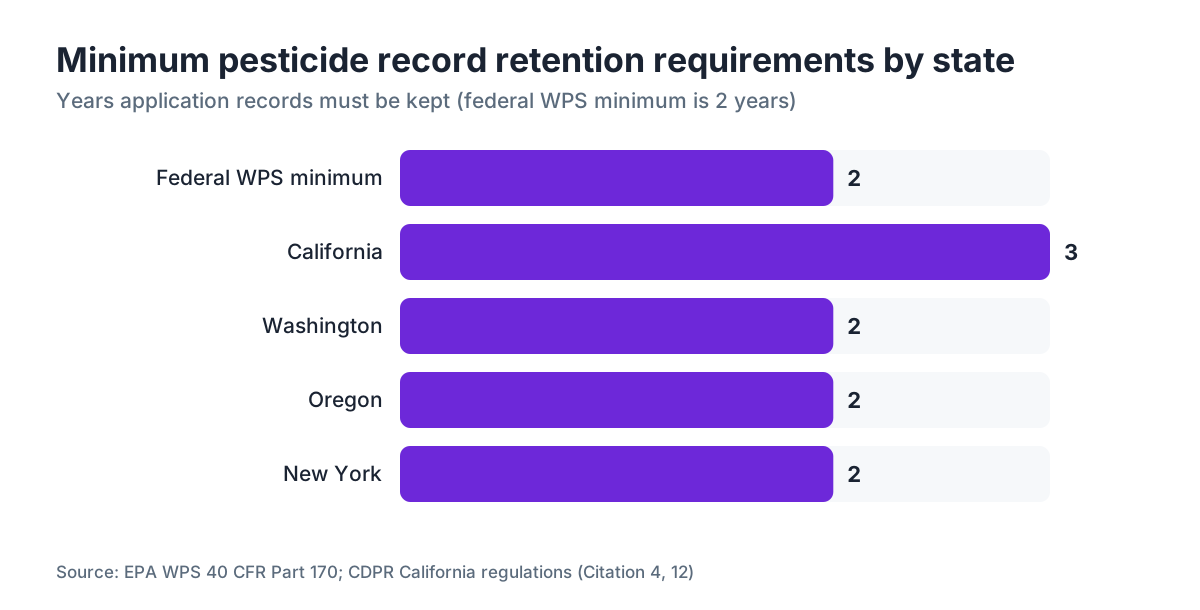
This is where VitiScribe's spray record module is worth a look. It captures every required field at time of application (mobile entry from the tractor or the end of the row) and formats the California DPR export and other state reports automatically. You can try it free. Whatever system you use, keep the records at least two years federally under the WPS [12] and up to three years under California state law. [4]
What's the fastest way to confirm a product is legal before I spray tomorrow morning?
This situation is real. Disease pressure is building, a product sits in the spray room, and you want to confirm before dawn.
Fastest path:
- Find the EPA Reg. No. on the product container.
- Go to your state agency's database and search that number. Most return results in under a minute.
- Confirm three things: active registration, grapes listed as a use, current label available.
- If the state database is down or crawling (CDPR's PPLS has had outages), call your County Agricultural Commissioner's main line. They can see the registration system and are usually helpful on a quick confirmation call.
- For Washington, Oregon, and New York, the state pesticide program offices take phone calls during business hours.
NPIC (1-800-858-7378) can help when you can't reach your state agency directly. [3] They aren't the registering authority, but they can confirm federal status fast and point you to the state system.
If you can't confirm the product is currently registered and labeled for grapes in your state, don't spray it. An audit finding, a food-safety certification flag, or a recall over a residue with no established tolerance costs far more than getting one spray cycle ahead of powdery mildew.
Frequently asked questions
Can I use a pesticide on grapes if it's federally registered by EPA but my state hasn't registered it?
No. FIFRA Section 3 federal registration is required but not sufficient. A product also needs registration in the state where you're applying it. Using a federally registered but state-unregistered product is a FIFRA violation in that state and can bring fines, loss of applicator license, and food-safety audit failures. Check your state's database before applying any product.
How do I find out if a pesticide is registered in California specifically for wine grapes?
Go to cdpr.ca.gov and use the PPLS (Pesticide Product/Label System). Search by EPA Registration Number or product name. Confirm the active state label lists grapes or wine grapes in the permitted crops section. Also check whether the product is a California Restricted Material, which requires a County Agricultural Commissioner permit before use. UC IPM's grape guidelines cross-reference registered materials by pest.
What is a 24(c) Special Local Need label and how do I know if one exists for my state and crop?
A 24(c) SLN label is a state-issued registration for a use that isn't on the federal label, granted under FIFRA Section 24(c). Your state lead agency's pesticide database lists active SLN labels. California, Washington, and Oregon all publish 24(c) labels online. Your county extension viticulture specialist usually knows when a new SLN label is issued for a grape pest in your region.
How long do I have to keep pesticide application records?
The federal EPA Worker Protection Standard requires a minimum of two years for application records. California state law requires three years. Washington and Oregon also require at least two years. Check your state's rule, since state law controls if it's stricter than federal. Records must be available to workers, their representatives, and regulators on request within timeframes set by the WPS.
Are there pesticide registration differences for certified organic vineyards?
Yes, significantly. State and EPA registration don't grant organic approval. Materials for certified organic vineyards must also appear on the OMRI (Organic Materials Review Institute) list or get specific approval from your certifier. Some OMRI-listed materials still carry REIs and PHIs on their state-registered labels that apply regardless of organic status. Verify state registration and organic approval separately, every time.
What does the pre-harvest interval (PHI) mean and where do I find it for grapes?
The PHI is the minimum number of days between your last pesticide application and harvest. It appears on every product label, usually in the Directions for Use. PHI for grape-registered products ranges from 0 days (some sulfur products) to 30 or more days for certain systemic fungicides. Calculate your earliest legal harvest date from your last application date and post it in your spray records.
How do I look up pesticide registration for a new state if I'm expanding my vineyard operation?
Start with NPIC's directory of State Lead Agencies at npic.orst.edu, which links to every state's registration system. Search your target state's database by EPA Reg. No. for each product in your current spray program. Connect early with that state's land-grant extension viticulture program: Cornell for New York, WSU for Washington, OSU for Oregon, UC Cooperative Extension for California, Michigan State for Michigan.
Can I find Washington State grape pesticide registrations through the WSU extension instead of WSDA?
WSU Extension's Pacific Northwest Pest Management Handbooks list registered materials for grapes in Washington (with Oregon and Idaho jointly). The PNW Handbooks are a solid starting point and update when registrations change. But the authoritative legal source is WSDA's pesticide registration database at agr.wa.gov. The handbooks can lag a recent cancellation or addition by a few weeks, so confirm in the WSDA system for anything uncertain.
What is the IR-4 Project and how does it affect minor-use pesticide registrations for vineyards?
The IR-4 Project (based at Rutgers University) supports pesticide registrations for minor-use crops, including specialty fruit like grapes, where market size doesn't push manufacturers to pursue registrations on their own. IR-4 runs residue trials and submits data to EPA to establish tolerances and expand labels. You can track pending and completed IR-4 registrations for grapes on their public database. New grape uses often come through IR-4 before hitting state systems.
Does EPA's Section 18 emergency exemption apply automatically to my farm, or do I need to apply separately?
Section 18 emergency exemptions go to a state or state agency, not to individual growers. If your state receives a Section 18 for a grape pest, the state agency publishes the exemption label and conditions for use. You don't apply separately, but you must obtain the exemption label, follow it exactly, and keep application records as you would for any registered product. Watch for announcements from your state lead agency and extension program.
How do I report pesticide use in California, and what information is required?
California requires monthly pesticide use reports (PURs) filed with the County Agricultural Commissioner. Required fields include product name, EPA Reg. No., active ingredient, rate, acres treated, commodity (such as wine grapes), specific field or site identifier, and county agricultural use codes. Reports are due by the 10th of the month following application. CDPR publishes the full reporting requirements and form guidance on cdpr.ca.gov.
What happens if I use a pesticide that loses its registration mid-season after I've already applied it?
If the registration was valid on the application date, that application was legal. The problem arises when a registration lapsed before your application date and you didn't catch it. Going forward, once a registration is cancelled you generally can't apply remaining stock past the use-up period stated in the cancellation notice. Check your state agency's cancellation notices. California CDPR and WSDA both publish cancellation lists separately from the main registration database.
Where can I find free training on pesticide safety and record-keeping requirements for vineyard workers?
The EPA Worker Protection Standard requires training for all agricultural workers and handlers. State extension programs provide free WPS training materials: Cornell Cooperative Extension for New York and the Northeast, UC Cooperative Extension for California, and WSU Extension for Washington and the Pacific Northwest. NPIC also offers free educational materials. Many county farm bureaus and grower associations host annual WPS training sessions before the season.
Sources
- U.S. EPA, Federal Insecticide, Fungicide, and Rodenticide Act (FIFRA) overview: FIFRA Section 3 governs federal registration; Section 24(a) allows states to impose stricter requirements; Section 24(c) allows states to register special local needs; penalties up to $5,000 per violation for commercial applicators
- U.S. EPA, Label Review Manual: EPA Label Review Manual states 'The label is the law'; federal registration does not supersede state registration requirements
- National Pesticide Information Center (NPIC), Oregon State University, State Lead Agency directory: NPIC maintains current directory of all state lead pesticide agencies; operates helpline 1-800-858-7378
- California Department of Pesticide Regulation (CDPR), Pesticide Use Reporting: California requires monthly pesticide use reports to County Agricultural Commissioner; records must be maintained for three years; Restricted Materials require CAC permit; PPLS database tracks state registrations
- Washington State Department of Agriculture (WSDA), Pesticide Registration: WSDA maintains pesticide registration database; Washington is second-largest wine grape producer in U.S.; registrations run on two-year cycle
- UC Statewide IPM Program (UC IPM), UC Davis, Pest Management Guidelines: Grape: UC IPM publishes annual grape pest management guidelines listing currently registered materials by pest and disease for California; updated when registrations change
- WSU Extension, Pacific Northwest Pest Management Handbooks: PNW Handbooks co-produced by WSU, OSU, and University of Idaho list registered pesticides for grapes in Washington and Oregon; updated when registrations change
- Cornell Cooperative Extension, New York State IPM Program, NY and PA Pest Management Guidelines for Grapes: Cornell publishes annual New York and Pennsylvania grape pest management guidelines with registered materials by pest category; updates communicated via extension newsletter
- IR-4 Project, Rutgers University, minor-use pesticide registration: IR-4 Project manages minor-use pesticide petitions for fruit and vegetable crops including grapes; publishes pending and approved registrations publicly
- U.S. EPA, Pesticide Tolerances and Crop Groups: EPA sets crop-specific tolerances under FFDCA; Crop Group 13-07B 'Fruit, Small, Vine Climbing' includes grapes; no tolerance means product cannot be applied to grapes for harvest
- OMRI (Organic Materials Review Institute), OMRI Products List: State and federal pesticide registration do not confer organic certification approval; organic vineyards must verify materials on OMRI list or certifier approval separately
- U.S. EPA, Worker Protection Standard (WPS), 40 CFR Part 170: WPS revised 2015, effective January 2017; requires REI posting, worker training, application records maintained minimum two years; governs restricted-entry intervals and worker notification requirements
Last updated 2026-07-09