How to complete a GWSS trapping record for county submission
TL;DR
- A GWSS trapping record for county submission needs the trap ID, GPS coordinates or legal description, installation and inspection dates, the adult glassy-winged sharpshooter catch count, the inspector's name and signature, and the grower's PCA or operator info.
- Most California counties want it within 5 to 10 business days of inspection.
- One missing field can void the record for compliance.
What is a GWSS trapping record and why do counties require it?
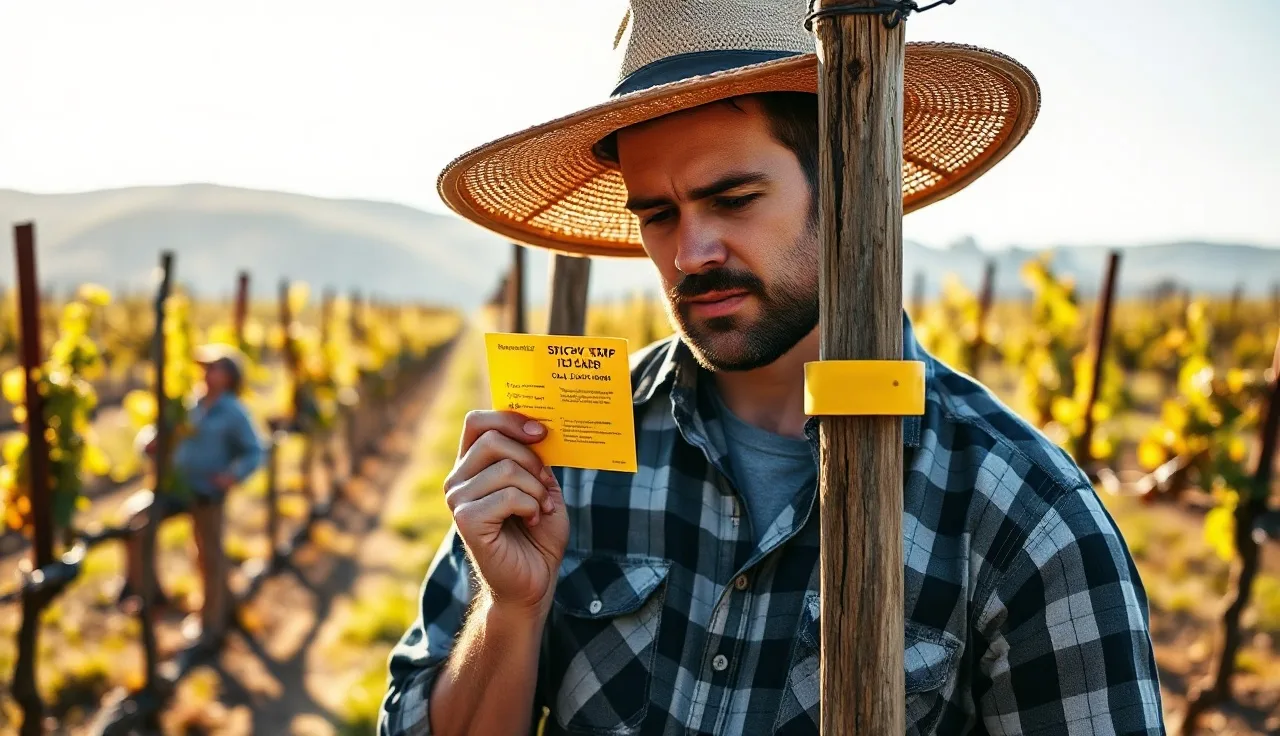
A GWSS trapping record is the field document that logs where a sticky trap sits, when it got inspected, and what it caught. The target is the glassy-winged sharpshooter (Homalodisca vitripennis), the insect that spreads the bacterium behind Pierce's disease. Counties require the record because California's GWSS program is regulatory, not a voluntary survey. The California Department of Food and Agriculture (CDFA) coordinates with county agricultural commissioners to map GWSS spread, and trap data is the backbone of that detection network. [1]
Without a complete, properly submitted record, your inspections don't count toward the program. That matters. If you're inside a Pierce's disease management zone or a regulated nursery area, commissioners can read incomplete records as non-participation. In high-pressure counties like Kern, Fresno, and Riverside, the program is tied straight to movement restrictions on plant material, so your paperwork is also your compliance defense. [2]
The data also feeds regional population models. County entomologists use cumulative catch numbers to decide when treatments or beneficial-insect releases make sense.
A trap that got inspected but never reported is exactly as useless as a trap that was never set.
What fields are required on a GWSS trapping record?
Every county form looks a little different, but the CDFA-coordinated program defines a minimum dataset. Here's what shows up on nearly every county submission form, with notes on where people trip.
Trap identification number. Each trap gets a unique ID, usually assigned by the county or by your PCA at setup. Don't invent your own numbering unless the county says you can. If the county hands you pre-numbered forms, the ID on the stake and the ID on the form have to match exactly.
Location. Most forms want both GPS coordinates (decimal degrees, WGS84 datum) and a legal land description (township, range, section). Some accept an APN or a parcel address instead. Either way, the county needs enough precision to relocate the trap on its own. "Block 4 east end" by itself doesn't cut it. [3]
Crop and commodity. Check the right box. Vineyards usually list as "Grape (wine)," "Grape (table)," or "Grape (raisin)." The split matters because some program thresholds and treatment triggers differ by commodity.
Trap installation date. The day the trap physically went in the ground. Not the day you ordered it, not the day you filled out the form. If you're replacing an old trap at the same spot, note that.
Inspection date(s). Each inspection event gets its own line. Check traps every two weeks and submit monthly, and you should have two inspection rows per trap per submission.
Adult GWSS count. The count of adult GWSS removed or observed on the sticky card. Count nymphs separately if your county asks, but the adult number is the headline. Inspect under magnification if you're unsure. A misidentified specimen skews regional data and can trigger a response nobody needed.
Trap condition. Most forms carry a checkbox or code: good, fouled by debris, missing, replaced. Don't skip it. A "missing" record with no condition note reads like negligence.
Inspector name and signature. The person whose eyes were on the sticky card signs here. If you sent a farm employee to check traps, their name goes here, not the PCA's or the ranch manager's.
PCA license number. If a licensed pest control adviser oversees the program, their California PCA license number goes on the form. That's separate from the inspector signature.
Grower/operator contact. Name, phone, sometimes email for the owner or operation manager. This is who the county calls when a catch triggers follow-up.
Submission date. The day you turn the form in, not the day of the last inspection.
How do you set up trap locations and assign trap IDs before you start?
Placement comes before paperwork, and getting it right keeps you from amending records later. CDFA guidance puts yellow sticky traps (3x5 inch or 4x7 inch cards are standard) at roughly 1 trap per 10 acres in vineyards, though your county may require denser coverage in high-risk or quarantine areas. [1]
Walk your blocks before you assign IDs. Hang traps on the shaded north or east face of the canopy at cluster height (about 3 to 4 feet), where they intercept leafhoppers moving through the fruit zone. Skip the posts and the canopy edges. Wind turbulence out there drops your catch rate.
Once a trap is physically placed, record its GPS coordinates right then, with a handheld unit or your phone (most field ag apps export decimal degrees). Move those coordinates onto your county form or digital record before the numbers wander off. The classic failure is hanging 20 traps, jotting GPS points on a notepad, then losing the notepad before transcription. A voice memo or a photo of the GPS display at each trap is cheap insurance.
Assign IDs in a logical sequence (block letter plus sequential number, like V-A-001 through V-A-020 for vineyard block A) unless the county pre-assigned them. Keep a master location map with every ID plotted. The county may ask for that map as part of your submission, and it's required in some Pierce's disease management areas. [4]
If you run this through a field records platform like VitiScribe, you log placement, GPS, and inspection data in one place and export county-formatted reports straight out. That kills the transcription step, which is where most data errors start.
How do you correctly count and record GWSS adults on a sticky trap?
This is where growers and inspectors rush and make the mistakes that actually matter.
Pull the trap card carefully. Sticky traps are a mess. Use a stiff backing board or the trap's cardboard cover so you don't smear the adhesive with skin oils, which can affect later catches if you're replacing rather than tossing. When you replace, record the removal date and hang a fresh card at the same time.
Count GWSS adults under a 10x hand lens at minimum. Adults run 12 to 14 mm, brownish, with white and yellow spots on the head, and they're bigger than most other leafhoppers you'll see in a vineyard. The wing venation pattern is the reliable field feature. Blue-green sharpshooter (Graphocephala atropunctata) also lands on traps in coastal California and looks similar to an untrained eye. [5]
Found something questionable? Don't guess. Save the card, or drop the specimen in a small vial of 70% ethanol, and bring it to your county ag commissioner for verification before you submit a count. Some counties take photos for verification too.
Record zero explicitly. If a trap caught nothing, write "0" in the count field. A blank reads like a skipped field. Zero is a real data point, and county models use it.
Most county programs track adults only for trend analysis, but some want nymphs too. If your form has a separate nymph column, fill it in even when the count is zero.
What are the submission deadlines and how do you turn records in?
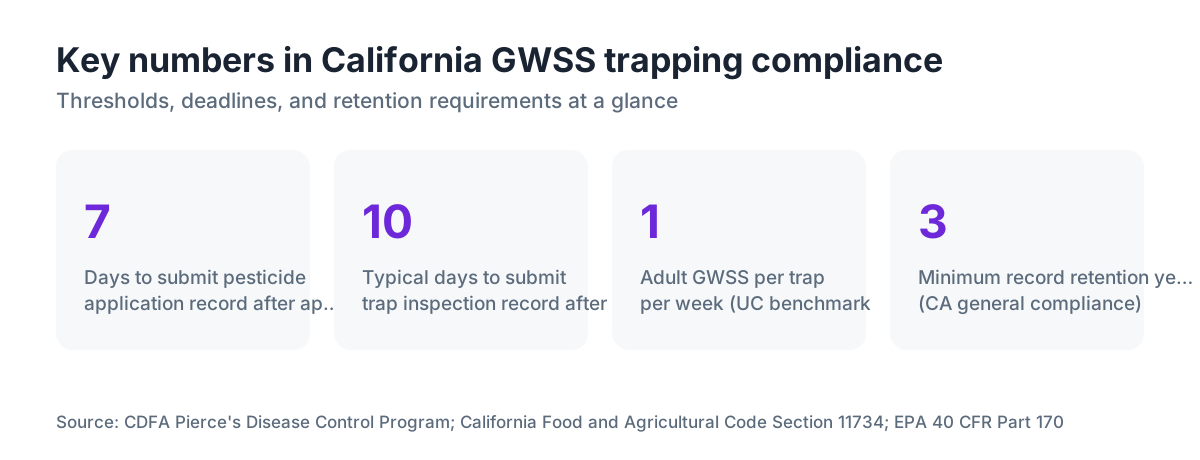
Deadlines shift by county and by season. Most California GWSS programs run active trapping from roughly March through October, aligned with adult flight. Within that window, most counties want inspection records inside 5 to 10 business days of the inspection date, and some high-pressure counties demand weekly submission once catches pass threshold. [2]
Kern County, historically one of the hottest GWSS areas in the state, has run under tight reporting timelines during outbreak years. Riverside and San Diego counties keep their own coordinators, forms, and deadlines. The form you used last year in one county may be worthless in the county next door. [12]
Submission methods vary too. Some counties still take paper in person or by mail to the agricultural commissioner's office. A growing number accept scanned PDFs by email. A few run online portals. Confirm the accepted method with your county ag commissioner at the start of the season, because the wrong method, even on time, can leave a record officially unreceived.
Keep copies of everything you send. Hold a dated copy for at least three years. If a compliance audit or a Pierce's disease investigation ever lands on your desk, your copy of the submitted record is your proof of participation.
What happens if catch counts exceed action thresholds?
Threshold triggers depend on the county and the area type (quarantine zone, regulated area, or general monitoring). As a rough benchmark, CDFA and UC Cooperative Extension treat a sustained catch of 1 or more adult GWSS per trap per week as a signal worth acting on, though that isn't a fixed statewide regulatory number. [7]
When a submitted record shows a catch above whatever threshold your county set, expect a call from the county entomologist or the commissioner's office. They may want a site visit to verify the catch, specimens for confirmation, or a coordinated treatment with neighboring operations.
Inside a Pierce's disease management area, elevated catches can also trip restrictions on moving plant material out of the area. That has real dollars attached for anyone buying or selling propagation material.
Report high catches fast, even mid-cycle. Most county programs have an immediate-reporting provision for unusually high catches, separate from your regular schedule. Don't sit two weeks on a trap holding 40 adults.
For treatment decisions after an exceedance, work with your PCA and pull up the UC IPM guidelines. The UC IPM program publishes GWSS management guidance with treatment efficacy data and timing built for vineyards. [8]
What recordkeeping rules apply to pesticide applications triggered by GWSS?
If elevated catches push you into a pesticide application, you've entered a second recordkeeping world on top of the trap records. California requires pesticide application records to be filed with the county agricultural commissioner within 7 days of each application under Food and Agricultural Code Section 11734. The code directs that the report go to the commissioner and that it "shall be filed" on the schedule the director sets. [9]
Your application record needs the product name, EPA registration number, application rate, acres treated, application date and time, target pest (GWSS), applicator name and license number, and field location. Separate document from your trap record, often the same county office.
The EPA Worker Protection Standard (WPS), 40 CFR Part 170, requires application-specific information at the central display for workers who might enter treated areas. If you reach for imidacloprid or another systemic insecticide labeled for GWSS, some of those products carry restricted-entry intervals of 12 to 48 hours. Get your WPS posting current before any crew walks into the block. [10]
WSU Extension's pest documentation resources lean toward Pacific Northwest conditions, but their templates for cross-referencing monitoring records with application records in one audit-ready file work anywhere. [11] UC Cooperative Extension advisors in Temecula, Paso Robles, and the San Joaquin Valley also publish county-specific GWSS fact sheets with application record checklists.
Growers in Paso Robles wine country, which sits in a GWSS-active part of San Luis Obispo County, run into this constantly. The program there is intense enough that trap records and application records almost always travel together.
How do you correct an error on a submitted GWSS trapping record?
Errors happen. The fix depends on whether you caught the mistake before or after submission.
Before submission, draw a single line through the error, write the correct information, and initial and date the change. No white-out, no correction tape on paper forms. County staff need to see that a correction happened and who made it.
After submission, call the county agricultural commissioner's office directly. Most counties run a simple amendment process: submit a corrected form marked "AMENDED" with the original submission date noted, plus a short written explanation of what was wrong and what's right. Some counties have a standard amendment form. Some just take a corrected copy with a cover note.
Don't quietly resubmit without flagging the amendment. The county ends up with two conflicting records for the same trap and inspection date, and that's a headache during audits.
The most common post-submission corrections are wrong GPS coordinates (usually a transposed digit), catch counts logged under the wrong trap ID, and missing inspector signatures caught during county review. The missing signature is the easiest to fix and the single most common reason a county bounces a record back to you.
How should you organize and store GWSS records across a full season?
A 50-acre vineyard with 5 traps checked every two weeks over 8 months generates roughly 80 to 100 individual inspection records in one season. That's a manageable stack if you stay organized from day one. It's a nightmare if you try to reconstruct it in October.
The simplest physical system is one binder per property with a tab per trap ID. Each inspection record files behind its trap tab in date order. Keep a master log up front: one row per inspection event, with trap ID, date, count, and submission date. That log surfaces any gaps at a glance.
Digital storage should mirror the physical system. Scan every form the day you complete it. A decent phone photo works for personal backup, but some counties require a flat-scan PDF for official submission. Name digital files the same way every time: GWSS_TrapID_YYYY-MM-DD_Inspection.pdf.
Running multiple properties or multiple counties? A field records platform handles the structure automatically and spits out the county-formatted export. Even then, keep a paper backup. County systems sometimes ask for original paper during audits, and "the software made it" is not a substitute for the signed original.
California's general statute of limitations for ag compliance records is 3 years. If you're inside a federally designated GWSS quarantine area, some federal program records carry 5-year retention. When you're unsure, keep everything 5 years.
Where can you get the official GWSS trapping form for your county?
There is no single statewide GWSS trap record form. Each county agricultural commissioner's office runs the program with forms that may be CDFA-standardized, county-modified, or built entirely in-house. The CDFA Pierce's Disease Control Program office in Sacramento coordinates the broader effort and can point you to county contacts, but it doesn't hand out one universal trap form. [1]
Your first call goes to your county agricultural commissioner's office. Search "[your county] agricultural commissioner GWSS trapping" or go to your county's official site and look under the agricultural commissioner department. Most California counties with active programs, including Kern, Tulare, Fresno, Riverside, San Diego, San Luis Obispo, Napa, Sonoma, and Ventura, post the form for download or keep it at the office.
If you work with a licensed PCA, they should already carry the current form for your county and know the current submission contact. New operations, or anyone who's never joined the monitoring program, should reach the county ag commissioner before trap season opens (typically late February in southern California counties) to register trapping locations and grab current forms.
UC Cooperative Extension farm advisors keep GWSS program contacts and can connect you with county coordinators. UC ANR's online GWSS resources link out to the Pierce's Disease Control Program and county-level contacts. [7]
Operations in South Coast wine country or Temecula Valley deal with San Diego and Riverside county programs, both particularly active given the historical GWSS pressure there. [12] Confirm the form version with each county at the start of every season. Forms get updated more often than you'd expect.
How do GWSS trapping records fit into your overall vineyard compliance file?
GWSS trap records are one layer in a compliance stack that also holds pesticide application records, worker protection standard documentation, restricted materials permits, and, depending on your county, water quality reporting. They don't sit alone.
A well-built vineyard compliance file groups records by regulatory program, not by date. GWSS trap records together, pesticide applications together, WPS training and posting records together. Auditors, whether from the county ag commissioner, CDFA, or a third-party certifier, move through your file by program type. A purely chronological file makes their job harder and your review more stressful.
Cross-reference trap records with application records out loud, on paper. If a high catch on June 10 triggered an application on June 14, note that link in both files. It shows your monitoring program actually drives management decisions, which is exactly what a regulator wants to see.
Some sustainability certifications, including CSWA (California Sustainable Winegrowing Alliance) and Fish Friendly Farming, score GWSS monitoring as a practice. Clean records don't just satisfy the county. They carry over into certification audits that may matter to your buyers. [13]
VitiScribe keeps these layers connected, so a catch record links straight to the application record it triggered, and both export in formats county offices and auditors can actually open.
For anyone managing properties across appellations, from the San Jacinto area to the coast, the county-by-county submission load is one of the real friction points in the whole GWSS program. Getting organized before the season opens is the only thing that keeps it from turning into an October crisis.
Frequently asked questions
Do I need a PCA to oversee my GWSS trapping program?
In most California counties, a licensed PCA is not strictly required to run a GWSS monitoring trap program, but one is required once trapping ties into a pesticide application recommendation. If you're only monitoring and submitting trap records, a trained farm employee can do the inspections. Check with your county ag commissioner, since some county programs do require PCA oversight for official participation.
How often do I need to check and submit GWSS traps?
Most California county GWSS programs require trap inspection every 1 to 2 weeks during the active adult flight season, roughly March through October. Submission deadlines run 5 to 10 business days after each inspection, though counties with elevated pressure may want weekly submission. Confirm the schedule with your county agricultural commissioner at the start of the season, since it can change year to year.
What's the difference between a quarantine area and a regulated area for GWSS purposes?
A GWSS quarantine area, set by CDFA, restricts moving regulated plant material out of the area without treatment or certification. A regulated area has monitoring and management requirements but doesn't necessarily block movement. Trapping records face higher scrutiny and tighter deadlines in quarantine areas. The CDFA Pierce's Disease Control Program lists current quarantine boundaries by county and zip code.
What trap type and size does the GWSS program require?
The CDFA-coordinated program uses yellow sticky cards, typically 3x5 inch or 4x7 inch, placed at vine canopy height. Some county programs specify the brand or adhesive. Do not substitute blue traps (used for blue-green sharpshooter monitoring in some areas) or white traps unless your county form specifically requests them. Confirm trap specifications with your county program coordinator before you buy.
Can I submit GWSS trap records electronically?
Some California counties accept scanned PDFs by email or through an online portal. Others still require paper. There is no statewide electronic submission system as of 2024. Contact your county agricultural commissioner's office directly to confirm the accepted method for the current season. Submitting by an unaccepted method, even on time, may leave the record officially unreceived.
What do I do if a trap is missing or vandalized when I go to inspect it?
Record the trap as "missing" in the trap condition field, note the date you found it gone, and replace it as soon as you can. Submit the record with the missing notation instead of skipping the cycle. Contact your county program coordinator if the trap sat in a quarantine or high-priority monitoring area, since a gap in that location's record may need documentation of the circumstances.
How do I identify adult GWSS on a sticky trap versus other leafhoppers?
Adult GWSS run 12 to 14 mm, noticeably larger than most other leafhoppers on traps. Look for white and yellow spots on the brownish head and the characteristic wing venation. A 10x hand lens is the minimum for reliable ID. Blue-green sharpshooter (Graphocephala atropunctata) is the species most often confused with GWSS in coastal California vineyards. When you're unsure, save the specimen and contact your county ag commissioner for verification.
How long do I need to keep GWSS trap records after the season ends?
California's general agricultural compliance record retention is 3 years. If your property sits in a federally designated GWSS quarantine area, federal program requirements may push that to 5 years. Keep signed originals or verified copies at least 5 years to cover both. Digital backups help but don't replace original signed documents for official audits.
What triggers a pesticide application under the GWSS program and what additional records does that require?
An application typically triggers when catches sustain at 1 or more adult GWSS per trap per week, though your county may use a different threshold. The application then requires a separate pesticide application record filed with the county ag commissioner within 7 days under California Food and Agricultural Code Section 11734. That record must include the EPA product registration number, application rate, acres treated, applicator license number, and target pest.
Does the EPA Worker Protection Standard apply to GWSS-related insecticide applications in vineyards?
Yes. Any pesticide application in an agricultural setting falls under the EPA Worker Protection Standard (40 CFR Part 170), which requires pre-application notification, WPS posting with application-specific information at the central display, restricted-entry interval compliance, and emergency access to the product label. Imidacloprid and other systemic insecticides commonly used for GWSS carry REIs from 12 to 48 hours depending on application method.
Are there GWSS trapping requirements for nurseries as well as vineyards?
Yes. California's GWSS program covers both vineyards and licensed nurseries, especially those producing grapevines or other GWSS host plants. Nursery requirements can be more stringent than field vineyard requirements, particularly in quarantine areas. Nursery operators should contact CDFA's Pierce's Disease Control Program and their county ag commissioner for nursery-specific trapping density and reporting requirements, which differ from vineyard protocols.
What happens if I miss a submission deadline?
A late submission doesn't automatically void the record, but it opens a gap in your participation record. In regulated or quarantine areas, repeated late submissions can bring a compliance notice from the county agricultural commissioner. Submit the late record as soon as you can with a note explaining the delay. For official participation status, contact your county coordinator the moment you realize you've missed a deadline.
Where can I find GWSS identification and trapping guidance from UC Cooperative Extension?
UC ANR's Integrated Pest Management program publishes GWSS identification guides and management recommendations at ipm.ucanr.edu. UC Cooperative Extension farm advisors in counties with active GWSS programs, including Kern, Riverside, San Diego, and San Luis Obispo, also publish county-specific fact sheets. The UC IPM GWSS pest page carries identification photos, lifecycle information, and current treatment guidelines for vineyards.
Sources
- CDFA Pierce's Disease Control Program: CDFA coordinates with county agricultural commissioners to track GWSS spread through regulated trapping and reporting programs
- CDFA Pierce's Disease Control Program: GWSS programs in high-pressure counties are tied to movement restrictions on plant material and county-specific submission deadlines
- CDFA Pierce's Disease Control Program: GPS coordinates and legal land descriptions are required for trap location documentation in CDFA-coordinated county programs
- CDFA Pierce's Disease Control Program: Trap location maps are required documentation in Pierce's disease management areas for county GWSS program participation
- UC IPM, Glassy-Winged Sharpshooter Pest Management Guidelines: Adult GWSS are approximately 12 to 14 mm long with distinctive white and yellow spots on the head; blue-green sharpshooter is commonly confused with GWSS in coastal California vineyards
- UC ANR, GWSS and Pierce's Disease Resources: UC Cooperative Extension uses sustained catch of 1 or more adult GWSS per trap per week as a benchmark warranting follow-up action
- UC IPM, Grape Pest Management Guidelines: Glassy-Winged Sharpshooter: UC IPM publishes GWSS management guidelines for vineyards including treatment efficacy data and timing recommendations
- California Food and Agricultural Code Section 11734: California requires pesticide application records to be filed with the county agricultural commissioner within 7 days of each application
- EPA Worker Protection Standard, 40 CFR Part 170: The EPA Worker Protection Standard requires application-specific information to be posted at the central display and mandates restricted-entry interval compliance for pesticide-treated agricultural areas
- WSU Extension, Pest Management Record-Keeping: WSU Extension provides templates for cross-referencing pest monitoring records with pesticide application records in audit-ready formats
- San Diego County Agriculture, Weights and Measures: San Diego County operates an active GWSS monitoring program with county-specific forms and coordinators distinct from other counties
- California Sustainable Winegrowing Alliance: CSWA certification includes GWSS monitoring as a scored practice, and trap records support certification audits
Last updated 2026-07-09