What constitutes a complete pesticide application record under state law

TL;DR
- A complete pesticide application record generally requires the date of application, applicator name and license number, pesticide product name and EPA registration number, target pest and crop, application site, rate and volume applied, and the pre-harvest interval observed.
- Most states mirror federal FIFRA requirements but add their own fields.
- Missing even one required element can void the record for compliance purposes.
What fields are legally required on a pesticide application record?
The federal baseline comes from FIFRA, the Federal Insecticide, Fungicide, and Rodenticide Act, and EPA's Worker Protection Standard at 40 CFR Part 170. But for commercial agricultural operations, the more detailed requirements come from state pesticide regulations, which must meet or exceed the federal floor. [1]
Most states require at least these fields on every record:
- Date and time of application
- Name and license or certification number of the applicator of record
- Pesticide product name exactly as it appears on the label
- EPA registration number printed on the label
- Pest or disease targeted (the "target pest")
- Crop, commodity, or site treated
- Location of the application (legal description, GPS coordinates, or field name referenced in a field map on file)
- Application rate per acre or per unit of water
- Total amount of product used or total volume mixed
- Pre-harvest interval (PHI) as stated on the label
- Equipment used or method of application (ground, air, chemigation)
Some states, California being the most detailed, add required fields beyond that list. [2]
Here's a concrete fact worth knowing. California's Department of Pesticide Regulation (CDPR) requires that records be submitted to the county agricultural commissioner within 7 days of application for restricted-use pesticides (RUPs), and that submission must carry 18 data fields under California Food and Agricultural Code Section 12981. [2] Most other states let you keep records on-farm rather than file them with an agency, but the list of required fields runs about the same length.
How do state requirements differ from federal FIFRA requirements?
FIFRA itself does not mandate a specific record format for private applicators of general-use pesticides. The EPA requires certified applicators of restricted-use pesticides to keep records for 2 years and to make them available to the state lead agency on request, but the federal rule leaves the specific data fields largely to the states. [1]
The Worker Protection Standard (WPS) adds its own requirements. Under 40 CFR 170.309, employers on agricultural establishments must keep a record of each pesticide applied to crops for which workers or handlers may enter, including the product name, EPA registration number, active ingredient, location and description of the treated area, and the restricted-entry interval (REI). Those records must stay on the establishment for 2 years. [3]
So the WPS record and the state record are often two different documents with overlapping fields. A well-built spray record form combines both sets of requirements onto one page. Then you have one document that satisfies the WPS inspection and the state ag commissioner in the same pass.
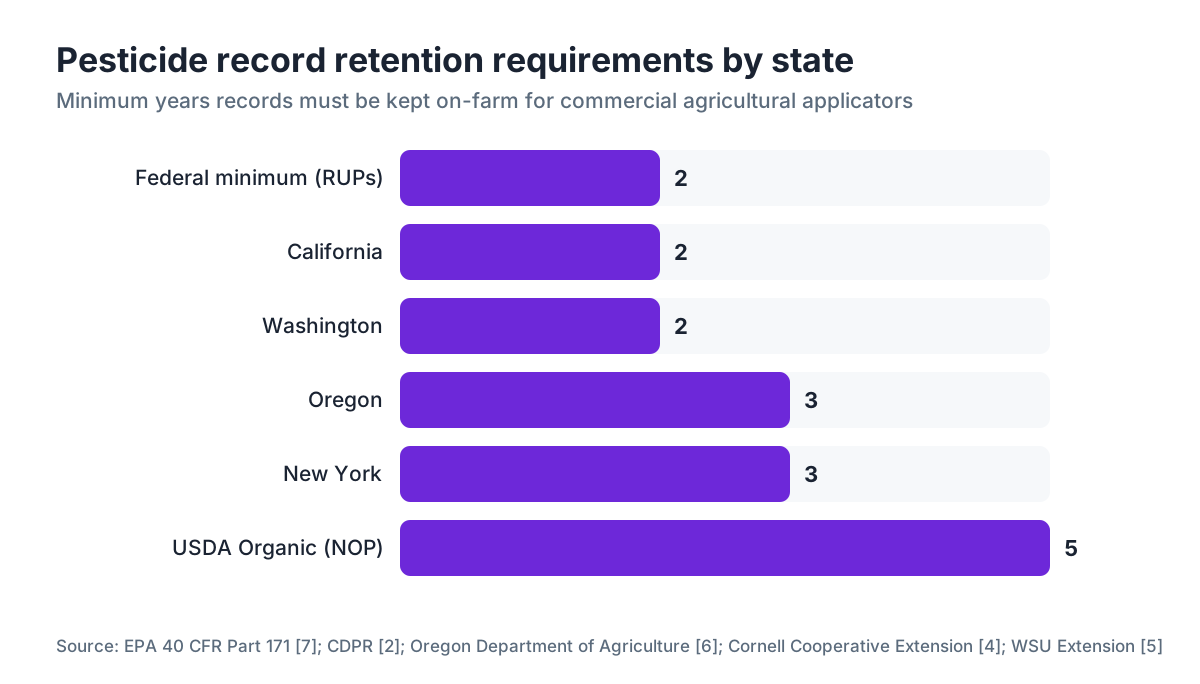
Cornell Cooperative Extension's pesticide management guidelines note that New York requires private applicators of RUPs to keep records for 3 years and submit annual summaries to the Department of Agriculture and Markets. [4] Washington State University Extension notes that Washington requires 2-year record retention for all pesticide applications on commercial farms, with records available for inspection at any time. [5] These retention windows differ from California's 2-year on-farm requirement that runs alongside the 7-day filing requirement for RUPs. Check your state's current rule every season. Legislatures and lead agencies update these requirements more often than most growers realize.
What does California require that other states don't?
California has the most demanding pesticide record system in the country, period. Every commercial pesticide application in California must be recorded, not only RUPs, and the record must be filed with the county agricultural commissioner (CAC) within specified timeframes. Under California Food and Agricultural Code Section 12981 and the implementing regulations in Title 3 California Code of Regulations (3 CCR), Section 6624, the required data fields include the grower's name and address, the operator of record, the license number of the pest control operator if one was used, the commodity and acres treated, the pesticide brand name, the EPA registration number, the amount of pesticide applied, the application method, the start and end dates, and the county where the treated parcel sits. [2]
For restricted-use pesticides in California, records must reach the CAC within 7 days of application. For non-restricted pesticides, a monthly summary report is due by the 10th of the following month. Filing late is a separate violation from having an incomplete record. You can be cited for both.
California also requires that the pesticide label be available at the application site during application, and that the applicator have a copy of the label (or a legible printed version) in their possession. The phrase "in their possession" has teeth. An inspector who finds an applicator in the vineyard with no label to produce has grounds for a stop-work order.
For comparison, the table below puts key requirements across four major wine grape states side by side.
Side-by-side: record requirements in CA, WA, OR, and NY
| Requirement | California | Washington | Oregon | New York |
|---|---|---|---|---|
| Applies to general-use pesticides | Yes | Yes | Yes | RUPs only (private applicators) |
| Filing with state/county agency | Yes (CAC) | No (on-farm) | No (on-farm) | Annual summary only |
| Deadline for RUP records | 7 days to CAC | Keep on-farm | Keep on-farm | Annual summary |
| Record retention period | 2 years | 2 years | 3 years | 3 years |
| Applicator license # required | Yes | Yes | Yes | Yes |
| GPS or legal description required | Yes | Recommended | Yes | No |
| REI documented on record | Yes | Yes | Yes | Yes |
| PHI documented on record | Yes | Yes | Recommended | Yes |
Sources: CDPR [2], WSU Extension [5], Oregon Department of Agriculture [6], Cornell Cooperative Extension [4]. These requirements update periodically, so check the current version of your state's pesticide control statutes before your season starts.
One thing most growers learn the hard way: Oregon's 3-year retention requirement is longer than federal and longer than California. If you farm in multiple states or shift operations between them, the safest policy is to keep every record for 3 years minimum.
What is a restricted-use pesticide and does it change the record requirements?
Restricted-use pesticides (RUPs) are products the EPA has classified under FIFRA Section 3(d) as needing extra regulatory restrictions because of their potential for harm to the applicator or the environment. [1] You can only buy and apply an RUP if you're a certified applicator or working under one's direct supervision.
RUP status triggers stricter record requirements almost everywhere. Federally, 40 CFR Part 171 requires certified applicators to keep RUP records for 2 years and make them available to state lead agencies. [7] States then add their own layers. In California, RUP records go to the CAC within 7 days. In New York, certified applicators must keep them 3 years.
Here's the distinction that matters for vineyards. Many fungicides, insecticides, and soil fumigants used in wine grape production are RUPs. Chlorpyrifos (where still legal), some copper formulations at high rates, and most soil fumigants like metam sodium fall into this category. When you schedule your spray program before the season, flag every RUP product so your record-keeping protocol automatically triggers the tighter requirements for those applications.
General-use pesticides, meaning everything not classified as restricted-use, still need complete application records in most states. The distinction mostly affects who can apply them and how quickly records must be filed, not whether a record is required at all.
What counts as a valid applicator license number on the record?
Every state issues pesticide applicator licenses or certificates through its department of agriculture. The number on those documents is what goes on the record. If a licensed pest control operator (PCO) or pest control adviser (PCA) made or supervised the application, their license number goes on the record alongside the name of the individual who physically applied the product. [2]
For growers who apply their own pesticides, the relevant license is the private applicator certificate or the commercial applicator license, depending on what your state requires for your operation size and the pesticides you use. In California, growers applying RUPs need either a pest control operator license (QAL or QAC category) or must operate under a written recommendation from a licensed PCA. That recommendation itself becomes part of the application record.
A common mistake: the person filling out the paperwork writes their own name, but the licensed applicator of record is someone else, often the vineyard manager or a PCO. Inspectors check that the license number on the record belongs to someone who was actually present or directly supervising. If the license number on file belongs to someone who wasn't there, that's a documentation failure even when the application itself was legal.
UC Davis Cooperative Extension's pest management guidelines note that in California the licensed PCA's recommendation number is a required field separate from the applicator's license number, because the two roles are legally distinct. [8]
Does the EPA Worker Protection Standard create its own record requirements?
Yes, and this catches a lot of small operations off guard. The EPA's Worker Protection Standard, codified at 40 CFR Part 170, requires that agricultural employers keep application records whenever workers or handlers may be in a treated area. [3] The WPS record must include the product name, EPA registration number, active ingredient(s), location and description of the treated area, and the REI. According to 40 CFR 170.309, "the establishment must retain these records for at least two years from the date of application and must make them available to workers, handlers, and their designated representatives upon request."
That quoted language is straight from the regulation. "Upon request" is the operative phrase. Under the 2015 WPS revision, workers have the right to ask for and receive this information, and the employer must provide it within 15 days of the request. [3]
The WPS record is not automatically satisfied by the state application record, though the two overlap a lot. The WPS specifically requires that the REI be documented, because workers need that information to know when they can safely re-enter a treated area. If your state record form has no field for REI, add one, or keep a separate WPS log.
Small vineyards with no workers or handlers (owner-operated, no employees, nobody entering treated areas) may be partially exempt from WPS provisions. Most operations hiring even seasonal labor are fully covered.
How long do you have to keep pesticide application records?
The federal minimum for RUP records is 2 years. [7] That's the floor. Several states require 3 years, including Oregon and New York. California requires 2 years for on-farm copies, and the CAC keeps the county's copies. For multi-state operations or anyone who wants a margin of safety, the practical answer is simple: keep everything for 3 years.
Record retention isn't only about inspections. Pesticide drift claims, worker illness complaints, and neighbor disputes can surface 18 to 24 months after an application. Clean records that far back are the difference between a documented defense and a credibility problem.
Digital records are generally acceptable, as long as they're accessible for inspection on-site or can be printed on demand. California explicitly allows electronic records for the on-farm copy. The CAC filing still requires submission in the format the county specifies, which for most counties is now an online portal. Oregon Department of Agriculture also accepts digital records, provided they can be retrieved and presented during an inspection without special equipment the inspector wouldn't have. [6]
If you use a record-keeping platform like VitiScribe, confirm the export format meets your state's specific requirements before your first inspection, not after.
What happens if a required field is missing or incorrect?
A record with a missing required field is, legally, an incomplete record. Most state regulations treat it the same as no record at all for that application. The penalties vary by state and by whether the violation is civil or criminal.
In California, incomplete or missing pesticide application records can draw fines up to $5,000 per violation under California Food and Agricultural Code Section 12999.5. [2] Repeat violations, or violations involving restricted-use pesticides, carry higher penalties. The CAC can also refer cases to the CDPR, which can suspend or revoke licenses.
Washington State fines for pesticide record violations range from a few hundred dollars for first-offense administrative penalties to several thousand dollars for willful violations, under RCW 17.21. [9] Oregon uses a tiered penalty system under ORS Chapter 634, where penalties scale with the degree of harm and whether the violation was intentional. [6]
Fines are only part of it. An incomplete record creates problems in other scenarios too. If a worker files a pesticide exposure claim and your records for that application are defective, you lose your documentation defense. If a packer or winery rejects a crop because residue testing flags an unexpected compound, you need clean application records to show what was and wasn't applied. Gaps in the record create liability exposure that has nothing to do with regulatory fines.
The most common missing fields, based on what inspectors actually flag: the EPA registration number (people write the product name but not the number), the REI, and the legal field description or GPS location. Make those fields mandatory on your form template and the error rate drops fast.
What is the EPA registration number and where do you find it?
The EPA registration number is a unique identifier assigned to every pesticide product registered under FIFRA. It appears on every legal pesticide label in the format XX-XXXX, where the first set of digits is the company registration number and the second is the product number. Some products carry a third set indicating a sub-registration. [1]
You find it on the front panel of the label, usually near the product name, or in the header of the "Directions for Use" section. It's also on the Safety Data Sheet (SDS). If you log applications from memory after the fact, this is the number most likely to get entered wrong or skipped, because it requires physically checking the label.
The EPA registration number matters for two reasons. First, it identifies the exact formulation you used, not merely the active ingredient. A product with the same active ingredient from two different manufacturers has two different registration numbers. Second, several state and federal databases, including the National Pesticide Information Retrieval System and California's Pesticide Use Reporting system, use this number for data matching. If the number on your record doesn't match a registered product, the record flags as problematic. [2]
Build a product master list before each season, with the brand name, active ingredient, EPA reg number, REI, and PHI all on one reference sheet. That single habit saves time and kills transcription errors during the season.
Do pre-harvest intervals need to be on the record?
Most states require or strongly recommend that the PHI be documented on the application record, and it's a required field in California. [2] The PHI is the minimum number of days between the last application and harvest, as specified on the pesticide label. It's a direct food safety concern, and it's the field winery quality assurance programs ask about most.
The PHI on the record does two jobs. It shows you checked the label before applying, and it gives you a retrievable calculation point if harvest dates shift and someone later questions whether the interval was observed.
Write the PHI on the record, pulled straight from the label at the time of application, rather than referencing it from memory later. Labels do change between product lots on occasion, especially after label amendments, so a PHI documented at the moment of application creates a contemporaneous record of what the label said when you used the product.
The REI and the PHI get confused all the time. The REI (restricted-entry interval) is about worker safety: how long before workers can re-enter the treated area. The PHI is about crop safety: how long before harvest. Both go on a complete record. They are different numbers for the same product.
Can one record cover multiple fields or blocks applied on the same day?
Generally yes, if the application conditions were identical: same product, same rate, same equipment, same applicator, same day. Most state regulations allow a single record to cover multiple treated areas applied on the same day, as long as each area is listed individually. Every treated location must be identifiable.
California is specific about this. Under 3 CCR Section 6624, if the same product is applied on the same day to contiguous fields under the same conditions, a single report can cover them, but each field or block must be listed with its acreage. You cannot lump multiple non-contiguous parcels under a single county section/township/range entry without listing them. [2]
For vineyards split into blocks with different varietals, different disease pressure, or different application timing, block-level records make operational sense even where state law allows broader aggregation. If you ever face a residue question, block-level records let you narrow the source of the problem instead of implicating your entire vineyard. WSU Extension recommends block-level records for exactly this reason. [5]
One practical note: if the same product goes on at different rates in different blocks the same day, those must be separate records. A single record carries one rate.
What's the easiest way to make sure your records are always complete?
The answer is a form template that makes an incomplete record impossible to submit. Either a paper form with every required field labeled and blank lines that force you to fill them in, or a digital system that won't let you save until the mandatory fields are done.
Start by pulling the specific required field list from your state's pesticide regulations, not from a generic template you found online. Then compare it against the WPS requirements at 40 CFR 170.309 [3] and confirm you have both covered. If you work with a PCA or PCO, check that their recommendation format feeds the data you need.
For vineyard operations tracking multiple blocks, multiple applicators, and multiple products across a season, a platform built for this kind of record-keeping helps. VitiScribe, for example, structures each spray record around the required fields for your state and exports them in formats accepted by most state ag agencies. That addresses the most common source of errors: manual transcription from field notes to a final record.
Software aside, the best habit is same-day entry. Records completed the day of application are more accurate than records reconstructed a week later. Inspectors know the difference. A record entered contemporaneously carries specific start and end times, equipment settings, and tank volumes that a reconstructed record often lacks.
Annual self-audits also help. After each season, pull a random sample of 10 records and check them against your state's required field list. If you spot a pattern of missing fields, fix the template before next season, not during an inspection.
Frequently asked questions
Do I need to keep pesticide records if I only use general-use pesticides?
In most states yes, though the requirements are lighter than for restricted-use pesticides. California requires application records for all commercial pesticide applications, including general-use products. Washington and Oregon require records for all commercial farm applications. The federal WPS record requirement also applies regardless of whether the product is restricted-use, as long as workers or handlers may enter the treated area.
How long do pesticide application records have to be kept?
The federal minimum for restricted-use pesticide records is 2 years under 40 CFR Part 171. Several states require 3 years, including Oregon and New York. California requires 2 years for on-farm copies. If you operate in multiple states or want a single policy, keep all records for 3 years. Digital records are acceptable in most states if they can be retrieved and printed during an inspection.
What is the EPA registration number and do I really need it on every record?
Yes. The EPA registration number uniquely identifies the exact product formulation under FIFRA and is a required field in most states. It appears on the front of every pesticide label in the format XX-XXXX. Writing only the product name is insufficient: different manufacturers producing the same active ingredient have different registration numbers, and state reporting databases match on this number.
Is the REI the same thing as the PHI on a pesticide label?
No. The restricted-entry interval (REI) is the minimum time workers must wait before entering a treated area after application, required by the EPA Worker Protection Standard. The pre-harvest interval (PHI) is the minimum days between last application and harvest. Both appear on the pesticide label and both should be documented on a complete application record. They are often different numbers for the same product.
Can I use a spreadsheet or digital app to keep pesticide records or does it have to be paper?
Digital records are acceptable in California, Washington, Oregon, New York, and most other states, provided the records can be retrieved and presented during an inspection. California accepts electronic on-farm copies and most counties now take digital filings through online portals. Oregon and Washington accept digital records that are printable on demand. Check your specific county or state agency for submission format requirements.
What triggers a pesticide record inspection and who can inspect?
In California, county agricultural commissioners can inspect at any time. Federal EPA inspectors have inspection authority under FIFRA. Under the Worker Protection Standard, workers and their designated representatives can request copies of application records within 15 days of the request. Complaints from neighbors, workers, or water districts can trigger unannounced inspections. In practice, most routine inspections in California are annual.
Does a written PCA recommendation count as the application record in California?
No. A written recommendation from a licensed pest control adviser is a required input to the application process in California for restricted-use pesticides, but it is not the application record. The application record is a separate document completed after the application, recording actual quantities applied, field conditions, and timing. Both documents must be retained for 2 years.
What penalties apply for missing or incomplete pesticide records in California?
Under California Food and Agricultural Code Section 12999.5, fines can reach $5,000 per violation. Separate violations can be cited for an incomplete record and for a late filing, so a single application event can generate two citations. Repeat violations or those involving restricted-use pesticides carry higher potential penalties. The county agricultural commissioner can also refer cases to CDPR for license action.
If a contract applicator applied the pesticide, whose name and license number goes on the record?
The licensed applicator of record is the person who made or directly supervised the application, typically the contract PCO or their licensed employee. Their name and license number are required on the record. The farm operator is also listed as the grower or permit holder. If the contract applicator fails to file or files incorrectly, the grower can still bear liability in California, because the CAC can cite the property operator.
Do organic operations need to keep pesticide application records?
Yes. USDA-certified organic operations must keep records of all inputs applied, including OMRI-listed materials, under NOP requirements at 7 CFR Part 205. These records must be kept for 5 years, which is longer than most state pesticide record requirements. State pesticide registration laws also apply to organic inputs: if the product is registered as a pesticide in your state, the state record requirements apply regardless of organic certification status.
What field location information satisfies the location requirement on a pesticide record?
Most states accept a legal land description (section, township, range, county) or a GPS coordinate tied to a field map on file. California requires enough location detail to identify the treated parcel on an assessor's map. In practice, a block name or number that corresponds to a labeled map kept with your records satisfies most state inspectors, as long as the map itself is current and accessible.
Are there federal record requirements for pesticides used near water or in sensitive areas?
Yes, though they operate separately from standard application records. EPA pesticide labels often include specific buffer zone and no-spray requirements near water under FIFRA. Some products also carry requirements under the Endangered Species Act protection measures. Your application record should note any label-required buffer distances observed, because that documentation supports compliance if a water quality complaint arises.
What records does a winery or packer have the right to ask for from a grower?
Wineries and packers have no independent legal authority to demand pesticide records, but growers who sell fruit under a purchase agreement often agree contractually to provide spray records on request or to disclose all materials applied. Many California wineries now require annual pesticide disclosure or require that growers follow approved spray programs. Those are contract requirements, not regulatory ones, but failing to meet them can affect fruit acceptance.
Sources
- EPA, Federal Insecticide Fungicide and Rodenticide Act (FIFRA) overview: FIFRA is the federal statute governing pesticide registration, labeling, and applicator record requirements; Section 3(d) defines restricted-use pesticide classification
- California Department of Pesticide Regulation, Pesticide Use Reporting: California requires pesticide application records be filed with the county agricultural commissioner within 7 days for restricted-use pesticides; fines up to $5,000 per violation under California Food and Agricultural Code Section 12999.5
- EPA, Agricultural Worker Protection Standard (WPS), 40 CFR Part 170: 40 CFR 170.309 requires agricultural employers to keep pesticide application records including product name, EPA registration number, REI, and treated area description for 2 years; workers may request records within 15 days
- Cornell Cooperative Extension, Pesticide Management Guidelines for New York: New York requires private applicators of restricted-use pesticides to keep records for 3 years and submit annual summaries to the Department of Agriculture and Markets
- UC Davis Cooperative Extension, Pest Management Guidelines: In California, the licensed PCA recommendation number is a required field on application records, separate from the applicator's license number, because the two roles are legally distinct under California Food and Agricultural Code
- Washington State Legislature, RCW 17.21 Washington Pesticide Application Act: RCW 17.21 governs pesticide application licensing and penalties in Washington State; fines for record violations scale with willfulness and degree of harm
- USDA Agricultural Marketing Service, National Organic Program, 7 CFR Part 205: USDA NOP requires certified organic operations to keep input application records for 5 years, longer than most state pesticide record requirements
- EPA, Pesticide Registration, EPA Registration Number explanation: Every EPA-registered pesticide product carries a unique EPA registration number in XX-XXXX format required on application records under FIFRA
Last updated 2026-07-09