How to complete a ranch water quality plan for California vineyards
TL;DR
- Most California vineyard operators must file a Ranch Water Quality Plan under the Central Valley or North Coast Agricultural Order, part of the Irrigated Lands Regulatory Program permit.
- The plan documents your farm's pollutant sources, best management practices, and monitoring commitments.
- First filing takes 8 to 20 hours depending on your operation.
- Filing through a Third-Party Group cuts that burden a lot.
What is a ranch water quality plan and who has to file one?
A Ranch Water Quality Plan is the document your vineyard submits to prove to a Regional Water Quality Control Board that you're keeping farm runoff from wrecking surface water and groundwater. People call it an RWQP or a Farm Water Quality Management Plan. It's not a pollution permit in the old sense. It's a structured self-assessment: here are my nutrient sources, here's my irrigation setup, here's what I do to manage the risk.
California's Irrigated Lands Regulatory Program (ILRP) is what makes this mandatory for most commercial vineyards. The State Water Resources Control Board runs the ILRP, and the nine Regional Boards administer it on the ground [1]. If your vineyard sits in the Central Valley, the Central Valley Regional Board's Irrigated Lands Order covers you. The North Coast Regional Board has its own Agricultural Order, and so do the San Francisco Bay and Los Angeles Regions. Find out which Regional Board has jurisdiction over your property before you start. The forms, thresholds, and monitoring rules change from region to region.
Who has to file? Almost every producing vineyard in California. The rule catches any commercial irrigated agricultural operation, and the Central Valley Order alone covers more than 5.6 million acres of irrigated farmland [2]. Operations under five acres that use no pesticides or fertilizers may qualify for a conditional waiver, but most winegrape parcels blow past that threshold. If you farm someone else's land as a tenant, the legal responsibility usually lands on the operator, not the landowner. Your lease can spell that out.
Many growers file through a Third-Party Group, which is a coalition of growers organized by a trade group or irrigation district. The group submits pooled monitoring data and a template management plan, and members tailor it to their own operation. That path drops your individual workload a lot. Ask your local Farm Bureau or wine grape commission whether a group exists for your region before you go it alone.
Which permit tier applies to your vineyard?
The Central Valley Order sorts growers into three tiers, and your tier decides how much monitoring you owe and how detailed your RWQP has to be [2]. Most mid-size vineyards land in Tier 2. Look yours up before you build the plan.
| Tier | Who it covers | Key RWQP requirements |
|---|---|---|
| Tier 1 | Low-risk operations (usually smaller acreage, no high-risk practices) | Basic RWQP, no individual surface water monitoring |
| Tier 2 | Moderate risk (most mid-size vineyards land here) | RWQP, participation in group or individual monitoring |
| Tier 3 | High risk or dischargers with a history of violations | Individual surface water monitoring, more detailed RWQP |
A few things push you into a higher tier: sitting near a 303(d)-listed impaired water body, applying high-priority pesticides or nutrients near a drainage feature, slopes over roughly 5 percent, or a prior Notice of Violation. UC Cooperative Extension has published guides for wine grape operations that walk through these risk factors in plain language [3].
The North Coast Order works differently. It leans hard on erosion and sediment because so many North Coast vineyards sit on hillsides. Growers there may also face Vineyard Erosion and Sediment Control Ordinance requirements from the county, stacked on top of the state order [4]. If you're in Napa, Sonoma, or Mendocino, read both the Regional Board order and your county's grading and erosion rules before you finalize anything.
Look up your parcel on the ILRP online system, identify your Regional Board, pull the current agricultural order, and read the tier definitions. That takes about an hour. It saves you from building the wrong plan.
What information do you need to gather before you write the plan?
This is where most vineyard managers stall. The RWQP asks you to write down things that already exist on your ranch but have never made it onto paper. Collect all of it before you open the form.
Parcel data. You need your Assessor's Parcel Number(s), total irrigated acres, and the name of any water body on or next to the property. A USGS topographic map and your county assessor's website cover this.
Water sources and irrigation system. List every source: well, surface water diversion, recycled water, or purchased district water. Write down your system type (drip, overhead, flood) and your backflow prevention setup. If you inject fertilizer through fertigation, note the make and model.
Soil and slope. You don't need a formal soil science report. You do need USDA Web Soil Survey data for your blocks [5]. Pull the hydrologic soil group (A through D) and the Ksat values for each management zone. That data feeds straight into the nutrient section.
Pesticide and fertilizer records. Pull two to three years of spray logs and fertilizer receipts. The plan asks which materials you apply and at what rates. UC IPM's pesticide database is handy for matching active ingredients against the high-priority pesticide list the Regional Board uses [6].
Drainage infrastructure. Walk the property. Map every drain inlet, check dam, vegetated buffer, sedimentation basin, and water diversion. Take photos. The Regional Board may ask for proof that your BMPs exist, and dated GPS photos beat a checked box every time.
Neighboring land uses. A school, a municipal water intake, or sensitive habitat within a mile downstream matters. It changes how the Board classifies your risk tier.
How do you actually fill out the ranch water quality plan form?
The exact form depends on your Regional Board and whether you file individually or through a Third-Party Group. The Central Valley Board's individual grower RWQP template lives in their online portal. The North Coast Board has its own template. The structure is similar across regions, so here's a section-by-section walkthrough.
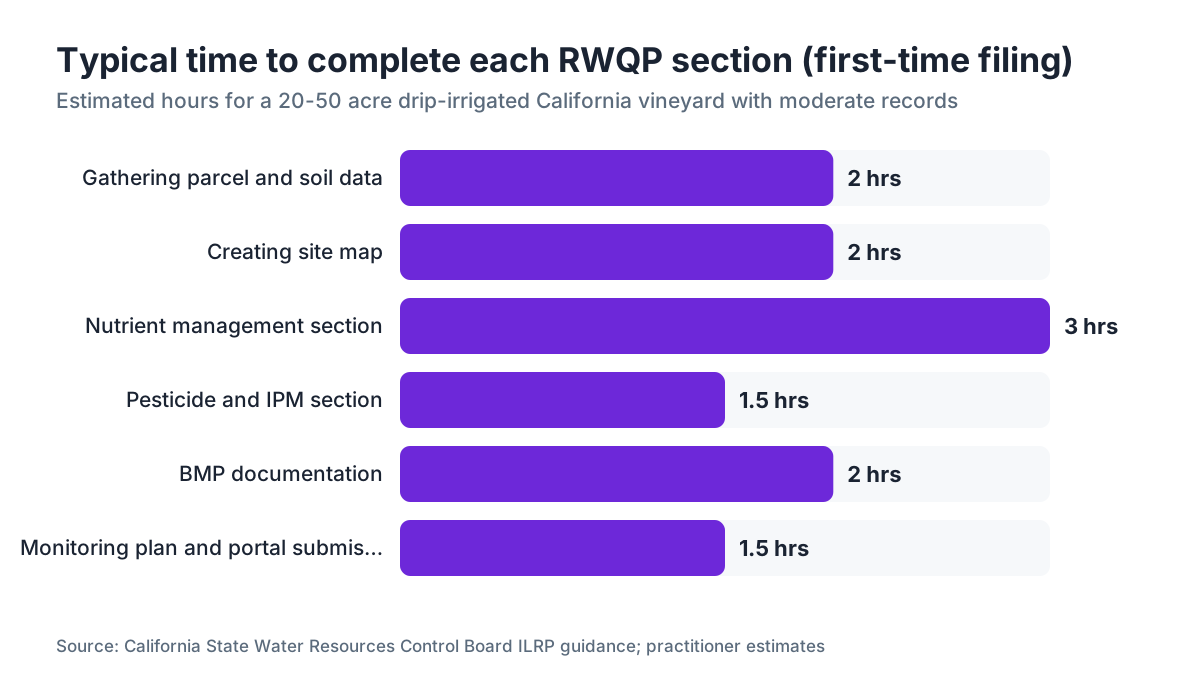
Section 1: Property and operator information. Straightforward stuff. Legal name, mailing address, APN, GPS coordinates of the ranch headquarters, total irrigated acres, the water body receiving your drainage. Check that water body name against the Regional Board's 303(d) impaired waters list.
Section 2: Field map. You need a site map showing parcel boundaries, irrigated blocks, drainage features, buffer strips, and any water bodies nearby. A hand-drawn sketch is technically fine. A PDF export from Google Earth Pro or your spray record software is cleaner and much easier to update later. Show a scale and a north arrow.
Section 3: Water sources and uses. List each source, the annual volume if you know it (the Board likes real data over guesses), and whether you hold a water right on file with the State Water Board.
Section 4: Nutrient management. This section trips up more people than any other. You have to show your nitrogen application rate doesn't run well past crop uptake. The UC ANR winegrape nitrogen management guide gives uptake rates by yield level [3]. A basic nitrogen balance reads like this: (fertilizer N + irrigation water N + organic matter mineralization) minus (crop N removal + cover crop uptake + expected denitrification). Perfect numbers aren't the point. The Board wants proof you've thought it through and you aren't dumping 200 pounds of N per acre on a low-yield block.
Section 5: Pest and disease management. List your pesticide programs at a high level. Point to your Pesticide Use Reports, which you already file monthly with the county ag commissioner under California Food and Agricultural Code Section 12980 [7]. Note any IPM practices: scouting thresholds, selective chemistries, cover crops as habitat. The Board cares most about pesticides on the 303(d) priority list for your local water bodies.
Section 6: BMPs. Best Management Practices are the operational spine of the plan. List every practice you run to stop runoff and leaching. Common vineyard BMPs: cover crops in row middles, vegetated filter strips along drainage channels, check dams in swales, tailwater recovery ponds, irrigation scheduling off ET data, riparian buffers. For each one, mark whether it's installed or planned. If planned, give a date.
Section 7: Monitoring and reporting commitments. In a Third-Party Group, your group handles most surface water and groundwater monitoring. Filing solo, you specify where and how often you'll sample, which parameters you'll test (nitrogen, pesticides, sediment, and so on), and which certified lab you'll use.
Sign it, date it, keep a copy. Submit through your Regional Board's portal, which is how most regions take it now.
What are the best management practices California vineyards most commonly include?
The Regional Boards don't hand you a mandatory BMP list. They want you to name your risks and show your practices address them. Still, a handful of practices read as strong evidence of good-faith compliance, and Boards see them constantly.
Cover crops in row middles cut erosion, improve infiltration, and soak up leftover nitrogen. This is probably the single most cited vineyard BMP in California. Even a winter mix of cereal rye and vetch changes the picture on a sloped block.
Vegetated filter strips along waterways. A 30-foot buffer of permanent vegetation between your vines and any stream, ditch, or seasonal drainage is a standard recommendation. Some orders set minimum widths, and the North Coast orders have been especially specific about this [4].
Tailwater return systems. If you flood-irrigate or get real runoff from overhead irrigation, a tailwater pond and pump is worth documenting. It usually pays for itself in water savings.
Irrigation scheduling off CIMIS ET data. CIMIS (California Irrigation Management Information System) runs more than 145 weather stations across the state [8]. Scheduling irrigations to actual evapotranspiration cuts over-irrigation, which drives nitrate leaching to groundwater more than almost anything else.
Soil moisture monitoring. Tensiometers, gypsum blocks, or capacitance sensors in the root zone give you live data behind your irrigation calls. That turns a BMP from a claim into documented evidence.
Integrated Pest Management. Scouting thresholds before you spray, picking pesticides with lower runoff potential, and timing applications away from irrigation events that carry product into drains all read well in a plan review.
Document each BMP with a yes or no for current use, and give a real date for anything planned. Listing 15 practices you haven't started and won't reach this season looks worse than listing 6 you already run.
How do irrigation and nutrient records connect to your water quality plan?
Your RWQP is a living document, and your records are what keep it alive between filings. The Regional Boards expect that if they audited you tomorrow, your records would back every claim in the plan.
For irrigation, keep a log with six things: date, block, water source, flow rate or volume, duration, and the ET-based trigger you used to schedule. Nothing fancy. A spreadsheet with those six columns per irrigation event does the job. If an ag water management company or an app exports this data, attach the reports.
For nutrients, record every fertilizer application: product, actual N-P-K analysis, rate per acre, and method. Fertigation records add injection rate and duration. UC Cooperative Extension's nutrient management resources for wine grapes suggest running an annual nitrogen budget you update after each application [3].
Pesticide records are already mandated separately through the county ag commissioner, but cross-reference them in your RWQP. Your monthly Pesticide Use Report data is public record anyway. Keeping your own copies filed by block and season makes updates go fast.
Digital record-keeping earns its keep here. VitiScribe, for one, is built around block-level records, so irrigation events, spray applications, and fertilizer logs sit in one place and export straight into RWQP reporting. Stuck on paper logs or scattered spreadsheets, you'll burn a few extra hours every year reconciling records before the annual report.
Hold all records for at least five years. Some Regional Board orders demand longer. Five years is the safe floor [2].
What are the filing deadlines and annual reporting requirements?
Deadlines change by Regional Board and by tier, and they don't sit still. The Central Valley Order runs on its own schedule; the North Coast Order runs on different dates. Both orders have been revised several times since 2012, and the deadlines have moved with them. Verify the current date straight from your Regional Board, never from a third-party summary that may be stale [1].
Here's the usual rhythm for a Tier 2 Central Valley vineyard.
Initial enrollment. You register through the Ag Portal (the Central Valley Board's online system) and submit your first RWQP within 90 days of enrollment, or by the date on your enrollment confirmation.
Annual report. Due every year, usually by a spring deadline (historically February 28 or March 1, but confirm it). The annual report is a short update. Did you install the BMPs you promised? Did the operation change? What did your monitoring turn up?
Monitoring data submission. If you monitor on your own, your lab data follows a schedule tied to the monitoring period. For surface water, that often means sampling the first rainfall runoff events of the season, and October through March is the usual Central Valley window.
Plan update. Make a material change, like adding a block, switching your irrigation system, or starting fertigation, and you update the RWQP within 30 to 90 days depending on the order. Don't sit on a big change until the annual report.
Third-Party Group members get most of this handled by the group administrator, who sends reminders. Read those emails. Blow a group reporting deadline and you can trigger individual reporting requirements that cost a lot more.
What does water quality monitoring actually involve for vineyard operators?
ILRP monitoring has two halves: surface water and groundwater. Which one applies to you comes down to your tier and your Regional Board's order.
Surface water monitoring. Tier 1 growers in the Central Valley usually take part only through their Third-Party Group's pooled monitoring, where the group samples representative sites across the coalition's footprint. Tier 2 growers may owe more, either through coalition sites or by monitoring a drainage feature on or beside their property. Tier 3 growers often monitor their own discharge points. The parameters tested most often: total nitrogen, nitrate, total phosphorus, sediment (turbidity or TSS), pH, electrical conductivity, and a rotating pesticide panel tied to the local 303(d) list.
Groundwater monitoring. This shows up more for Central Valley vineyards, where nitrate leaching to groundwater is a documented regional problem. If your area gets flagged as a high-nitrate groundwater zone, you may need to sample your agricultural supply well every year. Parameters are usually nitrate, and sometimes a pesticide panel.
Lab costs. A basic surface water panel (nitrogen, phosphorus, pH, EC, turbidity) runs roughly $50 to $150 per sample at a certified lab, depending on the lab and the suite. Pesticide panels cost a lot more, often $200 to $600 per sample based on how many analytes you include. In a Third-Party Group, these costs get pooled, which is one of the strongest reasons to join.
USGS water quality data for your area shows what's already in local waterways before your drainage even reaches them. That baseline is useful if your own monitoring ever kicks off a follow-up inquiry.
What happens if you don't file or if your plan has violations?
Skipping ILRP enrollment breaks the Porter-Cologne Water Quality Control Act, the state law underneath all of this. The State Water Board can issue a Notice of Violation, then a Cleanup and Abatement Order or a Cease and Desist Order. Administrative civil liability reaches $10,000 per day of violation, and for knowing violations the ceiling climbs to $25,000 per day [9].
In practice, the Regional Boards have historically cared more about getting growers into compliance than about writing fines. You're far more likely to get a compliance schedule and a warning letter before any money changes hands. That math shifts if you've already caught prior notices, or if there's documented discharge doing real harm to a water body.
When monitoring data shows an exceedance of a water quality objective, the standard response is a Root Cause Analysis followed by a BMP update. The Board expects you to document what caused the exceedance, what you changed, and when. Good records are the whole game here. A well-documented response with solid data behind it gets treated nothing like a shrug.
Sell the vineyard and the RWQP obligation goes with the operation. Make sure the purchase agreement says who files the transfer notification with the Regional Board and who pays for any outstanding monitoring. Buyers should ask for the last three years of RWQP submissions and monitoring results during due diligence.
How long does it take to complete a ranch water quality plan?
Honest answer: a first-time RWQP for a straightforward 20 to 50 acre drip-irrigated vineyard with decent records takes most operators 8 to 14 hours. That covers gathering the data, filling out the form, drawing the site map, and one review before you submit.
Poor records, multiple water sources, a violation history, or a messy drainage situation, and you're looking at 20 to 30 hours the first time. After that first submission, annual updates run 2 to 4 hours, because most of the foundational information carries over year to year.
Hiring a consultant. Agricultural water quality consultants in California typically charge $75 to $175 per hour for RWQP prep, based on rates growers report across the Central Valley and North Coast (these are practitioner-reported ranges; no formal survey exists that I'd point you to with confidence). For a straightforward vineyard, budget a $1,000 to $2,500 engagement for the initial plan. That's money well spent if your records are a mess or you're unsure of your tier.
Third-Party Group fees. Group membership usually costs $200 to $600 per year depending on the group, your acreage, and the services included. For most small to mid-size vineyards, a group beats filing solo once you add up monitoring costs and consultant time.
Where can you get help and what resources actually save you time?
Start with your Regional Water Quality Control Board's website. Each board keeps a dedicated ILRP page with current orders, templates, and contacts for the agriculture unit [1]. Then call them. The staff are approachable, and 20 minutes with the agricultural coordinator for your area can settle your tier and your deadlines faster than any guide.
UC Cooperative Extension farm advisors are an underused resource. Every major California wine grape region has an advisor who knows the local RWQP requirements cold. Their publications on nutrient management, irrigation, and water quality are free through the UC ANR catalog [3]. Cornell's viticulture program and Washington State University Extension both put out strong general viticulture material, though neither is California-ILRP-specific [10][11].
The California Department of Food and Agriculture's Fertilizer Research and Education Program offers free technical help for nutrient management planning, which drops straight into your RWQP's nutrient section [12].
For pesticide cross-referencing, UC IPM Online is the most current and complete California resource, with active ingredient details, environmental fate data, and links to label requirements [6].
Your local Farm Bureau usually knows which Third-Party Groups are active in your county. The California Farm Bureau Federation's water quality resources page links to regional programs [13].
For day-to-day record-keeping that feeds the annual update, a field operations platform like VitiScribe keeps irrigation, spray, and fertilizer logs organized by block all season, so annual reporting becomes a data export instead of records archaeology.
If your vineyard is in the Paso Robles wineries region or the South Coast area, check whether your local grape growers association has negotiated group monitoring rates. Both regions have active agricultural coalitions.
How does a ranch water quality plan connect to other vineyard compliance requirements?
The RWQP doesn't live in a box. It ties into several other regulatory systems, and seeing those connections makes the whole compliance load lighter.
Pesticide Use Reporting. Your county PUR filings under California Food and Agricultural Code Section 12980 log every restricted-materials application [7]. The RWQP points back to that system. If your PUR data and your RWQP pesticide section disagree, that's a red flag. Keep them in sync.
EPA Worker Protection Standard. The WPS governs pesticide safety for farm workers and handlers [14]. It's separate from water quality compliance, but your application records overlap. One organized master set of spray records that satisfies both WPS recordkeeping and RWQP documentation saves real time.
Winery wastewater orders. If your winery produces process water (that's winery wastewater, different from vineyard runoff), you may also need a Waste Discharge Requirement or enrollment in a general order for winery discharges. That sits apart from the ILRP agricultural order, though the same Regional Boards run it.
California Department of Pesticide Regulation. DPR regulates pesticide use more broadly and runs its own inspection program. Kept right, your spray records satisfy DPR and RWQP at once.
County grading and erosion permits. Developing a new vineyard block, especially on a slope, can trigger a county grading permit with an erosion control plan. The BMP documentation you build for that permit often drops straight into your RWQP.
Sustainability certifications. SIP Certified, CCOF Organic, and the California Sustainable Winegrowing Alliance all carry water quality components [15]. The overlap with RWQP requirements is heavy. Chase any of these and your RWQP paperwork does double duty.
Frequently asked questions
Do small vineyards under 10 acres have to file a ranch water quality plan in California?
Generally yes, if the operation is commercial and irrigated. The Central Valley Order's conditional waiver for very small, low-risk operations applies only to parcels under five acres with minimal chemical inputs, and even that requires enrollment. Most commercial wine grape parcels exceed five acres or use fertilizers and pesticides that disqualify them from the waiver. Check with your Regional Board to confirm, but assume you're covered until you verify otherwise.
Can I file my ranch water quality plan through a Third-Party Group instead of individually?
Yes, and for most small to mid-size vineyards it's the smarter choice. Third-Party Groups submit pooled monitoring data and a group-level management plan. You still customize a site-specific RWQP for your operation, but the group handles surface water sampling coordination, lab contracts, and much of the reporting. Annual fees typically run $200 to $600 depending on acreage and group. Ask your local Farm Bureau which groups serve your county.
How often do I need to update my ranch water quality plan?
You submit an annual report each year, which functions as an update to your base RWQP. You also need to update the plan whenever you make a material change to your operation: adding irrigated acreage, changing your irrigation system type, adding fertigation, or significantly altering your pesticide program. The timing requirement varies by Regional Board order, but 30 to 90 days after the change is a reasonable working rule. Verify the exact requirement in your current order.
What is the difference between a ranch water quality plan and a nutrient management plan?
A Nutrient Management Plan (NMP) is a specific technical document that calculates your crop's nitrogen uptake, your soil's nitrogen supply, and the recommended application rate to minimize leaching. An RWQP is broader: it covers pesticides, erosion, irrigation, drainage, and BMPs in addition to nutrients. Your NMP effectively becomes one section of your RWQP. Some growers hire a certified crop advisor to prepare the NMP portion and handle the rest of the RWQP themselves.
What water quality parameters does my vineyard need to monitor?
It depends on your tier and your Regional Board order. Common parameters include nitrate-nitrogen, total nitrogen, total phosphorus, pH, electrical conductivity, turbidity or total suspended solids, and a pesticide panel tied to locally listed 303(d) impairments. If your area has specific groundwater nitrate concerns, annual well sampling for nitrate may also be required. Through a Third-Party Group, your group selects representative monitoring sites and covers most of this cost through pooled fees.
How do I identify which water bodies are near my vineyard for the RWQP?
Use the USGS National Hydrography Dataset viewer or the SWRCB's GeoTracker map to identify named water bodies on or adjacent to your parcel. Then cross-reference those names against your Regional Board's current 303(d) impaired waters list, which is on the Regional Board's website. If a listed water body drains from or through your property, it affects your risk tier and the parameters you may need to monitor.
What records do I need to keep to support my ranch water quality plan?
At minimum: irrigation logs (date, block, source, volume or duration), fertilizer application records (product, rate, block, date), pesticide application records (product, rate, block, date, applicator), cover crop or BMP installation records, and any water quality monitoring lab reports. Keep everything for at least five years. Digital records organized by block and season make annual RWQP updates much faster and give you an audit trail if the Regional Board requests documentation.
What penalties apply if a California vineyard doesn't enroll in the ILRP?
Under the Porter-Cologne Water Quality Control Act, administrative civil liability for non-enrollment can reach $10,000 per day for initial violations and $25,000 per day for knowing or willful violations. In practice, Regional Boards typically issue warning letters and compliance schedules before fines. However, if there's documented discharge causing water quality harm, the enforcement response is faster and more severe. Enroll first, fix paperwork gaps after.
Do I need a consultant to prepare a ranch water quality plan, or can I do it myself?
Most vineyard managers can complete an RWQP themselves with organized records and a few hours. The Regional Board forms are designed for non-specialists. The sections that most benefit from outside help are the nutrient balance calculation and the drainage risk assessment on sloped sites. If your operation is above Tier 1, consider having a certified crop advisor or agricultural water quality consultant review your draft before submission. The cost is modest compared to a compliance issue.
How does the North Coast Agricultural Order differ from the Central Valley order for vineyards?
The North Coast Order, administered by the North Coast Regional Water Quality Control Board, places heavier emphasis on erosion and sediment control, reflecting the region's steep hillside vineyards and high-rainfall winters. It has specific provisions about road and drainage management and may require more detailed site maps and erosion control documentation. The Central Valley Order is more focused on nitrate leaching to groundwater. Both use tiered systems, but the tier criteria and monitoring parameters differ. Always read the specific current order for your region.
Can sustainable winegrowing certification substitute for a ranch water quality plan?
No. California Sustainable Winegrowing Alliance certification, SIP Certified, or organic certification does not substitute for ILRP enrollment or your RWQP. They operate under different legal frameworks. That said, the documentation you build for sustainability certification overlaps significantly with RWQP requirements, particularly for BMPs, nutrient management, and pesticide records. Pursuing both simultaneously is efficient because you're building the same underlying records.
What is the CIMIS system and how does it help with water quality compliance?
CIMIS is the California Irrigation Management Information System, operated by the California Department of Water Resources. It has more than 145 weather stations across California that provide daily reference evapotranspiration (ET0) data. Using CIMIS ET data to schedule irrigations is a recognized BMP under most Regional Board orders because it reduces over-irrigation and the associated leaching of nitrates to groundwater. It's free to use, and documenting that you use it strengthens your RWQP's irrigation management section.
How do I handle the RWQP if I'm a tenant farmer rather than the land owner?
The ILRP obligation attaches to the operator, which is typically the tenant in a farming lease. You, as the operator, are responsible for enrollment and RWQP filing. The landowner is generally not held responsible unless they're also directing operations. Review your lease to see if there's language about regulatory compliance costs and obligations. If not, add it at renewal. In any case, don't assume the landowner is handling it.
What should I do if my water quality monitoring shows an exceedance?
Don't ignore it. Notify your Third-Party Group administrator if you're in a group. Prepare a Root Cause Analysis documenting what likely caused the exceedance: a specific application event, a large rainfall runoff, equipment malfunction, or something outside your control. Then document what BMP change you're implementing and when. Submit this as a supplemental report per your order's requirements. A prompt, documented response almost always produces a better regulatory outcome than a delayed one.
Sources
- Central Valley Regional Water Quality Control Board, Irrigated Lands Program: The Central Valley Order covers more than 5.6 million acres of irrigated farmland and uses a three-tier risk classification system for RWQP requirements.
- UC Agriculture and Natural Resources, Cooperative Extension Wine Grape Resources: UC Cooperative Extension has published nutrient management guides for wine grapes that include nitrogen uptake rates by yield level and risk factor checklists for ILRP tier classification.
- USDA Natural Resources Conservation Service, Web Soil Survey: Web Soil Survey provides hydrologic soil group and saturated hydraulic conductivity (Ksat) data by parcel, which feeds directly into RWQP nutrient management and runoff risk assessments.
- UC IPM Online, Pesticide Information and Environmental Fate: UC IPM maintains the most complete California-specific database of pesticide active ingredients, environmental fate data, and label requirements for cross-referencing against Regional Board priority pesticide lists.
- California Food and Agricultural Code Section 12980, Pesticide Use Reporting: California Food and Agricultural Code Section 12980 requires monthly Pesticide Use Reports filed with the county agricultural commissioner for all restricted materials applications.
- California Department of Water Resources, CIMIS Program: CIMIS operates more than 145 weather stations across California providing daily reference evapotranspiration data used for irrigation scheduling as a recognized ILRP best management practice.
- California Water Code, Porter-Cologne Water Quality Control Act, Section 13350: Under Porter-Cologne, administrative civil liability for non-enrollment in required programs can reach $10,000 per day for initial violations and $25,000 per day for knowing or willful violations.
- Cornell University College of Agriculture and Life Sciences, Viticulture and Enology Extension: Cornell's viticulture extension program produces widely cited resources on vineyard nutrient management, irrigation, and integrated pest management applicable to general viticulture practice.
- Washington State University Extension, Viticulture and Enology Program: WSU Extension's viticulture resources include guidance on irrigation scheduling and cover crop management relevant to vineyard water quality best practices.
- California Department of Food and Agriculture, Fertilizer Research and Education Program: CDFA's Fertilizer Research and Education Program provides free technical assistance for nutrient management planning that can be incorporated into a vineyard RWQP nutrient section.
- California Farm Bureau Federation, Water Quality Resources: California Farm Bureau Federation links to regional Third-Party Group programs and provides grower resources for ILRP enrollment and RWQP preparation.
- U.S. EPA, Agricultural Worker Protection Standard: The EPA Worker Protection Standard requires pesticide application records for agricultural employers that overlap substantially with RWQP spray record documentation requirements.
- California Sustainable Winegrowing Alliance, SIP Certified Program: California sustainable winegrowing certifications have water quality BMP and record-keeping components that overlap with RWQP requirements but do not substitute for ILRP enrollment.
- California State Water Resources Control Board, Irrigated Lands Regulatory Program: The State Water Resources Control Board runs the ILRP statewide while the nine Regional Boards administer the agricultural orders locally, each with its own forms, thresholds, and deadlines.
- North Coast Regional Water Quality Control Board: The North Coast Agricultural Order emphasizes erosion and sediment control and may set specific vegetated buffer widths, layered with county Vineyard Erosion and Sediment Control Ordinance requirements.
Last updated 2026-07-11