Irrigation water quality testing records for vineyard compliance
TL;DR
- Vineyards using recycled or surface water for irrigation should test for pathogens, heavy metals, and agronomic parameters, then keep records at least two years under EPA and most state programs.
- The FSMA Produce Safety Rule adds its own sampling schedules and record-keeping windows.
- Knowing what to test, when, and where to file it keeps you out of trouble.
Why does irrigation water quality testing matter for vineyard compliance?
Wine grapes sit in a regulatory grey zone, and plenty of vineyard managers ride that ambiguity without knowing what it costs them. The FDA's FSMA Produce Safety Rule exempts wine grapes because fermentation counts as a kill step, but that exemption does nothing for state agricultural water rules, groundwater protection programs, or the conditions written into a recycled water permit. If your vineyard also grows fresh table grapes, or shares pipe and pumps with a property that does, the exemption can vanish for the whole system.
California, Washington, Oregon, and New York each run their own water quality programs tied to groundwater management and surface water discharge permits. Using a source that fails those requirements with no documented testing is the kind of thing that surfaces during a watershed inspection or a neighbor's complaint, never during your own quiet audit. The record is what protects you.
Here's the angle most operators miss. Crop insurance and some premium wine programs now ask for irrigation source documentation. A buyer with a food-safety certification requirement may want two to five years of water test records before signing a contract. Start the file now, even if no regulator has knocked on your door. The cost of starting late is a contract you can't sign.
What laws and regulations govern irrigation water quality for vineyards?
Three overlapping frameworks hit most American vineyards.
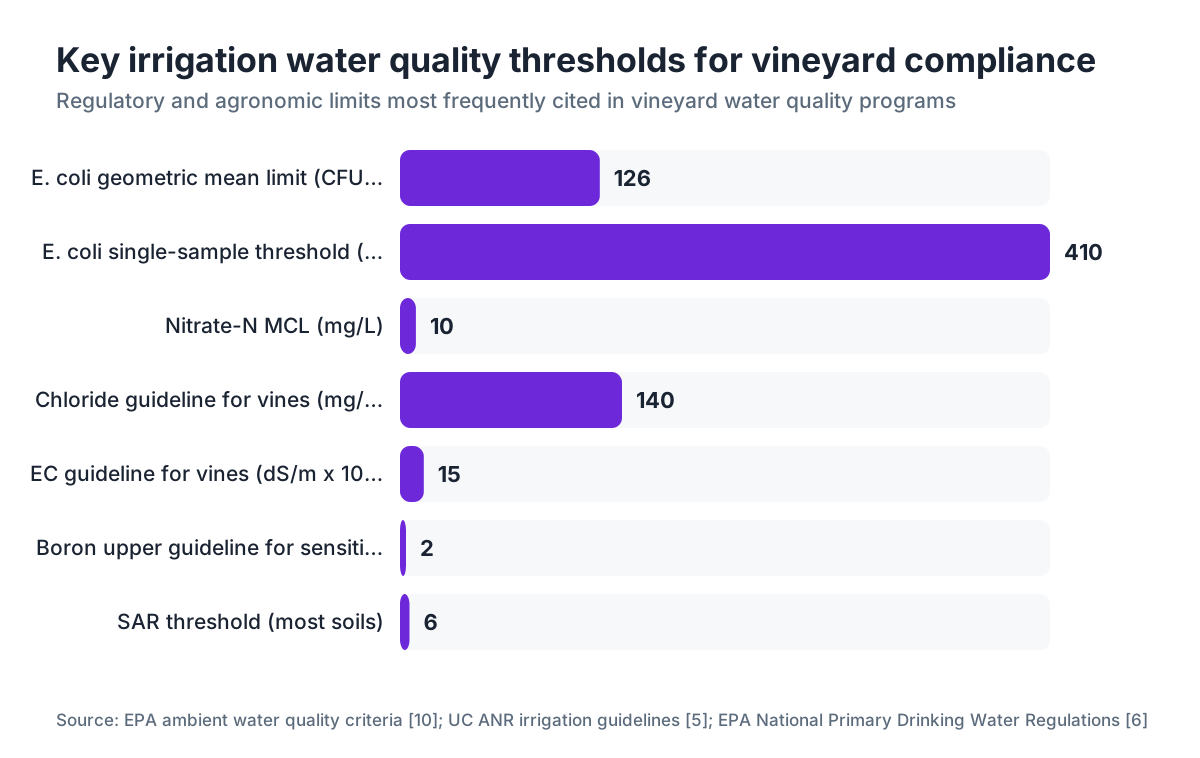
First is the federal FSMA Produce Safety Rule (21 CFR Part 112), which sets agricultural water standards for covered produce farms [1]. Wine grapes are conditionally exempt under 21 CFR 112.2(a)(1) because fermentation is treated as an adequate kill step, but the FDA has said more than once it may revisit that call. The rule sets a geometric mean of 126 CFU/100 mL E. coli and a statistical threshold value of 410 CFU/100 mL for surface water used on produce during the growing season [1]. Those numbers come straight from the EPA's 1986 recreational water criteria, the baseline most states still reference.
Second is the EPA Worker Protection Standard for agricultural pesticides (40 CFR Part 170). It doesn't regulate irrigation water quality directly, but a lot of spray goes out through irrigation delivery lines, and mixing pesticide into water that already carries contaminants can change efficacy and create runoff liability [2]. State pesticide records and water records live in the same compliance file for a reason.
Third, and most demanding day to day, are state recycled water permits for vineyards drawing treated municipal effluent or managed aquifer recharge. California's State Water Resources Control Board requires permitted agricultural recycled water users to test monthly or quarterly depending on treatment classification, under Title 22 of the California Code of Regulations [3]. Washington's Department of Health and Department of Ecology run parallel frameworks under WAC 246-272C [4]. Oregon's DEQ administers similar rules under OAR 340-055.
FSMA also includes a microbial die-off and removal calculation, the time and application interval adjustment, that lets covered farms cut testing frequency. Wine grape growers should still understand it, because some multi-crop operations fall partly under FSMA coverage.
What parameters should vineyards actually test for?
It depends on your water source. But there's a practical baseline that covers most regulatory and agronomic angles, and it isn't long.
Microbial indicators top the regulatory list. Generic E. coli is the standard indicator organism under FSMA and most state programs. Total coliform is a broader screen. Fecal coliform is an older metric still named in some state permits. On recycled water, your permit may add total suspended solids, turbidity, and sometimes enteric viruses or Cryptosporidium depending on the treatment tier.
Agronomic parameters matter for vine health, not compliance, but they belong in your file because they document due diligence if a crop problem shows up later. pH (target 6.5 to 8.0 for most irrigation), electrical conductivity (below 1.5 dS/m is a common target for vines), sodium adsorption ratio (under 6 for most soils), chloride (below 140 mg/L is a common guideline), boron (above 1 to 2 mg/L starts scorching leaves), bicarbonate, and calcium are the main ones. UC ANR's irrigation water quality guidelines lay out acceptable ranges for each [5].
Heavy metals and nitrates come into play if you pull recycled water or sit in an area with a heavy fertilizer history. Nitrate-nitrogen above 10 mg/L crosses the EPA drinking water standard and shows up regularly in Central Valley groundwater. Lead, arsenic, and cadmium have EPA maximum contaminant levels for drinking water that also work as agricultural benchmarks [6].
Biological and chemical oxygen demand show up in recycled water permits and matter near a treated effluent source.
Here's a working summary:
| Parameter | Threshold / Target | Regulatory Driver |
|---|---|---|
| Generic E. coli (surface water) | ≤126 CFU/100 mL GM; ≤410 CFU/100 mL STV | FSMA PSR [1] |
| Generic E. coli (recycled water) | Varies by treatment tier; often non-detect | State recycled water permits [3] |
| Nitrate-N | ≤10 mg/L (drinking water MCL) | EPA / State groundwater rules [6] |
| Electrical conductivity | ≤1.5 dS/m for vines (guideline) | UC ANR agronomic guidance [5] |
| Boron | ≤1-2 mg/L for sensitive varieties | UC ANR agronomic guidance [5] |
| SAR | ≤6 (most soils) | UC ANR agronomic guidance [5] |
| pH | 6.5-8.0 | General agronomic practice |
| Chloride | ≤140 mg/L | UC ANR agronomic guidance [5] |
How often do you need to test irrigation water?
Frequency rides on source type and which framework covers you, so there's no single number. The FSMA Produce Safety Rule for covered produce (not wine grapes, but useful as a model) required a minimum of five surface water samples per growing season in year one, taken at least 20 days apart, then let farms move to a rolling microbial water quality profile in later years [1]. The FDA revised and extended these timelines repeatedly from 2018 through 2024, so check the current FDA guidance for the enforcement schedule that applies now.
Recycled water users in California typically test monthly for disinfection performance and quarterly for metals and organics, though your permit may say something else. Your permit is the controlling document. Read it, don't guess at it.
Groundwater wells with no permit attached carry no mandatory testing frequency in most states. WSU Extension and UC ANR both recommend annual testing for the agronomic panel and at least one microbial test per season if you irrigate while fruit is on the vine [5][7]. That recommendation has no enforcement teeth unless a county or water district adds a local rule, but it's defensible due diligence.
What most seasoned vineyard managers actually do: test before first irrigation, test once mid-season on surface water, and test again after any upstream shock like flooding or a manure application next door. Three samples a year won't satisfy FSMA if you're a covered farm, but it builds a workable baseline.
How long do you have to keep irrigation water testing records?
Two years is the federal floor. Five years is what you should actually keep. That gap is where small operations get caught short.
The FSMA Produce Safety Rule requires covered farms to keep agricultural water quality records at least two years [1]. The rule also says you must hold onto testing data for as long as you're using it in a rolling calculation, which can push practical retention to five years or more if you run the multi-year microbial profile.
California recycled water permit holders typically face five-year retention under State Water Board general orders. Washington's Department of Health specifies three years for most reclaimed water users [4].
So keep everything five years. Digital storage costs nothing, and a five-year file answers almost every question you'll face from the FDA, a state agency, or a buyer's food-safety auditor. Paper files work but they burn, flood, and disappear the way field paperwork does. Scan and back up.
Date every record to the sampling date, not the result date. The sample date drives compliance calculations, not the lab report date. Routine microbial panels come back in three to five business days from most certified labs; metals can run seven to ten. Build your sampling calendar around that lag or you'll miss windows you didn't know were closing.
Who can perform the tests and what labs are acceptable?
For compliance, samples go to a state-certified laboratory. In California that's an Environmental Laboratory Accreditation Program (ELAP) certified lab [8]. Washington requires DOH-certified labs under its drinking and reclaimed water programs [4]. Oregon, New York, and most other states run equivalent programs tied to the EPA's NELAP framework.
You cannot self-certify microbial results for compliance with an on-farm test kit. Strip tests make a fine quick screen before you send samples off, but they don't replace the certified result in your file.
Collection method matters as much as the lab. For E. coli you typically need a sterile bottle with sodium thiosulfate (it neutralizes chlorine), pulled from a running flow point like the end of a drip zone or a pivot riser, and delivered to the lab within about 30 hours. The lab gives you exact instructions. Follow them to the letter, because sloppy collection is the single most common reason a result gets flagged invalid.
Field duplicates and chain of custody forms sound like paperwork for its own sake. They aren't. If a result comes back high and you want to argue the spike was an anomaly, the chain of custody is what proves the sample wasn't contaminated between the field and the bench. Cornell Cooperative Extension's food and agriculture program has one of the cleaner walkthroughs of proper collection protocol [9].
What should a vineyard irrigation water quality record actually contain?
A defensible record has six pieces: the sampling date and time, the sample location named clearly (well ID, GPS coordinate, or irrigation zone), the sampling method and collector's name, the chain of custody form, the certified lab report with the lab's accreditation number, and your written response if any result crossed a threshold.
That last piece is the one people skip. Say a result comes back at 200 CFU/100 mL generic E. coli against a 126 threshold. What did you do about it? Write it down, even if the answer is "re-tested two weeks later, result was 43 CFU/100 mL, likely tied to upstream runoff after the rainstorm on [date]." That note turns a scary data point into a managed situation instead of an open violation waiting for an auditor.
Organize by source, not by date. Three wells and a surface diversion means four folders. When an auditor asks about Well 2, you pull one file instead of sorting three years of mixed reports.
Some managers run a simple spreadsheet as a sampling log that cross-references the physical lab reports. VitiScribe is built for this kind of field record, letting you attach lab reports to sampling events with date and GPS location locked in. Software or a tidy filing cabinet, either works. The index matters as much as the records it points to.
What are the consequences of missing or incomplete water testing records?
The penalty depends on which framework covers you, and they range from a public embarrassment to a denied insurance claim.
For FSMA-covered produce operations, missing records is a prohibited act under 21 U.S.C. 331. The FDA can issue a warning letter, seek an injunction, or pursue civil penalties. Through 2024 the agency had brought relatively few formal actions against small produce farms over water record gaps, but its enforcement posture has tightened. Warning letters are public, and they cost you buyer relationships even when no fine lands.
For recycled water permit holders, gaps can trigger a notice of violation from your state water board, permit suspension, or a mandatory corrective action plan. California's enforcement actions for agricultural recycled water violations are public and searchable in the State Water Board's enforcement records.
For groundwater or surface water with no permit attached, the damage is mostly indirect. You lose the ability to defend yourself against a contamination claim, you fail buyer food-safety audits, and you may draw scrutiny under a county wellhead protection program.
Crop insurance claims can be denied if water quality records are incomplete and the insurer believes contaminated irrigation contributed to the loss. That angle gets little attention until a drought year pushes a marginal water source into service and the claim adjuster starts asking for records you never kept.
How do vineyard irrigation water records fit into a broader compliance program?
Water records don't live alone. They connect to your pesticide application records (what was in the tank when you ran it through that drip line?), your soil health records (sodium from irrigation shows in soil tests before it shows in vine symptoms), and your food-safety plan if you have one.
WSU Extension's irrigation guides recommend pairing water quality data with irrigation scheduling records so you can track EC trends against soil EC over time [7]. That linked record tells a story. If EC creeps up in well water while soil EC rises in the root zone, you have a salinity problem building. The records catch it years before the vines do.
If you farm inside a groundwater sustainability agency boundary in California (most San Joaquin Valley and many coastal growers do under SGMA), your irrigation records may need to feed the GSA's data management system. Sustainable groundwater plans increasingly ask agricultural users to document water quality alongside quantity, and that reporting burden only grows [12].
For the wider picture of how field operations and compliance records tie together on a working vineyard, water testing is one column in a matrix that also holds pest management records, equipment calibration logs, and worker safety documentation. The principle repeats across all of them: date it, source it, respond to anomalies in writing, keep it five years.
What are the specific rules for recycled or reclaimed water use in vineyards?
Recycled water use is growing across California, Arizona, and parts of the Pacific Northwest as surface water gets less reliable. It comes with a heavier compliance structure than groundwater or a surface diversion.
California sorts recycled water by treatment level. Title 22 defines several categories; for food crops where water touches the edible portion, you need Disinfected Tertiary Recycled Water (oxidized, coagulated, filtered, disinfected). Wine grapes, because the regulatory edible portion is effectively removed or processed, can often run on a lower tier, but that depends on your Regional Water Quality Control Board's conditions and your specific permit. Don't assume. Read the permit language and confirm with your regional board.
The California State Water Board's recycled water program pages and fact sheets explain the tiered system clearly [3]. Oregon's DEQ and Washington's DOH run analogous tier structures. In every case the permit controls, and testing frequency, parameters, and reporting requirements are spelled out in it.
One practical hazard: treatment plants have upsets. A bypass event or a disinfection failure can send off-spec water into your system before anyone catches it. Your file needs the treatment facility's monitoring reports, not only your own end-point samples. Most permits require the facility to notify you of bypass events. Writing a documented protocol for what you do when that notice arrives (stop irrigation, collect a sample, record the decision) is worth the hour it takes.
How do you set up a water testing schedule and record-keeping system that actually works?
Start with a map. List every irrigation source: each well with its ID and GPS, each surface diversion with its point of diversion, each recycled water connection. Give each one a label you'll use the same way across every record.
Then pull every permit condition and regulatory requirement that touches each source. Most operations have two or three frameworks landing on different sources, and each carries a different schedule. Build a calendar, not a sticky note. Put sample collection dates in a shared calendar that pings you two weeks out, so you have time to get sterile bottles from your lab supply before the date arrives.
Decide where results live before the first report comes in. A shared folder in Google Drive or similar, sorted by source, year, and parameter type, works fine for most small operations. Larger operations or those juggling multiple certifications may want dedicated software. If you already run VitiScribe for spray records and field operations, the same platform can anchor the water quality file.
Review results against thresholds the day they land, not on a quarterly cycle. Wait three months to check a high microbial result and you may have irrigated straight through a problem while losing the window to document a fast response. Same-day review plus a written note takes five minutes.
Train whoever collects the samples. Bad technique is the most common cause of junk results and the most preventable. UC ANR's farm advisor publications carry practical field-level guidance on collecting agricultural water samples [5]. Print it, laminate it, leave it in the cab of the truck that goes out to sample.
Frequently asked questions
Are wine grape vineyards exempt from FSMA Produce Safety Rule water testing requirements?
Generally yes, because fermentation counts as a kill step under 21 CFR 112.2(a)(1). But the exemption only holds if you grow exclusively wine grapes destined for an alcoholic beverage manufacturer. Mixed operations with table grapes, raisins, or other covered produce on the same property can lose the exemption for the entire water system. Confirm your classification with an agricultural attorney or your state department of agriculture before skipping any testing.
What E. coli level is considered safe for irrigation water used on or near crops?
The FSMA Produce Safety Rule uses a geometric mean of 126 CFU/100 mL and a single-sample statistical threshold value of 410 CFU/100 mL for surface water on covered produce. Those numbers trace to EPA's 1986 water quality criteria. Some state programs run stricter, especially for recycled water. For groundwater wells on non-covered crops like wine grapes there's no federal numeric standard, but the 126 CFU/100 mL benchmark is a widely used reference point.
How long must vineyard water quality records be kept?
FSMA requires at least two years for covered farms, though rolling-average calculations can push practical retention to five years or more. California recycled water permits typically require five years. Washington's Department of Health specifies three years for most reclaimed water users. The safest practice is keeping all irrigation water quality records five years minimum, stored so they're retrievable on short notice during an inspection.
Do I need a certified lab to test irrigation water, or can I use an on-farm test kit?
For compliance you need a state-certified lab. California requires ELAP certification, Washington requires DOH certification, and most other states follow the EPA's NELAP framework. On-farm strips and portable meters screen for gross problems and help with real-time EC and pH monitoring, but their results can't stand in for a certified lab result in your compliance file. Get the certified report even when you're also screening in the field.
What should I test well water for in a vineyard setting?
At minimum: generic E. coli for microbial safety, nitrate-nitrogen (shallow wells in ag areas can approach the 10 mg/L MCL), pH, electrical conductivity, sodium adsorption ratio, chloride, and boron. If your area carries heavy metal concerns from mining or industrial history, add arsenic and lead. UC ANR recommends annual testing for the full agronomic panel plus at least one microbial test per irrigation season.
What happens if my irrigation water test comes back with results above the threshold?
Stop using that source for any application where water contacts harvestable crop parts, collect a confirmation sample immediately, notify your permit authority if required (recycled water permits often set 24 to 48 hour reporting windows), investigate the likely cause, and document all of it in writing. A single high result with a documented investigation and a clean follow-up is manageable. An undocumented high result that surfaces in an audit is a much bigger problem.
Does irrigation water quality affect pesticide record compliance?
Not directly under the Worker Protection Standard or FIFRA labeling law, but indirectly, yes. Mixing pesticide with high-mineral water from a drip system can shift mix chemistry and touch label compliance, since some labels set pH ranges for tank mixes. High-sodium irrigation water interacting with certain herbicide applications has raised label questions in California. Water quality records give you documentation if a pesticide efficacy or runoff question comes up.
How do SGMA groundwater sustainability plans affect vineyard water quality record-keeping in California?
Most California vineyards in medium- and high-priority basins now operate inside a Groundwater Sustainability Agency boundary under SGMA. GSA plans increasingly require agricultural users to report water quality data alongside pumping volumes. The specifics depend on your local GSA's adopted plan, usually posted on the agency's website. The data you already collect for agronomic and compliance purposes generally satisfies most GSA water quality reporting fields.
Can I use a single water test to cover multiple irrigation zones on the same vineyard?
Only if all zones draw from the same source and the sample comes from a point representative of what reaches the field, usually the end of the distribution line rather than the wellhead or pump discharge. If different blocks pull from different wells or diversion points, each source needs its own sample. FSMA and most state permit frameworks treat each water source as a distinct sampling unit. Combining sources leaves a gap an auditor will spot.
What's the difference between total coliform and generic E. coli for compliance purposes?
Total coliform is a broad bacterial group that includes organisms from soil, plants, and animal waste. It's a general contamination indicator, not specific to fecal contamination. Generic E. coli is a subset that specifically indicates fecal contamination and is the standard indicator under FSMA and most modern water quality programs. Older state permits may reference total or fecal coliform. When unsure, test all three and use whichever metric your permit or program requires.
How do I document an irrigation system change that affects my water testing locations?
Update your source map right away with the new sampling point location, GPS coordinate, and the date the change took effect. Add a note in your file explaining the change and why the new sample location represents water quality reaching the field. If you're under a recycled water permit, notify your permit authority before making significant changes to distribution infrastructure, because some permits require approval for system modifications.
What is the sodium adsorption ratio (SAR) and why does it matter for vineyard irrigation records?
SAR measures the ratio of sodium to calcium and magnesium in water. High-SAR water degrades soil structure by displacing calcium and magnesium on soil particles, causing compaction and reduced infiltration that eventually starves vine roots of water and nutrients. UC ANR treats SAR above 6 as potentially problematic for most vineyard soils. Tracking SAR alongside soil EC data lets you catch sodium accumulation before it becomes a field-visible problem.
Are there federal resources or templates for vineyard irrigation water testing records?
The FDA publishes FSMA agricultural water guidance with sample log templates on its website. The EPA's water quality criteria pages reference the 1986 ambient criteria document. UC ANR, Cornell Cooperative Extension, and WSU Extension all offer free factsheets and record-keeping templates for agricultural water quality. State departments of agriculture in California, Washington, and Oregon have published grower compliance guides under their specific frameworks.
Sources
- EPA, Agricultural Worker Protection Standard (40 CFR Part 170): EPA Worker Protection Standard governs pesticide applications in agricultural settings and intersects with irrigation system use for pesticide delivery
- California State Water Resources Control Board, Recycled Water program: California Title 22 classifies recycled water by treatment tier; agricultural recycled water users face monthly or quarterly testing requirements and multi-year record retention under State Water Board general orders
- Washington State Department of Health: Washington Department of Health specifies certified lab requirements and three-year record retention for reclaimed water users under WAC 246-272C
- UC Agriculture and Natural Resources (UC ANR), irrigation water quality guidelines: UC ANR recommends EC below 1.5 dS/m, SAR below 6, chloride below 140 mg/L, and boron below 1-2 mg/L for vineyard irrigation; annual testing recommended for agronomic panel
- EPA, National Primary Drinking Water Regulations: EPA maximum contaminant level for nitrate-nitrogen is 10 mg/L; MCLs for lead, arsenic, and cadmium referenced as agricultural water quality benchmarks
- Washington State University Extension: WSU Extension recommends integrating irrigation water quality data with scheduling records to track EC trends; advises at least one microbial test per season when water contacts fruit
- Cornell Cooperative Extension, food and agriculture programs: Cornell Cooperative Extension provides guidance on proper sample collection protocol including sterile bottle use with sodium thiosulfate and 30-hour delivery window for E. coli samples
- EPA, Water Quality Criteria (recreational and ambient bacteria criteria): EPA's 1986 ambient water quality criteria established the 126 CFU/100 mL geometric mean and 410 CFU/100 mL single-sample threshold values later adopted by FSMA
- California Department of Water Resources, Sustainable Groundwater Management Act (SGMA): SGMA requires groundwater sustainability agencies in medium- and high-priority basins to track water quality alongside water quantity; agricultural users in GSA boundaries increasingly face water quality reporting requirements
Last updated 2026-07-10