How to document pesticide safety training in a language other than English
TL;DR
- The EPA Worker Protection Standard (40 CFR Part 170) requires pesticide safety training in a language the worker understands.
- Your record must show the language used, the trainer's name and qualifications, the date, the establishment, and each worker's name.
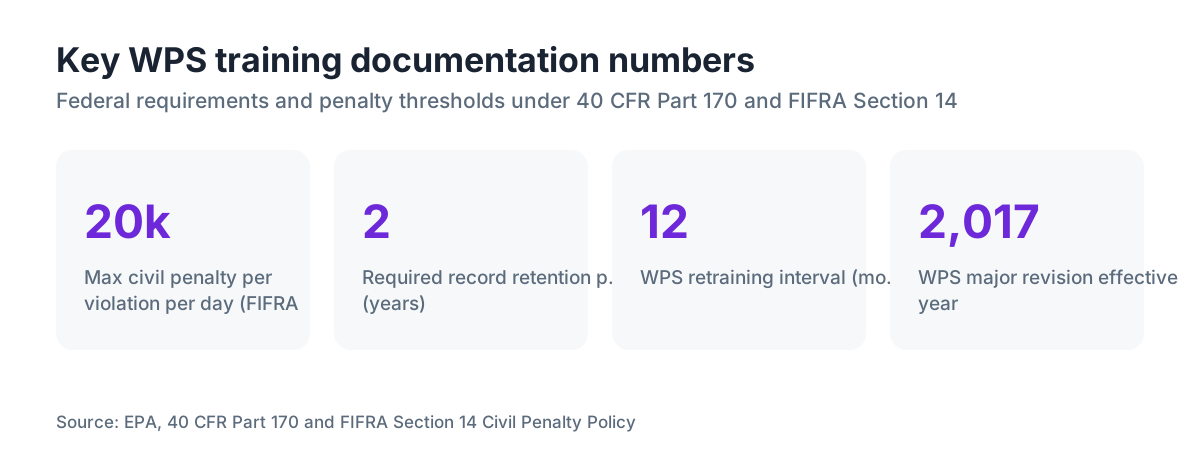
- Missing records can trigger FIFRA penalties up to $19,507 per violation.
- Free EPA materials exist in Spanish; other languages need a documented interpreter.
What does the EPA Worker Protection Standard actually require for training documentation?
The Worker Protection Standard requires that every agricultural worker and pesticide handler get WPS safety training before working in treated areas, and that training has to happen in a language the person actually understands. The rule lives at 40 CFR Part 170. Congress and the EPA rewrote it in 2015, and the new version took full effect January 2, 2017 [1].
Read the regulation carefully. It says training must be given "in a manner the agricultural worker or handler can understand" [1]. That phrase does a lot of work. Train a Spanish-only speaker in English and, legally, the training never happened. The worker's attendance does not fix it.
40 CFR 170.130(c) lists what each written record must contain: the establishment name, the worker or handler's name, the date, the trainer's name, evidence the trainer met the qualifications, and the name or identifier of the WPS-approved materials used [1]. There is no federal box on the form labeled "language of training." But because the underlying rule demands comprehension, language is baked in. Auditors and state lead agencies increasingly want it written down, and adding it costs you nothing.
The EPA's revised model Pesticide Safety Training Record, put out in 2018, includes a "language of training" field. Use that version and fill it in.
Which languages are officially supported by EPA-approved WPS training materials?
Spanish is the only language with a full, EPA-approved WPS curriculum ready to hand. The agency's "Protect Yourself from Pesticides: Guide for Agricultural Workers" comes in Spanish, and the train-the-trainer materials do too [2]. Everything else gets thinner fast.
Haitian Creole materials exist through state programs, mostly in Florida. A few Southeast Asian translations have come out of university extension offices. That is roughly where federal-grade support ends.
The University of California Cooperative Extension and UC Davis have produced Spanish WPS aids and fact sheets for years [3]. Washington State University Extension has done the same for the Pacific Northwest, with attention to the Central American Spanish dialects common in that workforce [4]. Cornell Cooperative Extension publishes resources aimed at the northeastern labor pool [5].
Here is the hard part. If your crew speaks Mixtec, Zapotec, Triqui, or another indigenous Mexican language, Spanish materials may not reach them at all. Many indigenous speakers understand little formal Spanish. In those cases the EPA expects you to run the training through a bilingual interpreter, record that interpreter's name and language pair, and note that you delivered the content orally through interpretation alongside the written Spanish materials.
Here is where to find translated materials by language:
| Language | Source | Notes |
|---|---|---|
| Spanish | EPA, UC Davis, WSU Extension | Full WPS curriculum available |
| Haitian Creole | Florida Dept. of Agriculture | Partial; check current availability |
| Mixtec / Zapotec | No federal materials | Use interpreter; document in record |
| Thai / Hmong | No federal materials | Use interpreter; document in record |
| Portuguese | Some state programs | Check your state lead agency |
What goes in the training record when training is delivered through an interpreter?
When you train through an interpreter, your record grows a few extra lines: the interpreter's full name, the language pair (say, English to Mixteco Bajo), a statement that this person interpreted live during the session, and the interpreter's signature if you can get one. The federal text does not spell all of this out. It shows good faith and gives you evidence if an inspector ever asks whether the worker actually understood.
Using an interpreter is legitimate. Sometimes it is the only honest option when no approved written materials exist in a worker's language.
The EPA's WPS guidance tells employers to document "the method used to ensure worker comprehension" when training happens in a language other than English [2]. A signed line from the interpreter is the cleanest way to meet that.
The interpreter does not need to be a certified translator. A bilingual coworker, a family member, or a community organization representative can do it. What matters is that the person genuinely speaks the worker's language, more than a cousin of it. Someone fluent in formal Mexican Spanish may not reach a monolingual Triqui speaker. Write down the specific language. "Indigenous language" on a form tells an inspector nothing.
One habit worth keeping: read the approved materials aloud in the source language, section by section, and let the interpreter carry each section over. That ties the training to the real WPS content instead of letting it drift into the interpreter's loose summary. Note in the record that you used this verbatim, section-by-section approach.
What form should you use, and how do you fill in the language field?
Use the EPA model Pesticide Safety Training Record from EPA.gov unless your state hands you its own required form [2]. Some states mandate their version, so call your state department of agriculture before you default to the federal one.
The language field on the EPA model form reads "Language Used for Training." Put the specific language there, not a broad bucket. Write "Spanish (Mexican)" rather than a bare "Spanish" if precision helps you. For interpreted training, write the target language ("Mixteco Bajo / Mixtec") and add a comment naming the interpreter.
Every line matters. State inspectors have treated incomplete forms as compliance failures even when the training genuinely happened. If a worker cannot read, you do not need a signature. Note "worker is not literate" and get a witness signature instead.
Keep completed records at least two years past the training date. The WPS requires records be available for inspection by workers, their designated representatives, and government officials [1]. If a worker later reports a pesticide exposure and claims they were never trained properly, that record is your first line of defense.
Vineyards juggling several crews, several languages, and dozens of spray events benefit from a digital system. VitiScribe is built for vineyard compliance paperwork and lets you tag training records by language, crew, and trainer, which turns end-of-season audit prep into an afternoon instead of a week.
Do state requirements go beyond the federal WPS minimum?
Yes, and often by a lot. The WPS is a federal floor. States pile requirements on top of it. California is the sharpest example. Under California Code of Regulations Title 3, employers must provide written materials in the worker's primary language when such materials exist, and verbal training must be in that primary language too [6]. The Department of Pesticide Regulation produces approved materials in Spanish and other languages and pushes hard on bilingual training during farm labor contractor audits.
Washington State requires a written summary of pesticide label information in the worker's language for any product they handle [4]. Oregon layers similar language-access rules on top of the federal standard.
Florida's Department of Agriculture and Consumer Services runs its own WPS training program with Haitian Creole materials, which matches the state's workforce [7].
Call your state lead agency to get the exact rules. The EPA keeps a list of every state lead agency on its worker safety page [10]. Extension programs at UC Davis [3], WSU [4], and Cornell [5] also publish state-specific compliance guides that tend to stay more current than the agency websites.
Do not assume federal compliance covers your state. A California vineyard that trains a Spanish-speaking crew in English only is exposed, even when the federal paperwork looks spotless.
What are the penalties for inadequate or missing training documentation?
The EPA can assess civil penalties up to $19,507 per violation per day under FIFRA Section 14 [8]. That number adjusts for inflation and gets republished in the Federal Register, so check the current figure. State penalties stack on top, which means a California vineyard can eat both a CDPR fine and an EPA fine for the same broken record.
Reality is usually milder than the ceiling. First-time administrative violations with no worker injury tend to land in the $500 to $5,000 range per violation under EPA penalty policy [8]. Add a worker illness or a repeat offense and the number climbs toward the statutory maximum fast.
Fines are only part of it. A documentation gap becomes evidence of negligence in a lawsuit. If a worker claims a pesticide injury and you cannot show they got comprehensible training, that missing record works against you. Your crop insurance and general liability coverage may exclude losses tied to a documented compliance failure.
Farm labor contractor licensing boards audit WPS records too. Losing a contractor license shuts down operations in a way no single fine captures.
The math is not close. Translating and documenting training costs pennies against a single-day penalty, and almost nothing against litigation.
How do you verify that a trainer is qualified to conduct WPS training in another language?
A qualified WPS trainer must be a certified applicator, a person who has finished an EPA-approved train-the-trainer program, or a state, tribal, or federal employee who completed an equivalent program. That comes straight from 40 CFR 170.130(c) [1]. Language ability is a separate question the rule does not certify.
A certified applicator who is a native Spanish speaker covers both bases at once. A certified applicator who speaks only English has two choices: train through a documented interpreter, or bring in a qualified bilingual trainer.
There is no "Spanish WPS trainer certificate." The EPA's training certification is not language-specific. What counts is that the trainer meets the qualification criteria and that the session ran in a language the workers understood.
For Spanish-language train-the-trainer sessions, UC Davis Cooperative Extension has offered courses in the past [3], and some state agriculture departments run bilingual versions. Check your state lead agency and your local extension office for what is currently scheduled.
Write the trainer's name and qualification evidence on every record. "Certified Applicator" plus a license number is the cleanest entry. If the trainer qualified through a train-the-trainer course, note the course name, the sponsoring organization, and the completion date.
Can electronic records satisfy the WPS documentation requirement?
Yes. The WPS never bans electronic records. It requires that records be maintained and available for inspection [1]. The EPA leans permissive on electronic recordkeeping, but your state may take a firmer line. California, for one, has its own electronic recordkeeping rules under CDPR covering pesticide use records; training records sit in a separate category, but the agency's technology standards tell you what it expects [6].
If you go electronic, you need to hand an inspector something legible and organized on the spot. Nobody arriving at your gate should need a login or your software to read your records. A printed PDF is the working standard.
For multi-language crews, a system that tags each record with the training language, the trainer, and the interpreter (if any) earns its keep. Pulling up "all workers trained in Spanish, season 2024" takes seconds instead of an hour in a filing cabinet. That is the exact job VitiScribe was built to handle for vineyards.
Electronic signatures work in most contexts, but check your state. A few states require wet signatures on training records specifically. A sensible middle path: keep your operational records digital, collect paper signatures at the session itself, then scan the signed sheet and attach it to the electronic record.
What translated materials are available for free, and where do you get them?
Start at the EPA. Its worker safety page links to free training materials in English and Spanish [2]. The "Protect Yourself from Pesticides" worker guide and the companion handler guide both download as free PDFs. The agency also publishes a WPS safety poster in several languages; those cover the central-posting requirement and double as teaching aids.
The National Pesticide Information Center, run by Oregon State University, is a solid second stop for Spanish-language pesticide safety materials [9]. Its staff answer questions about specific pesticides in Spanish by phone.
UC Davis Cooperative Extension has produced Spanish WPS fact sheets and posts them through its online catalog [3]. WSU Extension publishes bilingual pest management materials through its publications portal [4].
Farm worker advocacy groups have made their own aids. Some organizations carry materials in indigenous Mexican and Central American languages. These are usually not EPA-approved as standalone training, but they work well as supplements alongside approved English or Spanish materials.
When no materials exist in a worker's language, the EPA points you to your state lead agency, which sometimes holds resources the federal site never lists. The state can also confirm whether a specific translated document counts as WPS-approved training material where you operate.
How should you handle literacy barriers on top of language barriers?
Language and literacy are two different problems. A worker can speak Spanish fluently and read none of it. The WPS accounts for this: training is allowed to be entirely oral, and written materials are aids, not requirements. The rule demands comprehensible training, not written comprehension.
With low-literacy workers, run the whole session out loud. Walk through the content of the approved written materials verbally, leaning on pictures and diagrams. The EPA's WPS poster and the illustrated pages of the worker guide were partly built for exactly this.
On the record, write "verbal training delivered due to literacy limitation." If the worker cannot sign their own name, have a witness (the trainer, a bilingual coworker) sign alongside them. A thumbprint in place of a signature is legally accepted in most states for agricultural documents. Confirm your state's rule.
A non-English speaker who also cannot read in any language is the toughest case. Your documentation here: interpreter name, language pair, a note that training was oral, a note about literacy, and a witness signature. Keep that record for the full two-year minimum.
UC Davis's Small Farm Program has published guidance on agricultural safety with low-literacy populations [3]. Read it before your first season with a crew in this situation.
What does a complete, audit-ready training record look like?
A complete WPS record for a Spanish-language session at a California vineyard reads like this:
Agricultural establishment name: [Vineyard name, county, state]
Worker name: [Full name]
Date of training: [MM/DD/YYYY]
Trainer name: [Full name]
Trainer qualification: Certified Commercial Applicator, License No. [XXXX], State of California
Training materials used: "Protect Yourself from Pesticides: Guide for Agricultural Workers," EPA, 2018 edition (Spanish version)
Language of training: Spanish
Worker signature: [Signature or note if unable to sign]
For an interpreted session in an indigenous language, add:
Interpreter name: [Full name]
Interpreted language: Triqui (Bajo)
Interpreter signature: [Signature]
Note: Training conducted in Spanish using EPA-approved materials with simultaneous oral interpretation into Triqui (Bajo).
Store a copy of the materials you used with the records, or note the exact edition or URL so an inspector can pull the same document. If you added a custom slideshow or handout, keep that too. Do not lean on "we always use the EPA guide" as a spoken claim during an inspection. Have the document in your hand.
Audit-ready means a stranger who knows nothing about your operation can open your file and answer four questions in five minutes: who was trained, on what date, in what language, and by whom. Answer those cleanly and you are in good shape.
Frequently asked questions
Does the EPA require training records to be kept in any particular language?
No. The EPA does not require the record itself to be in any specific language. The record is an administrative document for the employer and inspector. What the WPS requires is that the training session ran in a language the worker understood. Your record should note which language you used. English-language records documenting a Spanish-language session are fully acceptable.
How long do I have to keep pesticide safety training records?
At least two years from the training date under the WPS. Some states want longer. California's CDPR ties pesticide records to enforcement timelines that can push best-practice retention to three years. Keep the records accessible rather than boxed off-site, because inspectors can ask for them during any farm visit without notice.
Can a bilingual worker serve as the interpreter during WPS training?
Yes. The WPS does not require a professional or certified interpreter. A bilingual coworker, supervisor, or family member can interpret during training. Document their full name, the language pair they interpreted, and get their signature on the record if you can. The one thing that matters is that the interpreter speaks the worker's primary language well enough to carry technical pesticide safety information accurately.
Are there WPS training materials available in Spanish that are already EPA-approved?
Yes. The EPA's "Protect Yourself from Pesticides: Guide for Agricultural Workers" comes in Spanish and is approved for WPS training. Download it free from EPA.gov. The companion handler guide is also in Spanish. UC Davis and WSU Extension have produced supplementary Spanish materials, but confirm with your state lead agency whether supplementary items alone meet your state's requirement.
What happens if a worker who speaks an indigenous language cannot understand Spanish materials?
You use an interpreter. Train through an interpreter in the worker's specific language, document the interpreter's name and the language pair, and note that you delivered the training orally through interpretation. The EPA's WPS guidance anticipates this and treats it as compliant when documented properly. Contact your state lead agency for any state-specific requirements on top of the federal minimum.
Do I need a separate training record for each worker, or can one record cover a group?
A group record listing everyone at a single session works, as long as the session ran in a language all listed workers understood. If you trained some workers in Spanish and others in English during the same period, they need separate records showing the language used. Mixing languages in one session and logging it as a single record creates ambiguity that an auditor will flag.
Does a worker who already holds a pesticide applicator license still need WPS training?
Certified applicators are generally exempt from worker-level WPS training while acting as applicators. If a certified applicator also does field tasks as an agricultural worker in treated areas, the training requirements can apply depending on the situation. Check 40 CFR 170.130 and your state's rules. Most California vineyards train certified applicators anyway to keep the records clean.
How often does WPS training need to be repeated?
At least once every 12 months under the 2015 revised WPS. This replaced the old "once per season" rule with a calendar-based one. Training completed anytime in the prior 12-month window counts. A worker trained in August 2024 needs retraining by August 2025, no matter when your growing season starts.
Can I use a video for WPS training in Spanish instead of a live trainer?
Video training is allowed if the video covers all required WPS content. A qualified trainer must still be present to answer questions, and the trainer's name and qualifications go on the record. An EPA-approved Spanish video with a qualified trainer present satisfies the language requirement. The trainer does not personally need to speak Spanish if the video is in Spanish and questions get handled through an interpreter.
What is the state lead agency and how do I find mine?
The state lead agency (SLA) is the state government body that administers the WPS in your state. In most farming states it is the department of agriculture. The EPA keeps a current list of all SLAs on its worker safety page. Contact yours for state-specific forms, approved material lists, and any language rules beyond the federal minimum. Many SLAs offer free compliance help before any inspection.
Is there a specific EPA form number for the WPS training record?
The EPA does not mandate a specific form number. The requirement is that your record contains the data elements listed at 40 CFR 170.130(c). Your state may require its own form. Download the current model form directly from EPA.gov's worker safety page so you are using the version with the language field added in the 2018 revision.
What if a worker refuses to sign the training record?
A refusal does not invalidate the training. Document it: write "worker declined to sign" and have the trainer and a witness sign instead. Note why the worker declined if you can. This is rare, but it happens when workers distrust paperwork for immigration-related reasons. The trainer attestation plus a witness signature is enough to show the training occurred.
Do I need to document pesticide safety training for workers paid through a farm labor contractor?
The responsibility is shared. Under the WPS the agricultural employer (the vineyard owner or operator) is ultimately responsible for making sure workers are trained. Farm labor contractors often run and document the training and must give proof to the employer. Get copies of the contractor's records for your own files. Do not assume the contractor handled it. Confirm it and keep documentation showing you confirmed.
Sources
- EPA, 40 CFR Part 170 Worker Protection Standard (2015 revision): WPS requires training 'in a manner the agricultural worker or handler can understand'; record must include worker name, date, trainer name, trainer qualifications, and training materials used; records kept two years
- EPA, Worker Protection Standard Training Materials page: EPA provides free WPS training materials in English and Spanish including 'Protect Yourself from Pesticides: Guide for Agricultural Workers'; model training record form available
- UC Cooperative Extension / UC Davis, Pesticide Safety and Worker Protection: UC Davis Cooperative Extension produces Spanish-language WPS training aids and fact sheets for agricultural workers in California
- Washington State University Extension, Pesticide Education Program: WSU Extension produces bilingual WPS and pesticide safety materials for the Pacific Northwest agricultural workforce
- Cornell University Cooperative Extension, New York State Agricultural Experiment Station: Cornell Extension publishes WPS compliance resources oriented toward northeastern U.S. agricultural labor pool
- California Department of Pesticide Regulation, Worker Health and Safety: California CCR Title 3 requires training in worker's primary language and written materials in that language when available; CDPR enforces bilingual training requirements
- Florida Department of Agriculture and Consumer Services, Pesticide Programs: Florida DACS runs WPS training certification program with Haitian Creole materials reflecting state agricultural workforce demographics
- EPA, FIFRA Section 14 Civil Penalty Policy: EPA can assess civil penalties up to $19,507 per violation per day under FIFRA Section 14 for pesticide law violations including WPS training failures
- National Pesticide Information Center (NPIC), Oregon State University: NPIC provides Spanish-language pesticide safety information and telephone assistance in Spanish for agricultural workers and employers
- EPA, State Lead Agencies for the Worker Protection Standard: EPA maintains a list of state lead agencies responsible for administering WPS at the state level
Last updated 2026-07-10