How to document annual vineyard pesticide applicator health monitoring

TL;DR
- Federal EPA Worker Protection Standard and state pesticide rules require vineyards using organophosphate or carbamate pesticides to offer applicators annual medical monitoring, including cholinesterase baseline testing.
- You keep those records for at least 30 years.
- This guide covers which workers qualify, what to document, how to store records, and how to handle a possible exposure event.
Who actually has to do this, and why does it matter for vineyards?
Not every vineyard needs a formal medical monitoring program. The trigger is your pesticide chemistry. If your operation applies organophosphate (OP) or N-methyl carbamate (NMC) pesticides, you almost certainly cross the threshold that requires annual health monitoring for applicators. In California wine country and the Pacific Northwest, common OP fungicide-season sprays like chlorpyrifos have been phased out, but many growers still use OP-based insecticides for leafhoppers or mealybugs, and carbamate choices remain on some pest management programs. Check every product you applied in the past 12 months. The signal is right there on the pesticide label under "Personal Protective Equipment" and "Agricultural Use Requirements."
The EPA Worker Protection Standard (WPS), codified at 40 CFR Part 170, sets the federal floor for worker protections on farms. [1] California's DPR overlays its own rules on top of that, and the Washington State Department of Agriculture runs a parallel system. At the federal level, the WPS does not itself mandate cholinesterase monitoring, but states that exceed federal minimums, including California, do. California Code of Regulations Title 3, Section 6728, requires agricultural employers to provide medical supervision, including baseline and periodic cholinesterase testing, for employees with "significant exposure" to OP or NMC pesticides. [2]
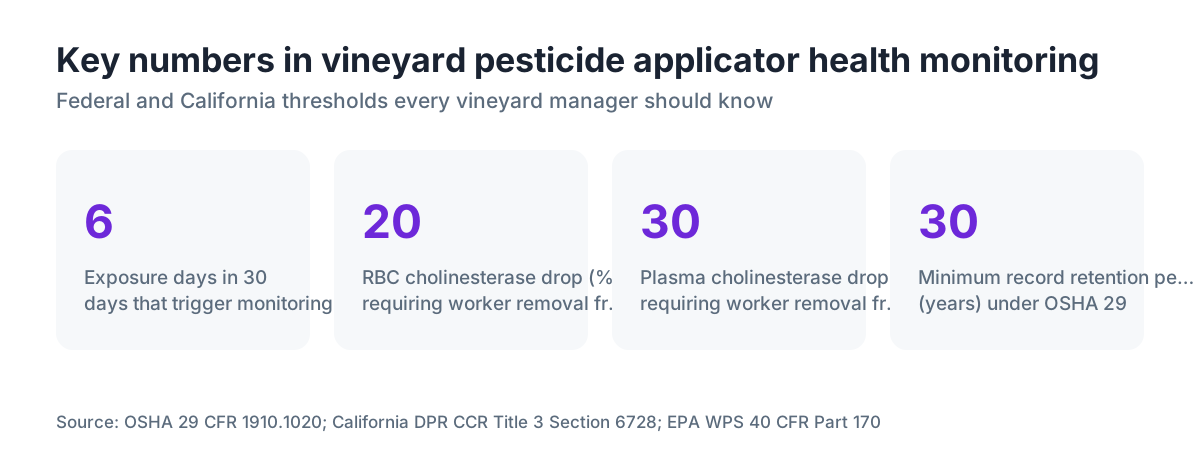
The practical threshold in California: if a worker applies, handles, or is otherwise exposed to OP or NMC pesticides on 6 or more days in a 30-day period, they have significant exposure and the employer must enroll them in a monitoring program. That number matters. Six days. Write it down somewhere visible.
For vineyards outside California, Cornell's pesticide safety program and WSU Extension both publish state-specific guidance. The underlying principle is the same everywhere: document who was exposed, document their health baseline, and keep those records long after the harvest party is forgotten. [3][4]
What is cholinesterase testing and why do vineyards use it as the baseline measure?
Organophosphate and carbamate pesticides work by inhibiting the enzyme cholinesterase in the nervous systems of insects. The problem is they do the same thing in humans. Cholinesterase inhibition builds across a season, so a worker might spray several times, feel fine after each application, and still have enzyme activity sliding toward a dangerous threshold with no obvious symptoms.
A blood cholinesterase test measures two things: red blood cell (RBC) cholinesterase and plasma cholinesterase. RBC cholinesterase is the more reliable indicator of OP exposure effects, but both values are typically recorded. The baseline test, which must be taken before any pesticide exposure in a season, gives you the individual's personal normal. "Baseline" is not a population average. Each person's normal is different, sometimes by 50 percent or more between individuals, so comparing against a lab reference range alone is not enough. [5]
California DPR's guidance says a worker should not return to work with significant OP/NMC exposure if their cholinesterase activity has dropped 20 percent or more below their personal baseline for RBC cholinesterase, or 30 percent or more for plasma. Those are the intervention numbers. [2]
The test itself is a simple blood draw, done at a clinic or a mobile occupational health service. Many larger vineyard operations in Napa, Sonoma, and the Central Valley run mobile clinic days at the start of spray season to test the whole crew at once. The cost runs roughly $40 to $150 per test depending on the lab and whether a physician review is bundled in. Pricing varies, so get quotes from local occupational health providers directly.
What records do you need to create before the spray season starts?
Before your first OP or NMC application goes out, you need three things documented and ready.
First, a list of every employee who will handle these pesticides or work in treated areas within a restricted-entry interval (REI). Include full legal name, job title, date of hire, and the date they were enrolled in the monitoring program. California DPR and OSHA both expect this roster to exist. [2]
Second, proof that each enrolled worker received a medical evaluation and baseline cholinesterase test. That means a lab report with the worker's name, the date drawn, the specific test values (RBC and plasma), and the name of the supervising licensed health care provider. The physician or occupational health nurse has to be a licensed health care professional. You cannot send someone to a pharmacy blood-draw kiosk and call it done. The provider must be willing to review results and advise on fitness for duty.
Third, a training record. The EPA WPS requires that workers receive safety training before they first enter a treated area or handle pesticides. That training has to be documented with the worker's name, the date, the trainer's name, and the topics covered. A form signed by the worker is the standard approach. [1] Many California counties provide a bilingual (English/Spanish) training log template through their agricultural commissioner's office, and those templates are worth using because they're already formatted to satisfy local inspection requirements.
Keep all three documents together in a dedicated monitoring file, physical or digital. Inspectors from the county agricultural commissioner or Cal/OSHA can ask to see them during or after the season. A frantic binder search during an inspection creates problems that a clean, organized file does not.
How do you document each spray event and worker exposure throughout the season?
Every pesticide application requires a written record regardless of monitoring status. California requires a Pesticide Use Report (PUR) filed with the county agricultural commissioner within seven days of application. [6] That report captures the pesticide product name, EPA registration number, amount applied, acreage, date, start and end time, applicator name, and the target pest. That's your application-level record.
On top of the PUR, your health monitoring program needs a separate exposure log tied to individuals. For each worker with significant exposure, you track the number of days in any rolling 30-day period that they handled or were exposed to OP or NMC materials. When that count hits six, the monitoring protocol kicks in and a retest must be scheduled within 30 days of the first triggering exposure. [2]
A simple spreadsheet works for this, with columns for worker name, date, product applied, hours of exposure, and cumulative days in the 30-day window. Some vineyard managers prefer paper tally sheets kept with the spray log book. Either format is fine as long as it's consistent and legible. What you cannot do is reconstruct these records from memory at the end of the season. They have to be contemporaneous.
Mid-season retest results also need to be logged the same way as the baseline: lab report, date, values, provider name. If a retest shows a drop approaching or exceeding the 20/30 percent thresholds, you need a physician's written clearance before that worker handles OP or NMC materials again. That clearance letter goes in the file. [2]
For operations managing multiple blocks and crews, keeping this documentation organized is genuinely hard. That's where a purpose-built tool saves you hours. VitiScribe lets you attach exposure logs and lab results directly to the employee record linked to spray events, so everything is in one place when an inspector arrives or when you're filling out year-end compliance reports.
What records does your licensed health care provider need to keep, and what do you keep?
There's a split in responsibility here that trips up a lot of first-timers. The supervising health care provider maintains the actual medical records in the traditional clinical sense. You, the employer, maintain a separate set of employment and exposure records that confirm the monitoring happened and document the exposure history.
Under California's program, the employer must keep: the list of employees in the monitoring program, the dates and results of each cholinesterase test (a summary, not necessarily the full lab report), the health care provider's written fitness-for-duty determinations, training records, and the pesticide use records that document what was applied and when. [2]
The health care provider retains the detailed medical files. Here's the piece people miss: those medical records, and your exposure records, must be kept for a minimum of 30 years under OSHA's standard for toxic substance exposure records at 29 CFR 1910.1020. [7] Thirty years. A worker who is 25 today and gets exposed to OPs this season has records that must survive until they're 55, or at minimum until 30 years from the date of the last entry. That's not a calendar reminder. That's a records retention policy.
If your operation closes or you sell the vineyard, the records obligation transfers. The seller must either transfer the records to the new owner or notify the workers directly and offer them copies. If no one can take the records, NIOSH has a records transfer procedure. [12] Sort this out in any vineyard sale agreement. Most buyers' attorneys familiar with agricultural operations will ask about it.
What happens if a worker shows signs of pesticide illness, and how do you document it?
Symptoms of cholinesterase inhibition range from mild (excessive sweating, nausea, dizziness, blurred vision) to severe (muscle tremors, seizures, loss of consciousness). If a worker shows any of these during or after a spray operation, that is a medical emergency first and a paperwork problem second.
Get them to emergency care. Call 911 if symptoms are severe. The California Poison Control System (1-800-222-1222) has agricultural toxicologists available around the clock and can advise the treating physician on management of OP poisoning. [10]
Once the immediate situation is handled, the documentation requirements kick in hard. California requires employers to file a Pesticide Illness Report with the county agricultural commissioner if a worker experiences a work-related pesticide illness. [6] OSHA may also require an incident report under its illness and injury recording rules depending on your operation size. The 300 log exemption applies to farms with fewer than 11 employees in the prior year, but that exemption has nuances. [8]
For your internal file, document the date, time, and location of the incident; the specific symptoms reported and observed; the product involved; what PPE was in use; the worker's last cholinesterase test results and when they were drawn; what medical care was provided and by whom; and the outcome. If the treating physician provides a written report, that goes in the file. If any product labels or SDS sheets went to the emergency room, note that too.
The county agricultural commissioner will often follow up with their own investigation, particularly if the illness is confirmed as pesticide-related. Clean, contemporaneous records protect the worker's right to medical care and compensation. They also protect you from confusion about what happened.
How long do you keep pesticide health monitoring records, and in what format?
The retention minimum under OSHA 29 CFR 1910.1020 is 30 years for medical and toxic substance exposure records. [7] California adds its own requirements through Title 3 and the county agricultural commissioner system, but none are shorter than the federal floor.
Pesticide Use Reports in California must be kept for at least two years from the date of application, per California Food and Agricultural Code Section 12981, but that is the use report only. The health monitoring records live under the longer 30-year window. [6]
Format is largely your call. Paper files work. Scanned PDFs stored on a local server or cloud service work. What doesn't work is anything that degrades or becomes unreadable over decades. If you're using a phone-photo-of-a-form approach, make sure those images are backed up to a format that will still open 30 years out, which is genuinely hard to guarantee. PDF/A, a standardized archival format, is a reasonable choice for long-term digital storage.
Employee access matters too. Under OSHA 29 CFR 1910.1020, workers have the right to access their own exposure and medical records within 15 working days of requesting them. [7] That access right survives employment. A former worker can request their records years later and you must provide them. Build your filing system with that in mind.
One practical move: keep a master index file that lists every employee in a monitoring program, the years they were enrolled, and the physical or digital location of their records. When someone leaves the operation, don't just file and forget. Flag their record with the exit date and the 30-year retention deadline. That flag can save a serious legal headache later.
Do WPS re-entry and notification rules create additional documentation requirements?
Yes, and they're separate from the health monitoring program. The EPA Worker Protection Standard requires two categories of notification when pesticides are applied: oral warnings for restricted-entry intervals, and posted warning signs for REIs of 48 hours or more. [1] Both need to be documented.
For each application, your records should show when the REI started, when it ended, how workers were notified (oral instructions, posting, or both), and who gave or placed the notification. If a written posting is required, keep a record of when it went up and when it came down.
The 2015 WPS revision strengthened the central posting requirement. Agricultural employers must post pesticide application and hazard information in a central location that workers can reach without entering a treated area or asking a supervisor. [1] That posting must include the product name, EPA registration number, active ingredient, REI, location of treated area, and the date and time the application ended. You need a log showing when each posting was made and removed.
Worker WPS training is required every year, more than at hire. Training must be conducted by a certified applicator or someone who has completed an EPA-approved WPS trainer program. The 2015 revision raised the standard: training must be completed before the worker enters a treated area, and the content requirements expanded to include information about rights under WPS and how to get emergency medical care. [1] Training records need the date, trainer name and credentials, topics covered, and worker signature. Keep those for at least two years per EPA guidance, but consider keeping them longer since they document a worker's right to be in a treated area.
What does a compliant vineyard health monitoring file actually look like?
Here's a practical table of what belongs in a complete annual file for one enrolled worker:
| Document | When created | Who creates it | Retention |
|---|---|---|---|
| Enrollment record (name, job, date) | Before first exposure | Employer | 30 years |
| Pre-season baseline cholinesterase test | Before first OP/NMC exposure | Health care provider + lab | 30 years |
| Physician fitness-for-duty letter | After baseline review | Health care provider | 30 years |
| WPS training record (signed) | Before entering treated areas | Employer/trainer | 2 years minimum |
| Seasonal exposure log (days/dates) | Ongoing, contemporaneous | Employer | 30 years |
| Mid-season retest results (if triggered) | Within 30 days of triggering day 6 | Health care provider + lab | 30 years |
| Return-to-work clearance (if needed) | After a retest showing drop | Health care provider | 30 years |
| Pesticide Use Reports | Within 7 days of each application | Employer, filed with county | 2 years minimum |
| WPS posting log | Day of application | Employer | 2 years minimum |
| Pesticide illness report (if applicable) | Within required timeframe | Employer, filed with county ag commissioner | 30 years |
The goal: any inspector, physician, or attorney can pick up this file and understand exactly what happened, when, and with what chemicals, without asking a single follow-up question. That standard sounds demanding, but it's also just good operations management. A clean file ends an inspection in 20 minutes. A partial file can drag one out for days.
For vineyards managing multiple crews across several properties, VitiScribe structures these records so they're linked to blocks, applicators, and spray events, which reduces the risk of records getting separated or lost when staff turns over.
Are there training resources that help vineyard managers set up a monitoring program from scratch?
Several university extension programs publish genuinely good, free guidance on this.
UC Davis's Pesticide Research and Education Program has detailed worker health and safety materials developed for California agricultural settings, with Spanish-language versions of key documents. [9] Their work is especially relevant for Napa, Sonoma, and Central Valley operations working through both state and federal requirements.
WSU Extension's Pesticide Safety Education Program covers Washington's requirements, which overlap heavily with federal rules but carry their own state notification and monitoring thresholds. WSU's program includes training curricula that count toward the required annual WPS worker training. [4]
Cornell's Pesticide Management Education Program serves the New York wine region and the broader Northeast, with resources aimed at smaller farm operations that may not have a dedicated safety officer. [3]
The EPA's WPS educational resources provide the official training modules in multiple languages, including the required content list that any third-party training must cover to count as valid. [1]
For cholinesterase monitoring protocols specifically, NIOSH has published guidance on biological monitoring of OP exposure that goes deeper than most state programs into interpreting test results and setting baselines for workers with variable exposure patterns. [5]
County agricultural commissioners are an underused resource. In California especially, many counties have staff dedicated to helping growers build compliant programs, and they will review your record-keeping system before an inspection, not during one. That pre-inspection consultation is free and worth doing.
What are the most common documentation mistakes vineyard operators make?
Missing the pre-season baseline is probably the single most common error. Some operations get busy with spring prep and start spraying before the health care provider appointment is scheduled. Once a worker has been exposed, that test is no longer a baseline, it's a post-exposure test. The baseline cannot be reconstructed retroactively. If you miss it, you have a compliance gap that shows up plainly in the records.
The second common problem is using population reference ranges instead of individual baselines to evaluate mid-season results. Lab reports always include a population reference range, and it's tempting to use it as the threshold. It's not valid for this purpose. The 20/30 percent drop rule applies to the individual's personal baseline. A worker whose baseline sits at the low end of the population range could be significantly inhibited but still technically within population norms.
Third: keeping training records separate from monitoring records, with neither set organized well. An inspector looking for your WPS training log and your cholinesterase records needs to find them in a reasonable time. If one is in a binder in the foreman's truck and the other is in an email thread from March, you're going to have a bad inspection.
Fourth: not tracking the rolling 30-day window continuously. The six-days-in-30-days trigger resets as the window rolls forward. A worker who sprayed four days in the first half of April and then two more in early May might cross the threshold with nobody noticing, because nobody was watching the rolling count.
Fifth: ignoring the record transfer obligation when staff turns over. If an enrolled worker leaves during the season, their records don't leave with them. They stay with you for 30 years, and you must notify that former employee of where the records are kept and of their right to access them.
Frequently asked questions
Which pesticides trigger the requirement for annual vineyard applicator health monitoring?
Organophosphate and N-methyl carbamate pesticides are the chemistry classes that trigger monitoring requirements. In California, the threshold is six or more days of significant exposure to these materials within any 30-day period. Check every product label under the active ingredient section and cross-reference with your state's DPR or department of agriculture pesticide list. Pyrethroids and fungicides generally do not trigger cholinesterase monitoring.
How often does a vineyard pesticide applicator need a cholinesterase blood test?
At minimum, once before the first OP or NMC exposure of the season to establish the personal baseline. After that, a retest is required within 30 days of the day a worker crosses the six-days-in-30-days significant exposure threshold. If a retest shows a 20 percent or greater drop in RBC cholinesterase from baseline, the worker must be removed from exposure and cleared by a physician before returning.
What is the legal record retention period for pesticide applicator medical monitoring records?
OSHA's standard for toxic substance exposure records, 29 CFR 1910.1020, requires a minimum of 30 years for medical and exposure records. That clock starts from the date of the last entry, not the start of the monitoring period. Pesticide Use Reports in California have a shorter statutory minimum of two years, but any health monitoring documentation tied to those applications falls under the longer federal window.
Who qualifies as a licensed health care provider for vineyard pesticide health monitoring?
California requires a licensed health care professional, typically a physician, nurse practitioner, or occupational health nurse, to supervise the monitoring program, review test results, and issue fitness-for-duty determinations. You cannot use over-the-counter testing or lay personnel. Many vineyards contract with an occupational health clinic or a mobile agricultural health service that specializes in farm worker monitoring programs.
Does the EPA Worker Protection Standard itself require cholinesterase testing?
The federal WPS (40 CFR Part 170) does not directly mandate cholinesterase testing. It sets floors for notification, training, and early entry protections. States like California impose the cholinesterase monitoring requirement on top of the WPS floor through their own pesticide regulations, specifically California Code of Regulations Title 3, Section 6728. Growers must comply with whichever standard is stricter.
What should a vineyard manager do if a worker's cholinesterase result drops 20 percent below baseline?
Remove the worker from any task involving significant exposure to OP or NMC pesticides immediately. They must not re-enter treated areas within a restricted-entry interval or perform applications until a licensed health care provider reviews the result and issues written clearance. That clearance letter must go into the worker's monitoring file. California DPR sets the 20 percent RBC threshold and 30 percent plasma threshold as the intervention points.
Do small vineyards with only one or two applicators still need to document health monitoring?
Yes, if those applicators handle OP or NMC pesticides at the significant exposure threshold. The six-days-in-30-days rule applies regardless of farm size. California's county agricultural commissioners actively inspect small operations. Some OSHA injury and illness recording exemptions apply to farms with fewer than 11 employees, but those exemptions don't eliminate the pesticide-specific health monitoring requirements under state law.
Can a vineyard use electronic records for pesticide applicator health monitoring, or must they be paper?
Electronic records are acceptable as long as they are legible, retrievable, and maintained for the full retention period. The practical challenge is 30-year digital preservation. PDF/A format on backed-up servers is a reasonable choice. Paper originals scanned and stored digitally, with the originals retained until confirmed readable in the digital system, is a conservative but defensible approach. The format matters less than the accessibility and integrity of the records.
What training do vineyard workers need before handling pesticides, and how do you document it?
EPA WPS requires annual training covering pesticide hazards, safe handling, PPE, REIs, and worker rights, including how to get emergency medical care. Training must be done by a certified applicator or an EPA-approved WPS trainer. Documentation needs the date, trainer name and qualifications, specific topics covered, and the worker's signature. Keep records at least two years, longer if the worker was enrolled in health monitoring, since those years may require integrated documentation.
What is required on a vineyard pesticide central posting, and does it need to be logged?
The 2015 WPS revision requires a central posting that includes the product name, EPA registration number, active ingredient, REI, treated area location, and the date and time the application ended. It must be accessible without entering a treated area or asking a supervisor. Yes, you should log when each posting went up and when it came down, because that log is what proves the notification happened when an inspector asks.
If a vineyard is sold, what happens to the pesticide applicator health monitoring records?
The records must transfer to the new owner or be delivered directly to the affected workers with notice of their right to access. If neither is possible, NIOSH has a transfer procedure for employee exposure records. This transfer obligation needs to be addressed explicitly in the purchase agreement. Buyers should request and review the monitoring file as part of due diligence, since inheriting a 30-year retention obligation with incomplete records is a real compliance liability.
How do you handle monitoring for a worker who misses their pre-season baseline test?
Honestly, you're in a difficult spot. The pre-season baseline must be collected before any OP or NMC exposure. Once exposure has occurred, no test taken after that point can serve as a true baseline. The practical options are: delay that worker's OP/NMC spray assignments until they're tested, or document the gap, have the physician note it in the file, and use that first post-exposure test as a conservative reference point going forward, with full acknowledgment of its limitations.
Are pesticide applicator health records accessible to workers and former workers?
Yes. Under OSHA 29 CFR 1910.1020, employees and former employees have the right to access their own exposure and medical records within 15 working days of a written request. This right does not expire. You must provide access or copies, and you may not charge more than the actual cost of reproduction. The access right is one reason your records need to stay retrievable for the full 30-year retention window, even after the worker has left.
Sources
- U.S. EPA, Worker Protection Standard (40 CFR Part 170): Federal WPS requirements for training, notification, REI posting, and central information posting; 2015 revision requirements for annual training and expanded content.
- California DPR, CCR Title 3 Section 6728, Medical Supervision of Pesticide Handlers: Six-days-in-30-days significant exposure threshold; 20 percent RBC and 30 percent plasma cholinesterase drop intervention thresholds; employer obligations for baseline and periodic testing.
- Cornell University, Pesticide Management Education Program: University extension guidance on pesticide safety for northeastern and small-farm operations including training curricula and documentation templates.
- Washington State University Extension, Pesticide Safety Education Program: Washington state-specific pesticide monitoring requirements and WPS training curricula for agricultural operations.
- NIOSH, Biological Monitoring of Organophosphate Pesticide Exposure: Individual baseline variability of up to 50 percent between persons; guidance on interpreting cholinesterase results using individual rather than population reference ranges.
- California DPR, Pesticide Use Reporting Program: California Food and Agricultural Code Section 12981 requires PUR filing within seven days of application and retention for at least two years; pesticide illness reporting requirement.
- OSHA, 29 CFR 1910.1020, Access to Employee Exposure and Medical Records: 30-year retention minimum for medical and toxic substance exposure records; 15-working-day window for employee record access; record transfer obligations upon business closure or sale.
- OSHA, Recordkeeping Rule 29 CFR Part 1904: OSHA 300 log exemption for farms with fewer than 11 employees in the prior year; requirements for recording pesticide illness incidents.
- UC Davis, Western Center for Agricultural Health and Safety: California worker health and safety materials, including Spanish-language documents, for agricultural pesticide handling and monitoring.
- California Poison Control System: 24-hour agricultural toxicologist consultation available at 1-800-222-1222 for emergency OP poisoning management guidance.
- U.S. EPA, Pesticide Labels and Safe Use: Pesticide labels carry legally binding PPE and agricultural use requirements that determine whether a product triggers monitoring obligations.
- NIOSH, Employee Exposure and Medical Records Transfer: NIOSH procedure for transfer of employee health records when an employer closes or no successor employer exists.
Last updated 2026-07-10