How to convert gallons per acre to liters per hectare for spray records
TL;DR
- Multiply gallons per acre by 9.3540 to get liters per hectare.
- One factor covers every spray volume entry on export certificates, EU market paperwork, and any metric record system.
- The math: L/ha = gal/ac × 9.3540.
- Reverse it by dividing L/ha by 9.3540 (or multiplying by 0.10693).
- Twenty gal/ac equals 187 L/ha.
What is the exact conversion factor from gallons per acre to liters per hectare?
The number is 9.3540, carried to four decimal places. It falls out of two settled unit relationships: one US gallon equals 3.78541 liters, and one hectare equals 2.47105 acres. Multiply 3.78541 by 2.47105 and you get 9.3540. [1]
So the formula is:
L/ha = gal/ac × 9.3540
And the reverse:
gal/ac = L/ha ÷ 9.3540 (or × 0.10693)
That's the whole toolkit for daily spray record work. Rounding to 9.35 is fine for field notes. But if you're filling in an export certificate or a USDA organic system plan where a reviewer cross-checks the numbers, use all four decimals.
Keep two benchmarks in your head. Ten gal/ac converts to about 93.5 L/ha, and 20 gal/ac lands near 187 L/ha. Those two catch a misplaced decimal before it ever reaches a certifier.
Why do spray records need both units, and who actually requires metric?
US spray records default to gallons per acre because that's how sprayers get calibrated here and how labels are written. The EPA Worker Protection Standard requires pesticide application records, but it never mandates metric units for domestic use. [2] The push to convert comes from your buyers, not from Washington.
Export markets drive most of it. The EU expects pesticide application records in metric when wine or grapes enter the bloc, and buyers running GlobalG.A.P. audits want L/ha. [3] Canada's Pest Management Regulatory Agency also documents in metric. Sell to a winery that exports and you may be asked to hand over spray records in L/ha as part of a residue audit trail.
Organic certification is the second driver. The USDA National Organic Program requires an Organic System Plan that tracks every material applied. NOP rules don't specify units, but plenty of certifiers use metric-native software and expect one consistent unit convention across your records. [4]
State agencies vary. California's Department of Pesticide Regulation accepts pounds per acre and gallons per acre in its Pesticide Use Reporting system, and metric is not required. [5] Washington and Oregon run the same way. For purely domestic compliance, conversion is optional. For any export pathway, treat metric as mandatory.
Here's the shortcut. Record both units in every entry from the start. Adding a column costs you nothing and saves you a scramble later.
Step-by-step: how do you convert a full spray record entry?
Say the entry reads: Sulfur (wettable powder), 40 gal/ac applied on 12 acres.
Step 1: Convert the application rate.
40 gal/ac × 9.3540 = 374.16 L/ha
Step 2: Convert the area.
12 acres ÷ 2.47105 = 4.856 ha
Step 3: Convert total volume applied.
40 gal/ac × 12 acres = 480 gallons total
480 gallons × 3.78541 = 1,817 liters total
(Cross-check: 374.16 L/ha × 4.856 ha = 1,817 liters. They match.)
That cross-check is the single best habit in this whole process. If your converted rate times your converted area doesn't equal your converted total volume, an error is hiding somewhere. Auditors running a residue trace do exactly this check.
Step 4: Log the product rate in both unit systems. Most US labels state the rate in US units, so note that 40 gal/ac sits inside the label's stated range before you convert to metric for the export record. Conversion never changes label compliance. The label rate governs under US law no matter how you write it down. [2]
Concentrate rates (say, ounces of active ingredient per acre) convert on their own factors, oz-to-gram or oz-to-liter, not the 9.3540 volume/area factor. Keep those separate. They're a different kind of unit.
Quick-reference conversion table for common spray volumes
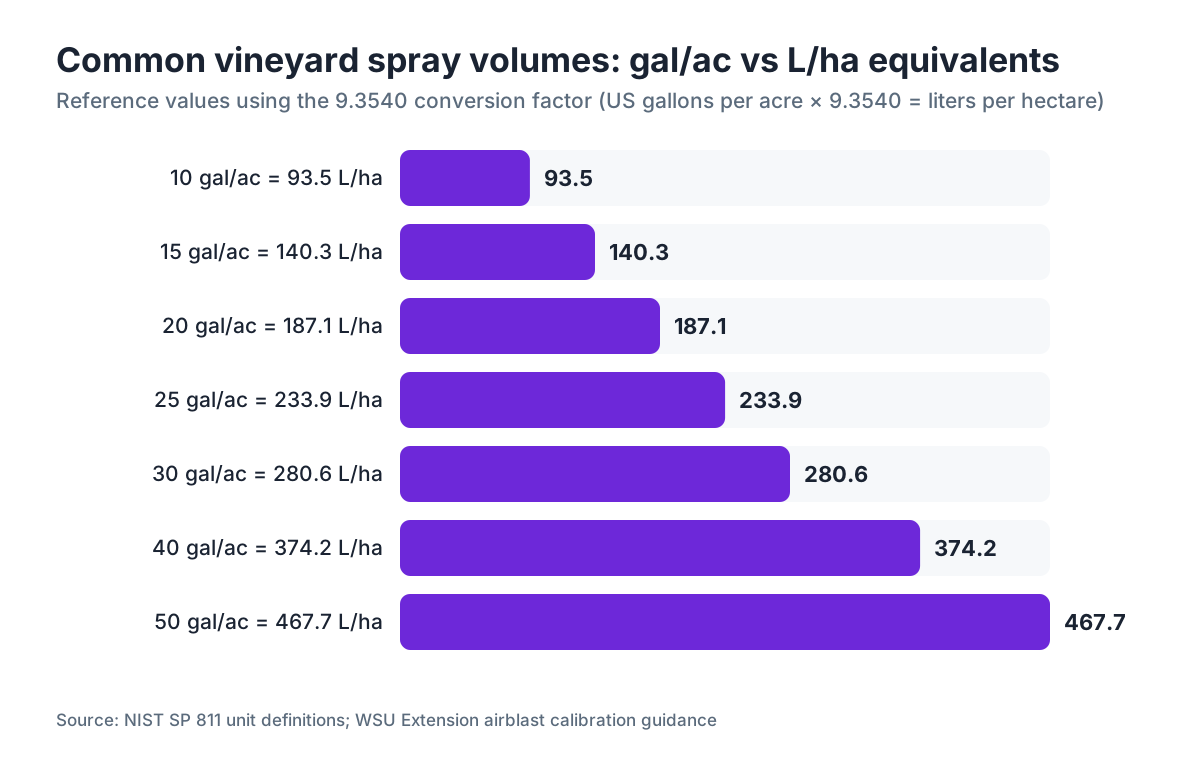
These are the values you'll pull up most. Every figure uses the 9.3540 factor and rounds to one decimal for practical use. [1]
| Gallons per Acre (gal/ac) | Liters per Hectare (L/ha) | Typical vineyard use |
|---|---|---|
| 5 | 46.8 | Low-volume concentrate sprays |
| 10 | 93.5 | Airblast at reduced volume |
| 15 | 140.3 | Light dilute airblast |
| 20 | 187.1 | Standard airblast, most vineyards |
| 25 | 233.9 | Higher canopy, dilute rate |
| 30 | 280.6 | Dense canopy, full dilute |
| 40 | 374.2 | High-volume dilute or ground rig |
| 50 | 467.7 | Maximum typical spray volume |
| 100 | 935.4 | Herbicide strip spray (rare at this vol.) |
Most California and Pacific Northwest vineyards run airblast sprayers between 15 and 30 gal/ac, depending on canopy density and trellis system. WSU Extension notes that calibrated airblast application in wine grape vineyards commonly falls in the 20-40 gal/ac range for dilute applications. [6] In metric, that's 187 to 374 L/ha.
How do you convert acres to hectares for the area field?
The factor is 1 acre = 0.404686 hectares. Flip it and 1 hectare = 2.47105 acres. [1]
For block-level records, round to three decimals. A 7.4-acre block is 2.995 ha, which you'd record as 3.0 ha or 2.995 ha depending on how much precision your certifier wants.
Many growers just divide acres by 2.471. It's not as tight as the full six-decimal factor, but the rounding error on a 10-acre block is under 0.01 ha. Nobody flags that.
Precision earns its keep when you compute total active ingredient applied for a residue audit. A sloppy area figure can shift your total enough to look like an over-application. On a 50-acre block, dividing by 2.5 instead of 2.471 understates the area by about 0.6 ha, which nudges your per-hectare rate slightly high. It won't fail an audit, but it's a habit worth fixing.
Record-keeping software like VitiScribe runs the acre-to-hectare conversion automatically alongside the volume rate, so you're not doing two conversions by hand on every line.
Does the conversion change if you're using a concentrate rate instead of a dilute rate?
Yes, and this one trips up a lot of people. A dilute rate (gallons of finished spray solution per acre) converts cleanly with 9.3540. A concentrate rate (fluid ounces or pounds of product per acre, or ounces of active ingredient per acre) needs an entirely different factor.
Fluid ounces per acre to milliliters per hectare: multiply by 116.52.
Ounces (weight) per acre to grams per hectare: multiply by 70.05.
Pounds per acre to kilograms per hectare: multiply by 1.1208.
Those all follow from standard unit definitions. [1] The 9.3540 factor works only when your numerator is a volume (gallons) and your denominator is an area (acres). Mix unit types and you need the right factor for those specific units.
If a spray record carries both a product rate (oz/ac) and a water volume (gal/ac), convert each one with its own factor. Apply 9.3540 to an ounces-per-acre figure and the result means nothing.
What do EPA and state agencies actually require you to record for pesticide applications in vineyards?
At the federal level, the EPA Worker Protection Standard (40 CFR Part 170) requires agricultural employers to keep pesticide application records for 2 years. Required fields: product name, EPA registration number, date applied, location and description of the treated area, size of area treated, applicator name and certification number (if applicable), and the restricted entry interval. [2] The WPS does not require metric units.
Growers using restricted use pesticides (RUPs) face extra record-keeping duties under FIFRA. Those records also run 2 years and must be available to authorized state or federal inspectors. [9]
California has the most detailed rules of any US state. The Department of Pesticide Regulation's Pesticide Use Reporting system requires records within a set window after application and monthly reports to the county agricultural commissioner. The fields include site description, acres treated, pounds of active ingredient applied, and application method. [5] California doesn't require L/ha, but plenty of growers record it anyway for winery buyer audits.
Cornell Cooperative Extension notes that New York growers holding Department of Environmental Conservation permits may carry extra reporting duties, especially near sensitive water bodies. [7]
The two-year federal retention is a floor, not a ceiling. Many export and organic certifiers want 5 years. Set your policy at 5 years and you're covered everywhere.
How do EU export documentation requirements affect your spray record format?
If your grapes or wine head to EU markets, the buyer or importer will likely ask for a residue declaration or a pesticide application log in a format that supports EU MRL (maximum residue level) verification. EU MRLs read in mg/kg, but the application records behind them run metric: kg/ha for solids, L/ha for liquids. [3]
EU Regulation 396/2005 sets the MRL framework, and growers supplying EU-market wineries should know inspectors can request field records to trace residue levels back to application rates and timing. [3] If your records are in gal/ac and the auditor needs L/ha, showing your conversion math (not only the converted number) proves your records are traceable.
GlobalG.A.P. certification, which many EU buyers require of their grape suppliers, carries its own inspection checklist. The application record requirement under GlobalG.A.P. Integrated Farm Assurance calls for metric units throughout. The current checklist lives on the GlobalG.A.P. website. [10]
Here's the honest advice. Supply even one EU-market winery and you should keep records in both unit systems from the first spray of the season. Converting a full season of logs under audit pressure is miserable work.
For context on how other California wine regions handle export paperwork alongside field operations, the way paso robles wineries and south coast winery operations structure their records is worth a look.
Can you do these conversions in a spreadsheet, or do you need dedicated software?
A spreadsheet handles this fine. Here's a minimal setup:
Column A: Block name
Column B: Date
Column C: Product
Column D: Rate in gal/ac (enter this)
Column E: Rate in L/ha (formula: =D2*9.354)
Column F: Area in acres (enter this)
Column G: Area in ha (formula: =F2/2.47105)
Column H: Total volume gallons (formula: =D2*F2)
Column I: Total volume liters (formula: =H2*3.78541)
Column J: Cross-check (formula: =E2*G2, should equal I2 within rounding)
That last column is your error-catcher. If J2 and I2 differ by more than a liter or two on a normal block, an input is wrong.
Where a spreadsheet falls short is version control and audit trail. Someone edits a cell six months after application and there's no log of the change. For that reason, UC Davis Cooperative Extension recommends purpose-built record systems, or at minimum locked, dated PDF exports from your spreadsheet as the official record. [8]
VitiScribe does the unit conversion automatically and timestamps every entry, which handles the audit trail without extra steps. Still, if you run 10 or fewer blocks, a well-kept spreadsheet with PDF backups is a legitimate approach.
Starting from scratch? The vineyard operations overview covers what a full record system should capture beyond spray logs.
What are the most common mistakes growers make when converting spray records to metric?
Applying 9.3540 to a concentrate rate instead of a dilute volume rate is the error I see most. A label rate of 8 oz/ac times 9.354 gives you 74.8, which is nonsense as a metric volume or weight per area.
Mixing up US and Imperial gallons is rarer in US vineyards, but it surfaces with imported sprayers and equipment manuals that use Imperial units. One Imperial gallon equals 4.54609 liters, not 3.78541. The factor from Imperial gallons per acre to L/ha is 11.2336, not 9.3540. Calibrate a sprayer on an Imperial gallon tank, then apply the US gallon conversion, and your records are off by about 20%.
Rounding area mid-calculation compounds the error. Convert acres to hectares once, keep every decimal, then multiply. Round to two decimals at the area step and your total volume won't balance.
Forgetting the label rate check is another one. Your converted L/ha still has to match a rate inside the US label's stated range, because the label is the law in the US no matter what unit you record. [2] Some growers convert to metric for the export record and lose track of whether the original gal/ac rate was legal. Keep the original US-unit rate too.
Using a slightly wrong factor rounds it out. A few online calculators quietly use 9.353 or 9.35. For export documents and audits, use 9.3540 and note that you're using the NIST-based conversion. It takes one line in your template.
How does WSU Extension recommend calibrating and recording airblast sprayer output in vineyards?
WSU Extension's airblast calibration guidance centers on measuring actual output in gallons per acre under field conditions, then adjusting for canopy density. [6] The method catches nozzle output over a timed interval, calculates flow rate per nozzle, then computes gal/ac from speed and nozzle spacing. That gives you a measured gal/ac figure to enter, which converts straight across with 9.3540.
WSU points out that airblast output swings hard with forward speed, and recommends calibrating at the exact gear and throttle you actually use in the vineyard. A 10% speed change shifts output by roughly 10%, so the calibrated rate in your records should tie to a documented speed, not an assumed one.
For the record itself, WSU's sample log format includes date, crop, location, pest target, product and rate, carrier volume (gal/ac), total acres, weather (wind speed, temperature, humidity), and applicator. That carrier volume field is the one you convert to L/ha.
UC Davis Cooperative Extension takes the same line in its pest management guidelines for wine grapes, noting that carrier volume records support both efficacy review and residue traceability. [8] Cornell's integrated pest management program for vineyards adds that weather at application time matters more and more for residue audits, especially for contact fungicides applied before rain. [7]
Frequently asked questions
What is 20 gallons per acre in liters per hectare?
20 gal/ac × 9.3540 = 187.1 L/ha. This is one of the most common airblast spray volumes in US wine grape vineyards, so 187 L/ha is worth memorizing. Running it backward, 187 L/ha ÷ 9.3540 = 19.99 gal/ac, which rounds cleanly back to 20.
Is the conversion factor different for Imperial gallons versus US gallons?
Yes. For US gallons per acre to L/ha, use 9.3540. For Imperial gallons per acre to L/ha, use 11.2336. Imperial gallons run about 20% larger than US gallons. Most US vineyard equipment uses US gallons, but check whether your sprayer manual comes from a UK or Australian maker, where Imperial measure is standard.
Do I have to record spray volumes in metric for California Pesticide Use Reporting?
No. California's Pesticide Use Reporting system accepts US units: gallons per acre and pounds of active ingredient per acre. The California Department of Pesticide Regulation does not require metric for state compliance. You'd only need L/ha records if a winery buyer, export certifier, or organic certifier asks for them.
How many years do I need to keep pesticide application records in a vineyard?
Federal EPA Worker Protection Standard requires 2 years. California DPR requires 3 years for pesticide use reports. USDA organic certification typically wants 5 years of input records, and GlobalG.A.P. audits often do too. Set your policy at 5 years and you satisfy every requirement without tracking different rules per record type.
What is the formula to convert liters per hectare back to gallons per acre?
Divide L/ha by 9.3540, or multiply by 0.10693. Example: 280 L/ha ÷ 9.3540 = 29.9 gal/ac. This reverse conversion earns its keep when you get application recommendations from European agronomists or compare your rates against metric-native research data.
Does converting to metric change whether my application rate is within the label limits?
No. US pesticide labels set rates in US units, and those rates govern no matter how you record them. Converting to L/ha doesn't change the legal rate. Verify your gal/ac application against the label first, then convert to metric for the export or certification record as a separate step.
What conversion factor converts pounds per acre to kilograms per hectare for dry materials?
Multiply pounds per acre by 1.1208 to get kilograms per hectare. This covers wettable powders, granules, and dry flowable formulations where you record product weight rather than carrier volume. It's a separate conversion from the 9.3540 volume/area factor, so don't cross them.
How do I convert fluid ounces per acre to milliliters per hectare for small-quantity products?
Multiply fluid ounces per acre by 116.52 to get mL/ha. A label rate of 6 fl oz/ac converts to 699 mL/ha. This applies to EC formulations, SL formulations, or any product where the label rate reads in fluid ounces rather than gallons.
Can I use 9.35 instead of 9.3540 as my conversion factor?
For field notes and internal records, yes. The difference on 20 gal/ac is 187.1 vs 187.0, which nobody flags. For official export documents, organic certification records, or GlobalG.A.P. audits, use 9.3540. Note the factor you used in your template so an auditor can verify your math on their own.
Does EU wine export compliance require me to keep spray records in metric?
EU Regulation 396/2005 sets MRL requirements, and buyers or importers supplying EU markets typically request pesticide application records in metric for residue traceability. It's not always a direct legal duty on the US grower, but any EU-market supply chain audit will expect L/ha records. Keep both unit systems to stay safe.
How do I convert acres to hectares for the area field in a spray record?
Divide acres by 2.47105 to get hectares. A 10-acre block is 4.047 ha. A quick field shortcut is dividing by 2.471, so a 50-acre vineyard is 20.23 ha. Use the full factor whenever you compute total active ingredient across a season, since rounding errors compound over many blocks.
What records does the EPA Worker Protection Standard require for pesticide applications?
Per 40 CFR Part 170, the required fields are product name, EPA registration number, application date, location and description of the treated area, area size, applicator name and certification number if applicable, and the restricted entry interval. Records must be kept for 2 years and made available to inspectors, handlers, and employee representatives on request.
Is there a mobile app or tool that handles gal/ac to L/ha conversion automatically for spray records?
Several vineyard record-keeping platforms handle this automatically. A basic spreadsheet with the formula =A1*9.354 works too. The feature that matters is an audit trail: a system that timestamps entries and logs edits, since that's what export and organic certifiers actually want to see in a records review.
How do I check that my converted spray record numbers are internally consistent?
Multiply your converted rate in L/ha by your converted area in ha. The result should equal your total volume in liters (gallons total × 3.78541). If those two figures don't match within rounding tolerance, one of your conversions is wrong. Build this cross-check into every entry as a validation column.
Sources
- NIST Special Publication 811, Guide for the Use of the International System of Units (SI), National Institute of Standards and Technology: Unit definitions for US gallon (3.78541 L), hectare (10,000 m²), and acre (4,046.86 m²) used to derive the 9.3540 conversion factor
- EPA, Agricultural Worker Protection Standard (40 CFR Part 170): WPS requires pesticide application records including product, rate, area, date, and REI; 2-year retention required; metric units not mandated
- EUR-Lex, Regulation (EC) No 396/2005 on maximum residue levels of pesticides in food and feed: EU MRL framework requiring metric-unit application records for residue traceability in export supply chains
- USDA Agricultural Marketing Service, National Organic Program regulations 7 CFR Part 205: NOP requires Organic System Plans tracking all material applications; certifiers typically expect consistent unit conventions
- California Department of Pesticide Regulation, Pesticide Use Reporting: California DPR PUR system accepts US units (gal/ac, lbs active ingredient); metric not required; monthly reports to county agricultural commissioner; 3-year retention
- Washington State University Extension publications on airblast sprayer calibration for vineyards and orchards: WSU Extension documents that calibrated airblast application in wine grape vineyards commonly falls in the 20-40 gal/ac range for dilute applications
- Cornell Cooperative Extension, New York State Integrated Pest Management Program: Cornell IPM program notes that weather conditions at application time are increasingly important for residue audit purposes; additional DEC permit record requirements may apply near water bodies
- UC Statewide Integrated Pest Management Program, UC IPM Pest Management Guidelines for Grapes: UC IPM recommends purpose-built record systems or locked dated PDF exports for spray records to maintain audit trail integrity; carrier volume records support residue traceability
- EPA, Federal Insecticide, Fungicide, and Rodenticide Act (FIFRA), record-keeping requirements for certified applicators of restricted use pesticides: Restricted use pesticide application records must be kept for 2 years and accessible to state or federal inspectors under FIFRA
- GLOBALG.A.P. Integrated Farm Assurance Standard, Crops Base module: GlobalG.A.P. IFA inspection checklist specifies metric units for pesticide application records throughout
Last updated 2026-07-10