How to record a systemic pesticide soil drench application on grapevines

TL;DR
- Federal regulations under FIFRA and the EPA Worker Protection Standard require you to record the product name, EPA registration number, active ingredient, application date, location, total product applied, target pest, applicator name, and REI within 24 hours of a soil drench application.
- State rules often add fields.
- Missing even one element can trigger a violation during an inspection.
What federal law actually requires you to record for every pesticide application
The short answer: more than most growers think. Under the Federal Insecticide, Fungicide, and Rodenticide Act (FIFRA), commercial pesticide applicators must keep records of restricted-use pesticide (RUP) applications for two years [1]. The EPA Worker Protection Standard (40 CFR Part 170) layers on additional requirements for agricultural employers around safety information and reentry intervals [2].
The core fields every soil drench record needs to include are:
- Product name (exactly as it appears on the label)
- EPA registration number
- Active ingredient(s)
- Date of application
- Location of application (field block or block ID, acres or square footage treated)
- Total amount of product applied (volume or weight, more than rate)
- Crop and target pest
- Name and certification number of the applicator (for RUPs)
- Restricted-entry interval (REI) in hours
- Application method (this is where "soil drench" belongs)
- Pre-harvest interval (PHI) if the product carries one
That's 11 data points minimum. Your state may require more. California's DPR, for example, requires county agricultural commissioner reporting for many pesticides beyond just RUPs, and the report must include start and end time, more than date [3]. Oregon, Washington, and New York have their own add-ons. Check with your state department of agriculture before assuming the federal floor is enough.
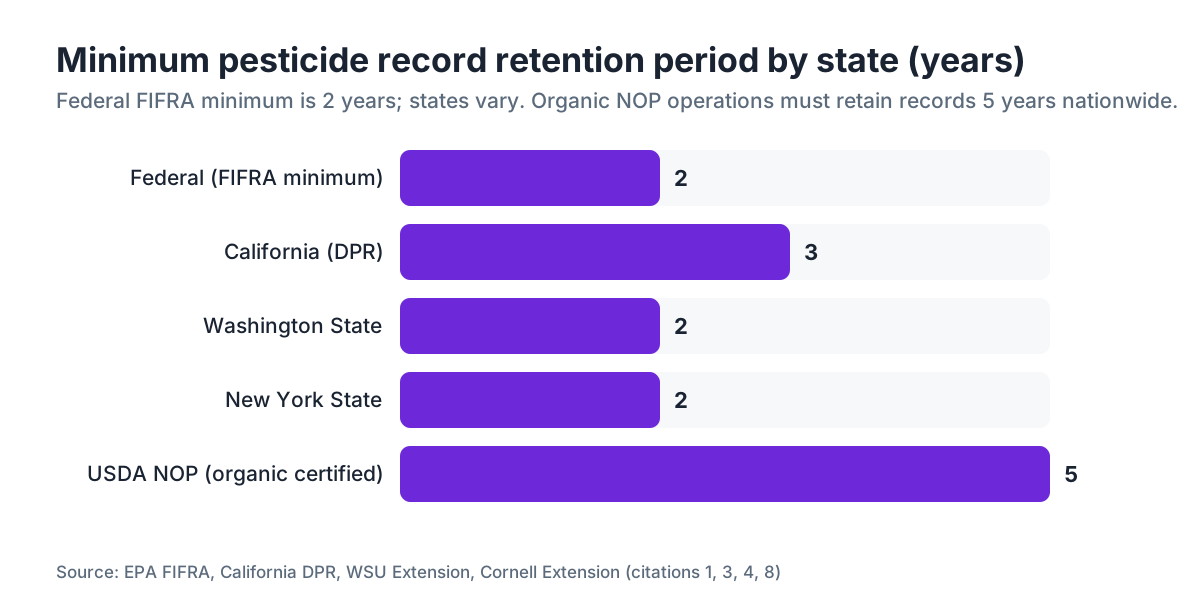
"Records must be maintained for a period of 2 years from the date of application" is the exact language in the federal recordkeeping rule governing certified applicators [1]. Two years is the federal minimum. Some states require three.
What makes a soil drench application different from a foliar spray on the record
A lot of growers copy their foliar spray template and drop "soil drench" in the method field. That mostly works. But a few fields genuinely differ for a drench, and getting them right matters for compliance and for your own records next season.
Application method. This should say "soil drench" or "soil injection" (not the same thing, pick the right one). Some labels specify "soil application" as the registered method, and your record should match label language exactly. A different term can look like an off-label use during an inspection.
Volume of water carrier. For a foliar spray, water volume per acre is standard. For a drench, it matters more because it affects how deep the active ingredient moves. Record gallons of finished solution per vine or per linear foot of row, whichever matches how you calculated the application. WSU Extension recommends tracking drench volume per vine separately from per-acre totals so you can reconstruct concentration if residue questions come up later [4].
Soil temperature and moisture at application. These aren't legally required fields under federal rules. But systemic soil actives like imidacloprid or dinotefuran move very differently in cold or saturated soil. Recording them takes 10 seconds and saves you when you're troubleshooting efficacy the following season.
Total acres vs. number of vines treated. A drench is often applied vine-by-vine rather than broadcast. If you treated 200 vines in a 5-acre block, record both. The total amount of product applied to that block is what matters for the mandatory field, but the vine count helps you verify math and defend against over-application questions.
Application equipment. Note the delivery method: hand-held watering can, backpack sprayer, injection needle, drip system injection. This is optional under federal rules but often required by state regulations, and always useful for your own troubleshooting.
What information goes on a soil drench record line by line
Here's how a complete record looks for a real example. Say you're applying imidacloprid 2F (a common systemic for leafhopper control) as a soil drench to Cabernet Sauvignon vines.
| Field | Example entry |
|---|---|
| Application date | 2024-04-15 |
| Start / end time | 07:30 - 10:15 (if state-required) |
| Product name | Admire Pro |
| EPA Reg. No. | 264-827 |
| Active ingredient | Imidacloprid 42.8% |
| Pesticide type | Restricted Use |
| Block / field ID | Block 4, Cab Sauv, 3.2 ac |
| Target pest | Western grape leafhopper |
| Crop growth stage | Pre-bloom (EL stage 12) |
| Application method | Soil drench, hand-directed at base of vine |
| Rate applied | 7 fl oz / 100 gal water per vine; 1.4 fl oz a.i. per acre |
| Total product used | 22 fl oz product (for 190 vines) |
| Water volume | 2 gal finished solution per vine |
| REI | 12 hours |
| PHI | 21 days |
| Applicator name | [full name] |
| Cert. / license no. | [state cert number] |
| Equipment | 2-gal backpack sprayer, directed soil pour |
| Soil temp at application | 58°F |
| Soil moisture | Moist, 2 days post-irrigation |
| Supervisor signature | [name if different from applicator] |
The fields below the double line are good practice, not federal mandates. But they're exactly the detail that helps you defend an application or figure out why it underperformed.
Which systemic pesticides used as soil drenches on grapevines are restricted-use products
Whether a product is classified as restricted-use (RUP) determines how strict your recordkeeping obligation is. RUP records must be kept by certified applicators or their employers and made available to the EPA within 72 hours of a request [1].
Some of the most common systemics applied as soil drenches in vineyards fall into the neonicotinoid class. Imidacloprid products (Admire Pro, Provado, generics) are among the most frequently used for grape leafhopper and mealybug [5]. Imidacloprid is a restricted-use pesticide. Dinotefuran (Venom, Safari) is generally not RUP in most states, but check your state label. Flupyradifurone (Sivanto Prime) is currently not RUP. Clothianidin and thiamethoxam products may be RUP depending on formulation and state.
Beyond neonicotinoids, spirotetramat (Movento) is sometimes used as a soil application for phylloxera and mealybug management and is not currently RUP federally. But soil application of Movento is an off-label use in many states, so confirm the registered method before you apply and before you record it.
If you're unsure whether a product is RUP in your state, the National Pesticide Information Center maintains a searchable database, and your county agricultural commissioner can confirm [6]. When in doubt, treat it as RUP for recordkeeping. The extra paperwork costs you nothing. The missing paperwork can cost you a lot.
How soon after a soil drench do you have to complete the application record
Twenty-four hours. That's the standard most states use, and it matches EPA Worker Protection Standard guidance [2]. Federal FIFRA rules don't set an exact deadline for completing individual application records beyond requiring they be kept for two years, but state regulations typically close that gap.
California is the strictest: records must be completed by the end of the same day or by the close of the next business day, depending on which county and which program applies [3]. Washington State requires records within 24 hours of application completion [7]. Cornell Extension recommends New York growers treat the same-business-day standard as a safe default even where state rules allow a few days [8].
Don't let a busy harvest push this to "I'll do it Friday." Memory degrades fast, and the details that matter most (exact rates, vine counts, water volumes) are the first things to blur. If your team does drenches over multiple mornings, record each day's application separately with its own date and total volume applied.
How do you calculate and record the total amount of product applied for a vine-by-vine drench
This trips up a lot of managers because the label rate is per acre but the application is per vine. Here's how to make the math traceable.
Step 1: Find the label rate. For Admire Pro on grapes, the label allows up to 7.0 fl oz product per 100 gallons of water, applied to the soil around each vine, not to exceed 1.4 fl oz a.i. per acre per application.
Step 2: Calculate product per vine. If your vine spacing is 8 x 5 feet (1,089 vines per acre), divide the per-acre a.i. limit (1.4 fl oz a.i.) by vine density to get maximum a.i. per vine. With 42.8% a.i. concentration, 1.4 fl oz a.i. equals about 3.27 fl oz product per acre, or about 0.003 fl oz product per vine. That's a tiny number per vine, which is why drenches are usually applied at a consistent volume of finished solution per vine and the concentration does the work.
Step 3: Record both per-vine rate and total block usage. Write down: "2 gal finished solution per vine at 7 fl oz product per 100 gal = 0.0014 fl oz a.i. per vine; 190 vines treated; total product used = 2.66 fl oz; total a.i. applied = 1.14 fl oz; treated area = 3.2 acres; application rate = 0.36 fl oz a.i. per acre." That's a complete, auditable chain from label rate to actual usage.
Step 4: Check against the per-acre maximum. Always verify you stayed under the label ceiling. If you're applying to partial rows or skipping alternate vines, document that too so the math adds up if anyone checks.
UC Cooperative Extension has published guidelines for calculating per-vine rates for soil-applied neonicotinoids that are worth keeping in your spray records binder [5].
What are the worker protection standard requirements specific to soil drench applications
The EPA Worker Protection Standard (WPS) under 40 CFR Part 170 covers agricultural workers who handle pesticides or who enter treated areas after application [2]. A soil drench creates some obligations that a canopy spray doesn't always trigger the same way.
Restricted-entry interval posting. The REI for soil-applied products can differ from the foliar REI on the same label. Imidacloprid 2F, for example, carries a 12-hour REI for soil application. That interval must be posted at the field entry point or communicated to workers before they enter. The WPS requires the REI be listed on the safety datasheet information you provide to workers [2].
Application exclusion zone. Under the 2015 WPS revision, handlers must maintain an application exclusion zone (AEZ) during application. For soil drenches with a hand-held applicator, the AEZ is typically 25 feet in all directions. No workers other than appropriately PPE-equipped handlers can be in that zone during application [10].
Decontamination supplies. During any pesticide application, the employer must have decontamination supplies (water, soap, single-use towels) within one quarter mile of the handler. For a vineyard drench crew, that usually means a wash station on the tractor or ATV. Record where the decon station was located. Some state inspections ask.
The WPS also requires you keep pesticide safety information (label and SDS) accessible to workers at a central location for 30 days after the last application of that product [2]. Most growers keep a running binder. If you're using software like VitiScribe for field records, the same digital system can store the label PDF and SDS next to the application log so everything's in one place during an inspection.
PPE requirements vary by product. Always check the label's "Personal Protective Equipment" section, more than the REI. For most neonicotinoid drenches, handlers need chemical-resistant gloves, long sleeves, and eye protection as a minimum.
How long do you have to keep pesticide application records for grapevines
Two years minimum under federal FIFRA for restricted-use pesticides [1]. Most states match this or add time. California requires three years for many pesticide records under the DPR reporting system [3]. When in doubt, keep everything for five years. Disk space is cheap.
For organic operations, the National Organic Program (NOP) under USDA requires records be kept for five years as part of the certified organic system plan [9]. If you're transitioning blocks to organic and using only approved materials, you still need to document any permitted soil amendments or pest control inputs, and the five-year retention requirement applies from certification date.
Where records get stored is also regulated. Federal rules require RUP records be available for inspection within 72 hours of an EPA request [1]. Practically, this means don't store your only copy in a field truck. A secured office binder or a cloud-based system works. Paper records that get wet, fade, or vanish have caused real violations.
What happens if your soil drench record is incomplete or missing during an inspection
Inspections for pesticide records come from state departments of agriculture, county agricultural commissioners (in California), or the EPA in serious cases. What they check varies by state, but every inspector is looking at the same core list: product, rate, location, date, applicator.
For a missing or incomplete RUP record in California, civil penalties under the Food and Agriculture Code can run from a few hundred to tens of thousands of dollars depending on whether the violation is willful, repeated, or tied to an actual harm or environmental incident [3]. Washington State penalties for recordkeeping violations range from warnings for first-time technical failures to fines over $1,000 per violation for patterns [7].
More practically, incomplete records hurt you in ways that don't involve fines. If a neighbor files a drift complaint or a water board asks about a neonicotinoid detection downstream, your records are your defense. "We applied 0.36 fl oz a.i. per acre to Block 4 on April 15, documented here" is a very different position than "we think we applied it sometime in April."
The other risk is spray interval management. Soil-applied systemics like imidacloprid can persist in vine tissue for weeks. Without clear records of application date and rate, you can't reliably calculate PHI for harvest or decide whether a second application is safe under label limits.
What's the best format for keeping soil drench records, paper or digital
Both formats are legally acceptable under federal regulations, which require only that records be "maintained" and available within 72 hours of an EPA request [1]. In practice, the format that actually gets filled out completely is the right one for your operation.
Paper forms work well for small operations where one person does all the spraying and files forms weekly. The Cornell Cooperative Extension Pest Management Guidelines for Grapes include a sample application record form that satisfies New York requirements and covers most federal fields [8]. UC Cooperative Extension also provides printable record forms calibrated to California DPR reporting requirements [5].
The problem with paper is consistency. A partial form left on the dashboard, then filled in from memory two days later, is worse than no form because it looks accurate but might not be. Paper also can't flag when you're approaching a per-acre maximum or a pre-harvest interval.
Digital records with a dedicated vineyard record-keeping tool solve the consistency problem by forcing field entry at application time, often from a phone. VitiScribe is built for vineyard operations, with application log templates that include soil drench as a method type and prompt for the fields regulators actually check. Purpose-built software or a spreadsheet, either works. The goal is a system you'll actually use every time, on the day of application.
WSU Extension recommends Washington growers use whatever format they'll consistently complete, noting that electronic systems reduce transcription errors and make multi-year pattern analysis much easier [4].
Are there state-specific reporting requirements for systemic soil drenches in major grape-growing states
Yes, and the differences are big enough that you need to look up your state's rules rather than rely on federal minimums alone.
California: The California DPR requires reporting to the county agricultural commissioner (CAC) for all pesticide applications to agricultural crops above certain thresholds, more than RUPs [3]. For most vineyards, this means monthly reporting using the Pesticide Use Report (PUR) format. The PUR requires start time, end time, GPS coordinates of the treated area (or APN/site number), and the specific commodity code for grapes. The CAC database is public, so your drench records for neonicotinoids on wine grapes are searchable by anyone.
Washington: The Washington State Department of Agriculture requires RUP records within 24 hours of application and that records be available during business hours for inspection without advance notice [7]. There's no centralized state reporting system like California's PUR, but county and state inspectors do conduct random farm audits.
Oregon: Oregon Department of Agriculture pesticide regulations require records for RUPs and recommend (but don't always mandate) records for general-use products on commercial operations. The department's pesticide division publishes a grower guide that's worth downloading.
New York: Cornell Cooperative Extension's guidelines note that New York requires records for RUPs for two years and encourages full documentation for general-use products as well [8]. The state DEC handles pesticide enforcement and has increased vineyard inspections in recent years, particularly around neonicotinoid applications near pollinator habitat.
How do you record a systemic soil drench that's part of an IPM plan
If you're operating under a formal integrated pest management (IPM) plan, the drench record ties back to a decision that was presumably documented. A good IPM-linked application record includes more than the application itself. It includes the scouting data that triggered it.
For leafhopper management, UC IPM thresholds suggest treatment when leafhopper egg and nymph counts exceed about 15-20 per leaf in the first generation [5]. Your record should note the scouting date, the count or index that triggered the decision, and who made the treatment call. That link between monitoring data and application is what separates a real IPM program from a calendar spray program.
The USDA NRCS 595 Practice Standard for Integrated Pest Management recommends records include pest pressure justification as part of compliant IPM documentation [9]. If you're receiving EQIP payments tied to IPM practices, this documentation is required for payment eligibility, more than good practice.
For phylloxera drench programs, the decision threshold is different. It's usually based on vine decline symptoms and root gall counts rather than a numeric sweep threshold. Document the observation (date, block, symptom description or root sample result) alongside the application record so the rationale is clear years later when you're assessing whether the program is working.
One note on systemic timing: soil-applied neonicotinoids for leafhopper control work best when applied at or before bud swell, before egg hatch [5]. Record the phenological stage at application time (EL stage, or a simple field note like "budbreak 10-15% complete") because that context is exactly what you'll want when evaluating efficacy at season end.
Frequently asked questions
Do I have to record a soil drench application if the pesticide is not a restricted-use product?
Federal law under FIFRA only mandates records for restricted-use pesticide applications by certified applicators. But most state regulations require records for all commercial pesticide applications on agricultural crops, regardless of RUP status. California requires reporting for virtually all pesticide uses on crops. Oregon and Washington have similar broad requirements. Keep records for everything you apply commercially. The cost of the habit is zero; the cost of a gap can be substantial.
Can I record a soil drench application on my phone and is that legally valid?
Yes, electronic records are legally valid under FIFRA and all major state pesticide regulations, provided they can be produced for inspection within the required timeframe (72 hours federally, sometimes less under state rules). The record must contain all required fields regardless of format. A photo of a hand-written field note that's then transcribed into a spreadsheet is acceptable. What matters is completeness and availability, not the medium.
What does 'total amount of product applied' mean for a vine-by-vine drench?
It means the actual total volume or weight of pesticide product you used in that application event, not the label rate. If you filled your backpack sprayer three times and used half the last fill, record the actual product used across all fills. You should also record the per-acre equivalent so you can verify you stayed within label limits. Both numbers together tell the full story a regulator or extension agent needs.
How do I record a soil drench that was applied through a drip irrigation system?
A chemigation application through drip has a few extra fields: note the injection point, flow rate calibration check date, and whether a backflow prevention device was inspected before application. Many states have specific chemigation permits or notification requirements separate from the standard application record. Contact your state department of agriculture for chemigation-specific rules. The core 11 pesticide record fields still apply; you're adding to them, not replacing them.
What REI applies to a soil drench compared to a foliar spray of the same product?
REIs can differ between application methods on the same product label. Always read the REI table on the specific label rather than relying on memory from a previous application. Imidacloprid 2F, for example, carries a 12-hour REI for soil application. Some products have longer REIs for soil applications because of volatility or secondary contact risk from disturbed soil. Record the method-specific REI, more than the product's highest REI.
Is there a standard form or template for vineyard pesticide application records?
There's no single federally mandated form. Cornell Cooperative Extension and UC Cooperative Extension both publish free printable record forms calibrated to their state requirements. The USDA NRCS also provides sample record formats as part of 595 IPM practice documentation. Any format that captures the 11 required fields works. If you spray in California, use a form that includes start/end time and GPS or site identifier, because county commissioners require both.
How far in advance of harvest do I need to stop applying systemic soil drenches?
That depends on the specific product. The pre-harvest interval (PHI) is listed on every label and must be recorded with your application. Admire Pro (imidacloprid) carries a 21-day PHI for grapes. Sivanto Prime (flupyradifurone) has a 7-day PHI. Movento (spirotetramat) is 7 days. Always verify against the current label, not memory or a colleague's recommendation, because PHIs can change between label revisions.
Do workers need to be notified before I do a soil drench with a systemic pesticide?
Yes, under the EPA Worker Protection Standard, agricultural employers must notify workers of pesticide applications before they occur if workers will be in treated areas during the REI. Notification can be oral, posted at a central location, or via signage at field entrances depending on the REI length. For products with REIs over 48 hours, written signage at field entries is required. The 2015 WPS revisions made these notification requirements stricter than before.
What soil conditions should I record alongside a systemic drench application for my own records?
At minimum, record soil temperature and moisture status at application time. Soil-applied systemics like imidacloprid move poorly in cold (below 50°F) or waterlogged soils, and this directly affects efficacy. Note whether the application followed irrigation and how recently. Soil type and pH matter for persistence but don't need re-recording every time if they're already in your block data sheet. These aren't legally required but will save you when troubleshooting a failure or defending a residue question.
Can I use one application record for multiple blocks if the soil drench was the same product and rate?
No, not if the blocks are different locations. Federal and state regulations require location be identified per application record, and each distinct field block or site is a separate location. If you applied the same product at the same rate to three blocks on the same day, you need three records, or one record with a table clearly listing each block's acreage and total product used separately. Combining locations into one entry makes it impossible to audit per-acre totals.
How do I handle a spill or accidental overapplication when recording the drench?
Record exactly what happened: the intended application rate, the actual rate applied (if different), the cause and location of the spill, and any immediate corrective actions taken. Overapplication of a restricted-use pesticide may require notification to your state department of agriculture or county commissioner beyond just the application record. Don't alter or omit the record to hide an error. That's a separate and more serious violation than the original overapplication.
Are neonicotinoid soil drenches on grapevines subject to any special state restrictions beyond normal recordkeeping?
Some states have enacted or are considering restrictions on neonicotinoid applications near pollinator forage areas or during bloom. Connecticut, for example, restricts imidacloprid applications near flowering crops. Maryland has restrictions tied to pollinator protection. California's DPR has proposed additional restrictions on soil-applied neonicotinoids. Always check current state regulations before applying. Your county agricultural commissioner is the best first call for current local rules on neonicotinoid use.
Does a certified applicator have to be present for the soil drench, or just for the records?
For restricted-use pesticides, the application must be made by or under the direct supervision of a certified applicator. 'Direct supervision' under federal FIFRA means the certified applicator doesn't have to be physically present during every minute of application, but must be immediately available by phone, must have given specific instructions, and must be legally responsible for the application. The definition of 'direct supervision' varies somewhat by state, so verify your state's standard.
Sources
- EPA, Federal Insecticide, Fungicide, and Rodenticide Act (FIFRA) Certified Applicator Recordkeeping Requirements: Certified applicators must keep records of restricted-use pesticide applications for two years and make them available to the EPA within 72 hours of request.
- EPA, Agricultural Worker Protection Standard (40 CFR Part 170): The WPS requires posting of REIs, maintaining decontamination supplies, and providing pesticide safety information to workers for 30 days after the last application; application exclusion zones apply during soil drench applications.
- California Department of Pesticide Regulation, Pesticide Use Reporting (PUR): California requires monthly Pesticide Use Reports to the county agricultural commissioner for all pesticide applications to agricultural crops, including start/end times and GPS or site identifier.
- Washington State University Extension, Pesticide Record Keeping for Agricultural Producers: WSU Extension recommends tracking drench volume per vine separately from per-acre totals to reconstruct concentration if residue questions arise, and advises completing records within 24 hours of application.
- UC Cooperative Extension and UC IPM, Integrated Pest Management for Wine Grapes: UC IPM publishes per-vine rate calculation guidelines for soil-applied neonicotinoids on grapevines and leafhopper threshold data (15-20 per leaf in first generation) that support IPM-linked application decisions.
- National Pesticide Information Center, Restricted Use Product Database: NPIC maintains a searchable database of restricted-use pesticide classifications that growers can use to confirm RUP status of products before application.
- Washington State Department of Agriculture, Pesticide Management Division: Washington State requires RUP application records to be completed within 24 hours and available for inspection during business hours without advance notice.
- Cornell Cooperative Extension, Pest Management Guidelines for Grapes: Cornell Extension publishes a sample application record form satisfying New York requirements and recommends growers treat the same-business-day completion standard as the safe default.
- EPA, 2015 Agricultural Worker Protection Standard Final Rule: The 2015 WPS revision established application exclusion zones (25 feet for hand-held applicators), strengthened notification requirements, and added new training mandates for agricultural employers.
- CDMS, Admire Pro Label and Product Bulletin (Bayer CropScience): Admire Pro (imidacloprid 42.8%) carries a 21-day pre-harvest interval for grapes, a 12-hour REI for soil application, and a maximum rate of 1.4 fl oz a.i. per acre per application.
- UC Davis Department of Viticulture and Enology, Vineyard Management Resources: UC Davis viticulture resources document phenological timing considerations for soil-applied systemic insecticides, noting best efficacy when applied at or before budbreak to target first-generation leafhopper eggs.
Last updated 2026-07-10