How to correct zinc deficiency in established vineyard blocks

TL;DR
- Zinc-deficient vines show small mottled leaves and poor fruit set.
- Foliar zinc sulfate (0.1-0.3 lb actual Zn per acre) from early shoot growth through bloom is the fastest fix.
- Soil applications work but take seasons to reach roots.
- Run a leaf tissue test before you spend a dollar, because a dozen problems look like zinc.
What does zinc deficiency actually look like in grapevines?
Little leaves. That's the classic tell. Young leaves come out small and lopsided, often with a mottled yellow-and-green pattern that a tired scout mistakes for virus. The interveinal chlorosis on zinc-deficient leaves shows up on the youngest tissue first, which is how you separate it from magnesium deficiency (that one hits older leaves). Shortened internodes give new shoots a stubby, bunched look.
Fruit set is where zinc costs you real money. Vines need zinc for pollen tube germination and normal berry development, and when zinc runs short at bloom you get shot berries (small, seedless berries) scattered through clusters next to normally fertilized fruit. Growers call it "hens and chicks." UC Cooperative Extension has documented 30-50% reductions in crop load from zinc deficiency alone [1].
Shoot tips are another clue. Zinc-deficient tips sometimes zig-zag slightly between nodes instead of growing straight.
None of this is unique to zinc. Boron problems, fanleaf virus, and cold-set injury all mimic it. Don't build a correction program off eyeball diagnosis. Run a leaf tissue test first, every time.
How do you confirm zinc deficiency with tissue testing?
Tissue testing is the only way to separate zinc deficiency from look-alikes like fanleaf virus, boron toxicity, and magnesium shortfall. The standard grapevine sample is the petiole (leaf stem) taken opposite the first cluster at bloom, or the blade if you sample at veraison [2].
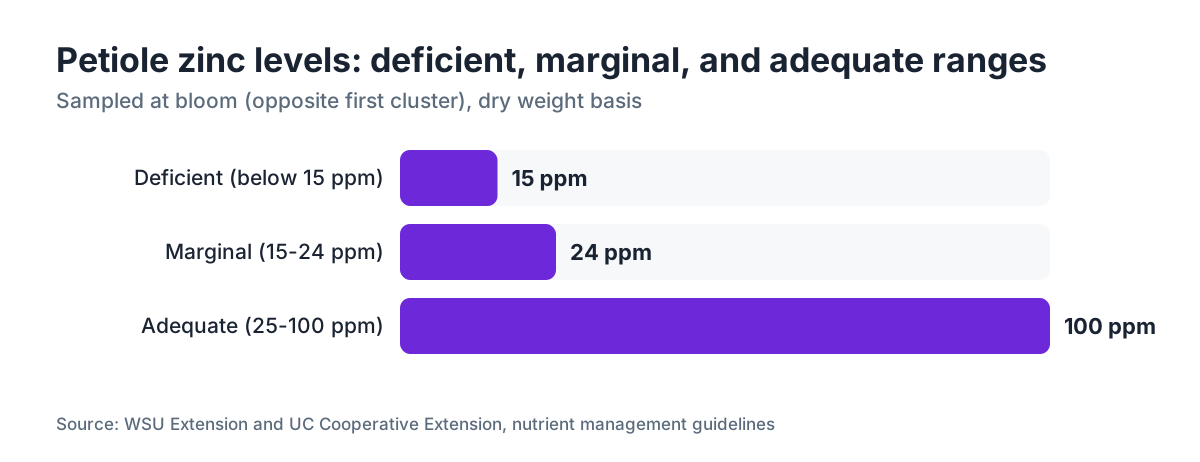
Sufficiency ranges shift a little by lab and region, but most extension programs put adequate petiole zinc at 25-100 ppm dry weight for the opposite-cluster-at-bloom sample [2][3]. WSU Extension calls anything below 15 ppm in bloom petioles deficient [3]. Seeing symptoms while your numbers read adequate? Ask for a full nutrient panel. High phosphorus can lock up zinc inside the plant even when the soil looks fine.
Soil testing for zinc tells you less about a deficient established block than tissue testing does. Still worth running a DTPA-extracted zinc test if you're trying to understand why a block keeps going short. Sandy soils low in organic matter and high-pH soils (above 7.5) are the usual suspects [6]. Soil phosphorus above the crop's need also ties up zinc, so read your soil P before you order more phosphate.
What zinc products work best for foliar correction?
Zinc sulfate (ZnSO4) is the workhorse. Cheap, well-studied, and taken up readily through leaves. The monohydrate form (35.5% Zn) and the heptahydrate form (22% Zn) are both common. Check the guaranteed analysis on the bag and calculate your actual zinc rate off that number, not the product weight.
For foliar sprays, UC Cooperative Extension recommends 0.1 to 0.3 pounds of actual zinc per acre in enough water for good coverage [1]. That works out to roughly 0.3 to 0.85 lb zinc sulfate monohydrate per acre, or about 0.45 to 1.4 lb of the heptahydrate. Don't push past 0.3 lb actual Zn per application without checking phytotoxicity risk, especially in hot weather.
Zinc chelates (zinc EDTA or zinc lignosulfonate) cost more but move into leaves better under cool, slow-growth conditions. Worth it on sensitive varieties, or on late-season sprays where the vine has limited time to absorb before dormancy. Zinc oxide has lower foliar availability than sulfate or chelate. Skip it for foliar programs.
Zinc nitrate turns up in early spring tank mixes because the nitrate adds a nitrogen kick. Be careful mixing it with anything alkaline, which drops the zinc out of solution. Jar test before you combine products in the tank. Every time.
| Product | Zn content (approx.) | Relative cost | Best use |
|---|---|---|---|
| Zinc sulfate monohydrate | 35-36% Zn | Low | Foliar, soil |
| Zinc sulfate heptahydrate | 22-23% Zn | Low | Foliar, soil |
| Zinc EDTA chelate | 9-14% Zn | Medium-high | Foliar, cool conditions |
| Zinc lignosulfonate | 5-10% Zn | Medium | Foliar, drip |
| Zinc nitrate | 9-22% Zn | Medium | Early foliar, tank mix |
| Zinc oxide | 50-80% Zn | Low | Soil amendment (slow) |
When is the best time to apply zinc in the vineyard?
Timing is the whole game with zinc. You want adequate zinc in the vine before bloom, because that's when demand spikes for pollen and fruit set. Two foliar windows do the most work.
First, the dormant or early-budbreak application. A zinc sulfate spray on dormant canes or right at budbreak loads zinc into woody tissue before the leaves are fully out. It isn't the most efficient absorption route, but it puts zinc in early. Some growers fold it into a delayed-dormant oil spray.
Second, and this is the one that matters most, the shoot growth window from roughly 4-6 inch shoots through late pre-bloom (about 3-4 weeks before bloom). Leaf absorption of zinc is highest here. Target at least two applications in this window when the deficiency is moderate to severe. One spray at 6-inch shoots and a second at 12-18 inches covers most situations [1][3].
Spraying after full bloom shrinks your absorption window and raises phytotoxicity risk on sensitive tissue. Post-bloom sprays can serve as a maintenance dose in blocks with a deficiency history, but they won't rescue a crop that already set poorly.
One hard rule: don't spray zinc on heat-stressed or water-stressed vines without irrigating first. Phytotoxicity risk climbs fast when stomata aren't working normally.
Do soil zinc applications work for established vines?
Yes, but slowly. Zinc moves through soil by diffusion, which is slow, and in established drip-irrigated vineyards the wet zone often misses the depth where you placed the zinc. That's why foliar programs correct a deficiency faster.
Soil applications still earn their place as a long-term play alongside foliar correction, mainly in blocks where the soil test shows genuinely depleted zinc (below 0.5 ppm DTPA-extractable) [7]. Broadcast rates for zinc sulfate run 5-20 lb actual Zn per acre, worked into the top few inches if you can. On blocks you can't till, banding zinc sulfate under the drip emitter moves it to roots better than broadcasting [3].
High-pH soils (calcareous, above 7.5) are the worst case for soil zinc. At high pH, zinc flips to insoluble forms fast and won't stay plant-available. In those blocks, foliar is your primary tool and you may need it every year.
Zinc oxide on soil is painfully slow to become available and isn't a practical fix for an established deficiency. Chelated zinc through drip costs more but works where soil pH and low organic matter make broadcasting a waste.
Can you apply zinc through a drip system?
Yes, drip injection works, but the product choice and system chemistry decide whether it succeeds. Zinc sulfate is fine in acidic irrigation water and precipitates if the water carries high bicarbonate or calcium. Jar test with your source water before you commit.
Zinc chelates (EDTA or lignosulfonate) tolerate a wider range of water chemistries and clog emitters less. Zinc EDTA is the most stable across a wide pH range in the injection solution [4]. Inject during active root uptake, spring through early summer, and chase it with enough water to push the solution into the root zone rather than parking it at the surface.
Drip injection rates run lower per pass than broadcast, around 0.5-2 lb actual Zn per acre, repeated 2-3 times a season. It corrects acute deficiency slower than foliar spraying but earns its keep as maintenance once you've fixed the acute problem with foliar sprays.
Record every injection: product, rate, water volume, timing, block ID. If you keep your spray and nutrient records in VitiScribe, drip injections belong there too, because your applicator license and water district records may call for that documentation.
How do you handle zinc deficiency when it's tied to high soil phosphorus?
This one gets missed a lot. Vineyards that got heavy phosphorus over the years develop a soil chemistry problem: high P ties up zinc in the soil and blocks zinc uptake inside the plant even when tissue reads borderline. The phosphorus-zinc antagonism is well documented [11].
The practical answer is to stop adding phosphorus until soil P comes down, and lean on foliar zinc to route around the soil chemistry entirely. Foliar zinc goes straight into the leaf regardless of what's happening in the rhizosphere. That makes it the right tool when soil P is the driver.
Getting soil P down takes years of no-P fertilization, and in blocks with decades of fertilizer history it's a slow grind. Optimize zinc through foliar programs in the near term and let P levels drift down on their own. Adding more phosphorus in any form while chasing a zinc fix works against you.
Check your rootstock too. Some pull zinc better than others. Own-rooted vines and 5C Teleki tend to run short on high-P soils more than rootstocks with aggressive root systems [1].
What are the worker protection and safety requirements for zinc sulfate sprays?
Zinc sulfate used as a fertilizer isn't a federally registered pesticide, so the EPA Worker Protection Standard (WPS) under 40 CFR Part 170 doesn't strictly apply to it [5]. But zinc sulfate is an irritant that can damage eyes and skin at spray concentrations. Handle it with the same PPE discipline you'd give any spray material.
For mixing and application: chemical-resistant gloves, safety glasses or a face shield, and long sleeves. The Safety Data Sheet (SDS) for your specific product lists the required PPE. Keep it accessible in the field for anyone mixing or applying.
Some zinc products are labeled restricted-use or get mixed with materials that do fall under WPS. Tank-mix zinc sulfate with a registered fungicide or pesticide and WPS applies to the whole tank based on the most restrictive material in it. The re-entry interval (REI) in that case comes from the pesticide label, not the zinc [5].
In California, the Department of Pesticide Regulation (CDPR) adds tracking and use-reporting requirements for materials on ag crops, and county agricultural commissioner rules pile on top. Even where zinc sulfate isn't restricted-use, clean application records are standard practice and some third-party audit programs require them.
How many applications does it take to actually fix a zinc-deficient block?
A moderately deficient block (petiole zinc 15-24 ppm) usually needs two to three pre-bloom foliar applications to bring tissue into the adequate range the same season. You'll see better fruit set that year if the timing landed right, though full crop recovery often waits until the second season, once the vine's overall zinc status settles.
Severely deficient blocks (below 15 ppm petiole zinc) often need foliar applications two to three seasons running before tissue stabilizes in the adequate range. The vine's perennial structure stores zinc poorly compared to nitrogen or potassium, so each spring starts from a lower baseline than a healthy vine would.
Confirm progress with tissue testing every season during correction. No point spending money on foliar zinc if you can't measure whether it's landing. Run petioles at bloom, compare to your baseline, adjust rate or timing off the numbers.
Maintenance sprays (one pre-bloom foliar per season) keep corrected blocks from sliding back, especially on soils with chronic availability problems. Plenty of growers in the San Joaquin Valley and coastal California with serpentine-derived soils treat zinc as an annual line item [1].
How do you document zinc applications for compliance and audit purposes?
Even when zinc sulfate isn't a registered pesticide, thorough records protect you on several fronts: third-party sustainability audits (SIP, LODI, CCOF), buyer requirements, water board reporting, and your own agronomic notes for next season's decisions.
A good record captures the date, block ID, product name and lot, active ingredient and rate (lb actual Zn per acre), application method (ground rig, airblast, drip injection), water volume, equipment operator, weather at the time, and re-entry restrictions if a co-applied pesticide is involved. That's more fields than most people scribble down when they're rushing between blocks.
Digital spray record systems make this easier. You set up the product and rate once, and the system handles unit math and block tracking. VitiScribe was built for exactly this kind of field documentation, nutrient applications logged right alongside pesticide records, so it's all in one searchable log when an auditor or your PCA asks.
In California, Pesticide Use Reports (PURs) are required for every DPR-registered pesticide, but not for fertilizer-only zinc [8]. Call your county ag commissioner if you're unsure whether a specific zinc product needs reporting in your county.
Which grape varieties are most prone to zinc deficiency?
Thompson Seedless, Concord, Cabernet Sauvignon, and Zinfandel show up most in zinc deficiency reports, but no variety is immune. The research leans hard toward table and raisin grapes over wine varieties, so for wine grapes much of the practical knowledge comes from grower experience rather than controlled trials.
Honest caveat: nobody has great data ranking wine varieties by zinc sensitivity. The closest systematic reference is UC Cooperative Extension's Nutrient Management for Grapevines, which notes that high-crop-load varieties and those on vigorous rootstocks tend to show deficiency less often, because their bigger root systems reach more soil volume [1].
Rootstock often matters more than scion. 110R, 1103P, and other drought-tolerant, deep-rooting stocks generally show less zinc deficiency than shallow-rooting stocks like 101-14 Mgt or 3309C, especially on sandy or high-pH soils [9]. Replanting a chronically zinc-deficient block? Factor rootstock into the decision.
Frequently asked questions
What is the fastest way to correct zinc deficiency in grapevines?
Foliar zinc sulfate sprays from 4-6 inch shoot growth through pre-bloom are the fastest correction. Two applications at 0.1-0.3 lb actual zinc per acre each can bring tissue levels into the adequate range within the same season. Soil applications work but take multiple seasons to move through the profile to active roots.
What petiole zinc level is considered deficient in grapevines?
WSU Extension puts the deficiency threshold below 15 ppm zinc in petioles sampled at bloom (opposite the first cluster). The adequate range is generally 25-100 ppm. UC Cooperative Extension uses similar thresholds. If your petiole results come back between 15 and 25 ppm, you're in a marginal zone that warrants a corrective foliar program.
Can zinc deficiency cause poor fruit set in grapes?
Yes. Zinc is required for normal pollen tube germination and berry development. When zinc runs short at bloom you get shot berries (the hens-and-chicks pattern) and reduced fruit set overall. UC Cooperative Extension has documented 30-50% crop load reductions in severely deficient blocks. Correcting zinc before bloom is the only way to protect fruit set that season.
How much zinc sulfate should I apply per acre as a foliar spray?
UC Cooperative Extension recommends 0.1 to 0.3 lb of actual zinc per acre per foliar application. Using zinc sulfate monohydrate (35-36% Zn), that's roughly 0.3 to 0.85 lb of product per acre. Use the guaranteed analysis on the bag to calculate the actual zinc you're delivering, and don't exceed 0.3 lb actual Zn per application to avoid phytotoxicity risk.
Why does my vineyard keep showing zinc deficiency even after soil applications?
Several things block soil zinc from reaching vines: soil pH above 7.5, which converts zinc to insoluble forms; high soil phosphorus, which drives zinc-phosphorus antagonism; sandy soils low in organic matter; and drip irrigation that wets only a fraction of the root zone. In those cases, foliar zinc bypasses the soil chemistry entirely and is the more reliable fix.
Is zinc sulfate a pesticide that requires a permit to apply in the vineyard?
Zinc sulfate used as a fertilizer is not a federally registered pesticide and is not subject to EPA Worker Protection Standard requirements on its own. But if you tank-mix it with a registered pesticide, WPS rules apply to the whole mix based on the most restrictive label. In California, check with your county agricultural commissioner for local reporting requirements.
Can I inject zinc through my drip irrigation system?
Yes. Zinc chelates (EDTA or lignosulfonate forms) are the most compatible with drip systems because they're less likely to precipitate with bicarbonate or calcium in your water. Zinc sulfate works in acidic, low-bicarbonate water. Always jar test with your source water first. Drip injection corrects acute deficiency slower than foliar spraying but works well for maintenance.
How do I tell zinc deficiency apart from fanleaf virus symptoms?
Both cause small, distorted leaves, but fanleaf virus typically shows a distinctive chrome-yellow coloration on young leaves and produces abnormally flattened or doubled petiolar sinuses. Zinc deficiency causes interveinal chlorosis on young leaves with a mottled pattern and no petiole deformation. Tissue testing that confirms low zinc, plus PCR testing to rule out virus, is the definitive way to separate them.
Does rootstock affect zinc deficiency risk in grapevines?
Yes. Deep-rooting, drought-tolerant rootstocks like 110R and 1103P generally reach more soil volume and show less zinc deficiency than shallow-rooting stocks like 101-14 Mgt or 3309C, especially on sandy or high-pH soils. Own-rooted vines are often more susceptible. If you're replanting a chronically deficient block, rootstock selection is a meaningful part of the long-term fix.
When should I take tissue samples to diagnose zinc deficiency?
The standard sample for zinc diagnosis is the petiole opposite the first cluster at bloom. This timing gives the most consistent results and has the best-established sufficiency ranges in the extension literature. Blade samples at veraison are an alternative if you miss the bloom window, but sufficiency thresholds differ, so confirm which standard your lab is using.
How many years of foliar zinc applications does it take to fix a severely deficient block?
Severely deficient blocks (below 15 ppm petiole zinc) typically need two to three consecutive seasons of pre-bloom foliar applications before tissue levels stabilize in the adequate range. Moderately deficient blocks often respond within one season. Annual tissue testing is the only way to confirm progress and calibrate whether you can shift to a maintenance-only program.
What records should I keep for zinc applications in the vineyard?
Record the date, block ID, product name, guaranteed zinc analysis, rate per acre (lb actual Zn), application method, water volume, equipment operator, and weather at application. If you co-applied a registered pesticide, add the REI and any WPS notifications. Third-party audit programs like SIP and LODI require nutrient application records, and digital record systems speed retrieval during audits.
Is zinc deficiency more common in certain California vineyard regions?
Sandy San Joaquin Valley soils, alkaline soils in the Central Coast, and serpentine-derived soils in parts of the North Coast have the highest reported rates of zinc deficiency. High-phosphorus soils in blocks with decades of fertilizer history are another common setting. UC Cooperative Extension's nutrient management guides for specific regions include local prevalence data.
Sources
- UC Cooperative Extension, Nutrient Management for Grapevines: Severe zinc deficiency can reduce crop load by 30-50%; adequate petiole zinc is 25-100 ppm at bloom; zinc sulfate foliar rates of 0.1-0.3 lb actual Zn per acre are recommended; own-rooted vines and 5C Teleki are more susceptible on high-P soils
- UC Davis Viticulture & Enology, Grapevine Nutrient Sampling Guidelines: Standard petiole sample is taken opposite the first cluster at bloom; zinc sufficiency range is 25-100 ppm dry weight in petioles at bloom
- Washington State University Extension, Grapevine Nutrition: WSU puts the zinc deficiency threshold below 15 ppm in bloom-stage petioles; banding zinc sulfate under drip emitters is recommended on established vines; zinc EDTA is stable across a wide pH range
- Cornell Cooperative Extension, Vineyard Nutrition and Soil Management: Zinc EDTA chelate is more compatible with irrigation water chemistries than zinc sulfate and is recommended for drip injection programs
- EPA, Worker Protection Standard for Agricultural Pesticides (40 CFR Part 170): WPS applies to registered pesticides; tank mixes including a registered pesticide are governed by the most restrictive label; zinc sulfate as a fertilizer is not a registered pesticide
- UC Cooperative Extension, Nutrient Deficiencies and Toxicities in Grapevines: Zinc deficiency symptoms appear first on young tissue as interveinal chlorosis; high soil pH above 7.5 converts zinc to insoluble forms; soil P antagonism with zinc is documented
- WSU Extension, Soil Zinc Testing and DTPA Extraction Method: DTPA-extractable zinc below 0.5 ppm indicates genuinely depleted soil zinc levels in vineyard soils
- California Department of Pesticide Regulation, Pesticide Use Reporting: California requires Pesticide Use Reports for all DPR-registered pesticides applied to agricultural crops; fertilizer-only zinc applications do not require PURs but county ag commissioner rules may add requirements
- UC Cooperative Extension, Rootstock Effects on Grapevine Mineral Nutrition: Deep-rooting rootstocks like 110R and 1103P show less zinc deficiency than shallow-rooting stocks on sandy or high-pH soils
- WSU Extension, Diagnosing Grapevine Nutrient Deficiencies: Zinc deficiency petiole threshold below 15 ppm; zinc EDTA is more efficient than zinc sulfate for foliar uptake in cool conditions
- UC Davis Department of Viticulture and Enology, Vine Nutrition Research: Phosphorus-zinc antagonism is documented in grapevines; high soil P reduces zinc uptake even when soil zinc is not severely depleted
Last updated 2026-07-11