How to record a hail damage assessment across vineyard blocks

TL;DR
- Walk each block within 24-48 hours of a hail event.
- Score shoot and berry damage on a 0-4 scale, count damaged shoot tips per 10-vine sample, photograph evidence with GPS tags, and record everything in a dated, block-specific log.
- Good records support crop insurance claims, USDA NASS reporting, and carryover spray decisions.
Why does how you record hail damage matter as much as the assessment itself?
The best field assessment is worthless if you can't prove what you found, when you found it, and where. Crop insurance adjusters, USDA NASS reporters, and your own spray decisions all lean on records that are block-specific, dated, and detailed enough to reconstruct the storm. A phone photo with no GPS tag and a note that says "Block 3, looked bad" will not hold up.
Hail creates at least three separate problems, and each one needs its own paper trail. There are the wound sites that invite Botrytis cinerea and other pathogens. There's the lost fruit and broken shoot tips that cut yield right now. And there's bark and cane damage that may not fully show up until next season. Each consequence runs on a different clock, so one walk-through the morning after the storm is rarely enough. Plan for a rapid assessment within 24-48 hours, a second look at 7-10 days when wound tissue starts to dry or rot, and a final tally at harvest.
Cornell Cooperative Extension, WSU Extension, and UC Cooperative Extension all publish hail and storm damage guides that call for block-by-block sampling instead of whole-vineyard guesses [1][2][3]. The block is the right unit for one reason: vine age, canopy density, row orientation, and trellis system all change how hard hail hits, and those variables shift across your property.
What information should every hail damage record include?
Decide your fields before you pick up a clipboard or open an app. Consistency is what makes the data defensible. Skip a field on one block and it's the field the adjuster asks about. At minimum, each record needs:
- Grower name, ranch/property name, and APN or parcel ID
- Block ID (the same identifier you use in your spray records and your insurance policy)
- Variety and rootstock
- Vine row count and vine count per row, or total vine count
- GPS coordinates or a polygon of the block boundary
- Date and time of assessment
- Name of the person doing the assessment
- Storm date, estimated storm duration, and hail size (use a ruler or a standard comparison object if you have one; golf ball is 1.68 inches, dime is 0.705 inches)
- Growth stage at time of storm, using standard BBCH codes [4]
- Sample size (how many vines, how many shoots per vine)
- Damage score per category (shoots, leaves, clusters, canes, trunk)
- Estimated percent yield loss for this block
- Photos: file names, GPS coordinates, what each photo shows
- Follow-up actions triggered: spray application, thinning, none
The USDA Risk Management Agency requires that you notify your crop insurance agent within 72 hours of discovering a loss [5]. That notice starts a process that ends with an adjuster reading your records, so the fields above aren't bureaucratic padding. They're the adjuster's checklist.
If you run a digital record system like VitiScribe, block-level event logs with timestamped photos are the right place to anchor hail records so they stay tied to the same block's spray history and harvest data.
What is a practical damage scoring system for hail in vineyards?
A 0-4 scale borrowed from plant pathology rating frameworks works well in the field. It's fast, it's ordinal (so you can average across samples), and it maps straight to percent-loss estimates adjusters already know.
| Score | Descriptor | Approximate % shoot or cluster affected |
|---|---|---|
| 0 | No visible damage | 0% |
| 1 | Minor bruising, small lesions, <5 tips broken | 1-10% |
| 2 | Moderate lesions, 5-20% of shoot tips broken, some cluster damage | 10-30% |
| 3 | Severe wounding, 20-50% shoot tips, clusters visibly shattered | 30-60% |
| 4 | Catastrophic: canes fractured, >50% shoot tips lost, most clusters shattered | >60% |
Score shoots and clusters separately. A storm at shoot emergence (BBCH 09-13) wrecks future crop potential in a different way than one at veraison (BBCH 81-85), when the clusters are mostly formed but the skins are thin and split on contact. At veraison, even a score-2 event can justify harvest acceleration or whole-block triage, because ruptured berries are immediate Botrytis targets [1].
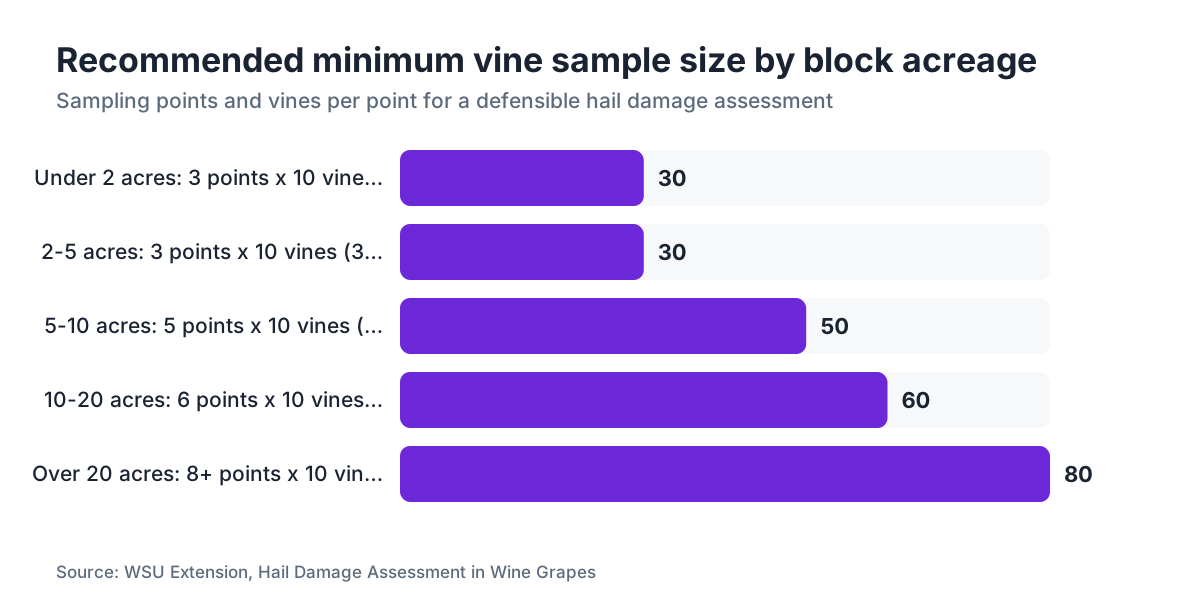
WSU Extension recommends sampling at least 10 contiguous vines per sampling point and at least 3 sampling points per block for blocks under 5 acres, more in larger blocks [2]. Count total shoots, then count damaged shoots. Count clusters, then count damaged clusters. Record raw numbers rather than percentages. Raw numbers are what an adjuster verifies against your vine count.
How do you photograph hail damage so the images are actually useful?
Photos are evidence. Treat them that way.
Check that your phone or camera is writing GPS coordinates into the image EXIF data. On most iPhones and Android devices this is on by default, but confirm it. If you shoot with a standalone camera, sync a GPS logger to the camera clock, or photograph a handwritten placard with the block ID and date before each sequence.
For each block, take at least three types of shot: one wide frame showing row orientation and trellis; one mid-range frame (roughly 3-4 feet back) showing representative shoot and cluster damage on a single vine; and close-ups of the worst damage you find, including any bark wounds or splintered canes. If hailstones are still on the ground, shoot those too, with a ruler or coin for scale.
Label files the same way every time. A convention like YYYY-MM-DD_BlockID_Shot-type (for example, 2025-06-15_Block07_Cluster-close) makes files sortable when an adjuster asks for documentation three weeks later.
Store photos in two places. A cloud backup that timestamps the upload gives you a second independent timestamp beyond the camera EXIF, which helps if anyone questions when the photos were taken.
How do you estimate yield loss by block from your damage scores?
Yield loss from hail is messier than it looks. What you see the first morning underestimates the final loss, because secondary disease pressure, mostly Botrytis, keeps destroying berries for two to four more weeks [1]. Nobody has strong predictive models here. The closest published guidance, from UC Cooperative Extension, says secondary losses after hail can equal or exceed the direct physical loss in warm, humid conditions [3].
For insurance, keep your first estimate conservative. Don't claim a loss you can't defend. For your own spray planning, assume the worst-case secondary loss and act on it.
A simple yield loss worksheet by block looks like this:
- Estimated pre-storm yield for this block (tons or lbs, from your prior-year average or current-season estimate)
- Direct cluster loss: (number of destroyed clusters / total clusters sampled) x estimated total clusters x average cluster weight
- Berry shatter loss: (percent of berries physically damaged per cluster) x remaining cluster count x average cluster weight
- Projected secondary loss: add 0-50% depending on weather forecast and current disease pressure
- Revised yield estimate: pre-storm yield minus direct loss minus secondary loss
Record all three loss rows separately. The adjuster wants to see your math, more than the bottom number.
If your blocks are in USDA's Noninsured Crop Disaster Assistance Program (NAP) rather than a private policy, the FSA requires you to notify your local FSA office before you dispose of or replant any damaged acreage, and they use their own loss forms [9].
When should you call your crop insurance agent, and what will they ask for?
Call within 72 hours. That's the RMA standard notice requirement, and missing it can sink your claim [5]. You don't need a finished assessment to make the call. Give them the storm date, the affected acreage, and your first read on severity. Then keep collecting data.
The adjuster will ask for your block map with acreage, your production history for each block (typically a 10-year APH if you have it), the completed loss forms their agency provides, and your supporting documentation, meaning your photos, your vine sample counts, and your damage scores.
They'll also ask about your spray response. If you applied a Botrytis fungicide after the hail, log that application with the usual fields: date, product, EPA registration number, rate, operator, PHI. The EPA Worker Protection Standard requires a complete pesticide application record no matter the circumstances [6]. A spray triggered by hail is not exempt. Tying your hail records to your spray records, so the sequence shows you responded fast and correctly, actually makes the insurance story stronger.
Small winery owners running their own estate blocks should also call the winery liaison at their state department of agriculture. Some states have disaster reporting programs or price support mechanisms that switch on after a qualifying weather event, and the enrollment window is often short.
How do you structure a multi-block hail assessment so nothing gets missed?
Draw your block walk order before you head out. Start with the blocks most exposed to the direction the storm came from (check the weather radar timestamp if you can pull it) and work toward the sheltered ones. The damage gradient across your property is itself useful information, and walking a logical spatial sequence makes the pattern easier to catch.
For each block, run the same sequence every time: photos first, then vine sample counts, then score entry, then notes on secondary concerns. Same order every block means you don't skip steps when you're tired and it's hot.
A sample field form for a single block assessment:
| Field | Entry |
|---|---|
| Block ID | |
| Variety / Rootstock | |
| BBCH growth stage | |
| Sample point 1: vines assessed | |
| Sample point 1: damaged shoots (count) | |
| Sample point 1: damaged clusters (count) | |
| Sample point 2: vines assessed | |
| Sample point 2: damaged shoots | |
| Sample point 2: damaged clusters | |
| Overall block damage score (0-4) | |
| GPS of worst damage site | |
| Photo file names | |
| Assessor initials | |
| Date / Time |
More than 10 blocks? Assign two people and walk at the same time. Split the property so each person covers contiguous blocks. Reconcile the forms that same evening, while it's fresh.
For growers running several properties, a shared digital record that team members fill in from the field, with automatic timestamps, cuts the reconciliation work. That's the core case for tools like VitiScribe in a multi-block hail event: everyone types into the same record, the timestamp is automatic, and you're not stapling paper forms together at 9 PM.
What follow-up actions should be triggered by hail records, and how do you document them?
A hail record should drive at least three decisions, and each one needs its own trail.
First, fungicide. Botrytis cinerea infects through wound sites within 24 hours in favorable weather. UC Cooperative Extension recommends applying a Botrytis fungicide (Group 7, 11, or 17 are common rotational choices) as soon as possible after a hail event if the growth stage runs from flowering through veraison [3][10]. That application goes into your spray record with full detail: date, product name, EPA registration number, target pest, rate per acre, total volume, operator name, weather conditions, and the exact blocks treated. This is a legal record under FIFRA and the EPA WPS [6].
Second, thinning or early harvest. If cluster damage hits score 3 or 4, log your decision to drop crop or move harvest up in the same event log. Note the estimated tons dropped and why. That supports the insurance claim and feeds your harvest forecast.
Third, cane and trunk wound monitoring. Flag any block with score 2 or higher bark damage for the dormant season. Hail wounds on canes can harbor Botryosphaeria and Eutypa, both of which cause wood disease that doesn't surface for 2-5 years [2]. A note in the block record now, linked to a dormant pruning reminder, saves you from chasing mysterious vine decline four seasons later with no idea where it started.
All three follow-up records should cross-reference the original hail event date. A linked structure, paper or digital, is what lets you rebuild the full timeline when you need it.
How does hail damage recording fit into your overall compliance record system?
Hail records don't live alone. They connect to your spray records, your pesticide use reports (required in California under the county Agricultural Commissioner system, and in other states under various programs), your harvest records, and maybe your food safety records if you're in a FSMA-regulated supply chain [7].
Here's the practical move: file your hail assessment records in the same binder or digital folder as the spray records for the matching blocks and season. When an insurance adjuster, a state pesticide inspector, or an auditor asks for a spray application from a certain date, you want it obvious at a glance that the spray followed a documented weather event, not some unexplained call.
USDA NASS collects grape acreage and production data every year, and that data helps calibrate crop insurance loss adjustments across the industry [8]. Accurate block-level loss records that you submit through your claim feed the broader system that decides how well future indemnity payments track real losses. It isn't altruism. It's the system working when growers put real numbers in.
California growers with blocks near homes should know that hail-triggered spray applications can carry extra notification duties under county Air Quality Management District rules or Pest Management Alliance agreements. Check with your local Agricultural Commissioner's office before you spray.
Are there resources or templates growers can use for hail damage assessment?
Several university extension programs publish specific tools. WSU Extension's hail damage assessment factsheet gives you a sampling protocol and a field form template [2]. Cornell Cooperative Extension's viticulture team has covered storm damage management in its Appellation Cornell series and in direct extension publications [1]. UC Cooperative Extension's Integrated Viticulture program covers disease management after physical damage [3].
The USDA Risk Management Agency publishes the Actual Production History (APH) policy document and loss claim forms, which are the forms your adjuster will use. Reading them before a storm hits saves real time [5].
For FSMA record-keeping under the Produce Safety Rule, if your operation is covered, the FDA has published compliance guides that treat weather events as potential food safety hazards [7]. A hail event that causes ground contact, soil splash, or bird feeding on damaged fruit belongs in your food safety log as a hazard that needs a corrective action.
None of these resources require expensive software. A printed field form, a smartphone camera, and a dated PDF summary are legally enough. What the digital tools add is search, linkage across seasons, and the ability to pull a block's full history in seconds when an adjuster calls. Whether that's worth the subscription is a fair question for each operation to answer, based on block count and how often you file claims.
Frequently asked questions
How soon after a hail storm do I need to notify my crop insurance agent?
The USDA Risk Management Agency standard is within 72 hours of discovering the loss. You don't need a completed assessment to make the call. Report the storm date, the blocks affected, and your rough sense of severity. Waiting longer can give the insurance company grounds to reduce or deny your claim, so call first and gather the full data second.
What growth stage is most vulnerable to hail damage in grapevines?
Flowering through early berry set (BBCH 61-75) and again at veraison (BBCH 81-85) are generally the highest-risk stages. During flowering, hail destroys the floral structures directly and cuts cluster set. At veraison, berry skins are thin and rupture easily, creating immediate Botrytis entry points. Dormant canes can absorb hail impact with less immediate effect but may develop wood disease symptoms years later.
Do I need to apply a fungicide after hail, and does that application need to be in my spray records?
UC Cooperative Extension recommends applying a Botrytis fungicide as soon as possible after hail during the period from flowering through veraison, because wound sites are infection sites. Yes, that application must be fully documented in your pesticide use records just like any other application. EPA's Worker Protection Standard and FIFRA have no weather-event exemption for record-keeping requirements.
How many vines should I sample per block to get a defensible damage estimate?
WSU Extension recommends at least 10 contiguous vines per sampling point and at least 3 sampling points per block for blocks under 5 acres. Larger blocks need more points. Count raw numbers of shoots and clusters rather than percentages, because adjusters verify against total vine counts. For a 10-acre block, sampling at 5-6 points spread across it is more defensible than concentrated samples near the access road.
Can I use my hail damage records to support a USDA Noninsured Crop Disaster Assistance Program (NAP) claim?
Yes. NAP claims through USDA's FSA office require that you notify your local FSA office before destroying, disposing of, or replanting any damaged crop. Your block-level assessment records, including photos, vine counts, and damage scores, are the supporting documentation for that claim. The FSA has its own loss forms separate from private insurance forms, so you may need to complete both.
What is the best way to document hail stone size on the farm?
Photograph hailstones right after the storm, before they melt, next to a ruler or a common reference object with a known size (a quarter is 0.955 inches, a golf ball is 1.68 inches, a baseball is 2.9 inches). Include the date and block ID in the photo or as a placard in the frame. Hailstone size correlates with impact energy and wound depth, which matters for both damage assessment and any eventual insurance review.
How do I record hail damage if I manage multiple vineyard properties or blocks under different ownership?
Keep a separate record for each ownership entity, even if you manage all of them. Insurance policies and FSA farm numbers are tied to the legal owner, so mixing records across ownerships creates claim complications. Use the same block ID system you use in your other compliance records for each property, and file each property's hail records with that property's seasonal documentation.
What secondary damage should I be watching for in the weeks after a hail event?
Botrytis cinerea infecting through wound sites is the most urgent concern, usually visible within 5-14 days in warm, humid conditions. Watch also for angular leaf spot, bacterial diseases entering through leaf wounds, and early signs of Botryosphaeria or Eutypa in cane and bark wounds. Document what you find at the 7-10 day follow-up assessment in the same block record as the original hail assessment, with dates and photos.
Do hail damage records need to be kept for a specific number of years?
USDA crop insurance records should be kept for at least 3 years after the policy year, per RMA guidance. EPA pesticide application records under FIFRA must be kept for 2 years after the application date. California's Pesticide Use Reporting system requires records for 3 years. Keep hail assessment records for at least 3 years to cover all of these overlapping windows.
Should a hail event appear in my food safety records as well as my spray and compliance records?
If your operation is covered under FDA's FSMA Produce Safety Rule, yes. A hail event that causes soil splash onto clusters, more bird or insect feeding on damaged fruit, or contaminated surface water contact should be logged as a potential hazard in your food safety plan records with a corrective action noted. The FDA's compliance guides for produce farms treat severe weather as a food safety consideration.
How do I estimate damage to canes and trunks compared to shoot and cluster damage?
Cane and trunk damage from hail is scored separately from shoot and cluster damage. Look for splintered canes, cracked bark, or spots where the cambium is exposed. Photograph and note the GPS location of the worst-affected vines. These wounds often cause no yield loss in the current season but can introduce wood disease pathogens. Flag those rows for priority monitoring during dormant pruning the following winter.
Is there a standard form growers use for hail damage assessment, or do I make my own?
WSU Extension publishes a sample field form in its hail damage assessment factsheet, and most crop insurance companies provide their own loss documentation forms once you report a claim. There is no single federal standard form for the initial field assessment. Many growers adapt the WSU or Cornell Extension templates to match their own block ID system. What matters is that every block record has the same fields so data is comparable across blocks.
Can hail damage records from one season affect my crop insurance premium in future seasons?
Yes, through the Actual Production History (APH) system. Hail losses that are properly documented and indemnified reduce your APH yield for that year, which can lower your guaranteed production level in future years. However, policies with catastrophic loss exclusions or separate hail endorsements treat the yield differently. Ask your crop insurance agent how a documented hail loss flows through your specific policy type before the season ends.
Sources
- Cornell Cooperative Extension, Grapes and Wine Program (storm and hail damage in vineyards): Cornell recommends block-by-block sampling and follow-up assessment at 7-10 days; secondary Botrytis losses after hail can equal direct physical losses under warm, humid conditions.
- WSU Extension, Hail Damage Assessment in Wine Grapes: WSU Extension recommends at least 10 contiguous vines per sampling point and at least 3 sampling points per block under 5 acres; bark wounds from hail can harbor Botryosphaeria and Eutypa, causing wood disease 2-5 years later.
- UC Agriculture and Natural Resources, Integrated Viticulture (disease management after physical damage): UC CE recommends applying a Botrytis fungicide as soon as possible after hail events from flowering through veraison; secondary losses can equal or exceed direct physical loss in warm, humid conditions.
- EPPO Global Database, BBCH growth stage scale for grapevine: Standard BBCH codes for grapevine phenology used to document growth stage at time of hail event.
- USDA Risk Management Agency, Crop Insurance Loss Reporting Requirements: RMA requires growers to notify their crop insurance agent within 72 hours of discovering a loss.
- US EPA, Agricultural Worker Protection Standard and pesticide application record-keeping: EPA WPS and FIFRA require complete pesticide application records for all applications including those triggered by weather events; private applicator records must be kept for 2 years.
- US FDA, Food Safety Modernization Act and Produce Safety Rule guidance: FDA FSMA compliance guides treat severe weather events including hail as potential food safety hazards requiring documentation in food safety records.
- USDA National Agricultural Statistics Service, Noncitrus Fruits and Nuts Annual Summary (Grapes): USDA NASS collects annual grape acreage and production data used to calibrate crop insurance loss adjustments industry-wide.
- USDA Farm Service Agency, Noninsured Crop Disaster Assistance Program (NAP): NAP requires notification to local FSA office before destroying or disposing of damaged crop; block-level assessment records are required supporting documentation.
- UC Agriculture and Natural Resources, UC IPM Botrytis bunch rot management in grape: Group 7, 11, and 17 fungicides are common rotational choices for Botrytis management after wound-causing events in vineyards.
Last updated 2026-07-10