Naming conventions for vineyard blocks across multiple properties
TL;DR
- A good block naming convention uses a short property prefix, a variety or location code, and a sequential number.
- NV-CAB-01 marks the first Cabernet block at your North Valley ranch.
- Consistency across properties matters most for spray records, WPS compliance, and harvest tracking.
- Build the system before you add your second property, not after.
Why does block naming matter so much across multiple properties?
One ranch, and informal names work fine. 'The hill block.' 'River row.' Everybody knows what you mean. Add a second property and that system falls apart overnight.
Here's how it breaks. Your foreman at Property B calls the first block he planted 'Block 1.' Your spray contractor at Property A already has a 'Block 1' on every record he's ever written. Now your harvest records, pesticide logs, and WPS training documents are carrying duplicate identifiers that point to two different pieces of dirt.
The EPA Worker Protection Standard (40 CFR Part 170) requires pesticide application records to identify the specific location where a pesticide was applied [1]. Vague or duplicate block names make that requirement nearly impossible to audit cleanly. State ag departments do ask for location-specific spray records during inspections, and 'Block 3' showing up on two different APN parcels with the same product on the same date is exactly the ambiguity that triggers a follow-up letter.
The harvest side has its own version of this problem. If you sell fruit from multiple ranches to a winery under an AVA or single-vineyard designation, the buyer's compliance team needs block-level traceability. Duplicate names are a paperwork mess for them, and it reflects on you.
Get this right before you add the second property. Retrofitting a naming system across three seasons of existing records is slow, painful, and easy to botch.
What are the most common vineyard block naming conventions in use?
There's no single industry standard. What exists is a handful of approaches that experienced growers land on independently, because they're all solving the same practical problems.
Property prefix + sequential number. The simplest system. Give each property a two or three letter code (RV for River Ranch, NV for North Valley), then number blocks in order: RV-01, RV-02, NV-01. Clean, short, unambiguous. The downside is that the code tells you nothing about variety or where the block sits on the ranch.
Property prefix + variety code + sequential number. One step richer. RV-CAB-01, RV-CHARD-01, NV-CAB-01. You read the name and know what's growing without pulling up a map. The tradeoff: codes get longer, and if you replant a block to a different variety you either live with a name that lies or rename it (and update every historical record that references it).
Property prefix + geographic subunit + number. Handy on big ranches with distinct topography: NV-HILL-01, NV-FLAT-03. Not much use on flat Lodi vineyards where geography barely differs across the property.
Owner or historical name. Some older Napa and Sonoma vineyards carry the names of former owners or legendary blocks: Martini Block, Old Vine Field. Fine for a single historic estate. It scales terribly across a multi-property operation run by a management company, because new staff have no mnemonic hook and no way to guess the pattern.
Grid or row-based systems. Used mostly in very large mechanized operations. Each block is defined by its row range within a GPS grid. Precise for routing equipment, unusable in conversation, and hard to print legibly on a field map.
For most small-to-mid operations running two to ten properties, property prefix + variety code + two-digit number hits the best balance of brevity and information.
How do you assign a property prefix without creating future conflicts?
Pick a prefix length and stick to it. Two letters works if you'll have fewer than 26 properties. Three letters gives you more room and more uniqueness. Dodge prefixes that could logically fit more than one property: if you farm both a 'Riverfront' and a 'Ridgeline' ranch, 'RI' is a trap. Use initials of the formal APN parcel name or the name on the farming agreement, not nicknames that shift over time.
Keep a master prefix registry in a shared document or spreadsheet, ideally version-controlled. Every time you add a property, register its prefix before any field work starts. This sounds bureaucratic for a two-ranch operation, but the overhead is tiny, and it stops the scenario where two employees independently coin the same prefix for different properties.
Managing properties for multiple clients? Put a client code at the outermost level: [ClientCode]-[PropertyCode]-[BlockCode]. Acme Vineyards' River Ranch Block 1 becomes ACM-RV-01. That layer adds two characters and makes your spray logs and invoices unambiguous from the first line.
WSU Extension's farm records guidance recommends that any identifier used in pesticide records be unique, persistent, and cross-referenced to a parcel map [2]. That three-part test is a good internal standard to hold any prefix against.
Should the block name include variety, clone, or rootstock?
Variety codes in block names are popular and genuinely handy for quick reference. But they create a maintenance headache. Blocks get replanted. A 1992 Chardonnay block might get grafted over to Pinot Gris in 2019. If the name is RV-CHARD-04, you now own a Pinot Gris block wearing a Chardonnay name, and rewriting every historical spray record to a new name is not realistic.
The cleaner approach treats variety as an attribute of the block, not part of its name. The block is RV-04. Your block registry (even a plain spreadsheet) records that RV-04 was planted to Chardonnay clone 4 in 1992, then top-worked to Pinot Gris in 2019. The name never changes. The attributes update.
Clone and rootstock belong in your records for sure, but they're too granular and too changeable to build into the primary identifier. UC Davis Cooperative Extension's vineyard record-keeping guidance treats the block as a fixed location unit and handles variety and clone as descriptive fields tied to that unit [3]. That's the right mental model.
For operations where reading a variety off the name matters more than long-term database hygiene (a small family ranch with one employee), tucking a variety abbreviation into the name is a fair trade. Just know what you're giving up.
How many digits should a block number have, and when should you use letters?
Use two digits minimum: 01, 02, not 1, 2. Once you pass 10 blocks per property, single-digit numbers sort wrong in spreadsheets and databases unless you've set up custom sort logic. Two digits sort correctly up to 99, and almost no single property has more than 99 distinct blocks.
Three digits (001, 002) are worth a look if any single property might someday clear 99 blocks, which is realistic for a large Central Valley operation. Paso Robles wineries running estate vineyards sometimes carry block counts in that range across one big ranch [see /paso-robles-wineries].
Letters inside the numeric portion breed ambiguity. Is RV-04A a subblock of RV-04, or a distinct block that came after RV-04 was split? Define it explicitly if you go that route. The safer move is to treat a subdivided block as new blocks: retire RV-04, replace it with RV-04a and RV-04b spelled out in the registry, with notes explaining the history.
Some operations run purely numeric systems with no letters anywhere, which makes life easier if you're piping data into any kind of software. All-numeric codes travel clean across platforms. No case-sensitivity issues, no character encoding problems, no CSV import surprises.
What's the difference between a block, a lot, and a picking unit for record-keeping?
People use these three terms interchangeably in conversation, but they mean different things in formal records, and mixing them up causes real compliance problems.
A block is a permanent geographic unit defined by its location on the ranch. It's tied to an APN, a GPS boundary, and a planting history. For EPA WPS purposes, the block is the location identifier on a pesticide application record [1].
A lot is a harvest unit, usually defined at crush. It might match one block exactly, or combine several blocks picked the same day at similar Brix, or split one block if a row-by-row look reveals disease variation. Lots are defined by the winery or crush facility, not the grower.
A picking unit is operational. It's the smallest chunk a crew harvests in a single pass. Sometimes it's smaller than a block (east rows today, west rows tomorrow), sometimes it matches the block exactly.
Spray records use blocks. Quality and traceability records use lots. Keep picking unit data only as long as it's operationally useful. Blurring these three is one of the most common sources of audit confusion Cornell's viticulture extension team has flagged in its field record reviews [4].
Tools like VitiScribe let you link blocks, lots, and picking units in one record so each type of data lands in its correct field instead of a free-text note.
How should spray records reference block names to stay EPA-compliant?
Under 40 CFR Part 170, the EPA Worker Protection Standard, commercial pesticide application records must include the location where a restricted-use pesticide was applied [1]. Most state lead agencies read 'location' as something specific enough to find the field on a map, more than a county or a ranch name.
Your block name alone usually clears this bar if it's unambiguous and cross-referenced to a parcel map. But 'Block 3,' no prefix, on a grower who farms multiple APNs, does not. The record has to uniquely identify the spot.
The California Department of Pesticide Regulation (CDPR) requires pesticide use reports to include the county, section, township, and range (or equivalent GPS coordinates), plus the site name or field identifier [5]. Your block name is that field identifier. Keep it unambiguous and use it consistently, and you're in good shape. Let block names go informal or duplicate across properties, and you're exposed.
Keep a current block map, even a hand-drawn one with GPS corners noted, physically filed with your pesticide records. The map ties the name to a real location. Without that tie, the name is just a label.
New York's DEC and Washington's WSDA have similar requirements, and the practical test is the same everywhere: a name that lets an inspector stand in the right spot, in the right county, on the right parcel [6].
What naming system works best for a vineyard management company running many client ranches?
The stakes climb fast for a management company. Multiple clients, each with their own APNs, each capable of sharing block number sequences unless you build the walls in from day one.
The structure that holds up: [ClientCode]-[PropertyCode]-[BlockCode]. Three tiers. No exceptions.
Client codes run three characters, registered in your master list before any field work begins. Property codes run two characters. Block codes are two-digit sequential numbers. The first Cabernet block at the Johnson family's Hillside Ranch becomes JHN-HS-01. Eight characters, globally unique inside your system.
Some management companies also append a vintage year to the application record (not the block name itself): JHN-HS-01-2024. That makes multi-year spray record retrieval by block much cleaner.
One detail trips up management companies constantly: your field crews' handhelds or paper forms have to use the same block name that shows up in the records you hand clients. A crew that calls a block 'the corner block' out loud but writes JHN-HS-04 is fine. A crew that writes 'corner block' on the spray record and JHN-HS-04 on the invoice hands you a reconciliation problem.
For operations running south coast winery or mountain winery estate vineyards with distinct topographic subunits, a geographic subcode between the property and the block number can earn its extra character if it helps daily crew communication.
How do you handle block naming when properties are acquired mid-season?
This happens more than people plan for. You take on a property in June, you need spray records that afternoon, and the previous operator had their own naming system, possibly a bad one.
Don't try to preserve the previous operator's block names if they clash with yours. Register new names right away, note the old names in an 'alias' field in your registry, and start all new records on the new names. For records you inherit from the prior operator, keep them in a separate file or folder labeled clearly, something like 'Pre-acquisition records, prior operator naming,' and don't merge them into your current set.
This matters. If there's ever a re-entry interval dispute or an injury claim, the record history from before your tenure has to be clearly separate from what you're responsible for. Commingling two naming systems in one continuous record set makes it look like you own the prior operator's applications.
For the map, survey the physical blocks as early as you can and set GPS corners. The prior operator's hand-drawn maps are a starting point, not gospel. Walk the rows before you trust them.
If the deal closes at harvest, you may be stuck issuing picking unit records under the old names for a few weeks just to match what the crush facility has on file. That's fine. Note in the record that the old names map to your new registered codes, and finish the formal transition after crush.
Comparison of vineyard block naming systems: tradeoffs at a glance
The table below compares the main naming approaches on the dimensions that matter most for multi-property operations.
| System | Example | Length | Information density | Replant-safe | Scales to 10+ properties |
|---|---|---|---|---|---|
| Property prefix + sequential number | NV-01 | Short (5 chars) | Low | Yes | Yes |
| Property prefix + variety + number | NV-CAB-01 | Medium (9 chars) | High | No (names go stale) | Yes |
| Property prefix + geography + number | NV-HILL-01 | Medium (10 chars) | Medium | Yes | Yes |
| Client + property + number (mgmt co) | JHN-NV-01 | Longer (9+ chars) | Medium | Yes | Yes |
| Historical / informal names | 'Old Vine Block' | Variable | High contextually | No | No |
The replant-safe column is the one most operations get wrong. Embedding variety in a permanent identifier feels useful right up until the first top-working job, and then it hands you either a lying name or a record-correction project.
What should a block registry document actually contain?
The block name is only as good as the registry behind it. A minimal registry for a multi-property operation carries, for each block:
- Block name (your official code)
- Property name and APN
- GPS coordinates of corners or centroid
- Acreage (gross and net)
- Variety (current, with history if replanted)
- Clone and rootstock (current, with history)
- Row spacing and vine spacing
- Year planted (each planting cycle if top-worked)
- Trellis system
- Irrigation system type
- Current status (active, fallow, retired)
- Any aliases (previous operator names, informal crew names)
That's 13 fields. It fits in a single spreadsheet row. You don't need expensive software to keep this, though software helps once the list clears about 40 blocks and you're cross-referencing against spray records. The vineyard record system you pick, paper or digital, has to be able to spit out this registry on demand.
Cornell Cooperative Extension's vineyard record-keeping guidance recommends reviewing and updating the block registry at least twice a year: once at pruning (to catch trellis or density changes) and once after harvest (to catch picking unit splits and any retiring of blocks) [4].
Store the registry somewhere your spray contractor, harvest crew foreman, and winery contact can all pull a read-only copy. Version control counts here. Date every revision and keep the prior version on file.
How do you train crews and contractors to use the naming system correctly?
A naming convention only works if every person writing on a field record uses it. That's your own crew, your spray contractor, your irrigation company, and the winery's field rep.
The most common failure is contractors who log by their own internal job numbers instead of your block names. A spray contractor might file your application as 'Job #4471' in their system and write your block name on the customer copy, or they might not. Ask to see their record format before the first application and confirm your block name shows up as the location identifier, more than the ranch name.
For your own crew, laminate a one-page block map with names labeled and clip it to every piece of equipment that touches paperwork: the tractor cab, the spray rig, the harvest gondola clipboard. When somebody asks 'which block?', the answer is on the map. No memorizing.
WPS re-entry interval posting is another touchpoint. Under 40 CFR Part 170, application-specific information has to be posted at a central location workers can reach, and it has to identify the treated area [1]. If your posting says 'NV-03' and your map shows where NV-03 sits, you've met the location requirement. If the posting says 'the hill block,' you haven't.
New hire orientation should include a ten-minute block map walkthrough. For most properties it really is that quick. It pays back the first time a new employee fills out a spray record correctly without asking for help.
What mistakes do multi-property vineyard operations make most often with block naming?
The biggest mistake is not building a system until there's a problem. Operations that run on informal names for years often have no documented reason blocks are numbered the way they are, no map tying names to locations, and no process for naming new blocks. Bolt a second property onto that, and the chaos multiplies.
The second is letting variety or owner names drift into the identifier in ways that go wrong over time. 'The Johnson Block' stopped being the Johnson family's in 2017. 'Chardonnay Row 3' is Pinot Noir now. But the names stuck in the records.
Third is inconsistent application. You have a system on paper, but your spray contractor writes something different, your harvest crew writes something else, and your QuickBooks invoices use a third variation. The system exists. Nobody enforces it at the touchpoints that generate records.
Fourth is no version history. Blocks retire, split, and merge. Without a documented history of which codes have been active, retired, or reassigned, records from five years back get hard to read. NV-12 in 2018 might point to an entirely different piece of ground than NV-12 in 2024 if you retired and reused the number.
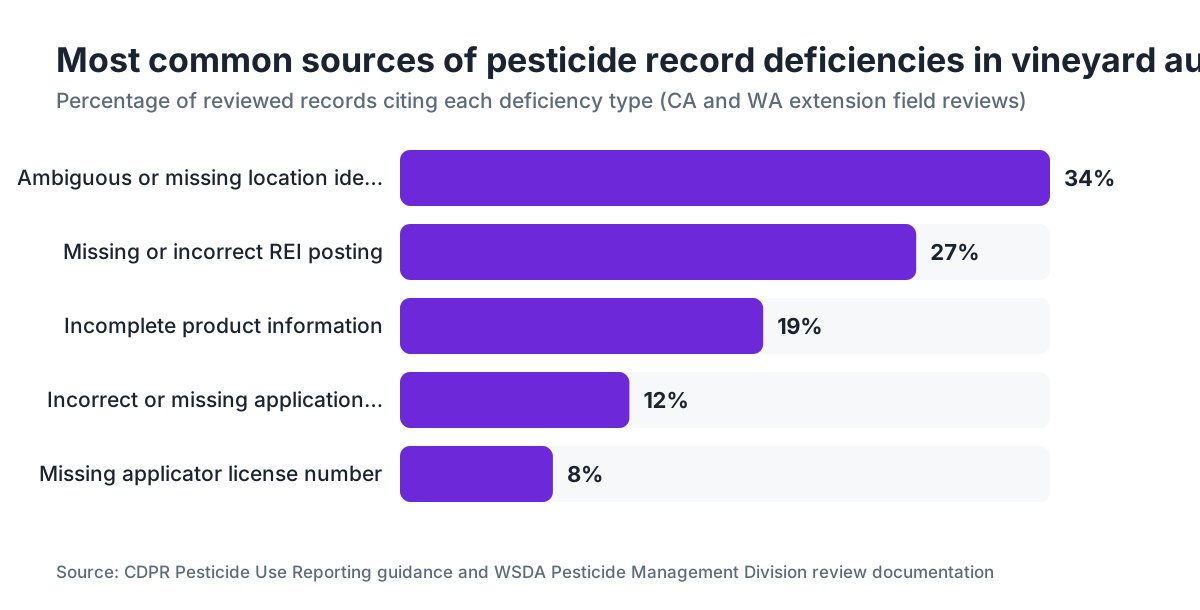
Nobody has good industry-wide data on how often block naming errors cause compliance issues. But extension advisors in California and Washington consistently rank location identification among the top sources of pesticide record deficiencies during routine reviews [5][6].
If you want a tool that enforces one block naming standard across spray records, harvest logs, and crew timesheets, VitiScribe is worth a trial. Define the block registry once, and every downstream record pulls from the same controlled list.
Frequently asked questions
Can I use the same block number on two different properties?
No, not without a property prefix that makes the full identifier unique. A block called '01' at both properties is a duplicate. NV-01 and RV-01 are fine because the prefix separates them. The test: can an inspector, a spray contractor, or a harvest crew member look at any record and know exactly which physical location it points to without asking a follow-up question?
Do federal regulations require a specific block naming format for pesticide records?
No specific format is mandated. The EPA Worker Protection Standard (40 CFR Part 170) requires application records to identify the location where a pesticide was applied, but it doesn't prescribe a naming format [1]. State agencies like California's CDPR require a site name or field identifier plus section, township, and range or GPS coordinates [5]. Your block name is the field identifier. The format is yours to set, as long as it's unambiguous and applied consistently.
How do I handle blocks that straddle two APNs?
Assign the block to the APN covering most of its acreage, and document the split in your registry with the acreage on each parcel noted. Some state pesticide records (California in particular) require the APN or township-range on application records, so you may need to split the spray record into two entries, one per parcel, even for a single application pass over one contiguous block.
Should block names appear on wine labels or marketing materials?
Your formal block codes (NV-01, JHN-HS-04) are operational identifiers and usually aren't consumer-facing. If a winery wants to market a single-block wine, they'll give it a commercial name separate from your operational code. Keep those two systems apart. The TTB requires any geographic designation on a wine label to meet specific sourcing rules, but those rules apply to the wine, not to a grower's internal block naming [7].
What if the vineyard I just bought has a completely different naming system than mine?
Transition to your system immediately for all new records, and document the mapping between old and new names in your registry under an 'aliases' or 'prior names' field. Keep pre-acquisition records in a separate folder labeled with the prior operator's tenure. Don't merge old records into your current naming system. Reference them as historical files if they're ever needed for residue history or an audit.
How granular should block definitions be? Is a half-acre strip its own block?
Define blocks by management unit, not by arbitrary size. If you spray, prune, irrigate, and harvest a half-acre strip separately because it has a different variety, rootstock, or microclimate, it's a block. If it's managed just like the area next to it and picked together, it's part of that larger block. The useful test from UC Davis extension: would you ever write a spray or harvest record specific to this area and not the one beside it? If yes, it's a block [3].
How do I keep a block map up to date without a GIS department?
A laminated hand-drawn map with GPS corners noted in the margin is legally sufficient and practically useful. Update it after any physical change: a new trellis row, a retired block, a subdivision. Date every revision and keep prior versions on file. Free tools like Google Earth let you draw and export block polygons as a PDF with no GIS expertise. The map doesn't need to be pretty. It needs to be accurate and reachable by everyone writing field records.
Do WPS worker training records need to reference specific block names?
WPS training records don't need block names, but WPS application-specific information postings do. Under 40 CFR Part 170, the central-location posting has to identify the treated area and the restricted-entry interval [1]. If your posting references a block name, that name has to be interpretable by workers, which means the laminated block map or an equivalent needs to be available to them. Training records reference the ranch or operation, not individual blocks.
What's the best way to retire a block name when a block is removed?
Mark it 'retired' with a retirement date in your registry. Never reuse the code for a different block. The retired code stays in the registry as a historical record. If you plant a new block in the same physical spot after a removal, it gets a new code. This keeps your spray and harvest records from the old block unambiguous. The pile of codes you build over time is not a problem worth solving by recycling numbers.
How should block names appear in harvest tonnage reports submitted to a winery?
Use your formal block codes in all official documents. Many wineries will ask you to map your codes to their internal lot system, and that mapping document should be signed and dated by both parties at the start of the season. This protects you if their records and yours ever diverge. If the winery uses only informal names (The Hillside, The Flats), push them to add your formal code as a reference field, even just in parentheses.
Is there a vineyard industry standard body that publishes block naming guidelines?
No single body publishes a mandatory standard. UC Davis Cooperative Extension, Cornell Cooperative Extension, and WSU Extension all publish vineyard record-keeping guidance that addresses block identification, and they consistently recommend fixed, location-based identifiers cross-referenced to parcel maps [2][3][4]. The EPA and CDPR set the legal floor through pesticide record requirements, not through the naming format itself.
How do block naming conventions affect organic certification record-keeping?
USDA National Organic Program (NOP) regulations under 7 CFR Part 205 require the organic system plan to identify and describe each field [8]. Your block naming has to match between your farm plan and your field application records. A block listed in your organic system plan as NV-03 must be called NV-03 in every input and harvest record you submit to your certifier. Name drift between internal records and certifier submissions is a common trigger for a corrective action request during organic audits.
What software features should I look for to support block-level record-keeping across properties?
Look for a system that maintains a controlled block registry (so names can't be free-typed differently each time), supports multiple properties under one account, links spray records to specific blocks rather than just ranch names, and can export block-specific reports for a date range. The ability to attach a block map or GPS polygon to each record saves real time during audits. Batch record entry across multiple blocks in one application event also matters for large operations.
Sources
- U.S. EPA, Electronic Code of Federal Regulations, 40 CFR Part 170 (Worker Protection Standard): EPA WPS requires pesticide application records to identify the location where a pesticide was applied and requires application-specific information postings to identify the treated area.
- WSU Extension, Farm Records and Management: WSU Extension farm records guidance recommends that any identifier used in pesticide records be unique, persistent, and cross-referenced to a parcel map.
- UC Davis Cooperative Extension, Vineyard Record Keeping: UC Davis Cooperative Extension describes block identity as a fixed location unit and treats variety and clone as descriptive fields associated with that unit.
- Cornell Cooperative Extension, Viticulture Program: Cornell's viticulture extension team has documented confusion between blocks, lots, and picking units as a common source of audit confusion in field record reviews, and recommends updating block registries at pruning and after harvest.
- California Department of Pesticide Regulation, Pesticide Use Reporting: CDPR requires that pesticide use reports include the county, section, township, and range or equivalent GPS coordinates, plus the site name or field identifier.
- Washington State Department of Agriculture, Pesticide Management: WSDA pesticide record requirements include location identification specific enough for an inspector to identify the field, consistent with the practical standard applied during routine reviews.
- Alcohol and Tobacco Tax and Trade Bureau (TTB): TTB requires that geographic designations on wine labels meet specific sourcing rules; these apply to the wine, not to a grower's internal block naming conventions.
- USDA Agricultural Marketing Service, National Organic Program, 7 CFR Part 205: NOP regulations require that organic system plans identify and describe each field, and that block names be consistent between the farm plan and all field application and harvest records submitted to the certifier.
- UC Davis Cooperative Extension, Viticulture and Enology: UC Davis extension outlines that a block is appropriately defined as the smallest management unit for which separate spray, harvest, or cultural practice records would be maintained.
- U.S. EPA, Agricultural Worker Protection Standard: The WPS applies to workers and handlers on farms producing agricultural plants, including wine grapes, and requires location-specific record-keeping for pesticide applications.
Last updated 2026-07-11