How to document an emergency action plan for vineyard chemical exposure

TL;DR
- A vineyard chemical exposure emergency action plan (EAP) has to name emergency contacts, spell out decontamination steps, identify the nearest medical facility, and exist in writing before any pesticide goes out.
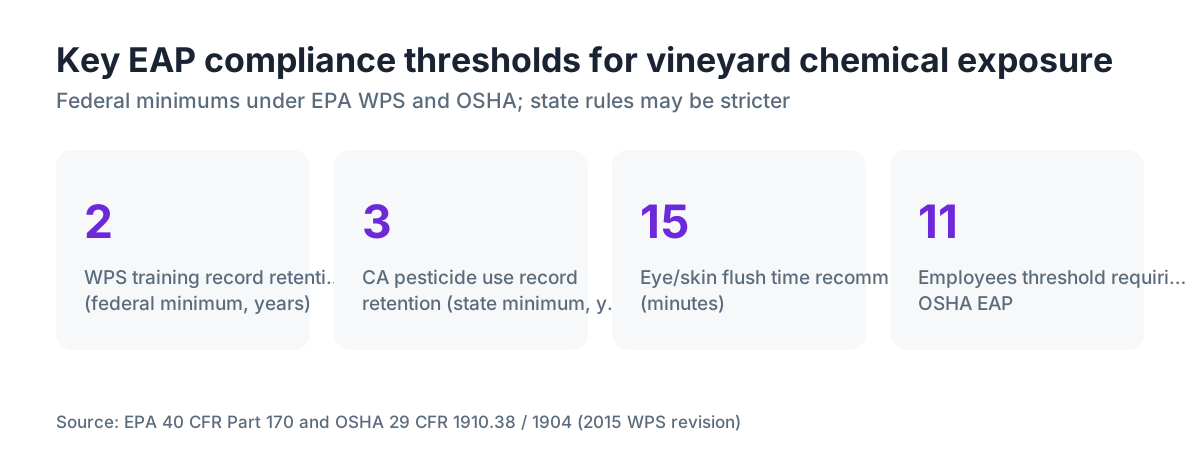
- The EPA Worker Protection Standard (40 CFR Part 170) and OSHA 29 CFR 1910.38 both require documentation before workers enter treated areas, and WPS training records must be kept two years.
What does the law actually require for a vineyard EAP?
Two federal rules overlap here, and you have to satisfy both. OSHA's Emergency Action Plan standard, 29 CFR 1910.38, covers any employer with more than ten employees and requires a written plan with evacuation procedures, emergency escape routes, procedures for anyone who stays behind to run critical equipment, and a way to account for every worker after evacuation [1]. Ten or fewer employees? You can keep the plan oral. But you still have to describe every element on demand, so write it down anyway. An oral plan disappears the moment your foreman quits.
The EPA Worker Protection Standard (WPS), at 40 CFR Part 170, adds pesticide-specific requirements. The 2015 revision requires agricultural employers to give emergency assistance to workers and handlers who may have been exposed. You have to make transportation available to a medical facility, hand the product's Safety Data Sheet (SDS) to the treating physician, and post the name, address, and phone number of the nearest emergency medical facility at your central display location [2]. The WPS never uses the word "EAP." Its requirements are exactly what a well-built EAP satisfies.
California, Washington, and Oregon each stack state rules on top. California's Division of Occupational Safety and Health (Cal/OSHA) requires every employer to have an Injury and Illness Prevention Program (IIPP) that references emergency procedures, and the California Department of Pesticide Regulation (CDPR) requires pesticide safety information posted at a central location accessible during working hours [3]. The Washington State Department of Agriculture enforces its own WPS program and expects emergency medical information posted at each work site, more than at a single hub [4]. Check your state ag department's addendums before you finalize anything.
What specific elements must the written EAP document include?
Think of the EAP as four layers: people, place, chemicals, procedures.
People layer. Name specific people, more than job titles, for each role. Who calls 911? Who escorts an injured worker to the vehicle? Who grabs the SDS? Who shuts off the spray rig? Title-only assignments fail the first time there's turnover. List the after-hours contact for the owner or vineyard manager too, because exposures happen on weekends.
Place layer. Include a simple site map showing the nearest unlocked exit from each block, the eyewash station, the first-aid kit, and the address (with GPS coordinates, more than parcel descriptions) you'll read to a 911 dispatcher. Rural vineyard roads do not show up cleanly in consumer GPS. Pre-load the coordinates. The WPS central posting location must display the name, address, and phone number of the nearest emergency medical facility [2].
Chemicals layer. The EAP has to reference or attach a current SDS for every pesticide and fertilizer on site. Under the WPS, the employer must provide the SDS to the emergency medical facility treating an exposed worker [2]. Keep a printed SDS binder in the spray rig and a duplicate in the office. Digital-only fails when cell service is out, which is most of the time in a vineyard.
Procedures layer. Write step-by-step decontamination instructions: remove contaminated clothing, flush skin with water for at least 15 minutes (that number is not arbitrary; it comes from OSHA first-aid guidance and most pesticide SDS documents), flush eyes for 15 to 20 minutes on eye contact, do not induce vomiting for ingestion, call Poison Control at 1-800-222-1222. Write these so a panicked seasonal worker can follow them. Short sentences. Simple words. Then document the route to the nearest emergency room with an estimated drive time. That estimate matters. If you're 45 minutes from an ER, your plan and your first-aid supplies have to reflect that.
How do you document decontamination procedures for pesticide exposure?
Decontamination is the most useful section of the EAP and the one most often botched. Botched usually means too vague ("flush with water") or too technical (copied straight off the SDS with no translation).
The WPS requires decontamination supplies, including water for routine washing, eye flushing, and emergency decontamination, to be available at all times when workers or handlers are in the field [2]. For early-entry workers or handlers, the supply must be at least 3 gallons per person for routine washing, plus enough clean water for emergency whole-body washing. Document the location and volume of that water in the plan. An inspecting officer from EPA or your state ag department will check it.
For the written procedure, organize the steps by exposure route: skin, eyes, inhalation, ingestion. UC Agriculture and Natural Resources pesticide safety guidance uses this structure [5]. Each route has a different first response. Skin contact, flush and remove clothing. Eye contact, flush immediately and continuously. Inhalation, move to fresh air, position the person comfortably, call 911 if breathing is labored. Ingestion, call Poison Control, give nothing by mouth unless directed. Write each scenario as a numbered list on a laminated card posted on the spray rig and inside the equipment shed.
Date every version of the decontamination procedure. Add a new active ingredient with different first-aid requirements, and the procedure has to be updated before that product goes out. Keep superseded versions in a file with a note on why they changed. That version history protects you if anyone asks what procedures were in place on a specific date.
What training records do you need to keep, and for how long?
This is where small operations get caught. The plan exists. The training happened. The records don't.
Under the revised WPS (effective January 2, 2017 for most provisions), agricultural employers must train workers before they enter a treated area or an area under a Restricted-Entry Interval (REI), and must keep those training records for two years [2]. The record has to include the worker's name, the date of training, a description of the materials used, and the trainer's name. A signed sign-in sheet plus a photocopy of the training materials satisfies this. A note scribbled on a desk calendar does not.
OSHA's Hazard Communication Standard (29 CFR 1910.1200) requires that employees be trained on the hazards of chemicals they may contact and that the employer keep records of that training [6]. For pesticide work this overlaps heavily with WPS training but is not identical. HazCom covers SDS interpretation, label reading, and PPE use. WPS covers restricted-entry intervals, worker rights, and emergency procedures.
Keep both in the same binder but on separate pages, each labeled with the standard it satisfies. Cornell's Pesticide Management Education Program recommends one training log with columns for the regulatory standard (WPS, HazCom, state), the product or hazard covered, the trainer's name, and the trainee's signature [7]. Simple. Audit-ready.
Two years is the federal floor. California requires three years for certain pesticide records under the California Food and Agricultural Code [3]. Keep records three years if you operate in California, and check your state ag department for the equivalent rule everywhere else.
How do you document emergency contacts and medical facility information?
The WPS central posting requirement is specific. The display must sit in a location workers can reach during their work period, and it must name the nearest emergency medical facility with address and phone number [2]. "Nearest" means nearest to the work site, which may not be nearest to the winery office. Run a drive-time calculation from your most remote blocks.
Your EAP should carry that same information plus several backups. The National Poison Control Center hotline is 1-800-222-1222 and runs 24 hours a day. Put it at the top of every page. Then list the nearest emergency room, the nearest urgent care (handy for non-critical cases), and your workers' comp insurer's nurse hotline if one exists.
For remote blocks, include the GPS coordinates of the block entrance and the closest paved road. If your county's 911 addressing system differs from your parcel map, write the 911 address explicitly. Rural emergency services increasingly run CAD (computer-aided dispatch) systems that need a proper 911 address, not a county road number.
Update this contact information every year, at minimum, before the first spray application of the season. Emergency rooms consolidate and close. Urgent care clinics move. A contact list that was right in 2022 can route an injured worker to a shuttered facility in 2025. Assign one person to verify every number and address annually and record the date they did it.
How do you set up the WPS central posting location correctly?
The WPS central posting location is a specific regulatory requirement, worth its own EAP section. Under 40 CFR 170.311, the agricultural employer must establish a central location at the establishment that workers can access during their work period, and post or make available specific information there at all times [2].
Required postings include the EPA WPS safety poster ("Protecting Workers and Handlers from Pesticide Exposure"), the name, address, and telephone number of the nearest emergency medical facility, and application-specific details for any pesticide workers might contact: product name, EPA registration number, active ingredient, first-aid instructions, REI, and the location and description of treated areas.
A central posting location is usually a bulletin board near a time clock, a break room, or the chemical storage entrance. It cannot be locked during working hours. Under the 2015 revision, employers with 11 or more workers or handlers on any single day in the previous 12 months must also make the SDS available to workers who ask [2].
Document the posting location itself in your EAP. Photograph the board quarterly, date the photo, and keep it in your compliance file. If an inspector or an injured worker's attorney asks whether the information was posted on a specific date, a dated photo is real evidence. A line in a spreadsheet is not.
What PPE documentation goes in the EAP?
Personal protective equipment requirements come off the pesticide label, which under FIFRA is a legal document. The label sets minimum PPE. Your EAP should document both the label requirements and any tougher standards you impose.
For each product in your program, document the label-specified PPE for mixers/loaders, applicators, and early-entry workers, along with the REI. Keep it in a pesticide use log that references the EAP. WSU Extension has published a pesticide application record template with PPE fields alongside application rate, location, and weather conditions [8].
The EAP should also document where PPE is stored, how it gets cleaned (most label PPE must be washed separately from household laundry), and the replacement schedule. Respirator cartridges have a shelf life once the foil is opened. Chemical-resistant gloves crack and degrade. Document inspection and replacement dates.
OSHA's respiratory protection standard (29 CFR 1910.134) requires any employer whose workers use respirators to keep a written respiratory protection program, run fit-testing, and hold medical evaluation records [9]. If your applicators wear half-face respirators, that's a separate documented program from the EAP, but cross-reference it in the EAP's PPE section so an auditor finds everything in one pass.
How should the EAP be reviewed and updated each season?
A plan nobody reviews turns into a liability. The common practice, supported by extension guidance from UC ANR and Cornell, is an annual review before the first pesticide application of the year, plus an ad-hoc review any time there's a reportable incident, a real change in the pesticide program, a change in key personnel, or a change in work-site locations [5] [7].
The annual review checklist covers the basics: are all emergency contacts current, is the nearest medical facility still accurate, are the SDS documents current for every registered pesticide, has the central posting board been refreshed, are PPE supplies adequate and unexpired, have all new workers had WPS and HazCom training, and has the EAP been signed and dated by the responsible person.
That last step matters. A signed, dated document establishes when the review happened. Courts and agencies give weight to a consistent, dated review history. An EAP with a single date from five years ago looks like something written to satisfy an auditor and then forgotten.
For operations tracking spray records across many blocks, a digital system helps connect the EAP to individual application records. VitiScribe is built around exactly this kind of linked documentation, where a spray event ties to the current EAP, the current SDS binder, and the current worker training log in one place.
After any actual exposure, add an incident report to the EAP file. Describe what happened, what procedures got followed, what worked, and what you'd change. OSHA's injury and illness recordkeeping rules (29 CFR Part 1904) require this for incidents involving medical treatment beyond first aid [6], and it's good practice for every incident regardless of severity.
What does a chemical exposure incident report need to document?
When an exposure actually happens, the documentation you create in the first 24 hours matters as much as the plan you built in advance. OSHA's injury and illness recording rule (29 CFR Part 1904) requires employers with more than 10 employees to record work-related injuries and illnesses that cause days away from work, restricted duty, loss of consciousness, or medical treatment beyond first aid [6]. An exposure with only minor skin flushing and no further treatment usually isn't OSHA-recordable. Document it anyway.
The incident report should capture the date, time, and location of the exposure; the exposed worker's name and role; the pesticide involved (product name and EPA registration number); the exposure route (skin, eyes, inhalation, ingestion); the PPE worn; the decontamination steps taken and by whom; whether the worker went to a medical facility and which one; and the names and contact details of any witnesses.
Attach a copy of the SDS for the product, a copy of that day's spray application record, and any notes from the treating physician. Under the WPS, the employer must provide the SDS to the treating physician when transportation is provided [2]. Document that you did.
Workers' comp claims require a separate employer's report of injury, usually within 24 to 72 hours depending on state law. The WPS incident report and the workers' comp report are different documents for different requirements. Both need to exist. File copies of both in the EAP compliance binder and keep them at least three years, longer if a claim is contested.
Are there template resources from extension programs you can use?
Yes, and using them beats writing from scratch. Extension programs have checked their templates against federal and state requirements, and a recognized template gives you a defensible starting point if you're ever audited.
UC Cooperative Extension and the UC Agriculture and Natural Resources network have produced Worker Protection Standard training materials and pesticide safety guides built for California vineyards and tree fruit. Their Pesticide Safety Education Program materials are available through the UC ANR catalog [5].
Cornell's Pesticide Management Education Program (PMEP) publishes pesticide application record templates, SDS filing guidance, and WPS compliance checklists that get heavy use in the Northeast and download for free [7].
WSU Extension's viticulture and enology work includes spray record templates and WPS training materials adapted for Pacific Northwest conditions, with guidance on documenting REIs and handler certifications across vineyards with blocks that ripen at different times [8].
EPA's own WPS resources include a compliance guide for agricultural employers that walks through each requirement with examples [2]. It's dense but authoritative. When EPA's own document describes what a central posting must include, that description is what an EPA inspector uses when they walk onto your property.
For operations running a big spray program across many blocks, VitiScribe's spray record module connects application records to the worker training log and SDS library, which makes producing a complete compliance package faster when you need it.
None of these templates replaces a conversation with your state ag department or a licensed certified crop adviser (CCA) who knows your state's specific requirements. They give you a solid, compliant foundation to build on.
How do you handle EAP documentation for H-2A workers and non-English speakers?
This is one of the most frequently cited deficiencies in WPS audits. The WPS requires safety information to be provided to workers in a language they understand [2]. For many vineyard operations that means Spanish at minimum, and sometimes Mixtec or another indigenous language.
EPA has produced official WPS materials in Spanish, available for download from the EPA website [2]. The official Spanish-language WPS poster satisfies the central posting requirement for Spanish-speaking workers. For training, the employer has to confirm that workers actually understood it, more than that it occurred. A sign-in sheet where the worker signs a Spanish-language acknowledgment beats an English-only document a non-English speaker was handed to sign.
H-2A workers get disclosures in their native language before they leave their home country, but those disclosures don't satisfy WPS or HazCom training. WPS training must happen before entry into a treated area or an area under an REI, no matter what pesticide safety content the H-2A onboarding included [2].
Document the language of training in the record. If a bilingual trainer taught in Spanish, note that. If you used translated materials, note which ones and keep a copy. This documentation protects the worker, and it protects you.
Frequently asked questions
Does a small vineyard with fewer than 11 employees need a written EAP?
Under OSHA 29 CFR 1910.38, employers with 10 or fewer employees can keep the EAP oral instead of written. But the EPA Worker Protection Standard requires written pesticide application records and central posting regardless of size. Write the plan down. An oral plan is not retrievable once the person who knew it leaves, and it offers no protection in a workers' comp dispute.
What is the nearest emergency medical facility requirement under the WPS?
Under 40 CFR 170.311, the agricultural employer must post the name, address, and phone number of the nearest emergency medical facility at the WPS central posting location and keep it current. 'Nearest' means nearest to the work site, not the winery office. Verify it before every season. Emergency facilities consolidate and relocate more often than most operators realize.
How long must vineyard pesticide training records be kept?
The EPA WPS requires training records to be kept two years. California's CDPR requires certain pesticide use records for three years under state law. If you operate in California or any state with a longer retention rule, use the state standard. Keep records past the minimum whenever an exposure incident or workers' comp claim is open or pending.
Can the EAP and the WPS central posting information be in the same document?
Yes, and combining them into one posted document cuts duplication. Many operators use a laminated binder at the central location with the WPS poster, emergency contacts, the nearest medical facility, current application records with REIs, and first-aid procedures. The EAP proper is a more detailed internal document, but a summary version at the posting location satisfies both sets of requirements at once.
What should a vineyard do immediately after a pesticide exposure incident?
Follow the decontamination steps on the SDS first. Then transport the worker to an emergency medical facility if needed and bring the SDS. Document the incident within 24 hours: worker's name, product involved, exposure route, PPE worn, steps taken, and where the worker was treated. File an OSHA injury report if the incident meets the recordkeeping threshold. Report to your state ag department if state pesticide rules require it.
Does the EAP need to cover chemical exposure from fertilizers and sulfur, or only registered pesticides?
OSHA's Hazard Communication Standard covers any hazardous chemical in the workplace, including fertilizers, sulfur, and copper-based fungicides, more than just EPA-registered pesticides. Every substance with an SDS has to be addressed in your HazCom program, which is part of the EAP framework. Elemental sulfur, applied all over vineyards as a fungicide and a strong respiratory irritant at application, is a good example of a chemical that needs documented first-aid procedures.
Who is responsible for ensuring the EAP is followed during an actual emergency?
The EAP has to name a specific person as plan administrator or emergency coordinator, more than a title. That person directs evacuation, accounts for all workers, and coordinates with emergency services. When that person is unavailable, a named backup takes over. Document both names and their contact information in the plan, and train both on their responsibilities at least once a year before spray season.
Does the EAP need to address exposure to fumigants or soil treatments differently?
Yes. Many soil fumigants, including methyl bromide where still permitted, chloropicrin, and metam sodium, carry acute inhalation risks that require a buffer zone and emergency procedures distinct from foliar spray events. Their labels and SDS documents specify evacuation distances and respiratory protection. Add a fumigation-specific section to the EAP if you use these products, with exclusion zones and a requirement that applicators carry communications that reach emergency services from inside those zones.
What is the difference between an EAP and an IIPP for a California vineyard?
California's Injury and Illness Prevention Program (IIPP), required by Cal/OSHA under Title 8 CCR Section 3203, is a broader workplace safety management program. The EAP is a component of the IIPP that covers emergency response. In California, your EAP does not stand alone: it must be embedded in or explicitly referenced by your IIPP. Both must be in writing for all employers regardless of size in California.
How do you document that decontamination water was available in the field?
Put a checklist in your pre-application procedure that makes the applicator verify and record the location and approximate volume of decontamination water before starting a spray event. The WPS requires at least one pint of water for eye flushing for handlers, and enough water for emergency whole-body washing for early-entry workers. Log the check in that day's spray record with the applicator's initials.
Can a digital record-keeping system satisfy the WPS central posting requirement?
No. The WPS central posting requirement specifies a physical location workers can reach during their work period. Workers aren't required to carry smartphones or have internet access, and most regulatory interpretations treat the posting as a physical obligation. Digital records are an excellent backup and compliance tool, but they supplement the posted physical materials, not replace them.
How often should EAP drills or walkthroughs be conducted?
OSHA doesn't set a drill frequency for agricultural EAPs, but the general practice is at least one annual walkthrough with all workers before the season starts. Cornell's PMEP recommends a tabletop exercise at the start of each season where the emergency coordinator walks staff through a simulated exposure scenario. Document the date, the attendees, and any plan changes that came out of the exercise.
What records does a workers' comp claim require beyond the EAP incident report?
Workers' comp claims require a separate employer's first report of injury (FROI), filed with your insurer and often your state labor department within 24 to 72 hours of the incident, depending on state law. The FROI includes the worker's information, the nature and cause of injury, and treatment details. Keep the EAP incident report, the FROI, all medical records you receive, and correspondence with the insurer in a single claim file, separate from but cross-referenced to the EAP.
Sources
- OSHA, Emergency Action Plans (29 CFR 1910.38): Employers with more than 10 employees must have a written emergency action plan; those with 10 or fewer may maintain it orally.
- EPA, Worker Protection Standard for Agricultural Pesticides (40 CFR Part 170): WPS requires central posting of nearest emergency medical facility, provision of SDS to treating physicians, decontamination water availability, and two-year retention of training records.
- California Department of Pesticide Regulation, Worker Protection Standard: California DPR enforces WPS requirements and requires pesticide use records to be retained for three years under the California Food and Agricultural Code.
- Washington State Department of Agriculture, Pesticide Program: Washington State WPS enforcement requires emergency medical information to be posted at each work site.
- UC Agriculture and Natural Resources, Pesticide Safety Education Program: UC ANR recommends organizing decontamination procedures by exposure route: skin, eye, inhalation, and ingestion.
- OSHA, Hazard Communication Standard (29 CFR 1910.1200) and Injury Recordkeeping (29 CFR Part 1904): OSHA HazCom requires employee training on chemical hazards and maintenance of training records; Part 1904 requires recording of work-related injuries resulting in medical treatment beyond first aid.
- Cornell University, Pesticide Management Education Program: Cornell PMEP recommends a unified training log with columns for regulatory standard, product covered, trainer name, and trainee signature, and recommends annual tabletop emergency exercises.
- WSU Extension, Pesticide Application Records: WSU Extension has published pesticide application record templates for Pacific Northwest vineyards that include PPE fields, handler certifications, and REI documentation.
- OSHA, Respiratory Protection Standard (29 CFR 1910.134): Employers whose workers use respirators must maintain a written respiratory protection program, conduct fit-testing, and keep medical evaluation records.
- National Pesticide Information Center: The National Poison Control Center hotline is 1-800-222-1222, operating 24 hours a day for pesticide exposure guidance.
- Cal/OSHA, Injury and Illness Prevention Program (Title 8 CCR Section 3203): California requires all employers regardless of size to have a written IIPP; the EAP is a required component of that program.
Last updated 2026-07-10