How to create a master vineyard record binder for regulatory inspections

TL;DR
- A master vineyard record binder holds every document a county ag inspector, EPA officer, or state labor board might ask for: pesticide application logs, Worker Protection Standard training records, water use reports, and more.
- Build it in 9 tabbed sections, keep it in the farm office, and update it within 24 hours of any field activity.
- Most inspectors want 2 to 3 years of history on the spot.
Why do you need a master vineyard record binder at all?
Nobody thinks about records until somebody with a clipboard is standing at the gate. That's the wrong time to start looking.
County agricultural commissioners, state labor boards, EPA region offices, and your crop insurance adjuster can all ask for field records with little or no notice. In California, the county commissioner can inspect pesticide use records at any time under Food and Agricultural Code Section 11501 [1]. Being unable to hand them over on the spot is its own violation, separate from whatever they came to check.
There's a second reason, and it has nothing to do with regulators. If you get sick, hire a new farm manager, or bring in a consultant, the binder tells the story of the block. No one has to reconstruct a season from memory and a shoebox of receipts.
For a small operation, one well-organized physical binder usually beats a multi-platform digital system. Some managers keep a printed binder updated from digital records, which gives them both. Either way, the structure matters more than the medium.
What records are legally required in a vineyard?
The list is longer than most people expect and it shifts by state, but there's a solid federal floor you can count on everywhere.
The EPA Worker Protection Standard (WPS), revised in 2015, requires you to keep records of every pesticide application and every worker and handler training [2]. Those records must be kept for two years after the application or training event. Each application record has to show the product name, EPA registration number, active ingredient, application rate, location treated, and the restricted entry period.
Federal OSHA rules (29 CFR 1910.1200) require Safety Data Sheets for every chemical workers could be exposed to [3]. Those sheets have to be accessible to workers during the work shift, more than filed somewhere.
Most western grape states pile more on top of the federal floor. California's Department of Pesticide Regulation requires a Pesticide Use Report submitted monthly to the county commissioner, and you must keep your own copies for three years [1]. Washington requires applicators to keep records for at least two years under WAC 16-228 [4]. Oregon is similar.
Water use reporting keeps getting stricter. If you pump from a surface source or a well under a water rights permit, your state engineer or water resources department probably wants annual or seasonal reporting. This varies so much by state and even by watershed that you have to ask your own agency directly.
Worker housing and labor contractor records fall under state labor departments and, for H-2A visa workers, the U.S. Department of Labor. Keep those in their own section, away from pesticide records.
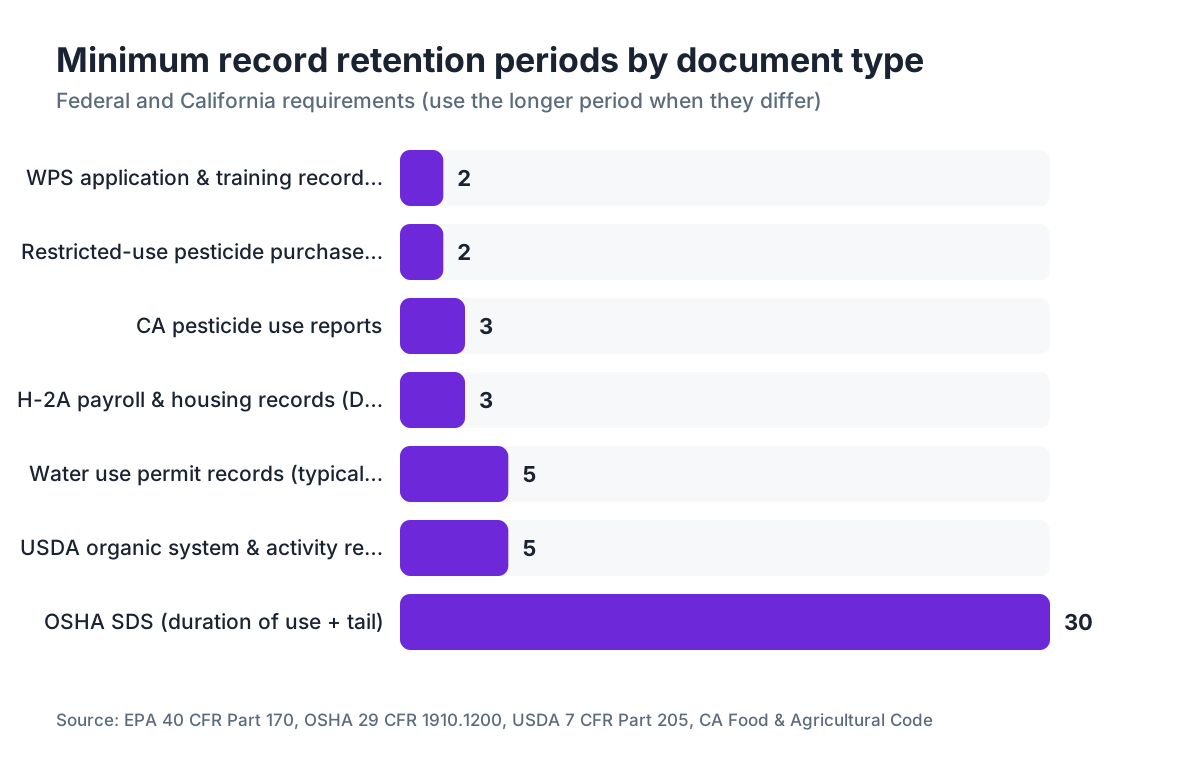
Here's a quick reference for the most common categories and their federal retention minimums:
| Record Type | Federal Minimum Retention | Governing Authority |
|---|---|---|
| Pesticide application (WPS) | 2 years | EPA / 40 CFR Part 170 |
| Worker/handler training (WPS) | 2 years | EPA / 40 CFR Part 170 |
| Safety Data Sheets | Duration of use + 30 years (OSHA) | OSHA / 29 CFR 1910.1200 |
| Restricted-Use Pesticide (RUP) purchase records | 2 years | EPA / FIFRA |
| H-2A payroll and housing records | 3 years | DOL / 20 CFR Part 655 |
| Water use (varies by state permit) | Typically 5 years | State water agency |
| Organic system plan & activity records | 5 years | USDA NOP / 7 CFR Part 205 |
Some states, California in particular, run past these federal minimums. When state law is stricter, state law wins.
What are the 9 sections every vineyard binder should have?
This is the core of the system. Each section gets a labeled divider tab. The goal is simple: any inspector, any farm manager, or you at 6 a.m. can find any document in under a minute.
Tab 1: Farm and property overview. Your Assessor Parcel Numbers, block map, acreage by variety, a copy of your farm operator registration or agricultural permit number (required in most states), and any lease agreements that decide who's the responsible party for compliance. Add your pesticide applicator license if you spray your own blocks.
Tab 2: Pesticide application log. The highest-scrutiny section. Every spray event gets one page or entry: date, block(s) treated, product name, EPA registration number, amount of product mixed, water volume, application method, REI (restricted entry interval), and the applicator's name and license number. UC Davis publishes field-tested pesticide use record forms through its IPM program [5]. Print a stack of blank forms before the season so you're never improvising.
Tab 3: Restricted entry interval (REI) and field activity log. A daily record of who entered which blocks and when. Cross-reference it against Tab 2 to prove no worker entered during an active REI. If a worker illness claim ever surfaces, this log is your first line of defense. Some operators fold in their scouting notes here, which is fine as long as the entry data stays unambiguous.
Tab 4: Worker Protection Standard training records. Every worker and pesticide handler has to be trained before working in treated areas. Keep a signed roster with the training date, the trainer's name, and the materials used. WPS requires these records for two years [2]. Include copies of the training materials, especially translated ones for a multilingual crew.
Tab 5: Safety Data Sheets. One SDS per product, current version, sorted the way you'll actually use it. Pull updated sheets from the manufacturer's site once a year. OSHA requires SDS to be readily accessible to employees during each work shift [3]. A binder locked in the supply shed does not count as accessible when the crew is out in a block and nobody has a key.
Tab 6: Water use and irrigation records. Meter readings, pump logs, telemetry printouts. For farms under water rights permits, include the permit number and any annual reports you've filed. Using recycled or reclaimed water? Add the permit from your regional water board.
Tab 7: Scouting and disease/pest monitoring records. Not always legally required, but priceless during an inspection that questions whether a spray was justified. Cornell's New York State IPM program recommends dated scouting notes as part of a defensible IPM program [6]. Write down the threshold decisions in plain language: what you saw, what the threshold was, what you decided.
Tab 8: Worker housing and labor compliance. If you provide housing, keep the inspection certificates here. If you use a farm labor contractor, keep a copy of their license and your written agreement. For H-2A workers, DOL requires the job order and housing inspection documents to be kept for three years after the last date of performance under the contract [7].
Tab 9: Organic or sustainable certification records. Certified organic under USDA NOP? You must keep an Organic System Plan, all input product labels, purchase receipts, and field activity records for five years [8]. Your certifier will ask for every piece of it at each annual inspection. Pursuing a sustainability certification like LIVE, SIP, or California Sustainable Winegrowing? Keep your self-assessments and audit results here.
How should you physically organize and store the binder?
Use a 3-inch or 4-inch D-ring binder, not an O-ring. O-rings let pages shift and tear once the binder is full and getting used in the field. Heavy-duty poly covers hold up to being tossed on a truck seat.
Put divider tabs with pockets between each section. The pockets matter. Small items like labels, receipts, and photo prints fall out otherwise.
Keep one master binder per operating unit, meaning one per farm or ranch, not one per block unless you're very large. Farm several non-contiguous properties? Keep a binder at each location or a clearly labeled duplicate set.
Store it where the crew can reach it but weather and theft can't. The farm office is ideal. The glove box of the spray rig is not, because heat wrecks paper and ink faster than you'd think.
Some managers carry a waterproof ziplock of the current season's most active pages (today's spray record, this week's REI log) into the field and file them into the master binder at end of day. That works well if you're disciplined about the daily transfer.
Back it up. Photograph or scan each completed log page and put it in cloud storage or a farm management platform. If the binder is ever lost, soaked, or dragged into a dispute, the digital copies are your insurance. VitiScribe is built around this workflow, letting you log applications on a phone and generate print-ready records in the format inspectors expect, but any consistent cloud backup beats nothing.
What do inspectors actually look at first?
The first thing they check is whether you can produce records at all. Hand them a complete, organized binder in under a minute and the whole tone of the visit changes.
After that, the pesticide application log gets the hardest look. Inspectors cross-check the product against the registered uses on the label, verify the rate doesn't exceed the label maximum, and confirm the REI was observed against your field activity log [9]. One entry with a missing EPA registration number or an illegible rate can trigger a Notice of Violation even when the application itself was done right.
WPS training records come next, especially in states with active labor enforcement. California's Division of Occupational Safety and Health has cited growers for missing or incomplete training rosters more often since the 2015 WPS revisions took effect.
For organic operations, the certifier follows the paper trail from a purchase receipt through to the field application and the scouting note that justified it. A gap anywhere in that chain puts your certification at risk.
One thing inspectors don't do: give you time to reconstruct missing records. If it's not there when they ask, it's not there.
How often should you update the binder?
Within 24 hours of any field activity that generates a record. That's the only honest answer.
It sounds strict until you think about why. WPS doesn't set a hard completion deadline beyond "the record must be available," but regulators and courts treat records created days later as unreliable. Washington State University's extension viticulture program recommends completing pesticide use records the same day as the application, precisely because end-of-week reconstruction breeds errors [10].
Build a routine that makes it automatic. Some managers clip a blank application log and a pen to the dashboard of the spray tractor. The applicator fills it out the second the tank is empty and the rig is parked. That page goes into the binder that afternoon.
Irrigation and scouting logs can run on a weekly update since they're less time-sensitive for inspection, but daily is better.
At the end of each calendar year, archive that year's completed sections in a separate labeled folder and start fresh tabs. Keep archived years for at least three, or five if you're certified organic, in a dry spot off-site if you can.
What's the biggest mistake vineyard operators make with record keeping?
Reconstruction. Sitting down in October to recreate a July spray event from memory and a fertilizer invoice is the single most common compliance failure, and it's almost always the one that turns a routine inspection into a formal investigation.
Second most common: incomplete pesticide entries. An operator fills in the product name and date but skips the EPA registration number, or records the rate in the wrong units (ounces per 100 gallons versus pounds per acre confusion is everywhere). The label is the law under FIFRA. If your record doesn't show you followed it, you're exposed.
A close third is failing to document REI compliance. You can have a flawless spray log and still get cited if you can't prove workers stayed out of the treated block during the REI. This is exactly where Tab 3 earns its keep.
For operators running H-2A labor, missing or unsigned housing inspection reports are a frequent DOL finding. The pre-occupancy housing inspection by the state workforce agency has to happen before workers arrive, and the paperwork has to be in your file.
None of these are hard to avoid. They're process failures, not knowledge failures. The binder works because it makes the right process the default.
Do digital records replace the paper binder?
Not entirely, and not yet. A few states have started accepting electronic records as primary, but most inspection frameworks still assume you can hand over a physical document or print one on demand. California's Food and Agricultural Code doesn't specify paper versus digital for pesticide use records, but county commissioners in the field still expect something they can hold or photograph.
The practical move is to keep digital records as your primary system, print them, and file the prints. You get the search and backup of digital with the instant accessibility of paper. If your tablet dies mid-inspection, the binder still works.
For organic certification, most USDA-accredited certifiers now accept electronic records stored in a system that timestamps entries and blocks backdating. Ask your specific certifier before you go paperless on organic records.
Managing multiple properties or blocks across a large vineyard operation? A digital platform that exports print-ready reports cuts the time it takes to keep binders current. But the platform is only as good as the data you feed it. Garbage in, compliance liability out.
Tools like VitiScribe generate the exact record formats WPS and state ag departments expect, which takes the formatting guesswork off your plate. You still have to understand what the records document and why. No software knows your fields for you.
What should you do before a scheduled inspection?
Not every inspection is a surprise. Annual organic audits are booked weeks out. Some county commissioners give notice of routine visits. When notice comes, here's the drill.
Pull the binder and read it as if you're the inspector. Hunt for gaps in application log entries, missing signatures on training rosters, SDS sheets that are years out of date. Fix what you can legitimately fix, meaning complete records that should have been done but weren't, using accurate dates. Don't backfill false dates.
Confirm your pesticide applicator license and any farm operator registrations are current. An expired license found during an inspection is an instant citation in most states.
Walk the relevant blocks and make sure your field maps in Tab 1 match what's actually in the ground. Inspectors sometimes walk blocks and compare them to your map. A real discrepancy (a block labeled Cabernet that's actually Syrah) raises questions about every other record you keep.
Brief whoever meets the inspector on where everything lives in the binder and what the visit is likely to cover. You don't want your crew manager fumbling through tabs while an inspector waits.
Are there templates or extension resources you can use?
Yes, and they're free. This is one area where university extension programs have done genuinely useful work.
UC Davis Agriculture and Natural Resources publishes pesticide use record forms and worker safety templates through its Integrated Pest Management program [5]. They're built for California requirements but line up well with federal WPS.
Cornell Cooperative Extension's New York State IPM program provides scouting log templates and spray record forms calibrated for northeastern grape growing [6]. If you farm in New York or the northeast, these are your closest match.
WSU Extension's viticulture resources include compliance guides for Washington's WAC pesticide record-keeping rules [10]. They also publish H-2A housing compliance guides worth keeping behind Tab 8.
The EPA's Worker Protection Standard page has a model training record form and a safety poster (available in Spanish and other languages) that meets the WPS posting requirement [2]. Download and laminate the poster. Put a copy in each chemical handling area.
For organic growers, the USDA National Organic Program publishes a sample Organic System Plan and record-keeping guidance as part of its accreditation materials [8].
None of these templates are mandatory. You can design your own forms as long as they capture every required field. But a tested template is faster and saves you from accidentally dropping a required line.
What happens if an inspector finds missing or incomplete records?
Outcomes run from a verbal warning to real fines, depending on what's missing, how long the pattern runs, and which agency is looking.
For pesticide record violations in California, civil penalties under the Food and Agricultural Code can reach $5,000 per violation [1]. Per violation, not per inspection. A single spray event with five missing data fields could in theory be cited as multiple violations, though first-time violations corrected in good faith often end in a written warning.
WPS violations are enforced by the EPA or the state lead agency, whichever has primacy. Civil penalties can reach $19,180 per violation as of 2024, adjusted annually for inflation [2].
DOL violations for H-2A non-compliance can lead to debarment from the H-2A program for future seasons. For operations that depend on that labor pipeline, that's severe.
For organic certification, a single gap in your input product trail can mean suspension or decertification of the affected acreage, sometimes the whole operation. You can appeal, but it takes months, and you can't market the affected grapes as organic in the meantime.
What regulators punish hardest isn't a single missing field. It's evidence of systemic non-compliance: records that never get completed, training that never happened, REIs that were plainly ignored. The binder doesn't just protect you at inspection time. It builds the habits that keep the underlying violations from happening at all.
Frequently asked questions
How far back do vineyard pesticide records need to go for an inspection?
Federal WPS requires two years of pesticide application and training records. California requires three years of pesticide use reports under the Food and Agricultural Code. Certified organic operations need five years under USDA NOP. Keep whichever is longest for your state. Most inspectors focus on the current and prior season, but gaps in older records can still be cited if they fall inside the statutory window.
Can the same binder cover multiple blocks or multiple varieties?
Yes. The binder is organized by record type (spray log, training records, and so on), not by block. Within the pesticide log, each entry names which block or blocks were treated. Use your block map in Tab 1 as the key. If you run 20 or more distinct blocks, add a block-by-block index sheet at the front of the pesticide log section to make cross-referencing faster.
Does a vineyard manager need a pesticide applicator license to keep spray records?
The record-keeper doesn't need a license, but whoever makes restricted-use pesticide applications must hold a valid state applicator license. That license number has to appear on every RUP application record. General-use pesticides applied by unlicensed workers still require a complete application record under WPS. The spray log should name both the applicator and, if different, the licensed supervisor.
What is a restricted entry interval and how do you document it?
A restricted entry interval (REI) is the time after a pesticide application when workers can't enter the treated area without required personal protective equipment. REIs range from 4 hours to several days depending on the product. Log each REI in your application record (the REI end date and time) and cross-reference your field activity log to show no worker entered before it expired. That cross-reference is what inspectors check.
Do Safety Data Sheets need to be in the binder or can they be stored separately?
OSHA requires SDS to be readily accessible to employees during each work shift (29 CFR 1910.1200). A binder in the farm office meets that for office and shop staff. For field crews, a laminated quick-reference card for each product they handle works well, with the full SDS binder available at the farmhouse or break area within reasonable reach. The binder and the field solution can both exist.
What's the difference between a pesticide use report and an application log?
An application log is your own daily record kept for WPS compliance and farm management. A pesticide use report (PUR) is a formal submission to the county agricultural commissioner, required in California for all pesticide applications above a threshold. California growers submit PURs monthly. The log and the PUR share most of the same data, so a well-kept log makes PUR submission easy, but they're separate documents with separate deadlines.
Do organic vineyards need a separate binder from conventional vineyards?
Not necessarily a separate binder, but organic records are denser and demand more documentation per field event. USDA NOP requires your Organic System Plan, all input product labels, purchase receipts, and five years of field activity records. If you're transitioning blocks while keeping conventional blocks, split organic and transitional records into clearly separate sections to keep the paper trails clean. Some certifiers require that separation explicitly.
What should I do if I realize a spray record was never completed?
Complete it now with accurate dates. Write the actual application date on the record. If you're filling it out after the fact, note at the bottom that it was recorded on a later date and why (for example, "applicator note: record completed 7/15 for application performed 7/12"). Do not write today's date as if it were the application date. Retroactive completion with an honest notation is defensible. Falsified dates are not, and regulators can sometimes verify true dates against weather data and purchase records.
Is there a required format for the worker WPS training sign-in sheet?
The EPA doesn't mandate a specific form, but the record must include the worker's or handler's name, the training date, and enough detail to identify who ran the training and what materials were used. The EPA publishes a model training record on its WPS page that covers every required element. Using it, or a version of it, cuts the risk of missing a field. Signed rosters, rather than a trainer's word alone, are the standard expectation.
Can I use a smartphone app instead of a paper binder?
You can use an app as your primary data entry system, but you still need to produce records immediately during a field inspection, which usually means printing them or having them accessible offline on a device you carry. Most county inspectors won't audit off a phone screen. A hybrid works best: enter records digitally, print them, file them in the physical binder. You get searchable backups and an instantly accessible physical file.
How do labor contractor records fit into a vineyard compliance binder?
Labor contractor records go in Tab 8. If you use a farm labor contractor, you need a copy of their state FLC license and your written agreement on file. For H-2A workers, the job order, housing inspection documentation, and payroll records must be kept for three years after the last date of performance under the contract (20 CFR Part 655). You share liability for WPS compliance for workers the contractor places on your property, so their training records belong in your binder too.
What maps or property documents should be in the binder?
At minimum: a block map showing block IDs, acreage, and variety for each block; your Assessor Parcel Number(s); your farm operator or pesticide operator registration number; and any water rights permit numbers. The block map is what inspectors use to cross-reference which blocks appear in your spray log. If your map doesn't match your records (a block ID renamed mid-season, say), it creates confusion that looks like a compliance gap even when it isn't.
How long does it take to build a binder from scratch?
Realistically, 4 to 8 hours spread over a week for a 20-to-50-acre operation. Most of that is gathering documents that already exist (SDS sheets, prior spray records, training rosters) and sorting them into the tab structure. Creating blank templates for the current season takes about an hour. Ongoing maintenance, updating records within 24 hours of field events, runs 5 to 15 minutes per spray event once the system is set up.
Sources
- California Department of Pesticide Regulation, Pesticide Use Reporting: California requires pesticide use reports to be retained for three years and authorizes county commissioners to inspect records at any time under Food and Agricultural Code Section 11501.
- U.S. EPA, Worker Protection Standard for Agricultural Pesticides: WPS requires pesticide application and worker training records to be retained for two years; civil penalties can reach $19,180 per violation as of 2024.
- U.S. Department of Labor OSHA, Hazard Communication Standard 29 CFR 1910.1200: OSHA requires Safety Data Sheets to be readily accessible to employees during each work shift.
- Washington State Department of Agriculture, Pesticides and Fertilizers: Washington State requires pesticide applicators to retain application records for at least two years under WAC 16-228.
- UC Davis Agriculture and Natural Resources, Integrated Pest Management Program: UC Davis IPM program publishes pesticide use record forms and worker safety templates designed for California WPS compliance.
- Cornell Cooperative Extension, New York State IPM Program: Cornell's New York State IPM program provides scouting log templates and spray record forms for northeastern grape growing, recommending dated scouting notes as part of a defensible IPM program.
- U.S. Department of Labor, H-2A Temporary Agricultural Program: DOL requires H-2A job order and housing inspection documentation to be retained for three years after the date of last performance under the contract (20 CFR Part 655).
- USDA National Organic Program, 7 CFR Part 205: USDA NOP requires certified organic producers to keep an Organic System Plan, all input product records, and field activity records for five years.
- U.S. EPA, Pesticides: Inspectors cross-check application records against EPA-registered label requirements; the pesticide label is enforceable law under FIFRA.
- Washington State University Viticulture and Enology Extension: WSU extension viticulture recommends completing pesticide use records the same day as the application to avoid errors, and publishes compliance guides for Washington WAC record-keeping and H-2A housing.
- USDA Economic Research Service, Farm Labor: Reference for H-2A agricultural labor program context and farm compliance framework.
Last updated 2026-07-11