How to create a vineyard block record that satisfies multiple certification audits

TL;DR
- A single vineyard block record can satisfy USDA Organic, Sustainability in Practice (SIP), CCOF, and EPA Worker Protection Standard audits if it captures seven data categories: block identity, variety and rootstock, soil and water inputs, pesticide applications (including re-entry intervals), cultural practices, yield, and a dated annual map.
- Build it once.
- Audit it four times.
What is a vineyard block record and why do auditors care about it?
A vineyard block record is the single document, paper or digital, that tracks everything that happened to one defined growing unit in a season. That unit might be two acres of Cabernet Franc on one slope, or a thirty-acre flat of Chardonnay. You set the boundaries. But once you set them, every auditor expects those boundaries to hold steady across years.
Auditors care because certifications are chain-of-custody programs at heart. A USDA Organic inspector needs proof that the grapes off Block 7 grew without prohibited substances for the full transition or certification period. A SIP auditor needs to verify that your pesticide choices and rates matched the products the program approved. A Worker Protection Standard compliance officer needs a written record that re-entry intervals were observed before anyone walked into the treated area [1]. Different programs, same underlying demand: a written trail that proves what you said happened actually happened.
The programs overlap more than they diverge. Most of the data one certification wants shows up in at least one other, which means a well-built block record is not four separate documents. It is one document with a few extra columns.
What certifications does a single block record need to cover?
Most vineyard managers running multiple certifications are dealing with some mix of these four programs.
USDA National Organic Program (NOP) requires records that document every input applied to certified or transitioning land, the source and approval status of that input, and the field where it went. The regulation at 7 CFR Part 205.103 says certified operations must "maintain records for a minimum of 5 years" and make them available to the certifying agent [2].
Sustainability in Practice (SIP Certified) is the Central Coast's dominant sustainability standard. It requires pesticide use records, water monitoring data, soil health practices, and worker welfare documentation. A third-party auditor cross-references your records against the SIP Certified scorecard [3].
CCOF (California Certified Organic Farmers) is one of the largest USDA-accredited certifying agents. On top of the federal NOP baseline, CCOF wants a farm plan updated every year and field activity logs showing dates, materials, and quantities [4].
EPA Worker Protection Standard (WPS) requires any agricultural employer who applies pesticides or sends workers into treated areas to keep specific records: product name, EPA registration number, active ingredient, re-entry interval (REI), application date, and the location and description of the treated area. Records stay on file for two years [1].
A fifth program worth knowing is California's DPR spray record requirement under California Food and Agricultural Code Section 12981. It mandates that growers report pesticide applications to their county agricultural commissioner within set timeframes, typically by the last day of the month following application [5]. That state rule feeds straight into your block record structure.
What are the seven data fields every block record must contain?
Map the requirements across NOP, SIP, CCOF, and WPS and seven categories cover the whole overlap. Miss one and at least one auditor flags you.
1. Block identity. Block name or number, acreage, GPS boundary or a reference to a dated map. This is the anchor everything hangs on. SIP and NOP both require that you can connect a specific parcel to a specific harvest lot.
2. Variety, clone, and rootstock. Organic inspectors want to know whether you used organic planting material or whether a documented exception applies. NOP requires organic seeds and planting stock when commercially available [2].
3. Soil and nutritional inputs. Every amendment, compost application, cover crop termination, and fertilizer. For organic, each input needs the brand name, the OMRI listing or equivalent review confirming NOP compliance, the rate per acre, and the date. For SIP, you also need total nitrogen load if you applied synthetic fertilizers, which SIP allows but tracks for water quality scoring.
4. Pesticide applications. This is where most of the audit-critical detail lives. Each record needs the trade name, EPA registration number, active ingredient, FRAC or IRAC code if you track resistance, rate applied, total volume mixed, application method (air blast, hand gun, drone), date and start and end time, crop growth stage, re-entry interval, pre-harvest interval, applicator name and license number, and weather at time of application (wind speed, temperature, relative humidity). California DPR and WPS each want a subset of these. Capture all of them and you satisfy both [1][5].
5. Cultural practices. Canopy management (shoot positioning, leaf pulling, hedging), irrigation events (date, duration, volume or pressure if you run a flow meter), frost protection events, and any mechanized operations. SIP scores these for sustainability points. NOP reviewers scan them to confirm no prohibited weed or pest management slipped through.
6. Yield. Tons harvested per block, harvest dates, lot or bin numbers, and the winery destination. This closes the chain of custody. If you pulled 4.2 tons off Block 7 and 4.2 tons of organic Chardonnay showed up at the crush pad with the right paperwork, the trail is clean.
7. Annual block map with GPS coordinates. A dated map, even a simple PDF with drawn polygons, satisfies the spatial requirement for NOP, SIP, and CCOF. Cornell Cooperative Extension recommends at minimum one verifiable coordinate per block corner [6]. If you keep a GIS layer, export a dated PDF each year and attach it to that year's record.
Which fields are required by which certification? (comparison table)
This table maps the seven core data categories to each program's explicit requirements. An X means the program requires it. A (P) means it is a scored or preferred element, not a hard requirement.
| Data Field | USDA NOP | CCOF Supplemental | SIP Certified | EPA WPS | CA DPR |
|---|---|---|---|---|---|
| Block ID and acreage | X | X | X | X | X |
| Variety and rootstock | X | X | (P) | ||
| Soil and nutrient inputs | X | X | X | ||
| Pesticide applications (full detail) | X | X | X | X | X |
| Re-entry and pre-harvest intervals | X | X | X | X | X |
| Cultural practices | X | X | X | ||
| Harvest yield and lot ID | X | X | X | ||
| Annual block map | X | X | X |
The pesticide application row is the one field all five programs require. Build that section to the most demanding standard (NOP plus WPS plus DPR combined) and the others fall into place automatically [1][2][5].
How do you structure the record so one document works for every audit?
The cleanest structure splits static block information (things that don't change year to year) from seasonal event logs (things that do).
Your static block sheet holds the block ID, variety, clone, rootstock, year planted, soil series (pull it from the USDA Web Soil Survey), irrigation system type, and any transition history relevant to organic certification [7]. Update it only when something physically changes, like a replant or a new drip system.
Your seasonal event log is a running chronological ledger for that block in that vintage year. Every row is a date. The columns cover the seven categories above. Most growers run a spreadsheet where rows are events and columns are data fields, with a dropdown for event type (spray, fertilize, cultivate, irrigate, harvest). One design rule matters most: never merge cells and never skip the event-type column. Auditors sorting by event type need clean data, not a narrative.
Attach to each season's log the copies of input labels for any new products used that year, the OMRI listing or equivalent for organic inputs, and the dated block map. Keep the label copies. NOP requires you can produce them, and a product reformulated mid-season can change its compliance status.
Here is a small trick that saves time at every audit. Put the certifying agent's name and your certification number on the cover sheet of each block record. When a SIP auditor opens the folder and sees the SIP certificate number right there, they know the record was kept with their program in mind. Small signal, real minutes saved.
For operations running more than a handful of blocks, a purpose-built platform like VitiScribe can generate per-block logs already structured around these compliance fields, which cuts the reformatting work before an audit. A well-built spreadsheet works fine too, if you stay disciplined about it.
What are the record retention requirements you can't afford to miss?
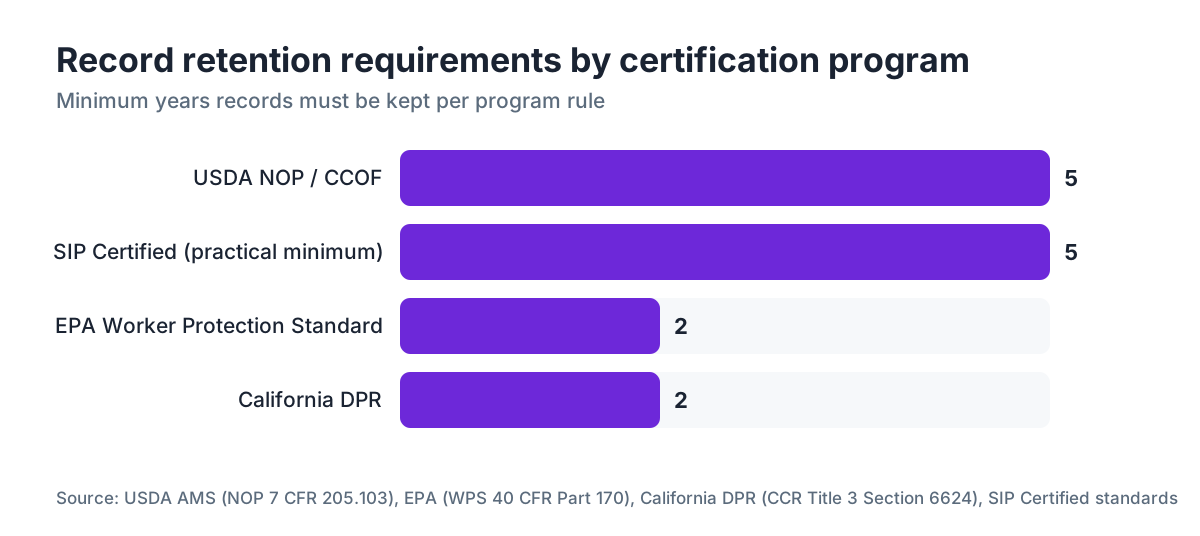
Retention varies by program, so you satisfy the longest window and stop worrying about the rest.
USDA NOP requires five years of records [2]. CCOF follows the NOP baseline. SIP Certified's current audit protocol does not set a retention period beyond the current certification year, but because SIP auditors sometimes ask for prior-year data to check trend claims, five years is the practical floor. EPA WPS requires two years [1]. California DPR requires records held for two years from the date of application under California Code of Regulations Title 3, Section 6624 [5].
So keep everything for five years. That covers NOP, CCOF, WPS, and DPR at once, with no edge cases.
Store records in a format you can produce fast. An auditor arriving for an unannounced NOP inspection (allowed under 7 CFR Part 205.403) expects access within a reasonable time. The regulation does not define the term, but CCOF's farm guide treats it as same-day access [4]. Cloud backups are fine as long as you can print or share on short notice. A cabinet of paper binders works too, and scanning them once a year is worth the hour it takes.
How does the EPA Worker Protection Standard affect your block records specifically?
WPS is federal law under 40 CFR Part 170, and the 2015 revised rule expanded record-keeping requirements for agricultural employers [1]. You have to maintain a pesticide application record with the product's EPA registration number, the active ingredient, the restricted-entry interval, the application date, and a description of the treated area good enough for a worker to identify it.
That last point matters for vineyards with numbered blocks. "Block 14, 3.8 acres, northeast corner of property, bounded by the irrigation road on the south" satisfies the description requirement. "The vineyard" does not.
WPS also requires central posting information: the name of the pesticide applied, the location treated, the REI, and the date workers can re-enter. Posting is separate from record-keeping, but they draw on the same data. If your block record is complete, generating the posting notice takes about two minutes.
WSU Extension has a clear breakdown of WPS record-keeping for tree fruit and grape growers in Washington that ports to other states with minor adjustments for state law [8]. Worth downloading and comparing against your current form.
What common mistakes cause block records to fail an audit?
The most common failure is incomplete pesticide records. Growers log the product name and date but leave out the EPA registration number, the re-entry interval, or the weather. Any one of those gaps can trigger a corrective action request from a NOP certifier or a WPS compliance officer [1][2].
The second is inconsistent block boundaries. A grower maps Block 5 as 4.1 acres in the NOP farm plan, then records spray applications covering 4.6 acres in the event log. An auditor reading both flags the discrepancy even if it was a measurement slip. Fix it once: survey your blocks with a GPS app (any modern smartphone handles this) and use that acreage everywhere, permanently.
Third is missing input labels or OMRI documentation. For organic certification, if you applied a product and no longer have the label or OMRI listing for that vintage year, you cannot prove that input was compliant. Auditors see this constantly with growers who buy in bulk and lose track of the source. The fix is to attach a photo of the label or a PDF of the OMRI listing at purchase, not months later.
Fourth is harvest records that don't tie back to specific blocks. If you harvest Blocks 4 and 6 into the same bins, your winery lot number covers both, but your block record has to show which tons came from which block. That is the chain-of-custody break that most often bites a winery seeking organic certification for a single-vineyard bottling.
Fifth is records that exist but carry no date. An undated pesticide record is effectively no record under WPS and NOP.
How do digital tools change block record management compared to paper?
Paper works. Plenty of excellent growers have passed every audit with a three-ring binder and a sharp pencil. Paper has three practical problems: it's hard to search, it can't generate a summary report an auditor wants in five minutes, and it gets wet.
A spreadsheet solves the search and summary problems but opens up version-control trouble if several people edit the same file. A shared Google Sheet with edit history turned on handles most of that.
Purpose-built vineyard management software, including platforms like VitiScribe, can pre-fill EPA registration numbers from a product database, flag missing fields before you close a record, and export a formatted spray log that matches CA DPR reporting. The time savings are real, especially at season's end when you're compiling hundreds of application records before an audit window.
UC Davis Cooperative Extension has published guidance on digital record-keeping for organic operations, noting that electronic records are acceptable under NOP as long as they can be reproduced in printed form [9]. The format matters less than the completeness.
One honest caveat: no software removes the need to actually understand what each certification wants. A tool is only as good as the data you feed it. Spend two hours reading the SIP audit standards and the WPS record-keeping rule before you configure any system.
What does a complete block record look like in practice?
Here is a concrete example. Say you manage Block 3, a 2.7-acre planting of Grenache on SO4 rootstock, certified organic through CCOF and SIP-certified, on a property in Paso Robles.
Your static block sheet shows Block 3, 2.7 acres, Grenache clone 362, SO4 rootstock, planted 2008, drip irrigation, sandy loam soil (Lockwood series per USDA WSS), CCOF certificate number, transition completed 2011 [7].
Your 2024 season log opens with a January cover crop seeding event (species mix, seed source, seeding rate), then a March sulfur dust application (product name, EPA reg number, OMRI listing attached, rate in pounds per acre, applicator name, wind speed, temperature, REI listed as 24 hours, date re-entry allowed). Then a May irrigation event (duration, estimated volume). Then a June shoot-positioning record (labor hours, no chemical inputs). Then a July copper hydroxide application (full pesticide record as above). Then September harvest (date, tons, bin numbers, lot ID passed to the winery).
A SIP auditor pulls scorecard data straight from that log. A CCOF inspector confirms no prohibited inputs. A WPS officer confirms REIs were documented. A DPR report generates from the pesticide rows. That is the whole game.
The well-run vineyard operations that pass audits cleanly aren't doing anything exotic. They capture the same data fields every single time, without exception.
How do you manage block records across multiple certifications without duplicating work?
The short answer: one event log per block per year, structured to the most demanding program's requirements. Everything else is a filtered view of that same data.
For CA DPR monthly reporting, you export or copy the pesticide rows from your event log, sorted by application date. That's your monthly report [5].
For your NOP annual update, you summarize inputs by block, attach labels and OMRI listings, and submit to CCOF alongside your updated farm plan [4].
For SIP pre-audit prep, you pull the pesticide and input records, verify no products outside the SIP-approved list were used, calculate nitrogen loading if applicable, and compile the cultural practice notes [3].
For WPS compliance, you check that each pesticide row carries the EPA registration number, REI, and treated-area description, and that you made the required central posting at application time [1].
None of these is a different record. They're different slices of the same record. That architecture is worth defending when your winemaker or owner asks why you track so many fields. Each extra field costs about thirty seconds per application entry and saves two to four hours per audit, per certification.
Frequently asked questions
How many years do I need to keep vineyard block records for organic certification?
USDA NOP requires five years of records under 7 CFR Part 205.103. CCOF follows that same baseline. EPA WPS requires two years and California DPR requires two years under CCR Title 3 Section 6624. Keep five years across the board and you satisfy every program at once, with no edge cases to track.
Does the EPA Worker Protection Standard require block-level pesticide records or just farm-level?
WPS requires records with a description of the treated area good enough for workers to identify it, per 40 CFR Part 170. For vineyards, that means naming the specific block or blocks treated, not the whole property. A farm-level record that says 'vineyard' without specifying blocks does not meet the WPS location requirement.
Can I use the same block map for my NOP farm plan and my SIP audit?
Yes, as long as the map is dated and the block boundaries stay consistent between programs. Both NOP and SIP require that you can spatially identify each certified parcel. A dated PDF with labeled block polygons and GPS coordinates satisfies both. Update and re-date it any year the boundaries change.
What weather data do I need to record for each pesticide application?
California DPR requires wind speed at time of application. EPA WPS does not specify weather fields, but NOP best practice and SIP both expect enough detail to confirm the application was appropriate. Recording wind speed, air temperature, and relative humidity at start and end of application covers all programs and answers any drift or efficacy questions that come up later.
Do I need OMRI-listed products for SIP certification or only for USDA Organic?
OMRI listing is a hard requirement for USDA NOP and CCOF organic certification. SIP Certified allows conventional inputs but scores you on pesticide risk and sustainability metrics. SIP's pesticide scoring uses the Pesticide Environmental Assessment System (PEAS), not OMRI status. Document all product labels for SIP audits either way, but OMRI is not the compliance threshold SIP uses.
What is the difference between a spray record and a block record?
A spray record is a subset of a block record. It captures pesticide applications only. A block record captures everything that happened in a block: soil inputs, cultural practices, irrigation, harvest, and pesticide applications. NOP and SIP require the full block record; WPS and DPR focus on the spray record portion. A complete block record automatically contains a compliant spray record.
How do I handle a block that is transitioning to organic while the rest of my vineyard is conventional?
NOP requires transitioning parcels to be clearly identified with a transition start date and kept separate from certified organic parcels in your records. Under 7 CFR Part 205, the three-year transition clock requires documented proof that no prohibited substances were applied during that period. Keep a separate static block sheet for transitioning blocks noting the start date, and log all events as you would for a certified block.
Can electronic records satisfy NOP and WPS audit requirements?
Yes. NOP accepts electronic records as long as they can be reproduced in printed form and made available to the certifying agent within a reasonable time, per 7 CFR Part 205.103. WPS under 40 CFR Part 170 also accepts electronic records provided they are retrievable. UC Davis Cooperative Extension confirms electronic farm records meet NOP standards. The format is flexible; the completeness is not.
Does SIP Certified require GPS coordinates for each vineyard block?
SIP's current audit standards require that parcels be identifiable on a site map but do not mandate GPS coordinates by regulation. That said, third-party SIP auditors commonly ask for coordinates or GIS shapefiles on larger operations to verify block acreage matches what is reported. Providing GPS data is the simplest way to kill any dispute about block size or location during an audit.
What applicator information do I need to record for each pesticide application?
California DPR requires the name and license number of the person who performed or supervised the application. WPS requires the name of the employer, not necessarily the applicator. NOP requires restricted materials applications to be performed by or supervised by a licensed applicator where state law mandates it. Recording the applicator's full name and pest control adviser or applicator license number on every spray record satisfies all three.
How do I document a block that had no pesticide applications in a season?
Create a record entry for the season with a note stating no pesticide applications were made. NOP and SIP auditors want to see that you actively managed the block and kept records, more than an absence of entries. A zero-spray log with cultural practice records is strong evidence for an organic or sustainability audit. Never leave a block with no seasonal record at all.
What is the pre-harvest interval and how does it appear in a block record?
The pre-harvest interval (PHI) is the minimum number of days between the last pesticide application and harvest, as stated on the product label. It belongs in your pesticide application record alongside the re-entry interval. Record both the PHI in days and the resulting earliest legal harvest date. This protects you from harvest timing disputes and satisfies NOP, SIP, and WPS in a single field.
Sources
- EPA, Worker Protection Standard for Agricultural Pesticides (40 CFR Part 170): WPS requires agricultural employers to keep pesticide application records including product name, EPA registration number, active ingredient, REI, application date, and treated area description, retained for two years.
- USDA AMS National Organic Program, 7 CFR Part 205: NOP requires certified operations to maintain records for a minimum of 5 years and make them available to the certifying agent; organic seeds and planting stock must be used when commercially available.
- SIP Certified, Certification Standards: SIP requires pesticide use records, water monitoring data, soil health practices, and worker welfare documentation, audited by a third-party auditor against the SIP scorecard.
- CCOF, Organic Certification and Farm Guide: CCOF supplemental requirements include an annually updated farm plan and field activity logs showing dates, materials, and quantities; same-day record access is recommended for unannounced inspections.
- California DPR, Pesticide Use Reporting Requirements, California Food and Agricultural Code Section 12981 and CCR Title 3 Section 6624: California requires growers to report pesticide applications to the county agricultural commissioner by the last day of the month following application; records must be retained for two years.
- Cornell Cooperative Extension, Vineyard Record Keeping Resources: Cornell Cooperative Extension recommends using at minimum one verifiable GPS coordinate per block corner for spatial documentation supporting organic and sustainability certification.
- USDA Web Soil Survey, Natural Resources Conservation Service: USDA Web Soil Survey provides official soil series identification by parcel location, usable for vineyard block static records and NOP farm plans.
- WSU Extension, Pesticide Record Keeping for Agricultural Operations: WSU Extension provides a breakdown of WPS record-keeping requirements for grape growers applicable across states with minor adjustments for state law differences.
- UC Agriculture and Natural Resources, Organic Farming Compliance Resources: UC Cooperative Extension confirms that electronic records are acceptable under NOP as long as they can be reproduced in printed form.
- USDA AMS, National Organic Program Handbook and Program Instructions: NOP program guidance specifies that records must be adapted to the operation and sufficient to demonstrate compliance at each step in the production, handling, and sales process.
Last updated 2026-07-10