How to create a vineyard block coding system for spray records

TL;DR
- A vineyard block coding system gives each distinctly managed area a short, consistent alphanumeric ID that shows up on every spray record, scouting log, and harvest note.
- A good system takes an afternoon to build, maps cleanly to your physical blocks, and meets EPA Worker Protection Standard recordkeeping rules.
- Four to six characters per code is the practical sweet spot.
Why does a block coding system matter for spray records?
Every pesticide application in a vineyard needs a record, and that record has to identify the site treated. The EPA Worker Protection Standard (40 CFR Part 170) requires agricultural employers to keep pesticide application records accessible to workers and their designated representatives, and state lead agencies add their own location-specificity rules on top [1]. If your spray record says "the back block" or "Row 14 area," you'll fail an audit. Worse, you won't be able to reconstruct your own records two seasons later when a buyer's food-safety auditor shows up.
A block code gives every distinctly managed unit in your vineyard one stable, unambiguous ID. Once every crew member, every contractor, and every software field uses the same code, you stop cross-referencing hand-drawn maps against handwritten notes. You also get to use your records for what they're actually good for: spotting which blocks have the worst mildew pressure, tracking cost per acre by variety, comparing re-entry intervals across the ranch.
This is not busywork. Managers with a coherent block system spend less time per record, make fewer omissions, and catch application errors faster. That's the return.
What information should a vineyard block code contain?
Enough to identify the block uniquely, and no more. If nobody can remember or type the code correctly in the field, it fails at the one job it has.
A good block code carries two or three pieces of information at most. The most common approach in California and Washington extension programs is a two-part or three-part alphanumeric structure: a ranch or property identifier, a block number or letter, and an optional sub-block suffix [2][3].
Here's what each segment can carry:
Property/Ranch prefix. Farm a single contiguous property, and you might skip this or use one letter ("H" for your home ranch). Lease multiple sites, and it's non-negotiable. Two or three letters works well. Use initials of the property name, or the APN's last three digits if you want something administratively traceable.
Block number or letter. This is the core identifier. Numbers beat letters here, because you're less likely to confuse "B" and "D" on a scratched paper record. Zero-pad to two digits (01, 02 ... 12) so alphanumeric sorting works correctly in any spreadsheet.
Sub-block or variety suffix. Some managers add a one-letter suffix for variety ("CS" for Cabernet Sauvignon) or for a management split within a single block ("N" and "S" for north and south halves farmed to different canopy targets). Keep it optional. If every block has only one variety, skip it and keep the code shorter.
A typical result looks like RR-07-CS (Red Rock Ranch, block 7, Cabernet Sauvignon), or simply RR07 if the property is small and single-variety.
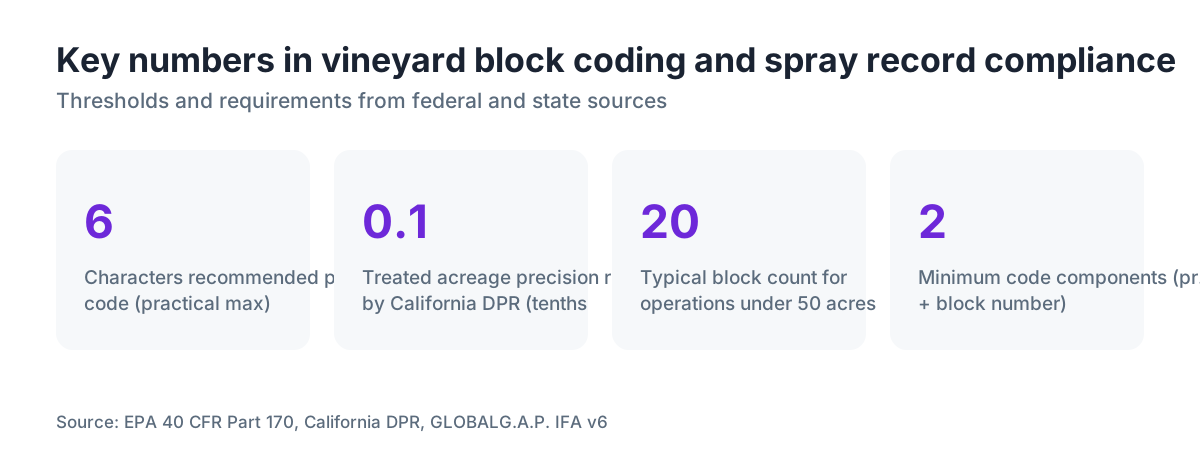
UC Cooperative Extension recommends keeping field identifiers short enough for practical field use. In their vineyard record-keeping guidance, that works out to a target of six characters or fewer [2].
How do you physically define a "block" before you can code it?
You can't code what you haven't defined. This is where most managers stall, because the boundaries of a "block" feel obvious until you sit down to draw them.
For spray-record purposes, a block is any contiguous area you treat as a single unit for pesticide applications. The practical test is simple. If you'd ever spray this area with a different product, at a different rate, or on a different date than the area next to it, they're two blocks. Common split criteria are variety, rootstock, vine age, irrigation zone, or trellis system, because any of those can drive a different spray decision.
Cornell's viticulture program recommends that block boundaries also line up with the blocks you use for harvest sampling and yield tracking, so all your production records map to the same units [3]. That alignment pays off when you're running cost-per-ton analysis or trying to correlate vine health data with spray history.
Once you've walked the property and sketched the logical divisions, count them. Most small operations (under 50 acres) have between 8 and 30 blocks. A large estate winery running 200+ acres might have 60 to 100. Over 100 blocks, you almost certainly need a property prefix in your code, and you probably want software to manage the lookup table.
Draw your blocks on a satellite image or topographic base map before you assign codes. Number from northwest to southeast, or from the winery road inward, whichever gives your crew a mental map that matches the drive. Consistency of numbering direction matters more than which direction you pick.
What's a practical block code format, with real examples?
Below are four common structures. The right one depends on your property count, block count, and how many variety splits you manage.
| Structure | Example | Best for |
|---|---|---|
| 2-digit number only | 07 | Single ranch, under 30 blocks, one variety per block |
| Letter + 2-digit number | A07 | Single ranch with multiple farm units or sub-ranches |
| 2-letter prefix + 2-digit number | RR07 | Multiple leased ranches, all tracked in one system |
| Prefix + number + variety suffix | RR07CS | Multi-ranch with mixed varieties per block and per-variety cost tracking |
A few notes on each:
2-digit number only. Fine for a 10-acre home property. Breaks down the moment you add a second ranch or bring in a contract vineyard manager who has their own numbering system.
Letter + 2-digit number. Common in Napa and Sonoma operations that farm several contiguous parcels under one brand. The letter maps to the APN or the historic field name on the county parcel map.
2-letter prefix + 2-digit number. This is what Washington State University's extension farm records templates push you toward once you start filling in their multi-site spray log worksheets [4]. It's the most portable format.
Prefix + number + suffix. Use the variety suffix only if you actually make spray decisions that split by variety within a block. If you spray the whole block the same way regardless of what's planted, the suffix adds noise without value.
One opinion, stated plainly: don't encode the variety in the code unless you need it operationally. Variety information belongs in your block lookup table, not in the code string. A shorter code means fewer transcription errors in the field, and the field is where records get corrupted.
How do you build the block lookup table that supports the codes?
The code is the key. The lookup table is the lock. Every block code needs a matching record that captures the static attributes of that block. You update this document once a season, not once per spray.
At minimum, your lookup table needs:
- Block code (the key)
- Legal description or APN
- Acres (gross and net vine acres, separately)
- Variety and clone
- Rootstock
- Year planted
- Row orientation
- Trellis and training system
- Irrigation system type
- GPS boundary (even a rough polygon in Google Maps beats nothing)
The EPA WPS doesn't make you record all of these per application, but state programs do ask for location and acreage on pesticide use reports. California's Department of Pesticide Regulation requires the grower's pesticide use report to include the field ID and the treated acreage to the nearest tenth of an acre [5]. If your block code doesn't link to a defined acreage, you can't fill that form out correctly.
WSU Extension's farm business management materials recommend building this lookup table in a simple spreadsheet first, then migrating to whatever record system you use, because paper and digital systems both need to reference the same IDs [4]. Keep a printed copy of the table in the spray rig. That one habit saves enormous confusion when you have a new employee or a contract applicator who doesn't know your land.
For operations managing more than 20 blocks across multiple sites, a tool like VitiScribe lets you build the block registry once and pull it into every spray record automatically, which kills the retyping that introduces errors.
What EPA and state recordkeeping rules actually require for block identification?
The EPA Worker Protection Standard at 40 CFR 170.309 requires the employer to keep pesticide application information that includes the location of the application. The rule text says the location must be "described so that workers and their designated representatives can find the specific area in the field" [1]. That gives you flexibility in format, but the functional test is whether an unfamiliar person can find the treated area from your record alone.
Beyond federal WPS, most states layer on stricter pesticide use reporting. California requires county-level Pesticide Use Reports for every agricultural pesticide application, and DPR's instructions say the field ID must match the official site ID registered with the county agricultural commissioner [5]. Oregon's Department of Agriculture requires a site description sufficient for inspectors to locate the treated area [10]. Washington requires the application site to be identified in a way that stays consistent across records for the same location [6].
What this means in practice: a block code satisfies all of these, but only if you use it consistently. A code that shows up as "RR07" on one record and "Red Rock Block 7" on another creates a traceability gap that an auditor will flag. Pick the code. Use only the code. Every time.
The National Agricultural Law Center reports that inconsistent field identifiers are one of the most common deficiencies found during pesticide record audits [7]. A block coding system erases that entire category of error.
How do you roll out a new block coding system with your existing crew?
Design in the office. Test in the field. That order matters.
Before you announce anything, walk every block yourself with the draft code list and a paper map. Verify that the physical boundaries match what you drew. Check that block 07 and block 08 don't share a row where your tractor turns around. If they do, your applicators will guess which block the end rows belong to, and they'll guess differently every time.
Once the codes work physically, build a one-page reference sheet. It has the code, a thumbnail map, the variety, and the acreage for every block. Give a laminated copy to every tractor operator and every scout. Put one on the shop wall. This sounds obvious. Most managers skip it, then wonder why the codes don't stick.
For the transition (plan for one full season), run your old field names alongside the codes. Your spray records can say "RR07 (formerly Back Cab block)" until everyone stops reaching for the old names. After one season, drop the old name from official records.
Training a new employee on your block system should take under 20 minutes if your map and reference sheet are clear. If it takes longer, your codes are too complex or your map is wrong. Fix the system, not the training.
How do you handle sub-blocks, trial plots, and non-producing areas in your coding?
Not every square foot of your vineyard is a billable spray block. You've got headlands, roadways, cover crop strips, reservoir areas, and sometimes small trial plots under different treatments. Your coding system has to handle all of these without collapsing.
For sub-blocks, append a decimal or letter suffix to the parent block code. If RR07 has a 0.4-acre trial plot on a different fungicide program, call it RR07T (T for trial) or RR07-TR. Keep the trial codes in your lookup table with a flag marking them as trial areas. That keeps them out of your main block statistics unless you explicitly pull them in.
For non-producing or non-spray areas, the simplest move is to skip the code entirely. Headlands don't get sprayed as a separate application. They're covered under the adjacent block's application. If you do apply something separately to a roadway (a vegetation management herbicide, say), give it a code in a different series, something like RR-HW01 (headway 01), so it clearly isn't a vine block.
For buffer zones and setback areas, especially in a regulated district with riparian setbacks or sensitive area restrictions, flag those blocks with a "BUF" suffix or a separate color category in your lookup table. Some state pesticide use reporting programs now ask whether the treated area sits within a sensitive site boundary. Having that flag in your block table means your staff can answer without pulling a GIS map every time.
What tools and formats work best for managing block codes in practice?
Start with a spreadsheet, then decide if you need more.
A simple Excel or Google Sheets workbook with two tabs, one for the lookup table and one for spray records, handles a 20-block operation cleanly. Use data validation to make the Block Code field in your spray record tab a dropdown that pulls from the lookup table. That one feature kills roughly 90% of transcription errors at essentially zero cost.
For paper records (which many small operations still run, and which are perfectly legal), print a spray record form with the block code already at the top of each block's section, not left as a blank line. Pre-printed forms take the guessing out. Cornell's extension office publishes vineyard spray record templates built for this kind of pre-structured field use [3].
For operations with 30+ blocks or multiple properties, a purpose-built vineyard record system makes the block table much more usable. It ties block attributes to application records, generates the pesticide use reports automatically, and keeps re-entry intervals and pre-harvest intervals bound to the block-level application date. VitiScribe, for example, structures its whole spray module around the block registry, so every record inherits the correct acreage and location data with no re-entry. That's the category of tool worth a look once your spreadsheet starts feeling like a liability.
Whatever tool you use, export a backup of your block lookup table at the start of every season. Blocks change, splits happen, new leases come in. The lookup table is the master record. Protect it.
How do you update your block codes when the vineyard changes?
Vineyards don't hold still. You replant a block, split a large block into two management units, or pick up a new lease. Your coding system has to absorb change without losing historical continuity.
The cardinal rule: never reuse a block code for a different physical area. If RR07 was Cabernet Sauvignon planted in 2004 and you ripped it out and replanted to Chardonnay in 2023, the block is still RR07. Your lookup table just gets a new row for RR07 showing the 2023 replant date and variety. Your historical spray records stay accurate because they still point to the same physical location.
Split a block (RR07 gets a new irrigation line down the middle and now you'll spray east and west halves independently), and you create RR07E and RR07W. Retire RR07 as an active code but keep it in the lookup table marked "retired after [year]" so historical records still resolve.
For new leases, assign codes from your property prefix series right away. Don't call a new 15-acre lease "the new block" for even one spray record. The moment you make the first application, it needs a code.
UC Davis Cooperative Extension's vineyard record-keeping guidance stresses that field ID continuity across years is what makes multi-year yield and disease data useful for management decisions [2]. A block code that drifts or gets recycled corrupts that longitudinal value entirely.
How does a block coding system connect to food safety audits like GLOBALG.A.P. and SQF?
Sell grapes to wineries that require food safety certification, or work toward your own, and your block coding system is the foundation of passing the audit. Both GLOBALG.A.P. and SQF require field-level traceability, meaning an auditor must be able to trace any lot of fruit back to a specific treated area and confirm that re-entry intervals and pre-harvest intervals were respected for every application made there [8][9].
GLOBALG.A.P.'s IFA standard (currently version 6) requires each production unit to have a unique identifier used consistently across all crop records. Your block code is that identifier. If your spray records use one set of identifiers and your harvest records use another, the traceability chain is broken and you fail the control point.
SQF's agriculture module requires field records to demonstrate the identity of the production area for each chemical application and to show that the pre-harvest interval was met. Without consistent block codes linking spray records to harvest dates by location, meeting that requirement turns into a manual reconciliation exercise every audit cycle.
So the habit is simple. Set your block codes before your first spray of the season, use them on every record without exception, and make sure the same codes ride on your harvest weight tickets. Three steps put you in compliance with both programs and add zero extra documentation burden.
What are the most common mistakes in vineyard block coding systems, and how do you avoid them?
The mistakes cluster into a few predictable patterns.
Codes that are too long. An eight-character code with a property prefix, block number, variety code, and row sub-range looks thorough on paper and is a nightmare in the field. People abbreviate it or skip it. Keep codes to six characters or fewer.
No written definition of block boundaries. A code without a mapped boundary is an aspiration, not a record. Before a block gets a code, draw its boundary on a map and put the acreage in the lookup table.
Multiple codes for the same block. This creeps in when a new employee invents their own shorthand, or when a software field gets filled differently than the paper form. Solve it with training and pre-populated forms, not by tolerating the duplication.
Reusing codes after replanting or lease changes. Covered above, but worth repeating, because this one corrupts years of historical data in a way that's hard to detect and expensive to fix.
Leaving block codes off some record types. Spray records get the codes; scouting sheets don't; harvest records use a different numbering system from the crush facility. This is the most common failure mode for operations that grew into a block system rather than planning one. Fix it by auditing every form you use and making the block code field mandatory on all of them.
WSU Extension's farm record recommendations flag inconsistent site identifiers as a compliance risk in their pesticide recordkeeping training materials [4]. It's a preventable problem. The fix costs an afternoon at the start of one season.
Frequently asked questions
How many characters should a vineyard block code be?
Four to six characters is the practical sweet spot for most operations. Short enough that field crew write it correctly every time, long enough to encode a property prefix and a two-digit block number. Codes longer than eight characters reliably get abbreviated or skipped in field conditions. If you manage a single property with fewer than 30 blocks, four characters is plenty.
Do I need a block coding system if I only have a few acres?
Yes. Even a two-acre backyard vineyard making commercial wine has to identify treated areas on pesticide records. The EPA Worker Protection Standard applies to any agricultural establishment using pesticides where workers may be present. The good news: a tiny property might need only two or three block codes, which you can design and document in an hour.
Can I use GPS coordinates instead of block codes on spray records?
GPS coordinates identify a point, not an area, and they're not practical to write on a paper spray record or type into a field form quickly. State pesticide use reporting programs generally require a field identifier or site description, not a coordinate pair. GPS polygons are valuable as the supporting map for your block lookup table, but the block code is still what goes on the spray record itself.
How do block codes work when a contract applicator does the spraying?
Give the applicator your block map and lookup table before the job. Require that their application record uses your block codes, not their own site description. Worth putting in the contractor agreement in writing. An applicator who writes "back vineyard" on their record and hands you a copy has not given you a compliant spray record for your files. Your codes, your map, every time.
What's the difference between a block code and a field ID for California DPR pesticide use reports?
California DPR pesticide use reports require a site ID that matches the ID registered with your county agricultural commissioner. In many counties you register your growing site and receive a commodity site ID. Your block code should either match that registered ID or be directly cross-referenced to it in your lookup table. Check with your county ag commissioner's office for the exact registration requirement in your county.
How do I handle a block that spans two parcels with different APNs?
For spray record purposes, the block is the management unit, not the legal parcel. Assign it one code. In your lookup table, note both APNs and the acreage in each. For your county pesticide use report, you may need to split the application record by APN, which your lookup table acreage breakdown makes straightforward. This is common in Napa and Sonoma, where parcels are small and vineyards cross lines.
Should variety names be part of the block code itself?
Generally no. Variety belongs in your lookup table, not encoded in the code string. The exception is when you have multiple varieties planted in the same block and you make separate spray decisions by variety. In that case, a one- or two-letter variety suffix on the sub-block code is defensible. But if the whole block gets the same spray regardless of variety mix, keep the code shorter and let the lookup table carry the variety data.
How often should I update my block lookup table?
Review it once before each growing season. Update it immediately whenever a block boundary changes, a new lease starts, a block is replanted, or you make a management split that creates a new spray unit. The lookup table is a living document but not a frequently edited one. Most operations change three to five records per year. Never update it mid-season in a way that affects in-progress records.
Does my block coding system need to match what my winery buyer uses?
Not necessarily, but consistency between your codes and the codes on your harvest weight tickets and wine lot records makes food safety traceability audits much easier. If your winery buyer assigns their own lot numbers, keep a cross-reference table that maps your block codes to their lot IDs. That cross-reference is what closes the chain of custody from application to bottling.
What happens to old block codes when I retire a lease or rip out a block?
Keep retired codes in your lookup table indefinitely, marked inactive with the retirement date. Never delete them and never reassign them to a new location. Your historical spray records point to those codes, and if an auditor or a buyer asks about an application made three years ago on a now-replanted block, you need the old record to resolve correctly to its original location.
How do block codes help with re-entry interval compliance?
Re-entry intervals (REIs) run from the time of application on a specific block. If your spray record ties the product, the application date, and the block code together, anyone can calculate when entry is permitted for that area. Without block codes, you can't reliably tell a worker which physical area is restricted, which is a direct WPS violation. The block code is the link between the application event and the physical location of the REI posting requirement.
Can I use the same block coding system for both spray records and scouting logs?
Yes, and you should. Using the same codes across spray records, scouting logs, irrigation logs, and harvest records is the whole point. When everything references the same block ID, you can compare disease pressure observations to spray timing block by block. That kind of comparison is what turns records from a compliance burden into a management tool.
What does Cornell or UC Davis recommend for vineyard block record systems?
Cornell's viticulture extension recommends aligning block definitions with harvest sampling units and using consistent field identifiers across all production records. UC Davis Cooperative Extension's vineyard record-keeping guidance emphasizes short, memorable field IDs with documented acreage and encourages defining blocks by management practice rather than arbitrary geography. Both programs publish downloadable spray record templates built around this approach.
Sources
- EPA, Worker Protection Standard (40 CFR Part 170): EPA WPS requires agricultural employers to keep pesticide application records that include the location of the application, described so workers can find the specific treated area.
- UC Cooperative Extension, Vineyard Record Keeping: UC Cooperative Extension recommends short field identifiers with documented acreage and stresses continuity of field IDs across years for longitudinal yield and disease data.
- Cornell Grapes and Wine, Vineyard Record Keeping Resources: Cornell's viticulture program recommends aligning block boundaries with harvest sampling units so production records map to the same units used for cost-per-ton analysis.
- Washington State University Extension, Farm Business Management and Pesticide Recordkeeping: WSU Extension recommends building the block lookup table in a spreadsheet first and flags inconsistent site identifiers as a common compliance risk in pesticide recordkeeping.
- California Department of Pesticide Regulation, Pesticide Use Reporting: California DPR requires pesticide use reports to include a field ID and treated acreage to the nearest tenth of an acre, with the site ID matching the county agricultural commissioner's registered site.
- Washington State Department of Agriculture, Pesticide Recordkeeping Requirements: Washington State requires the application site to be identified in a way that is consistent across records for the same location.
- National Agricultural Law Center, Pesticide Record Audit Deficiencies: Inconsistent field identifiers are one of the most common deficiencies found during pesticide record audits.
- GLOBALG.A.P., Integrated Farm Assurance Standard v6: GLOBALG.A.P. IFA version 6 requires each production unit to have a unique identifier used consistently across all crop records to support traceability.
- SQF Institute, SQF Agriculture Module: SQF's agriculture module requires field records to demonstrate the identity of the production area for each chemical application and confirmation that pre-harvest intervals were met.
- Oregon Department of Agriculture, Pesticide Application Record Requirements: Oregon Department of Agriculture requires a site description sufficient for inspectors to locate the treated area on pesticide application records.
Last updated 2026-07-11