How to link weight ticket numbers to vineyard block spray records

TL;DR
- Link weight ticket numbers to spray records by adding a block ID field to both documents, then keeping a cross-reference log that pairs each ticket number with the spray entries for that block and season.
- That gives auditors, buyers, and food safety certifiers a clean chain from vine to weigh station in under five minutes of lookup time.
Why does linking weight tickets to spray records matter at all?
The short answer is liability and traceability. When a buyer, auditor, or state department of ag inspector asks whether a load of fruit was harvested inside a pre-harvest interval (PHI), you need to answer in minutes, not days. If you can't connect the weight ticket number for bin 4,217 to the spray history of the block it came from, you're guessing or running a full-season paper search.
California's Department of Pesticide Regulation requires growers to keep pesticide use records for at least two years and to produce them for inspection on request [1]. Washington State Department of Agriculture imposes similar rules under WAC 16-228 [2]. The EPA Worker Protection Standard (revised 2015) requires application records to be accessible to handlers and inspectors, and says those records must identify the specific crop, location, and date [3]. None of those rules explicitly require a cross-reference to weight tickets. But the moment a food safety audit (SQF, GLOBALG.A.P., or a winery's own vendor audit) asks for chain-of-custody documentation, the gap gets expensive.
Then there's the math of a multi-block vineyard. A 50-acre ranch with 12 blocks, four spray passes per block per season, and three harvest picks per block generates roughly 144 spray records and 36 weight tickets in one vintage. Matching those by memory six months later is a bad bet.
The money is real too. California DPR civil penalties for recordkeeping violations run up to $5,000 per violation per day [1]. County ag commissioners issue those notices regularly for missing or incomplete records. That's not a scare number.
What information lives on a weight ticket and what lives on a spray record?
Two documents, two industries, two purposes. That's exactly why they don't talk to each other.
A typical weight ticket (also called a harvest receipt or lot ticket) carries the receiving winery or crush facility name, a sequential ticket number, date and time, grower name and grower ID, vineyard name, variety, sometimes a block identifier, gross weight, tare weight, net weight, and Brix at delivery. Some facilities add a lot or tank destination. What weight tickets almost never carry by default: any reference to a spray application, a PHI confirmation, or a pesticide use report number.
A pesticide application record carries the operator of record name, license number, applicator name, date and start/end time, target pest, product name, EPA registration number, amount applied, dilution rate, total acres treated, and the specific field or block identifier. California's DPR pesticide use report forms ask for a site ID or legal description of the treated area [1]. What they don't carry by default: any reference to the harvest that followed.
The gap between these two documents is the whole problem. The fix is one shared field: a block identifier that appears on both, in an identical format.
| Field | Weight ticket (typical) | Spray record (typical) | Shared? |
|---|---|---|---|
| Ticket / record number | Yes | Yes (separate sequence) | No |
| Grower ID | Yes | Sometimes | Partial |
| Vineyard name | Yes | Yes | Usually |
| Block ID | Sometimes | Yes | Not always |
| Variety | Yes | Yes | Yes |
| Date | Yes | Yes | Yes |
| PHI confirmation | No | No | No |
| Cross-reference field | Rarely | Rarely | Gap |
How do you set up a block ID system that works across both documents?
Pick one block ID format and use it everywhere, no exceptions. The format barely matters. Consistency is the whole game. A simple approach: ranch abbreviation plus a two-digit number. If your ranch is called Ridgeline, blocks become RL-01, RL-02, and so on. Farm multiple ranches? Prefix by ranch: RDG-01, OAK-01.
Now get that ID onto weight tickets. Most crush facilities will add a block field to their ticket if you ask. Some already have a separate lot description line. Ask their weigh station manager to add a grower block field. If they won't, write the block ID in the memo or lot description line yourself at delivery and keep your copy. The point is that the block ID shows up on your copy of every ticket.
On the spray record side, your pesticide use reports already require a site or field identifier. Make your block ID the site identifier. Don't run legal parcel descriptions as your primary field ID in the spray record while using block names on the weight tickets. Keep them identical.
WSU Extension recommends a consistent field ID across all farm records as the backbone of any traceability system [4]. UC Davis Cooperative Extension's food safety resources for wine grapes make the same point: a single location identifier used across planting records, spray records, and harvest records is the minimum foundation for a traceable lot [5].
Spend one hour at the start of each season mapping every block ID to its GPS boundaries, variety, acreage, and owner if it's custom farmed. That map is your master reference. Everything else hangs off it.
What does the actual cross-reference log look like?
The cross-reference log is the document that explicitly connects weight ticket numbers to spray record entries. Build it in a spreadsheet, a paper binder, or record-keeping software. The structure stays the same no matter the tool.
At minimum, the log needs these columns: Block ID, crop year, weight ticket number(s), harvest date, products applied in that block that season, last application date for each product, PHI for each product (in days), days between last application and harvest, PHI met (Yes/No), and spray record reference numbers for that block.
Here's a concrete row:
Block: RL-03 | Year: 2024 | Weight ticket: 004217, 004218 | Harvest date: 09/14/2024 | Last product: Pristine (boscalid + pyraclostrobin), EPA Reg. 7969-224 | Last app date: 08/25/2024 | PHI: 0 days | Days elapsed: 20 | PHI met: Yes | Spray record refs: SR-2024-047, SR-2024-048
That one row answers every question an auditor asks in under 30 seconds. The weight ticket number goes in. The PHI compliance comes out.
For paper operations, a three-ring binder with one tab per block works fine. The spray records for that block go behind the tab, and a cover sheet lists the weight ticket numbers from that block's harvest picks for the season. You update the cover sheet at each pick.
For digital operations, a shared spreadsheet with locked header rows and a tab per vintage is the floor. Tools like VitiScribe link these records in a relational database, so the cross-reference generates itself from the application entries and harvest events you're already entering.
How do pre-harvest intervals (PHIs) connect weight tickets to spray records legally?
The PHI is the minimum number of days that must pass between the last pesticide application and harvest. It's printed on the product label, and the label is the law under FIFRA Section 12(a)(2)(G) [6]. Harvesting inside the PHI is a federal violation, more than a recordkeeping slip.
So your cross-reference log doubles as your PHI compliance document. When you record that weight ticket 004217 came from block RL-03, harvested September 14, and the last spray in that block was August 25, you're documenting 20 days elapsed against whatever the product's PHI requires. If the PHI is 0 days, you're fine. If it's 7 days, you're fine. If someone sprayed Captan (7-day PHI for grapes) on September 10 and you harvested September 12, that same record now shows a violation.
That's exactly why buyers and food safety auditors want to see weight tickets tied to spray records. They're checking that you actually observed the PHI for every product applied to every block in that harvest lot.
The EPA's Agricultural Worker Protection Standard requires employers to keep application records showing "the specific location of the application" and to retain them for two years [3]. State programs go further. California DPR requires pesticide use reports filed with the county agricultural commissioner within set timeframes, and those reports reference the same block locations that should sit on your weight tickets [1].
One note on restricted-use pesticides: some RUPs require the certified applicator's license number on the record. If an RUP hit a block, that block's spray records need the license number, and your cross-reference log should flag it so an auditor can verify it fast.
What's the best timing to update the cross-reference log during harvest?
Update it at the weigh station, not back at the office. The weight ticket number gets assigned when the load crosses the scale. That's the moment you have it. Write the block ID on your copy right there. If you're running a cross-reference spreadsheet on a tablet or phone, enter the row before you leave the crush facility parking lot.
Wait even 24 hours and memory errors creep in, especially during a compressed harvest when you're moving several blocks the same day. A load from RL-03 and a load from RL-04 picked on the same afternoon look identical in memory a week later.
The spray record side should already be current. California requires pesticide use reports within a month of application (sooner in some counties) [1], and Washington requires application records completed by the end of the application day [2]. Keep up with those state rules and the spray entries are ready to link the second you have the ticket number.
A harvest-day checklist helps. Before leaving the block: confirm the block ID on your pick sheet. At the scale: write the block ID on your copy of the ticket, enter the ticket number into your log. End of day: verify the last application date for that block, confirm PHI met, mark the log row complete.
Cornell Cooperative Extension's produce food safety resources recommend a written harvest procedure that names record completion as a step, not an afterthought [7]. The principle carries straight over to wine grapes.
How do you handle a block harvested in multiple picks?
Multiple picks from one block in one season are common. Early picks for sparkling base wine, later picks at higher Brix, or a second pass for late-harvest fruit can generate three or four weight tickets from the same block. The spray record for that block covers the whole season. The PHI question turns on the last application date, whichever pick you're doing.
In the cross-reference log, list all weight ticket numbers from that block in the same row (or a sub-row per pick, with the same spray record references). The spray record references don't change between picks. The harvest date does, so recalculate days elapsed for each pick and confirm PHI compliance separately for every harvest date.
Example: Block RL-07 last sprayed August 18. Pick 1 on September 5 (18 days). Pick 2 on September 22 (35 days). Both picks clear any product with a PHI under 18 days. The weight tickets for both picks reference the same spray records.
Here's the trap. If a spray application lands between pick 1 and pick 2 on the same block (common with late-season botrytis pressure), update the cross-reference with the new last application date and recheck PHI compliance for pick 2. This is the scenario where a well-kept log catches a problem before it turns into a violation.
What do you do when a winery or buyer requests your spray records for a specific lot?
The request comes in two forms. The buyer either hands you a weight ticket number and asks for the spray history behind it, or hands you a lot number from their tank and asks you to trace it back to the source block and spray records.
With a good cross-reference log, the weight ticket lookup takes about 30 seconds. Find the ticket number in your log, read across the row for the block ID and spray record references, pull those records, done.
A tank lot lookup adds one step. You need the winery's internal records showing which weight tickets went into that tank. Most wineries track this at intake. Once you have the ticket numbers, the vineyard-side lookup is identical.
Format matters when you answer. Don't just email a folder of scanned documents. Write a one-page cover summary stating the weight ticket number(s), the block(s) they came from, the harvest date(s), the products applied in that block that season with application dates and rates, the PHI for each product, and the days elapsed at harvest. Attach the underlying records as backup. A quality team that gets a clean summary with attachments closes the request faster and asks fewer follow-up questions.
Selling to multiple wineries as a custom grower? Keep a PDF export of each block's seasonal spray-and-harvest summary ready to send. Generate it at the end of each vintage while the records are fresh.
How do digital record-keeping tools handle this linkage differently from paper?
Paper systems work. Don't let anyone tell you otherwise. A well-organized binder with one tab per block, a seasonal cover sheet, and filed spray records is auditable, legally valid, and costs nothing but time. The limit is search speed and error resistance. Finding every record for every block that got a specific product in a specific season takes 20 minutes of manual scanning on paper and about 10 seconds in a database.
Spreadsheets sit in the middle. A Google Sheet or Excel workbook with consistent column headers, one row per application, and a harvest tab you update at the scale is genuinely serviceable up to about 100 acres. The risk is formula errors, accidental overwrites, and the fact that a spreadsheet doesn't enforce data consistency the way a relational database does. Nothing stops you from typing 'RL03' in one row and 'RL-03' in another and breaking every lookup that depends on that field.
Dedicated vineyard software links application records to blocks by design, because the block is the primary record object in the database. Enter a harvest event and assign it to block RL-03, and the software already knows the full spray history for RL-03 and checks PHI compliance automatically. Platforms built for this include VitiScribe, which holds blocks, spray applications, and harvest events in one shared record so the cross-reference log comes out of data you're already entering.
WSU's viticulture extension resources note that digital records are increasingly expected by food safety auditors and should be structured to allow block-level queries [4]. UC Davis food safety guidance for wine grape growers makes the same recommendation for computerized lot traceability [5].
What records do you need to keep, and for how long?
Federal and state rules set floors, not ceilings. Keep records longer than required.
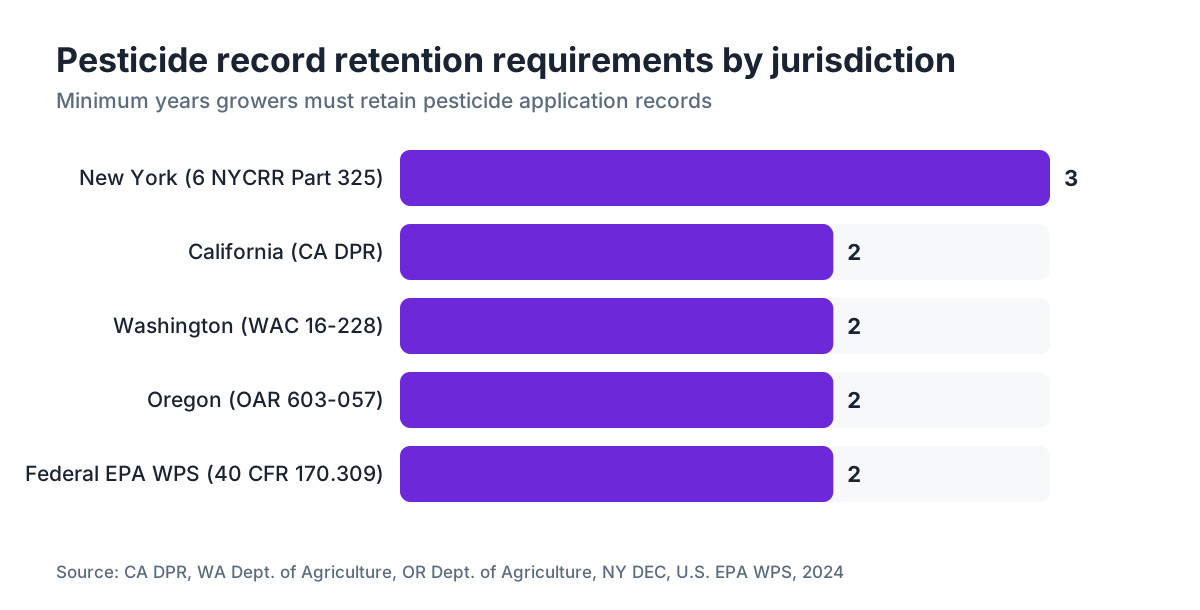
Pesticide use records: California requires two years from the date of application [1]. Washington requires two years [2]. Most other major grape states (Oregon, New York, Michigan, Virginia) follow a similar two-year minimum. The EPA WPS two-year retention requirement applies federally [3].
Weight tickets: no federal mandate sets a retention period, but winery contracts and food safety schemes (GLOBALG.A.P. Level 2, SQF) typically require two to three years of traceable harvest records. If a marketing order or wine grape commission reporting rule applies in your state, check those separately.
My recommendation: keep everything for five years. Hard drives are cheap. Scan and back up paper records once a year. A five-year archive covers any realistic statute of limitations for a pesticide violation, covers most food safety audit windows, and costs almost nothing beyond a disciplined annual scan session.
Any record headed into a food safety audit should be stored in a way that shows it wasn't altered after the fact. Dated PDFs in a cloud folder with edit history, or a software system with an audit trail, meet that bar. A spreadsheet where cells change without a trace does not.
| Jurisdiction | Pesticide record retention | Authority |
|---|---|---|
| California | 2 years | CA DPR |
| Washington | 2 years | WAC 16-228 |
| Oregon | 2 years | OAR 603-057 |
| New York | 3 years | 6 NYCRR Part 325 |
| Federal (EPA WPS) | 2 years | 40 CFR 170.309 |
What mistakes do small vineyard operations make most often with this linkage?
The most common failure is inconsistent block naming. The vineyard map calls it 'Block 3 East.' The spray contractor writes 'B3E.' The weight ticket says 'East Block.' None of the three match in a search. Fix: write your block ID list on a card and hand it to every contractor and crew leader at the start of the season. If the crush facility asks for a lot or block identifier, give them your standard ID, not a description.
Second most common: waiting until after harvest to reconcile spray records with weight tickets. By then the spray contractor may have filed their records with the county and your copies are buried. The reconciliation takes ten times longer and the error rate climbs.
Third: not tracking which tank or barrel a load went into. That's the winery's job, not the grower's. But if you're a small estate where one person runs the vineyard and the cellar, cross-reference tank lot numbers to weight tickets in the same log. Auditors trace backward from finished wine to source block, and that trace runs through the tank lot.
Fourth: treating spray records and weight tickets as two separate filing systems with no connection. They usually live in different places (spray binder in the shop, weight tickets in the office drawer) and get maintained by different people (vineyard manager vs. bookkeeper). The cross-reference log only works when one person owns it and both sets of documents flow to that person on a set schedule.
Fifth, and this one hurts during audits: filing spray records by product or by date instead of by block. An auditor asking about block RL-03 doesn't want to flip through a chronological spray log of 200 entries. File by block first, then chronologically within each block.
Frequently asked questions
Do weight tickets legally need to reference spray records?
No federal law or state ag code requires a weight ticket to cite spray records by number. The legal obligation runs the other direction: spray records must identify the treated field location, and you must be able to show PHI compliance for any harvested lot on request. The cross-reference is your operational tool for meeting that obligation quickly, not a mandated form field.
What happens if a weight ticket and the corresponding spray record have different block names?
You get a lookup failure when it matters most, usually during an audit. If the inconsistency already exists in your records, create a written mapping document that translates the old naming convention to your current block IDs, date it, and keep it with the records. For future seasons, standardize the block ID at the start of the year and distribute it to everyone who generates documents for those blocks.
Can I use the grower ID from the weight ticket to find spray records instead of a block ID?
A grower ID gets you to the right ranch but not the right block. For a single-block vineyard, grower ID is enough. For multi-block vineyards, grower ID alone won't tell you which block's spray history applies to a specific ticket. You still need the block identifier to isolate the correct spray records and confirm PHI compliance for that specific lot.
How do I link spray records to weight tickets for custom farmed blocks I don't own?
Responsibility for pesticide use records stays with the operator of record, usually the custom farm manager or the licensed PCA who directed the applications. As the grower selling the fruit, request a copy of the spray records for any block you harvest, confirm your block IDs match, and build the cross-reference in your own system. Don't assume the landowner or winery is tracking this for you.
What if I applied a pesticide to only part of a block, and the weight ticket covers the whole block?
Record the partial application with a clear note on the spray record: 'Applied to north 4 acres of RL-03 only.' On your cross-reference log, reference that spray record for the weight tickets from that block and note the partial coverage. If PHI compliance is met for the treated portion, the whole-block weight ticket is covered. If you regularly harvest sub-block sections separately, consider assigning sub-block IDs.
How do organic vineyards handle this linkage differently?
Organic certification adds a layer: every input applied to a certified block must be on the approved materials list for your certifier (CCOF, WSDA Organic, etc.), and your certifier's annual inspection cross-checks inputs against your spray records and harvest records. The block-ID-based cross-reference log works the same way. The difference is that your certifier may also want the organic system plan alongside those records, and the retention period for organic certification records is typically five years.
Do I need to include water source and spray equipment records in the cross-reference?
Some food safety standards, particularly GLOBALG.A.P. and certain retailer supplier codes, ask for water source documentation and equipment calibration records alongside spray records. These aren't required for a basic PHI compliance cross-reference. But if you're working toward food safety certification, adding equipment ID and water source to your spray record template now means you won't have to retrofit the records later.
What's the best way to handle spray records when a licensed pest control adviser (PCA) writes the recommendations but a separate applicator does the work?
Both parties generate paperwork. The PCA produces a written recommendation with their license number, target pest, product, and rate. The applicator produces the pesticide use record with actual application date, time, and amount. Both documents should reference your block ID. Keep copies of both. Your cross-reference log should note which PCA recommendation number corresponds to which application record so you can produce both on request.
How do I correct an error in a spray record or weight ticket that's already been filed?
For pesticide use records already filed with the county ag commissioner (required in California), contact the county office about amendment procedures; you generally submit a corrected form with a written explanation. For your own internal copies, draw a single line through the error, write the correction next to it, initial and date it. Never white out or delete an original entry. Keep both the original and the corrected version.
How far back do I need to go when setting up a cross-reference system for the first time?
At minimum, go back to the start of the current retention period, which is two years for pesticide records in most states. If you're pursuing food safety certification, three to five years of linked records is stronger. For any vintage still in bottle or tank at a winery, the records for those harvest lots should be accessible. Practically, start with the current vintage, then work backward through the previous two years as time allows.
What does an EPA Worker Protection Standard inspection look for in vineyard spray records?
EPA WPS inspections check that application records include the product name, EPA registration number, active ingredient, location of application, date, time period of application, acres treated, and the name and license number of the certified applicator for restricted-use pesticides. Records must be retained for two years and made available to inspectors on request. The WPS doesn't specifically require a link to weight tickets, but location specificity is required, which is where block IDs matter.
Can a spreadsheet template replace dedicated vineyard software for this cross-referencing job?
Yes, for operations under roughly 100 acres with a consistent block structure and a single person maintaining the records. Spreadsheets break down when multiple people edit the same file, when block names drift between tabs, or when you need to query across multiple vintages fast. If you run more than one ranch or sell to buyers with rigorous third-party audit requirements, software that enforces data consistency and generates reports is worth the monthly cost.
What's the minimum a winery can require from a grape supplier in terms of spray record documentation?
Wineries with food safety certification programs, premium buyer contracts, or sustainability program requirements (Lodi Rules, CSWA, LIVE) typically require at minimum a seasonal spray summary by block, confirmation that all PHIs were observed, and records available on request for two to three years. Some contracts require pre-harvest PHI sign-off before accepting a load. Check your grape purchase agreement for the specific language; requirements vary a lot by buyer.
Sources
- California Department of Pesticide Regulation, Pesticide Use Reporting: California requires pesticide use records to be kept for two years and to be available for inspection; civil penalties run up to $5,000 per violation per day
- Washington State Department of Agriculture, Pesticides program: Washington State requires pesticide application records to be completed by end of application day and retained for two years under WAC 16-228
- U.S. EPA, Agricultural Worker Protection Standard (40 CFR Part 170): EPA WPS requires application records identifying specific crop location and date, retained two years; records must be accessible to handlers and inspectors
- Washington State University Extension: WSU Extension recommends consistent field IDs across all farm records as the backbone of a traceability system and notes digital records are increasingly expected by food safety auditors
- University of California Agriculture and Natural Resources (UC ANR), food safety resources for wine grapes: UC Cooperative Extension recommends a single location identifier used across planting, spray, and harvest records as the minimum foundation for a traceable grape lot
- U.S. EPA, Federal Insecticide, Fungicide, and Rodenticide Act (FIFRA): Under FIFRA Section 12(a)(2)(G), the pesticide label is the law; harvesting within the pre-harvest interval stated on the label is a federal violation
- Cornell Cooperative Extension, Produce Food Safety Resources: Cornell CE recommends creating a written harvest procedure that includes record completion as a named step, not an afterthought, to ensure consistent documentation
- Oregon Department of Agriculture, Pesticides program: Oregon requires pesticide use records retained for two years under OAR 603-057
- New York State Department of Environmental Conservation, Pesticide Reporting Law: New York State requires pesticide use records retained for three years under 6 NYCRR Part 325
- U.S. EPA, Worker Protection Standard recordkeeping requirements (40 CFR 170.309): 40 CFR 170.309 specifies that WPS application records must include EPA registration number, active ingredient, location, date, time period, acres treated, and certified applicator license number for RUPs
Last updated 2026-07-11