How to depreciate vineyard development costs and document improvements

TL;DR
- Grapevines planted after 1988 depreciate over 10 years using MACRS.
- Land preparation and trellising usually fall under 15-year property.
- Pre-productive costs in years one through three must be capitalized under IRC 263A unless you elect out under 263A(d), which forces 20-year straight-line depreciation instead.
- Dated invoices, planting maps, and a block-level fixed-asset ledger are what survive an audit.
What vineyard costs are depreciable and which ones aren't?
Land is never depreciable. Everything you attach to it or build on it might be. That single distinction decides most of your vineyard tax picture, and getting the buckets right from day one saves you a painful reclassification years later.
The IRS splits vineyard costs three ways: land (no depreciation, ever), depreciable improvements, and operating expenses you deduct now. You paid for the dirt, you own it, you'll sell it someday, but the IRS never lets you write it down. Grapevines are a different animal. They're depreciable property under the Modified Accelerated Cost Recovery System (MACRS) with a 10-year recovery period, per IRS Publication 946 and Revenue Procedure 87-56 [1]. Trellising, irrigation infrastructure, and frost protection equipment generally land in 15-year MACRS as land improvements. Permanent roads and drainage: also 15-year. A winery building, if you put one up, goes to 39-year nonresidential real property.
Mature-vineyard operating costs like spray materials, pruning labor, and cover crop seed get expensed the year you incur them. The complication is the pre-productive period, meaning the stretch from planting until a vine first bears a commercially harvestable crop, usually two to four years. Under IRC Section 263A, those pre-productive costs have to be capitalized unless you elect out [2]. That election gets its own section below.
A few things trip people up. Replacing a dead vine in an established block is usually an expense (a repair, not a new asset) unless you're replanting the whole block, which looks like a new capital asset. Soil fumigation before planting is capitalizable as land preparation. Soil amendments spread annually on established vines are operating expenses. The test is simple to say and hard to apply: did the money create or improve a long-term asset, or just maintain what you already had?
How does MACRS depreciation work for grapevines specifically?
MACRS front-loads your deductions. You get bigger write-offs early in an asset's life, which helps cash flow when a young vineyard is bleeding money. Almost every vineyard uses it.
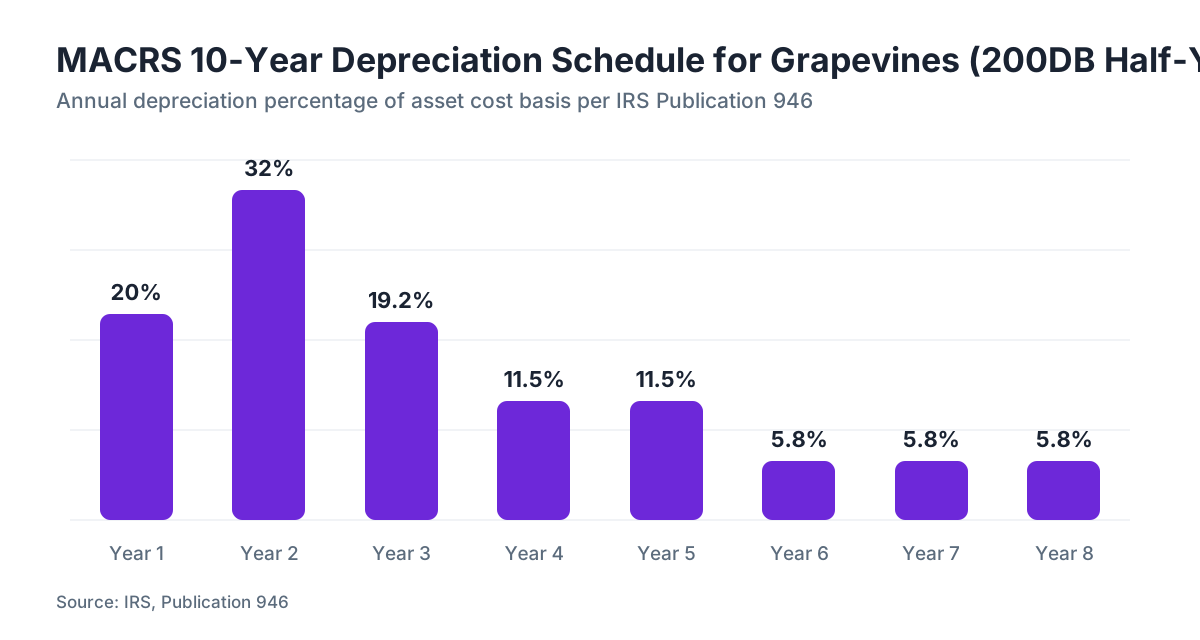
Grapevines run on the 10-year MACRS recovery period using the 200% declining balance method, switching to straight-line when that produces a larger deduction [1]. The IRS applies a half-year convention by default, so you get half a year of depreciation the year vines are placed in service, no matter which month you plant. Put more than 40% of your total depreciable property in service in the last quarter of the year and the mid-quarter convention takes over instead, which shifts all the percentages.
Here are the annual percentages for 10-year property under 200DB half-year convention:
| Year | Depreciation % |
|---|---|
| 1 | 20.00% |
| 2 | 32.00% |
| 3 | 19.20% |
| 4 | 11.52% |
| 5 | 11.52% |
| 6 | 5.76% |
| 7 | 5.76% |
| 8 | 5.76% |
| 9 | 5.76% |
| 10 | 5.76% |
| 11 | 2.88% |
On a $100,000 vine block, that's a $20,000 deduction in year one and $32,000 in year two. Year two is the steepest write-off you'll ever see on that block. Year 11 exists only because of the half-year convention, which pushes a stub deduction into the year after the nominal recovery period ends [1].
Bonus depreciation (IRC Section 168(k)) is the other lever. The Tax Cuts and Jobs Act of 2017 set it at 100% for assets placed in service after September 27, 2017. It's been phasing down since: 80% in 2023, 60% in 2024, 40% in 2025, and 20% in 2026 before it sunsets [3]. Plant a block now and bonus depreciation can still cover a chunk of the basis in year one. Ask your tax preparer whether that front-loading actually helps, because a giant deduction in a loss year buys you nothing.
What is the pre-productive period capitalization rule, and can you elect out?
This is where small growers and big operations split. Under IRC Section 263A, the uniform capitalization (UNICAP) rules make farmers capitalize pre-productive costs for any plant with a pre-productive period over two years [2]. Grapevines qualify because they typically take three to four years to make a commercially salable crop.
So during those early years, labor, irrigation water, spray materials, and even a slice of your overhead get added to the vine's depreciable basis instead of expensed now.
There's a way out. Under IRC Section 263A(d), certain farmers can elect not to apply UNICAP to pre-productive costs. Here's the catch: make the election and you lose MACRS. You have to depreciate the vines under the Alternative Depreciation System (ADS), which for grapevines means 20-year straight-line instead of 10-year MACRS [2]. That's a real trade. You get current deductions during the pre-productive years, then you stretch depreciation on the mature vine asset out an extra decade.
Who can elect? Generally any taxpayer other than a C corporation. Sole proprietors, partnerships, and S-corps can elect out. You make the election on Form 1040, Schedule F, or the entity return, and once made it covers every plant in the farming operation. It is not asset-by-asset. Most small vineyards under cash flow pressure elect out because getting early spray and labor costs off the books beats carrying them as a multi-year asset. Whether that's smarter for you depends on your bracket and the size of those pre-productive costs. A development project spending $15,000 per acre over three pre-productive years has a lot riding on the call.
How do you calculate depreciable basis for a new vineyard block?
Basis is everything. Get it wrong and every deduction downstream is wrong too.
A vine block's depreciable basis starts with the direct costs of buying and establishing the plants: vine stock price, freight, planting labor, and soil prep tied specifically to the planting (fumigation, ripping, mounding). If you're capitalizing under UNICAP, add the allocated pre-productive costs on top: irrigation water for that block, spray materials, training labor, and a share of general farm overhead.
Trellising is its own asset. Do not fold it into the vine basis. Split it out at installation and set it up on its own schedule as 15-year MACRS property. Same with drip irrigation. This pays off later: if you tear out and replace the trellis while the vines keep producing, you can write off the old trellis's remaining basis without touching the vine schedule.
Here's a rough illustration for a one-acre block in year one. These are not your numbers, which will swing hard by region and variety:
| Cost item | Amount |
|---|---|
| Vine stock (including freight) | $4,200 |
| Planting labor | $1,800 |
| Soil fumigation | $900 |
| Trellis materials and installation | $6,500 |
| Drip irrigation installation (this block's share) | $3,200 |
| Pre-productive year-1 allocated costs (if capitalizing) | $2,100 |
| Total depreciable basis (vines + trellis + irrigation as separate assets) | $18,700 |
Vines, trellis, and irrigation are three separate entries on your depreciation schedule. It's tedious bookkeeping. It's also the only way to handle a partial disposition cleanly when the time comes.
What records do you need to document vineyard improvements?
An audit of a vineyard depreciation schedule is a document chase. The auditor wants to see that the number on your return matches something that actually exists out in the field.
Start with dated invoices for every item in basis: nursery invoices with varietal and plant counts, trucking bills, labor records tagged by block, contractor invoices for trellis or irrigation work. Dated means the invoice date and, ideally, the payment date. Both matter.
Next, a fixed-asset ledger. This is a running list of every depreciable asset on the property with its description, date placed in service, cost, salvage value (usually zero for vines), recovery period, method, accumulated depreciation, and net book value. Tax software builds this automatically, but the raw data still comes from your records. If your bookkeeper assembles the schedule from a shoebox of receipts every December, the descriptions turn vague and the dates get guessed. That's a problem waiting for an auditor.
For vines, a planting map tied to your records is worth more than people think. It's a block-level diagram showing varietal, row and vine spacing, planting date, rootstock, and source nursery. Tell the IRS you hold $180,000 in vine assets across six blocks and that map is your physical proof the assets exist. UC Cooperative Extension publishes block-level record-keeping guidance in its vineyard cost studies [4]. Cornell Cooperative Extension likewise recommends block-by-block production records that double as asset documentation [5].
Photos sound like overkill until you need them. Shots of a new block at planting, at training, and at first harvest build a timeline that can settle a date-placed-in-service dispute. Geotag them if your phone lets you.
What does 'placed in service' mean for vineyard assets, and why does it affect depreciation timing?
Placed in service is the date your depreciation clock starts. It's not the day you pay. It's the day the asset is ready and available for its intended use [1].
For grapevines, that's typically the date of planting, or more precisely the date the vines are in the ground and the block is operational, meaning irrigation is hooked up and training stakes are set. For a trellis, it's when construction is done. For irrigation, it's when the system runs and passes a test.
This matters most at year-end. Buy vine stock in October, pay in November, plant in March, and your depreciation starts the year you plant, not the year you bought. Flip it: plant in December, odd as that may be for your region, and you grab that first half-year of depreciation in December's tax year.
The date placed in service is what belongs in your fixed-asset ledger. Not the invoice date. Mixing those two up is one of the most common errors in vineyard depreciation records, and it can shift deductions by a full tax year.
Can you use Section 179 expensing for vineyard property?
Section 179 lets you deduct the full cost of qualifying property the year it's placed in service instead of spreading it out. The 2024 limit is $1,220,000, with the phase-out starting at $3,050,000 of qualifying property placed in service [3].
Grapevines sit in IRS asset class 01.1 (agriculture) and do qualify for Section 179. So do trellising and drip irrigation. What doesn't qualify is land improvements in the narrow tax sense: certain paving, fencing not used in farming, and landscaping. Vineyard roads used in farming operations generally qualify, but the road rules are genuinely murky, so ask your CPA before you expense one.
The real constraint is the taxable income limitation. Your Section 179 deduction can't exceed your taxable income from active business. If the vineyard already shows a loss, Section 179 carries forward but won't create or deepen a loss this year. Bonus depreciation has no such cap, which is why growers who expect development-year losses reach for bonus depreciation instead.
The two aren't mutually exclusive. Apply Section 179 first, then bonus depreciation to whatever's left. The order matters because of that income limitation.
How should you handle vine removal and block replanting for depreciation purposes?
Vines die. Blocks get pulled. That's normal viticulture, and the tax treatment turns on whether you're doing a partial removal or a whole-block replant.
Replace one dead vine in an established block and the cost is almost always a repair or maintenance expense, deductible now. The failed vine was a rounding error against the block's total basis, and swapping it doesn't create a new long-term asset. You don't retire a unit of the old asset or add a new one.
Whole-block removal is a different beast. Pull an entire block and you write off whatever net book value (undepreciated basis) remains on that block's vine asset. That write-off is a loss in the removal year. The new planting then starts fresh as its own depreciable asset with its own basis and schedule. This is exactly where block-level tracking earns its keep: track all your vines as one lump farm asset and you can't cleanly figure out what you're writing off.
Soil work tied to the replant, such as deep ripping, amendment, or fumigation, is capitalizable into the new planting's basis. It's part of getting the new asset ready. Pulling and grinding the old vines is a removal expense, deductible the year you incur it.
What are the most common audit triggers in vineyard depreciation returns?
The IRS has long scrutinized farm and vineyard returns, especially in early years when losses run large. A handful of patterns pull the thread.
Misclassifying land costs as depreciable property is the big one. It usually happens when the bare-land purchase gets allocated entirely to land, then soil work and grading before planting gets expensed or depreciated without ever being separated from that land cost. Land prep is depreciable. Land is not. The split has to be documented on paper.
Wrong recovery periods are close behind. A trellis or irrigation system claimed as 7-year property instead of 15-year, or vines claimed as 5-year, shows up more than it should. Recovery periods live in Revenue Procedure 87-56 and the IRS asset class tables [1], and you don't get to guess them.
Then there's failing to capitalize pre-productive costs under Section 263A when the election out was never properly made. Expense three years of pre-productive labor and inputs without filing the IRC 263A(d) election, and those costs belonged in basis. The IRS can require recapture.
Last, claiming bonus depreciation or Section 179 on assets that weren't actually placed in service in the claimed year. This comes down to documentation: if you can't show the asset was in the ground and operational by December 31, the deduction slides to the next year.
Good records keep all of this from turning expensive. The IRS statute of limitations is generally three years from the filing date, but jumps to six if the IRS suspects income was understated by more than 25%. Basis errors don't expire with the return that made them. They carry forward.
How do you set up a fixed-asset tracking system for a small vineyard?
Most small vineyards don't need pricey software for this. A disciplined spreadsheet does the job if you know what it has to hold.
Minimum columns for the ledger: asset ID, a specific description ("Cabernet Sauvignon Block 4 vines, 2.3 acres"), date placed in service, cost basis, salvage value (almost always $0 for vines), recovery period, depreciation method, prior-year accumulated depreciation, current-year depreciation, and net book value. Add columns for disposal date and disposal proceeds so you can close out assets properly when they come out.
Separate assets by type: vines by block, trellis by block, irrigation by zone or block, equipment by unit, structures by building. That granularity lets you handle partial dispositions without reconstructing years of history under audit pressure.
If you already track spray records, scouting data, and water use at the block level, tying that to your financials makes sense. A tool like VitiScribe can connect block-level field records straight to your asset records, so when you replant Block 6 the replanting date is already logged and timestamped from the spray and labor entries, no manual reconciliation.
WSU Extension publishes enterprise budget templates for wine grape production with line-item development costs by year, a reasonable starting frame for the categories your asset ledger should carry [6]. UC Cooperative Extension has similar cost studies built around California cost structures [4].
Are there state tax differences that affect vineyard depreciation?
Yes, and they bite harder than people expect. California does not conform to federal bonus depreciation. That 60% federal bonus deduction you took in 2024 simply doesn't exist on your California return.
California runs its own depreciation schedules under the California Revenue and Taxation Code, which decoupled from federal bonus depreciation back in 2003 and never re-conformed [7]. For California growers that means two separate depreciation schedules, one federal and one state. Your California taxable income will look a lot higher in the early development years than your federal number.
Washington has no personal income tax on this kind of income, and Oregon generally conforms to federal depreciation, including bonus, though each state has its own wrinkles. New York also generally conforms. Grow grapes in any income-tax state and you should confirm conformity with the state department of revenue or your tax preparer.
Section 179 conformity varies too. Plenty of states cap Section 179 below the federal limit, so a state that conforms in principle might still hold the deduction to $25,000 or $50,000 rather than the federal $1.22 million.
Own vineyards in two states and each state's rules apply to the income earned there, with depreciation allocated across states getting complicated fast. That's a job for a CPA with agricultural tax experience, not a weekend spreadsheet.
How do worker protection and compliance records connect to your asset documentation?
This looks like a different subject, but under audit your field records and your financial records need to tell one consistent story.
The EPA Worker Protection Standard (WPS) requires you to keep records of pesticide applications, including the product, the rate, the treated area, and the restricted-entry interval [8]. Those same spray records document pre-productive spending that either gets capitalized or expensed depending on your 263A election. If the IRS asks whether $8,000 in pre-productive labor and materials really went to Block 4 in year two, your WPS spray records back up the activity.
Same logic for cost-share programs. Claim development costs for irrigation or trellis work under USDA EQIP and that program paperwork becomes part of your basis record. Cost-share payments you receive are generally excluded from gross income under IRC Section 126, but they also cut your depreciable basis in the improvement [9]. Skip that basis reduction and the IRS will find it.
For any vineyard in a certification, organic transition, or sustainability program, those record-keeping demands overlap heavily with the documentation depreciation needs. Build one system that satisfies all of them instead of separate paper trails that can contradict each other. See also the broader topic of running a vineyard as one operation where the field records and the financial records agree.
Frequently asked questions
What depreciation period applies to grapevines under federal tax law?
Grapevines fall under IRS asset class 01.1 (agriculture) with a 10-year MACRS recovery period using the 200% declining balance method. That's been the rule since the Tax Reform Act of 1986 took effect. Elect out of UNICAP under IRC 263A(d) and you switch to the Alternative Depreciation System at 20-year straight-line instead. The trade is real: current deductions now, slower write-offs later.
Can I deduct the cost of planting cover crops or applying compost in a new block?
It depends on whether you're in the pre-productive period and whether you've made the 263A(d) election. If you're capitalizing pre-productive costs, annual inputs like compost and cover crop seed get added to the vine's basis rather than expensed. Elect out of UNICAP and these costs are expensed now. In a mature block, they're operating expenses either way.
How long do I need to keep vineyard depreciation records?
Keep them as long as you own the asset, plus at least seven years after disposal. The IRS can generally audit three years back from a filing date, or six years if income was understated by more than 25%. But depreciable basis carries forward indefinitely. Sell your vineyard 25 years from now and the buyer's basis and your gain calculation trace back to records you make today.
Does a drip irrigation system depreciate separately from the vines?
Yes, always set it up as a separate asset. Drip irrigation is typically 15-year MACRS as a land improvement. Vines are 10-year. If you replace or upgrade the irrigation while the vines are still producing, you can write off the remaining basis in the old system as a loss without touching the vine schedule. Bundling everything into one 'vineyard' asset is a common mistake.
What counts as the 'placed in service' date for grapevines?
Placed in service means the vines are in the ground and the block is ready for its intended agricultural use. In practice that's the date planting is done and irrigation is connected. It's not the nursery invoice date, and it's not when you paid. Plant in late December and you still get that first year's depreciation in the calendar year of planting. Write the planting date down.
Is land preparation before planting depreciable?
Yes, with a caveat. The land itself is not depreciable, but site prep like deep ripping, soil amendment incorporation before planting, and fumigation is treated as capitalizable land improvement or as part of the vine's cost basis. The classification depends on how directly the work ties to the vine crop versus general land improvement. Keep receipts and contractor invoices that clearly describe the work done.
How does USDA EQIP cost-share affect my depreciable basis?
Under IRC Section 126, EQIP cost-share payments for conservation practices are generally excludable from gross income. But the excluded amount reduces your depreciable basis in whatever improvement it funded. If EQIP paid $10,000 toward a $40,000 irrigation system and you excluded that payment from income, your depreciable basis is $30,000, not $40,000. Failing to reduce basis understates your gain on eventual sale.
What happens to remaining vine basis when I pull out a block?
Remove an entire block and you recognize a loss equal to the remaining undepreciated basis (net book value) of that block's vine asset in the year of removal. This is why block-level tracking matters: with all vines in one lump account, you can't cleanly calculate what you're retiring. Removal and grinding costs are a current expense the year you incur them. The new planting starts fresh with its own basis.
Does California allow bonus depreciation for vineyards?
No. California has not conformed to federal bonus depreciation since 2003. A California vineyard operator taking 60% federal bonus depreciation in 2024 on a new vine block must use regular MACRS on the California return instead. The result is higher California taxable income in a block's early years compared to federal. Tracking two depreciation schedules is standard practice for California growers.
Can a partnership or S-corp make the Section 263A(d) election to avoid capitalizing pre-productive costs?
Yes. Partnerships and S-corps that are not C corporations may elect out of the pre-productive capitalization rules under IRC 263A(d). The election binds every plant in the entity's operation, across blocks and varieties. The trade is that the entity must then depreciate vines under ADS at 20-year straight-line rather than 10-year MACRS. You make the election on the entity's return for the first year it applies.
Do I need a formal appraisal to set my vine basis?
For a new planting, no. Basis comes from actual cost: invoices, labor records, and contractor bills. You need a formal appraisal when you buy an existing vineyard and have to allocate the purchase price among land, vines, equipment, and improvements. In that case an agricultural appraisal that breaks out component values by asset class is essential for setting the right depreciation schedule on each piece.
How do spray records and field logs support a depreciation audit?
Spray records required under the EPA Worker Protection Standard document when and where inputs went on, which corroborates that pre-productive spending was real and tied to specific blocks. Field labor logs, irrigation records, and scouting notes all build a contemporaneous activity trail. If the IRS questions whether $12,000 in pre-productive costs hit Block 3 in year two, those field records are your evidence. They're not filed with your return, but they need to exist.
What is the depreciation period for a vineyard trellis system?
Vineyard trellising is generally classified as a 15-year land improvement under MACRS. It uses the 150% declining balance method rather than the 200% that applies to 10-year vine assets. Bonus depreciation applies to trellising just as it does to vines, at whatever the current-year percentage is. Trellis and vines should be tracked as separate assets even when installed at the same time.
How does VitiScribe help with vineyard asset documentation?
VitiScribe ties block-level field records, spray logs, and labor entries to your vineyard layout in a way that builds a timestamped activity trail. That trail supports both EPA WPS compliance and the financial record-keeping depreciation needs. The block-level structure makes it easy to keep separate records for each planted asset, which is what auditors expect. It won't replace your CPA or tax software, but it fills the field-data gap those tools don't cover.
Sources
- IRS, Publication 946: How to Depreciate Property: Grapevines are 10-year MACRS property under asset class 01.1; MACRS depreciation percentages for 200DB half-year convention
- IRS, Publication 225: Farmer's Tax Guide (uniform capitalization and the 263A(d) election out): Plants with pre-productive periods over two years must capitalize pre-productive costs unless the 263A(d) election is made; electing out requires use of ADS
- IRS, Tax Cuts and Jobs Act: A Comparison for Businesses (Section 168(k) bonus depreciation and Section 179 limits): Bonus depreciation phase-down: 100% through 2022, 80% in 2023, 60% in 2024, 40% in 2025, 20% in 2026; Section 179 limit of $1,220,000 for 2024
- UC Davis Agricultural and Resource Economics, Sample Cost Studies to Establish a Vineyard: Block-level development cost categories and pre-productive period expense structures for California wine grapes
- Cornell Cooperative Extension, vineyard management and record keeping: Block-by-block production and input records recommended for vineyard management documentation
- Washington State University Extension, enterprise budgets for wine grape production: Enterprise budget templates with year-by-year development cost line items for wine grape vineyards in Washington
- California Franchise Tax Board, tax forms and instructions (FTB 3885, California depreciation nonconformity): California does not conform to federal bonus depreciation under IRC 168(k); California uses its own depreciation schedules
- EPA, Agricultural Worker Protection Standard (WPS): WPS requires records of pesticide applications including product, rate, treated area, and restricted-entry interval
- IRS, Publication 225: Farmer's Tax Guide (IRC Section 126 exclusion for cost-share payments): EQIP cost-share payments excluded from income under IRC 126 reduce the depreciable basis of the funded improvement
- IRS, Publication 946: How to Depreciate Property (asset class recovery periods from Rev. Proc. 87-56): Asset class tables defining 10-year recovery for agriculture (class 01.1) and 15-year for land improvements
- USDA Economic Research Service, farm household economics and tax topics: Analysis of pre-productive period capitalization elections and Section 179 use among farm operations
Last updated 2026-07-11