How to document a water availability assessment for new vineyard development

TL;DR
- A water availability assessment documents your water source, its reliable yield, your legal right to use it, and how seasonal demand lines up with supply.
- Regulators and lenders want a licensed hydrogeologist's stamped report, a water budget matching peak vine ET to supply, and proof of legal right.
- Start 12 to 24 months before planting.
What is a water availability assessment and why do you need one before planting?
A water availability assessment answers one question. Do you actually have enough water, with a legal right to use it, to grow grapes reliably on this parcel? The report covers physical supply (groundwater yield or surface flow), the legal right to that water, and a demand forecast built from your planned acreage and irrigation system.
Most western states require this before they issue a well permit or approve an agricultural land-use change. In California, the Sustainable Groundwater Management Act (SGMA) says new extraction in a medium- or high-priority basin has to get reviewed against a Groundwater Sustainability Plan before a county signs off on new development [1]. That review alone runs 6 to 18 months. In the Pacific Northwest, water rights are fully appropriated in many basins, which means you cannot legally pump a new well without buying or transferring an existing right [2].
Even where permitting is loose, lenders financing a vineyard want this document. No bank finances 20 acres of Cabernet Sauvignon on a well that fails in year three.
A good assessment protects you, too. If a neighbor or a state agency challenges your water use later, a stamped report from a licensed professional is your first line of defense.
Who is qualified to prepare the assessment, and what does it cost?
A licensed professional geologist (PG) or certified hydrogeologist (CHG) has to sign the report for it to carry regulatory weight in most states. California requires a CHG or California Professional Geologist license on any report submitted to a Groundwater Sustainability Agency [1]. Washington requires a licensed hydrogeologist for reports going to the Department of Ecology [2].
Cost swings hard with scope. A desktop review plus a water budget for a small parcel under 20 acres usually runs $3,000 to $8,000. A full hydrogeological study with well testing, pump tests, and aquifer characterization can hit $15,000 to $40,000 on a larger site [3]. Drilling and testing a new well adds another $10,000 to $30,000 on top, depending on depth and formation.
Don't hire a generalist engineer who doesn't know your basin. Your best referral source is the county Farm Bureau or your local groundwater sustainability agency. The consultants who already work in your basin know the aquifer data and the exact format your GSA or state agency wants to see.
What documents and data go into a complete water availability assessment file?
Think of the file as four layers stacked together. Miss one and the review stalls.
Layer 1: Water source characterization. For groundwater, that means a well log (the driller's log from DWR or your state well database), static water level measurements, a pump test (usually a 4-hour or 24-hour sustained yield test), and a map showing the well against property lines and neighboring wells. For surface water, it means stream flow records, the diversion point location, and your water right certificate or application number.
Layer 2: Water rights documentation. This is the legal piece. You need a copy of your water right permit (from the State Water Resources Control Board, Department of Ecology, or your state equivalent), a water service agreement if you're buying from a district, or an application number if you're mid-process. Plenty of developers in appropriated basins buy a water right with the land. If you're in a groundwater basin with no permit requirement, get your attorney to write a memo on the applicable groundwater law and your standing under it.
Layer 3: Demand analysis (the water budget). Here you calculate how much water the vineyard needs, month by month. UC Davis recommends reference evapotranspiration (ETo) from CIMIS stations paired with a grapevine crop coefficient (Kc). Vine Kc runs from about 0.1 during dormancy to roughly 0.5 to 0.7 at peak season [4]. Your budget should show monthly demand for your irrigated acreage, the peak month, and total annual demand, each compared against available supply.
Layer 4: Risk and reliability. Regulators and lenders want to know what happens in a dry year. Show historical well yield or stream flow from drought years. If local data is thin, UC extension or your state department of water resources may have basin-level drought yield studies you can cite [4].
All four layers get bound into one report with a cover letter, a professional's stamp, and an executive summary a county planner can read in five minutes.
How do you calculate vineyard water demand for the assessment?
The water budget is the analytical heart of the document. You're calculating ETc, or crop evapotranspiration, with a simple formula: ETc = ETo x Kc.
ETo is reference evapotranspiration, measured in inches per day or per month. You pull it from the nearest CIMIS station in California [5], the AgriMet network in the Pacific Northwest, or your state's equivalent. These are measured values, not guesses.
Kc for grapevines shifts by growth stage. UC extension publishes approximate monthly Kc values for coastal California wine grapes: about 0.1 in January and February, climbing to roughly 0.5 to 0.7 in July and August, then dropping again after veraison [4]. Apply those to your monthly ETo, then multiply by irrigated acreage and a distribution efficiency factor for your system. Drip efficiency usually lands at 85 to 95 percent, overhead sprinklers at 70 to 80 percent.
Work an example. A 15-acre Pinot Noir block in Sonoma County, July CIMIS ETo of 8.2 inches, Kc of 0.55, drip efficiency of 90 percent: 15 acres x 8.2 inches x 0.55 / 0.90 comes to roughly 75 acre-inches for the month, or about 2.0 acre-feet. Your well or water right has to deliver that reliably at peak demand.
Show the calculation month by month in a table. Regulators like the transparency, and it also helps you size a reservoir if you plan to bank early-season water for August.
WSU Extension has a good irrigation scheduling guide with crop coefficient tables for Pacific Northwest vineyards. Download it and cite it directly in your assessment [6].
What does a vineyard water demand vs. supply comparison table look like?
Here is the structure regulators expect. The numbers below are illustrative only. Your assessment has to use real CIMIS or AgriMet data for your location and your permitted yield.
| Month | ETo (in) | Kc | ETc (in) | Demand (AF, 15 ac) | Well Yield (AFM) | Surplus/Deficit |
|---|---|---|---|---|---|---|
| April | 3.1 | 0.20 | 0.62 | 0.77 | 4.0 | +3.23 |
| May | 4.8 | 0.35 | 1.68 | 2.10 | 4.0 | +1.90 |
| June | 6.5 | 0.50 | 3.25 | 4.06 | 4.0 | -0.06 |
| July | 8.2 | 0.55 | 4.51 | 5.64 | 4.0 | -1.64 |
| August | 7.8 | 0.55 | 4.29 | 5.36 | 4.0 | -1.36 |
| September | 5.2 | 0.40 | 2.08 | 2.60 | 4.0 | +1.40 |
The table shows the assessor in one glance that this hypothetical site runs short in July and August. That gap means the developer needs on-site storage, a supplemental water right, or a demand reduction plan. That's the conversation you want before you plant, not in year two of a drought.
AFM means acre-feet per month. Pull well yield from your pump test at sustainable extraction rate, not theoretical maximum.
What water rights documentation do you need, and how do you get it?
Water rights law is state-specific, and it's the single most common documentation gap in vineyard development files. Here's what each major wine region usually wants.
In California, the State Water Resources Control Board (SWRCB) administers surface water rights. You need a valid water right permit, a claim of pre-1914 appropriative right, or a riparian claim backed by a title attorney's opinion [7]. For groundwater in a SGMA-adjudicated basin, you need a verified allocation from the Groundwater Sustainability Agency. The SWRCB's EWRIMS database lets you look up existing permits and applications by parcel [7].
In Washington, the Department of Ecology runs the show. Washington is a prior appropriation state, and many eastern Washington basins are closed to new surface water appropriations. Search existing rights in Ecology's Water Rights System. A transfer or change application usually takes 2 to 5 years [2].
In Oregon, the Water Resources Department administers rights through prior appropriation. New applications get reviewed for basin availability, and many basins carry moratoriums. Have your attorney confirm available water before you file.
In Virginia, North Carolina, and most eastern states, groundwater falls under riparian common law with lighter permitting. Some counties now require withdrawal registration above a set volume. Check with your state environmental quality department.
For district water from an irrigation or rural water district, get a written service agreement. It should spell out annual allotment in acre-feet, peak delivery rate in gallons per minute, and any shortage provisions. A verbal assurance from a district manager means nothing to a regulator or a lender.
What do state regulators and county planners actually review in the file?
County planners reviewing a land-use application for new vineyard development check four things, roughly in this order.
Is the water right real and current? They cross-reference your permit number against the state database. Does physical supply (well yield or stream flow) equal or beat peak month demand in the water budget? A deficit triggers immediate questions. Is the report signed and stamped by a licensed professional? An unsigned report goes in the recycle bin. Are the well setbacks and extraction points in line with the local groundwater ordinance?
Some counties, especially in California's coastal wine regions, also require a separate environmental review under CEQA that looks at cumulative groundwater impacts from all the development applications in the basin. If your project triggers CEQA, budget another $10,000 to $50,000 and 6 to 18 months [1].
The USDA Natural Resources Conservation Service (NRCS) runs a free farm irrigation water management planning process. It's no substitute for a professional assessment, but it gives you a framework for what a complete file looks like before you hire a consultant [8].
For pesticide records and compliance paperwork running parallel to site development, a tool like VitiScribe keeps your field records in one place so your environmental review file stays current alongside the water documentation.
How do you document well testing and what results are acceptable?
A pump test is your physical proof of supply. Regulators want a sustained yield test for vineyard development, not a single instantaneous flow reading.
The standard protocol is a constant-rate pump test run for at least 4 hours. Some jurisdictions require 24 hours, and that's the better practice on any site where you plan significant extraction. Through the test you record pumping rate (gallons per minute), drawdown (how far the water level drops), and recovery (how fast it climbs back once you stop). Those three data points let a hydrogeologist estimate aquifer transmissivity and sustainable yield [3].
A minimum acceptable well yield for small vineyard irrigation generally sits at 5 to 15 gallons per minute sustained across the test period for a 10 to 20 acre block, though it depends heavily on your storage and delivery schedule. A well holding 5 gpm around the clock delivers about 7.2 acre-feet per month, which can cover a small block with good storage.
The hydrogeologist or a licensed well driller under their supervision has to run the test, and results go in the report. Include the raw field log (time, depth, and flow rate at each interval) as an appendix. Regulators sometimes ask for it, and a test done right has nothing to hide.
Run water quality testing at the same time. Salinity (electrical conductivity), boron, pH, and sodium adsorption ratio (SAR) all hit vine health and irrigation system life. UC Cooperative Extension publishes acceptable thresholds for vineyard irrigation water quality. Cite them in your assessment [4].
How does SGMA in California change the documentation requirements?
The Sustainable Groundwater Management Act, passed in 2014 and in force for high-priority basins since 2020, changed vineyard water documentation in California for good [1]. Any new groundwater extraction in a medium- or high-priority basin now has to line up with the applicable Groundwater Sustainability Plan (GSP).
What that looks like in practice: your hydrogeologist's report has to show your proposed extraction fits inside the unallocated sustainable yield of the basin as the GSP defines it. If the basin is already over-drafted, you may have to buy an existing extraction allocation from another party instead of just drilling a new well.
Groundwater Sustainability Agencies in Napa, Sonoma, Santa Barbara, and San Luis Obispo counties have set up groundwater trading or allocation programs. Call the GSA directly and ask whether allocations exist and what they cost. In some basins, allocations for new agricultural users simply aren't available until the basin reaches sustainability.
The SWRCB's SGMA data portal at sgma.water.ca.gov shows which basin your parcel sits in and what priority it carries [7]. Do this before you hire a consultant. If you're in a critically overdrafted basin, the project economics can change entirely.
What worker and environmental compliance considerations tie into the water assessment?
Water assessments don't sit off by themselves. Several adjacent rules touch on water use and documentation for a vineyard.
The EPA's Worker Protection Standard (WPS) requires that potable water for field workers be documented and available within a quarter mile of where people are working with pesticides [9]. That isn't part of your water availability assessment directly, but regulators reviewing a new development sometimes ask how worker water is handled, especially on remote parcels.
California's Porter-Cologne Water Quality Control Act requires that any discharge to waters of the state, irrigation tailwater included, be covered by a waste discharge requirement or a waiver [10]. For vineyards that usually means enrolling in the Central Valley or North Coast Agricultural Order. Your assessment should note whether your irrigation system produces tailwater and where it goes.
Wetland delineation under Section 404 of the Clean Water Act often comes up alongside a water assessment if you're developing land near drainages. The Army Corps of Engineers administers it. A jurisdictional determination that flags wetlands on your parcel can sharply limit where you can install irrigation infrastructure.
Cornell's viticulture extension program and WSU's viticulture and enology program both publish guidance on vineyard site planning that treats water, pesticide, and environmental documentation as one connected set of tasks [6].
How do you organize and store the assessment file for ongoing compliance?
The assessment file is not a one-time document. Treat it as a living record you update as conditions change.
Keep the original stamped report, all well test data, your water right certificate or permit, annual water use logs, and every piece of correspondence with regulators in one organized file. If your GSA or state agency requires annual groundwater extraction reports (California GSAs typically do), those go in the file too.
A folder structure that works for most operations: a root folder named with the parcel APN and property name, then subfolders for Water Rights, Well and Source Data, Water Budgets by Year, Regulatory Correspondence, and Water Quality Tests. Date every document you add. Regulators often ask for production data going back 5 to 7 years, and pulling it in ten minutes makes you look like a professional operation.
If you're running multiple blocks or water sources, a purpose-built vineyard record platform like VitiScribe can attach water use logs to specific blocks and flag annual reporting deadlines before they hit. That matters when you're trying to run a harvest and file a GSA report the same week.
Keep physical copies of the stamped hydrogeologist report and your water right certificate somewhere fireproof. Everything else can live in cloud storage, but those two originals matter.
In regions with established wine infrastructure, talking to your local farm advisor or seeing how established vineyard operations structure their compliance files can save you real time setting up your own.
What are the most common mistakes that get vineyard water assessments rejected?
A few errors come up again and again across development projects.
The most common is an unsigned or unstamped report. Some developers try to save money with an unlicensed consultant. County planners reject it on sight. Pay for the licensed professional.
Second most common: a water budget built on well nameplate capacity instead of sustained pump test yield. A well that pushes 50 gpm at startup may hold only 15 gpm after 4 hours. Use the sustained number.
Third: water rights documentation that doesn't match the parcel. If your certificate lists an adjacent APN that got split later, you may not have a clean legal right to the water. Title attorneys and water rights attorneys are different specialties. You need the latter to review the chain.
Fourth: no drought scenario. A demand-supply table showing only average years won't satisfy reviewers in the western states. Show a 20th percentile dry year scenario built from historical records.
Fifth: skipping water quality. You can hold a rock-solid water right and a well that tests fine for yield but still have irrigation water with boron above 1.0 mg/L, which damages most grapevine varieties. UC Cooperative Extension publishes the thresholds [4]. Test early and address it in the report.
Last: underestimating the clock. A new water right application in Washington or Oregon can run 3 to 5 years [2]. Starting the assessment 90 days before you want vines in the ground is far too late.
Frequently asked questions
How long does it take to complete a water availability assessment for a vineyard?
For a site with an existing well and water right, a professional assessment usually takes 4 to 8 weeks from site visit to stamped report. Drilling and testing a new well adds 2 to 4 months. A new water right in a western prior-appropriation state can take 2 to 5 years on its own. Start at least 12 to 24 months before your target planting date.
Do I need a water availability assessment if I'm in a state with no groundwater permitting?
Probably yes, even without a state mandate. County land-use agencies in many eastern states now require water supply documentation for new agricultural development. Lenders almost always require it for vineyard financing. And knowing your supply and its limits before you plant 20 acres is just good business. A basic assessment from a licensed hydrogeologist is worth the $3,000 to $8,000 in any state.
What is a sustainable yield test for a vineyard well?
A sustained yield test (also called a constant-rate pump test) runs your well at a fixed pumping rate, usually 4 to 24 hours, while measuring drawdown and recovery. The hydrogeologist uses that data to calculate aquifer transmissivity and estimate the rate you can pump indefinitely without depleting the aquifer. That number, not the instantaneous flow rate, belongs in your water budget.
How many acre-feet of water does a vineyard typically need per year?
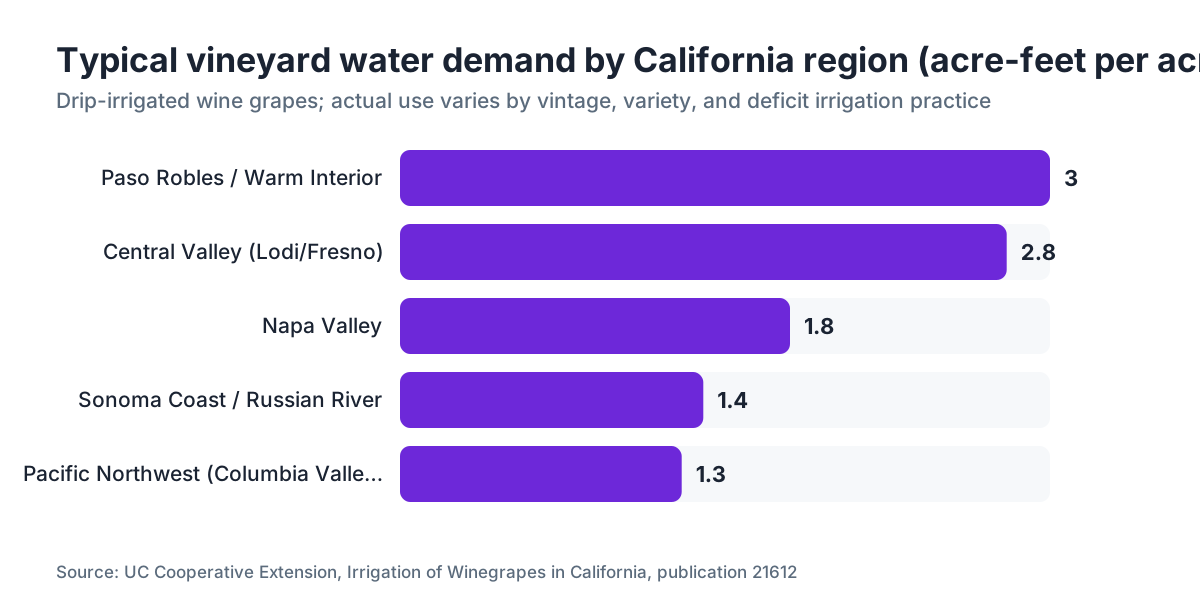
It varies with climate, vine spacing, and deficit irrigation practice. On California's Central Coast, drip-irrigated wine grapes commonly use 1.0 to 2.5 acre-feet per acre per year. In hotter inland regions like Paso Robles, demand can hit 2.5 to 3.5 acre-feet per acre. Pacific Northwest vineyards with lower summer ETo may use 0.8 to 1.8 acre-feet per acre. Build your budget from local CIMIS or AgriMet data, not regional averages.
What is SGMA and how does it affect vineyard water rights in California?
SGMA, the Sustainable Groundwater Management Act passed in 2014, requires local Groundwater Sustainability Agencies to manage medium- and high-priority basins to sustainable yield by 2040. New vineyard groundwater extraction in these basins has to be consistent with the basin's Groundwater Sustainability Plan. In critically overdrafted basins, new allocations may not be available at all. Check your basin's status at the SWRCB's SGMA portal before planning new development.
Can I use a water district supply agreement instead of a well for my vineyard?
Yes, and for many sites it's the better option. A written district service agreement that specifies annual acre-foot allotment, peak delivery rate in gpm, and shortage provisions satisfies most regulatory and lender requirements. The key is getting the allotment in writing rather than a verbal assurance. Confirm the district's total available supply covers both existing customers and your new demand before you close on the land.
What water quality parameters matter most for vineyard irrigation water?
The parameters that matter most are electrical conductivity (EC, a salinity measure), boron, sodium adsorption ratio (SAR), pH, and chloride. UC Cooperative Extension recommends EC below 1.0 dS/m for most wine varieties and boron below 0.5 to 1.0 mg/L depending on rootstock. High SAR damages soil structure. Test your source water before you design the irrigation system, because some fixes (like blending with low-salinity water) need specific infrastructure.
What is a crop coefficient (Kc) and where do I get the right number for grapevines?
The crop coefficient (Kc) is a dimensionless number that adjusts reference evapotranspiration (ETo) for the water use of a specific crop at a specific growth stage. For wine grapevines it runs from roughly 0.1 during dormancy to 0.5 to 0.7 at mid-season. UC Davis extension and the ITRC at Cal Poly San Luis Obispo publish grapevine Kc tables by growth stage and region. Use values that match your climate and vine variety.
Does a water availability assessment cover water quality compliance for wineries too?
No. The vineyard development assessment covers irrigation water supply and agricultural water rights. Winery water use, including process water for crush, cave cooling, and wastewater treatment, is a separate regulatory category. Most states require winery process water under a separate industrial use permit, with wastewater managed under a regional water quality control board order. Plan a separate consultant engagement for winery water and wastewater compliance.
How often should a vineyard water availability assessment be updated?
At minimum, revisit the demand side of your water budget any time you add irrigated acreage, change varieties, or alter your irrigation system significantly. On the supply side, re-run well measurements every 3 to 5 years or after any prolonged drought to check whether aquifer levels have dropped. If you're in a SGMA basin, your GSA may require annual extraction reports that force you to track this anyway. Keep those reports in your assessment file.
What if my well yield is lower than my vineyard water demand?
That's a supply gap, and the assessment should state it plainly along with your proposed fix. Common solutions include on-farm reservoir storage to capture winter rainfall or off-peak pumping, acquiring a supplemental water right, buying water from an irrigation district, reducing planted acreage, or switching to more drought-tolerant rootstocks. A supply gap isn't automatically a deal-breaker. Regulators and lenders want to see you've identified it and have a credible plan.
Are there free tools or data sources I can use to prepare before hiring a hydrogeologist?
Yes, several. California's CIMIS network provides free ETo data by station. The USGS National Water Information System has groundwater level data for many basins. California's DWR well completion report database (OSWCR) lets you look up neighboring well logs. USDA NRCS Web Soil Survey gives you soil drainage class and permeability. Gathering this background before your first consultant meeting makes the engagement more efficient and saves money.
Do I need a separate environmental impact assessment or does the water assessment cover CEQA?
A water availability assessment is not the same as a CEQA environmental review, though it's usually an exhibit within one. If your vineyard project triggers CEQA, the lead agency (usually the county) requires an Initial Study that addresses water supply impacts among other topics. In many coastal California counties, new vineyard development above a set acreage threshold triggers at least a Mitigated Negative Declaration. Budget separately for CEQA; it's a different process with different consultants.
Sources
- California Department of Water Resources, Sustainable Groundwater Management Act overview: SGMA requires new groundwater extraction in medium- or high-priority basins to be consistent with an approved Groundwater Sustainability Plan; high-priority basins must achieve sustainability by 2040.
- Washington State Department of Ecology, Water Rights Program: Washington is a prior appropriation state; many eastern Washington basins are closed to new surface water appropriations, and water right change applications can take 2-5 years to process.
- University of California Agriculture and Natural Resources, Groundwater and Well Testing guidance: A constant-rate pump test for agricultural wells is typically run for at least 4-24 hours to determine sustainable yield, with measurements of drawdown and recovery used to estimate aquifer transmissivity; professional hydrogeological assessment for small sites typically costs $3,000-$40,000 depending on scope.
- UC Cooperative Extension, Irrigation of Winegrapes in California (publication 21612): Grapevine crop coefficients (Kc) range from approximately 0.1 during dormancy to 0.5-0.7 at peak mid-season growth; irrigation water EC should be below 1.0 dS/m and boron below 0.5-1.0 mg/L for most wine varieties.
- California Irrigation Management Information System (CIMIS), California Department of Water Resources: CIMIS provides free reference evapotranspiration (ETo) data by station across California, used as the baseline for vineyard water budget calculations.
- Washington State University Extension, Irrigation Scheduling for Pacific Northwest Vineyards: WSU Extension publishes grapevine crop coefficient tables and irrigation scheduling guidance specific to Pacific Northwest wine grape production.
- California State Water Resources Control Board, Electronic Water Rights Information Management System (EWRIMS): The SWRCB administers surface water rights in California; the EWRIMS database allows parcel-level lookup of existing water right permits and applications; the SGMA data portal at sgma.water.ca.gov identifies basin priority for each parcel.
- U.S. EPA, Agricultural Worker Protection Standard: The EPA Worker Protection Standard requires potable water for field workers be available and documented near areas where workers handle or are exposed to pesticides.
- California State Water Resources Control Board, Porter-Cologne Water Quality Control Act: California's Porter-Cologne Act requires that any discharge to waters of the state, including agricultural irrigation tailwater, be covered by a waste discharge requirement or waiver; vineyards typically enroll in a regional agricultural order.
- USGS National Water Information System, Groundwater Data: The USGS NWIS provides publicly available groundwater level records for monitoring wells across the United States, useful for baseline aquifer condition research prior to hiring a hydrogeologist.
Last updated 2026-07-11