How to document a beneficial nematode application in IPM records

TL;DR
- A complete beneficial nematode application record needs: the date and block, the nematode species and strain, the product source and lot number, the application rate and water volume, the target pest, soil temperature and moisture at the time of application, the applicator's name, and what monitoring you'll do afterward.
- No restricted-use pesticide license is required, but IPM records must still meet state audit standards and EPA WPS documentation norms.
Why do beneficial nematode applications need to be documented at all?
Beneficial nematodes are living organisms, not registered pesticides, so you don't log them in a pesticide application record the way you would a copper spray. That distinction trips up a lot of vineyard managers. The record still matters.
IPM programs, whether certified by a third party or self-managed, require you to show that every pest management decision was made on evidence, targeted at a documented pest, and followed up with a monitoring outcome. If you're applying nematodes to suppress grape root borer (Vitacea polistiformis) or other soil-dwelling pests in your vineyard, and an auditor or your certifier asks why, your IPM log is the only answer you have.
State departments of agriculture take IPM records seriously even for biological controls. California's Department of Pesticide Regulation, for example, requires that growers in certain programs document all pest management actions, including biological ones [1]. USDA National Organic Program rules under 7 CFR Part 205 also expect growers to keep records demonstrating that inputs, including biological controls, conform to their organic system plan and can be traced back to a supplier [2]. A missing lot number or an undocumented soil temperature reading can turn a routine audit into a compliance headache.
Good documentation is also just how you learn. Nematode efficacy depends heavily on soil conditions at the time of application. If you don't record soil temperature and moisture, you can't figure out whether a failed application was a product problem or a timing problem.
What specific information must go into a beneficial nematode application record?
Here's what a complete record contains. Every field earns its place.
Date and time. Nematodes are photosensitive and heat-sensitive. Morning applications are standard practice. The timestamp tells you whether you followed your own protocol.
Block or zone identifier. Reference your vineyard map. Row numbers or GPS coordinates are even better, especially if you only treated a portion of a block.
Target pest. Name the pest by species if you can. "Soil pests" is not enough. UC IPM guidance on wine grapes expects the target pest to be documented as part of the decision record [3].
Nematode species and strain. Steinernema carpocapsae, Heterorhabditis bacteriophora, and Steinernema feltiae all have different host ranges and soil temperature optima. These are not interchangeable. Record the genus, species, and if the supplier provides it, the strain designation.
Product supplier and lot number. You need this for traceability. If the product failed, you want to know whether others from the same lot had complaints. Biological suppliers like ARBICO Organics or Koppert print lot numbers on packaging. Write it down.
Application rate. Most beneficial nematode recommendations fall in the range of 500 million to 1 billion infective juveniles (IJ) per acre for soil pests, but this varies by species and target pest [3]. Record the rate you actually applied, not the label recommendation.
Water volume and application method. Nematodes go out in a water suspension, and the carrier volume affects distribution. Record gallons per acre and whether you used a spray rig, drip system, or hand wand.
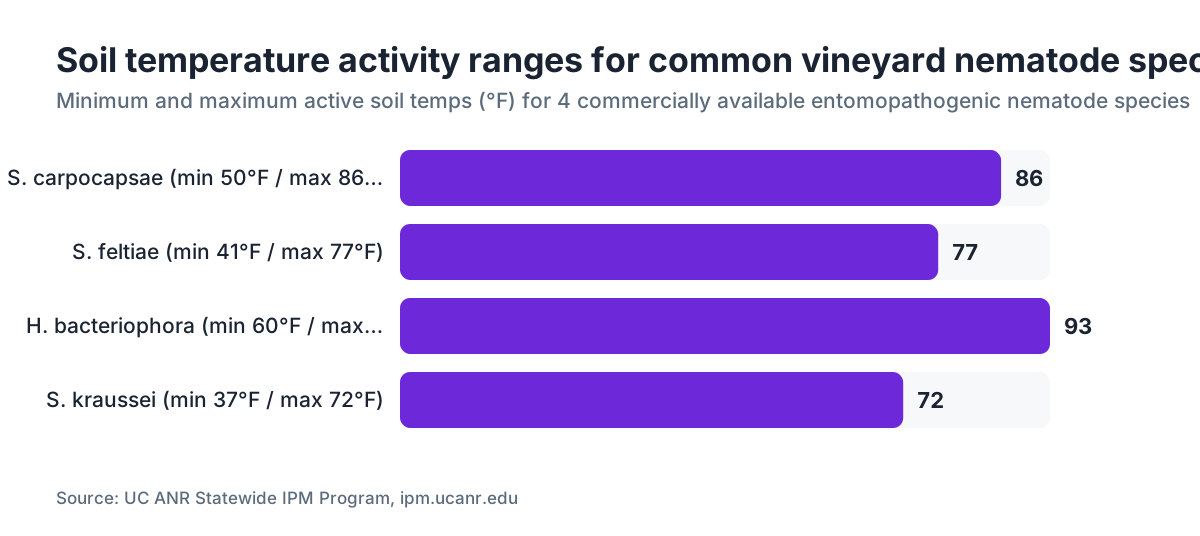
Soil temperature at time of application. This is the single most important environmental variable. Steinernema carpocapsae is active between about 50°F and 86°F; Heterorhabditis bacteriophora prefers warmer soils, roughly 60°F to 93°F [4]. Log the reading in the top 2-4 inches of soil, where the nematodes will be working.
Soil moisture. Nematodes need moist soil to move. Record whether you pre-irrigated, and log the approximate soil moisture condition at application.
UV and weather conditions. If you sprayed foliage surfaces (less common in vineyard use, but possible for above-ground targets), direct sun kills infective juveniles fast. Log cloud cover or note that application was made in morning shade.
Applicator name. Required for any IPM action record, and specifically required under the EPA Worker Protection Standard [5] for records that could relate to pesticide exposure. Even though nematodes are not pesticides, keeping consistent applicator records across all field actions is standard practice.
Monitoring plan and outcome. Note what you plan to check and when. A nematode release with no follow-up monitoring is incomplete as an IPM record. Log your post-application observation date and what you found.
What does a completed record actually look like, as a field-by-field example?
Here's a realistic template you can copy. This is a hypothetical record, not a real vineyard, but every field and value reflects real-world practice.
| Field | Example Entry |
|---|---|
| Date / Time | June 14, 2025, 6:45 AM |
| Block / Zone | Block 7, rows 12-28 (GPS: 38.512°N, 122.481°W) |
| Target Pest | Grape root borer (Vitacea polistiformis), confirmed by adult trap catch |
| Nematode Species | Steinernema carpocapsae (SC strain) |
| Supplier | ARBICO Organics, lot #SC-2025-0589 |
| Application Rate | 600 million IJ per acre |
| Water Volume | 100 gallons per acre |
| Application Method | PTO-driven sprayer, nozzles removed, boom flood-applied |
| Soil Temp (2-inch) | 64°F |
| Soil Moisture | Pre-irrigated 24 hours prior, soil visibly moist |
| Weather | Overcast, no direct sun, wind < 3 mph |
| Applicator | [Your name] |
| Monitoring Plan | Trap check July 5 and July 19; soil sample for IJ viability 3 weeks post-application |
| Monitoring Outcome | (to be completed) |
That's the whole record. It fits on a single page. Keep a blank version as a field form so your crew fills it out the same way every time.
Does the EPA Worker Protection Standard apply to beneficial nematode applications?
The short answer is no, not directly. The EPA Worker Protection Standard (WPS) under 40 CFR Part 170 applies to pesticides as defined under the Federal Insecticide, Fungicide, and Rodenticide Act [5]. Beneficial nematodes are not registered pesticides. They're exempt from FIFRA registration under EPA's provisions for naturally occurring organisms.
Still, two reasons argue against ignoring WPS norms when you log a nematode application.
First, your overall spray record system probably mixes nematode applications with other materials that do fall under WPS, and auditors read the whole log. A system that's disciplined for one type of application and sloppy for another raises questions. Cornell's IPM program recommends treating biological inputs with the same documentation rigor as conventional inputs for exactly this reason [6].
Second, the nematode carrier solution and application equipment may be shared with other materials, and applying any liquid to soil or vegetation looks identical to a spray application from a worker safety standpoint. Keeping applicator names, dates, and block identifiers in one consistent format protects you if a worker ever claims exposure to anything applied in that block on that day.
The EPA WPS requires agricultural employers to maintain records of pesticide applications for two years [5]. For your biological control actions, matching that two-year retention practice is a reasonable minimum even though it's not legally compelled for nematodes.
How do beneficial nematode records fit into a formal IPM plan?
A formal IPM plan has a few layers, and nematode application records slot into different places depending on which layer you're looking at.
The decision layer is where you document the monitoring data that triggered the application. That's your trap counts, your soil samples, your economic threshold reference. WSU extension guidance on IPM decision-making calls this the "action threshold" documentation, and it's what separates IPM from calendar-based spraying [7]. Your nematode record should reference the monitoring data that justified the release, even if it's just a note saying "grape root borer trap catch exceeded 5 moths per trap over two consecutive weeks."
The application layer is the record described in the previous sections: what you applied, where, when, and under what conditions.
The outcome layer is post-application monitoring. For nematodes, that usually means checking your trap counts at 3-6 week intervals after application, or doing a soil bioassay to confirm infective juveniles are still present. Log the outcome in the same record or in a linked monitoring log.
If you're managing a vineyard through an organic certification program, your certifier expects to see all three layers during an annual inspection. NOP allows naturally occurring beneficial organisms as inputs, but the documentation burden is yours [2].
A software-based field record system can link these three layers automatically, so your trap count from the monitoring phase populates the "trigger event" field in your application record. VitiScribe, for example, is built for this kind of cross-linked IPM documentation in vineyard settings, and it stores supplier lot numbers, soil conditions, and monitoring outcomes in a single searchable record.
What soil temperature and moisture thresholds should you log, and why do they affect the record?
Soil temperature and moisture aren't nice-to-have data. They're the main reason nematode applications succeed or fail, and an auditor or certifier who sees a failed application looks at these fields first to judge whether you applied with reasonable care.
The temperature ranges for the most common vineyard-relevant species are fairly well established. UC IPM guidelines and peer-reviewed literature on entomopathogenic nematodes put the ranges roughly as follows [4]:
| Species | Optimal Soil Temp | Lower Threshold | Upper Threshold |
|---|---|---|---|
| Steinernema carpocapsae | 60-75°F | 50°F | 86°F |
| Steinernema feltiae | 50-65°F | 41°F | 77°F |
| Heterorhabditis bacteriophora | 68-86°F | 60°F | 93°F |
| Steinernema kraussei | 45-60°F | 37°F | 72°F |
Log the soil temperature from the top 2-4 inches (where most root pests are active) using a probe thermometer. Don't use air temperature as a proxy. Soil and air temperatures can differ by 10°F or more in shaded or mulched vineyard blocks.
For soil moisture, you don't need tensiometer readings in your IPM record (though that's ideal). A simple notation of your irrigation history and a field observation ("soil moist to 4 inches at application") is enough. The point is documenting that you didn't apply into bone-dry soil, which kills IJs quickly, or into waterlogged conditions, which limits their ability to move.
One more field worth logging: did you water in the soil surface after application? Some growers apply a light irrigation pass right after releasing nematodes to move them into the root zone. If you did this, note the volume and timing. It becomes part of the efficacy story when you review why an application worked or didn't.
How long do you need to keep beneficial nematode application records?
That depends on which programs you're enrolled in and which state you're in.
For organic certification, USDA NOP requires you to keep all records sufficient to demonstrate compliance with 7 CFR Part 205 for at least 5 years [2]. Since nematode applications are part of your pest management record and must align with your organic system plan, five years is the minimum for certified operations.
For California growers, the Department of Pesticide Regulation requires pesticide use records to be kept for 3 years [1]. Because biological controls like nematodes aren't regulated pesticides under California law, DPR's retention rule doesn't technically apply, but commodity-specific programs may impose their own requirements. When in doubt, match the 5-year NOP standard.
For non-certified operations with no state mandate, the EPA WPS two-year retention rule for pesticide records is a reasonable floor to adopt for all field input records, biological or not.
Keep records in a format you can actually retrieve. A paper binder that molds in a barn, or a spreadsheet you can't find three seasons later, doesn't protect you in an audit. Digital storage with offsite backup is the practical answer for most small vineyard operations.
What are the most common documentation mistakes vineyard managers make with biological controls?
The most common mistake is treating the record as an afterthought. You release the nematodes on a busy morning and tell yourself you'll write it up later. Later turns into never.
Second most common: logging the product name but not the lot number. Product names change, but lot numbers tie your application back to a specific production batch. If that batch had a viability problem (it happens with live organisms), you need the lot number to make a warranty claim or explain a failed application.
Third: no target pest specified. "Applied nematodes to block 7" tells an auditor nothing. The IPM framework requires every application to tie to a pest decision. Name the pest.
Fourth: skipping the monitoring outcome. An IPM record that has a trigger event and an application but no follow-up is incomplete by definition. Even a brief entry like "July 5 trap check: adult catch down 70% vs. pre-treatment baseline" closes the loop.
Fifth, and this one is specific to nematodes: recording the label rate instead of the actual rate applied. If your tank mix calculations or equipment calibration produced a different rate, write down what you actually applied. The label recommendation is a reference; your record is reality.
Cornell's IPM program makes the same point in its record-keeping guidance for biological inputs: records that don't reflect what actually happened in the field have no value for decision-making and can actively mislead future management choices [6].
Does applying beneficial nematodes require any license or permit?
No pesticide applicator license is required to buy or apply beneficial nematodes in the United States. They're exempt from FIFRA registration as naturally occurring organisms that pose no unreasonable risk. You can order them from a supplier and apply them without any state license.
A few nuances are worth knowing.
Some states regulate the import or movement of certain beneficial organisms if they aren't native to the region. The USDA Animal and Plant Health Inspection Service (APHIS) oversees the importation of biological control agents under 7 U.S.C. 7701 et seq., though most commercially produced entomopathogenic nematode species in wide use (Steinernema and Heterorhabditis species) are already established in U.S. soils and don't require import permits [8].
If you're applying nematodes as part of a state-funded IPM program or a cost-share program, there may be program-specific documentation requirements beyond what's described here. Check with your local farm advisor or county agricultural commissioner.
For growers in any third-party sustainability certification (Sustainability in Practice, CCOF, USDA Organic), confirm with your certifier that the specific nematode species and supplier are on their approved materials list before you apply. A few certification bodies have supplier vetting requirements.
How do digital IPM record systems handle beneficial nematode entries differently from pesticide records?
Most digital farm management platforms were built around pesticide application records, which have fixed fields driven by regulation: EPA registration number, REI, PHI, restricted-use flag. Beneficial nematode applications don't have most of those fields, so you end up either leaving them blank or shoehorning nematode data into pesticide-shaped forms.
The practical consequence: your nematode records look incomplete when they're not, or they get filed in a miscellaneous notes field where nobody can find them later.
A better approach, whether you're using software or a paper system, is a separate biological control application form with its own required fields: organism name, supplier, lot number, application rate in IJ/acre, soil conditions, and monitoring plan. That form can live alongside your pesticide records in the same filing system without pretending to be a pesticide record.
If you want a single system that handles both without compromise, VitiScribe's vineyard compliance module has a biological control record type that captures lot numbers, soil conditions, and links to the pest monitoring event that triggered the release. That's genuinely useful for the cross-linked IPM documentation certifiers want to see.
WSU Extension publishes guidance on structuring farm records for IPM compliance that's worth reading before you build your record system, paper or digital [7]. They're clear that the structure of the record matters less than the consistency of the information captured.
What do state IPM audits actually look for in biological control records?
State IPM audits vary a lot. California's DPR audits focus heavily on restricted-use pesticide records and licensed applicator compliance, so a nematode record won't draw much scrutiny from DPR specifically. But if you're in a CDFA-administered program with IPM requirements, the auditor looks for evidence that your biological control decisions followed the IPM decision framework: monitoring, threshold, action, evaluation [1].
Organic certification inspections are the most thorough. USDA NOP inspectors check that your inputs match your organic system plan, that you have purchasing records (invoices) to support what you say you applied, and that your field records line up with your supplier invoices [2]. If your record says you applied 600 million IJ per acre to 5 acres, but your invoice shows a quantity consistent with only 2 acres, you have an inconsistency to explain.
Third-party sustainability program audits (SIP, Lodi Rules, LIVE) tend to focus on the IPM decision logic. Can you show that you monitored before the application, that there was a documented reason for it, and that you followed up to evaluate efficacy? Those three questions drive most audit conversations about biological controls.
The cleanest audit outcome comes from records that answer those questions before the auditor asks. A record showing "trap count on date X, exceeded threshold Y, applied Z on date A, checked traps on date B, result C" is a complete IPM record regardless of whether the input was a nematode or a copper spray.
Where can you find authoritative guidance on beneficial nematode IPM documentation?
The three best university extension sources for vineyard IPM documentation are UC IPM, Cornell, and WSU, and each comes at it from a different angle.
UC Statewide IPM Program (ipm.ucanr.edu) has pest management guidelines for wine grapes that include biological control options and reference monitoring thresholds [3]. The guidelines describe what to monitor, when to act, and what to expect from nematode applications for specific pests.
Cornell's New York State IPM Program has practical documentation guidance for biological inputs and crop record-keeping that applies well beyond New York [6]. Their materials are especially good on the record-structure side of the question.
WSU Extension's pest management resources for wine grapes include guidance on using IPM records for program compliance, with specific notes on biological control documentation [7].
For the regulatory backbone, the EPA's Worker Protection Standard page and the USDA NOP regulations are the primary sources for retention requirements and the broader compliance context [5][2].
Nobody has published a single consolidated federal standard specifically for beneficial nematode application records. The closest thing is the combination of NOP requirements for organic growers and the IPM decision documentation standards embedded in state and third-party certification programs. You assemble the standard yourself from these sources, which is why a clear internal template matters so much.
Frequently asked questions
Do I need a pesticide applicator license to apply beneficial nematodes in a vineyard?
No. Beneficial nematodes are naturally occurring organisms exempt from FIFRA registration, so no pesticide applicator license is required to buy or apply them in the U.S. You should still check whether your state has any biological agent movement rules, but for the common commercial species (Steinernema and Heterorhabditis), no permit is needed. Confirm with your county agricultural commissioner if you're uncertain.
Can I record a beneficial nematode application on the same log sheet as my pesticide applications?
You can, but it creates confusion because pesticide records have fields (EPA reg number, REI, PHI) that don't apply to nematodes. Better practice is a separate biological control application form with fields specific to living organisms: species, lot number, application rate in IJ/acre, soil temperature, and soil moisture. File it alongside your pesticide records but don't force it into a pesticide-shaped form.
What nematode species should I use for grape root borer control, and does my species choice affect what I record?
Steinernema carpocapsae is the most commonly recommended species for grape root borer (Vitacea polistiformis) because it's an ambush predator well-suited to soil surfaces and tunnels. Your choice absolutely affects what you record: log the specific species, strain, and the soil temperature at application time, since SC is active between roughly 50°F and 86°F. Recording the wrong species or skipping soil temp makes the record useless for evaluating efficacy.
How long do I need to keep beneficial nematode application records?
For USDA certified organic operations, NOP requires records be kept for at least 5 years. For California growers, DPR's 3-year rule applies to pesticide records, but since nematodes aren't pesticides, there's no direct mandate. Match the most stringent requirement you're subject to. If you're organic, keep records 5 years. If not, the EPA WPS two-year standard for pesticide records is a reasonable floor for all field inputs.
What soil temperature should I record, and does it matter if I log air temperature instead?
Log soil temperature from the top 2-4 inches using a probe thermometer. Air temperature is not an acceptable substitute. In a shaded or mulched vineyard block, soil and air temperatures can differ by 10°F or more. Since nematode efficacy depends on soil temperature (not air temperature), recording air temp gives you a data point that doesn't explain the outcome. Take the soil reading at or just before application.
Do beneficial nematode applications need to be disclosed to workers under EPA WPS rules?
No. The EPA Worker Protection Standard applies to pesticides regulated under FIFRA, and beneficial nematodes are exempt from FIFRA. No WPS posting, REI, or safety data sheet is required. That said, telling your crew what's being applied and why is just good management, and keeping applicator names in your records protects you if any exposure claim arises from activity in that block on that day.
What should I include in my monitoring plan after a beneficial nematode release?
At minimum, plan a follow-up pest monitoring check at 3-6 weeks post-application using the same method that triggered the release (usually trap counts for moths or adult emergence for soil pests). You can also run a soil bioassay to check IJ viability 2-3 weeks after application. Log the plan date in the application record, then return and fill in the results. An IPM record without a monitoring outcome is incomplete.
Does the USDA NOP require me to document beneficial nematode applications for organic certification?
Yes. Under 7 CFR Part 205, certified organic growers must keep records demonstrating compliance with their organic system plan for all inputs, including biological controls. Records must be sufficient to trace the input to a supplier and confirm it was allowed under NOP. Keep your supplier invoice, the lot number, and your application record together. NOP requires these records be kept for at least 5 years.
How do I document a failed beneficial nematode application where I saw no pest reduction?
Document it honestly. Log your post-application monitoring outcome, note the lack of pest reduction, and record the soil conditions at application for comparison against recommended ranges. Then note your hypothesis: wrong species for the target, soil too dry or too hot, or a product viability issue (which is why you need the lot number). A failed application with good documentation is an IPM learning record. A failed application with no record just means you spent money and have nothing to show for it.
Can I use the same record template for beneficial nematodes and other biological controls like predatory insects?
A biological control template can cover both, but the fields differ. Predatory insects don't have a water volume or soil temperature field; nematodes don't have a release density-per-release-point field in the same way. Design your template so the shared fields (date, block, target pest, organism species, supplier, lot number, applicator, monitoring plan) are fixed, and add organism-specific fields as needed. One template per input type is cleaner than forcing everything into one form.
What happens if my beneficial nematode application records are incomplete during a DPR or organic certification audit?
For DPR audits focused on pesticide records, incomplete nematode records won't directly trigger a violation since nematodes aren't regulated pesticides. For organic certification inspections, incomplete records can result in a non-compliance finding, a corrective action request, or in serious cases, suspension of certification. Auditors look for evidence that the input matches your organic system plan and that you have supplier documentation to support the application record.
Do I need to record the brand name or just the species of nematode I applied?
Record both. The species (e.g., Steinernema carpocapsae) tells you what organism was applied and informs your efficacy review. The brand name and supplier tell you who produced it. The lot number is the most important identifier for traceability. A brand name alone doesn't tell you which production batch you used. If there's a product quality issue, the lot number is what lets you pursue a warranty claim or compare notes with other growers who used the same batch.
Sources
- California Department of Pesticide Regulation: California DPR requires pesticide use records to be kept for 3 years; certain IPM-enrolled growers must document all pest management actions including biological controls
- USDA Agricultural Marketing Service, National Organic Program Regulations 7 CFR Part 205: USDA NOP requires certified organic growers to keep all compliance records, including biological input applications, for at least 5 years and to trace inputs back to the supplier
- UC Agriculture and Natural Resources Statewide IPM Program, Pest Management Guidelines: Grape: UC IPM guidelines for wine grapes include biological control options, monitoring thresholds, and documentation expectations for pest management decisions
- UC Agriculture and Natural Resources Statewide IPM Program, entomopathogenic nematodes in biological control: Soil temperature optima and thresholds for commercial entomopathogenic nematode species: S. carpocapsae active 50-86°F, H. bacteriophora 60-93°F, S. feltiae 41-77°F
- EPA, Agricultural Worker Protection Standard (WPS), 40 CFR Part 170: EPA WPS requires agricultural employers to maintain pesticide application records for two years; the standard applies to FIFRA-registered pesticides, not exempt biological organisms
- Cornell University, New York State Integrated Pest Management Program: Cornell IPM program recommends treating biological inputs with the same documentation rigor as conventional inputs, and that records reflect actual conditions and outcomes rather than just planned actions
- Washington State University Extension: WSU Extension IPM guidance for wine grapes includes action threshold documentation requirements and notes on structuring farm records for program compliance, including biological control entries
- EPA, Pesticide Registration (biopesticides and FIFRA exemptions): Naturally occurring organisms including entomopathogenic nematodes are generally exempt from FIFRA registration; no pesticide applicator license is required for their purchase or application
- UC Agriculture and Natural Resources Statewide IPM Program, grape root borer management: Steinernema carpocapsae is recommended for grape root borer control at application rates typically ranging from 500 million to 1 billion infective juveniles per acre
Last updated 2026-07-10