How to document compost application rates and source material in records
TL;DR
- For each compost application, record the date, field block, product source and supplier, lot or batch number, nutrient analysis (especially N-P-K and heavy metals), application rate in tons or cubic yards per acre, application method, and the operator's name.
- Organic and food-safety programs add extra fields.
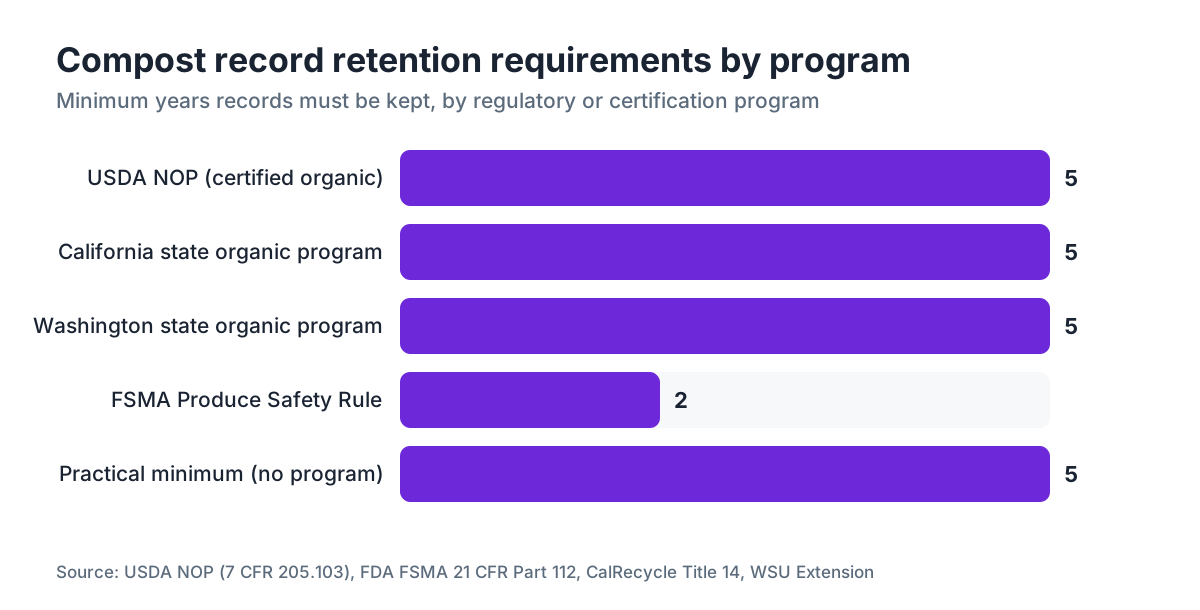
- Keep records at least three years, often five.
Why do compost records matter for a vineyard?
Compost records protect you. When a soil test comes back high in copper three years from now, a complete application log tells you exactly which product and which lot introduced the load. Without that record, you're guessing.
Compost is not a fertilizer you can apply and forget. It moves nitrogen, phosphorus, heavy metals, and sometimes pathogens into your soil, and regulators, certifiers, and buyers increasingly want proof of what you put down and where.
For certified organic operations, the USDA National Organic Program requires that all inputs be documented with the product name, source, and evidence that the material meets the composting process standards in 7 CFR Part 205.203 [1]. Missing records are one of the most common reasons certifiers put operations on probation.
Food-safety audits under the FSMA Produce Safety Rule (21 CFR Part 112) require covered farms to keep records of all biological soil amendments of animal origin, including compost, for at least two years [2]. Vineyards below the FSMA coverage threshold still face this documentation expectation from major retail buyers and third-party auditors like PrimusGFS or SQF.
Even if none of those programs apply to you today, good compost records let you track fertility trends, avoid over-applying nutrients, and answer the one question every land bank and winery purchase due-diligence process will ask: what have you been putting in the ground?
What fields should every compost application record include?
A complete record has two layers: the source material layer (what the product actually is) and the field application layer (what you did with it). Fill in both, or the record can't defend itself at audit.
Source material fields
- Supplier name and address
- Product name and lot or batch number
- Feedstock description (e.g., wood chips and food scraps, yard trimmings, dairy manure)
- Composting method stated by supplier (windrow, in-vessel, aerated static pile)
- Temperature and turning logs or a certificate of analysis confirming process compliance, if your certifier requires it
- Most recent nutrient analysis: total N, available N, P2O5, K2O, pH, organic matter percentage, moisture percentage, carbon-to-nitrogen ratio, and a heavy metals panel (at minimum arsenic, cadmium, copper, lead, mercury, selenium, zinc)
- Date of lab analysis and name of the testing laboratory
Field application fields
- Date of application
- Block ID or field identifier (match this exactly to your vineyard map)
- Crop year
- Application rate: tons per acre (wet weight or dry weight, state which), or cubic yards per acre if you're buying by volume
- Total quantity applied to that block
- Application method (broadcast spread, banded, incorporated)
- Equipment used and calibration date
- Operator name
- Supervisor or manager sign-off
- Pre-harvest interval notes if relevant (NOP rules on raw vs. composted material carry different PHI requirements [1])
That's more fields than most operations fill out today. Start with the minimum: date, block, supplier, lot number, rate, and operator. Add the rest as your program matures.
How do you determine and record compost application rates?
Weigh the load. Application rate is the field where most records fall apart, because people write down what they meant to apply, not what they actually applied, and those two numbers are usually different.
If a supplier delivers 8.4 tons and you spread it over 3.2 acres, your rate is 2.625 tons per acre. Record the delivery weight from the supplier's ticket, the acreage from your vineyard map, and calculate the rate. Attach the delivery ticket to the record or log its reference number.
Buying in cubic yards with no delivery weight? Use the product's bulk density from the lab analysis to convert. Finished compost runs 800 to 1,100 pounds per cubic yard depending on moisture, so 1 cubic yard per 1,000 square feet works out to roughly 1.7 to 2.4 tons per acre. Write down the assumed density and where it came from so anyone reading the record later can follow your math [3].
WSU Extension recommends expressing rates on a dry-weight basis for comparing applications year over year, because moisture content swings hard between batches [4]. If your lab analysis gives moisture percentage, the math is: dry tons = wet tons × (1 - moisture fraction). Record both the wet-weight delivery figure and the dry-weight equivalent.
For nitrogen management, the number that matters is plant-available nitrogen, which is only a fraction of total N in compost. UC Davis Extension guidance suggests roughly 10 to 20 percent of total organic N mineralizes in the first year for typical finished composts, though that range depends heavily on C:N ratio, soil temperature, and moisture [3]. Record the total N from the lab analysis and your assumed first-year mineralization rate so you can credit it against your nitrogen budget.
What source material information do you need from your compost supplier?
You need a Certificate of Analysis (COA) for every lot you buy, more than the first shipment of the season. Every lot. Feedstock composition and process conditions vary, and a supplier's January batch and August batch can carry meaningfully different nutrient and pathogen profiles.
Ask your supplier for:
- A COA showing the complete nutrient panel and heavy metals from an accredited laboratory. The U.S. Composting Council's Seal of Testing Assurance (STA) program sets standards for this; buying STA-certified product is the simplest way to guarantee the analysis meets a recognized minimum [5].
- Documentation of the composting process temperatures and duration. NOP requires that compost reach 131°F to 170°F for at least 15 days, during which the pile is turned at least five times, for windrow systems [1]. Ask for time-temperature logs or the supplier's process certification.
- Feedstock disclosure. Organic certifiers need to know if the feedstock included sewage sludge (biosolids), synthetic inputs, or prohibited materials. Biosolids-based products are not allowed in NOP organic programs [1].
- A copy of any state permit or registration. Many states require compost facilities to register or permit under solid waste regulations. California compost facilities must comply with Title 14 of the California Code of Regulations [6]. Keep a copy of that registration or permit number in your supplier file.
If a supplier won't hand over a COA with a traceable lot number, don't buy from them. The record you're legally required to keep cannot be reconstructed after the fact.
What does the USDA NOP require for compost records in organic vineyards?
The USDA National Organic Program regulation at 7 CFR 205.103 requires certified organic producers to keep records that "fully disclose all activities and transactions of the certified operation in sufficient detail as to be readily understood and audited" [1]. For compost, that means records that show the input was allowed, was produced by an acceptable method, and was applied consistently with the farm's organic system plan.
Your certifier checks three things: that the product was on the NOP-approved materials list or otherwise reviewed, that the composting process met the temperature and turning standards in 205.203(c)(2), and that you can link the application to a specific lot with a traceable COA.
Organic certifiers want a running input log covering every compost application for the year, tied to both the block map and the supplier documentation. Most require five years of records, longer than the FSMA two-year minimum [1][2]. When in doubt, keep five.
Apply raw or incompletely composted manure instead of finished compost and the NOP rules tighten: a 90-day interval before harvest for crops not in contact with soil, 120 days for crops that contact soil. Grapes on a trellis are generally treated as not-soil-contact, but confirm this with your certifier in writing and log that confirmation [1].
What does FSMA require for compost records in vineyards?
The FDA's Produce Safety Rule under FSMA (21 CFR Part 112, Subpart F) covers biological soil amendments of animal origin, which includes compost made from animal manure or other animal-derived feedstocks. Table 1 in Subpart F sets the application intervals before harvest based on the treatment status of the amendment [2].
For treated (properly composted) biological soil amendments, the rule requires application in a manner that minimizes contamination risk, and it requires growers to keep records documenting the identity and source of the amendment, its application rate and date, and the results of any testing conducted [2].
FSMA coverage applies to farms with average annual produce sales above $25,000. Vineyards selling wine grapes to a winery that processes them are often classified as "farm mixed-type facilities," and the analysis gets complicated fast. The FDA's FSMA training resources through Cornell Extension's National Good Agricultural Practices Program are worth reviewing for your specific situation [7].
The required record retention period under FSMA Produce Safety is two years [2]. Keep records in a format you can produce for an FDA inspector within 24 hours of a request.
How should you format and store compost application records?
Pick the format you'll actually fill out in the field on the day of application, paper or digital. A beautiful spreadsheet filled in from memory two weeks later is less reliable than a paper field card completed at the moment of application.
If you go paper, design a one-page field record that covers every required field, print a stack, and keep them on a clipboard in the tractor. After the application, transfer to a binder organized by crop year and block. Scan or photograph the completed records and back them up off-site.
Digital records in a dedicated platform let you attach supplier COAs directly to the application entry, which makes audits much faster. Tools like VitiScribe let vineyard managers log compost applications by block with attached documents, so the COA and the field record live in the same place and export for a certifier in minutes.
Whatever the format, organize records so an inspector can pull everything for a specific block and year in under ten minutes. The standard audit request sounds like this: "Show me all inputs applied to block 4B in 2023 and the supporting documentation for each." If that takes you more than ten minutes, your filing system needs work.
Store records for at least five years. USDA NOP requires five years for certified operations [1]. FSMA requires two [2]. California's state organic program mirrors the NOP five-year requirement [6]. Pick the longest applicable standard and apply it across the board.
What heavy metals and contaminants should you track in compost records?
Compost made from municipal biosolids, industrial food waste, or mixed feedstocks can carry copper, zinc, cadmium, lead, arsenic, and mercury at levels that accumulate in vineyard soils over time. Copper is the one to watch, because Bordeaux mixture and other copper-based fungicides already load your soil with it.
EPA's Part 503 biosolids rules set ceiling concentrations for nine metals in land-applied materials [8]. Those limits apply directly to biosolids but make a useful benchmark for any compost program. The two most commonly flagged in vineyard applications are copper (ceiling: 4,300 mg/kg dry weight) and zinc (ceiling: 7,500 mg/kg dry weight), though feedstock-based composts rarely come close to those numbers.
The U.S. Composting Council's STA program requires analysis for the metals panel defined in EPA Method 3050B or equivalent: arsenic, cadmium, copper, lead, mercury, molybdenum, nickel, selenium, and zinc [5]. Record all nine values from the COA, more than nitrogen and phosphorus.
Calculate the cumulative metal loading per acre per year. Apply 3 tons per acre of a compost testing 200 mg/kg copper (dry weight), and you're adding about 1.2 pounds of copper per acre. That sounds trivial. Over fifteen years it adds up, and some European export markets now ask for soil copper loading histories. Having the annual calculation sitting in your records beats reconstructing fifteen years of it later.
How do you document compost applications for a soil health or nutrient management plan?
A nutrient management plan (NMP) ties compost records to soil test results, tissue samples, and yield data to give you a running picture of soil fertility. Skip the compost records and the plan is missing its inputs.
Extension programs at UC Davis, Cornell, and WSU all publish nutrient management planning guides for wine grapes [3][4][9]. The common structure asks you to log each compost application's total N, P, and K contribution against your crop's nutrient demand, with soil tests setting the baseline.
A practical NMP compost record entry needs:
- Block ID and acreage
- Application date and rate (tons/acre, dry weight)
- Product N-P-K from COA (expressed as percent dry weight)
- Calculated nutrient loading: (rate × %N / 100) = lbs N/acre from compost
- Assumed first-year N availability percentage (document your source for this)
- Net N credit applied to the block's fertilizer budget
The nitrogen credit calculation is where most growers over- or under-apply supplemental fertilizer. Cornell's nutrient management guidance for fruit crops uses a 15 to 25 percent first-year N availability for well-composted materials, with higher availability for less mature composts [9]. Log which percentage you used and why.
Some states now require nutrient management plans for operations above certain acreage thresholds or near sensitive water bodies. Check your state's department of agriculture for current requirements before assuming you're exempt.
What's a practical record-keeping template for compost applications?
Below is a minimal working table you can adapt for a field card or spreadsheet. Add columns for your specific certifier or audit program.
| Field | What to enter | Example |
|---|---|---|
| Date | MM/DD/YYYY | 04/15/2025 |
| Block ID | Match vineyard map | Block 3A |
| Acreage | Decimal acres | 2.4 ac |
| Supplier | Name and address | Green Valley Compost, Fresno CA |
| Product name | As labeled | Supreme Blend Compost |
| Lot/Batch number | From delivery ticket | Lot 2025-041 |
| Feedstock | As stated on COA | Yard trimmings, food scraps |
| Application method | Broadcast / banded / incorporated | Broadcast with spinner |
| Wet weight delivered | From delivery ticket (tons) | 7.2 tons |
| Moisture % | From COA | 38% |
| Dry weight applied | Calculated | 4.46 tons |
| Rate (dry tons/acre) | Dry weight / acreage | 1.86 tons/acre |
| Total N (% dry wt) | From COA | 1.8% |
| N loading (lbs/acre) | Rate × %N × 2000 / 100 | 67 lbs N/acre |
| First-yr N avail % | From NMP assumption | 15% |
| N credit (lbs/acre) | N loading × avail % | 10 lbs N/acre |
| Cu (mg/kg dry wt) | From COA | 95 mg/kg |
| Cu loading (lbs/acre) | Calculated | 0.35 lbs/acre |
| COA reference | File name or document # | COA_GVC_2025-041.pdf |
| Operator | Full name | Maria Gutierrez |
| Supervisor sign-off | Signature or initials | JT |
This structure covers NOP, FSMA, and most state nutrient management requirements in one record. The calculation columns are the point: auditors want to see your work, more than the raw input numbers.
How long do you need to keep compost application records?
The retention period depends on which programs apply to your operation. When more than one applies, keep records for the longest period.
USDA NOP requires certified organic producers to keep records for five years from the date of creation [1]. FSMA Produce Safety requires two years [2]. California's Department of Food and Agriculture organic program mirrors the NOP five-year standard [6]. Washington State's organic program follows the same five-year federal standard [4].
For operations not covered by any of these programs, five years is still a sensible default. Soil disputes, land sales, and export certifications have all called for records going back five or more years in practice.
Store records in a way that keeps them legible. Paper fades and gets wet. Scanned PDFs on a server you control (with a backup) hold up. Cloud-based compliance platforms hold up better still, as long as you own an export of your data.
A simple rule: never destroy compost records while you still own the land they cover.
What are the most common record-keeping mistakes vineyard managers make with compost?
These are the failure patterns certifiers and auditors flag over and over. Each one is easy to avoid once you know it exists.
Using the supplier's suggested rate instead of the calculated actual rate. The delivery ticket is your evidence. Reconstruct the actual rate from weight delivered and acreage treated.
One COA for the whole season. Compost lots vary. Pull a COA for every delivery.
No lot number on the application record. Without a lot number you can't link the field record to the COA. This is the single most common audit finding.
Recording rates in volume with no density conversion. "4 yards per acre" means nothing in a nutrient management context without the bulk density to convert it to weight.
Forgetting to note the moisture basis. Wet-weight and dry-weight rates can differ by 30 to 50 percent for a typical 35 to 45 percent moisture compost. Leave out which basis you used and the record is ambiguous.
Keeping records in a format only one person understands. When that person leaves, the records go with them. Use standard field names and store documents in a shared system.
A tool like VitiScribe that links block-level records to attached supplier documents removes most of these problems by design, because the fields are defined and the attachment is required before the record saves. You can hit the same result with a well-built paper system, as long as you enforce it every single time.
For more on building a full vineyard field operations system, see our guide to vineyard record-keeping practices.
Frequently asked questions
Do I need to keep compost records if I'm not certified organic?
Yes, for two reasons. If your vineyard grosses over $25,000 in produce sales and uses animal-based compost, FSMA Produce Safety requires records for at least two years. Beyond legal requirements, soil test anomalies, land sales, and retail buyer audits all demand a paper trail. Five years of records is a reasonable baseline for any operation.
What's the difference between a nutrient analysis and a Certificate of Analysis for compost?
A nutrient analysis covers N-P-K, pH, organic matter, and C:N ratio. A full Certificate of Analysis includes the nutrient panel plus heavy metals (at minimum arsenic, cadmium, copper, lead, mercury, selenium, zinc) and often moisture and bulk density. For compliance, always request the full COA rather than a nutrient summary. The U.S. Composting Council's STA program defines a minimum acceptable COA.
Can I use a supplier's website nutrient data instead of a lot-specific COA?
No. Website averages have no traceable lot number, so they can't be linked to a specific delivery. USDA NOP certifiers and FSMA auditors both require documentation tied to the specific material you applied. Ask your supplier for a COA with the lot or batch number printed on it before or at delivery, not after.
How do I record a compost application that was spread across multiple blocks in one day?
Create a separate record entry for each block. Log the total delivery weight, then allocate it across blocks in proportion to the acreage you spread in each. Attach the same COA reference and delivery ticket number to all entries from that day's delivery. Each block record stands alone for audit purposes while the source documentation is shared.
What application rate of compost is typical for wine grape vineyards?
Rates vary widely by soil type and fertility goals, but one to three dry tons per acre per year is common for maintenance applications in established vineyards. UC Davis Extension notes that heavy applications above four dry tons per acre per year risk phosphorus buildup in many California soils. Anchor your rate to a soil test and a nutrient management plan rather than a default number.
Does the NOP composting temperature standard apply to purchased compost or only to on-farm composting?
It applies to the composting process regardless of where it happened. If you buy compost, you need documentation that the supplier's process hit 131°F to 170°F for 15 days with five turnings (for windrow systems) per 7 CFR 205.203(c)(2). A process certificate or time-temperature logs satisfy this. If they can't provide it, the material is treated as raw manure under NOP rules, which triggers the 90- or 120-day pre-harvest intervals.
What's the pre-harvest interval for compost under USDA organic rules?
For finished compost that meets the NOP process standards, there is no mandated pre-harvest interval in the NOP regulations. The 90-day (no soil contact) and 120-day (soil contact) intervals apply to raw or incompletely composted manure under 7 CFR 205.203(c). Confirm the classification with your certifier in writing and document that confirmation in your records.
How do I calculate nitrogen credit from compost for my vineyard nutrient budget?
Multiply the dry-weight rate (tons/acre) by the total N percentage from the COA divided by 100, then multiply by 2,000 to get total lbs N per acre. Apply your assumed first-year mineralization rate (typically 10 to 20 percent for finished compost per UC Davis Extension guidance) to get the plant-available N credit. Document the mineralization rate you assumed and where it came from.
What should I do if my compost supplier can't provide a lot-specific COA?
Don't use that supplier for regulated applications. For NOP organic and FSMA-covered operations, a lot-specific COA is not optional. If you're outside those programs and still want the product, have an independent accredited lab test a representative sample from the delivery before you apply it, and treat the resulting analysis as your COA. Log the sampling date, lab name, and sample ID.
Are biosolids-based compost products allowed in organic vineyards?
No. The USDA NOP expressly prohibits materials derived from sewage sludge or biosolids under 7 CFR 205.203(e)(2). Even a fully composted biosolids-based product that meets pathogen reduction standards cannot be used in certified organic production. Check the feedstock disclosure on the COA and your certifier's approved materials list before purchasing.
What records do I need if I make compost on the farm from grape pomace and cover crop residue?
On-farm composting requires the same application records as purchased compost, plus production records: feedstock sources and quantities, temperature monitoring logs showing compliance with the NOP process standard, turning dates, and final moisture and nutrient analysis from an accredited lab. Cornell Extension's on-farm composting guides detail the monitoring protocol. Keep production records with the application records for the same retention period.
How do I handle compost applications near a well or waterway for record-keeping purposes?
Some state nutrient management regulations require buffer setbacks and reduced rates near water features, and those deviations belong in your records. Note any buffer distance observed, the reason (proximity to well, creek, drain tile), and the adjusted rate applied in that portion of the block. If your state runs a water quality certification program, those buffer records are part of the required documentation.
What's the easiest way to organize compost records for an annual organic certification renewal?
Create one folder per crop year containing three items: the application log (all entries for that year sorted by date), the supplier file (one COA per lot purchased that year plus supplier registrations), and the supporting calculations (nutrient credits applied to each block). Certifiers following the NOP renewal process check those three things. Having them organized before the inspection saves hours and reduces findings.
Sources
- USDA Agricultural Marketing Service, National Organic Program, 7 CFR Part 205: NOP requires certified organic producers to maintain records for five years and that compost meet 131 to 170 F for 15 days with five turnings; biosolids are prohibited inputs under 205.203(e)(2).
- UC Agriculture and Natural Resources (UC Davis Extension), nutrient and compost management guidance: UC Davis Extension guidance estimates roughly 10 to 20 percent of total organic N in finished compost mineralizes in the first year, and flags phosphorus buildup risk above four dry tons per acre per year in many California soils.
- Washington State University Extension, Soil Fertility and Nutrient Management for Wine Grapes: WSU Extension recommends expressing compost application rates on a dry-weight basis for year-over-year comparison because moisture content varies widely between batches; Washington's organic program follows the federal five-year record retention standard.
- U.S. Composting Council, Seal of Testing Assurance Program: The STA program defines the minimum acceptable Certificate of Analysis including a nine-metal panel (arsenic, cadmium, copper, lead, mercury, molybdenum, nickel, selenium, zinc) analyzed by EPA Method 3050B or equivalent.
- California Department of Resources Recycling and Recovery (CalRecycle), Compost Facility Regulations Title 14: California compost facilities must comply with Title 14 of the California Code of Regulations; California's state organic program mirrors the NOP five-year record retention requirement.
- Cornell University, National Good Agricultural Practices Program: Cornell's GAPs program provides FSMA training resources to help farms, including vineyard operations, determine coverage status and compliance requirements for biological soil amendments.
- U.S. EPA, Biosolids Laws and Regulations, 40 CFR Part 503: EPA Part 503 sets ceiling concentrations for nine metals in land-applied materials, including copper at 4,300 mg/kg dry weight and zinc at 7,500 mg/kg dry weight.
- Cornell Cooperative Extension, Nutrient Management Guidelines for Fruit Crops: Cornell's nutrient management guidance for fruit crops uses a 15 to 25 percent first-year N availability assumption for well-composted materials, with higher availability for less mature composts.
- USDA Agricultural Marketing Service, National Organic Program, National List of Allowed and Prohibited Substances: The NOP National List governs allowed input materials for certified organic production; materials must be on the approved list or otherwise reviewed by the certifier before use.
Last updated 2026-07-10