How to document a Botrytis rating at veraison for spray decision records
TL;DR
- At veraison, walk each block and score Botrytis incidence on a 0-to-5 scale (or percent bunches infected) across at least 25 to 50 randomly chosen clusters.
- Record the date, block ID, scorer name, weather, and the spray decision.
- A written scouting log tied to your pesticide application record is what auditors and crop insurance adjusters actually want to see.
Why does Botrytis rating at veraison matter for spray records?
Veraison is the window. Berry skins soften, sugar climbs, and Botrytis cinerea switches from a quiet latent infection into an active rot that moves through a tight cluster in days. [1] Spray after that window without a documented reason and you own a pesticide application record that says you used a fungicide but nothing explaining why. That gap is exactly what a California Department of Pesticide Regulation auditor, an EPA Worker Protection Standard inspector, or a crop insurance adjuster flags first.
The spray decision record is bigger than the application. It is the field observation that triggered the call. Under the EPA Worker Protection Standard, 40 CFR Part 170, employers must keep records of pesticide applications, but state pesticide use reporting rules often expect a stated basis for the application so it holds up on re-inspection. [2] "Per label schedule" reads thin next to a scouting log showing 15 percent cluster incidence against a 10 percent action threshold.
There is a resistance angle too. Cornell's integrated pest management program reports that Botrytis has built resistance to several fungicide classes, including benzimidazoles and dicarboximides, partly because growers spray on a calendar instead of on risk. [3] A documented rating forces the honest question: is there real disease pressure here? Sometimes the answer is no. That is a spray you get to skip.
What is the standard Botrytis rating scale for vineyard scouting?
There is no single mandated federal scale, which is genuinely inconvenient. Three systems get used in American viticulture. Pick one and stick with it inside your operation so records compare year over year.
Percent incidence (most common in extension programs): Count the bunches showing any visible Botrytis (gray mold, water-soaked berries, sporulating lesions) out of the total bunches assessed. Express it as a percentage. UC Davis and UC Cooperative Extension recommend this for commercial block monitoring because it is easy to train and easy to audit. [1]
The 0-to-5 severity scale: Scores each assessed bunch by the share affected: 0 = no symptoms, 1 = one or two berries, 2 = up to 10 percent of the bunch, 3 = 10 to 25 percent, 4 = 25 to 50 percent, 5 = more than 50 percent. Washington State University extension uses a similar categorical scale in research trials. [4] Average the bunch scores for a block mean, which gives you more resolution than a plain incidence count.
The E-L (Eichhorn-Lorenz) linked scale: Some researchers tie Botrytis severity to canopy development stage using the E-L scale. Useful for modeling, overkill for most spray-record work.
For spray decision records, percent incidence is the most defensible pick because the threshold language in most extension guidelines is written that way. If a certified crop adviser or your agronomist works on the 0-5 scale, write down the conversion formula so records stay consistent.
How many vines and clusters should you sample per block?
Sample size decides whether your number means anything. Five clusters is a hunch. A hundred clusters walked systematically across a block is a measurement.
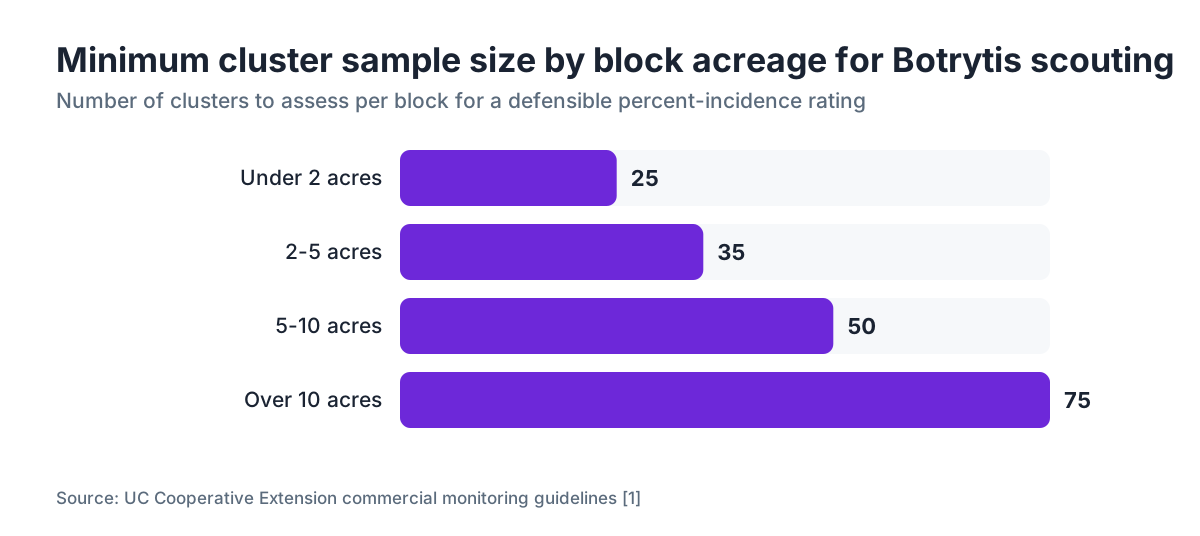
UC Cooperative Extension recommends at least 25 to 50 clusters per block for practical commercial monitoring, pulled from at least 10 vines spread across the block in a zigzag or W-pattern so you catch both ends of rows and the middle. [1] For blocks over 10 acres, push to 50 to 100 clusters. WSU extension work on cluster disease in Washington recommends at least 50 cluster observations for research-grade assessments. [4]
Here is a field rule that works: sample one cluster per vine (grab the most accessible exterior cluster), walk 25 vines minimum, mark each observation symptomatic or not. That gives you percent incidence in two minutes of data entry. Want severity? Score the bunch on the 0-5 scale instead of a binary yes/no.
Note which cluster position you sample (basal, medial, or apical on the shoot) and whether you covered all rows or every other row. It matters when you compare numbers season to season or when you have to explain a spike to an adjuster.
| Block size | Minimum clusters | Recommended clusters | Pattern |
|---|---|---|---|
| Under 2 acres | 25 | 35 | W-walk |
| 2-5 acres | 35 | 50 | Zigzag |
| 5-10 acres | 50 | 75 | Grid rows |
| Over 10 acres | 75 | 100 | Stratified random |
Source: UC Cooperative Extension commercial monitoring guidelines [1]
What threshold triggers a Botrytis spray decision at veraison?
Thresholds move with variety, market, and risk tolerance. No single federal or state threshold applies everywhere, and anyone selling you a universal 5-percent rule is oversimplifying.
For wine grapes, UC Cooperative Extension guidance puts the action threshold near 5 to 10 percent cluster incidence at or before veraison for susceptible varieties in humid years. [1] Cornell's Lake Erie and Finger Lakes work suggests tight-clustered varieties like Riesling and Pinot Noir get treated at first sign of infection (under 5 percent) rather than waiting for 10, because a tight cluster makes runaway spread nearly certain once infection sets in. [3]
WSU's integrated pest management guidance for the Pacific Northwest frames it differently. They lean on infection event modeling (stretches with more than 4 hours of wetness at 60 to 77 degrees F) paired with a pre-veraison scouting score, rather than one magic number. [4] That is a legitimate approach. It also needs weather station data you have to record.
Table grapes run a much lower tolerance, sometimes effectively zero for premium markets.
Here is the honest answer: set your own documented threshold, write it into your vineyard pest management plan, and apply it the same way every year. A 10-percent threshold you hold to consistently beats a fresh guess each season. If you work with a licensed pest control adviser (PCA), their written recommendation becomes part of your spray decision record and adds regulatory cover.
What exactly should you write down in the scouting log?
A scouting log entry for a Botrytis rating at veraison needs these pieces to work as a spray decision record:
- Date and time of the assessment
- Block ID or vineyard name and map reference
- Variety and vine age (susceptibility differs)
- Phenological stage using E-L or a plain descriptor (e.g., "50% veraison")
- Number of clusters assessed
- Number of symptomatic clusters (or the 0-5 score per cluster)
- Calculated incidence percentage or mean severity score
- Weather at scouting time: temp, humidity, recent rainfall and duration
- Canopy density note (dense canopy raises risk; write it down)
- Scorer name and, if it applies, PCA license number
- Decision made: spray, hold, re-scout in X days
- If spray: product picked, and why it fits the resistance rotation
Points 11 and 12 are the ones most growers skip. The decision is the connective tissue between the observation and the application record. Without it you have two unlinked documents instead of a compliance trail.
Paper field notebook, spreadsheet, or a purpose-built platform all work. On paper, date and sign each entry and move it to a master log within 24 hours of the field visit. If you want a digital option, VitiScribe was built to link scouting entries to application records in a format that matches common state pesticide-use-report field names, which cuts re-entry time at season's end.
Keep scouting records at least two years to match your pesticide application record retention under most state programs. California requires PUR records kept for two years. [5]
How do weather observations connect to the Botrytis rating record?
Botrytis needs moisture to germinate and set. The biology is settled: spore germination needs relative humidity above roughly 90 percent and free water, with best disease development at 64 to 77 degrees F. [4] So your field rating alone does not tell the whole risk story. A 3 percent reading on a dry year heading into a wet forecast is a different decision than 3 percent on a block that has been bone-dry for two weeks.
Attach weather data to each scouting entry. You do not need an on-site station, though one is ideal. Workable alternatives:
- Weather station data from the nearest CIMIS (California Irrigation Management Information System) station or a CoAgMet station [6]
- Your own Davis Instruments or similar weather station log
- Manual reading of a max/min thermometer and a wet/dry bulb humidity recorder at scouting time
Note the consecutive hours above 90 percent RH in the prior 48 to 72 hours. Note whether dew sat in the canopy when you scouted. Note any recent overhead irrigation that added leaf wetness.
That weather context makes the spray decision look grounded, because it is. It also protects you when a neighbor or buyer asks why you sprayed twice in a low-disease year: the records show three infection periods in a row and more rain forecast, so the math added up.
WSU's Botrytis disease risk model (through their Decision Aid System) turns temperature and wetness period data into spray advisories. Tying your scouting log to a published risk model output is the strongest documentation you can put on paper. [4]
Which fungicide records need to link back to the Botrytis rating?
Under California law (Food and Agriculture Code sections 12981 to 12987 and the Pesticide Use Reporting system), every restricted-materials pesticide use requires a written report filed with the county agricultural commissioner within one month of application. [5] The report lists the product name, EPA registration number, amount used, acres treated, and the site. It does not require you to attach a scouting log. The scouting log is what proves the application was justified if you get audited.
For EPA Worker Protection Standard purposes, 40 CFR Part 170 requires employers to keep a record of each pesticide application for two years, including the product name, EPA reg number, active ingredient, date applied, location, size of area treated, and the applicator's name. [2] WPS does not mandate a scouting record, but it does require that the Application Information be available to workers and handlers.
Best practice is to assign each spray application a reference number, then write that same number in the scouting log entry that triggered it. Now the link runs both ways. When an auditor pulls the application record for product X on block 7, they match it to scouting entry 7-23 showing 12 percent cluster incidence assessed three days earlier.
For crop insurance under USDA Risk Management Agency programs, the Vineyard Revenue Protection policy asks you to show production losses came from an insured cause. [7] A Botrytis scouting log proving you spotted the problem and responded is your evidence that you met the "good farming practices" standard. Missing records have gotten RMA claims reduced or denied.
What do UC Davis, Cornell, and WSU recommend for Botrytis scouting protocols?
The three big viticulture extension programs take slightly different angles, and it pays to know what each stresses.
UC Davis / UC Cooperative Extension (California): The UC IPM guidelines for grape Botrytis recommend scouting from bloom (E-L 23) through harvest, with extra attention at bunch closure and veraison. They favor percent incidence as the primary metric and flag tight-clustered varietals for more frequent monitoring. Their veraison threshold guidance: consider a spray if incidence tops 10 percent in standard conditions, or 5 percent if the forecast shows prolonged wet periods ahead. [1] The guidelines are public through the UC IPM online database.
Cornell Cooperative Extension (New York): Cornell's Finger Lakes and Hudson Valley work, published through their viticulture extension team, leans hard on resistance management rotation. They recommend alternating FRAC code groups with each application and want growers to document which FRAC code ran at each timing to prove rotation. [3] So your spray decision record should carry the FRAC group of the fungicide, alongside the product name.
Washington State University Extension: WSU's Pacific Northwest Plant Disease Management Handbook and their Decision Aid System give both cultural and chemical guidance. Their Botrytis section wants disease scouting records paired with a weather-based risk assessment, so observed incidence plus modeled infection periods drive the decision together. [4] They also call canopy management the single biggest non-chemical lever, noting that open canopies with good airflow run lower Botrytis pressure than dense, shaded ones, consistently.
All three agree on one point: calendar-based Botrytis spraying speeds up resistance. Scouting-based records are how you show you are managing that risk.
How should Botrytis rating records be organized for end-of-season review?
At season's end you want to answer three questions fast: How did each block trend from veraison to harvest? Did your spray decisions match the risk data? Which blocks keep showing high pressure and need a canopy change next year?
Organize your scouting logs so they sort by block and date. A simple spreadsheet with columns for date, block, incidence percent, severity score, weather notes, and spray decision gets you there. Add a running column showing days since the last application in that block, which helps you confirm label reapplication intervals held.
For multi-block operations, a block comparison table at season's end earns its keep. Something like this:
| Block | Variety | Veraison incidence | Pre-harvest incidence | Sprays applied | Avg interval |
|---|---|---|---|---|---|
| Block 1 | Pinot Noir | 8% | 14% | 3 | 14 days |
| Block 2 | Chardonnay | 3% | 5% | 1 | N/A |
| Block 3 | Zinfandel | 12% | 22% | 4 | 12 days |
This table becomes your planning document for next year's canopy work. Block 3 is telling you something. Incidence roughly doubled despite four applications, which points to a resistance problem, a canopy density problem, or both. Write that inference into your end-of-season notes.
If you work with a PCA, hand them this summary before the dormant season so their written recommendation for next year reflects what you actually saw. That keeps the whole chain, scouting log to PCA recommendation to spray record, internally consistent.
For farms on a platform like VitiScribe, the end-of-season export can double as your compliance file for county PUR filing and crop insurance documentation without separate reformatting.
What are common mistakes growers make in Botrytis documentation?
Most documentation failures have nothing to do with dishonesty. They come from rushing, from scouting on time but writing it up days later from memory, or from running two systems (paper and phone photos) that never get reconciled.
Dating entries after the fact. Scout Tuesday, write it up Thursday, and the record looks contemporaneous while your spray application was entered Wednesday. That sequence inversion is a red flag. Scout and record same day, or at minimum note in the log "scouting conducted 6/28, recorded 6/30" with the reason for the delay.
Vague location descriptions. "Block near the barn" is not a block ID. Spray records need a legal description or at least a map reference. If your blocks are named, use the exact name. If they carry numbers, use them. Matching the block identifier across the scouting log and the application record is what builds the link.
No scorer identified. If seasonal employees do the scouting, their name and training level belong in the log. A PCA's name carries more weight than an unlicensed employee's for threshold-based decisions, but either beats a blank field.
Skipping the no-spray decisions. Scouted, found 3 percent incidence, decided to hold? That belongs in the record too. A log that only contains entries that triggered applications looks like you only scouted when you wanted an excuse to spray. Documenting the hold decision shows the system is real.
Not recording the FRAC code. Cornell's resistance management guidance is blunt: track which mode of action ran at each application. [3] A spray record showing the same FRAC group four times running is a compliance problem for growers under sustainability certifications that require rotation.
How do Botrytis scouting records support sustainability and GAP certifications?
Several certification schemes now require documented IPM scouting as a condition of certification. The California Sustainable Winegrowing Alliance (CSWA) self-assessment asks whether growers use action thresholds and keep scouting records. [8] Good Agricultural Practices (GAP) certification programs, including those run through USDA's Agricultural Marketing Service, require written evidence that disease and pest management decisions come from monitoring rather than calendar schedules. [9]
For organic operations, the National Organic Program (NOP) requires growers to document pest monitoring as part of the Organic System Plan and keep records showing interventions followed observation. [10] Botrytis management in organic vineyards usually runs on copper, sulfur, and biological products, all of which need the same documentation structure as conventional fungicides.
Harvest buyer audits, especially for large retail customers or premium wineries that contract-purchase fruit, increasingly include a records review. A clean, consistent Botrytis scouting log from veraison through harvest signals a professional operation. The absence of one signals the opposite.
The structure this article describes, dated block-level scouting entries with incidence scores, weather context, scorer ID, and linked spray decisions, meets the documentation standard for CSWA, GAP, NOP, and most regional sustainability programs without separate record formats for each.
Frequently asked questions
When exactly during veraison should I do the Botrytis rating?
Scout when roughly 50 percent of berries in a block have started color change. At that stage you can see latent infections that turned visible as berries softened, and you still have time to apply a post-veraison fungicide before the spray interval closes near harvest. Waiting until 100 percent veraison costs you 7 to 10 days of lead time and may push the application too close to the pre-harvest interval on many labels.
Can I use smartphone photos as part of my Botrytis documentation?
Yes, and they add real value. GPS-tagged photos with timestamps support your written log and settle disputes about what the canopy looked like on a given date. Label each photo with the block ID and cluster number so it matches your written record. Photos alone do not replace a numerical incidence rating, because one symptomatic cluster photo tells you nothing about the percentage of the block affected.
Does my Botrytis scouting record need to be signed by a PCA in California?
Not for every entry. But if you are applying a restricted-materials fungicide and you want the PCA's written recommendation to provide regulatory cover, the PCA has to issue a signed recommendation before application. Your own scouting log can be the basis for that recommendation. The PCA signs the recommendation; you sign the application record. Both reference the same scouting data.
What is the EPA Worker Protection Standard's requirement for pesticide application records in a vineyard?
Under 40 CFR Part 170, employers must keep records of each pesticide application for two years. The record must include the product name, EPA registration number, active ingredient, date and time of application, location and size of treated area, and the name of the certified applicator. WPS does not require a scouting log, but state pesticide use reporting rules may require a stated justification for restricted-materials applications.
How long do I need to keep Botrytis scouting records?
Match your retention period to your pesticide application records. California requires pesticide use reports to be kept for two years after the report is filed. Most state programs require two years minimum. If you carry crop insurance, keep scouting records at least three years, since RMA claims can be reviewed after the policy year closes and supporting records are expected.
What FRAC groups are registered for Botrytis in wine grapes and why does it matter for records?
The main FRAC groups registered include Group 7 (SDHIs, e.g., boscalid), Group 9 (anilinopyrimidines, e.g., cyprodinil), Group 11 (QoIs/strobilurins, e.g., azoxystrobin, though resistance is widespread), Group 12 (phenylpyrroles, e.g., fludioxonil), and Group 17 (hydroxyanilides, e.g., fenhexamid). Recording the FRAC group in your spray log lets you show rotation, which many sustainability certifications require and Cornell and UC extension programs recommend to manage resistance.
Can Botrytis scouting records help with a crop insurance claim?
Yes, and missing records can hurt one. USDA RMA Vineyard Revenue Protection policies require growers to show they followed good farming practices. A documented scouting log proving you spotted Botrytis pressure at veraison, responded with a registered fungicide, and kept monitoring supports that standard. Claims can be reduced if the adjuster concludes you failed to monitor or respond to obvious disease pressure.
What is a realistic time commitment for a Botrytis rating at veraison?
For a single five-acre block, scouting 50 clusters on a W-walk takes 20 to 30 minutes in the field plus 10 minutes of data entry. Multi-block operations should budget about one person-hour per 10 to 15 acres. The time is modest against the cost of a missed spray decision or an insurance claim reduced because the records were not there.
How does canopy density affect my Botrytis rating and should I note it?
Canopy density drives Botrytis pressure by trapping humidity and cutting airflow. Always note whether the canopy is open or dense when you scout. WSU and UC extension both name canopy management as the top non-chemical control factor. A dense canopy at 8 percent incidence carries higher forward risk than an open canopy at the same number, and your spray decision and record should reflect that context.
Do organic vineyards need the same Botrytis scouting documentation as conventional ones?
Yes, and arguably more. The USDA National Organic Program requires growers to document pest monitoring as part of their Organic System Plan and show that interventions followed observation. For Botrytis, organic-approved materials like copper hydroxide and Bacillus subtilis products still need a pesticide application record, and the NOP requires evidence that the spray followed documented monitoring showing pest pressure justified it.
What is the difference between Botrytis incidence and severity, and which should I record?
Incidence is the percentage of clusters showing any infection. Severity is how much of each affected cluster is damaged, usually scored 0 to 5. Incidence is faster to assess and drives most extension action thresholds. Severity gives more resolution for tracking disease progression and helps when benchmarking block to block. Record both if time allows; incidence alone is the minimum for a defensible spray decision record.
Should I record Botrytis scouting differently for tight-clustered versus loose-clustered varieties?
The data format stays the same, but your threshold and frequency should differ. Cornell's extension guidance notes that tight-clustered varieties like Riesling and Pinot Noir run inherently higher risk because infection spreads faster through the cluster architecture. For those varieties, note cluster architecture in your scouting log and use a lower action threshold, sometimes 5 percent rather than 10, especially heading into wet forecast periods.
What happens if my Botrytis scouting records and spray application records don't match on dates or block IDs?
Mismatches are the most common audit finding. If a scouting entry references Block 7A and the application record says Block 7, an auditor has to decide whether those are the same place. Standardize your block IDs across every document type before the season starts and use them without variation. Date mismatches, where the spray precedes the documented scouting, raise questions about whether the scouting was real.
Sources
- UC IPM Online, University of California Agriculture and Natural Resources, Botrytis bunch rot and blight of grape: UC Cooperative Extension recommends assessing 25-50 clusters per block at veraison using percent incidence, with action thresholds in the range of 5-10 percent cluster incidence for susceptible varieties.
- U.S. EPA, Worker Protection Standard for Agricultural Pesticides, 40 CFR Part 170: The EPA Worker Protection Standard requires employers to maintain pesticide application records for two years, including product name, EPA registration number, active ingredient, date, location, and applicator name.
- Cornell Cooperative Extension, Integrated Crop and Pest Management Guidelines for Commercial Vegetable Production (viticulture/Botrytis sections): Cornell's IPM program notes that Botrytis has developed resistance to multiple fungicide classes including benzimidazoles and dicarboximides, partly from calendar-based spraying, and recommends FRAC group rotation documented in spray records.
- Washington State University Extension, Pacific Northwest Plant Disease Management Handbook, Botrytis bunch rot of grape: WSU's Botrytis guidelines recommend pairing disease scouting records with weather-based risk assessment (temperature and leaf wetness period data) and note that spore germination requires RH above 90 percent with optimum disease development at 64-77°F.
- California Department of Pesticide Regulation, Pesticide Use Reporting Program: California Food and Agriculture Code requires pesticide use reports to be filed with the county agricultural commissioner within one month of application and records retained for two years.
- California Irrigation Management Information System (CIMIS), California Department of Water Resources: CIMIS provides publicly accessible weather station data including temperature, humidity, and dew point suitable for supporting spray-decision weather documentation in California vineyards.
- USDA Risk Management Agency, Vineyard Revenue Protection Policy and Good Farming Practices: USDA RMA Vineyard Revenue Protection policies require growers to demonstrate that good farming practices were followed, and crop insurance adjusters review production records and pest management logs when evaluating claims.
- California Sustainable Winegrowing Alliance, Sustainable Winegrowing Self-Assessment Workbook: The CSWA self-assessment includes questions about whether growers use documented action thresholds and maintain written scouting records as part of IPM compliance.
- USDA Agricultural Marketing Service, Good Agricultural Practices and Good Handling Practices Audit Verification Program: USDA GAP certification requires written evidence that disease and pest management decisions are based on monitoring records rather than calendar-only schedules.
- USDA Agricultural Marketing Service, National Organic Program Regulations, 7 CFR Part 205: The National Organic Program requires that growers document pest monitoring as part of their Organic System Plan and maintain records showing that interventions were preceded by documented observation of pest pressure.
- UC Davis Department of Viticulture and Enology, Botrytis cinerea research publications: UC Davis viticulture research identifies veraison as the critical window for Botrytis establishment, as berry skin softening and rising sugar coincide with increased susceptibility to active rot development.
- WSU Decision Aid System for Plant Disease Management: WSU's Decision Aid System provides weather-based Botrytis spray advisories for Pacific Northwest vineyards, using temperature and wetness period data to model infection risk periods.
Last updated 2026-07-11