How to document a pruning-based disease management decision in block records
TL;DR
- A pruning-based disease management entry needs six core fields: date and block ID, the disease pressure that triggered the decision, the pruning method used, who did the work, how infected material was disposed of, and any follow-up spray or scouting scheduled.
- That record satisfies most state pesticide-adjacent compliance audits and documents your integrated pest management reasoning in one place.
Why do block records need a disease management reason, more than a pruning date?
Most vineyard managers log pruning as a cultural activity, full stop. Date, crew, done. That's fine for scheduling, but it leaves a gap that auditors and crop insurance adjusters find fast: what was the agronomic basis for this pruning event, and did it actually reduce disease pressure?
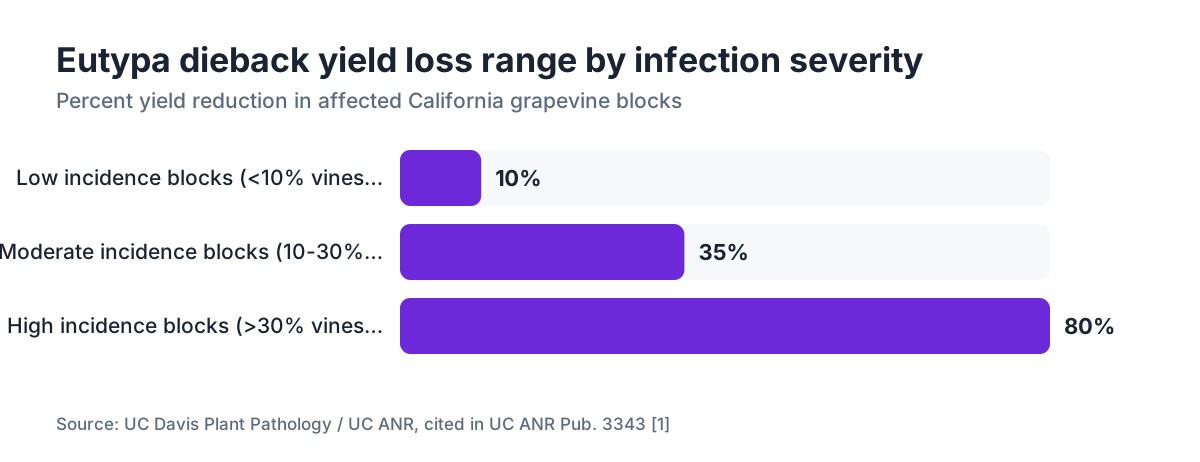
When pruning is specifically a disease management tool, the record has to carry enough information to reconstruct the decision. If you're removing Eutypa-infected cordons, or double-pruning to delay bud-break and shrink Botrytis infection windows, or cutting out Esca-symptomatic wood, that's an integrated pest management action. UC Davis Plant Pathology has tracked wood disease losses across California blocks and found that Eutypa dieback alone can reduce yields by 10 to 80 percent in affected vines, depending on how long infection goes unmanaged [1]. A grower who documents the infected wood percentage at the time of pruning, the corrective cut made, and the subsequent vine health assessment has real evidence that the action worked. A grower who only logs "pruned Block 4, Jan 15" has nothing.
This matters beyond self-interest. State departments of agriculture in California, Washington, and New York increasingly require that growers in cost-share programs or organic certification demonstrate decision-making logic, more than activity. USDA's Risk Management Agency uses cultural practice documentation when evaluating prevented-planting and disease-related yield loss claims [2]. And if you're under a third-party sustainability audit like CCSW or LIVE Certified, the auditor looks specifically for records that connect an observation to an action.
What fields should every pruning-disease-management record include?
Think of the record as answering six questions any reasonable agronomist would ask. Here's the minimum:
| Field | What to capture | Example entry |
|---|---|---|
| Date | Actual work date, not plan date | 2025-01-22 |
| Block ID / Row range | Specific location within the vineyard | Block 7, Rows 12-28 |
| Disease trigger | What you observed or scouted that prompted this cut | Eutypa symptoms on ~15% of cordons |
| Pruning action | Method, severity, cuts made | Removed infected cordons to clean wood, 2-bud spur |
| Disposition of material | How infected cuttings were handled | Chipped in-row; did NOT incorporate |
| Operator / crew | Who performed the work | Crew lead: M. Torres; 4 workers |
Beyond those six, add two more whenever they apply. First, any follow-up action triggered by the pruning observation: a wound protectant application, a scouting appointment, a decision to remove and replace the vine entirely. Second, a photo reference or GPS note if you're tracking spatial disease spread across seasons.
The "disposition of material" field is the one most records skip, and it's the one that creates liability. WSU Extension's guidance on trunk diseases flags that burning or chipping infected wood outside the vineyard reduces inoculum load, while leaving canes on the vine row or incorporating them can sustain Botryosphaeria and Eutypa populations through the next season [3]. If a disease outbreak intensifies after pruning and someone questions your management, you need to show what happened to the wood.
Don't overthink the format. A paper log, a shared spreadsheet, or a field records app all work as long as the six fields get captured every time. Consistency across seasons beats any single perfectly detailed entry.
How do you document the scouting observation that triggered the pruning decision?
The observation record and the action record should be linked, even if they live in separate logs. If you scouted Block 7 on January 15 and found Eutypa symptoms at 15 percent incidence, that's a separate entry from the January 22 pruning entry, but the pruning record should point back to it: "Based on January 15 scout: 15% Eutypa incidence, exceeds 10% economic threshold per UC farm advisor recommendation."
That reference does two things. It shows the decision followed an actual observation, not a standing calendar habit. And it documents the threshold logic, which is what an IPM program requires. UC Cooperative Extension's Eutypa management guidelines suggest that when dead arm symptoms exceed roughly 10 percent of cordons in a block, removal of infected wood combined with a registered wound protectant is economically justified [9]. If your threshold is different because your market or variety warrants it, note that too.
For scouting records themselves, capture the date, the scout's name, the method (walking every row versus random sampling), the disease and symptom description, the incidence estimate (percent vines or percent cordons affected), and the severity scale you're using if you're using one. Cornell's Pest Management Guidelines for Grapes include standardized rating scales for Botrytis bunch rot and downy mildew that translate straight into block records [4]. A published scale makes your data comparable across seasons.
Photos are underrated here. A dated photo of the worst-affected vine in the block, taken at scouting and again at pruning, gives you a visual reference that no amount of written description fully replaces. Store photos with the block ID and date in the filename so they're searchable.
What's the right way to record pruning method for disease-specific situations?
"Spur pruning" or "cane pruning" isn't enough detail for a disease management record. You need to capture what was cut, how far back you cut, and why that cut was chosen.
For Eutypa and Esca, the key detail is how far into clean wood you cut. Eutypa lata moves from the infection point toward the vine's head over years, so a cordon removal that stops at discolored tissue hasn't actually removed all the pathogen. Cornell's training materials note that cuts should be made 10 to 15 centimeters beyond visible wood discoloration to reach clean tissue [4]. Record the cut point description: "removed to 12 cm below last visible discoloration, cross-section showed white wood."
For double pruning targeting Botrytis or powdery mildew, the detail that matters is timing relative to bud swell. WSU Extension's double-pruning research found that pruning vines to a longer cane position in November or December, then returning to final spur positions in late February or early March, delays bud-break by 7 to 14 days in Washington Riesling and Chardonnay blocks, which shrinks the frost and Botrytis risk window [3]. Your record should note both pruning events with dates, the intermediate cane length left, and the final spur count.
Record tool sanitation too. For wood disease management, UC Davis recommends disinfecting pruning shears between vines using a 10 percent bleach solution or a commercial disinfectant labeled for this use, especially when cutting through symptomatic tissue [1]. Writing "tools sanitized between vines with 10% bleach dip" in the method field is an accurate record and evidence of good IPM practice. It takes two seconds and matters if a disease spread event is ever questioned.
How does material disposal affect your records and your disease risk?
This is the field growers most often leave blank, and it has real consequences.
Eutypa lata and Botryosphaeria species keep producing spores from infected wood for months after pruning, including from canes left on the vine row or on the ground. Rain and overhead irrigation splash those spores onto fresh pruning wounds. WSU Extension recommends removing or destroying cuttings from infected blocks as quickly as possible, ideally burning where permitted or chipping to a small particle size to speed decomposition [3].
In your record, the disposal field should capture the method used (burning, chipping, mulching, removal from block), whether the material stayed in or left the vineyard, and the date disposal happened if it was separate from pruning. If you burned, note the burn permit number in California, where the AQMD and county ag commissioner both care about open burning of agricultural material [5].
For certified organic operations, your organic system plan may require specific disposal methods for diseased plant material, and the National Organic Program's recordkeeping requirements under 7 CFR Part 205 mean your practice has to match your plan [6]. If your plan says you chip and incorporate but you actually burned because incidence was high, update the plan and document the deviation with your reasoning.
Don't get too precious about this. A one-line entry, "Canes chipped in-row, Feb 1," beats a blank field every time.
Do pruning records count as pesticide records under EPA Worker Protection Standard?
Pruning itself isn't a pesticide application, so the EPA Worker Protection Standard doesn't directly regulate the pruning record. But WPS applies to related activities in a way that connects to your pruning documentation.
If you apply a wound protectant fungicide right after pruning, that application requires a full WPS-compliant application record: pesticide product name and EPA registration number, application date and location, applicator name and certification number, target pest, rate applied, and the restricted-entry interval established [7]. The EPA WPS rule at 40 CFR Part 170 states that handlers must be informed of "any pesticide application on the establishment," and records must be kept for two years [7]. So if your pruning-triggered wound protectant application isn't recorded separately and completely, you have a WPS gap even when your pruning record is perfect.
The practical move is to link the two records with a cross-reference. In the pruning record: "Wound protectant applied same day, see spray record #2025-017." In the spray record: "Applied following Eutypa pruning in Block 7, see pruning record 2025-01-22." Two minutes of writing, one clean audit trail.
Where workers enter blocks after fungicide wound protectant applications, the restricted-entry interval must be posted and the WPS training documentation must be current. California's Department of Pesticide Regulation has state-specific requirements that layer on top of federal WPS, including county permit requirements for certain fungicides used as wound protectants [5].
How long do you need to keep pruning and disease management records?
The retention period depends on which regulatory framework applies to your operation.
For federally certified organic growers, the NOP requires that all records supporting organic certification be kept for at least five years [6]. That includes cultural practice records like pruning decisions if they're referenced in your organic system plan.
For operations under the Food Safety Modernization Act's Produce Safety Rule, the FDA requires that records be kept for two years for covered produce [8]. Grapes grown for wine are generally exempt from PSR as a commodity processed to eliminate microbiological hazards, but if any part of your operation falls under PSR, the two-year rule applies to those activities.
For WPS pesticide application records, including wound protectant sprays after pruning, EPA requires two years [7].
For crop insurance, USDA RMA recommends retaining all production and cultural practice records for the life of the policy plus three years, since some claims and reviews can extend that far [2].
The practical answer: keep everything for five years. It covers every framework and isn't burdensome once you're digitizing. A paper record box or a cloud-synced folder both work, as long as records are organized by crop year and retrievable by block.
What does a complete disease management pruning record look like in practice?
Here's a real example of what a well-written block record entry looks like. This is the kind of entry that would satisfy a state ag auditor, an organic certifier, and a crop insurance adjuster:
Date: 2025-01-22
Block: Block 7 (Chardonnay, planted 2008, VSP)
Rows pruned: 12-28 (217 vines)
Disease trigger: Scout record 2025-01-15 shows 14.3% of vines with Eutypa dead arm symptoms. Exceeds 10% threshold used by farm advisor. Three vines showing bilateral cordon loss.
Pruning action: Removed all symptomatic cordons to 12-15 cm below last visible wood discoloration. Final cross-sections confirmed white wood. Where one arm symptomatic and one healthy, retained healthy arm with 2-bud spurs; retrained replacement arm from sucker where feasible. Three vines headed back to trunk; replacement cane selected.
Tool sanitation: Loppers dipped in 10% bleach solution between each vine. Solution refreshed every 30 vines.
Disposal: All cuttings removed from block and chipped outside vineyard, 2025-01-22.
Crew: Crew lead M. Torres, 4 workers. Pruning certified to farm's disease management SOP.
Follow-up: Wound protectant (Topsin M 70WP, EPA Reg. No. 73545-14) applied by J. Park (applicator cert. CA-2024-0312) same afternoon. See spray record 2025-017. REI 12 hours posted at block entry.
Next scout: 2025-03-01, check replacement cane establishment, flag any missed symptomatic wood.
That entry takes about 10 minutes to write. It's complete, it's cross-referenced, and three years from now it tells the whole story with no memory required.
Should you use paper, spreadsheet, or software for these records?
Honest answer: any format you'll actually use consistently beats a sophisticated one you abandon by April.
Paper block cards work fine for small operations (say, under 50 acres) if someone is disciplined about transferring field notes before they degrade or get lost. The failure mode for paper is transcription lag: you jot notes in your phone, mean to move them to the card, and three weeks later you're reconstructing from memory. That reconstructed record is worth less than nothing if it's ever questioned.
Spreadsheets are the common middle ground. A shared Google Sheet with one tab per block and a date-stamped row for each event covers the basics. The limitation is that spreadsheets don't prompt you for required fields, so records stay incomplete unless someone enforces the column structure.
Field record software built for vineyard operations can automate the linking between scouting observations, pruning actions, and spray records, and it can force required fields before an entry saves. VitiScribe, for example, is built for this workflow and structures disease management pruning entries with the scout observation and follow-up action already connected. Whether you use it or a spreadsheet, the field structure matters more than the technology.
For compliance, the format matters less than the content and the timestamp. An organic certifier or a WPS auditor wants to see that the record was made at or near the time of the event, not backdated. Digital records with automatic timestamps handle that; paper records should be dated in the field, not in the office.
If you run a vineyard with multiple blocks across varieties or appellations, check whether your record system can filter by block, by date range, and by disease type. You'll need that when you prepare a summary for a certifier or an adjuster.
How do you handle disease management pruning records for multi-block or multi-variety operations?
Scale creates two specific problems: consistency across blocks managed by different crew leads, and the ability to aggregate data across the whole ranch at season end.
For consistency, build a one-page standard operating procedure that lists the six required fields and gives field staff examples of acceptable entries. If crew lead A writes four words and crew lead B writes four sentences, neither record is comparable to the other and neither satisfies an auditor who wants to see systematic practice. The SOP doesn't need to be long. It needs to define what each field means and what "done" looks like.
For aggregation, the most useful end-of-season summary is a block-level table showing total vines scouted, incidence at pruning, incidence at the following spring scout, and yield data if you have it. That comparison lets you judge whether the pruning decision actually reduced disease pressure, which is the whole point of the record.
WSU Extension's long-term trunk disease monitoring in Washington State found that structured annual scouting combined with corrective pruning reduced Eutypa and Botryosphaeria incidence in study blocks over a three-to-five-year horizon [3]. You can't replicate that finding in your own vineyard without multi-year records that connect pruning actions to outcomes. The record is the foundation of that learning.
For multi-block operations near appellations like Paso Robles wineries or South Coast winery regions, where appellation-level sustainability programs sometimes require documentation of cultural disease management practices, clean multi-block records can directly support program participation and marketing claims.
What are common mistakes that make pruning-disease records fail an audit?
The most common failure is a record that documents the action but not the reason. "Removed cordons in Block 3, January 18" tells an auditor nothing about whether this was routine renewal pruning or a disease-triggered removal. Without the triggering observation, there's no IPM record, just a labor log.
The second most common failure is no cross-reference to related records. If a wound protectant spray followed the pruning and the spray record exists but neither document references the other, an auditor has to assume they're unrelated. That breaks the chain of evidence for an IPM claim.
Third: backdating. If all your January pruning records were entered March 1 with identical timestamps, a digital audit flags that. Paper records with identical handwriting across a month of entries raise the same concern. Record at or near the time of the event.
Fourth: no disposition record for infected material. This reads as either an incomplete record or a disposal practice someone didn't want documented. Neither interpretation helps you.
Fifth: tool sanitation not mentioned. Auditors for organic certification look for this specifically when wood diseases are involved, because cross-contamination via pruning tools is a documented transmission pathway. If you sanitized tools, say so. If you didn't, that's a practice gap worth fixing before the next certification audit.
VitiScribe's block record templates help close these gaps, since required fields are enforced before an entry saves and the system links pruning events to scout observations automatically. Any disciplined record-keeping system that covers the six core fields will pass.
How do university extension guidelines inform what you should be documenting?
Extension programs from UC Davis, Cornell, and WSU have each published disease management guidelines that quietly define what a well-documented decision looks like, because they specify the observation thresholds, the timing windows, and the intervention methods that make up good practice.
UC Davis Cooperative Extension's Grape Pest Management guide covers Eutypa dieback, Esca, and Botryosphaeria canker diseases with specific guidance on symptom identification, pruning wound susceptibility windows (roughly from bud break through about six weeks post-pruning for Eutypa [1]), and wound protectant application timing. If your record doesn't mention the wound susceptibility window, an auditor applying UC standards would question whether the pruning decision was timed correctly.
Cornell's Integrated Pest Management program provides economic thresholds and scouting protocols for Botrytis bunch rot and powdery mildew that translate straight into the triggering-observation section of your record [4]. Cornell's Botrytis guidelines, for example, distinguish between primary infection at bloom and secondary bunch-to-bunch spread, which changes whether a canopy management pruning event (shoot removal, leaf pulling) is the right intervention and how it should be documented.
WSU's research on double pruning in Washington State [3] gives you a documented rationale for a calendar-based pruning method that looks like it belongs in the spray record but really belongs in the cultural practice record. Citing "per WSU Extension double-pruning protocol" in your record puts the agronomic basis on paper without re-explaining it every season.
The practical rule: if an extension publication describes the practice you're using, cite it in your record. It costs nothing and it anchors your decision in published agronomy rather than personal judgment alone.
Frequently asked questions
Does a pruning record count as an IPM record for organic certification?
Yes, if it captures the triggering observation, the threshold used, and the action taken. NOP under 7 CFR Part 205 requires organic producers to document all practices in their organic system plan and keep supporting records for five years. A pruning entry that says 'Eutypa incidence exceeded 10% threshold, cordons removed to clean wood' qualifies as a documented cultural IPM practice. One that only says 'pruned' does not.
What disease does double pruning prevent, and how should I document it?
Double pruning primarily targets Botrytis bunch rot and late-season powdery mildew by delaying bud-break 7 to 14 days, which shortens the high-risk infection window. WSU Extension research in Washington Riesling and Chardonnay blocks documented this timing effect. Record both pruning events with dates, the intermediate cane length left after the first cut, and the agronomic rationale referencing the delayed bud-break goal.
Do I need a separate spray record if I apply a wound protectant right after pruning?
Yes. The pruning record documents the cultural decision; the wound protectant application is a separate pesticide event requiring a full WPS-compliant spray record including product name, EPA registration number, applicator certification, rate, and REI under 40 CFR Part 170. Cross-reference the two records so the connection is clear, but don't combine them into one entry.
How do I record tool sanitation between vines in my block records?
A single line in the method or notes field works: 'Pruning shears dipped in 10% bleach solution between each vine; solution refreshed every 30 vines.' UC Davis guidelines recommend this practice specifically when cutting Eutypa-symptomatic tissue to prevent tool-mediated spread. If you used a different disinfectant, name it. If tools were not sanitized, that's a practice gap, not a record gap.
What happens if I don't document the disposal of infected pruning cuttings?
You lose the evidence that you actually removed the inoculum source. More practically, if disease pressure rises the following season, you have no defense against the suggestion that your pruning made things worse by leaving infected wood in the row. In California, if you burned, you also need a burn permit record. WSU Extension flags infected-wood disposal as critical for Botryosphaeria and Eutypa management continuity.
Can I reconstruct pruning records after the fact if I forgot to write them down at the time?
You can, but they're worth less. Reconstructed records clearly entered weeks or months after the event are a red flag for auditors and crop insurance reviewers. If you're reconstructing, date the entry honestly, note that it's a reconstruction based on crew logs or invoices, and attach any supporting documentation. Never enter a reconstructed record with a false field date.
How detailed does the disease incidence estimate need to be?
Enough to show you counted or estimated something. A percent of vines affected, a percent of cordons affected, or a disease severity rating from a published scale (Cornell's scales work well for this) all qualify. 'A few vines looked bad' does not. If you're using a published threshold to trigger action, your incidence estimate has to be comparable to that threshold, which means you need an actual number.
Should pruning records include photos, and how should those be filed?
Photos aren't required by any regulation, but they're excellent supporting evidence. A dated photo of the worst-affected vine at scouting and again at pruning gives visual context no description fully replaces. Name the file with the block ID, date, and disease type, for example 'Block7_20250115_Eutypa_worst_vine.jpg,' and store it in the same folder or linked from the same digital record as the written entry.
What if the same pruning crew works across multiple blocks and uses different methods in each?
Each block needs its own record, even if the crew is the same. The pruning method, incidence level, and disposition of material can differ by block, and lumping them together makes neither record useful. Build a simple per-block form that takes 5 to 10 minutes to complete and have the crew lead fill it out before leaving the block, not that evening when details blur.
Do FSMA produce safety rules affect how I keep vineyard pruning records?
Wine grapes are generally excluded from the FDA Produce Safety Rule because they undergo processing that eliminates microbiological hazards. However, if any part of your operation sells fresh table grapes or produces juice for direct consumption, those activities may fall under PSR, which requires two-year record retention under 21 CFR Part 112. Confirm your commodity status with FDA or your extension farm advisor.
How do I document a pruning decision when I chose not to prune despite disease pressure?
Document the decision anyway. Record the scouting observation, the incidence level, the reason you chose not to act (economic threshold not reached, labor timing, variety tolerance), and any alternative action taken. A negative decision with reasoning is evidence of IPM thinking. No record at all looks like you didn't scout, which is worse than documenting a conservative call.
What extension resources give me documented thresholds I can cite in my pruning records?
UC Davis Cooperative Extension's Grape Pest Management publication covers Eutypa and Esca thresholds for California. Cornell's Pest Management Guidelines for Grapes cover Botrytis and powdery mildew with economic thresholds for the Northeast. WSU Extension's trunk disease and double-pruning publications cover Botryosphaeria and timing decisions for the Pacific Northwest. All are freely available online from their respective university extension sites.
How far back from visible discoloration should I cut when removing Eutypa-infected wood?
Cornell's training materials recommend cutting 10 to 15 centimeters beyond the last visible wood discoloration to reach clean tissue, since Eutypa lata advances through internal wood tissue ahead of visible symptoms. Record the approximate cut-back distance and note whether the cross-section showed clean white wood, since that observation is your field confirmation that the cut was sufficient.
Sources
- UC Davis Plant Pathology, Eutypa Dieback of Grapevine: Eutypa dieback can reduce yields by 10 to 80 percent in affected vines; wound susceptibility window extends roughly six weeks post-pruning; tool sanitation with 10% bleach recommended between symptomatic vines
- USDA Risk Management Agency, Whole Farm Revenue Protection Handbook: RMA uses cultural practice documentation when evaluating disease-related yield loss claims; recommends retaining records for policy life plus three years
- Washington State University Extension, Trunk Diseases of Grapevines: Double pruning delays bud-break 7 to 14 days in Washington Riesling and Chardonnay blocks; removing or destroying infected cuttings quickly reduces Botryosphaeria and Eutypa inoculum; structured corrective pruning reduced trunk disease incidence over 3-5 years in study blocks
- Cornell University, Pest Management Guidelines for Grapes (PMEP): Cornell provides standardized disease rating scales for Botrytis bunch rot and downy mildew; recommends cutting 10-15 cm beyond visible Eutypa wood discoloration to reach clean tissue
- California Department of Pesticide Regulation, Pesticide Laws and Regulations: California layers state-specific requirements on top of federal WPS; county permit requirements apply to certain fungicides used as wound protectants; AQMD burn permit required for open burning of agricultural material
- USDA Agricultural Marketing Service, National Organic Program 7 CFR Part 205: NOP requires certified organic producers to keep all supporting records for at least five years; organic system plan must match actual practice; deviations must be documented with reasoning
- EPA, Worker Protection Standard 40 CFR Part 170: WPS requires handlers be informed of all pesticide applications; application records including EPA registration number, date, location, applicator certification, REI must be kept for two years
- FDA, FSMA Produce Safety Rule 21 CFR Part 112: FSMA Produce Safety Rule requires two-year record retention for covered produce; wine grapes are generally exempt as a commodity processed to eliminate microbiological hazards
- UC Cooperative Extension, Grape Pest Management, UC ANR Publication 3343: Eutypa management guidelines suggest that when dead arm symptoms exceed roughly 10 percent of cordons, removal of infected wood combined with a registered wound protectant is economically justified
Last updated 2026-07-10