How to document a pesticide application error and corrective action taken

TL;DR
- When a pesticide application goes wrong, document it the same day: write down what happened, what product was involved, which field and REI/PHI windows are affected, who you notified, and what corrective steps you took.
- Most state ag departments require amended spray records within 24 to 72 hours.
- Written documentation is your best defense against license suspension, civil liability, and Worker Protection Standard violations.
What counts as a pesticide application error in a vineyard?
An error is any deviation from the approved pesticide label or your intended application plan. That covers a lot of ground.
The obvious ones: wrong product on the wrong block, wrong rate (over or under), applying during a restricted-entry interval, missing the pre-harvest interval, spraying in wind the label prohibits, or putting a product on a crop or pest the label doesn't list. The less obvious ones include applying to a buffer zone that should have been excluded, a tank contamination event, or spray drift that reaches a neighboring property or a sensitive site.
The EPA label is a federal document. Applying a registered pesticide in a manner inconsistent with its labeling violates the Federal Insecticide, Fungicide, and Rodenticide Act (FIFRA), 7 U.S.C. § 136j(a)(2)(G). That applies whether you meant to or not. [1]
For vineyard operators, PHI (pre-harvest interval) and REI (restricted-entry interval) errors are the two most common triggers for a documentation event. A PHI violation can affect your ability to sell fruit or deliver to a bonded winery. A REI violation triggers Worker Protection Standard notification requirements under 40 CFR Part 170. [2]
Why does written documentation matter so much after an error?
Because memory is unreliable and inspectors know it.
State department of agriculture inspectors, crop insurance adjusters, and plaintiff attorneys all work from paper (or your digital records). If you have no written account of what happened and what you did to fix it, the story gets written for you, usually in the worst possible way.
Documentation does three things. It shows good faith, which matters in every enforcement context. It creates a timestamped account before details get fuzzy. And it gives you a record of corrective action that can reduce or eliminate penalties under many state programs.
California's Department of Pesticide Regulation weighs self-reporting and corrective action history when it sets civil penalty amounts under the California Food and Agricultural Code. [3] Washington's WSDA works the same way: a first-time self-reported error with documented correction gets treated differently from a repeat or concealed violation. [4]
You're not helping the regulator catch you. You're building the paper trail that shows you run a responsible operation.
What information should be in the error documentation record?
Think of this as a two-part document: what happened, and what you did about it. Both parts need to be specific and dated.
The "what happened" section needs:
- Date and time the error occurred (or was discovered)
- Application record number it relates to (your spray log entry)
- Product name, EPA registration number, and rate actually applied
- Target site (block, row range, GPS coordinates if you have them)
- Intended application versus what actually occurred
- Weather conditions at time of application (wind speed, direction, temperature)
- Equipment used and any equipment malfunction notes
- Applicator name and license number
- How and when the error was discovered
The "corrective action" section needs:
- Specific steps taken (field posted, workers notified, supervisor notified, product pulled from inventory, fruit sampling ordered)
- Date and time each step was completed
- Names of everyone notified, including neighboring landowners if drift was involved
- Whether a state or county ag commissioner notification was made, and when
- Any monitoring or testing ordered (fruit residue sampling, water quality)
- Expected resolution date
WSU Extension recommends including a root-cause note: one or two sentences on why the error happened, whether it was a training gap, a label-reading mistake, or an equipment failure. [5] That note helps your own corrective training records, and it shows regulators you understand the cause.
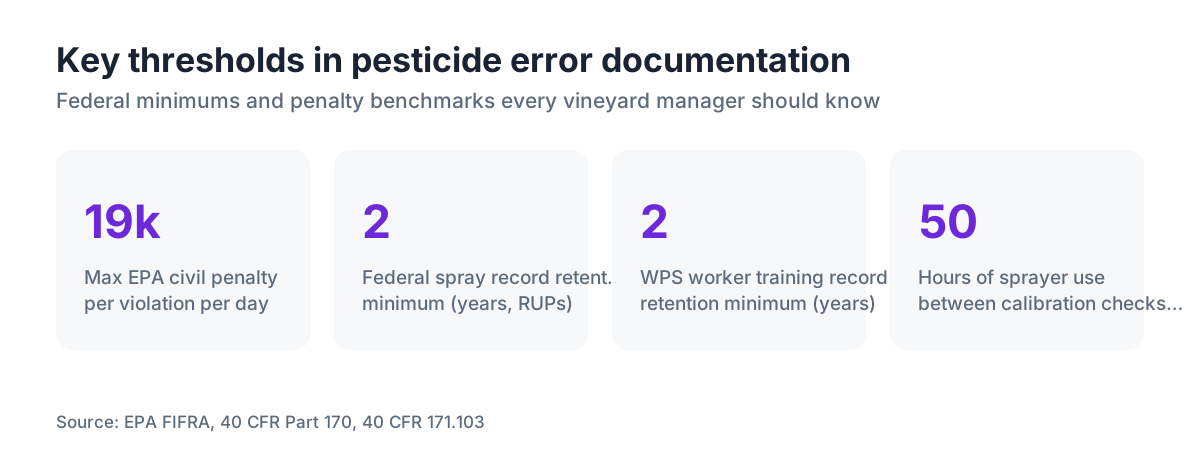
If the error involved a Restricted Use Pesticide, that record has to be kept at least two years under 40 CFR 171.103. Some states require longer. [6]
How do REI and PHI violations change what you have to document?
They add mandatory layers on top of your internal error record.
A REI violation under the EPA Worker Protection Standard means workers may have entered a treated area before the restricted-entry interval expired. Under 40 CFR Part 170, you must notify affected workers, post the field correctly going forward, provide WPS-required information to any worker who entered the area, and give them access to the Safety Data Sheet and label. [2] Document every one of those steps with a date and a signature if you can get one.
A PHI violation is a different animal. It doesn't automatically trigger a regulatory notice in most states, but it creates a commercial problem: the fruit in that block can't be legally harvested until the PHI has run from the date of application. Write down the new earliest harvest date, attach it to the block record, and notify your winery contact immediately in writing. That written notice protects both parties if a delivery dispute comes up later.
If you applied a product with a PHI longer than your planned harvest window, be honest about your options. In most cases the fruit stays on the vine until the interval clears. If it can't, you're looking at a possible crop loss and your crop insurance documentation kicks in. Either way, the paper trail starts the same day.
UC Agriculture and Natural Resources publishes pest management guidelines for wine grapes, including PHI and REI data by product, that's worth keeping in your compliance binder. [7]
Do you have to report the error to a state agency?
Often, yes. The threshold for mandatory reporting varies by state and by the nature of the error.
In California, any incident involving pesticide illness (or suspected illness) in a worker must be reported to the County Agricultural Commissioner within 24 hours. Drift incidents that reach neighboring properties also have to be reported. [3]
In Washington, WSDA requires notification of any adverse incident: any pesticide use that may have caused illness, injury to people, or significant damage to crops, livestock, or the environment. [4]
In New York, Cornell's pesticide management program notes that applicators must keep records and that regulatory agencies can request them; self-reporting guidance is handled at the county level through Cornell Cooperative Extension contacts. [8]
Even when reporting isn't mandatory, many state ag departments run voluntary disclosure programs that carry lighter penalties than discovered violations. If you're not sure whether your error crosses a reporting threshold, call your state or county ag commissioner the same day. Log that call: the name of the person you spoke with, the time, and what they advised.
One number worth knowing: EPA can assess civil penalties up to $19,162 per violation per day (2024 inflation-adjusted) under FIFRA Section 14 for commercial pesticide applicators. [1] Voluntary self-disclosure with documented corrective action isn't a guaranteed discount, but it's consistently the best starting position.
What does a corrective action plan actually look like?
A corrective action plan (CAP) doesn't have to be formal or long. It needs to be honest, specific, and actionable.
Here's a practical structure:
Section 1: Incident summary. Two to four sentences. Date, block, product, what went wrong.
Section 2: Immediate containment. What you did in the first 24 hours to prevent further harm. Field posting, worker notification, winery notification, equipment shutdown.
Section 3: Root cause. One honest sentence. "Applicator did not confirm block boundary before filling tank." "Label rate was in oz/100 gal but data entry was in oz/acre."
Section 4: Corrective steps with dates. A numbered list. Each item has a responsible person and a completion date. This isn't aspirational, it's what actually happened.
Section 5: Preventive measures going forward. What process changes, training, or equipment checks will stop it from happening again.
Keep it on one page if you can. Attach the original spray log entry, the product label (or the relevant label pages), and any notification letters or call logs.
If you're using digital spray record software like VitiScribe, you can attach the CAP document directly to the affected spray event record, which keeps everything in one searchable place instead of spread across folders.
For leased vineyards, send a copy to the landowner the same day. For grapes going to a bonded winery under a grape purchase agreement, check whether your contract has a pesticide residue notification clause. Most do, and it'll tell you exactly what you're obligated to disclose and when.
How do you notify neighboring landowners or farmworkers after a drift incident?
Drift is the scenario that escalates fastest. Move quickly.
For farmworkers who may have been exposed: under the WPS, the agricultural employer has to provide immediate access to emergency medical care and inform the attending physician of what product was involved. The SDS and label go with any worker seeking medical attention. Document the referral, the time, and the product information you provided. [2]
For neighboring landowners: tell them verbally as soon as you know, then follow up in writing within 24 hours. Your written notice should include the product name, the EPA registration number, the date and approximate time of the application, the direction of drift, and your contact information. Keep a copy.
If a neighboring crop, beehive, or water source was potentially affected, the neighboring operator may have their own reporting obligations. You can't control what they do, but your written notice shows you acted in good faith.
Document every conversation. Name, date, time, what was said. If you leave a voicemail, log that too.
What records do you need to keep, and for how long?
Federal minimums under FIFRA and the WPS set the floor. State law often requires more.
| Record type | Federal minimum retention | California | Washington | New York |
|---|---|---|---|---|
| Commercial applicator spray records (RUPs) | 2 years (40 CFR 171.103) | 2 years (FAC 12981) | 2 years (WAC 16-228-1250) | 2 years (6 NYCRR 325) |
| WPS pesticide application records | 2 years (40 CFR Part 170) | 2 years | 2 years | 2 years |
| Incident/error documentation | Not specified federally | Recommended 3 years | Recommended 3 years | Recommended 3 years |
| Worker training records | 2 years (40 CFR Part 170) | 2 years | 2 years | 2 years |
The honest answer on error documentation retention: no federal statute sets a specific period for corrective action plans, but extension guidance from WSU [5] and UC ANR [7] consistently recommends keeping them at least three years, matching your liability exposure window under most state statutes of limitation.
Keep records in a format you can actually retrieve. A handwritten note in a spiral notebook that gets wet and fades isn't retrieval-ready. Scanned PDFs organized by block and date, or records in a dedicated software system, pass an inspection.
Can documenting an error actually reduce your penalties?
Yes, in most states, with real caveats.
California's DPR uses a civil penalty matrix that includes factors for voluntary disclosure and corrective action taken. Self-reporting and a documented CAP can pull penalty amounts down, though DPR keeps discretion. [3]
EPA's FIFRA enforcement policy allows reductions for good-faith efforts to comply and cooperation during investigations. The policy is guidance, not a guarantee, but inspectors and enforcement staff work by it in practice. [10]
Here's the caveat. Documentation that reveals a violation you wouldn't otherwise have been caught for doesn't automatically get you a pass. The reduction applies to the penalty calculation, not the underlying violation. You still violated the label. What documentation does is shift the outcome from "willful, concealed violation" to "self-disclosed error with documented correction," and those two outcomes look very different on your license record and in any later civil litigation.
For a small vineyard operator running under 100 acres, a clean license record has real economic value. It affects your ability to hire certified applicators, keep your own license, and sometimes your crop insurance eligibility.
How should you handle tank mix contamination or the wrong product applied?
Tank contamination is one of the harder error scenarios because the size of the problem isn't always clear right away.
First step: stop the application and secure the equipment. Don't rinse the tank until you've documented what's in it. Photograph the tank, the mix records, and any residual product containers. That establishes what was actually applied.
Next, identify every block or row that got the contaminated mix. Map it precisely. If your equipment tracks GPS, pull that data before you do anything else.
Then pull every label for every product that was in the tank. Check which crops each label lists, the most restrictive REI across all products, the most restrictive PHI, and whether any products in the mix carry a "do not mix" prohibition with each other.
If any product in the contaminated mix isn't labeled for grapes, you have a FIFRA violation regardless of rate. Document it and call your county ag commissioner before harvest.
If all products are labeled for grapes but one rate is wrong, calculate the actual rate applied (use your tank volume, mix concentration, and acreage covered) and document that calculation with your error record. Residue testing may be warranted before harvest; call your winery and your crop consultant the same day.
For operations using VitiScribe's spray record system, the block-specific application history is right there by block, so you can pull the affected event fast and attach your tank contamination notes directly to that record.
What training records should support your corrective action plan?
A corrective action plan without a training response is half a plan. Regulators notice.
After you've documented what happened and what you fixed, the next question is: what training or process change keeps it from happening again? That answer needs its own paper trail.
If the error was a label-reading mistake, document a label-reading review with the applicator. Date it, sign it, note what specifically was reviewed. WPS training records are required under 40 CFR Part 170 and must be kept two years. If the error reveals a WPS training gap, update the training and log it. [2]
If the error was equipment-related, document an equipment inspection and calibration check. Calibration records aren't federally required for private applicators, but they're good practice and most extension programs recommend them. Cornell's pesticide management program recommends calibrating every 50 hours of use or at the start of each spray season. [8]
If the error was a communication failure between crew members, document a team meeting where the relevant protocol was reviewed. A sign-in sheet with the date and topic covered is enough.
These training records attach to your CAP and show the full loop: error identified, corrected, root cause addressed, recurrence prevention documented.
What's the fastest way to build a documentation system before an error happens?
Set it up before you need it. Building a documentation system after an incident is like designing the fire escape once the alarm's going off.
At minimum, keep a spray log template with all the fields from the "what information" section above, plus an error/amendment flag on the form. When an error happens, you pull the same form, mark it as an amendment, and fill in the deviation fields. The structure is already there.
Keep a contact sheet with your county ag commissioner's number, your state pesticide program's 24-hour reporting line (if your state has one), your crop consultant's number, your winery contact's number, and the national Poison Control number (1-800-222-1222). [9] Post it in the spray shed, more than on your phone.
For multi-block operations, a block-level status board showing current REI expiration dates and PHI windows for each product applied in the last 90 days prevents the most common PHI and REI errors. It takes ten minutes to update after each spray event.
A lot of vineyard managers are moving to digital spray records for exactly this: the timestamping, the searchability by block and product, and the ability to attach photos and notes to each event. Spreadsheet, purpose-built system, or paper binder, the structure matters more than the format.
Frequently asked questions
How quickly do I need to report a pesticide application error to the state?
For worker illness or exposure incidents, most states require notification to the county agricultural commissioner within 24 hours. Drift incidents affecting neighboring property also typically require same-day or next-day reporting. For label violations with no immediate health or environmental impact, timelines vary by state, but documenting internally the same day is the standard, and calling your county ag office within 48 hours is widely considered best practice.
Does documenting an error mean I'm admitting guilt?
Documentation is an acknowledgment of facts, not a legal admission of liability. In practice, documented self-disclosure consistently produces better regulatory outcomes than discovered violations. Regulators in California, Washington, and under federal FIFRA enforcement all have stated policies giving weight to voluntary disclosure and corrective action. Consult an agricultural attorney if you face a serious incident, but for routine errors, thorough documentation is protective, not incriminating.
What should I do if I applied the wrong rate but don't know the exact amount?
Estimate it and document your estimation method. Pull your tank fill records, calibration data, and acreage covered. Calculate the range of possible rates applied and state that range explicitly in your error record. An honest estimate with a calculation trail is far better than leaving the rate blank. If residue testing is warranted given the product and harvest timeline, order it and attach results to the record.
Do I have to notify my winery contact after a pesticide error?
Check your grape purchase agreement first. Most winery contracts include a pesticide residue notification clause that sets specific obligations and timelines. Even if yours doesn't, notifying the winery in writing protects you from liability if a residue issue surfaces later. A brief written notice on the day you discover the error, stating the product, the block, and the corrective action underway, is usually enough for initial notification.
Can a pesticide application error affect my certified applicator license?
Yes. State departments of agriculture can suspend or revoke applicator licenses for repeated or serious FIFRA violations. A single documented error with corrective action rarely results in license action. Undisclosed violations, repeat patterns, or errors involving worker injury carry much higher license risk. Keeping clean records and self-reporting when required is the most direct way to protect your license status over time.
Is there a difference between how private and commercial applicators need to document errors?
Yes. Commercial applicators (those applying pesticides for hire) face stricter federal recordkeeping requirements under 40 CFR 171.103, including mandatory Restricted Use Pesticide records for two years. Private applicators have fewer mandatory federal records requirements, though state law often adds its own. Both categories face the same FIFRA labeling requirements, and both benefit from the same corrective action documentation practices.
What if a worker was exposed during a REI violation, what do I document?
Document the exposure event separately from your spray error record. Under the WPS (40 CFR Part 170), you must provide immediate access to medical care, give the attending provider the product label and SDS, record who was exposed, when, and what field they were in, and note what medical attention was provided. Notify your county agricultural commissioner within 24 hours in most states. Keep all exposure records at least two years.
Can I amend an existing spray log entry to note the error, or do I need a separate record?
Both approaches work; the key is a clear link between the two documents. Create a separate error documentation record and note its existence in the original spray log entry with a cross-reference. Never alter the original application data in a way that removes evidence of what was actually applied. Regulators treat altered original records very differently from properly amended records with a documented correction chain.
What's the EPA penalty range for a FIFRA labeling violation?
As of 2024, EPA can assess civil penalties up to $19,162 per violation per day for commercial applicators under FIFRA Section 14. Penalties for private applicators are lower, with maximums around $1,000 per violation. Actual assessed amounts depend on violation severity, history, economic benefit, and cooperation. Self-disclosure with documented corrective action is a standard mitigating factor in EPA penalty calculations.
Do I need a corrective action plan for minor errors like slightly exceeding a labeled rate?
A brief written note in your spray records is appropriate for minor rate deviations, even if a full formal CAP feels like overkill. Write down what happened, the intended versus actual rate, and what you're doing differently next time. If the overage is significant enough to affect residue levels near harvest, treat it as a full documentation event and consider residue testing. The threshold for significant depends on the product and your harvest timeline.
How do I document a drift incident that may have reached a neighboring organic vineyard?
Move immediately. Document the application conditions including wind speed, direction, and nozzle configuration. Map the affected area as precisely as you can. Notify the neighboring operator in writing within 24 hours with product name, EPA reg number, date, and application conditions. Contact your county ag commissioner the same day. For drift to a certified organic operation, USDA National Organic Program rules may require the neighbor to report the incident; offer your full application record to support their process.
Where can I find a pesticide application error documentation template?
UC Agriculture and Natural Resources, WSU Extension, and Cornell Cooperative Extension all publish spray record templates and compliance guides, some with amendment or incident sections. Your state department of agriculture's pesticide program office often has a preferred form. At minimum, build your own template from the field list in this article and keep it in your spray shed so the structure is ready before an error happens.
Sources
- EPA, Pesticides program (FIFRA overview and civil penalty information): Applying a pesticide inconsistent with its labeling violates FIFRA 7 U.S.C. 136j(a)(2)(G); EPA can assess civil penalties up to $19,162 per violation per day for commercial applicators
- EPA, Agricultural Worker Protection Standard (WPS), 40 CFR Part 170: REI violations and worker exposure require written notification, field posting, access to SDS and label, and mandatory emergency medical care under the WPS; training records must be kept two years under 40 CFR Part 170
- California Department of Pesticide Regulation, enforcement and penalties: California DPR considers voluntary disclosure and documented corrective action when calculating civil penalties under the California Food and Agricultural Code
- Washington State Department of Agriculture, pesticide regulatory program: WSDA requires notification of any adverse incident and treats first-time self-reported errors with documented corrective action differently from repeat or concealed violations under WAC 16-228
- Washington State University Extension: WSU Extension recommends including a root-cause note in error documentation and retaining corrective action records for at least three years
- EPA, Restricted Use Pesticide recordkeeping requirements 40 CFR 171.103: Records for Restricted Use Pesticide applications must be kept for a minimum of two years under 40 CFR 171.103
- UC Agriculture and Natural Resources, UC IPM Pest Management Guidelines: Grape: UC ANR publishes PHI and REI management guidance for wine grapes and recommends retaining incident documentation for at least three years
- Cornell Cooperative Extension, pesticide management program: Cornell's pesticide management program recommends calibrating spray equipment every 50 hours of use or at the start of each spray season; state regulatory guidance is handled at the county level through Cornell CCE contacts
- America's Poison Centers, national Poison Control hotline: The national Poison Control Center number is 1-800-222-1222
- EPA, Enforcement policy and guidance: EPA FIFRA penalty policy allows reductions for good-faith compliance efforts, voluntary disclosure, and cooperation during investigations
- California Food and Agricultural Code, pesticide recordkeeping FAC 12981: California FAC 12981 requires pesticide application records be kept for two years
- Washington State Legislature, pesticide recordkeeping WAC 16-228-1250: WAC 16-228-1250 requires pesticide application records be retained for two years in Washington State
Last updated 2026-07-11