How to document a pesticide use dispute between grower and winery

TL;DR
- In a pesticide dispute between a grower and a winery, the party with the better paper trail almost always wins.
- You need dated spray records (required by federal and state law), the purchase agreement or custom crush contract, written communication about pesticide restrictions, and residue test results.
- Start documenting the moment you sense conflict, not after the rejection notice lands.
Why do pesticide disputes between growers and wineries happen in the first place?
The short version: two different regulatory worlds collide in the same vineyard row.
Growers operate under USDA and state department of agriculture rules, which set legal Maximum Residue Limits (MRLs) for pesticide residues on harvested grapes. Wineries, especially those exporting to the EU or Japan, often impose stricter private residue tolerances that run ten to a hundred times lower than what US law allows. Neither party is wrong on the law. But if the contract doesn't spell out which standard applies, you get a fight at the crush pad.
The other common trigger is a spray application that one party claims was never authorized. A grower uses a registered fungicide, the winery's buyer says it violates a side agreement, and neither can produce a signed document. Cornell Cooperative Extension notes that these conflicts often trace back to informal verbal agreements that never got written down before the season started [1].
Then there's drift. A neighbor applies something, residue shows up on your fruit, and now you're arguing over who eats the cost of the rejection. That scenario needs a different documentation strategy than a straight contract dispute. The core principle holds either way: whoever documents first, and most carefully, is in the strongest spot.
What records are legally required for pesticide applications in a vineyard?
Federal law under FIFRA (the Federal Insecticide, Fungicide, and Rodenticide Act) requires that pesticide applicators follow label directions, and the label is the law [2]. State rules govern the actual recordkeeping on top of that.
In California, every licensed pesticide applicator must file a Pesticide Use Report (PUR) with the county agricultural commissioner within 30 days of application [3]. That report has to include the pesticide product name and EPA registration number, the amount used, the target pest, the date and time of application, the total acres treated, and the grower and operator names. California's Department of Pesticide Regulation publishes the full data set publicly, so a winery can independently verify what went on a parcel.
Washington State has similar rules under RCW 15.58 [4]. Oregon, New York, and most other wine-producing states have comparable requirements, though the filing window and level of detail vary. WSU Extension's pesticide safety program keeps a good state-by-state comparison of applicator record requirements if you want to check yours [5].
Here's the practical takeaway for growers. Your state-required spray records are your first line of evidence. Keep copies. Don't lean on the county's database as your only backup. For wineries, those same public records can be pulled to verify what a contract grower actually applied, which helps when you're building a case.
The EPA Worker Protection Standard (WPS) also requires that specific application information be available to farm workers and handlers [6]. WPS records aren't identical to PURs, but they overlap enough to corroborate your timeline in a dispute.
| Required Record Element | California PUR | WA Applicator Record | Federal WPS |
|---|---|---|---|
| Product name and EPA reg. number | Yes | Yes | Yes |
| Date and time of application | Yes | Yes | Yes |
| Total acres treated | Yes | Yes | No |
| Rate applied per acre | Yes | Yes | No |
| Target pest | Yes | Yes | No |
| Re-entry interval posted | No | No | Yes |
| Filed with state agency | Within 30 days | Kept 3 years on file | Posted on-site |
What should a grower-winery purchase agreement say about pesticide use?
This is where most disputes are actually born, and where they can be prevented.
A solid grape purchase agreement (GPA) should spell out five things. Which pesticide standards govern the fruit (USDA tolerances, EU MRLs, the winery's own approved list, or some combination). The procedure for the winery to update its restricted materials list mid-season and how much notice they owe you. Who pays for residue testing and when it happens. What the remedy is if fruit is rejected for pesticide reasons (full payment, partial payment, nothing). And whether the grower has any right to cure (re-sample, re-test) before the rejection is final.
UC Davis viticulture and enology extension has published model contract language for grape purchase agreements that covers some of these points [7]. Read it even if your own attorney drafts the final document.
If your current contract is silent on any of those five points, you already have a dispute waiting to happen. The time to fix it is January, not September. If harvest is two weeks out and you're reading this with a sinking feeling, at least get an email exchange going that documents both parties' current understanding. A court can treat a clear email exchange as a binding modification to a contract in many states, though this is not legal advice and you should confirm with an attorney who knows your state's commercial law.
What's the right way to document a pesticide dispute once it starts?
Move fast. The moment a winery signals a problem with your fruit, or the moment a grower smells a rejection coming, the documentation clock starts.
Step one: preserve everything you already have. Pull your spray records, the purchase agreement, your purchase receipts for every pesticide used on that block, any text messages or emails about spray programs from the past 12 months. Print or export them now. Don't assume cloud platforms stay accessible during a legal dispute.
Step two: build a written timeline. List every application on the disputed block in order: date, product, rate, applicator name, who ordered the application. Note the pre-harvest interval (PHI) for each product and whether you respected it. If any application came from a third-party PCA (Pest Control Adviser), get their signed report right away.
Step three: document the communication. Every phone call about the dispute should get a written summary emailed to the other party within 24 hours. Something like: "Per our call today at 2pm, I understand your position is X and my position is Y." It's unglamorous and it works. It creates a contemporaneous record and gives the other party a chance to correct any misunderstanding before positions harden.
Step four: sample and test if residue is in question. Both parties should agree in writing on the sampling protocol, the lab, and who bears the cost before the sample gets taken. If you can't agree, hire an independent certified lab and document everything: who collected the sample, chain of custody, time of collection, the specific lot of fruit. UC Davis's analytical chemistry lab and several private labs certified under the National Environmental Laboratory Accreditation Program (NELAP) can run wine grape residue panels.
Step five: file a complaint with your county agricultural commissioner if you believe pesticide laws were actually broken. This creates an official record separate from the commercial dispute. The commissioner's investigation, even if it goes nowhere, documents that you took the alleged violation seriously.
If you're managing spray records across multiple blocks and multiple seasons, a digital system makes step one much faster. VitiScribe is built for exactly this, letting you pull a complete spray history for any block in under a minute, with applicator name, rate, and PHI compliance in one export.
What does a proper pesticide dispute paper trail look like?
Think of it as four stacks of documents.
Stack one is the contractual record: the signed grape purchase agreement, any amendments or addenda, any written restricted materials list the winery provided, and any written acknowledgment from the grower that they got it. If the winery sent a restricted materials list by email and the grower replied "got it," that email chain lives in this stack.
Stack two is the application record: state-required spray records (PURs or equivalent), invoices or receipts for every pesticide purchased, the PCA recommendation letters if a licensed adviser was involved, and equipment calibration records if spray rate is in dispute. Application records should prove more than the fact that you applied a product. They should show you applied it at the correct rate and respected the PHI.
Stack three is the testing record: any residue test results, the sampling chain-of-custody forms, the lab's accreditation documentation, and any winery-conducted tests. If the winery tested and rejected, get a copy of their test report. You have a right to it. If they refuse to hand it over, document that refusal in writing.
Stack four is the communication record: every email, text, and written follow-up to phone calls, in date order. Include any rejection notice in its original form, plus any invoices for fruit the winery did or did not pay for.
A dispute that goes to mediation or litigation moves at the speed of paper. The side that walks in with four organized stacks wins on credibility before a word gets spoken.
Who investigates pesticide violations in a vineyard dispute?
At the state level, the county agricultural commissioner (CAC) is the first-line enforcement agency for pesticide law in California [3]. In Washington, it's the Washington State Department of Agriculture [4]. These agencies can inspect spray equipment, review records, interview applicators, and issue citations or civil penalties.
At the federal level, EPA has authority under FIFRA to investigate violations of label requirements and take action against pesticide registrations [2]. In practice, EPA usually defers to state lead agencies on ground-level enforcement, but for large commercial violations or interstate disputes, federal involvement is possible.
The USDA's Agricultural Marketing Service handles MRL compliance for domestic produce broadly, and the FDA has jurisdiction over pesticide residues in food, including wine, under the Federal Food, Drug, and Cosmetic Act [11]. For most vineyard disputes, these federal agencies stay in the background. But if a winery is importing fruit or selling wine in interstate commerce, the federal MRL standards enforced by FDA become directly relevant.
For a commercial dispute (money owed, contract breach), enforcement runs through civil courts, not these agencies. Filing with the CAC documents the regulatory dimension but doesn't replace a lawsuit or a demand letter. Many grower-winery disputes end up in mediation under the dispute resolution clause in the contract, which is one more reason to write that clause clearly.
How do EU export requirements change the documentation stakes?
A lot. The EU sets MRLs for wine grapes that in many cases run stricter than US tolerances, and some active ingredients legal in the US have no established EU MRL at all, which defaults to 0.01 mg/kg [8]. That's effectively a ban.
If a winery is making wine destined for EU markets and it has a contract grower, the winery has a commercial need to know that no prohibited materials touched any fruit lot going into that wine. That need translates into extra documentation requirements that standard US grape purchase agreements usually don't cover.
A winery in this spot should be handing growers a written EU-compliant restricted materials list before the season starts, getting written confirmation from each grower that the list was received and will be followed, then testing harvested fruit or finished wine against EU MRL thresholds.
For the grower, this documentation protects you in both directions. If you followed the winery's list and the fruit still fails an EU test, you have proof that you complied with everything you were told to comply with. If the winery's list was incomplete or ambiguous, you have proof of that too.
The European Commission maintains a public pesticide MRL database anyone can query by active ingredient [8]. Bookmark it. Checking it when your winery mentions EU exports is a five-minute habit that can head off a five-figure dispute.
What role does a licensed PCA play in documenting a pesticide dispute?
A licensed Pest Control Adviser (required in California under Food and Agricultural Code Section 11501 for any pesticide recommendation on a commercial vineyard) creates documentation that stands independent of both parties in a dispute [9].
The PCA's written recommendation is a legal document. It includes the target pest, the specific product recommended, the rate, and the PCA's license number. If a grower followed a PCA recommendation to the letter, that's a real defense against a claim that an unauthorized product got used.
PCAs can also be called as witnesses in mediation or litigation. Their professional license depends on staying objective, which gives their testimony credibility that a grower's own records might not fully carry.
If you're a grower without a PCA relationship, making spray decisions on informal advice or your own judgment, you're carrying real legal risk. That's true especially in states where a PCA is legally required for restricted-use pesticide applications. It's a separate compliance issue, but it matters in a dispute because it means you may be missing the independent documentation layer a PCA provides.
For wineries, asking whether a grower uses a licensed PCA, and requesting PCA recommendation letters as part of the harvest documentation package, is both reasonable and increasingly common.
What should you do if your fruit is rejected for pesticide residues?
Don't accept the rejection silently. That isn't hostile. It's standard commercial practice.
First, get the rejection in writing immediately. If the winery calls to tell you your fruit is rejected, send a follow-up email that afternoon confirming the rejection, the stated reason, the lot and block involved, and the dollar value at stake. Ask for their test results in the same email.
Second, request a second independent test on retained or representative samples before the fruit gets dumped or processed elsewhere. Most contracts allow for this. If yours is silent, ask anyway. If the winery refuses and destroys the evidence before you can retest, document that refusal in writing. Courts have taken a dim view of evidence destruction in commercial disputes.
Third, calculate your damages and document them: the contracted price per ton, the tonnage rejected, any costs you ate hauling fruit to a secondary buyer (if you found one), and the difference between your contracted price and what you actually got. Keep receipts for everything.
Fourth, review the PHI. If the winery claims a residue violation, check that the pre-harvest interval for every product applied was respected. The product label gives the PHI, and your spray records give the application date. Do the math and write it down. PHI compliance is often the fastest way to show that any detected residue, if real, sat within expected tolerances.
For ongoing grape purchase agreements, it helps to see how similar disputes get handled in established wine regions. The vineyard operations context across California AVAs and the operational practices at estates near Paso Robles wineries or South Coast Winery offer practical comparison points for what documentation standards look like in commercial contracts.
How long should you keep pesticide dispute records?
Longer than you think, and for more reasons than one.
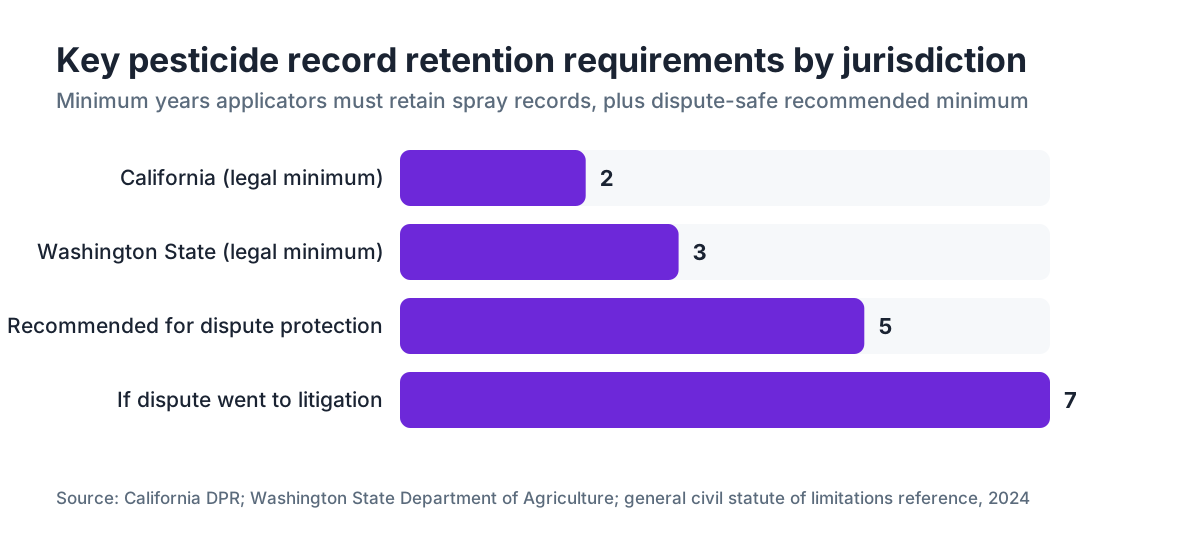
California requires applicators to keep spray records for two years [3]. Washington requires three [4]. But a civil lawsuit for contract breach can be filed within three to four years of the event in most states, and longer in some cases. Keeping records for at least five years from the date of the contested application is a reasonable floor.
For any dispute that actually went to mediation or litigation, keep everything indefinitely, or at least until you have a signed settlement agreement and any appeal period has passed.
Digital records are fine, but keep a backup that doesn't depend on a vendor staying in business. Export your spray records to PDF at the end of each season and store them somewhere you control. If you use field operations software like VitiScribe, that export function is one of the most useful things to exercise before you need it.
Wineries face the same clock. Residue test results, lab certifications, and any restricted materials lists you handed out to growers belong on the same five-year schedule. The restricted materials list matters most of all, because it establishes what standard you actually communicated, more than what you meant to.
Can mediation or arbitration resolve a grower-winery pesticide dispute without going to court?
Yes, and it's almost always faster and cheaper than litigation.
Many grape purchase agreements include a mandatory mediation or arbitration clause. Read yours before a dispute starts so you know what process binds you. If your contract requires arbitration, you generally cannot sue in court first.
USDA runs an Agricultural Mediation Program available in all states, and it covers farm-related disputes including contract disagreements [10]. It's free or low-cost compared to private arbitration.
In mediation, you bring your four stacks of documents and a clear summary of your position. The mediator isn't a judge and can't order anything, but they can help both sides find a middle position. A grower who walks in with organized documentation and a clean timeline signals credibility from the first minute.
Arbitration runs closer to a private trial. The arbitrator can issue a binding decision. Rules of evidence apply less strictly than in court, but documentation still matters enormously. An arbitrator reading a clean paper trail on one side and a pile of text-message screenshots on the other will draw conclusions.
The strongest outcome in any dispute is one where your documentation is so clear that the other party decides early that fighting isn't worth it. That's not cynicism. It's how commercial negotiations work.
Frequently asked questions
Do I need to keep spray records even if I'm not a licensed applicator?
In most states the recordkeeping obligation attaches to the applicator or the operator of record, more than to licensed applicators. In California, growers who apply restricted-use pesticides must file Pesticide Use Reports regardless of license status. Even for general-use pesticides, keeping your own dated spray log is basic self-protection. If a dispute arises, "I don't have records" is never a helpful answer.
What is the pre-harvest interval and why does it matter in a dispute?
The pre-harvest interval (PHI) is the minimum number of days that must pass between the last pesticide application and harvest, as stated on the product label. It exists so residues decline to safe levels. In a dispute, PHI compliance is often the first thing a winery, regulator, or arbitrator checks. If you applied a product 10 days before harvest and the PHI is 14 days, you have a problem no matter what the residue test shows.
What is a Maximum Residue Limit and who sets them?
An MRL is the highest concentration of a pesticide residue legally permitted in or on a food commodity. In the US, the EPA sets MRLs (called tolerances) under FIFRA and the Federal Food, Drug, and Cosmetic Act. The EU sets its own MRLs, which are often stricter. A winery exporting to the EU may require growers to meet EU MRLs, which can run dramatically lower than US tolerances for the same active ingredient.
What if a neighbor's pesticide drifted onto my vineyard and caused the rejection?
Drift disputes are a separate legal category, but the documentation principle is identical: act fast. Photograph the damage, note wind speed and direction on the day in question (weather station data is admissible), get residue tested on a retained sample, and file a complaint with your county agricultural commissioner right away. You may have a tort claim against the neighbor, a crop insurance claim, or both. Your spray records showing you did not apply the detected compound are the key document.
Is a verbal agreement between a grower and winery about pesticide restrictions enforceable?
Possibly, but it's genuinely hard to prove. Most states follow the Uniform Commercial Code for agricultural contracts, and while verbal contracts can be enforceable for goods under $500, commercial grape purchase agreements almost always clear that threshold. Even where verbal contracts are technically enforceable, you need a witness or corroborating evidence. Courts are skeptical of verbal-only agreements in commercial disputes. Write everything down.
Can a winery refuse to share their residue test results with the grower?
Not without consequences in most commercial and legal contexts. If the winery uses test results to justify a rejection while withholding those results, a mediator or arbitrator will draw negative inferences. Your first step is to request the results in writing. If they refuse, document that refusal. In some states, discovery rules in arbitration or litigation can compel disclosure. Ask your attorney about your specific rights in your state.
What's the difference between a Pesticide Use Report and a spray log?
A Pesticide Use Report (PUR) is a formal document filed with a county or state agricultural agency within a legally specified window (30 days in California). A spray log or spray record is your internal field record, which you keep yourself. They should carry overlapping information, but the PUR is the official government document and holds more evidentiary weight because it was created contemporaneously and filed with a government agency.
How much can a pesticide dispute actually cost a small grower?
The range is wide. A single rejected ton of wine grapes at $1,500 per ton is $1,500 lost. A full block rejection on a 10-acre vineyard at 4 tons per acre is $60,000 in lost revenue before you count secondary market discounts and trucking. Legal fees for mediation run $2,000 to $10,000 depending on complexity. Litigation with attorneys easily reaches $50,000 or more. Prevention through documentation is almost always cheaper.
Do I need a lawyer to document a pesticide dispute?
Not necessarily at the start, but consult one before signing any settlement. You can build your own documentation file, write your own follow-up emails, and file your own complaint with the county agricultural commissioner without an attorney. An attorney earns the fee reviewing your contract, advising on your state's enforcement rules, and handling formal mediation or arbitration. An agricultural attorney who knows grape purchase agreements is worth one hour of consultation early on.
What makes a residue test result admissible or credible in a dispute?
Chain of custody and lab accreditation. The sample must be traceable from the moment of collection through the lab report, with no gaps. The lab should be accredited under NELAP (National Environmental Laboratory Accreditation Program) or an equivalent state program. If either party collected the sample without the other present, make sure the process was documented carefully and in detail. Both parties agreeing in advance on the sampling protocol kills a lot of these arguments.
What should a winery's restricted materials list include?
At minimum: every active ingredient prohibited or restricted, the standard the list is based on (US MRLs, EU MRLs, the winery's own internal standard), the season it applies to, and a signature line for the grower to acknowledge receipt. Some wineries also list permitted products by trade name. The list should be specific enough that a grower can make spray decisions from it without calling the winery every week. Ambiguity in the list becomes the winery's problem in a dispute.
How does the EPA Worker Protection Standard relate to a pesticide dispute?
The WPS, codified at 40 CFR Part 170, requires that pesticide application information be posted and accessible to agricultural workers and handlers [6]. WPS records document what was applied and when, which overlaps with the spray records relevant to a dispute. A WPS violation (failing to post required information, for example) can also signal broader recordkeeping failures that undermine your credibility, even if the WPS violation itself isn't directly at issue.
Should I notify my crop insurance carrier if a pesticide dispute leads to a fruit rejection?
Yes, and quickly. Most crop insurance policies require timely notice of any potential loss event. A fruit rejection for pesticide reasons may be a covered loss, a recoverable loss from a neighbor's drift, or outside your policy entirely, but you won't know until you file. Delay can void your claim. Document the rejection notice, the dollar value, and your first contact with your insurance agent, all with dates.
Sources
- Cornell Cooperative Extension, Grape Production resources: Grower-winery conflicts often trace back to informal verbal agreements that were never put in writing before the season started
- EPA, Federal Insecticide, Fungicide, and Rodenticide Act (FIFRA) overview: Under FIFRA, the pesticide label is the law and applicators must follow label directions
- California Department of Pesticide Regulation, Pesticide Use Reporting: California requires licensed pesticide applicators to file a Pesticide Use Report with the county agricultural commissioner within 30 days of application, and records must be retained for two years
- Washington State Department of Agriculture, Pesticide Registration and Licensing: Washington State pesticide applicator records must be kept on file for three years under RCW 15.58
- Washington State University Extension, Pesticide Safety Education Program: WSU Extension's pesticide safety program provides state-by-state comparison of applicator record requirements
- EPA, Worker Protection Standard, 40 CFR Part 170: The EPA Worker Protection Standard requires that specific application information be available to farm workers and handlers, including product name, date of application, and re-entry interval
- UC Davis Viticulture and Enology, Extension and Outreach: UC Davis viticulture and enology extension has published model contract language for grape purchase agreements addressing pesticide standards
- European Commission, EU Pesticides Database (MRL search): EU MRLs for wine grapes are in many cases stricter than US tolerances; active ingredients with no established EU MRL default to 0.01 mg/kg, effectively a prohibition
- California Department of Pesticide Regulation, Pest Control Adviser licensing: California Food and Agricultural Code Section 11501 requires a licensed Pest Control Adviser recommendation for pesticide use on commercial agricultural operations
- USDA Farm Service Agency, Agricultural Mediation Program: USDA's Agricultural Mediation Program is available in all states and provides free or low-cost mediation for farm-related disputes including contract disagreements
- EPA, Pesticide Tolerances under the Federal Food, Drug, and Cosmetic Act: The EPA sets US pesticide tolerances (MRLs) under FIFRA and the Federal Food, Drug, and Cosmetic Act; the FDA has jurisdiction over pesticide residues in food including wine
Last updated 2026-07-10