How to document a pre-harvest field inspection for food safety

TL;DR
- A pre-harvest field inspection means walking every block before picking and writing down what you found: water test results, worker hygiene, animal intrusion signs, equipment condition, and any corrective actions.
- Under FDA's FSMA Produce Safety Rule, covered farms must keep these records for at least two years and hand them to inspectors on request.
What is a pre-harvest field inspection and why does food safety require one?
A pre-harvest field inspection is a walk-through of your vineyard blocks in the days right before harvest to find and document anything that could contaminate fruit. For table grape and fresh-market wine grape operations, it's a legal requirement under the FDA Food Safety Modernization Act Produce Safety Rule (21 CFR Part 112). Wineries crushing exclusively for fermented product may be exempt from FSMA, but auditors for most third-party programs, including GLOBALG.A.P., still expect written inspection records.
Here's the logic. A lot changes in the field in the 48 to 72 hours before a crew shows up. Deer or feral pigs walk through overnight and leave feces near fruit. An irrigation valve back-siphons untreated water. A contract sprayer leaves a rig parked in a block. None of that lands on your spray records or your soil tests. Only a physical walk-through, written down in real time, proves you looked.
The FDA Produce Safety Rule says covered farms must "take measures during the growing season that are reasonably necessary to identify and address conditions that are reasonably likely to result in the introduction of known or reasonably foreseeable hazards" (21 CFR Part 112). That language about "measures" and "address" is exactly what inspectors point to when they ask for your inspection forms. A verbal account of what you noticed is not enough. The record has to exist.
For how this fits the rest of your paperwork, the vineyard overview covers the full set of field record-keeping obligations.
Which farms are actually covered by FSMA's Produce Safety Rule?
Coverage depends on your average annual sales of all food over the prior three years. The rule sets three tiers (21 CFR Part 112).
| Tier | Average annual food sales | Status under PSR |
|---|---|---|
| Covered farm (large) | More than $500,000 | Fully covered, all subparts apply |
| Qualified Exemption (small) | $25,001 to $500,000, and more than half of sales are to qualified end-users | Modified requirements; must disclose farm name and address on product |
| Exempt | $25,000 or less | Not covered |
The qualified exemption matters for a lot of small wineries. If your grapes go entirely to your own winery for fermentation and you sell the finished wine to consumers, the grapes may fall under the exemption because the winery is a qualified end-user. But state departments of agriculture run their own FSMA compliance programs with their own audit schedules, and the exemption does not shield you from state requirements. Call your state ag department before you assume you're off the hook.
Cornell's food safety team makes a practical point: even exempt farms benefit from written records, because a regulatory exemption does nothing for your liability exposure if a foodborne illness outbreak traces back to your fruit. That's reality, not a legal opinion.
What exactly do you need to record during a pre-harvest inspection?
Record anything you observed, including nothing. A form that says "no animal intrusion observed, no equipment left in block, irrigation lines clear" is as useful as one that logs a problem, because it proves you walked the block.
Here are the categories FDA and extension programs name as required or strongly recommended.
Agricultural water. If you irrigated within the preharvest interval or if it rained, note the water source, the application method, and whether you have a current microbial test on file. Under 21 CFR Part 112 Subpart E, covered farms must test agricultural water applied to harvestable portions of the crop using a geometric mean and statistical threshold value (STV). Log the date of your most recent test and its result. Surface water gets tested more often than well water.
Biological soil amendments. If any compost, manure-based amendment, or biosolid went on during the season, confirm the application date, the wait period observed, and the source documentation. Note whether the amendment met treatment standards.
Animal intrusion and wildlife. Walk the perimeter and the interior of each block. Look for feces, tracks, burrows near fruit zones, or big animals breaking through the trellis wire. Feral pig activity near water sources is a known high-risk condition. If you find something, record exactly where (row, GPS point if you have it), what you found, and what you did about it.
Worker and equipment hygiene. Confirm that toilets or restrooms sit within the required distance for the crew. Under the EPA Worker Protection Standard, sanitation facilities must be within a quarter mile of workers or as close as practicable. Check that handwashing supplies are stocked. Note the condition of harvest bins, gondolas, and picking knives: clean, sanitized, dry.
Crop and canopy condition. Look for mold, bird damage that opens fruit, or anything that lets free juice pool on fruit surfaces during picking. This matters for food safety and for what ends up in the tank.
Spray or pest-control activity near the block. If a neighbor applied pesticides and drift is a risk, note it. Check your own preharvest intervals for anything applied to that block.
WSU Extension's food safety resources for tree fruit and berry crops offer template logic that carries over cleanly, because the hazard categories are identical even though the crop isn't grapes.
How do you format a pre-harvest inspection form that will satisfy an auditor?
The form doesn't have to be fancy. Auditors want specificity, a date, and a signature. That's the whole game.
Every form needs fixed fields: farm name, block or lot identifier, inspection date, inspector name, time of inspection, and a signature line. Without a date and a named person, the record is useless for traceability.
After that, the body should mirror the hazard categories above. For each one, give yourself either a simple yes/no/N-A checkbox with room for a finding note, or a narrative field. The checkbox is faster for crews. The narrative is better when something actually happened and you need to explain it.
When you find a problem, the form needs three things: what the problem was, what you did about it (the corrective action), and who authorized it. A record that says "animal feces found in row 14" and stops there is worse than no record, because it documents a hazard without documenting the fix. Fill the corrective action column every time.
UC Davis's Good Agricultural Practices program publishes a field activities log template through the UC ANR catalog that covers most of these fields. It's a reasonable start. Adapt it to your blocks, water sources, and equipment rather than copying it whole.
Managing multiple blocks across multiple harvest windows, a paper binder gets unwieldy fast. That's where a field record platform like VitiScribe earns its keep: you build the inspection template once, inspectors fill it out on a phone in the field, and the signed record attaches to that block's harvest event. Timestamp and GPS log are automatic, which meets the "documented in real time" standard without extra steps.
How close to harvest does the inspection have to happen?
FSMA doesn't name a specific number of days before harvest for the inspection itself. It requires that you take measures reasonably necessary to identify hazards during the growing season and before harvest begins (21 CFR Part 112). Auditors and extension advisors read that as within 24 to 72 hours of the crew entering the block.
Why 72 hours as the outer limit? Conditions change. Animal activity, deer and feral pig especially, shows up in the early morning after a night of foraging. A Thursday inspection tells you nothing about what walked through Friday night before a Saturday pick. On a big vineyard running a multi-day harvest, the expectation is one inspection per block per harvest pass, not one inspection for the whole season.
Some third-party audits, including the California Sustainable Winegrowing Alliance verification process, ask specifically whether inspections happened on the day of or the day before harvest. Get the inspection done within 24 hours and you're in the strongest spot no matter which program is looking at you.
What are the agricultural water testing requirements that belong on the form?
This is the section that trips up most small vineyards, because the water testing schedule under 21 CFR Part 112 Subpart E is genuinely complicated and FDA has revised it more than once since the rule was finalized in 2015.
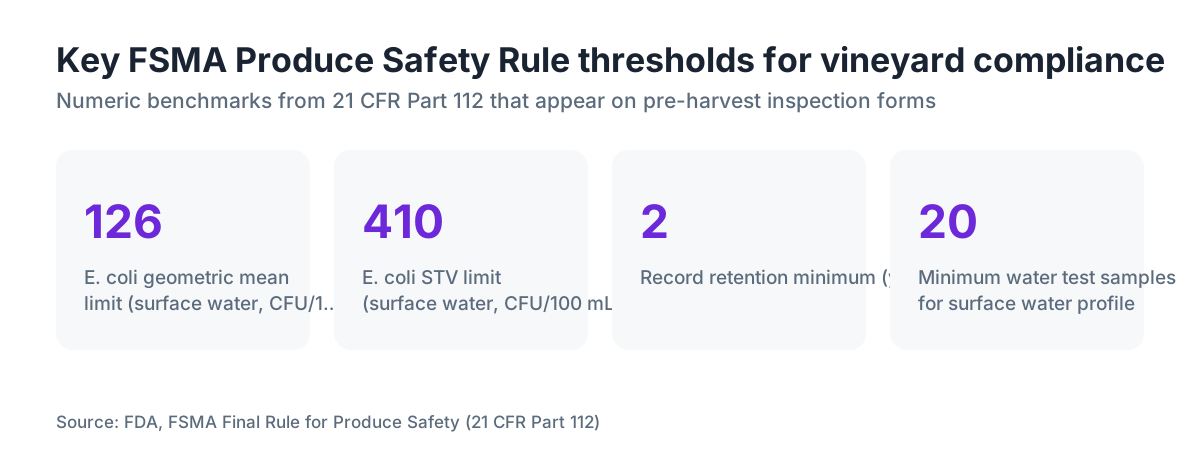
For surface water (rivers, canals, open ponds, districts that pull from surface water), covered farms must build a microbial water quality profile using E. coli as the indicator. The framework requires a geometric mean of no more than 126 CFU per 100 mL and an STV of no more than 410 CFU per 100 mL, based on at least 20 samples collected over two to four years (21 CFR Part 112 Subpart E).
For groundwater (wells), the initial survey is four samples taken in a single year, with annual testing after that. The thresholds are the same.
You're not running a fresh water test the morning of harvest. On the form, you log that your current results sit inside the acceptable range and note when the last test was pulled. If your most recent result exceeds the STV, or you're on surface water after a heavy rain that could spike E. coli, that's a condition that may force a corrective action before picking starts.
FDA's FSMA Produce Safety Rule resources carry the current compliance dates and the revised water framework, which changed with the 2022 Agricultural Water Amendments.
How long do you have to keep pre-harvest inspection records?
Two years, minimum. That's the requirement under 21 CFR Part 112.161 for covered farms. The records have to be retrievable and presentable to an FDA or state inspector on request, which in practice means within 24 hours during an inspection and within the business day for a written request.
A physical binder works legally, but it creates real problems. Paper degrades. Binders vanish in the chaos of harvest. And when an inspector shows up two seasons later asking about the 2022 Chardonnay pick, digging out the right form in the right binder is slower than it should be. Digital records with block-level tagging fix all of that and give you a searchable audit trail.
The two-year minimum is a floor, not a ceiling. In a product liability claim or a foodborne illness investigation, records older than two years can still show up through discovery. Many food safety attorneys keep farm records for five to seven years for exactly that reason, though that's legal practice, not a regulatory rule.
What corrective actions should be documented when you find a problem?
The action depends on what you found, but the documentation shape never changes: what you found, what you decided to do, when you did it, and who made the call.
Animal feces near harvestable fruit: remove the contaminated fruit and a buffer around it (UC Davis recommends the affected cluster plus one meter in all directions), document the GPS location or row/vine coordinates, and note that the material was disposed of, not harvested. If the source is a large animal like a pig or a bear and the area is extensive, you may need to hold the block entirely.
A water test above the STV: run a new test to see if the first was an anomaly (and document the new result), treat the water and retest, or switch sources. Harvesting past a known exceedance is not a corrective action.
Equipment found dirty or poorly sanitized: wash, sanitize, and reinspect before use. Log the sanitizer product, concentration, and contact time. The sanitizer has to be food-contact safe, so read the label.
A missing or unstocked sanitation facility: delay harvest in that block until the facility is in place and stocked. That's not optional under the EPA Worker Protection Standard.
End each corrective action entry with a statement that the condition was resolved before harvest proceeded, or, if it wasn't, why harvest was delayed or the block was pulled.
Does the pre-harvest inspection cover pesticide preharvest intervals too?
It should, even though pesticide PHI compliance lives in a different bucket (EPA pesticide registration, state ag department enforcement) than the food safety inspection (FDA FSMA, state produce safety programs).
The smart move is to run both checks on the same form, or attach a PHI confirmation note to the food safety record. It's not a regulatory requirement, but it closes a real gap. An inspector from a wine grape buyer's audit program often asks both questions in one breath: "Do you have your pre-harvest food safety inspection?" and "Can you show me the spray records for this block and confirm all PHIs were met?"
Your spray records already document the last application date for each material on each block. On the inspection form, add one field: "Spray record reviewed for this block, all PHIs met: Yes / No / N-A" with a line for the reviewer's initials. That cross-check takes 30 seconds and stops a situation where the food safety inspector catches a PHI problem you missed.
For grape-specific lookups, UC Davis Integrated Pest Management keeps a pest management guide for wine grapes with labeled materials and their preharvest intervals.
What's the difference between a GAPs audit and a FSMA compliance inspection?
A GAPs (Good Agricultural Practices) audit is a voluntary, third-party verification, usually demanded by a buyer or retailer, that checks whether your practices follow food safety guidelines. Most GAPs audits use USDA's GAPs and GMPs audit checklist as the reference. A third-party auditor you hire runs it, and the certificate goes to your buyer.
A FSMA compliance inspection is run by an FDA inspector or a state partner agency (most states signed cooperative agreements with FDA to run the program). It's a regulatory inspection, not a voluntary one. The inspector checks whether you're following the law, not whether you've earned a marketing badge.
The overlap is heavy. Almost everything that satisfies a FSMA inspection satisfies a GAPs audit, and the reverse. The gap is in consequences. A failed GAPs audit costs you a buyer contract. A FSMA inspection with significant findings can bring a warning letter, a consent decree, or recall authority.
Most small and mid-sized vineyards meet the GAPs audit first, through a winery buyer's food safety program. That's useful practice for FSMA, because the record-keeping habits you build for the audit also satisfy the law.
USDA's Agricultural Marketing Service runs the voluntary GAPs audit program. FDA runs FSMA compliance.
How does the EPA Worker Protection Standard connect to your harvest inspection record?
The EPA Worker Protection Standard (WPS) covers pesticide safety for agricultural workers and applies to any farm using pesticides registered for agricultural use, which is basically every vineyard. WPS requires that workers have access to central display postings with pesticide application information, that safety data sheets are available, and that sanitation requirements are met.
The tie to your pre-harvest inspection is the sanitation check. WPS requires at least one toilet and handwashing facility per 80 workers, within a quarter mile of where they work (or as close as practicable given the terrain). Before a crew enters a block, confirming those facilities are in place and stocked is both a WPS requirement and a food safety hygiene checkpoint.
Your form should carry a WPS sanitation field. It doesn't have to say "WPS compliance check." It just confirms facilities are present, stocked, and working before work starts. When an EPA WPS inspector visits, that field gives you a timestamped record that you verified compliance before each work event, which beats saying you generally keep facilities around.
Can a paper form still work, or do you need software for pre-harvest inspection records?
Paper still works legally. FDA does not require electronic records for FSMA Produce Safety Rule compliance. Prefer a clipboard and a pen? That's a legitimate choice.
But paper fails in specific ways at harvest. Forms get wet, illegible, or lost. A form filled out in a hurry skips fields. There's no automatic timestamp, so reconstructing the sequence weeks later means trusting everyone's memory. When an inspector asks for records from three blocks on a specific date and the binder holds 200 forms, finding those three fast is harder than it should be.
Digital systems, whether a dedicated farm record platform like VitiScribe or even a well-built Google Form linked to a spreadsheet, kill those problems. The timestamp is automatic. The form can require every field before it submits. Records are searchable by block, date, or inspector. A PDF export reads cleaner in an audit than a field-stained page.
The real question is which failure you fear more: losing a paper form, or losing access to a digital system. For most operations with decent mobile coverage in the vineyard, digital is lower risk. For remote blocks with no cell service, paper plus a same-day entry protocol into a digital backup is a sound hybrid.
What should a completed pre-harvest inspection form actually look like?
Here's the field structure that covers every category an FDA inspector or GAPs auditor expects to see. Nothing proprietary here; it's built from published UC Davis, Cornell, and WSU extension guidance.
| Field | What to record |
|---|---|
| Farm / Ranch name | Legal entity name |
| Block / Lot ID | Your internal block naming |
| Acres in block | Numeric |
| Variety | Grape variety |
| Inspection date | MM/DD/YYYY |
| Inspection time | HH:MM, 24-hour preferred |
| Inspector name | Printed and signed |
| Agricultural water (last test date) | Date + result (CFU/100 mL) |
| Water source type | Surface / Well / Municipal |
| Animal intrusion observed | Yes / No; if yes, describe location and species evidence |
| Corrective action taken | Describe, or N/A |
| Equipment condition | Clean / Needs cleaning; note which equipment |
| Sanitation facilities present | Yes / No; distance to furthest work area |
| Sanitation facilities stocked | Yes / No |
| Spray records reviewed, PHIs met | Yes / No / N/A |
| Soil amendment applications this season | Yes / No; if yes, list amendment, date, wait period met |
| Crop condition (mold, bird damage, open fruit) | Describe, or none observed |
| Block cleared for harvest | Yes / No; if no, explain |
| Supervisor signature | Printed and signed |
| Date of supervisor review | MM/DD/YYYY |
Fill every field. "N/A" counts as a complete entry. "N/A" without a signature and date does not.
Frequently asked questions
Do I need a pre-harvest inspection if I'm only growing grapes for wine, not fresh market?
If your grapes go entirely to a winery for fermentation and that winery is your only customer, you may qualify for a FSMA Produce Safety Rule exemption as a qualified end-user arrangement. But most third-party winery buyer audits and voluntary sustainability certifications still require written pre-harvest inspection records regardless of FSMA coverage. Check with your state department of agriculture and your winery buyer before assuming an exemption applies.
How do I document animal feces found in a vineyard block before harvest?
Record the exact location (row number, vine number, GPS coordinates if available), the estimated species if identifiable, and the approximate freshness. Then document your corrective action: how much fruit was removed, the buffer zone distance, and how the contaminated material was disposed of. UC Davis recommends removing at least the affected cluster plus a one-meter buffer in all directions. End the entry by stating whether the block was cleared for harvest or held.
How often do you need to test irrigation water for E. coli under FSMA?
For surface water sources, covered farms must build a microbial water quality profile from at least 20 samples collected over two to four years, then test annually to maintain it. For wells, the initial survey requires four samples in one year, then annual testing. The geometric mean threshold is 126 CFU per 100 mL and the STV is 410 CFU per 100 mL under 21 CFR Part 112 Subpart E. FDA's 2022 Agricultural Water Amendments updated some of these requirements.
Can the same person who does the inspection also sign off on it, or does it need a supervisor signature?
FSMA does not require a separate supervisor signature on field inspection records. The inspector's own signature is legally sufficient. But many third-party audit programs and internal quality systems require a second signature, both as a quality check and to establish chain of custody for the record. If your winery buyer's audit program requires dual signatures, follow that requirement regardless of the regulatory floor.
What happens if you find a food safety problem and harvest anyway?
Harvesting after documenting a known, unresolved hazard is worse from a liability standpoint than never inspecting at all, because you've created a record showing you knew and proceeded. Under FSMA, taking measures to address known hazards is required. If a foodborne illness later traces to your lot and your records show an unresolved contamination event, that's a significant legal exposure. Document the problem, document the corrective action, and hold the block until the hazard is resolved.
What's the difference between a pre-harvest inspection record and a harvest activity log?
A pre-harvest inspection happens before the crew enters the block and focuses on hazard identification: water, animal intrusion, sanitation, equipment. A harvest activity log documents what happened during harvest: crew size, start and end times, yields, any incidents during picking. Both are required for full traceability. The pre-harvest inspection creates the clearance record; the harvest log creates the production record. They're separate documents with different purposes.
Does the pre-harvest inspection replace the requirement to keep spray records?
No. Spray records and pre-harvest food safety inspection records are separate requirements under separate regulatory frameworks. Spray records are required under state pesticide use reporting laws and EPA pesticide registration. Pre-harvest food safety inspections are required (for covered farms) under FDA's FSMA Produce Safety Rule. The pre-harvest inspection form should reference your spray records and confirm PHIs were met, but it does not substitute for maintaining the spray records themselves.
Do contract harvest crews need to be trained on food safety before entering the vineyard?
Yes. Under FSMA's Produce Safety Rule, all covered farm personnel who handle covered produce or food contact surfaces must receive food safety training. This includes contract harvest crews. The minimum requirement is training in topics specified in 21 CFR Part 112 Subpart C. The Produce Safety Alliance (PSA) Grower Training course, developed with Cornell University, is the most widely accepted way to satisfy this requirement for both permanent staff and contractors.
What's the Produce Safety Alliance (PSA) training and is it required?
The PSA Grower Training is a one-day course developed by Cornell University and co-sponsored by FDA that covers FSMA Produce Safety Rule requirements for farm owners and workers. Completion provides a certificate recognized by FDA and most state produce safety programs as satisfying the training requirement under 21 CFR Part 112 Subpart C. It's not the only acceptable training, but it's the most straightforward path to documented compliance for small and mid-sized farms.
How do I handle a situation where rain fell the night before harvest and I'm worried about water contamination?
A significant rain event on a surface water source is a recognized risk factor for elevated E. coli counts, because runoff carries biological material into waterways. On your pre-harvest inspection form, document the rain event (date, approximate rainfall amount if measurable), note your irrigation water source, and confirm whether any irrigation occurred during or after the rain event. If your most recent water test is more than 30 days old and you're on a surface source, a new test before harvest is the prudent call.
What records does a state produce safety inspector actually ask for during a vineyard visit?
State inspectors under FDA cooperative agreements typically request: your farm's FSMA coverage determination, agricultural water test records (most recent results and the underlying testing history), training records for personnel, pre-harvest inspection records for recent harvests, records of any corrective actions taken, and equipment cleaning and sanitation logs. They usually ask to see records covering at least the current season and may request prior seasons. Having records organized by block and date dramatically reduces inspection time.
Is there a free pre-harvest food safety inspection template I can download?
UC Davis's Good Agricultural Practices program publishes field activity log templates as free downloads through the UC ANR publications catalog. Cornell's Produce Safety Alliance also offers grower resources and template forms. USDA's GAPs audit checklist is another public resource that outlines every field a form should cover. None of these templates are vineyard-specific, so you'll need to adapt them to your blocks, water sources, and equipment. Search the UC ANR catalog for 'GAPs field records.'
Can I use my phone to complete the pre-harvest inspection form?
Yes, and it's generally better than paper in the field. A phone-based form auto-timestamps the submission, can capture a GPS coordinate, and sends the record to cloud storage immediately so it won't be lost or damaged. The key requirement is that the digital record must be retrievable and presentable to an inspector on request. Make sure your system stores records for at least two years and that you can export a human-readable version (PDF or CSV) quickly.
Sources
- Cornell University, Produce Safety Alliance Grower Resources: Even exempt farms benefit from keeping written food safety records because regulatory exemption does not eliminate civil liability exposure in a foodborne illness investigation.
- EPA, Agricultural Worker Protection Standard (WPS): WPS requires at least one toilet and handwashing facility per 80 workers, within a quarter mile of where workers are working or as close as practicable.
- Washington State University Extension, Food Safety: WSU Extension provides transferable food safety template logic covering hazard categories including water, animal intrusion, equipment sanitation, and worker hygiene applicable across fresh produce crops.
- UC Davis, UC ANR Publications Catalog: UC Davis GAPs program publishes field activities log templates and recommends removing affected fruit plus a one-meter buffer zone when animal feces is found near harvestable crop.
- California Sustainable Winegrowing Alliance, Certification Program: California SWA verification asks specifically whether pre-harvest inspections were conducted on the day of or the day before harvest.
- UC Davis Integrated Pest Management, Grape Pest Management Guidelines: UC Davis IPM maintains a pest management guide for wine grapes with labeled materials and their preharvest intervals for use in PHI verification.
- USDA Agricultural Marketing Service, Auditing Programs (GAP/GHP): USDA AMS runs the voluntary GAPs audit program; audits use the USDA GAPs and GMPs audit checklist and result in a certificate shared with buyers.
- Cornell University, Produce Safety Alliance Grower Training: The PSA Grower Training is a one-day course developed by Cornell and co-sponsored by FDA; completion satisfies training requirements under 21 CFR Part 112 Subpart C.
Last updated 2026-07-11