How to document a raptor perch installation as an IPM practice

TL;DR
- Document a raptor perch as an IPM action by recording seven things: install date, GPS coordinates, perch type and dimensions, target pest species, the monitoring data that triggered the decision, the installer, and a link to the pest monitoring record.
- Add a seasonal observation log.
- That link ties conservation to a real pest decision and satisfies audits under Lodi Rules, SIP Certified, CCOF, and USDA Organic.
Why does raptor perch documentation matter for IPM compliance?
A raptor perch is a real biological control tool. On its own, though, it's a wooden pole in a field. Documentation is what turns the installation into an IPM action you can defend to a certifier, a buyer's sustainability auditor, or a state agricultural agency. No written record tying the perch to a pest problem and a decision? Then it's scenery.
Most formal IPM definitions require that every pest action, chemical or biological, link to a threshold, a target pest, and an outcome. The UC Statewide IPM Program at UC Davis defines IPM as a decision-based process that "uses a combination of techniques to suppress pests," built around monitoring and economic or aesthetic thresholds as the trigger for action [1]. A perch counts as a biological control tactic under that framework, but only if you can show you chose it on purpose to suppress a documented pest population.
SIP Certified, CCOF, Lodi Rules, and USDA Organic each write their own audit language. They all want the same answer underneath: what problem were you solving, and what did you do about it? A perch record answers that without you applying a single pesticide, which is exactly the kind of documentation these programs reward.
The record protects you if a neighbor, regulator, or inspector ever questions your rodenticide patterns. Two seasons of documented raptor activity is objective evidence that you've been chasing alternatives. That matters.
What information should a raptor perch installation record include?
A complete installation record has seven core fields, and you need all seven to pass an audit. None of them require special software. A paper field log works fine.
- Installation date. Day, month, year. more than the season.
- Location. GPS coordinates or a block-referenced field map with the perch marked. "Near the east end of Block 4" isn't enough. An auditor wants to walk straight to it.
- Perch type and dimensions. Height, material (pressure-treated post, T-post, natural snag), perch arm width and orientation. WSU Extension recommends perch arms at least 12 to 18 inches wide to hold red-tailed hawks and other buteonine raptors [2].
- Target pest. Be specific: Botta's pocket gopher (Thomomys bottae), California vole (Microtus californicus), ground squirrel (Otospermophilus beecheyi), or whichever species you've flagged as the economic problem.
- Triggering observation. What monitoring data justified the action? Burrow counts per 100 linear feet, damage ratings, or trap index numbers all work. This is your threshold documentation.
- Installer name, plus any contractor involved.
- A reference to the pest monitoring record that preceded the decision. This cross-reference is what IPM auditors hunt for hardest, and it's the field most growers skip.
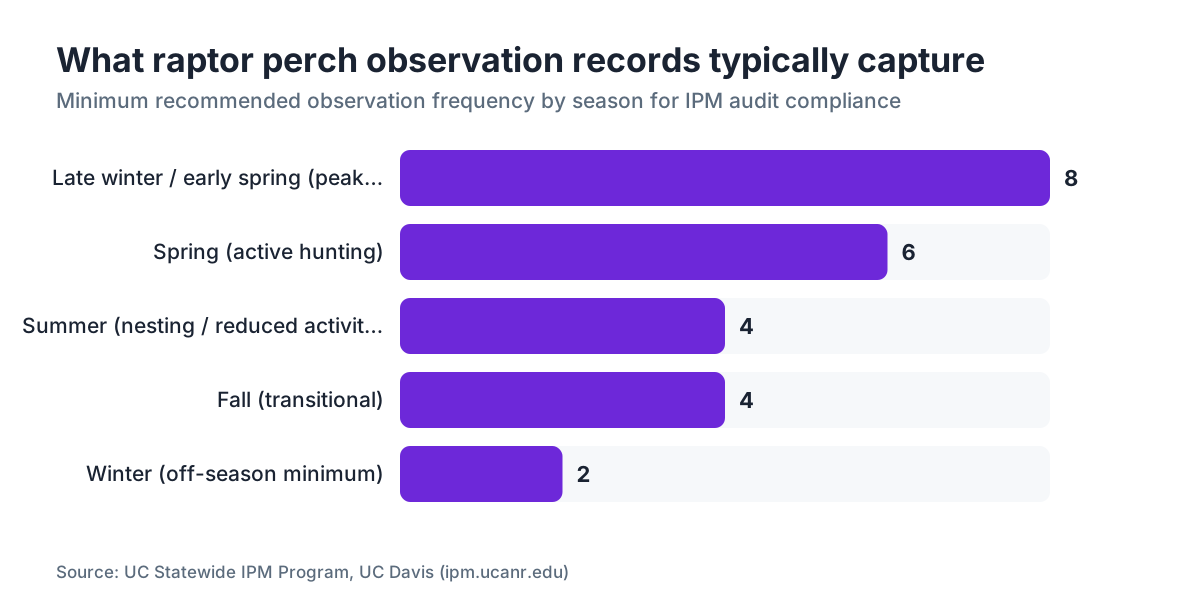
Once the perch is up, attach an observation log. Check it weekly or biweekly through the first active season and note the date, raptor species if you can tell, time spent on the perch, and any prey sign. You don't have to be an ornithologist. "Large buteo, roughly 45 minutes, pellets at base" is honest and enough.
What does a raptor perch IPM record form look like in practice?
Here's a field-ready structure you can copy into any system or print for the truck.
| Field | Example entry |
|---|---|
| Record ID | RPX-2024-003 |
| Block / APN | Block 7, APN 012-345-678 |
| GPS (WGS84) | 38.5412°N, 122.8034°W |
| Installation date | 2024-03-15 |
| Perch height | 14 ft |
| Perch arm width | 16 in, facing SE |
| Material | 4x4 pressure-treated pine, galvanized hardware |
| Target pest | California vole (Microtus californicus) |
| Pest monitoring trigger | 12 active burrows per 100 ft transect, March 12 survey |
| Linked monitoring record | VM-2024-031 |
| Installer | J. Ruiz, vineyard manager |
| Contractor (if any) | None |
| IPM tactic category | Biological control, conservation |
| Estimated cost | $85 materials + 1.5 hrs labor |
The observation log lives on a second page or a linked record. Keep it plain: date, time of day, notes, initials. Frequency beats length. Twenty short entries across a season are far more convincing than one detailed paragraph written after the fact.
If you keep records digitally, VitiScribe lets you attach GPS-stamped photos and link pest monitoring records to conservation actions in one workflow, which cuts the time to assemble an audit package. A well-kept spreadsheet or three-ring binder works perfectly too, as long as you're consistent.
How many raptor perches do vineyards typically install, and where should they go?
Placement density drives both efficacy and the credibility of your records. Put a perch in the wrong spot and no raptor uses it, so your observation log stays empty. An empty log looks worse than no log at all.
UC Davis recommends one perch per 3 to 5 acres for rodent management in orchards and vineyards, based on the home range and hunting territory of common vineyard raptors including American kestrels, red-tailed hawks, and barn owls [1]. Treat that as a rough guide, not a hard rule. Terrain shifts the math. A perch on a ridgeline may cover more ground than one in a low, wind-sheltered block.
Placement principles worth writing down:
- Set perches 50 to 75 feet from the vine row, not inside the canopy. Raptors need clear sightlines to the ground.
- Face the perch arm toward the highest-pressure pest area from your monitoring data. Note this in the record.
- Avoid spots right next to busy roads. Barn owls have high vehicle-strike mortality [3].
- Where irrigation risers or other verticals exist, confirm the perch is the tallest object within hunting range so raptors pick it first.
WSU Extension's guidance for Washington wine grape production recommends pairing perch placement with cover crop management, since short inter-row vegetation raises raptor hunting success and vole vulnerability [2]. Make that connection in your records if you're doing it. It shows systems-level IPM thinking, which scores well with most certifiers.
What pest monitoring records do you need before installing a raptor perch?
This is the step most growers skip, and it's the step that separates a real IPM record from a box-checking exercise.
Before a perch can be documented as an IPM response, you need evidence of the pest problem it addresses. The monitoring record that comes before installation is the foundation of the whole file.
For voles and gophers, the common methods are:
- Transect burrow counts. Walk a measured transect (typically 100 to 300 feet per block) and count active burrow openings. Record date, transect ID, observer, and count. UC IPM suggests counts above 3 to 5 active gopher mounds per acre as a general action threshold for some crops, though vineyard-specific thresholds are less well established [1].
- Bait station index. Place tracking stations and count activity after 24 to 72 hours.
- Visual damage assessment. Photograph vine row damage, girdling, or raised tunnels, and record the percentage of affected vines per block.
Your installation record should cite the specific monitoring record by ID number. The auditor pulls that monitoring record and sees the problem the perch was meant to solve. Skip that link and the perch is a conservation action, which is fine, but it doesn't count as an IPM decision under most frameworks.
Cornell's viticulture extension materials make the same point: documentation of monitoring data is what separates IPM from simply avoiding pesticides, and effective IPM "relies on regular monitoring to determine if and when interventions are needed" [4].
How do certifiers and auditors verify raptor perch IPM records?
Certifiers differ on the paperwork they ask for, but the verification logic is the same everywhere. They want the record made at the time of the action, not reconstructed later, and they want it tied to a real pest management decision.
Here's what Lodi Rules, SIP Certified, and CCOF auditors typically check, based on their publicly available audit criteria:
| Program | What they check | Key documentation requirement |
|---|---|---|
| Lodi Rules | Biological control tactic usage | Pest ID, tactic description, placement date |
| SIP Certified | IPM practice log completeness | Monitoring trigger, action taken, outcome notes |
| CCOF Organic | Materials and methods review | No restricted materials used, tactic description |
| USDA Organic (NOP) | System Plan compliance | Written IPM plan, practice records |
For CCOF and USDA NOP, a perch is a non-chemical tactic and generally needs no pre-approval. It does need to appear in your Organic System Plan (OSP) if you're claiming it as part of your pest strategy [5].
SIP and Lodi Rules audits are usually a document review plus a field walk. The inspector confirms the perch exists where you recorded it. If your GPS is off, or the perch came down without a note, that's a flag. Keep the record current. If a perch is removed or damaged, log it same day.
One thing most growers get wrong: a single observation log entry per month is usually enough for audit purposes. The standard isn't scientific rigor. It's evidence of ongoing attention.
Does installing raptor perches reduce rodenticide use, and can you document that connection?
This is where the record-keeping earns its keep beyond compliance. Show, across two or more seasons, that rodenticide applications dropped in blocks with active perch programs, and you have a real efficacy story that certifiers, buyers, and sustainability programs actually care about.
The evidence for raptor predation suppressing vineyard rodents is real but modest. A study in the journal Agriculture, Ecosystems and Environment found barn owl territories in vineyards cut vole populations by an estimated 30% compared to control areas, with differences showing up within one breeding season [6]. Meaningful, yes. The authors also flagged wide variability tied to owl pair density and landscape context.
To document the connection on your own ground, keep parallel records: rodenticide application logs (or zero-application records) next to pest monitoring data and perch observation logs. When monitoring shows falling burrow counts in a perch-active block, and that same block had no rodenticide applied, you have a case.
This documentation also feeds pesticide-use reporting. California's Department of Pesticide Regulation (CDPR) requires reporting of all restricted materials and many general-use pesticides through the County Agricultural Commissioner [7]. A downward trend in rodenticide use in perch-active blocks is data worth keeping, even when no rule forces you to analyze it.
If you track field operations across multiple seasons, see how operations like Ponte Winery and South Coast Winery run their field documentation programs. The structure of their ongoing records shows what multi-season IPM tracking looks like in practice.
What are the EPA Worker Protection Standard requirements, if any, for raptor perch work?
Installing a raptor perch doesn't trigger EPA Worker Protection Standard (WPS) obligations, because no pesticide is applied or handled [8]. WPS covers workers who handle, apply, or get exposed to agricultural pesticides, not crews putting up physical structures.
Two nearby situations do pull WPS in, and your IPM records should reflect the coordination.
First, if you use a perch program to justify reduced rodenticide use but still apply a rodenticide in that block that season, the application is fully subject to WPS: restricted-entry intervals (REIs), handler training, personal protective equipment, and posting [8]. Note any such application separately in your IPM record, and never imply the perch replaced a required safety step.
Second, if your perch crew includes agricultural workers who might re-enter treated areas during or after installation, the standard WPS re-entry rules apply to the area, not to the perch work. Have your field activity log note which blocks were under REI at the time of any perch install, so you can show workers weren't exposed.
The EPA WPS final rule (40 CFR Part 170) was last substantially updated in 2015 and sets the current standards for handler and early-entry worker protections [8]. Nothing in the perch record needs to cite WPS unless you're combining the install with a pesticide application in the same workflow.
How do you photograph and use GPS data to strengthen a raptor perch IPM record?
A photo taken at installation and a GPS coordinate are the two fastest ways to make a record hard to dispute. Together they build a time-stamped, location-verified artifact.
For photos: take at least three shots at installation. One wide shot showing the perch in its landscape (block rows visible, surrounding vegetation visible). One close shot of the perch arm and mounting hardware. One of the base or anchor, especially if it's a T-post or buried post that could be confused with other infrastructure. If your phone embeds GPS in the EXIF metadata, that's a bonus, but don't lean on it as your only location record.
For GPS: record in decimal degrees (WGS84) to four decimal places. That gives you roughly 11-meter accuracy, plenty for field verification. A five-dollar app like GPS Fields Area Measure, or your phone's built-in tools, will do it. On iPhone, the Compass app shows coordinates. On Android, most GPS apps do the same.
Store photos linked to the record, not buried in a general phone gallery. On a spreadsheet system, a shared Google Drive folder named for the record ID works fine. On a purpose-built vineyard compliance platform, attach the photos straight to the record entry.
Label each file with the record ID and date. "RPX-2024-003_2024-03-15_wide.jpg" beats "IMG_4521.jpg" every single time you're standing in front of an auditor.
How does raptor perch documentation fit into a written vineyard IPM plan?
A written IPM plan is required for USDA Organic certification and strongly recommended (sometimes required) by Lodi Rules, SIP, and CCOF. Raptor perches belong in three places in that plan.
First, the pest section. List the target pests by common and scientific name and describe the economic or aesthetic threshold that triggers action. Cite your monitoring method.
Second, the biological controls section. Describe the perch program: number of perches, density (perches per acre), target species you're drawing in, and how you judge effectiveness. Reference WSU or UC guidelines as the basis for your approach [1][2].
Third, the monitoring and recordkeeping section. Describe how you log installations, observations, and outcomes. Reference the form or digital system you use.
A plan that names raptor perches as a specific biological control tactic, with thresholds and monitoring protocols spelled out, is much stronger than one that mentions them in passing. Certifiers read the specificity of your plan as evidence you're actually following it.
Washington State University's viticulture extension program publishes IPM plan templates for wine grape production that include sections for biological control infrastructure, which you can adapt for your own operation [2].
Running a small vineyard or regional winery? The documentation principles hold regardless of scale. See related field operations considerations for Gervasi Vineyard and Paso Robles wineries to see how different-scale operations handle field compliance records.
How long should you keep raptor perch IPM records?
Retention rules vary by program and jurisdiction, but one conservative standard covers you under almost all of them: keep five years.
USDA Organic certification requires that all records supporting your Organic System Plan be retained for at least five years [5]. That includes pest monitoring records, application records, and documentation of non-chemical practices like raptor perches.
California DPR pesticide-use records must be kept for three years from the date of the application [7]. Since your perch records sit next to (and ideally pair with) your rodenticide application records, keeping them on the same schedule is practical.
Lodi Rules and SIP run annual audit cycles, but certifiers can ask to review prior-year records. Three years is the standard recommended retention in both programs' producer guides.
So default to five. It's the longest common requirement, and the cost of keeping an extra year or two is essentially zero next to the cost of failing a retroactive audit.
Digital records are easiest to hold long-term. A single CSV export, backed up annually to cloud storage in a datestamped folder, satisfies retention for most programs. Paper records need a consistent filing system and a spot protected from moisture and pests. Yes, you need to protect your pest records from pests.
Label records with the program they belong to. "CCOF-OSP / Biological Control / Block 7" is faster to retrieve than "perch stuff 2022."
A well-organized multi-season record set is also the foundation for any vineyard IPM program that moves toward measurable outcomes instead of activity logging alone.
Frequently asked questions
Does a raptor perch installation count as an IPM practice for organic certification?
Yes. Under USDA National Organic Program rules, raptor perches are a biological control tactic and qualify as a non-chemical IPM practice. They should appear in your Organic System Plan with the target pest, placement rationale, and monitoring protocol described. The installation and observation records become supporting documentation at your annual CCOF or certifier audit. No pre-approval is needed, but the written record has to exist.
What target pests justify a raptor perch installation in a vineyard?
The main targets are burrowing and surface rodents: Botta's pocket gopher, California vole, meadow vole, ground squirrels, and in some regions deer mice. American kestrels also take large insects and small birds. Name the specific species you're targeting from field ID or monitoring data, more than 'rodents.' Specificity matters to auditors and helps you judge whether the perch program is actually working over time.
How high should a raptor perch be in a vineyard, and does that go in the record?
Yes, perch height goes in the installation record. UC Davis and WSU Extension both recommend a minimum of 10 to 15 feet, with 12 to 15 feet the most common range for buteonine hawks. Barn owl boxes go higher, typically 15 to 20 feet, and are a separate structure from a simple hunting perch. Record the actual measured height at installation, not the height you intended.
Can I document raptor perches installed in a previous season retroactively?
You can write a current record describing prior installations, but label it clearly as reconstructed from memory or photos, not a contemporaneous log. Most certifiers accept this for existing infrastructure during an initial audit, then expect prospective records going forward. Retroactive records with no photos, no GPS, and no observation log are weak and may not survive a serious audit. Start a proper log now, even for old perches.
Do I need to notify anyone before installing a raptor perch in California or Washington?
Generally no permit is needed to install a hunting perch. If you're drawing raptors near a neighbor's poultry operation, that's a practical concern worth noting in your file. For a barn owl box, some counties or HOAs have setback or structure-height rules, so check with your county agricultural commissioner if you're unsure. No federal or state permit is required to provide raptor perching habitat.
How often should I check and log raptor activity at a perch for IPM records?
Weekly or biweekly observation during the active rodent season (typically late winter through early summer in California and the Pacific Northwest) is enough for most audit purposes. Off-season, monthly is fine. The goal is a pattern over time, not exhaustive data collection. Even brief notes, date, weather, presence or absence, species if identifiable, add up to a convincing record across a season.
What if no raptors are using my perches? Do I still need to keep the record?
Yes, and document the lack of use honestly. An empty observation log is useful information. It may push you to relocate the perch, adjust height, or check whether the site has enough prey. Certifiers know conservation practices don't always produce fast results. What they don't want is a blank log with no explanation. Write a note: 'No raptor use observed, considering relocation to Block 3 in spring 2025.'
Is there a standard form or template for raptor perch IPM records?
No single universal form exists, but UC IPM and WSU Extension both publish general biological control record templates you can adapt. The core fields are installation date, location, pest target, triggering monitoring data, perch description, and an observation log. Any format that captures all seven fields in a consistent, searchable way satisfies audit requirements. Paper, spreadsheet, or vineyard compliance software all work if you use them consistently.
Can raptor perch documentation help reduce pesticide reporting requirements?
Not directly. California DPR pesticide-use reporting applies to any qualifying application no matter what other IPM practices you run. But a documented perch program that correlates with reduced rodenticide use over time is strong evidence of your IPM commitment and may support applications for cost-share programs or conservation grants. It also builds a clear narrative for sustainability buyers who ask about pesticide reduction trends.
How do raptor perch records interact with my county agricultural commissioner's records?
They're separate record sets. Your county ag commissioner tracks pesticide-use reports, not conservation practices. Your raptor perch records live in your own IPM file, not with the CAC. But if your perch program supports reduced rodenticide use and the CAC asks you to explain a year-over-year drop in restricted-material applications, a well-documented perch program gives you a clear, credible answer.
What's the difference between a raptor perch record and a barn owl box record for IPM purposes?
Logically the same structure, but they differ in detail. A barn owl box record should also include box dimensions (standard exterior is roughly 24x24x16 inches), entrance hole diameter (typically 6 inches), internal nest material, and monitoring of active nesting (eggs, chicks, pairs). Barn owls are nocturnal and take voles almost exclusively, so pest specificity in the record is higher. Observation protocol shifts to dusk and dawn checks or camera trap data.
How do I link my raptor perch record to my pesticide application records so auditors can follow it?
Use a shared block reference system. Every field block should have a consistent ID (Block 7, or APN-plus-row-range, or whatever your system uses). Your raptor perch record cites Block 7. Your pesticide application records cite Block 7. Your pest monitoring records cite Block 7. An auditor pulls all three record sets for that block and sees the full management picture without you having to explain the connection.
What university extension resources are best for backing up my raptor perch IPM approach?
UC Davis's Statewide IPM Program (ipm.ucanr.edu) has specific guidance on biological control of vertebrate pests in vineyards, including barn owls and raptors. WSU Extension's wine grape IPM publications cover raptor habitat enhancement for the Pacific Northwest. Cornell's viticulture extension covers IPM recordkeeping broadly for eastern grape operations. Citing one of these in your written IPM plan adds credibility and shows your approach rests on peer-reviewed extension guidance.
Sources
- UC Statewide IPM Program, UC Davis - What is IPM?: UC IPM defines IPM as a decision-based process that 'uses a combination of techniques to suppress pests' with monitoring and thresholds as triggers; recommends one perch per 3-5 acres for rodent management
- Washington State University Extension - Wine Grape IPM: WSU Extension recommends perch arms at least 12-18 inches wide for buteonine raptors and advises pairing perch placement with cover crop management to increase raptor hunting success
- Cornell University Cooperative Extension - Viticulture and Enology: Cornell extension materials note barn owl road mortality as a placement consideration for raptor habitat near vineyards
- Cornell University Cooperative Extension - IPM Fundamentals: Effective IPM 'relies on regular monitoring to determine if and when interventions are needed' - distinguishing IPM from simply avoiding pesticides
- USDA Agricultural Marketing Service - National Organic Program (7 CFR Part 205): NOP requires all records supporting an Organic System Plan be retained for at least five years; non-chemical biological control tactics must appear in the written OSP
- Agriculture, Ecosystems and Environment - Barn owl predation and vole population suppression in vineyards: Study found barn owl territories in vineyards reduced vole populations by an estimated 30% compared to control areas, detectable within one breeding season
- California Department of Pesticide Regulation - Pesticide Use Reporting: CDPR requires reporting of restricted materials and many general-use pesticides through the County Agricultural Commissioner; records must be kept for three years from application date
- U.S. EPA - Worker Protection Standard (40 CFR Part 170): EPA WPS final rule covers workers who handle or are exposed to agricultural pesticides; raptor perch installation itself does not trigger WPS obligations as no pesticide is applied
- CCOF Certification Services - Organic Certification Requirements: CCOF auditors review materials and methods; non-chemical tactics like raptor perches generally require no pre-approval but must appear in the Organic System Plan
- SIP Certified - Sustainability in Practice Standards: SIP Certified auditors check IPM practice log completeness, requiring monitoring trigger, action taken, and outcome notes for each biological control tactic
Last updated 2026-07-11