How to document a rodenticide application under restricted use requirements

TL;DR
- Any restricted-use pesticide (RUP) application, including rodenticides like zinc phosphide or brodifacoum, must be recorded within 30 days under 40 CFR 171.
- Records need the applicator's license number, the product's EPA registration number, rate, target pest, and acreage treated.
- Most states tighten that window to 24 hours.
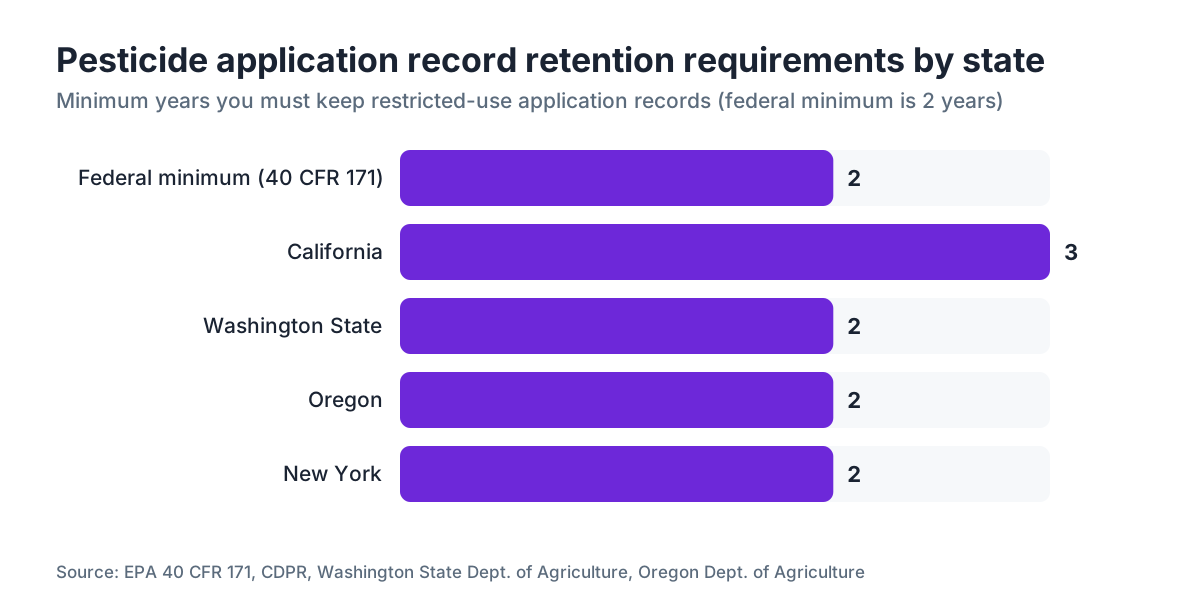
- Keep records at least two years.
- California wants three.
What makes a rodenticide a restricted use pesticide?
A pesticide becomes restricted use when the EPA decides it poses unreasonable risk to the applicator or the environment without extra safeguards [1]. In vineyards, the rodenticides that usually carry that classification are zinc phosphide baits and the second-generation anticoagulants (SGARs) like brodifacoum. Look at the top of the label. If it reads "Restricted Use Pesticide," that statement is legally part of the product's EPA registration.
The label is the law. That's not a slogan. It comes straight out of FIFRA, which makes it illegal to use a pesticide in a way that's inconsistent with its labeling [2]. If the label says RUP, you have to be a certified applicator, or work under the direct supervision of one, before you ever open the bag.
Zinc phosphide shows up constantly in gopher and vole work. It's acutely toxic and it releases phosphine gas the moment it hits moisture, which is exactly why the EPA keeps it restricted [3]. SGARs earned their restriction for a different reason: they poison raptors and other wildlife that eat dosed rodents. That secondary poisoning problem came to a head in 2020, when the EPA opened a review of the major SGAR products for most outdoor uses [4].
Knowing why a product is restricted changes how you document it. Some states want the hazard basis noted on the record, and any incident involving dead wildlife will get read against what you wrote down.
Who is legally allowed to apply and sign off on restricted-use rodenticide records?
Under federal law, only a certified applicator can apply a restricted-use pesticide, or someone working under that applicator's direct supervision [1]. The certified applicator's license number goes on every single record. "Direct supervision" has a legal meaning: the certified applicator doesn't have to stand next to the worker, but they have to be reachable and the worker has to follow their instructions.
Every state stacks its own rules on top. California requires anyone applying a pesticide in a commercial ag setting to hold a Qualified Applicator License (QAL) or Qualified Applicator Certificate (QAC), or work under someone who does [5]. Washington makes the supervising certified applicator countersign the record in many commercial situations [6]. Call your state department of agriculture. The variation is real, and fines for unlicensed RUP application run into thousands of dollars per violation.
At a small vineyard, this usually means the manager holds the license personally. That's the clean answer. If a PCA (Pest Control Adviser) is supervising or writing the recommendation, their license number goes on the record separately from the applicator's. In California, you need both.
What information must a restricted-use rodenticide application record contain?
The federal minimum fields for any RUP application record live at 40 CFR 171.11 [1]. States add to that list. They never subtract. Here's the federal baseline:
| Field | Required by federal rule | Notes |
|---|---|---|
| Certified applicator name | Yes | Person holding the license |
| Certified applicator license/certificate number | Yes | State-issued number |
| Application date | Yes | Actual date product was placed or applied |
| Product brand name | Yes | As it appears on the label |
| EPA registration number | Yes | Found on label (e.g., EPA Reg. No. 12455-86) |
| Crop or commodity treated | Yes | e.g., "Winegrape vines, Cabernet Sauvignon" |
| Location of application | Yes | Field, block, or APN number |
| Amount of pesticide applied | Yes | In label units (lbs active ingredient or lbs product) |
| Size of area treated | Yes | Acres or square feet |
| Target pest | Yes (many states) | e.g., Botta's pocket gopher |
| Method of application | State-dependent | Burrow builder, hand-placed bait station, etc. |
| PCA recommendation number | California required | License number of recommending adviser |
A couple of fields trip people up. The EPA registration number is not the UPC or the lot number. It's printed on the label as "EPA Reg. No. XXXXX-XXXX," and you need that exact string, because it's how an auditor confirms you used a legal, registered product [2]. Copy it off the label, not from memory.
For bait station records, log the number of stations and their GPS coordinates or a block map reference. Federal and state rules don't always demand it, but do it anyway. A wildlife investigator will ask, and it's how you find every station at season's end so you're not leaving rodenticide in the field for months.
How long do you have to create the record after an application?
Federal rules give you 30 days from application [1]. That's the floor, and almost every state sets it higher.
California wants the Pesticide Use Report (PUR) filed with the County Agricultural Commissioner within 30 days of the month the application happened, but your internal production record (the one an inspector asks to see in the field) should be done same day or within 24 hours [5]. Washington requires records completed within 24 hours [6]. Oregon runs a similar 24-hour rule for commercial ag applications.
Here's the honest advice. Fill it out before you leave the field, or that night at the latest. Memory fades. Bait station counts get mixed up with a different block. And if you have a worker safety incident or a dead hawk, investigators will want exact times and locations. "I'll do it later" is how records end up wrong, and a wrong record can hurt you more than a missing one in an enforcement fight.
California PUR filings have to match your internal records. If an auditor pulls your field log and it disagrees with what you sent the county, that's a separate violation from whatever went wrong in the application itself.
How long do you have to keep restricted-use rodenticide application records?
The federal minimum is two years from the date of application [1]. That's the number in 40 CFR 171.11. Storage requirements climb from there depending on your state and the record type.
California requires pesticide use records for three years [5]. Washington requires two years for most records, though some license categories run longer if their conditions say so [6]. Oregon and the other western wine states generally sit at two to three years.
Keep the label, or a copy, for every restricted-use product you apply. You don't have to staple it to each record, but you need to produce it, because the label is the legal yardstick for whether your application was done right. UC Cooperative Extension recommends filing label copies with the matching batch of application records so they travel together when you need them [7].
One thing people miss: if you sell the vineyard or hand off management, the records don't stop being an obligation. They follow the operation. Whoever runs the property is on the hook to produce them for the full retention period.
What does the EPA Worker Protection Standard require for rodenticide applications?
The Worker Protection Standard (WPS), at 40 CFR 170, covers agricultural workers who might touch treated surfaces or be in an area where pesticides go down [8]. Rodenticide baits placed in the soil around vines or in stations trigger specific WPS duties.
The WPS requires workers to get pesticide safety training before they handle application equipment or enter treated areas during a Restricted Entry Interval (REI). For most rodenticide products in a vineyard the REI is 12 hours, but read the specific label, because some zinc phosphide products carry longer REIs in certain scenarios.
Your record has to back up WPS compliance. Log the date and time you applied (so you can figure out when the REI ends), the REI off the label, and proof that workers were notified or kept out during that window. The 2015 WPS revision requires this information posted at a central location in the workplace, not buried in a filing cabinet [8].
Bait stations count too. WPS notification still applies to anyone who might run into a station or work the treated area. Write down who was told, when, and how. A one-line log entry does it: "Workers in Blocks 3-5 notified of REI at 7:30 AM on [date], REI expires [time]."
What is a Pesticide Use Report and how does it relate to your application record?
A Pesticide Use Report (PUR) is the state reporting document. It's a separate animal from your internal application record. California goes furthest: every commercial ag pesticide application in the state, restricted-use rodenticides included, gets reported to the County Agricultural Commissioner on a standardized PUR form [5]. That's the pipeline behind the annual statewide use data researchers and regulators lean on.
The PUR fields overlap your internal record heavily: product name, EPA registration number, amount used, acreage, crop, county, and section-township-range for location. Plenty of vineyard operators fill out both from the same field notes. If your bait or spray log is thorough, the PUR is mostly transcription.
Other states run similar programs under different names. Oregon has a Pesticide Use Reporting System (PURS) for certain categories. Washington makes dealers keep sales records, while growers carry different reporting duties depending on whether they're a private or commercial applicator.
The point: your internal record and your state PUR are legally separate documents, and you need both. Software that pulls the PUR fields straight from your application data cuts transcription errors, which is where a tool like VitiScribe saves real time. Even so, you as the certified applicator own the accuracy.
What are the most common documentation mistakes vineyard operators make with rodenticides?
A wrong or missing EPA registration number is the most common technical error. People get the product name right, then copy the lot number or UPC instead of the reg number. Those are different things. The EPA registration number stays the same across every lot of a product. The lot number changes with each batch.
Skipping the method of application is second. "Placed bait" isn't enough. "Hand-placed in covered bait stations at gopher burrow entrances, 2 oz per station, 14 stations in Block 4" is what you need. For zinc phosphide run through a burrow builder, note the equipment, the tractor operator, and linear feet treated if the label calls for it.
Forgetting the mixing ratio is third. Some rodenticide baits get mixed with grain before placement. That ratio and the total amount of finished bait both belong in the record.
Thin location detail is fourth. "Vineyard" tells an inspector nothing. Use the field name, block number, APN, or GPS. Somebody has to find the exact spot from your record, whether it's an auditor or a wildlife investigator.
Late records are fifth, and they're a red flag. Regulators recognize a batch-completed log on sight: same handwriting pressure, suspiciously even spacing, dates that fill in gaps a little too neatly. Write records in real time.
Multiple applications across multiple blocks is where organization earns its keep. See our notes on general vineyard operations documentation for a way to structure the whole field record system.
How do state requirements differ from federal minimums for rodenticide records?
The federal baseline is 40 CFR 171.11, and every major wine state layers on top of it. Here's an honest comparison:
| State | Retention period | Submission required? | Key addition to federal requirements |
|---|---|---|---|
| California | 3 years | Yes, PUR to County Ag Commissioner within 30 days of month of application | PCA license number, Section-Township-Range for location, Ag Commissioner signature on some documents |
| Washington | 2 years | No routine submission for private applicators, but records available on demand | Supervising certified applicator signature, 24-hour record completion |
| Oregon | 2 years | PURS reporting for some categories | Application site GPS or legal description |
| New York | 2 years | No routine submission | Cornell extension recommends block-level maps be retained with records [9] |
| Texas | 2 years | No routine submission for private applicators | Records must be shown on request to TPWD for wildlife incidents |
California is the toughest by a wide margin. If you farm there, the California Department of Pesticide Regulation (CDPR) is your main compliance authority, and its Pesticide Use Reporting requirements sit in Food and Agricultural Code Section 67760 [5]. The county agricultural commissioner enforces it on the ground.
WSU Extension keeps a practical guide for Washington commercial applicators that covers rodenticide record-keeping [10]. In California, your local UC Cooperative Extension office can walk you through the PUR process county by county, since some counties tack on their own requirements [7].
What happens during a pesticide compliance inspection and what records will an inspector ask for?
State ag inspectors can ask for your pesticide application records at any time. They don't need a warrant for records the law already requires you to keep. Inspections usually start from a complaint, a wildlife mortality report, or a random audit of licensed applicators.
Expect them to ask for the original application records (not a spreadsheet you typed up after the fact, the actual contemporaneous record), your storage inventory showing the product you used, the label for anything you applied, your certified applicator license, and any PCA recommendations behind the application.
For rodenticides, they may want to see bait station locations and confirm the stations are marked and maintained. California requires stations to carry the product name and a poison warning. If you set stations and later pulled them, your records should show both the placement date and the removal date.
The penalty range for bad or missing RUP records in California runs from a written warning for a first minor violation up to $5,000 per violation per day under Food and Agricultural Code Section 12999 [11]. Washington civil penalties for record violations reach $7,500 per violation [6]. Those aren't scare numbers. They're the statutory ceilings.
Orderly, complete records are the cheapest risk management you have. An inspector who opens a clean binder almost always moves on fast.
What is the right format for a rodenticide application record, and can you use software or paper?
Federal and state rules generally accept any format, paper or electronic, as long as the required fields are there and you can produce the record for inspection [1]. There's no mandated federal form. California's PUR submission uses a standardized form, but your internal record doesn't have to match it exactly.
Paper logbooks work fine. A dedicated binder organized by block and season is the old reliable. The risks are legibility, missed fields, and the fact that one flood or fire wipes out years of records. Keep a copy offsite, or scan the pages.
Electronic records work just as well and carry some real advantages. You can auto-fill repeated fields (your license number never changes), require fields so a record can't save without the EPA registration number, and generate the California PUR from the same entry. VitiScribe is one platform built for vineyard compliance, including bait and spray records that feed straight into PUR-compatible exports.
Whatever you use, back it up and keep it printable without special software in case that software ever goes away. CDPR recommends electronic records be printable in a form an inspector can review on paper [5].
WSU Extension's record-keeping resources suggest treating your record system as a legal document from the day you start it [10]. That framing helps. You wouldn't sign a contract two weeks after the fact and hope the dates work out.
What should you document if a non-target animal is found dead near a rodenticide bait station?
This is where thorough records earn their keep. A dead raptor, a poisoned dog, or any non-target species found near a station makes your application documentation the first thing state wildlife or ag officials ask for.
Start here. Photograph the location, the animal, and the nearest bait station. Note the GPS coordinates. Don't move or dispose of the carcass without guidance from your state fish and wildlife agency, because disposing of a poisoned protected animal can itself be a violation.
Your application record should already show what product went down, when, how much, and exactly where. If it does, you can demonstrate you followed the label, used a lawful rate, and secured the stations. That matters in any investigation.
SGAR-related raptor deaths are a federal issue under the Migratory Bird Treaty Act. The EPA's 2021 interim registration review decision for SGARs named secondary poisoning of raptors as the primary concern, pointing to studies that found brodifacoum residues in 70 to 100 percent of barn owls tested in some California agricultural areas [4]. Your records won't erase that problem, but they show whether you used the product legally.
Report the incident to your state fish and wildlife agency and your county agricultural commissioner. Loop in your PCA if you have one. Document every step of your response as carefully as you documented the application.
Frequently asked questions
Do I need a license to apply a restricted-use rodenticide in my vineyard?
Yes. You must be a certified applicator or work under direct supervision of one. "Direct supervision" means the certified applicator doesn't have to be physically present but must be reachable and in charge. Their license number must appear on your application record. In California, that means a QAL or QAC. Requirements differ by state, so confirm with your state department of agriculture.
What is the EPA registration number and where do I find it on the label?
The EPA registration number is the unique identifier for a pesticide product registered under FIFRA. It's printed on the label in the format "EPA Reg. No. XXXXX-XXXX." It's not the lot number, UPC, or bar code. You'll find it on the front or back panel of the container. Copy it exactly; it's a required field on every restricted-use application record.
How soon after applying a rodenticide do I have to complete the application record?
Federal rules say within 30 days, but most states are stricter. California requires your internal record same day or within 24 hours. Washington requires 24-hour completion for commercial applicators. The practical answer is fill it out before you leave the field. Late or batch-completed records are a red flag in inspections and can be challenged as inaccurate.
Can a vineyard worker (non-certified) place rodenticide bait stations?
Only if a certified applicator is directly supervising them, which means the certified applicator is reachable, has given specific instructions, and is responsible for the application. The certified applicator's name and license number still go on the record. The worker cannot make independent decisions about rate, placement, or product. If the label requires certified applicator presence, that supersedes the general supervision rule.
What records does California require that other states don't?
California requires submission of a Pesticide Use Report to the County Agricultural Commissioner within 30 days of the month of application. The PUR requires Section-Township-Range location data, the PCA's license number if a PCA was involved, and the grower's name and ID. California also requires a three-year retention period versus the federal two-year minimum. No other major wine state has as detailed a reporting obligation.
Do bait stations require different documentation than broadcast rodenticide applications?
The required fields are the same, but bait station applications need extra detail to be useful: number of stations placed, their locations (block map or GPS), amount of bait per station, and station type. If you're required to remove stations at the end of the season, log the removal date too. California and some other states require bait stations to be labeled and inspected on a schedule; document those inspections.
What does the Worker Protection Standard require me to document for a rodenticide application?
Under 40 CFR 170, you must record the application date and time, the product's Restricted Entry Interval (REI), and proof that workers were notified or kept out of treated areas during the REI. This notification must be posted at a central workplace location. Keep records showing who was notified, when, and by what method. A simple log entry with worker names and notification time works.
What happens if my application record is missing required fields during an inspection?
Missing fields can bring a notice of violation, a fine, or in repeat cases, license suspension. California fines run up to $5,000 per violation per day under Food and Agricultural Code Section 12999. Washington civil penalties reach $7,500 per violation. First violations are often a written warning if no harm occurred, but don't count on it. Complete records are the simplest protection you have.
Can I use a digital app or software to keep restricted-use pesticide application records?
Yes. Federal and most state regulations allow electronic records as long as required fields are present and records can be produced for inspection. Electronic records should be backed up and printable. California's CDPR recommends that electronic records be printable in a form inspectors can review. Some platforms generate California PUR-compatible exports directly from application record data, which cuts transcription errors.
Are second-generation anticoagulant rodenticides still legal to use in vineyards?
As of the EPA's 2021 interim registration review decision, most SGAR products (brodifacoum, bromadiolone, difethialone, difenacoum) face significant use restrictions for agricultural outdoor use. Some are being cancelled for open-area agricultural use. Check the current EPA registration status for any SGAR product before purchasing. California adds restrictions under its 2020 program for SGARs. Always verify current label registrations.
Do I need to keep the actual product label with my application records?
Federal and state rules don't always require the label be physically attached to each record, but you must be able to produce the label for any product you applied during the retention period. UC Cooperative Extension recommends keeping label copies with the corresponding batch of application records. A digital scan is fine. The label is the legal document that defines whether your application was lawful.
What location information is specific enough for a rodenticide application record?
"Vineyard" or a property address alone isn't enough. Use your block or field designation (e.g., "Block 4, Cabernet Sauvignon, north of access road"), plus GPS coordinates or a Section-Township-Range. California PUR submissions require Section-Township-Range. For bait station placements, a block map with station locations marked is best practice and the first thing investigators ask for if there's a wildlife incident.
What should I do if a hawk or owl is found dead near my rodenticide bait stations?
Photograph the animal and bait station location without moving anything. Note GPS coordinates. Contact your state fish and wildlife agency before disposing of the carcass; raptors are protected under the Migratory Bird Treaty Act. Notify your county agricultural commissioner. Pull your application records to confirm label-compliant use. Consult your PCA. Document every step of your response the same way you document applications.
Sources
- U.S. EPA, Pesticide Worker Safety (40 CFR Part 171, Certification of Pesticide Applicators and Recordkeeping): Federal requirements for certified applicators, RUP recordkeeping fields, and 30-day record completion window under 40 CFR 171.11
- U.S. EPA, Pesticide Registration (FIFRA labeling requirements): FIFRA makes it illegal to use a pesticide in a manner inconsistent with its labeling; the label is the law
- U.S. EPA, Ingredients Used in Pesticide Products (zinc phosphide): Zinc phosphide is on the RUP list due to acute inhalation toxicity from phosphine gas generated on contact with moisture
- U.S. EPA, Pesticide Reevaluation (Second-Generation Anticoagulant Rodenticides 2021 interim registration review decision): EPA's 2021 interim decision cited secondary poisoning of raptors as the primary concern, referencing brodifacoum residues found in 70 to 100 percent of barn owls in some California agricultural area studies
- California Department of Pesticide Regulation (CDPR), Pesticide Use Reporting Program: California requires Pesticide Use Reports submitted to the County Ag Commissioner within 30 days of the month of application, three-year retention, and QAL/QAC licensing under Food and Agricultural Code Section 67760 and related code
- Washington State Department of Agriculture, Pesticides: Washington requires 24-hour record completion for commercial applicators and civil penalties up to $7,500 per violation; supervising certified applicator signature requirements
- University of California Agriculture and Natural Resources (UC Cooperative Extension), pesticide record-keeping guidance: UC Cooperative Extension recommends keeping label copies with the corresponding batch of application records and treating electronic records as legal documents from creation
- U.S. EPA, Agricultural Worker Protection Standard (WPS), 40 CFR Part 170: EPA WPS requires pesticide safety training before workers handle application equipment, REI notification to workers, and posting of application information at a central workplace location; revised 2015
- Cornell Cooperative Extension: Cornell Extension recommends block-level maps be retained with pesticide application records and that records be treated as legal documents
- Washington State University Extension, pesticide record-keeping resources: WSU Extension guidance on record-keeping for commercial applicators in Washington, including rodenticide applications and 24-hour completion requirement
- California Legislative Information, Food and Agricultural Code Section 12999 (civil penalties for pesticide violations): California civil penalty ceiling of $5,000 per violation per day for pesticide record and use violations under Food and Agricultural Code Section 12999
- U.S. EPA, Pesticide Registration (EPA registration number): EPA registration number (format EPA Reg. No. XXXXX-XXXX) is the unique legal identifier for each registered pesticide product under FIFRA and is required on application records
Last updated 2026-07-11