How to document a sticker-spreader addition to a vineyard fungicide mix

TL;DR
- Every adjuvant added to a fungicide tank mix, sticker-spreaders included, belongs on the pesticide application record next to the fungicide.
- Log the adjuvant product name, EPA registration number (or "NR" if exempt), rate per acre or per 100 gallons, total volume used, and the reason for use.
- Federal law and most state ag departments require it.
- Missing adjuvant entries are one of the easiest gaps for an auditor to find.
Why does a sticker-spreader need to be on the spray record at all?
A sticker-spreader belongs on the record for the same reason the fungicide does: it went in the tank. Federal and state rules treat the application record as the account of everything applied, and an adjuvant added at two pints per 100 gallons is part of that application whether or not it carries its own use label.
Plenty of vineyard managers log the fungicide perfectly and then treat the sticker-spreader like it's invisible. It's an easy habit to fall into. The adjuvant doesn't carry a federally required use label the way a registered pesticide does, so it feels like a non-issue. That's the exact gap state ag departments flag in audits.
The EPA's Worker Protection Standard (WPS) requires application records to cover every pesticide applied, and several state rules extend that language to adjuvants used with a registered pesticide [1]. California's Department of Pesticide Regulation (CDPR) requires adjuvants to be documented on the Pesticide Use Report (PUR) when they go on with a restricted-materials pesticide [2]. Washington's agricultural reporting rules read much the same [3].
There's a practical reason too. If you ever face a crop damage claim, a drift complaint, or a worker exposure incident, the spray record is your evidence. A record that shows the fungicide but omits the adjuvant has a hole in it. That hole gets expensive fast.
Log it every time, even when it feels redundant.
What fields belong on a sticker-spreader entry in a spray record?
A sticker-spreader entry should mirror the fungicide entry: same date, block, and equipment, with the adjuvant's own product name, EPA number, rate, and total volume. Capture the reason for use too. Here's what to record for every tank.
| Field | What to record | Example |
|---|---|---|
| Application date | Calendar date, not week or season | June 14, 2025 |
| Product name | Exact label name, not generic | Regulaid, Bond Xtra |
| EPA Reg. No. | From the label; "NR" if exempt | EPA Reg. No. 5905-356 |
| Adjuvant type | Sticker, spreader, sticker-spreader, NIS | Sticker-spreader |
| Rate (oz or fl oz per 100 gal) | As label or your SOP states | 8 fl oz / 100 gal |
| Total volume applied | Gallons per acre or total tank volume used | 60 gal / acre |
| Total acres treated | Block name and acreage | Block 4B, 3.2 ac |
| Target crop / pest | Fungicide target, since adjuvant is tank-mixed | Grape / Botrytis |
| Application method | Equipment used | Airblast sprayer |
| Applicator name & cert. no. | If your state requires a licensed applicator | J. Ortega, WA CAC #12345 |
| Wind speed & direction | Required under WPS for many products | 4 mph NW |
| Reason for adjuvant use | One line is enough | Improve cuticle adhesion on dense canopy |
The "reason for use" field isn't required in every state, but writing it in takes ten seconds and makes the record look deliberate instead of accidental. UC Davis extension recommends documenting adjuvant rationale as part of IPM record-keeping [4].
Running a paper logbook? Put the adjuvant on the same line as the fungicide it went in with, or the line directly below it. Don't bury it on a separate page where the connection to the application disappears.
Does a sticker-spreader have an EPA registration number, and does it matter?
Some do, some don't. Many adjuvants are classified as inert ingredients or are exempt from registration under FIFRA Section 25(b), so they carry no EPA number at all [5]. That has nothing to do with whether you record them. Registered or not, an adjuvant that goes in the tank goes on the record.
If the sticker-spreader has an EPA registration number on its label, record it. If it doesn't, write "NR" (not registered) or "exempt" in that field so the blank doesn't read as an oversight. Your state department of agriculture may have its own coding for exempt products, so check your state's PUR form instructions.
The common vineyard sticker-spreaders fall into different regulatory buckets. Organosilicones like Silwet L-77 are EPA-registered. A basic crop oil, say a generic 83% paraffinic blend, often isn't. The label is your guide: if there's an EPA number, use it.
Washington State University's pesticide safety education program makes the point plainly: even unregistered adjuvants should be logged by product name and rate when they're part of a pesticide application, because the record is a record of everything that went into the tank [3].
How do California's Pesticide Use Report requirements apply to adjuvants?
In California, any adjuvant applied with a restricted-materials pesticide has to appear on the Pesticide Use Report filed with your county agricultural commissioner. The state runs the most exacting adjuvant documentation rules in the country, so read the CDPR guidance directly rather than trust a secondhand summary [2].
The PUR is due within a set reporting window, monthly in most counties, though the exact deadline varies by county and license type. Leave an adjuvant off and the entire application record can get flagged as incomplete.
For non-restricted pesticide applications, the rules are a little less formal, but CDPR still recommends recording adjuvants as part of a complete spray log. Many PCAs (Pest Control Advisers) writing fungicide recommendations now name the adjuvant on the written recommendation, which builds a paper trail that lines up with PUR requirements.
Farming conventional wine grapes in Napa, Sonoma, or the Central Coast? Your county ag commissioner's office has the county-specific PUR forms and filing instructions. The CDPR reporting portal is the central hub, but the county office is your first call for questions [2].
What does the EPA Worker Protection Standard actually require you to log?
The WPS (40 CFR Part 170), revised in 2015 and effective January 2017, sets the federal floor for pesticide application records on farms [1]. Each application record has to include the product name, EPA registration number, active ingredient(s), location and description of the treated area, size of that area, date of application, and the name of the handler who applied it.
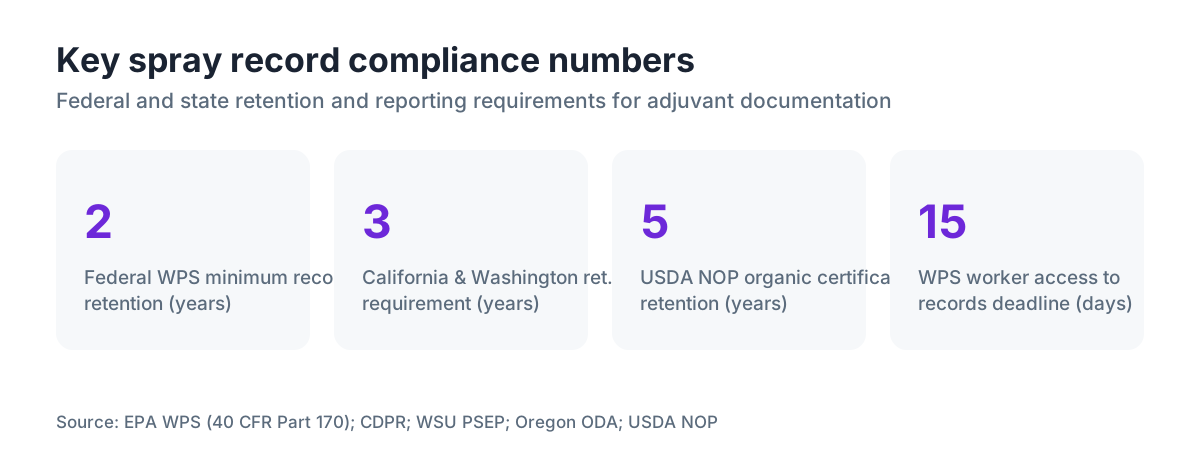
The rule text requires records to be "maintained for a period of 2 years" from the date of application [1]. That two-year window is a hard floor. Several states (California, Oregon, Washington) require longer, sometimes three years.
The WPS doesn't call out "adjuvants" as a named field the way some state rules do. But EPA guidance is clear that any substance deliberately added to the tank that could affect worker exposure or environmental fate should be documented, because the record is supposed to represent what workers could have been exposed to [1]. A sticker-spreader changes droplet retention and extends surface contact time. It belongs in the record.
For growers with agricultural workers under WPS-covered conditions, the application record also has to be accessible to workers and their designated representatives within 15 days of a request [1]. An incomplete record isn't only a compliance problem. It's a worker rights problem.
How do you record a sticker-spreader when you're using a pre-mix that already contains a surfactant?
If the fungicide already contains a surfactant, you don't need a separate adjuvant entry. The surfactant is part of the registered product you're already documenting. The label will say something like "contains surfactant" or list it in the inert ingredients section.
The documentation problem starts when a grower adds a second sticker-spreader on top of a pre-mix. This happens more than people admit: the label allows it, the agronomist recommends it for dense-canopy blocks, and the applicator adds it. All three of those facts belong in the record. The pre-mix goes on as the primary fungicide. The added adjuvant goes on as a second line item in the same application entry.
Not sure whether your formulation already carries enough surfactant? Cornell's viticulture extension team has published guides on fungicide adjuvant compatibility worth reading before you double up [6].
What's the difference between a sticker, a spreader, and a sticker-spreader, and does the label name matter for records?
For the record, the label name is what matters, not the category. You don't write "sticker-spreader" in your log. You write "Bond Xtra" or "CapSil" or whatever's printed on the container.
Understanding the categories still helps you pick the right product and defend your rate. A spreader lowers surface tension so the droplet spreads across the leaf. A sticker (sometimes called a spreader-sticker or rainfastness adjuvant) helps the deposit hold onto the leaf after drying, so it resists wash-off from rain or irrigation. A sticker-spreader does both. Organosilicone adjuvants are aggressive spreaders and can cause phytotoxicity at high rates, which is a good reason to log your rate precisely.
The product name on the container should match the label, and that label name is what goes in the record. Pouring from a bulk container that's been decanted? Trace it back to the original product. "Generic NIS" or "surfactant from bulk" isn't adequate. That's an audit failure waiting to happen.
How should you handle sticker-spreader records for organic-certified vineyards?
Organic certification stacks another layer on top of the basic spray record. The National Organic Program (NOP) requires certified operators to keep records that demonstrate compliance, including a record of all materials applied to the operation [7]. For your certifier, the adjuvant gets documented as carefully as the copper or sulfur fungicide it went in with.
Many certifiers have their own forms or Organic System Plan (OSP) update requirements when you add a new input. Switching to a new sticker-spreader? Confirm with your certifier that it's on your approved materials list before the spray goes on. OMRI (Organic Materials Review Institute) listing is a common benchmark but isn't required by every certifier. Your certifier's specific allowed-materials list is the governing document [7].
The record you keep for your certifier should include product name, OMRI or certifier approval status, application rate, date, block, and the fungicide it was mixed with. Most certifiers want to see the adjuvant doing a real agronomic job (rainfastness, canopy penetration) rather than acting as a back door for a non-approved substance.
Oregon Tilth, CCOF, and similar certifiers publish their own record-keeping templates. If you run a certified organic vineyard and haven't looked at your certifier's current template in two seasons, check that it captures adjuvants.
What does a complete spray record entry actually look like in practice?
Here's a single application entry with a sticker-spreader in the tank, a straightforward Botrytis spray at pre-bunch closure.
Date: June 14, 2025
Block: Estate Block 4B, 3.2 acres, Pinot Noir
Equipment: Airblast sprayer, 60 gal/acre
Wind: 3-5 mph NW; Temp: 68°F; RH: 55%
Product 1: Luna Sensation (fluopyram + trifloxystrobin)
EPA Reg. No.: 264-1177
Rate: 4.0 fl oz / acre
Total used: 12.8 fl oz
Product 2: CapSil (silicone surfactant, sticker-spreader)
EPA Reg. No.: 5905-356 (verify on your label)
Rate: 4 fl oz / 100 gal
Total used: 7.7 fl oz
Reason: Improve rainfastness ahead of forecast rain event
Applicator: J. Ortega, CA QAL #A12345
Supervising PCA: M. Santos, CA PCA #C67890
Growth Stage: BBCH 77 (late berry development, bunch closure)
That's the whole entry. It takes about three minutes to fill in after the application is done. The growth stage note (BBCH scale) isn't universally required but is worth adding: it ties the application to an agronomic decision point and meets the IPM documentation UC Davis extension recommends [4].
Some recordkeeping tools, including field-operations platforms like VitiScribe, build this entry from drop-down product libraries so you're not retyping EPA numbers every time. Software or paper log, the fields are the same.
How long do you need to keep sticker-spreader application records?
The federal WPS floor is two years from the date of application [1]. State and organic rules run longer:
- California: CDPR requires PUR records for three years from the date of application [2].
- Washington State: WAC 16-228 requires licensed applicators to keep pesticide application records for three years [3].
- Oregon: ODA rules require two years for most applicators, three years for licensed commercial applicators [8].
- Certified organic operations: NOP requires five years of records to show continuous organic management [7].
Not sure which period applies to you? Use the longest one that touches your operation. Five years of records costs you nothing but storage space. Getting audited with records you shredded at the two-year mark costs a lot more.
Digital records are fine under WPS and most state rules, as long as they're accessible on the operation and can be printed for an inspector. Keep a backup. A spray record that lives only on a phone that goes in the pond at harvest is not a record.
What are the most common documentation mistakes for adjuvant additions, and how do you fix them?
The most common gap is the simplest: the adjuvant never makes it onto the record. Guidance from UC Davis, WSU, and Cornell extension programs points to the same handful of mistakes, and each one has a quick fix.
- Leaving the adjuvant off entirely. The single most common error. Fix: make adjuvant lines a required field on your spray log template, not optional.
- Writing "surfactant" or "sticker" with no product name. Inspectors and certifiers need the actual product. Fix: use only products from a maintained approved-products list with names and EPA numbers already populated.
- Recording volume added to the tank instead of rate per acre or per 100 gallons. Those numbers look identical when you spray exactly 100 gallons per acre and diverge fast when you don't. Fix: record both the concentration (per 100 gal) and the total volume used.
- Not linking the adjuvant to the fungicide it went in with. If the adjuvant is on page 4 and the fungicide is on page 2, the connection is anyone's guess. Fix: same-line or same-section entries, or a cross-reference field.
- No copy of the adjuvant label on file. You need it if anyone asks you to prove what was used. Fix: scan labels and store them with your input records for the season.
WSU's Pesticide Safety Education Program suggests treating adjuvant documentation as part of the same workflow checkpoint as re-entry interval (REI) posting, since both get triggered at the start of the application [3]. If you've already built WPS compliance into a physical checklist, add adjuvant documentation to that same list.
Should you document the reason you chose that specific sticker-spreader rate?
Nobody requires a dissertation on your rate decision. A single sentence explaining why you used the rate you did is worth the thirty seconds it takes.
Something like: "Canopy density at bunch closure; added rainfastness for 48-hr rain forecast" or "Label max rate for systemic uptake enhancement." That sentence protects you two ways. If a crop damage claim ever involves the adjuvant rate, the record shows a deliberate, agronomically grounded decision instead of a pour-and-hope. If a worker exposure incident occurs, the record shows the adjuvant was used within its labeled use pattern.
PCAs writing formal fungicide recommendations in California increasingly include the adjuvant and its rationale in the written recommendation, which then gets attached to the spray record. That's the standard to aim for. VitiScribe's application-log module has a notes field for exactly this. Whatever tool you use, build in a place for the rationale note.
Cornell's viticulture program notes that block-level canopy management documentation, including why you use specific adjuvants in dense-canopy situations, is increasingly part of sustainable winegrowing certifications in New York and the Finger Lakes [6]. The record-keeping habit that satisfies compliance also satisfies certification auditors.
Frequently asked questions
Is a sticker-spreader considered a pesticide under FIFRA?
Most sticker-spreaders are classified as inert ingredients or adjuvants, not pesticides, under FIFRA. Some are EPA-registered (they carry an EPA registration number), some are exempt under FIFRA Section 25(b). Neither classification removes them from spray record requirements when they're tank-mixed with a registered fungicide. Check your product label for an EPA number and log accordingly.
Do I need a licensed applicator to apply a sticker-spreader in a vineyard?
The sticker-spreader alone typically doesn't trigger licensed-applicator requirements. But it's almost always tank-mixed with a registered fungicide. If that fungicide is a restricted-use pesticide (RUP), a licensed applicator is required for the whole tank, adjuvant included. If it's a general-use pesticide, check your state's rules, because some states require supervision even for general-use applications in commercial agriculture.
What if the sticker-spreader doesn't have an EPA registration number?
Write "NR" (not registered) or "exempt" in the EPA number field of your spray record. Don't leave it blank. Blank looks like an oversight; "NR" looks like documentation. Some states have specific codes for exempt products on their PUR forms. The product still needs to be listed by its full label name and rate. FIFRA Section 25(b) exemption does not mean the product is invisible to your records.
Can I use one spray record entry for the whole tank mix instead of separate lines?
Yes, one application entry is appropriate for a tank mix. What matters is that all products in that mix appear somewhere in the entry. The most readable format puts the fungicide and the adjuvant on sequential lines within the same application block, with the same date, block, and equipment fields. Separate entries for the same application create ambiguity about whether two applications happened or one.
Does the WPS re-entry interval (REI) change because I added a sticker-spreader?
The REI is set by the most restrictive product in the tank mix. Adding a sticker-spreader doesn't change the REI triggered by the fungicide, but it doesn't override it either. Your posted REI and your spray record should both reflect the fungicide's REI. If the adjuvant itself carries a label restriction on re-entry (unusual but not impossible), use the longer of the two.
How do I document a sticker-spreader added mid-season when the rate changes from my original spray plan?
Log the actual rate applied on the date of application, not the rate from the original plan. If your spray plan is a separate document (as required under many sustainable winegrowing programs), update the plan to note the change, or add a dated annotation. The spray record is a record of what actually happened. It should always reflect reality, not the original plan.
Do organic vineyards have different sticker-spreader documentation requirements than conventional ones?
Yes. Certified organic operations must document all inputs under NOP regulations and keep those records for five years. The adjuvant must also appear on the operation's Organic System Plan and be approved by your certifier before use. OMRI listing is a common benchmark but check your specific certifier's approved materials list. The spray record format is similar to conventional, but the retention period and OSP linkage add obligations.
What happens if a state audit finds I didn't document the adjuvant in my spray records?
Consequences vary by state and severity. A first-time omission often results in a written warning and a requirement to correct the records going forward. Repeated violations or patterns of incomplete reporting can result in fines. In California, PUR violations carry civil penalties that can reach several hundred dollars per violation per day. A missing adjuvant entry in a restricted-materials application is treated more seriously than a gap in a general-use record.
Should I keep the sticker-spreader product label on file, and for how long?
Yes. Keep a copy of the label for every product you use, for at least the same period you retain your spray records. The label is the law under FIFRA: it defines the legal use pattern. If your rate or application method is ever questioned, the label proves you applied it correctly. Scan it and store it with your seasonal input records. Paper copies are fine too but tend to disappear.
Is there a standard template for vineyard spray records that includes adjuvant fields?
No single federal template exists. UC Davis, WSU, and Cornell extension programs each publish suggested spray record templates, and your state department of agriculture may publish official forms (California's PUR form is the most detailed). The fields listed in this article cover what most state and federal frameworks require. Build those fields into whatever template you use, paper or digital, before the season starts.
Can a PCA's written recommendation substitute for my spray record entry for the adjuvant?
No. The PCA recommendation is a separate document that supports the application decision. Your spray record must document what was actually applied, by whom, on what date, at what rate. A PCA recommendation that lists the adjuvant is useful corroborating documentation, but it doesn't replace the application record. Attach the recommendation to the spray record if you want, but the record itself must stand on its own.
What rate should I use for a sticker-spreader in a vineyard fungicide application?
Always follow the product label, which is a federal legal requirement under FIFRA. Most sticker-spreaders for vineyard use are labeled in the range of 2 to 16 fluid ounces per 100 gallons, depending on product type and application target. Organosilicone adjuvants generally run lower (1 to 4 oz per 100 gal) because they spread aggressively. High rates on tender tissue at bloom can cause phytotoxicity. Whatever you apply, log that exact rate.
Sources
- EPA, Worker Protection Standard (40 CFR Part 170): WPS requires pesticide application records to be maintained for two years and made accessible to workers within 15 days of request; records must include product name, EPA registration number, active ingredient, location, area treated, and date.
- California DPR, Pesticide Use Reporting: California requires adjuvants used with restricted-materials pesticides to be documented on the Pesticide Use Report filed with the county agricultural commissioner; records must be retained for three years.
- Washington State University Pesticide Safety Education Program: WSU PSEP guidance states that even unregistered adjuvants should be logged by product name and rate when part of a pesticide application, and Washington requires pesticide application records to be kept for three years.
- UC Statewide Integrated Pest Management Program (UC ANR): UC extension recommends documenting adjuvant rationale and crop growth stage (BBCH scale) as part of IPM record-keeping best practices.
- EPA, Pesticide Registration: Many adjuvants are exempt from EPA registration under FIFRA Section 25(b) as minimum-risk pesticides or inert ingredients, but exemption does not remove them from spray record requirements when mixed with registered pesticides.
- Cornell University College of Agriculture and Life Sciences, Viticulture and Enology: Cornell viticulture program guidance covers fungicide adjuvant compatibility and notes that block-level adjuvant documentation is part of sustainable winegrowing certifications in New York.
- USDA Agricultural Marketing Service, National Organic Program: NOP requires certified organic operators to maintain records of all materials applied for five years and to document inputs in their Organic System Plan; adjuvants must be approved by the certifier before use.
- Oregon Department of Agriculture, Pesticides Program: Oregon ODA rules require pesticide application records to be kept for two years for most applicators and three years for licensed commercial applicators.
- EPA, Summary of the Federal Insecticide, Fungicide, and Rodenticide Act: Under FIFRA, the product label is a legal document and applicators must follow label directions for rate, timing, and use pattern; applying at a rate inconsistent with the label is a federal violation.
- California DPR, Enforcement: CDPR enforcement guidance notes that PUR violations involving incomplete application records, including missing adjuvant entries, can carry civil penalties per violation per day.
Last updated 2026-07-09